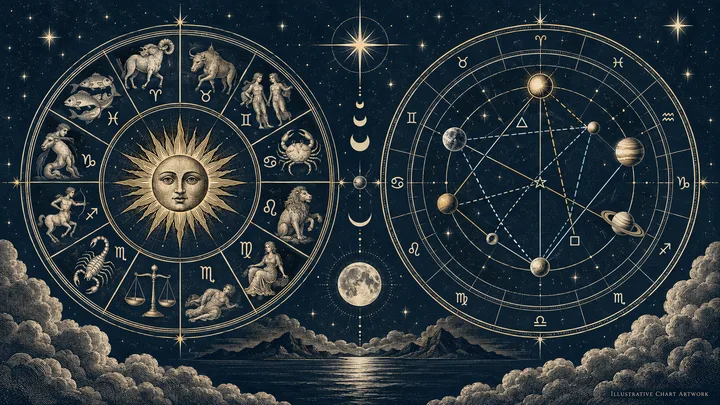
Imagine the same couple receiving two very different readings
Imagine Maria and Daniel comparing known placements after a promising first month. Maria has Moon in Taurus, Venus in Gemini, and Mars in Leo. Daniel has Moon in Virgo, Venus in Cancer, and Mars in Libra. A quick sign reading finds plenty to discuss. Taurus and Virgo share an earth tone, so their Moons may value steadiness, practical help, and a calm home rhythm. Gemini and Cancer do not use the same love language, while Leo and Libra can enjoy social warmth and visible affection. That is useful. It is not yet an aspect reading.
Now imagine that Maria’s Moon is at 28 degrees Taurus and Daniel’s Venus is at 2 degrees Gemini. The placements are four degrees apart across a sign boundary, so they do form a close out-of-sign conjunction within a six-degree working orb. Some astrologers give the conjunction strong weight. Others let the Taurus-Gemini mismatch modify it. The right move is to name both facts: the degree contact is close, while the sign boundary changes its tone.
Then add the degrees. Maria’s Moon is at 14 degrees Taurus, and Daniel’s Venus is at 15 degrees Cancer. The signs are two signs apart, and the shortest zodiacal distance is 61 degrees, so this is a 1-degree sextile. The earth-water combination may describe a gentle way of caring, while the exact sextile gives that affinity a specific channel for cooperation. A reader who calls it a trine because Taurus and Cancer feel compatible has skipped the calculation.
Change the example once more. Maria’s Moon is at 14 degrees Taurus, and Daniel’s Venus is at 14 degrees Virgo. Now the placements form an exact trine by degree. The sign affinity and aspect evidence point in the same direction, but they do different jobs. Taurus and Virgo describe the earthy tone. The 0-degree trine tells you that Maria’s emotional habits and Daniel’s way of showing affection meet with unusual clarity in the comparison.
This is why synastry readers should resist a single word such as compatible. It hides the evidence. A sign pair can feel promising but remain broad. An exact aspect can be vivid but describe only one channel between two people. Put the layers together, then ask which planet is doing what. Moon-Venus is not the same as Mars-Mars, even when both contacts are equally close.
The practical rule is simple. Read sign affinity as context. Read exact aspects as active links. If they agree, the interpretation gains coherence. If they disagree, do not average them into a bland middle. Name the agreement, name the tension, and let the planet pair tell you where the pattern will show up in ordinary life.
This distinction also changes how you talk to a couple. Instead of saying, ‘Your signs are compatible,’ you can say, ‘Your Moons share an earth emphasis, so steadiness may matter to both of you. Your degrees also show a close Moon-Venus trine, so affection may land through practical care. Watch what happens when one of you wants comfort and the other offers a solution.’ That sentence gives the reader a pattern and a way to test it in daily life.
A reader should leave this first comparison knowing what has actually been established. Sign affinity has described the atmosphere. The degree check has confirmed a conjunction, sextile, square, trine, opposition, or no major contact under the chosen rule. That is enough to move forward. Synastry becomes clearer when each layer earns its own claim.
Try a three-line record for every important pair. Write the first planet and its sign, the second planet and its sign, then the shortest angular distance and orb. Add the aspect name only after that. This order prevents the attractive symbolism of the signs from deciding the geometry. It also leaves a visible trail when someone wants to review how the interpretation was reached.
Maria and Daniel do not need a dramatic chart to make the distinction matter. A couple deciding how to talk about reassurance may need the Moon layer. A couple wondering why chemistry turns into impatience may need Mars. The question chooses the planet pair, and the degrees decide whether that pair is joined.
The order also keeps a reader from chasing the most flattering symbol. A warm sign match can feel reassuring, but the close contact that explains a recurring misunderstanding may be more useful. Read for the pattern that changes the conversation, not the phrase that sounds nicest.
That is the difference between affinity and aspect evidence. Affinity says, ‘These energies may recognize each other.’ Exact aspect evidence says, ‘These two functions meet at this angle, with this strength, and this kind of exchange.’ Both belong in synastry. They simply do not carry the same kind of information. Once you keep them distinct, you can give an out-of-sign conjunction its proper exception, a 1-degree sextile its proper name, and a sign-only impression its proper scale.
What sign affinity can tell you before degrees enter the picture
A sign describes the manner in which a planet operates. The Moon in an earth sign often seeks tangible steadiness, predictable care, and time to settle before speaking. Venus in an air sign may connect through conversation, curiosity, and mental movement. Mars in a fire sign may act quickly, compete openly, or need a visible sense of momentum. These are interpretive starting points. They help you ask the right question about a placement before you decide how strongly it links to another placement.
Elemental affinity is the first broad comparison. Fire and air often feed each other. Earth and water can create a receptive, sustaining pattern. Fire and water may produce warmth and steam, while earth and air may need translation between practical results and ideas. None of these pairings guarantees ease. They describe the kind of material the two placements are made from, not the exact conversation happening between them.
Modality adds pace. Cardinal signs initiate. Fixed signs sustain, protect, and hold their ground. Mutable signs adjust, interpret, and keep options open. Two fixed placements may understand loyalty but resist changing course. Two mutable placements may share flexibility but struggle to choose. Cardinal placements can move quickly together or collide over who leads. This is often where a sign reading becomes genuinely useful: it turns a vague feeling of similarity into a question about timing, persistence, or decision-making.
Polarity matters too. Opposite signs belong to different ends of the same axis. Aries and Libra, Taurus and Scorpio, Gemini and Sagittarius, Cancer and Capricorn, Leo and Aquarius, and Virgo and Pisces can recognize each other because each carries a missing counterpart. That recognition is not the same as a degree-based opposition. Two planets in those signs may share the axis by sign while sitting too far apart to form an opposition within your chosen orb.
A sign comparison also lets you describe the background when degrees are unavailable. If you know only that one person has Venus in Libra and the other has Mars in Aquarius, you can discuss an air-sign rapport and the possibility of shared social or intellectual energy. You cannot responsibly call it a Venus-Mars trine without degrees. You also cannot tell whether the placements are 2 degrees apart, 8 degrees apart, or nowhere near the 120-degree angle. The sign layer remains meaningful, but its claim is narrower.
Use this layer to establish the stage, not to announce the ending. Ask what each placement wants, how it moves, and what it may misunderstand. Then stop. The next step is to see whether the actual degrees connect those planets through a conjunction, sextile, square, trine, opposition, or another chosen aspect.
Sign affinity is especially useful when a report has incomplete inputs. You may know that one person’s Venus is in Cancer and the other’s Moon is in Pisces, but not know either degree. That can support a reading about water-sign sensitivity, memory, and the need for emotional safety. It cannot tell you whether the two planets form a trine, a sextile, or no major aspect at all. The honest limit makes the useful part easier to trust.
Do not let the word broad sound dismissive. Broad does not mean empty. It means the interpretation belongs to a wider symbolic layer. An element can describe the climate of a relationship. A modality can describe its speed. A polarity can show the axis of recognition. These observations become more precise when you keep them in their proper place and avoid borrowing the force of an unconfirmed degree contact.
A sign reading can also reveal which calculation deserves attention first. If two Moons share a modality but differ in element, check their degrees for a close Moon-Moon contact and ask whether the shared pace becomes cooperation or friction. If two Venuses share an element, check whether their degrees create a conjunction, trine, sextile, or no major contact. Let the symbolic question choose the pair. Let the angle settle the label.
This order keeps the reading warm without making it vague. You can honor the symbolic meaning of a Taurus Moon, a Cancer Venus, or a Leo Mars while still telling the reader which part is a general placement meaning and which part is a relationship contact. The result feels more grounded because the reader can follow the path from symbol to claim.
A useful sign comparison names both the gift and the edge. Earth and water may create care, but earth may want a plan while water wants emotional presence. Fire and air may create animation, but air may discuss a feeling that fire wants to act on immediately. The sign layer becomes practical when it describes the translation the two people may need.
Keep the language conditional at this level because a sign alone does not show the whole exchange. Say ‘may seek’ and ‘can support’ when you are describing general placement tendencies. Reserve stronger language for a close, relevant aspect whose planets and orb you can actually state. That difference is not timid writing. It is accurate ranking.
You can make a sign comparison concrete without turning it into a verdict. Ask what each person calls reassurance, what kind of affection feels natural, who moves first, and who needs time. Then mark which answers are placement themes and which are confirmed contacts. The questions belong to the couple; the chart helps sort the language. If the supplied information cannot decide between two possibilities, keep both visible until better degrees arrive.
Start with sign affinity, but let exact aspects carry the sharper meaning. A sign pairing can show how two placements speak: earth may steady water, fire may energize air, and signs of the same modality may share a pace. An aspect tells you whether two specific planets actually meet by degree, at what angle, and with what kind of pressure or ease. In a careful synastry comparison, read the signs as the setting, then rank the closest major contacts between the Moon, Venus, and Mars. A close Moon-Venus trine usually deserves more attention than a vague claim that two signs are naturally compatible. A close square still matters; it describes work and friction, not failure. Use supplied signs for the broad pattern, supplied degrees for the aspect check, and a stated six-degree working orb. If degrees are missing, keep the reading at the sign layer and say what remains unconfirmed.
Sources: What’s Your Sign? An Intro to Synastry Charts and Astrological Compatibility; Synastry: Love and Relationship Astrology
What an exact aspect adds to the reading
An aspect is an angular relationship between two chart factors. The main aspects are the conjunction at 0 degrees, sextile at 60 degrees, square at 90 degrees, trine at 120 degrees, and opposition at 180 degrees. The aspect describes how the two planetary functions meet. The planets describe what meets. The signs describe how each one does its job. The orb tells you how close the contact is to exact.
Closeness gives an aspect volume. A conjunction at 0 degrees is usually more immediate than one at 5 degrees. A square at 1 degree often presses harder than a square at 6 degrees. That does not make the wider contact meaningless, especially when the Sun or Moon is involved, but it does affect rank. In this article’s working method, use a six-degree orb for major synastry aspects unless a report states another rule. Tell the reader when a contact sits near the edge.
The aspect type gives the motion of the exchange. A conjunction blends the functions and can feel inseparable, though the planets decide whether that blend soothes or overwhelms. A sextile offers cooperation that people can choose to develop. A trine tends to flow with less effort and may become invisible through familiarity. A square creates friction that demands a method. An opposition pulls two poles into awareness, sometimes through attraction and sometimes through a repeating see-saw.
The same sign affinity can carry different lives through different aspects. Venus in fire signs may share enthusiasm by sign, but a close Venus-Mars square can turn desire into timing disputes or sharp pursuit and retreat. Venus and Mars in compatible elements may feel warm, yet a wide contact may not be the central bond. Conversely, a close square between different elements can become the relationship’s most noticeable growth edge.
Exactness also protects you from inflated readings. If a pair of planets is 11 degrees apart, do not quietly call it a six-degree aspect because the signs look right. If the planets are 2 degrees apart but cross a sign boundary, name the out-of-sign question. Technical honesty makes the interpretation stronger. It lets you say what the chart shows and what remains a matter of school, method, or judgment.
Astrodienst’s astrological reference material defines an aspect as an angular relationship and an orb as the allowed distance from its exact angle. That vocabulary gives the reader a repeatable path. Identify the two planets. Measure their distance. Compare it with the chosen aspect angle. Record the orb. Then interpret the planet pair through its signs.
The calculation does not need to become a performance. Write the positions in a simple form, such as Moon 14 degrees Taurus and Venus 15 degrees Virgo. The separation is 121 degrees, so the contact is a 1-degree trine. If the second placement were Venus 21 degrees Virgo, the separation would be 127 degrees, outside a six-degree trine orb. If Venus were instead 15 degrees Cancer, the separation would be 61 degrees, a 1-degree sextile. The symbols have not changed, but the aspect and its evidentiary weight have.
For a supplied-placement report, this is the useful boundary. The reading can compare the signs and any degrees the reader provides. It should not pretend to calculate missing natal positions, houses, angles, or a complete chart from birth details when those inputs are not part of the report. Clear scope protects the reading from turning a small confirmed contact into an invented whole-chart story.
The angle is not a decorative detail. It changes the verb you choose. A close trine may support, ease, or reinforce. A square may press, provoke, or require adjustment. An opposition may polarize, attract, or alternate between two positions. A conjunction may merge, amplify, or intensify. The planet pair still controls the subject, but the aspect controls the shape of the exchange.
When you explain an orb, give the reader the reason for the number. A six-degree orb is not a magical pass mark. It is a declared boundary that keeps the comparison from collecting every nearby relationship. A tighter contact can lead. A wider contact can remain background. Different astrologers may choose differently, but the reader should never have to guess which rule produced the interpretation.
Sources: Synastry: Love and Relationship Astrology; Aspect; Orb
How to rank sign messages, aspects, and planet jobs
Not every true observation deserves equal space. A good synastry reading ranks evidence. Start with the closest major contacts between personal planets and luminaries, especially the Moon, Venus, and Mars when the question concerns emotional safety, affection, desire, or shared action. Then look at the planet roles. A close Moon-Mars contact will not replace a close Moon-Venus contact; it answers a different question.
First rank exactness. A 0-degree or 1-degree major aspect usually leads. A 5-degree contact can support the story, but it should not outrank a closer aspect simply because its symbolism sounds romantic. Next rank relevance. If the reader asks how care is received, Moon and Venus deserve priority. If she asks why arguments spark quickly, Mars and Mercury, Moon and Mars, or Mars and Saturn may matter more than a pleasant Venus-Venus sign match.
Then rank repetition. If several contacts repeat one theme, treat the theme as louder. A person’s Moon touched by the other person’s Venus, Jupiter, and Saturn is not three unrelated facts. It may describe care, encouragement, and responsibility gathering around emotional needs. But do not count every contact as a separate vote. A conjunction and the sign affinity it creates belong to one interpretive cluster. This prevents double-counting.
After that, bring in sign condition and modality. A close square between cardinal signs may describe open, fast conflict. A close square between fixed signs may show a stand-off that lasts. A mutable square may scatter irritation through details, mixed signals, or changing plans. These are useful refinements, not replacements for the aspect itself. The 90-degree relationship comes first. The signs tell you how its friction tends to speak.
Finally, look for support and contradiction. A Moon-Mars square may heat the emotional field, while a close Moon-Venus trine provides a softer way back into contact. The supportive aspect does not erase the square. It may give the couple a repair language. A sign affinity that looks easy may also be complicated by a close Saturn contact. Keep the strongest exception visible.
Cafe Astrology’s synastry guide makes a similar distinction in practice. It describes conjunctions as powerful interaction, trines and sextiles as easier blending, squares as energies that need work, and oppositions as a polarity that can alternate between complement and competition. Use that framework as a vocabulary, then make your own ranking from the supplied planets, degrees, and question.
A useful ranking has a stopping point. Choose the leading two or three patterns, not every possible contact. If a report lists twelve aspects, group them by theme. Moon contacts may describe emotional regulation. Venus contacts may describe affection and values. Mars contacts may describe desire, assertion, and conflict. Saturn may show the structure that tests or steadies the personal planets. The reader needs a map, not a pile of symbols.
For example, a close Venus-Mars conjunction may lead a question about attraction, while a close Moon-Saturn square may lead a question about emotional safety. Neither aspect proves that the relationship will last or fail. Each tells you where the couple is likely to feel the chart most directly. If the question is about daily affection, the Moon-Saturn contact may deserve more room than the more exciting Venus-Mars contact.
This ranking also keeps the reading from becoming a compatibility score. A score compresses different planet jobs into one number. A ranked interpretation preserves the differences. It can say that the Moon-Venus contact supports tenderness, the Mars square raises a timing problem, and the Saturn sextile offers a structure for staying present. That is more useful than declaring a high or low result.
Use the same discipline when contacts compete for attention. A 1-degree Venus-Venus sextile may be exact but answer a softer question than a 3-degree Moon-Mars square. The square does not win because it is harder, and the sextile does not win because it is easier. Relevance decides between close contacts. Ask which planet pair speaks to the reader’s actual concern, then let exactness settle the order among equally relevant choices.
Sources: What’s Your Sign? An Intro to Synastry Charts and Astrological Compatibility; Synastry: Love and Relationship Astrology; Aspect
The worked example changes when the degrees change
Consider an example. Maria’s Moon is in Taurus and Daniel’s Venus is in Virgo. At the sign level, both placements speak through earth. Maria may seek calm, touch, reliability, and proof through consistent action. Daniel may show affection through practical care, useful details, and a wish to improve the shared environment. The sign pairing suggests a natural translation between emotional need and affection style.
Now give them degrees. Maria’s Moon is at 10 degrees Taurus and Daniel’s Venus is at 12 degrees Virgo. The 2-degree difference from the exact 120-degree trine makes this a close Moon-Venus trine. The sign affinity explains the earthy language. The aspect explains why the two functions may meet with little translation. Daniel’s care can land as care. Maria’s need for steadiness can feel welcome rather than demanding.
Change only Daniel’s degree. Put Venus at 18 degrees Virgo. The signs still match by element, but the trine is now 8 degrees wide and outside the six-degree working orb. The reading does not become empty. It becomes less specific. You can still describe the earth-sign affinity, but you should not present a close Moon-Venus trine as the reason. The broad pattern remains. The strongest technical evidence has changed.
Change the sign too. Put Daniel’s Venus at 10 degrees Scorpio. Taurus and Scorpio form an opposition by sign, and the degree distance is exact. Now the interpretation moves from easy earth translation to a strong polarity around comfort, trust, attachment, and value. Maria may seek peace through stability while Daniel’s Venus seeks depth, intensity, or emotional proof. Attraction can be powerful. So can the question of how much closeness each person can hold.
Notice what the method prevents. It stops the reader from treating every pleasant sign pairing as a major aspect. It also stops the reader from treating every hard aspect as a verdict. The close Taurus-Scorpio opposition has weight, but its expression depends on the Moon and Venus, their wider chart context if known, and the couple’s actual choices. The chart gives a pattern to work with. It does not remove the need to observe the relationship.
If a report contains only the four signs and no degrees, keep Maria and Daniel at the first level. If it includes Moon and Venus degrees, calculate the angular relationship and state the orb. If one degree is uncertain, mark the aspect as unconfirmed. Near a sign boundary, preserve the uncertainty even when the reported signs are known, because a small change can alter both the angle and the out-of-sign judgment. That sentence protects the reading from sounding more exact than its inputs allow.
The example also shows why a close aspect should not be read in isolation. Maria’s Moon and Daniel’s Venus may describe tenderness, but their Mars contacts could change how that tenderness behaves under pressure. A Venus-Mars square can bring strong attraction and poor timing. A Saturn contact can make affection cautious or durable. The Moon-Venus aspect remains real. It simply does not answer every relationship question.
Use the changed example as a test for your own notes. Keep the sign placements fixed and alter one degree at a time. Does the interpretation become more exact, less exact, or qualitatively different? If moving a planet by three degrees changes your conclusion completely, you may have been relying on a label instead of reading the orb. Good synastry can survive a close inspection because each claim has a clear input.
The same method works with Venus and Mars. Suppose Venus is at 6 degrees Gemini and Mars is at 7 degrees Libra. The signs share air, and the degrees create a close trine. You can describe both the airy sign affinity and the specific Venus-Mars flow. Move Mars to 13 degrees Libra, and the trine becomes wider than six degrees. The air-sign rapport remains a background possibility, but the exact romantic contact no longer leads under this method.
Now keep the degrees close but change the planet pair. Replace Mars with Saturn at 7 degrees Libra. The angle is still a trine, but the story is no longer desire and pursuit. It becomes a question about responsibility, patience, agreements, and the form love takes over time. Exactness tells you how strongly the link may speak. Planet meaning tells you what it is saying.
Sources: What’s Your Sign? An Intro to Synastry Charts and Astrological Compatibility; Aspect; Orb
What to do when sign affinity and aspect evidence disagree
The strongest reading often contains a disagreement. Two people may share compatible Venus signs but have a close Venus-Saturn square. They may feel drawn to each other and still meet questions about timing, expectations, permission, or emotional reserve. Instead of choosing one message, separate the jobs: Venus by sign describes the style of pleasure, while the Venus-Saturn contact describes the condition placed on expressing it. Keep both, but do not let them compete for the same sentence.
A close hard aspect is not a curse. Squares and oppositions can make a pattern impossible to ignore. They ask the two people to develop a skill. A Moon-Mars square may require better timing during conflict. A Venus-Mars opposition may ask each person to respect a different rhythm of pursuit and response. A Mars-Saturn square may need patience, clear limits, and a shared plan for action. The relationship does not become easy by being named difficult. It becomes workable when the pattern is named precisely.
The reverse is true too. A sign pairing that looks awkward can still carry a close supportive aspect. A Virgo Moon and Sagittarius Venus may not share an obvious emotional style by sign, yet a close Moon-Venus sextile can create a practical opening. The sextile may not run itself. It gives the couple a door. They still have to walk through it by asking, listening, and adjusting their habits.
When the messages disagree, use three questions. What does each person need from this planet? What does the aspect make easy or difficult between them? Which observable choice would express the healthier form of the pattern? This keeps the interpretation connected to life. It turns ‘different love languages’ into a question about reassurance, time, touch, words, money, or space.
The meaningful exception is the out-of-sign contact. A close angle can cross a sign boundary, especially when a planet sits near the end of one sign and the other sits near the start of another. Some astrologers read the exact angle strongly. Others give the sign mismatch a larger role or decline to treat it as a full aspect. Do not hide that judgment. Label it dissociate or out-of-sign, explain your method, and avoid making it carry the whole reading.
Your final paragraph should rank the result. Say which evidence leads, which evidence modifies it, and what the couple can notice next. Do not end with ‘it depends’ when you can decide. Say, for example, that the close Moon-Venus contact is the primary ease, while the wider sign affinity is background and the Mars square is the main repair task. That is a reading someone can use.
A decision guide can be short. If the closest contact is supportive, ask how the couple can use that ease deliberately. If the closest contact is tense, ask what skill it demands and whether another contact helps. If the strongest evidence is sign affinity without degrees, keep the conclusion provisional and gather the missing placement information before making a sharper claim. Each result leads to a different next action.
And keep the chart in its proper role. Astrology can name a pattern, give language to a difference, and show where attention may help. It does not make the conversation for you. A reader comparing Moon, Venus, and Mars placements should come away with one clear observation to bring into real life: how do we offer care, receive affection, pursue closeness, and repair the moment our styles collide?
That observation can become a small experiment. If the Moon signs suggest different comfort needs, ask each person to name one action that feels caring. If a Venus-Mars square describes pursuit and response out of step, agree on a clearer signal for space and return. If a close trine makes affection easy, do not leave it unnamed. Turn the ease into a ritual that protects the bond when life becomes busy.
The final decision is not whether the chart is good. It is which pattern deserves conscious attention now. Let the closest relevant aspect lead. Let the signs tell you its language. Let the strongest exception keep you honest. Then compare the interpretation with what both people actually do, especially when they are tired, disappointed, or asking for something plainly. That is where a symbolic reading becomes a shared practice instead of a label. Keep the conclusion clear enough to use tonight, and modest enough to remain true when new degrees or wider chart context become available. That balance is the reader's real advantage. It keeps wonder and judgment in the same room, for both people every day.
Sources: Synastry: Love and Relationship Astrology; Aspect; Orb
A little more clarity
Is sign compatibility more important than an exact synastry aspect?
Neither replaces the other. Sign affinity describes the style and background of a placement. An exact aspect shows a specific relationship between two planets and usually deserves more weight when it is close, relevant to the reader’s question, and supported by the rest of the comparison. Read signs first, then let exact major aspects set the rank.
Can two planets be in a synastry aspect if they are in different signs?
Yes, an aspect can be out-of-sign when the degrees are close to the aspect angle, but astrologers do not all weigh it the same way. Record the exact angle and orb, name the sign boundary, and treat it as a meaningful exception rather than a standard example.
What orb should I use for a synastry comparison?
Use the method stated by the report. A six-degree working orb for major synastry aspects is a clear, conservative choice for supplied placements. Tighter contacts usually deserve more emphasis. If the planets are near the edge, call the aspect wide and let closer, more relevant contacts lead.
What if I know the signs but not the degrees?
Stay at the sign layer. You can compare elements, modalities, polarities, and the planet meanings, but you cannot confirm a precise conjunction, sextile, square, trine, or opposition. A synastry comparison using supplied placements can still be useful. It simply has a narrower scope until degrees are available.
Sources & further reading
- What’s Your Sign? An Intro to Synastry Charts and Astrological Compatibility
Supports the distinction between broad sign comparisons, planet meanings, degree-based aspects, and tighter orbs in synastry.
- Synastry: Love and Relationship Astrology
Supports the interpretive roles of conjunctions, oppositions, trines, sextiles, squares, signs, and personal planets in synastry.
- Aspect
Supports the definition of an aspect as an angular relationship measured by degrees and interpreted within an orb.
- Orb
Supports the meaning of orb, variation in orb practice, and the special interpretive question raised by out-of-sign aspects.
Synastry Comparison Report
Enter known placements for two people. Get an input-by-input comparison, selected aspect calculations and a clear record of what remains uncertain.
Compare our placements