
Saturn trine Sun can symbolize steadiness in service of direction
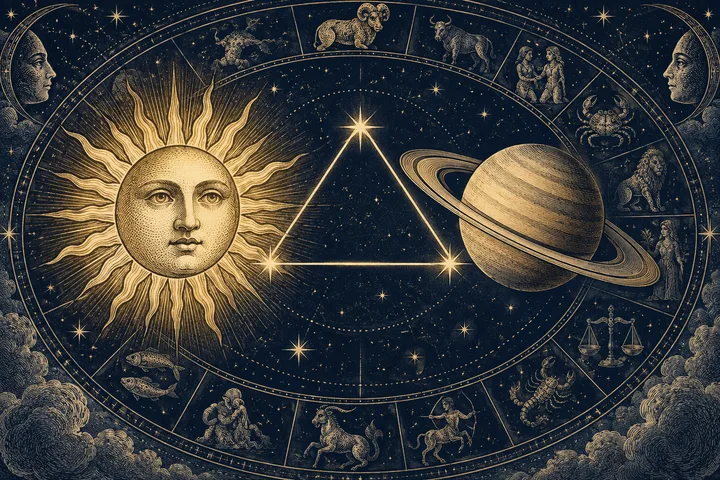
In synastry, Saturn trine Sun can symbolize an easier channel between one person’s direction and the other’s structure. Saturnian steadiness may help the Sun person give form to a chosen aim; it does not guarantee support, compatibility, commitment, or longevity. Kerykeion’s “Synastry Saturn-Sun Aspects - Learn Astrology” describes the trine as cooperative, while also allowing its ease to become passive. Cafe Astrology’s “Synastry: Sun–Saturn Aspects Between Two Charts” supplies the counterweight: Sun–Saturn symbolism can also involve judgment or restriction. The useful reading is therefore conditional: does structure help the Sun person pursue their own direction, or does it replace that direction? Treat “support” as a symbolic possibility to examine, not a fact about either person before their choices are known.
For example, in a purely illustrative situation, one person’s plan to learn a craft might be helped by the other making time and space for practice. The chart symbolism suggests a possible way the two functions can work together; the interaction shows whether that possibility is welcome and useful. Read the contact in order: verify the geometry, identify whose planets are involved, consider sign and chart context, then compare the interpretation with an actual interaction. The Synastry Comparison Report uses placements you supply and optional degrees; it does not calculate natal charts from birth details. That check keeps interpretation connected to choice.
Sources: Synastry Saturn-Sun Aspects - Learn Astrology - Kerykeion; Synastry: Sun–Saturn Aspects Between Two Charts - Cafe Astrology
Why this is an interchart contact, not a natal one
When one person’s Sun trines another person’s Saturn, the comparison is between two charts. Astrodienst’s “Synastry - Astrodienst Astrowiki” defines synastry as comparing horoscopes and their interaspects: contacts between placements belonging to different charts. The notation “A’s Sun trine B’s Saturn” records that direction. A’s Sun is being compared with B’s Saturn; it does not describe a contact between A’s own Sun and Saturn, nor does it say that B’s Sun makes the same aspect to A’s Saturn. Those are different comparisons and would need their own chart information.
This distinction changes the question being interpreted. In a natal chart, a Sun–Saturn aspect describes a relationship between two planetary functions within one person’s chart. In synastry, the same planetary names describe a contact across two people’s charts. The symbolism is not simply a description of one person’s inner balance: the reading asks how one chart’s Sun placement relates to the other chart’s Saturn placement. Astrodienst’s entry uses the term interaspect for these cross-chart contacts. Keeping the chart owners attached to the notation prevents a general Sun–Saturn interpretation from being mistaken for a statement about which person carries which role in this specific comparison.
A composite chart marks another method and a different object of interpretation. It derives a chart for the relationship from two birth charts; it is not the same thing as lining up A’s placements against B’s. So a Sun–Saturn contact found in a composite would answer a different chart question from A’s Sun trine B’s Saturn in synastry. The present reading stays with the stated interchart contact. It does not treat a composite placement as evidence for how this contact operates between the two natal charts.
Astrodienst also describes synastry as broader than a single aspect and recommends understanding the individual charts as part of fuller comparison. That context can qualify what one contact means, but it should be distinguished from what the contact alone establishes. With only the supplied Sun and Saturn placements, the reader can identify which planets are being compared and keep their chart ownership clear. They cannot infer houses, angles, other aspects, or a complete picture of either natal chart from that pair of placements. Those unknown layers should remain open rather than being filled with an imagined chart.
This boundary also keeps interpretation proportionate. Saying “A’s Sun trines B’s Saturn” identifies a chart relationship; it does not establish that A is always expressive or that B is always authoritative. Astrodienst’s synastry definition supports the cross-chart method, not a measured claim about how a particular couple behaves. The symbolic interpretation can be developed once the comparison itself is clear, while any fuller reading would require the relevant additional chart context.
A practical way to keep the method straight is to preserve the two chart labels while reading the contact: note which chart supplies the Sun and which supplies Saturn, then describe the relation between those placements. This is a comparison, not a merger of the people into one natal chart. Nor does the word “interaspect” imply that one person determines or governs the other. It names the cross-chart relation being examined. Astrodienst’s account supports that method-level distinction; it does not establish a behavioral outcome for a pair. Any claim about how the contact feels or functions needs to remain an interpretation of the symbolism and be considered alongside the actual interaction.
Sources: Synastry - Astrodienst Astrowiki
Check the angle before interpreting the label
A trine is an angular relationship whose exact point is 120 degrees. To check one, convert each planet’s zodiac position to an ecliptic longitude, then find the smaller separation around the 360-degree circle. Astrodienst’s “Aspect - Astrodienst Astrowiki” defines the trine at 120 degrees and an orb as the distance between an observed angle and its exact value. For a plainly hypothetical calculation, suppose one placement were at 40 degrees and the other at 160 degrees: their separation is 120 degrees, so the aspect is exact. These numbers illustrate the method only; they are not placements for a real person or couple.
The circle wraps at 360 degrees, so subtraction alone can give a misleading large number. In another hypothetical example, positions at 350 degrees and 110 degrees differ by 240 degrees if the first is simply subtracted from the second. The shorter separation is 120 degrees, found by subtracting 240 from 360, and that is the separation to compare with the trine’s exact angle. For any pair, take the absolute difference; if it exceeds 180 degrees, subtract it from 360. Then compare the resulting smaller angle with 120. The amount it differs is the orb: a measured separation of 116 degrees is four degrees from exact. Whether that four-degree deviation is admitted depends on the stated orb convention, which the next section addresses.
Sign labels provide a useful first clue, not a degree measurement. Signs traditionally associated by element often form trines, so a reader can describe that sign-based relationship when only signs are available. But signs cover ranges of longitude, and two placements in signs associated with a trine can sit far from 120 degrees. Conversely, placements near sign boundaries can form a 120-degree angle even when their signs do not have the expected elemental relationship; Astrodienst’s “Aspect - Astrodienst Astrowiki” discusses these as dissociate aspects. Keep the descriptions distinct: the signs give one layer of symbolic context, while the longitudes establish the measured geometry. Without degrees, the sign pair alone cannot confirm an exact angular contact or determine its orb. Record the aspect as unverified rather than silently treating sign shorthand as a measured trine.
To convert a zodiac position into the longitude used in the check, count the signs from the start of the zodiac and add the planet’s degree within its sign. Each sign spans 30 degrees: the first sign begins at 0, the second at 30, the third at 60, and the sequence continues in equal steps around the circle. As a hypothetical illustration, a placement at 12 degrees in the third sign would be at 72 degrees of zodiac longitude. This conversion is bookkeeping, not interpretation; it puts both placements on the same scale so their separation can be compared. Keep minutes if the chart provides them, since rounding can shift the apparent distance near an orb boundary. If a chart source already gives absolute longitudes, use those values consistently instead of converting a rounded display by eye.
The calculation answers a narrow question: how close are the two positions to the exact angle? It does not settle what the trine means, how much weight to give it among other contacts, or how the people behave. Those are interpretive questions with their own chart context. An aspect list can save arithmetic, but a reader should still know whether it reports exact degrees, rounds positions, and names the orb it applies. If those details are unavailable, preserve the source’s label as a reported label and avoid claiming an independently verified angle. This keeps a convenient chart description from being mistaken for a calculation the available information cannot reproduce.
Sources: Aspect - Astrodienst Astrowiki
What the six-degree convention can establish
The Synastry Comparison Report uses a six-degree orb for selected major aspects. That is the report’s declared inclusion rule: a measured contact no more than six degrees from its exact aspect can be counted under this convention. It is a reproducibility setting, not a universal astrological standard and not a statement that every astrologer would include the same contact. Astrodienst’s “A Brief Introduction to Astrology: The Aspects” presents different orb tables for different chart types, while “Interaspect - Astrodienst Astrowiki” suggests that a smaller orb may be useful in synastry, where comparing two charts creates many possible contacts. Those references show that practice is method-dependent; they do not replace the report’s stated rule or establish one correct allowance for all readings.
In practice, separate technical inclusion from interpretive prominence. A close contact is more exact by the chosen measure, so it can be described as tight and given clearer emphasis within that method. A contact near the six-degree edge still meets the report’s rule, but “within orb, near the limit” communicates its lower precision without implying that it carries the same emphasis as a tighter one. A contact beyond six degrees falls outside this report’s selected-aspect convention; another astrologer using a wider allowance might discuss it, but that would be a different method. This boundary is about how the comparison is assembled, not a threshold at which a relationship effect suddenly appears or disappears.
A useful reading note therefore names both status and strength: tight and included; included near the limit; or outside this convention. The labels make the method visible and help readers compare like with like when they review more than one contact. They do not rank the people, predict what they will do, or settle whether the symbolism will feel supportive. Astrodienst’s “Interaspect - Astrodienst Astrowiki” offers the strongest counterpoint to a broad allowance by favoring tighter synastry orbs to keep the larger set of potential contacts manageable. The report retains six degrees as its fixed setting so the same rule is applied consistently. Readers can still interpret an included contact cautiously, especially at the edge, and can state a different astrologer’s convention separately rather than blending the two thresholds.
This distinction matters most when two descriptions appear to disagree. One reader may say a contact is present because it falls within the report’s six-degree setting; another may omit it after choosing a narrower synastry allowance. They can both be applying their announced methods correctly. Before comparing their conclusions, ask which rule each used and whether the contact is exact, comfortably inside the chosen range, or near its boundary. A disagreement about inclusion may reflect a different convention rather than a dispute about the underlying positions. Keeping the rule beside the interpretation lets a couple understand what was counted and decide whether they want to compare readings using one shared setting.
A cutoff also cannot tell the reader how symbolically central a contact should be in the whole comparison. The report applies the six-degree rule to selected major aspects, but inclusion alone does not mean a contact outranks every other known feature or deserves equal space in the interpretation. Exactness is one useful descriptor; the question being considered and the other supplied placements still shape emphasis. That is why a near-limit contact should not be inflated into a defining relationship theme simply because it passes a technical check. Equally, an excluded contact under this one setting need not be erased from every tradition’s vocabulary. Describe what this report establishes, then leave any alternative convention clearly labeled.
Saturn trine Sun can symbolize an easier way for one person’s structure to support the other’s direction. It offers a possible resource, not a verdict about compatibility or longevity. First confirm the 120-degree interchart angle and the stated orb convention; then identify whose Sun and Saturn are involved and read the signs. Give the contact weight only in relation to the question and other known placements. As a practical check, ask whether the structure serves a goal the Sun person chose, leaves room for disagreement, and can be revised.
Sources: A Brief Introduction to Astrology: The Aspects - Astrodienst; Interaspect - Astrodienst Astrowiki
Who occupies the Sun role and who occupies the Saturn role
The Sun person is the chart owner whose Sun makes the contact; the Saturn person is the owner whose Saturn receives that contact. These are shorthand labels for the two planetary functions in this particular interchart aspect, not permanent identities. In “Sun-Saturn Synastry,” ELIXTEN treats the contact’s direction as part of its interpretation, and Cafe Astrology’s “Synastry: Sun–Saturn Aspects Between Two Charts” describes the Sun-to-Saturn pairing through themes that can include responsibility as well as judgment or restriction. Those meanings do not turn the Saturn person into the older, wiser, stricter, or more authoritative partner, or the Sun person into the younger, more expressive, or less responsible one. Both charts contain a Sun and a Saturn. The role name follows the planet that forms this contact, not gender, age, social standing, or a complete description of either person. It lets a reader say precisely which chart contributes which function before considering how the symbolism might be expressed.
Direction matters because the same two planetary names attach to different people when the chart owners are reversed. Imagine one person has a self-chosen goal and the other offers practical structure. If the first person’s Sun is trine the second person’s Saturn, the symbolic shorthand places purpose with the Sun person and structure with the Saturn person: an invited schedule or resource could be read as Saturn supporting that solar aim. In the reverse arrangement, the second person’s Sun is linked to the first person’s Saturn, so the symbolic roles switch even if the same two people and the same themes are under discussion. This is a comparison of chart functions, not a claim that one partner always leads while the other organizes. The illustration supplies no actual placements and describes no real couple; it makes the direction in the notation easier to follow.
A reader should not infer mutuality from a single Sun-to-Saturn contact. Because each chart contains both planets, the reverse statement, one person’s Saturn trine the other person’s Sun, is a separate possible aspect. It must be checked against those planets’ own positions and the chosen orb rule; one direction does not prove the other direction is close enough to count. If the reverse contact is present, it can be interpreted on its own terms, with the owners again identified by the planets involved. If it is absent or unverified, describe only the first contact. This keeps a single geometry from being turned into a reciprocal exchange by assumption. A role label also remains a symbolic shorthand: how either person actually responds can differ from the chart function’s traditional interpretation, so the label should not be used to assign authority or predict conduct.
The practical distinction is between who supplies the symbolism and what the interaction shows. Suppose the Sun person names a goal and asks for help keeping time for it. A Saturn-person offer of a workable schedule can illustrate structure directed toward the other person’s stated purpose. If the same kind of schedule is imposed without invitation, it is still possible to describe the same chart roles, but the interaction no longer demonstrates that the structure is serving the Sun person’s chosen direction. Cafe Astrology’s discussion allows supportive and restrictive readings of Sun–Saturn contact; it does not establish which one applies to a particular pair. Keeping role direction separate from behavior preserves both useful questions: whose planets form the aspect, and does the actual exchange resemble the supportive symbolism? Neither answer can substitute for the other, and neither role is a verdict on the person occupying it.
Sources: Sun-Saturn Synastry - ELIXTEN; Synastry: Sun–Saturn Aspects Between Two Charts - Cafe Astrology
What the Sun and Saturn contribute before the trine modifies them
Before considering the trine, identify the planetary vocabulary being joined. In astrological interpretation, the Sun is commonly associated with identity, vitality, purpose, and self-expression: the impulse to occupy a direction and make it visible. Saturn is associated with limits, responsibility, time, and structure: the conditions, commitments, and sustained effort that give an aim a workable form. These are symbolic meanings, not measured personality findings about the two chart owners. Cafe Astrology’s “Synastry: Sun–Saturn Aspects Between Two Charts” discusses responsibility and steadiness alongside possible criticism, judgment, and restriction in Sun–Saturn contacts. Astrodienst’s “Synastry - Astrodienst Astrowiki” likewise notes that Saturn contacts can be stabilizing while difficult. Together those descriptions support a pair of meanings with an inherent tension: structure can help a purpose endure, yet it can also feel like an imposed limit. The trine’s geometry comes later; it does not replace these underlying planetary meanings.
This pairing can be useful to think about because responsibility is not automatically opposed to self-expression. A chosen aim often needs time, repetition, boundaries, or a plan before it can take shape; in this symbolic vocabulary, Saturn names those forms of continuity, while the Sun names the direction they may serve. The interpretation can therefore ask whether a limit protects energy for a valued purpose, or whether it narrows the person’s room to act. Cafe Astrology’s account is an interpretive source, not evidence that one person will reliably organize or support the other. Its value here is to keep both possibilities in view: duty may give the solar aim staying power, while a burden of duty may weigh against it. The distinction depends on what the structure is for and how it is experienced, not simply on assigning one planet a positive meaning and the other a negative one.
The same Saturn symbolism can describe containment and restriction. A deadline may make a chosen project possible by giving it a protected place in a crowded week; a rigid demand may consume that time or make the project feel no longer self-directed. These are illustrative contrasts, not reports about a specific couple. In both, the vocabulary is still Sun for the aim and Saturn for the boundary or obligation, but the practical meaning changes with the boundary’s purpose and effect. A structure that answers to the aim can be read as giving it support; one that overrides the aim can be read as constraining it. This contrast prevents “responsible” from becoming a synonym for “helpful” and “expressive” from becoming a synonym for “right.” Neither symbolic role settles what either person intends or how a particular exchange unfolds.
Keeping planetary meanings separate from aspect geometry also clarifies what the trine can and cannot contribute. The Sun–Saturn symbolism names the functions being brought into relation; the trine describes their angular relationship and supplies a traditional interpretive modifier. It does not erase the possibility of duty, pressure, judgment, or constraint already present in Sun–Saturn interpretations. Nor should the base symbolism be treated as a personality diagnosis: a person is not reducible to the planet they contribute to this one contact, and a chart label cannot establish a fixed pattern of behavior. Cafe Astrology’s range of supportive and difficult themes is a useful counterweight to a one-sided reading, while Astrodienst’s description of stabilization alongside difficulty reinforces that the same planetary pair can carry both meanings. The careful sequence is to understand the pair’s vocabulary first, then consider what the aspect geometry adds, leaving actual conduct to be understood from the interaction itself.
Sources: Synastry: Sun–Saturn Aspects Between Two Charts - Cafe Astrology; Synastry - Astrodienst Astrowiki
What the trine changes about the planetary meeting
The trine adds a traditional expectation of relative ease and cooperation to the Sun–Saturn meanings already established. Astrodienst’s “A Brief Introduction to Astrology: The Aspects” describes the trine as a harmonious, complementary relationship; “Synastry Saturn-Sun Aspects - Learn Astrology - Kerykeion” applies that quality specifically to cooperation between Saturnian responsibility and solar self-expression. Read together, these references suggest that the trine describes how the two functions may coordinate, not a new planetary meaning and not proof that coordination occurs in a particular couple. Its contribution is a symbolic pathway: structure may be more readily available to a direction, and a direction may give structure a purpose. The aspect describes a potential quality of connection, not an outcome or a guarantee of support.
That potential changes the interpretive question. With Sun and Saturn alone, a reader can name the functions and their possible tension; adding a trine asks whether those functions can work together with less friction than a more discordant geometry might suggest. “Less friction” does not mean that decisions require no discussion, or that the Saturn person automatically understands what the Sun person wants. It means the traditional symbolism makes cooperation a plausible reading to consider. Kerykeion describes natural ease in this pairing, while Cafe Astrology’s “Synastry: Sun–Saturn Aspects Between Two Charts” preserves responsibility and steadiness alongside criticism, judgment, and restriction in Sun–Saturn contacts. Because Cafe Astrology discusses multiple aspect types, its counter-reading qualifies the planetary pairing rather than proving that a trine itself produces criticism. The harmonious modifier should therefore soften neither the complexity of Saturn nor the need to examine how the contact is expressed.
One generic project-planning illustration shows the proposed mechanism. Imagine two collaborators planning a community event: one has a clear creative direction, and the other is good at turning a goal into a schedule, budget, and sequence of tasks. If the structure gives the chosen direction room to develop, a reader using this symbolism might see the Saturn function making the Sun function easier to sustain. If the schedule becomes a routine nobody revisits, however, coordination can continue without much attention to whether it still serves the original aim. This is an illustration of an interpretive possibility, not a report about real people or a prediction based on a chart. The point is that the same ease can make cooperation available and make it easier to stop noticing whether the arrangement remains useful.
The trine’s supportive quality is therefore best understood as access, not achievement. A resource can be present without being used deliberately; a familiar way of working can be smooth while no longer matching the purpose it was meant to serve. Kerykeion explicitly warns that natural ease can be taken for granted or become passive. Astrodienst’s “Aspect - Astrodienst Astrowiki” also cautions that harmonious aspects may slip into lethargy, complicating any simple equation of ease with benefit. These are interpretive cautions, not measured claims about how often couples underuse a trine. They show why a favorable aspect label cannot do the reader’s evaluation for them. Relative ease may lower the symbolic emphasis on struggle, but conscious engagement still matters: the people involved must keep choosing, adjusting, and giving the structure a purpose.
This is an editorial synthesis across interpretive references: Astrodienst supplies the traditional harmonious and complementary quality of a trine, while Kerykeion describes its Sun–Saturn expression as cooperation that can be underused; Astrodienst’s lethargy caution reinforces the qualification. Together they support a reading of the trine as making coordination more available, not automatic. For a reader, the useful distinction is between an arrangement that still helps a chosen direction and one that simply runs because it is familiar. The aspect can invite attention to that distinction, but it cannot establish which case applies. That judgment belongs to the actual exchange: does the structure continue to make the purpose easier to pursue, and can the arrangement be consciously renewed when circumstances change?
Sources: Synastry Saturn-Sun Aspects - Learn Astrology - Kerykeion; Aspect - Astrodienst Astrowiki
How signs qualify an otherwise valid trine
If the measured longitudes form a trine but the placements occupy signs without the expected elemental relationship, describe both facts: the geometry is a trine, and the signs qualify how its symbolism is expressed. Astrodienst’s “Aspect - Astrodienst Astrowiki” calls an aspect of this kind dissociate, or out of sign, and explains that placements near sign boundaries can have a trine angle even when the signs do not form the usual sign-based trine. The label does not cancel the measured relationship. Nor does the angle make the sign pairing disappear. They answer separate questions: the longitudes establish the aspect’s geometry, while the signs provide another layer for interpretation. Keeping both visible avoids silently treating a degree-based contact as though it necessarily followed the familiar same-element pattern.
A hypothetical case makes the distinction clear without assigning placements to any real chart. Suppose two planets sit close enough to neighboring sign boundaries that their measured separation is exactly the trine angle, although their signs are not the signs a reader would normally associate by element. A geometry-first account can call the contact a trine if the degrees and chosen orb rule support it. A sign-aware account should then say that the trine is dissociate or out of sign, rather than describing the signs as if they shared the expected elemental quality. The hypothetical illustrates a method only; it supplies no actual chart data. The sign names, if known, can still qualify the symbolic tone, but they do not replace checking the measured angle. If only sign labels are available and degrees are missing, the reader cannot verify this geometry from the labels alone.
The practical reading has two steps, and neither should swallow the other. First record what the angle establishes: the measured separation fits the trine within the stated orb convention. Then read the signs as sign placements, considering their own symbolism and the way their relationship differs from an ordinary same-element trine. Astrodienst’s discussion recognizes both the angular aspect and sign-based relationships, while its dissociate terminology gives readers a way to name cases where those layers do not line up neatly. That terminology is useful precisely because it resists a false choice between “the aspect counts” and “the signs matter.” A reader can preserve the geometric contact while describing its sign context more cautiously, without claiming that every interpretive school will give the two layers equal weight.
The strongest qualification is methodological: astrologers vary in how much emphasis they place on sign relationships when interpreting an angle-based aspect. Astrodienst’s technical account supports identifying a dissociate aspect, but it does not prescribe one universal weighting rule for all astrologers. So an interpretation should make its sequence legible. State that the measured angle is trinal under the chosen method; then state that the signs do not share the expected elemental relationship and may color the expression. Avoid saying that the sign mismatch makes the trine invalid, since that would turn one interpretive preference into a universal rule. Also avoid presenting the contact as a straightforward same-element trine, because that erases information visible in the placements. Separate description lets readers understand the basis for a conclusion even if they prefer another weighting convention.
This distinction also helps when a description based on signs seems to conflict with one based on degrees. A sign-based reading may emphasize that the placements do not form the conventional elemental pairing, while a measured reading may still identify a trine by angular separation. These statements need not contradict one another; they refer to different layers of the chart. The reader can preserve both in a concise note: “The degree geometry is trinal under this orb rule; the signs make it dissociate, so I am not assuming the usual same-element expression.” This is a transparent interpretive method, not a claim that the wording settles how a particular couple experiences the contact. If another astrologer weights sign relationships differently, the disagreement can be located in the interpretive method rather than obscured by calling one description simply correct.
For this Sun–Saturn question, the sign layer qualifies the possible coordination described by the trine; it does not determine whether that coordination feels supportive, restrictive, or easy to sustain. Those judgments need the symbolic meanings of the particular signs and the wider known chart context, where available. When that information is missing, leave it open rather than supplying imagined placements or an elemental story that the chart does not show. The reliable report is modest but useful: identify the measured contact, mark it as dissociate if the signs differ from the expected pattern, and keep sign symbolism beside rather than in place of the geometry. That lets a reader discuss an otherwise valid trine without forcing the sign pairing to say more than it does.
Sources: Aspect - Astrodienst Astrowiki
How to compare the trine with other geometries
A trine does not make Sun–Saturn inherently easier in the sense of making the relationship better. In the interpretive vocabulary summarized by Astrodienst’s “Aspect - Astrodienst Astrowiki” and “A Brief Introduction to Astrology: The Aspects - Astrodienst,” a trine suggests complementary, harmonious cooperation. That makes coordination symbolically available; it does not establish that either person notices or uses it. Compare the geometry by asking what kind of work the contact invites, not by assigning each aspect a score. With Sun and Saturn, the planetary themes remain purpose and structure across the comparison. The geometry changes the question about how those themes meet. Astrodienst cautions against sorting aspects into simply good and bad classes: ease can become passive, while tension may prompt engagement. Those are possibilities within interpretation, not predictions about a pair.
A conjunction brings the two planetary functions into close blending. In this pairing, the reader might ask whether purpose and responsibility feel bound together: does practical commitment become part of how the Sun person expresses a direction, or does duty become hard to distinguish from that direction? Blending can make a theme prominent, but closeness does not tell us whether the blend feels supportive or burdensome. Cafe Astrology’s “Synastry: Sun–Saturn Aspects Between Two Charts” describes Sun–Saturn contacts with both steadiness and possible judgment or restriction; its account treats a range of contacts and cannot establish a conjunction-specific outcome. The useful contrast is therefore one of emphasis. A conjunction can invite close attention to how the functions combine, while the trine invites attention to how they may cooperate. Neither label answers how the arrangement is experienced.
A square is traditionally read through friction, challenge, or the need to adjust. For Sun–Saturn, that suggests a question about negotiation: where do limits and responsibility press against a stated aim, and what adjustment would let the aim remain genuinely chosen? Astrodienst’s “Aspect - Astrodienst Astrowiki” resists treating challenging aspects as simply harmful and notes that they can motivate engagement. Applied here, friction may make a difference in expectations easier to notice and discuss. It can also feel difficult; calling it motivating should never erase that possibility. This is a symbolic interpretive route, not evidence that conflict produces growth. The square foregrounds where accommodation may be needed. A trine can make cooperation seem more accessible, but its relative ease may leave the arrangement unexamined. These are contrasting prompts, not rankings of relationship quality.
An opposition emphasizes polarity and the work of balancing two ends of a shared axis. In this contact, the reader could ask whether purpose and obligation are being treated as competing claims, and whether each person can recognize what the other function contributes. Balance does not mean splitting every difference or assuming equal responsibility. It means looking for how the two poles are represented and whether their tension can be held in view. Astrodienst’s technical discussion supplies a general interpretive distinction among aspect types, not a rule for how a particular couple will respond. The opposition therefore directs attention toward negotiation across difference; the square toward a point of friction that may demand adjustment; the conjunction toward close blending; and the trine toward available cooperation. Those descriptions identify interpretive emphases, not fixed interpersonal scripts.
The strongest alternative to a favorable reading is that a harder aspect may make the Sun–Saturn theme more explicit. A recurring disagreement about time, expectations, or who sets the plan could bring the question of agency into the open, while a smooth trine might allow a familiar arrangement to run without either person asking whether it still serves the Sun person’s purpose. This comparison is an editorial inference from Astrodienst’s distinction between harmonious and challenging aspects and its warning that ease can lapse into lethargy. It is not a claim that squares or oppositions are more useful, or that trines conceal problems in every chart. Use each geometry to choose a question, then check that question against the actual exchange. No aspect guarantees growth, harm, cooperation, or conflict; the interpretation is more precise when it names the invitation and leaves the outcome open.
Sources: Aspect - Astrodienst Astrowiki; Synastry Saturn-Sun Aspects - Learn Astrology - Kerykeion
How much weight should one contact receive in the known chart?
Foreground the trine only after establishing that it is a valid contact under the method being used; then ask whether it is relevant to the reader’s actual question. Astrodienst’s “Interaspect - Astrodienst Astrowiki” describes an interaspect as a relation between two horoscopes and notes that a narrower orb may help keep the enlarged set of possible interchart contacts interpretable. That is a methodological preference, not a universal prominence formula. The first decision is whether the contact belongs in the reading at all under the disclosed convention. The second is whether Sun–Saturn speaks to the issue being considered. If the question concerns how a shared aim is supported or constrained, the contact may deserve attention. If the question is about another subject, its presence alone does not make it central. Technical inclusion establishes eligibility for interpretation, not importance to the people involved.
Next, make the direction and sign context legible before assigning emphasis. The reading concerns one chart’s Sun contacting the other chart’s Saturn; reversing the owners changes which chart contributes each function. The signs then qualify the way those functions are described, including when sign relationships do not match the familiar pattern associated with an aspect. These layers matter because an unlabeled statement such as “Sun trine Saturn” can hide whose purpose and responsibility are being compared and what sign information is actually known. Astrodienst’s “Synastry - Astrodienst Astrowiki” frames synastry as comparison across charts and notes that an interaspect is only part of a broader chart reading. That broader practice may add useful context, but only when those chart details are available. Clear direction and sign context make this one contact interpretable without pretending it describes either whole person.
After those checks, compare the contact with other close aspects that are actually known and relevant. This is a qualitative review, not a contest in which the chart with more contacts wins. Another close aspect may reinforce the same theme, complicate it, or point to a different concern; record what each contact contributes rather than tallying them into a compatibility score. The specific question can guide the comparison: if you are examining support for a chosen goal, which known contacts speak directly to agency, structure, or shared effort? The answer should distinguish direct relevance from mere presence. A contact can be technically close but peripheral to the question, while a less prominent feature may help explain a specific tension. No count turns planetary contacts into a measured ranking of relationship quality. This ordering is a practical editorial synthesis for deciding what to discuss first, not a numerical astrological law.
A concise salience order is therefore: confirm the contact under the stated method; judge its relevance to the question; state which person’s planets and which signs are involved; then set it beside other known, close, relevant contacts. Each step answers a different question. Validity asks whether the aspect is included. Relevance asks whether it helps with this inquiry. Direction and sign context make its symbolism specific. Comparison shows whether the known chart gives a broader pattern or a qualification. Astrodienst’s synastry guidance supports keeping an interaspect within the comparison of charts, and its interaspect entry supports care in managing the quantity of possible contacts. The order is our interpretive synthesis of that scope guidance. It helps prevent the vividness of a familiar Sun–Saturn description from making one contact dominate before the reader has checked what else is genuinely available.
Unknown information must remain outside the ranking. If degrees are unavailable, do not claim a precise closeness; if houses, angles, or additional aspects have not been supplied or verified, do not use them to strengthen or weaken the interpretation. A fuller chart comparison may qualify the prominence of this contact, as Astrodienst’s “Synastry - Astrodienst Astrowiki” indicates, but the possibility of wider context is not permission to invent it. Instead, mark the current conclusion as limited to the known placements and identify what remains unresolved. Also keep prominence separate from relationship importance: foregrounding an aspect means it is useful to explain a particular chart question, not that it matters most in the couple’s life. A careful reading can leave the trine in the background when evidence is sparse or the question lies elsewhere, even if the contact is valid.
Sources: Synastry - Astrodienst Astrowiki; Interaspect - Astrodienst Astrowiki
What would make the supportive reading less convincing?
The supportive reading becomes less convincing when structure repeatedly turns into criticism, interference, or a restriction that the Sun person cannot meaningfully question. Cafe Astrology’s “Synastry: Sun–Saturn Aspects Between Two Charts” includes responsibility and steadiness among its Sun–Saturn themes, but it also describes judgment, criticism, and the possibility that the Sun person feels diminished. That is the strongest interpretive counter-reading to treating the trine as uncomplicated support. The page discusses more than one aspect type, so these themes should not be presented as effects unique to a trine or as proof of what happens in a particular pair. They do, however, make a necessary question visible: is the practical structure helping a chosen direction, or is it becoming a way to supervise that direction?
Ease itself does not settle the question. Kerykeion’s “Synastry Saturn-Sun Aspects - Learn Astrology” describes the trine through cooperation, while warning that what comes naturally can be taken for granted or become passive. Applied cautiously, that warning has two sides. A familiar arrangement may keep working without fresh attention to whether it still serves its purpose; alternatively, the label of cooperation may make one person’s preference seem automatically reasonable. Neither possibility follows inevitably from the aspect. They are interpretive cautions that stop a harmonious description from covering over what the people actually experience.
A useful practical check is to ask three things about the arrangement: does it serve a goal the Sun person has chosen, can that person disagree without losing a voice in the plan, and can both people revise the arrangement when it stops helping? This three-part agency check is an editorial synthesis, not a validated instrument and not a rule from either source. It translates the symbolic question of support into observable features of an interaction. The first part keeps the goal with the person whose direction is being discussed. The second distinguishes an offer of help from a decision made on their behalf. The third tests whether the structure remains responsive rather than becoming permanent simply because it once worked.
Consider a generic, invented example: someone wants to finish a creative project and asks for help protecting two evenings each week. Their partner offers to handle a recurring task on those evenings, then checks whether the arrangement is useful after a few weeks. The structure is attached to a self-chosen aim and can be adjusted. In another version, the partner selects the project’s priorities, sets the schedule without being asked, and treats objections as evidence that the other person lacks discipline. Both scenes contain planning and limits, but only the first leaves the goal and the terms open to the person pursuing it. These examples illustrate a decision aid; they are not reports about a couple or evidence for an aspect’s effects.
The check should also be fair to both people. A Sun person’s dislike of any limit does not by itself show that another person is controlling them; a boundary, deadline, or shared obligation may be reasonable even when it frustrates an individual preference. In the other direction, a Saturn person’s wish to help does not establish that the help is welcome or useful. Intent and impact answer different questions. Ask what was proposed, whether it was invited, how disagreement was handled, and whether the arrangement changed when its effects became clear. A chart role cannot supply those answers, and no single reaction should be turned into a diagnosis of either person.
The practical conclusion is conditional: read the trine supportively when the structure helps the Sun person pursue a chosen aim while leaving room for dissent and revision. If the arrangement repeatedly displaces that person’s choice or makes criticism difficult to contest, the supportive interpretation needs qualification, whatever either person intended. This does not prove that the chart has been read incorrectly; it means the symbolic reading is not a substitute for judging the arrangement itself. The next useful move is modest: identify one goal, ask what form of support would help, and notice whether the answer remains negotiable.
Sources: Synastry: Sun–Saturn Aspects Between Two Charts - Cafe Astrology; Synastry Saturn-Sun Aspects - Learn Astrology - Kerykeion
Try one bounded conversation, then record the chart details
Choose one goal the Sun person actually wants to pursue and ask what small form of support would help. The Saturn person can offer a practical structure, but leave its terms open: “Would a weekly check-in help, and should we change it if it gets in the way?” Notice whether the conversation keeps the goal with the person who chose it and whether both people can revise the arrangement. It can clarify what they choose to do; it cannot prove an astrological interpretation or predict how long a relationship will last.
Then make a concise chart note: whose Sun contacts whose Saturn, each known sign, the degrees if available, and the orb convention used. If degrees are missing, record the proposed contact as unconfirmed rather than inferring exact geometry from sign names. Keep the note descriptive: it records the comparison method, not a score or verdict about the pair. The Synastry Comparison Report can compare supplied placements and optional degrees at [Compare our placements](/compatibility-test); it does not calculate natal charts from birth details. Use the chart note as a symbolic prompt, then let the actual conversation show whether the proposed support helps or crowds out choice.
Sources & further reading
- Aspect - Astrodienst Astrowiki
Defines major aspects including trine at 120 degrees; explains orb as deviation from exact angle, sign-element relationships, dissociate aspects, and cautions against treating harmonious aspects as simply good because ease may become lethargy.
- A Brief Introduction to Astrology: The Aspects - Astrodienst
Defines aspects as angular relationships measured on the ecliptic; calls the trine a complementary, harmonious relationship and notes the use of orbs and chart-specific orb settings.
- Synastry - Astrodienst Astrowiki
Defines synastry as comparison of two or more horoscopes and interaspects; distinguishes it from composite methods and recommends understanding individual charts before interpreting comparison. It notes Saturn-personal-planet contacts may be stabilizing while difficult.
- Interaspect - Astrodienst Astrowiki
Defines an interaspect as an aspect between two horoscopes and notes a smaller orb may be useful in synastry to keep the doubled set of possible aspects interpretable.
- Synastry: Sun–Saturn Aspects Between Two Charts - Cafe Astrology
Interprets Sun–Saturn interchart contacts as potentially stabilizing and responsible while describing criticism, judgment, restriction, and the possibility that the Sun person feels diminished; its interpretation discusses multiple aspect types, so claims here must be limited to its stated contact themes and not treated as outcomes. The source explicitly treats the Sun in one chart contacting Saturn in another and supplies an alternative emphasis on duty and restriction, supporting a counter-reading to effortless support.
- Synastry Saturn-Sun Aspects - Learn Astrology - Kerykeion
Describes the Sun–Saturn trine as easy cooperation between Saturnian responsibility and solar self-expression, while warning that natural ease can be taken for granted or become passive.
- Sun-Saturn Synastry - ELIXTEN
Frames Sun–Saturn as an interchart contact whose role direction matters and offers a distinct reading for trine; supports treating the Sun person and Saturn person as chart roles rather than fixed identities.
Synastry Comparison Report
Enter known placements for two people. Get an input-by-input comparison, selected aspect calculations and a clear record of what remains uncertain.
Compare our placements