
The planet stays put while the map changes
Suppose your partner's Venus is in Leo. One synastry report places it in your third house. Another puts it in your fourth. The contradiction is only apparent.
The planet has one zodiac position. Its degree and sign remain the same, and its aspects remain the same when the underlying chart data and orb settings stay the same. What changes is the set of house boundaries used to classify that degree.
Whole-sign houses assign the entire rising sign to the first house, then count one complete sign per house. Quadrant systems calculate cusps from the chart's angles and local sky geometry. A planet close to one of those boundaries can receive a different house label.
Synastry lays Person B's planet over Person A's houses, then reverses the comparison. Person B brings Venus. Person A's chart supplies the houses. If Person A's house cusps change, Person B's Venus may change houses in the overlay. The direction matters, too: your Venus in his fourth isn't the same statement as his Venus in your fourth.
A house-system disagreement usually changes emphasis, not the planet's symbolism. Don't let one changing label cancel a close aspect or a clear sign placement.
The same synastry planet can fall in different houses because each house system draws different boundaries around the chart. The planet's zodiac degree, sign, and planet-to-planet aspects don't change when you switch from whole-sign to Placidus or another method. The house overlay can change, especially when the planet is near a cusp. Read the stable layers first: planet, sign, close aspects, and contacts with the Ascendant, Descendant, Midheaven, or IC. Then name one primary house system and treat the alternate house as a qualified second emphasis. A third-house Venus can describe affection through talking and daily contact; a fourth-house Venus can describe private belonging and home. If both fit, look for the bridge between them. If the birth time or house data is uncertain, keep the house claim conditional. The report should tell you what is secure, what depends on the method, and what to observe next.
Sources: House System, Astrodienst Astrowiki; Quadrant House Systems, Astrodienst Astrowiki; Synastry: Planet Overlays in Houses, Cafe Astrology
What each house system is actually dividing
A chart has two useful reference frames here. The zodiac gives planets their longitude along the ecliptic. Houses give that longitude a local field of experience. House systems are different ways to draw the second frame.
Whole-sign houses use sign boundaries. If Taurus is rising, Taurus is the first house, Gemini the second, Cancer the third, and Leo the fourth. The Ascendant degree still marks an important angle inside the first house, but it doesn't begin the whole-sign house at a partial degree.
Equal houses are similar only in one respect: each house spans thirty degrees. The first house begins at the Ascendant degree. An Ascendant at 18 degrees Taurus makes the second house begin at 18 degrees Gemini. That can produce a different result from whole sign.
Placidus is a quadrant system. The Ascendant, Descendant, Midheaven, and IC form the main axes, and the intermediate cusps are calculated through the sky's daily motion at the birth place. The houses can be unequal.
This is why a house label without its method is incomplete. 'Her planet is in his fourth' leaves out the boundary rule that produced the claim. 'Her Venus is in his fourth by Placidus and third by whole sign' gives the reader something reproducible.
Sources: House System, Astrodienst Astrowiki; Quadrant House Systems, Astrodienst Astrowiki; House Division Principles, Skyscript Glossary
The two systems answer different questions
Whole-sign houses make the sign-to-topic relationship easy to see. A planet in the sign assigned to the seventh house carries a clear partnership emphasis in that framework, even when the Descendant degree falls somewhere else within the sign.
Quadrant houses keep the angles as house cusps. They show where a planet sits in relation to the horizon and meridian, and how close it is to a cusp. That degree-sensitive view can make a contact feel more immediate, visible, private, or transitional.
Astrologers have long used more than one house method. Astrodienst lists whole-sign, equal, Placidus, and several other systems, while its quadrant reference notes that the same astrologer may choose different systems for different kinds of work. Skyscript describes whole-sign division as using sign boundaries and quadrant division as relating the chart to its four angles.
The practical mistake isn't using one system or another. It's switching between them without saying so, then treating every resulting house as separate proof. Choose the framework that fits your method. Keep it consistent. If you compare systems, let the comparison show which part is stable and which part is cusp-sensitive.
For synastry, read a house as location. Read the planet and aspect as the active relationship language. That ranking keeps a dramatic house change in proportion.
Sources: House System, Astrodienst Astrowiki; Quadrant House Systems, Astrodienst Astrowiki; House Division Principles, Skyscript Glossary
A worked example: Venus in the third or fourth
Consider an example. Person A has Taurus rising. Person B's Venus is in Leo. In whole-sign houses, Leo is the fourth sign from Taurus, so Person B's Venus falls in Person A's fourth house. In a quadrant chart, a cusp can place the same Venus on the third-house side. This is an illustrative teaching example, not a calculated chart for a real couple.
The whole-sign reading begins with belonging. Venus in the fourth can describe warmth in private life, shared rituals, family feeling, and the wish to make affection feel like home. Leo adds pride, celebration, and a generous display of love. The bond may feel strongest when the couple creates a private world together.
The quadrant reading begins with contact. Venus in the third can describe pleasure through talking, texting, learning, short trips, errands, and the small observations that make ordinary days companionable. Leo still wants wholehearted attention. The setting is different.
These interpretations can meet. Conversation may be the route into belonging. A couple may talk for hours, then turn those talks into a home ritual. Or the third-house story may be the clear one if the connection lives in messages and shared movement while private life stays separate.
The question isn't which house sounds nicer. Ask which topic repeats, which one the chosen system makes primary, and whether the planet is close to the relevant cusp. The house describes where the Venus story enters the relationship. It doesn't promise an outcome.
Let the planet, sign, and aspect carry their own jobs
A house shouldn't be asked to explain everything. The planet names the function. Venus speaks to attraction, pleasure, taste, and visible affection. Mars speaks to desire, initiative, heat, and conflict pace. The Moon speaks to emotional rhythm, memory, and instinctive safety.
The sign gives the style. Venus in Leo may want warmth and clear appreciation. Venus in Virgo may show care through useful attention. Venus in Pisces may express tenderness through imagination and emotional merging. A house-system switch doesn't change that style.
The aspect shows how the planet meets the other chart. A close Venus-Mars contact still describes attraction and friction whether Venus overlays the third or fourth house. A Moon-Saturn contact still brings gravity. The house adds the setting: daily exchange, private refuge, work, partnership, or another life area.
Use a four-part sentence when reports disagree: the planet says what arrives, the sign says how it arrives, the aspect says how it meets the other person, and the house says where it becomes noticeable. If the disputed house adds no new question, don't give it more weight than it has earned.
This isn't a reason to discard houses. It's a way to keep them precise.
Sources: Synastry: Planet Overlays in Houses, Cafe Astrology; House Division Principles, Skyscript Glossary
Cusp proximity is when the alternate house matters most
A planet near a house cusp deserves a wider reading than one sitting well inside a house. The closer it is to the boundary, the more sensitive its label becomes to the system, birth time, and chart settings.
A neighboring-house change, such as third to fourth, often describes a bridge between connected topics. Conversation can create intimacy. Daily contact can become a private ritual. Don't turn that into a claim that both houses are equally strong. Name the primary house, then explain the bridge.
A change involving an angle deserves more attention. A planet close to the Ascendant, Descendant, Midheaven, or IC may remain strongly angular even when whole-sign and quadrant house labels differ. The angle can carry more weight than the neighboring-house dispute.
A wide change between less-related houses needs firmer conditional language. Saturn in the seventh and Saturn in the eighth raise different questions about partnership, commitment, shared resources, vulnerability, and trust. They can connect, but they aren't interchangeable.
If you know only signs, you can discuss a whole-sign outline when the rising sign is known. You can't honestly describe the exact distance to a quadrant cusp. If degrees and a reliable birth time are available, inspect the cusp. If not, call the house emphasis conditional and let the stronger layers lead.
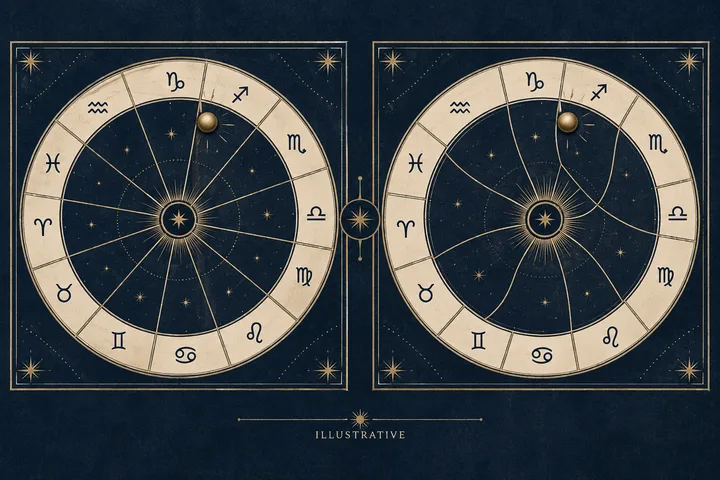
Sources: Quadrant House Systems, Astrodienst Astrowiki; Synastry: Planet Overlays in Houses, Cafe Astrology; Astronomical Foundations of the Astrological Houses, Astrodienst
Birth time and latitude can widen the difference
The house person's birth time and place shape the house structure. So does latitude. A planet degree may be precise while the house receiving it remains uncertain because the recipient's Ascendant or cusps are uncertain.
This matters especially with quadrant houses. Astrodienst describes Placidus through time-based movement, using portions of a point's diurnal arc. At high latitudes, the geometry can produce unusual results or prevent an ordinary Placidus calculation. The location is part of the technique.
Whole-sign houses avoid that particular unequal-cusp problem because each sign remains a complete house. They still need a rising sign, and the rising sign depends on time and place. Don't infer it from a Sun sign or a guess about how someone looks.
When the birth time is missing, keep the reading to known placements and known aspects. A report that uses supplied Moon, Venus, and Mars signs, optional degrees, and selected major aspects can still be useful. It shouldn't present a complete set of natal houses as if missing inputs were present.
Write the limit directly: this planet's sign and contacts are known; its house overlay depends on the recorded time and selected system. That is enough precision to continue.
Sources: House System, Astrodienst Astrowiki; Quadrant House Systems, Astrodienst Astrowiki; Astronomical Foundations of the Astrological Houses, Astrodienst
The strongest exception is a change in relationship emphasis
The case against minimizing house changes is strong when the shift changes the question itself. A planet moving from the eleventh to the twelfth can move the reading from shared networks and future plans toward retreat, privacy, and unspoken material. Fourth to fifth can move from roots and home into romance, play, and creative expression.
Don't smooth that difference into a vague 'both are true.' Ask which method is primary, whether the planet is near a cusp or angle, how secure the birth data is, and whether other chart factors repeat one theme.
Imagine Maria's partner's Saturn is seventh house by the selected quadrant system and eighth by whole sign. The first reading asks how the partner shapes commitment, agreements, and the bond itself. The second asks how the relationship handles trust, shared obligations, vulnerability, and common territory. Keep both questions distinct until the chart method and lived pattern give one priority.
Sometimes the relationship really does occupy a threshold. A partner's Mercury can stir family memories while filling the day with messages. A planet can connect two rooms. But the reader still has to say which room the chosen method makes primary.
The strongest exception doesn't defeat the main rule. It tells you when the conditional house deserves a louder voice.
Sources: House System, Astrodienst Astrowiki; Quadrant House Systems, Astrodienst Astrowiki; Synastry: Planet Overlays in Houses, Cafe Astrology
How to audit two reports that disagree
Audit the reports before interpreting them. First write the direction of the overlay: whose planet, whose houses? Then record the zodiac reference, planet degree, birth place, birth time, time-zone treatment, house system, and aspect settings.
Isolate one planet. Put the same degree against the same recipient chart. If the degree changes between reports, you aren't testing house systems yet. You're comparing different chart data.
Next, read the planet and sign without a house. Add close aspects and angle contacts. Only then compare the house results. This order prevents a disputed label from taking over the reading before you know what actually changed.
Choose one primary method and write it beside the result. For the alternate, identify the size of the shift: neighboring house, angular change, or a wider change in topic. The size tells you how hard to press the interpretation.
Look for supporting links in the house ruler, an angle, another personal planet, or a repeated situation. These are context, not votes. End with one observable question: does closeness grow through daily conversation, shared refuge, practical work, or direct partnership?
Save the raw placement table with the prose. A good comparison makes the settings visible, so the next reader can reproduce the reasoning.
Sources: Quadrant House Systems, Astrodienst Astrowiki; Synastry: Planet Overlays in Houses, Cafe Astrology; Astronomical Foundations of the Astrological Houses, Astrodienst
Choose a method, then keep the bridge
Return to the question. The same synastry planet falls in different houses because the house system changes the boundaries used to place it. Its sign, degree, and planet-to-planet aspects remain intact.
Your best reading has three moves. Lead with the planet, sign, close aspects, and meaningful angle contacts. Name the primary house system. Use the alternate house only when cusp proximity, data quality, or repeated experience gives it a real job.
In the Venus example, the bridge is affectionate exchange becoming belonging. The third house describes the words and small movements that keep closeness alive. The fourth describes the private refuge those exchanges may build. That is more useful than arguing over which room exists.
Make two columns for the disputed planet. Record the primary and alternate houses, the stable sign and aspects, any angle contact, and one behavior that would show the connection between the two topics. Add: 'This interpretation would change if...' Finish with the missing fact that matters most, such as a confirmed birth time or exact cusp degree.
If the bridge feels forced, let the stable layers lead. If both topics repeat, keep both and explain their order. One method may show the room. Another may show the doorway. Read the doorway only when it changes how the room is lived.
Sources: House System, Astrodienst Astrowiki; Quadrant House Systems, Astrodienst Astrowiki; Synastry: Planet Overlays in Houses, Cafe Astrology
Sources & further reading
- House System, Astrodienst Astrowiki
Defines houses as the terrestrial chart frame and distinguishes whole-sign, equal, and unequal house systems, including their treatment of angles.
- Quadrant House Systems, Astrodienst Astrowiki
Explains quadrant cusps, unequal house sizes, the angular axes, and the historical use of whole-sign and quadrant approaches.
- Synastry: Planet Overlays in Houses, Cafe Astrology
Explains how one person's planets overlay the other person's houses and why the two directions of a synastry comparison should be read separately.
- House Division Principles, Skyscript Glossary
Distinguishes quadrant division from whole-sign division and identifies the four angles as the framework for quadrant houses.
- Placidus House System, Astrodienst Astrowiki
Describes Placidus as a time-proportional house method based on diurnal arcs and notes its special behavior at high latitudes.
- Astronomical Foundations of the Astrological Houses, Astrodienst
Provides technical background for how local sky movement and birth location enter the construction of house cusps.
Synastry Comparison Report
Enter known placements for two people. Get an input-by-input comparison, selected aspect calculations and a clear record of what remains uncertain.
Compare our placements