Imagine one tender place keeps getting touched
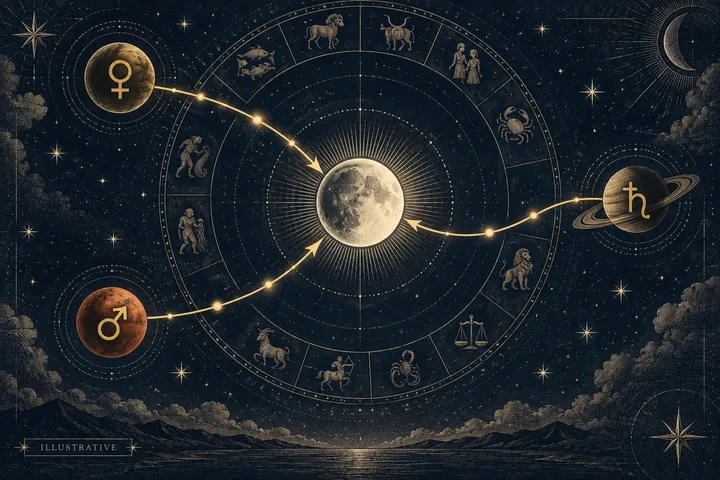
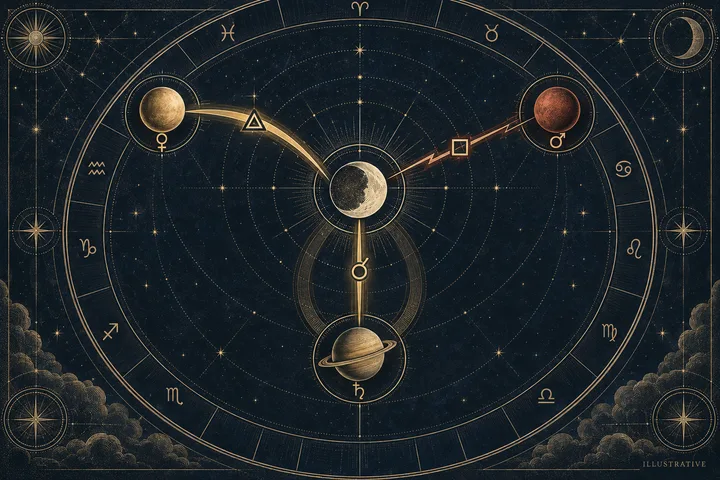
Imagine Maria and Daniel comparing known placements. Maria’s Moon is the receiving point in three contacts. Daniel’s Venus trines it, his Mars squares it, and his Saturn conjoins it. A quiet evening feels warm. A changed plan feels sharp. A serious conversation carries weight. The same Moon keeps showing up, but not in the same mood.
That is the shift. Several contacts to one planet turn that planet into a central relationship theme. They don’t become a compatibility score, and they don’t erase one another. They show different ways the same inner function gets activated. Maria and Daniel are an illustrative case built from stated placements and degrees, not a calculated personal chart. The method begins with the data you actually have, then asks what the repeated pattern helps you notice.
Start with the planet receiving the contacts
The receiving planet tells you where the pattern lands first. The Moon speaks to emotional safety, habit, comfort, and timing. Venus speaks to affection, value, pleasure, and exchange. Mars speaks to desire, initiative, anger, pace, and the body’s yes or no. Mercury brings the theme into speech, interpretation, and disagreement. The Sun brings it into recognition, pride, vitality, and identity.
This is why ‘Venus means love’ is too thin. If several of one partner’s planets aspect your Venus, the repeated question may be how you value yourself, receive affection, spend resources, or decide what feels worth choosing. The contacts are entering one symbolic room through different doors. Astrological synastry sources likewise treat the aspected planet as a major part of the initial experience, while the planet person brings a distinct role into the exchange.
When several of one partner’s planets aspect the same planet in the other person’s chart, that receiving planet becomes a main meeting place in the relationship. The contacts don’t simply add up. They describe different ways the same inner function gets activated. Start with the tightest aspect, then read the other contacts as modifiers: one may open the channel, another may add heat, and a third may create the work. A close Venus contact to someone’s Moon can make affection feel emotionally recognizable; a Mars contact to that Moon can make the same bond more reactive; Saturn can give it weight and duty. Which contact leads depends on the planets, aspect types, exact degrees, and the pattern you can actually observe. This scope uses supplied placements, optional degrees, selected major aspects, and a six-degree orb. The next step is to name the theme that keeps repeating, then ask how each person wants to handle it.
Sources: Cafe Astrology: Aspects Between Charts; The Astrology Podcast: Synastry: The Astrology of Relationships
Several contacts make a theme, not a total
A cluster tells you where to look first. It doesn’t mean three aspects equal three times the attraction. One contact may open the subject, another may disturb it, and a third may show the condition that makes it sustainable. Venus to the Moon can make care feel natural. Mars to the Moon can speed up reactions. Saturn to the Moon can make the same emotional bond feel serious or constrained.
Keep the contacts separate before you synthesize them. One partner’s Venus can contact the other person’s Moon and Mars, which creates a repeated Venus voice. That is different from Venus, Mars, and Saturn all contacting one Moon. In the first pattern, affection links two functions. In the second, one receiving function gathers several kinds of pressure. Confusing those structures creates a crowded reading and a false sense of certainty.
Sources: Cafe Astrology: Aspects Between Charts; Cafe Astrology: Synastry, Love and Relationship Astrology
Rank the pattern by geometry, orb, and function
Read the aspect before you reach for a broad sign meaning. A conjunction brings the planets together directly. An opposition creates polarity. A square creates friction that needs a way to work. A trine blends with more ease. A sextile offers an opening the couple can use. None is automatically good or bad. A trine can go unused, while a square can become a skill.
Then check the orb, the distance from exactness. This comparison scope uses selected major aspects within a six-degree orb. A one-degree contact usually leads a five-degree contact, but the planets still matter. If two contacts share the same orb, let their functions divide the work. One may describe the first felt response. The other may describe what happens next. Sign symbolism adds texture. It doesn’t replace degree evidence.
Sources: Cafe Astrology: Synastry, Love and Relationship Astrology; Astrology.com: What’s Your Sign? An Intro to Synastry Charts
A worked example: one Moon, three pressures
Consider this example. Person A has the Moon at 12° Taurus. Person B has Venus at 14° Virgo, Mars at 10° Leo, and Saturn at 16° Taurus. The Moon receives a Venus trine at 2°, a Mars square at 2°, and a Saturn conjunction at 4°. Those placements support a comparison of aspects and orbs. They don’t establish houses, angles, or a complete natal story.
Lead with the Venus trine because it gives the Moon an easy route into affection. The Taurus-Virgo link can make care practical: food, touch, routines, useful help, and small acts of steadiness. Add the Mars square next. It has the same orb, so it cannot sit in a footnote. Mars can make changes in pace, blunt words, or rushed plans land quickly in the Moon’s emotional field.
Saturn adds consequence at 4°. It may bring steadiness, responsibility, delay, or the fear of asking for too much. The synthesis is neither ‘good’ nor ‘bad.’ Person B repeatedly activates Person A’s emotional world through comfort, heat, and weight. The useful question is not which contact wins. It is when each one appears.
Let equal or mixed contacts keep their tension
The Venus trine and Mars square in the example share a 2° orb. Orb alone cannot rank them. Venus names the resource: affection that feels receivable. Mars names the fault line: movement that can feel abrupt. A report that calls the pattern harmonious loses the trigger. A report that calls it difficult throws away the resource.
The same rule applies to Jupiter and Saturn touching one Venus. Jupiter may widen pleasure, generosity, humor, or forgiveness. Saturn may bring standards, timing, and duty. Together they can describe affection that wants both delight and durability. The aspect type shows how each contact moves. The receiving planet shows what is at stake. Keep both layers visible.
Sources: Cafe Astrology: Aspects Between Charts; Cafe Astrology: Synastry, Love and Relationship Astrology
Describe both people without assigning blame
The receiving person often feels the contact inside the activated function. The planet person may feel that they are bringing a particular force into the other person’s life. In a Venus-Moon contact, the Moon person may feel emotionally met while the Venus person feels drawn to soothe, please, or enjoy the Moon person’s world. Add Mars, and one person may feel stirred while the other feels invited to act.
Those are symbolic roles, not fixed identities. ‘Saturn person’ doesn’t mean controlling. ‘Moon person’ doesn’t mean fragile. Write the interpretation in two directions: what the receiving person may notice, what the planet person may express, and what can happen when those responses meet. That keeps the chart readable without turning it into a verdict about either partner.
Sources: Cafe Astrology: Aspects Between Charts; The Astrology Podcast: Synastry: The Astrology of Relationships
Outer planets can repeat a theme without making it rare
If Uranus, Neptune, or Pluto makes several contacts to one personal planet, classify the contacts before you call the pattern exceptional. Slow planets can share signs and nearby degrees across a generation. Uranus can awaken freedom and disruption. Neptune can heighten longing, imagination, and projection. Pluto can intensify questions of power and honesty. The symbolism may matter, but it doesn’t automatically describe a rare or permanent bond.
Look for personal reinforcement. A close Venus, Mars, Moon, Mercury, Sun, or Saturn contact to the same receiving planet can give the outer-planet pattern a more individual voice. Without that support, say that the slower planet colors the theme. Don’t let a busy chart wheel outrank a close personal contact or the relationship’s observable pattern. More lines don’t always mean more intimacy. Sometimes they mean one planet sits inside a broader generational weather system.
Sources: Cafe Astrology: Aspects Between Charts; Cafe Astrology: Synastry, Love and Relationship Astrology
Use a short worksheet before you interpret
Make four columns: receiving planet, planet making the contact, aspect and orb, and the behavior or question it resembles. Record whether each degree is exact, rounded, or unknown. Mark selected major aspects inside the six-degree scope. Keep sign-only links, wider contacts, houses, angles, and other techniques in a separate group when the supplied information can’t support them.
Then write one sentence: ‘This relationship keeps bringing our attention to...’ Finish it with the receiving planet’s function. Add the closest meaningful contact, the strongest modifier, and the clearest exception. If the rows point to one repeated scene, you have a usable theme. If they point to unrelated scenes, don’t force a cluster. A busy report may still contain several separate stories.
The Synastry Comparison Report works from supplied Moon, Venus, and Mars placements, with optional degrees and selected major aspects using a six-degree orb. It doesn’t calculate a natal chart from birth details or establish houses and angles. If a degree is missing, call the contact unverified. That boundary makes the comparison cleaner.
Sources: Cafe Astrology: Synastry, Love and Relationship Astrology; Astrology.com: What’s Your Sign? An Intro to Synastry Charts
End with one question the couple can use
Return to the illustrative Moon pattern. The reading is simple enough to carry into a real conversation: Venus offers warmth, Mars brings quick reactions, and Saturn adds weight. Maria could ask, ‘When I feel unsettled, what kind of support helps me most, and what kind starts to feel like pressure?’ Daniel can answer without being cast as either comforting or controlling.
That is the point of several contacts to one planet. Name the receiving function. Rank the contacts. Preserve the resource and the fault line. Then ask what the pattern requires in daily life. Compare your supplied placements and trusted degrees when you’re ready. Keep the final interpretation small enough to use.
Sources: Cafe Astrology: Synastry, Love and Relationship Astrology; The Astrology Podcast: Synastry: The Astrology of Relationships
A little more clarity
Does a planet receiving several synastry contacts automatically become the most important part of the relationship?
It becomes a priority for interpretation, not an automatic verdict about the relationship. Rank the contacts by orb, aspect type, planet relevance, and repeated lived behavior. A close personal-planet contact usually deserves more attention than several wide outer-planet contacts. Then check whether the pattern matches what the couple actually experiences. The receiving planet shows where the relationship gathers energy. It doesn’t decide what either person will do with it.
Sources & further reading
- Cafe Astrology: Aspects Between Charts
Explains how each person takes on a planetary role in an interchart contact and why sign context changes its expression.
- Cafe Astrology: Synastry, Love and Relationship Astrology
Describes how conjunctions, flowing aspects, squares, oppositions, and planet meanings shape relationship interpretation.
- Astrology.com: What’s Your Sign? An Intro to Synastry Charts
Explains degrees and orbs in synastry and states that smaller degree distances generally indicate stronger contacts.
- The Astrology Podcast: Synastry: The Astrology of Relationships
Explains the initial experience of the planet being touched and how both partners’ responses build the relationship pattern.
Synastry Comparison Report
Enter known placements for two people. Get an input-by-input comparison, selected aspect calculations and a clear record of what remains uncertain.
Compare our placements