Start with the change, not a new verdict
A relationship changes first in ordinary life. You move in together. One of you starts a demanding job. You stop seeing each other every day. A private bond becomes a public commitment, or a warm beginning meets the dull pressure of repetition. Then an old synastry interpretation can feel wrong. It may have described the first spark beautifully, yet say little about the season you are in now. That does not mean the chart failed. It means the question changed.
The cleanest rereading begins with one sentence: what is different now? Be specific. Do not write that the energy has shifted. Write that you now share money, that she needs more solitude, that he avoids repair after an argument, or that your desire remains strong while tenderness has thinned. Synastry describes how two chart patterns meet. It does not replace the lived history that gives those patterns something to say. The same contact can become visible in a new form when the circumstances around it change.
The first job is archival, not predictive. Keep the original reading beside the present one and label the old claim with its original question. A report written during courtship may have asked about attraction. A reread after moving in together may need to ask about labor, privacy, or repair. The natal placements and interchart contacts have not changed, but the life question has. That difference is the key to a clean revision.
Consider an example. Imagine Maria and Daniel began with an easy exchange between her Venus and his Mars. Their first interpretation emphasized attraction and pursuit. Two years later, they are caring for a parent, and Maria feels that every affectionate moment must be scheduled. Daniel still reaches for her, but he does so when she is exhausted. The question is no longer whether Venus and Mars are present. It is how desire, labor, and availability have become entangled. A reread should name that new question before it reaches for new astrology.
Make a small timeline before opening the chart. Mark when you met, when the relationship became exclusive, when the conflict began, and when the present change became clear. Then separate a lasting pattern from a recent event. One cold weekend is data about a weekend. A repeated refusal to discuss repair is data about the relationship's current form. This distinction protects the chart from both extremes: using it as a fixed label and using it as a mirror that changes with every mood.
Treat the old reading as a hypothesis about a particular season. It may still be right at the level it addressed, while being incomplete at the level you now need. That is different from saying the chart was wrong. A good revision adds context to the old sentence, then narrows the new question until the chart can meet it.
A useful change statement has a time marker and a behavior: ‘Since we moved in together, his quick decisions make me feel rushed, and my silence makes him push harder.’ It is better than ‘our Mars energy got worse.’ The first sentence gives the chart something exact to illuminate and gives the couple something exact to discuss. Add the need underneath it: ‘I need ten minutes before we decide.’ Now the symbolic language points toward a real experiment rather than another label.
Sources: Summary of Techniques in Synastry, Relationship Astrology - Cafe Astrology; Aspects Between Charts - Cafe Astrology
Check the inputs before you interpret the change
A reread is only as clear as the chart information underneath it. Before you compare meanings, list what you actually know. Do you have both Moon signs? Do you have Venus and Mars signs? Do you have exact degrees, or only signs? Are the birth dates certain? Are the birth times recorded, rounded, or unknown? Did the first interpretation include houses and angles, or did it stay with sign placements and interchart aspects? These are not minor details. They decide which layer you can responsibly revisit.
For this field guide, begin with supplied placements and optional degrees. A sign tells you the style of a planet. A degree lets you test whether two planets form a major aspect and how close that aspect is. We use a six-degree orb for selected major contacts in the comparison. The orb is the distance from an exact aspect. A conjunction sits near 0 degrees, an opposition near 180, a square near 90, a trine near 120, and a sextile near 60. A contact at 1 degree deserves more attention than a similar contact at the edge of the chosen orb, though the planet, sign, and wider chart still matter.
Birth time changes the scope again. It matters most when you want to use the Ascendant, Descendant, Midheaven, houses, or a timing technique that depends on angles. Astrodienst's reference material explains that the Ascendant moves about one degree every four minutes and that predictive methods can demand a more exact time. If a birth time is unknown, do not quietly fill in a house overlay and call it evidence. Keep the reread with the placements and aspects you can name. The narrower reading will often be the stronger one because it tells the truth about its inputs.
Now compare the old reading with the present record. Copy its factual statements into one column: her Moon in Taurus, his Venus in Gemini, a 4-degree Mars-Saturn square. In a second column, mark what was interpretive: she seeks reassurance, he shows love through action, arguments may sharpen desire. In a third, write what has been observed since then. This simple separation reveals where the reading was precise, where it was broad, and where life has supplied a useful exception.
Imagine the first report said that a partner's Venus in Libra harmonizes with your Moon in Aquarius by trine. If you only know the signs, you can discuss an element and mode relationship, but you cannot claim an exact degree-based trine. If you later obtain degrees and find the planets are 8 degrees apart, the contact may sit outside the stated six-degree scope. You do not need to force it back in because the signs feel attractive. You can say that the sign pattern remains relevant to the comparison, while the selected major-aspect calculation does not include that wider distance.
This is also where you record missing data. The report can compare known Moon, Venus, and Mars placements. It cannot calculate a natal chart from birth details here, calculate houses, or manufacture a degree for a planet whose position was never supplied. If the Moon changed signs on the birth date, say that the Moon placement is uncertain. If one partner has no exact birth time, leave angles and houses aside. A relationship can still be read. It just needs a clean boundary around what the chart can carry.
Keep the old input sheet beside the new notes. People often remember an interpretation but forget whether it used natal or progressed positions, whether an aspect was exact or wide, or whether the reader quietly added house meaning. That memory gap can make a familiar phrase look more certain than it was. Mark the method in plain language: natal synastry, sign comparison, major aspects within six degrees, houses not used. If the earlier reading used a different method, compare methods before comparing conclusions.
A clean audit might read like this: Moon signs known, Venus and Mars signs known, degrees supplied for Venus and Mars, birth times unknown, houses excluded, selected major aspects limited to six degrees. That sentence tells you what the reread can discuss. It can compare emotional style, affection, desire, and the contacts supported by the degrees. It cannot explain an Ascendant overlay or claim that a transit to a house caused the change. Precision makes the reading more useful because it keeps the interpretation attached to real inputs.
Also record what changed in the method, not only what changed in the relationship. An original reading may have used a ten-degree orb, while your current comparison uses six. It may have included outer planets, parallels, or a composite chart that you no longer have data to revisit. Don't silently merge those systems. Keep the old conclusion in its original frame, then state what the narrower reread confirms, revises, or leaves open.
Sources: Aspect - Astrodienst Astrowiki; Time of Birth - Astrodienst Astrowiki; Partner horoscopes - Astrodienst
Read the natal synastry that still belongs to the bond
Once the inputs are clear, return to the original synastry before adding timing. Synastry compares two natal charts point by point. Its central question is not whether one person is good for the other in the abstract. It is what happens when one person's planets meet the other person's planets. The aspect shows the kind of contact. The planets show the functions involved. The signs show the style. The house, when known, shows where the interaction concentrates. You need all the pieces you actually have, not all the pieces a full chart might contain.
Start with the personal planets. The Moon describes feeling, habit, safety, and the body's need for a familiar rhythm. Venus describes attraction, pleasure, affection, taste, and the ways a person gives value. Mars describes desire, initiative, anger, pursuit, and the force used to get something moving. These are not sealed personality boxes. They are living functions. A Moon contact can become clearer when two people share a home. A Venus contact can change when money or loyalty becomes part of love. A Mars contact can show itself in sex, work, arguments, or the way a couple makes decisions.
Then rank the contacts instead of collecting them. Give the closest major contacts priority. Give repeated themes priority. Give contacts involving the Moon, Venus, and Mars priority when the question concerns reassurance, affection, or desire. A single loose aspect should not outrank a tight contact that repeats the same story through another planet. This is why a synastry reading is not a score sheet. Even compatibility guides that organize aspects by relative weight caution that the values are not absolute and that chart context changes their meaning. A neat total can hide the one pattern the couple actually lives.
Separate three kinds of strength while you rank. First is geometric strength: how close the supplied degrees are to the exact aspect. Second is symbolic relevance: whether the planets answer the question you are asking. Third is lived repetition: whether the theme appears in ordinary scenes. A close Jupiter-Sun contact may matter greatly to encouragement, but it should not outrank a close Moon-Saturn contact when the question is why comfort feels formal. A wider Venus-Mars sign resemblance may be beautiful background, yet it is not the same claim as a degree-based aspect inside the chosen orb.
Look at both roles in an interchart contact. If her Saturn squares his Sun, she may experience herself as asking for structure while he experiences her as judging his vitality. He may bring the Sun qualities of visibility and self-direction, while she brings the Saturn qualities of limits, responsibility, and consequence into that exchange. The roles can switch by situation, too. When she needs recognition, he may become the one who withholds it. When he needs a plan, she may become the reliable one. The aspect describes a loop, not a permanent cast list.
The strongest reread asks which contacts have survived the change in circumstances. A Moon-Venus contact that once appeared as sweetness may now appear as the habit of making tea after a difficult day. A Venus-Saturn contact that once felt restrained may now show as loyalty, but it may also become a pattern in which affection must be earned. A Mars-Mars square can describe conflict, sexual heat, competitive work, or all three. Do not pick the most flattering meaning. Pick the meaning that matches repeated behavior and still respects the planets involved.
Imagine Maria's Moon in Cancer receiving Daniel's Mars in Aries by a close square. At the beginning, she read his directness as exciting and he read her emotional responsiveness as intimate. After they began sharing a home, the same contact became visible when he pushed for immediate decisions and she needed time to settle. The reading is not that he is aggressive and she is fragile. The reading is that action and emotional safety meet at an angle. Their task is to create a pause without killing initiative. That interpretation can remain useful long after the first date has disappeared.
When an aspect seems to have disappeared, check the channel before you discard it. Venus may stop showing as flirtation and start showing as taste, money, touch, or the way a couple protects pleasure. Mars may leave the bedroom and enter household decisions, work, sport, or the timing of hard conversations. The planet has not become irrelevant because its first expression ended. Ask what function the relationship now gives it.
Sources: Summary of Techniques in Synastry, Relationship Astrology - Cafe Astrology; Aspects Between Charts - Cafe Astrology; Romantic Compatibility Synastry Analysis in Astrology - Cafe Astrology
Let the current relationship test the interpretation
The present record has a different job from the chart. It cannot prove an aspect, but it can show which expression deserves attention. Test the old interpretation against more than one scene: reassurance, space, repair, affection, work, illness, travel, and disappointment. You aren't looking for a score. You’re sorting the contact into active, dormant, or redirected.
Use one compact observation grid. In the first column, write the circumstance: a move, a long-distance stretch, a new job, or a change in family care. In the second, write the chart theme it seems to touch. In the third, record the behavior without astrological language. In the fourth, record the result. A move may seem to call up a Saturn or fourth-house story, but the evidence is whether you divided the work, spoke about strain, and repaired the argument. The circumstance is not the aspect. The aspect is not the behavior.
Add a fifth column for the old interpretation's confidence. Mark it high when the original claim named a supplied placement or close aspect. Mark it medium when it depended on a broad symbol, such as ‘this person needs freedom.’ Mark it low when it came from an unknown house, an assumed birth time, or a dramatic promise about the future. This doesn't turn astrology into bookkeeping. It stops a vivid sentence from receiving more authority than its inputs earned.
The grid should also include counter-scenes. If the old reading says Saturn makes one partner feel judged, record the evening when that partner set a careful boundary and the other respected it. If it says Venus creates ease, record the time affection was offered but not received. A pattern that survives both kinds of scene deserves interpretation. A claim that survives only the worst moment is probably describing a mood, a trigger, or a story you have been carrying forward.
Now test the claim in both directions. If Moon-Saturn suggests that care and responsibility become linked, look for practical help that arrives without warm words. Also look for warmth that arrives without a duty attached. If Venus-Neptune suggests idealization, record the moments when you both name limits, keep promises, and stay tender after an illusion breaks. A good interpretation must explain its bright expression and its difficult one.
Consider an example. Imagine Maria believes Daniel's Mercury square her Moon means he will always invalidate her feelings. He does ask for facts when she wants comfort, but he returns to the conversation and learns the words that calm her. The contact describes a translation problem, not a character sentence. The useful revision is, ‘We need comfort before problem-solving,’ followed by a practice they can repeat.
Keep the record long enough to see repetition, perhaps four to six weeks, and include successful responses. Note the time a Mars contact brought urgency but one partner slowed down. Note the spontaneous care that softened a Saturn-Venus pattern. Note the direct question that replaced Neptune-style guessing. The point isn't to make behavior serve the chart. It is to find the exact expression your new question can examine.
The same contact can change expression without changing identity. A Mars contact may feel lively during courtship, abrasive during a rushed move, and productive once the couple gives conflict a set time. A Venus-Saturn theme may begin as caution, become loyalty, and harden into a duty nobody chose aloud. The reread should name the condition that changed the expression. That is more useful than saying the energy shifted.
This test has a firm boundary. Don't ask the chart to decide whether a behavior is acceptable. That judgment belongs to your values and boundaries. Astrology can show why a conflict feels charged, but it can't make disrespect into devotion. A hard aspect may be workable. It is never a command to endure harm.
Finally, write two sentences, not one blended conclusion. The old sentence might say, ‘Our Moon-Mars contact brings fast emotional reactions.’ The new sentence might say, ‘Since the move, fast decisions make her withdraw and make him push harder.’ The first preserves the symbol. The second records its current channel. Keeping both prevents present behavior from being mistaken for a permanent chart fact.
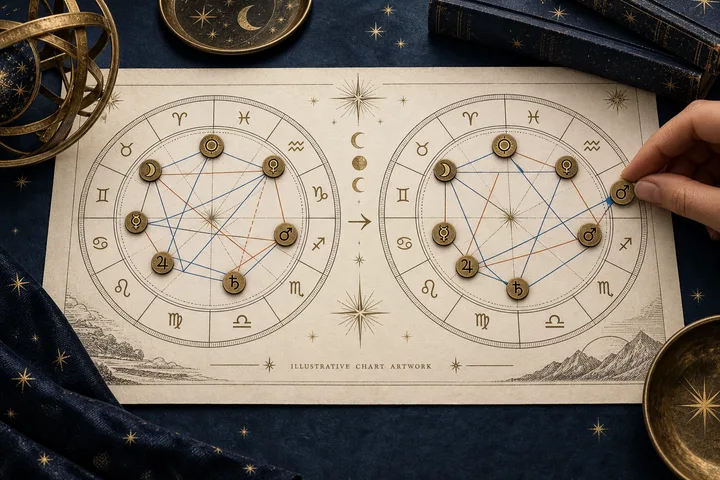
The best way to revisit a synastry interpretation is to keep the original chart comparison intact, then read the relationship in layers. Start with the supplied natal placements and ask which pattern still describes the bond. Next, compare that pattern with what has actually changed: your routines, level of commitment, distance, conflict style, or emotional needs. Then add timing only if you have accurate degrees and birth data for the method you want to use. A Moon, Venus, or Mars contact can keep describing the bond while its expression changes. A Saturn contact may feel different after commitment. A once-bright Venus-Mars story may need a new reading when desire, privacy, or daily effort has shifted. Do not erase the first interpretation or let the newest difficult week rewrite the whole chart. Rank the lasting natal themes first, the current relationship evidence second, and any transit or progressed layer third. Your next step is simple: write down three original chart claims, three repeated present-day behaviors, and one question you want the comparison to help you discuss. Keep the question narrow enough to answer in one conversation, not broad enough to turn the chart into a verdict on the entire relationship right now.
Add timing only after the natal layer is stable
If the relationship changed at a particular time, you may want to know why that season felt different. This is where timing techniques enter. A transit is a moving planet forming an aspect to a natal planet, angle, or other chart factor. A progression describes a symbolic development from the natal chart. A progressed synastry comparison places the progressed charts of two people into conversation. These methods ask when a theme becomes louder. They do not replace the natal synastry that describes the underlying bond.
The order matters. First, identify the natal contact. Second, describe how it has been lived. Third, ask whether a dated transit or progression may have emphasized it. If you reverse that order, every difficult month can seem to invent a new relationship story. A Saturn transit to a natal Venus may coincide with a serious conversation about commitment, but the natal Venus-Saturn pattern may already explain why commitment carries both loyalty and weight. Timing activates a theme. It does not create the whole meaning from nothing.
You need accurate inputs for this layer. A transit to an exact natal degree requires the relevant degree. A transit to an angle requires a reliable birth time. A progressed chart requires the dates and birth data used for the progression. If the data is missing, keep the timing question open. Do not use a calendar event as a substitute for a chart calculation. The most honest phrase is also the most useful: the present change may invite a timing study, but this supplied comparison does not calculate that layer.
Before asking for timing, write a short brief: the event or season, its dates, the natal degree or angle involved, and the question you want answered. ‘Why did we become serious?’ differs from ‘Why did our conversations become tense in March?’ If you can't name the date or the chart input, stay with the natal layer. A technique should narrow the mystery, not add another pile of symbols.
Choose the method by the kind of change. A transit is useful when a current planet appears to press on a natal or relationship-chart point. A progression is useful when the people themselves seem to be developing into a new emotional or relational phase. A composite chart describes the relationship as a third entity, and its later transits or progressions can speak to the partnership's season. These are different questions. Don't blend them into one vague promise that the chart will explain everything.
A simple choice rule helps. If the question is ‘What has always been between us?’ stay with natal synastry. If it is ‘Why did this familiar theme become louder during this dated period?’ investigate a transit or progression. If it is ‘What kind of entity are we creating together now?’ a composite chart may be the right language. That last question belongs to a different chart layer, so it shouldn't be smuggled into a placement-only report and presented as though nothing changed in the method.
Timing is most helpful when it gives the change a beginning and an end. Suppose conversations became serious between two dated months, then eased after a decision. A timing study can examine that window. It doesn't need to explain every argument before or after it. Keep the window narrow, name the natal point involved, and ask what the activation added to an existing theme. If the timing layer only makes the story bigger, drop it and return to the behavior you can actually describe.
Suppose a couple has lasting Venus-Mars contact but intimacy becomes difficult during a long period of stress. Timing may show what was activated, yet the reread still needs sleep, privacy, health, workload, and consent in view. A transit can describe the season. It cannot supply the conversation. And sometimes the relationship changes through a boundary, an apology, or a daily choice with no dramatic timing signature at all. That change is still real.
Sources: Time of Birth - Astrodienst Astrowiki; Synastry in More Detail - Cafe Astrology; The Composite Chart: Relationship Astrology - Cafe Astrology
Decide what the changed season asks the chart to explain
A changed season rarely asks one clean question. After a move, you may be asking about both closeness and workload. After a rupture, you may care about both forgiveness and trust. The chart can contain the relevant symbols, but you still have to choose the decision in front of you. Otherwise every contact becomes an answer and the reread becomes another catalogue.
Use the changed season to choose one of three jobs for the chart. Preserve a theme when the old interpretation still names the same pattern. Reinterpret it when the planet is showing through a new channel. Defer it when the claim depends on a degree, angle, house, or timing input you don't have. This is more useful than asking whether the whole relationship is still compatible. It gives each symbol a clear task.
For each task, write the supported view and the exception that would change your next move. A close Moon-Saturn contact may make reliability a central language of love. The exception is that reliability can become withholding when nobody names a need. Venus-Mars may keep desire alive. The exception is that desire cannot repair disrespect. An exception matters only when it changes what you ask, observe, or refuse.
Imagine Maria and Daniel have her Moon square his Mars, his Venus trine her Moon, and a close Saturn contact to her Venus. A flat reading would call the pair compatible or incompatible. A better reading ranks the themes. The Venus-Moon trine supports tenderness and an instinct to soothe. The Moon-Mars square makes timing and emotional pressure combustible. Saturn-Venus gives the bond staying power, but it can make affection feel measured. The relationship may work best when the couple protects softness, slows conflict, and turns commitment into visible care rather than silent duty.
Put the result into a change memo. ‘Preserve: Moon-Venus still helps us return to warmth. Reinterpret: Moon-Mars now appears as urgency during household decisions. Defer: any house claim until the birth-time question is settled.’ That memo is the original contribution of a reread. It tells you what remains, what has moved channels, and what should not be forced into the present story.
The same chart can therefore produce different priorities without changing its placements. Desire moves Venus and Mars forward. Shared safety moves the Moon and Saturn forward. A question about where the bond is lived may require houses, while a question about attraction may not. Relevance isn't bias. It is the discipline of reading the chart you have for the problem you actually need to handle.
A useful memo has three lines. Preserve the contact that still describes the bond. Reinterpret the contact whose expression changed with the circumstances. Defer the claim that needs missing data. In Maria and Daniel's case, Moon-Venus remains a resource, Moon-Mars needs a slower channel, and any house story stays outside the reading. That is a decision guide, not a compatibility verdict.
Notice what this method changes. It stops the old reading from competing with the new one. The trine doesn't have to defeat the square. Saturn doesn't have to certify permanence. A hard contact doesn't erase tenderness. Each placement is assigned a narrower question, and the relationship supplies the scene in which that question can be tested.
If the competing indications remain genuinely unresolved, say what would resolve them. More accurate degrees may clarify whether an aspect falls inside the selected orb. A reliable birth time may make a house overlay relevant. A direct conversation may reveal whether a need is being heard. Another month of observed behavior may distinguish a phase from a pattern. A good reread does not hide uncertainty. It turns uncertainty into the next useful question.
Sources: Aspect - Astrodienst Astrowiki; Summary of Techniques in Synastry, Relationship Astrology - Cafe Astrology; Aspects Between Charts - Cafe Astrology
Use the reread to choose the next conversation
A synastry interpretation earns its keep when it changes the next conversation. Don't end with a label such as intense, karmic, or challenging. Translate the leading theme into one subject and one small agreement. If the Moon needs reassurance, ask what reassurance sounds like. If Mars rushes the bond, agree on a pause before decisions. If Venus and Saturn link love with duty, separate chosen care from unpaid emotional labor.
Use three lines: I notice this. I need this. I propose we try this. Imagine Maria saying, I notice that we solve practical problems quickly but stop talking when one of us feels hurt. I need comfort before advice. For the next two weeks, can we listen for ten minutes before planning a fix? The chart can name the subject. The couple still has to write the sentence.
Share the reading with permission and begin with your own experience. ‘I read this Moon-Saturn contact as a place where care and pressure can mix in me. Does that fit your experience of us?’ Let your partner disagree. Remove the planet from the accusation and return to the scene you can both see. Then choose one action, one review date, and one sign that the action helped.
Leave some subjects for later. Don't use a beautiful Venus contact to avoid an immediate safety question, and don't spend an incomplete-data reading on houses or exact angles. If both people are flooded, wait. A reading can be accurate and still arrive at the wrong moment.
This is where the Synastry Comparison Report can help when you already know the placements. It organizes supplied Moon, Venus, and Mars signs, optional degrees, and selected major aspects under a six-degree orb. It can show which themes deserve the first conversation and where missing degrees or birth information limit the comparison. It doesn't calculate a natal chart from birth details, calculate houses, or decide whether the relationship should continue. Enter the placements, mark what is unknown, and begin with the contact that answers your written question.
Use the report's output as a starting order. If it shows three close contacts, don't discuss all three at once. Pick the one tied to the current change, write its planet roles in one sentence, and bring one observed scene to the conversation. A report can organize the comparison. It can't tell you which memory matters most, whether your partner feels the same pressure, or what agreement both people can keep. Those are the parts of the reread that require attention rather than more chart layers.
Give the conversation a stopping point. After you name the contact and the scene, ask whether the other person recognizes the pattern, rejects it, or sees a different expression. All three answers are useful. Recognition supports the working interpretation. Disagreement may show that the contact is being lived asymmetrically. A different expression may reveal the new channel you were looking for. Don't argue someone into your reading. Let the exchange supply the next piece of the chart's meaning.
Close the reread by filing the change memo with the chart. Keep one preserved theme, one reinterpretation, and one deferred claim. Then choose the smallest action that tests the reinterpretation in life: a conversation, a privacy boundary, a plan for household work, or permission to stop a ritual that now creates pressure. Revisit the memo after the action, not after every mood. That's how an old reading becomes useful again.
Sources: Summary of Techniques in Synastry, Relationship Astrology - Cafe Astrology; Aspects Between Charts - Cafe Astrology; Synastry in More Detail - Cafe Astrology
A little more clarity
Should I get a new synastry reading after a breakup or major relationship change?
Start by revisiting the original natal synastry and naming what changed in lived experience. A new reading can help when you have new chart data, a genuinely different question, or a timing layer you can calculate. It should clarify the pattern and your next conversation, not issue a verdict about whether the relationship is destined or should be restored. If the original reading was broad, keep its useful theme and rewrite it around the present scene before adding another technique.
Can the same synastry aspect mean something different over time?
Yes. The natal contact stays the same, but its expression can change as circumstances change. Moon contacts may become clearer through shared routines. Venus contacts may change when commitment or money enters the bond. Mars contacts may show through conflict, sex, work, or decision-making. Read the aspect with its planets, signs, degrees, and current behavior. Compare the first expression with the present one, then ask what changed around the contact.
What if I do not know both birth times or exact degrees?
Keep the reading within the information you have. You can compare known Moon, Venus, and Mars signs, and you can use degrees when they are supplied. Without reliable birth times, leave houses and angles aside. Without exact degrees, do not claim a precise major aspect or use a timing technique that depends on it. A focused reading is better than an invented detail. Mark each unknown input beside the interpretation it would affect, then keep that claim provisional instead of filling the gap with a familiar chart phrase. If the missing fact later becomes available, revisit only the affected layer. You don't need to throw away the whole reading. Update the claim, not the entire meaning.
Sources & further reading
- Aspect - Astrodienst Astrowiki
Defines major aspects and the orb as the degree range allowed around an exact aspect.
- Time of Birth - Astrodienst Astrowiki
Explains why accurate birth time matters for angles, houses, and predictive methods.
- Partner horoscopes - Astrodienst
Describes synastry and the reduced orb used by Astrodienst for drawing synastry aspects.
- Summary of Techniques in Synastry, Relationship Astrology - Cafe Astrology
Distinguishes natal potential, temperament, interchart aspects, house overlays, and composite charts.
- Aspects Between Charts - Cafe Astrology
Explains planet roles in interchart contacts and the need to read sign and house context.
- Synastry in More Detail - Cafe Astrology
Describes how progressed and transit activations can add a timing layer to significant relationships.
- Romantic Compatibility Synastry Analysis in Astrology - Cafe Astrology
Shows why numerical compatibility weights are only organizing aids and not absolute judgments.
- The Composite Chart: Relationship Astrology - Cafe Astrology
Defines the composite chart and describes progressed or transiting relationship-chart techniques.
Synastry Comparison Report
Enter known placements for two people. Get an input-by-input comparison, selected aspect calculations and a clear record of what remains uncertain.
Compare our placements