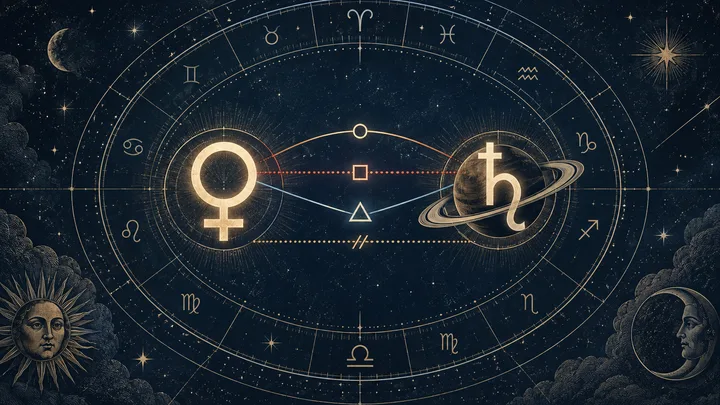
What counts as a repeated contact?
Start with the planet pair. A repeated contact means the same two planets meet through more than one accepted relationship in the comparison. Venus in one chart may square Saturn in the other and also sit in a declination parallel with it. The same pair may also form a wider trine. Those contacts belong in the same evidence group, but they don’t use the same measuring stick.
Longitude aspects measure distance around the zodiac. Conjunctions, squares, trines, oppositions, and sextiles describe different ways two planetary functions meet. Declination compares how far north or south each planet sits from the celestial equator. A parallel can be read alongside a longitude aspect, yet it remains a declination contact, not a second version of the same angle. Cafe Astrology describes the parallel as able to reinforce a synastry aspect, while its worked method checks declination separately.
That distinction changes the question. Don’t ask, ‘How many aspects do we have?’ Ask, ‘What does this planet pair keep bringing into the relationship?’ Venus and Saturn might keep returning you to affection, value, time, limits, and commitment. The aspect names then tell you whether that conversation feels fused, pressured, balanced, or easy to enter. Repetition raises priority. It doesn’t finish the interpretation.
Sources: Cafe Astrology: Determining Parallels and Contra-Parallels in Synastry; Cafe Astrology: Synastry in More Detail
Record the evidence before you interpret it
You need both planetary positions, the degrees when available, and the method behind each reported contact. For every line in the report, record the planet pair, direction, aspect or parallel, exact distance, orb, zodiac reference, and measurement. A sign-only comparison can suggest a relationship between signs. It cannot tell you whether a contact is exact or barely within the chosen limit.
Consider an example: Person A’s Venus is listed at 14 degrees Taurus and Person B’s Saturn at 17 degrees Aquarius. That gives a three-degree square by longitude. If their declinations also fall within the method’s parallel limit, record that as a second line with its own declination distance. The numbers here are illustrative, not a personal chart calculation.
Write down the source of the data, too. A chart wheel may show a line without showing the degrees. An aspect table may use a different orb from another site. The report may mix tropical and sidereal settings if you copy from separate screens. Repeated contacts are easy to inflate when the underlying settings disappear. Keep one zodiac reference and one stated method in the working record.
Sources: Deborah Houlding, The Classical Origin and Traditional Use of Aspects; Skyscript Glossary: Orbs (or rays); Cafe Astrology: Determining Parallels and Contra-Parallels in Synastry
Rank the anchor contact first
The anchor is the contact you can defend most clearly. Usually it is the closest major longitude aspect between the same two planets, provided it falls inside the orb your method accepts. Skyscript’s aspect material treats exactness as important and distinguishes close, partile contacts from looser ones. Its glossary also shows that astrologers use different orb traditions. State yours. Then rank consistently.
A close square should lead over a wide trine simply because the trine sounds kinder. A close conjunction should lead over a faint parallel if the conjunction is the clearer part of your chosen comparison. This is not a moral ranking. It is an evidence ranking. The anchor tells you where the planet pair speaks most plainly.
Next, read the planets before you read the mood of the aspect. Venus brings attraction, pleasure, taste, and value. Saturn brings time, responsibility, boundaries, and endurance. A Venus-Saturn square may put affection under pressure, but its actual expression still depends on the signs and on the condition of Venus and Saturn in the two natal charts. The angle gives the style of contact. The planets give the subject.
Sources: Deborah Houlding, The Classical Origin and Traditional Use of Aspects; Skyscript Glossary: Orbs (or rays)
Decide what the next contact adds
Once the anchor is clear, give the next contact one job. It can intensify the same exchange, change its tone, or provide another route for the planetary functions to work together. This is the step that keeps a layered reading from becoming a list of repeated adjectives.
Imagine Maria’s Venus and her partner’s Saturn form a close square, with a near-exact parallel as well. The square gives the main tension: affection meets caution, duty, or a fear of being judged. The parallel can make the link more immediate and noticeable. Cafe Astrology treats this kind of parallel as reinforcing the longitude aspect. It does not turn the parallel into a second square, and it doesn’t erase the need to read Venus and Saturn in their signs and natal condition.
Now change the second contact. Suppose the square is close but the trine is wider and still within the selected orb. The trine doesn’t cancel the square. It changes the available expression. The couple may have pressure around reassurance while also possessing a natural talent for keeping promises, respecting time, or giving affection through steady acts. Write the contrast. Don’t average it into ‘mixed energy.’
A useful test is subtraction. Remove the second contact from the paragraph. What disappears? If nothing changes, keep the contact in the evidence table and leave it out of the conclusion. If the tone, emphasis, or practical route changes, name that change in one sentence. The extra contact has earned its place when the reader can feel what would be missing without it.
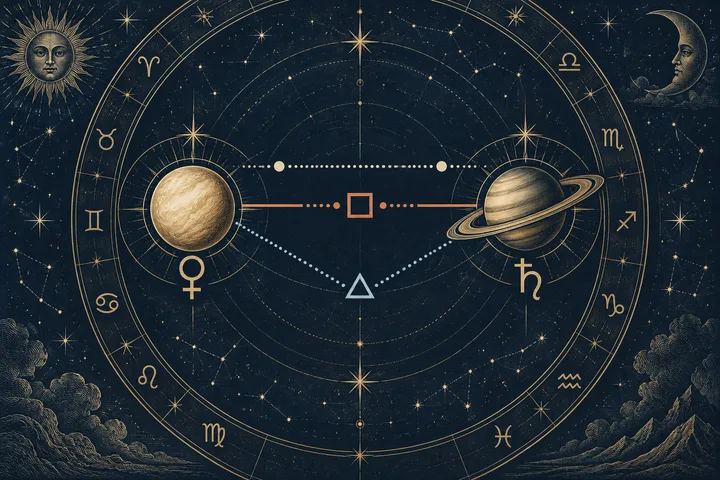
Repeated contacts between the same two planets give that pair more weight, but they don’t automatically create several separate messages. First sort the contacts by measurement. A conjunction, square, trine, opposition, or sextile uses zodiacal longitude. A parallel uses declination. Then rank the clearest contact by exactness, stated orb, and planetary condition. Finally ask what the next contact adds: emphasis, a different tone, or a practical way to express the pair. A close Venus-Saturn square with a wider trine can describe pressure alongside a workable form of loyalty. A Venus-Saturn parallel may reinforce the connection without becoming another square. The goal is a ranked reading you can connect to behavior, not a score or a relationship verdict.
Let signs and motion refine the reading
The aspect tells you how the planets meet. The signs tell you how they try to do it. Venus in Taurus and Saturn in Aquarius will handle a square differently from Venus in Gemini and Saturn in Pisces, even though the underlying question about affection and structure remains. Use the signs to replace a stock interpretation with a more exact one.
Then inspect applying or separating motion if your method uses it. Skyscript’s traditional material distinguishes aspects moving toward exactness from those moving away, and it notes that the receiving planet’s condition affects expression. In a synastry reading, treat this as a refinement, not a shortcut to intention. An applying contact may feel like a pattern gathering force. A separating contact may feel familiar or easier to name after the fact. Neither tells you who cares more.
Direction matters as well. Person A’s Venus to Person B’s Saturn is not identical to Person B’s Venus to Person A’s Saturn. One person’s affection may meet the other’s structure, while the reverse contact gives the second person a different role. If both directions are close, describe the exchange. If only one is close, let that direction lead. Same planet names do not create perfect symmetry.
The strongest exception is a contact near a sign boundary. A sign-based relationship and a degree-based relationship can point in different directions, as Deborah Houlding’s discussion of partile and platick aspects shows. Don’t hide the tension. Record the degrees, state the sign relationship, and explain which layer your method gives priority.
Sources: Deborah Houlding, The Classical Origin and Traditional Use of Aspects; Skyscript Glossary: Separation
Keep the reading inside the chart information you have
A repeated contact can be important without giving you permission to invent the missing chart. If you have exact degrees, you can rank selected aspects and state their orbs. If you have only Moon, Venus, and Mars signs, you can compare those sign placements and identify contacts worth checking. You cannot call an aspect exact, calculate houses, or describe applying motion without the relevant data.
This matters because repeated contacts often look more impressive in a software display than they are in the underlying comparison. A parallel requires declination data. Cafe Astrology’s example checks north and south declinations and uses a one-degree orb for its demonstration. If your report does not show declinations, call the parallel unconfirmed. If the report supplies a label without a distance, record the label as a prompt, not as a ranked fact.
The same rule applies to natal condition. A partner’s Saturn lands in a natal Saturn story, not on an empty page. That story may make the contact feel familiar, difficult, protective, or surprisingly useful. But if you don’t have the natal pattern, stay with the synastry layer. You can describe the meeting between two planetary functions. You can’t assign a private motive from a missing chart.
For a placement-based comparison, the useful scope is clear: supplied Moon, Venus, and Mars signs, optional degrees, and selected major-aspect calculations using a six-degree orb. That scope can help you choose which relationship question to discuss first. It does not calculate a complete natal chart, houses, or a prediction about the relationship’s future.
Sources: Cafe Astrology: Determining Parallels and Contra-Parallels in Synastry; Cafe Astrology: Synastry in More Detail
Turn the ranked contacts into a useful next step
Your final paragraph should do three things in order: name the anchor, explain the added layer, and connect the theme to something observable. For the Venus-Saturn example, the anchor might be the close square. The parallel makes the connection harder to ignore. The wider trine points toward a workable practice of steady affection. That is a reading with a shape, not a pile of labels.
Now bring the pattern into ordinary life. Ask what happens when one person needs reassurance, when plans change, or when affection has to compete with work and responsibility. A repeated Moon-Mars contact invites you to watch the interval between feeling and action. A repeated Mercury-Pluto contact invites you to notice whether questions create honesty or a contest for control. The chart supplies the language. Your observations test which expression is alive.
Choose one action. For Venus-Saturn, agree on a concrete way to show care and a time to revisit whether it feels supportive rather than evaluative. For Moon-Mars, decide what either person may request before a fast reaction becomes a fight. For Mercury contacts, set a boundary around privacy and a rule for returning to a hard conversation. Keep the action small enough to observe.
Then make the decision point explicit. If the practice gives the repeated pattern a healthier form, keep working with it. If the pattern stays painful and neither person wants to change the behavior, take that information seriously. Repeated contacts deserve priority because they keep a theme in view. They do not make the choice for you.
Sources: Skyscript Glossary: Orbs (or rays); Cafe Astrology: Determining Parallels and Contra-Parallels in Synastry; Cafe Astrology: Synastry in More Detail
A little more clarity
Do repeated synastry contacts mean the relationship is stronger?
They make the planet pair more important to the reading. They don’t prove ease, permanence, or success. Rank the clearest contact, then decide whether the others intensify it, change its tone, or add a separate measurement.
Is a parallel a second conjunction, square, or trine?
No. A parallel uses declination, while the familiar major aspects use zodiacal longitude. It may reinforce a longitude aspect, but it keeps its own measurement and should be recorded separately.
What if one contact is hard and another is easy?
Let both remain visible, but rank them. A close square can show the pressure point while a wider trine shows a skill or route that helps the pair work. Check the degrees, orb, signs, direction, and chart data before you decide how much weight the softer contact deserves.
Sources & further reading
- Deborah Houlding, The Classical Origin and Traditional Use of Aspects
Supports aspect geometry, exact and loose contacts, sign-boundary cases, applying and separating motion, and planetary condition.
- Skyscript Glossary: Orbs (or rays)
Supports the definition of an orb and the fact that modern and traditional astrologers use different orb practices.
- Skyscript Glossary: Separation
Supports the technical distinction between an aspect applying toward exactness and separating from it.
- Cafe Astrology: Determining Parallels and Contra-Parallels in Synastry
Supports calculating synastry parallels from declination, distinguishing north and south positions, and the illustrative one-degree orb.
- Cafe Astrology: Synastry in More Detail
Supports the convention that a parallel can reinforce a longitude aspect while remaining a distinct declination contact.
Synastry Comparison Report
Enter known placements for two people. Get an input-by-input comparison, selected aspect calculations and a clear record of what remains uncertain.
Compare our placements