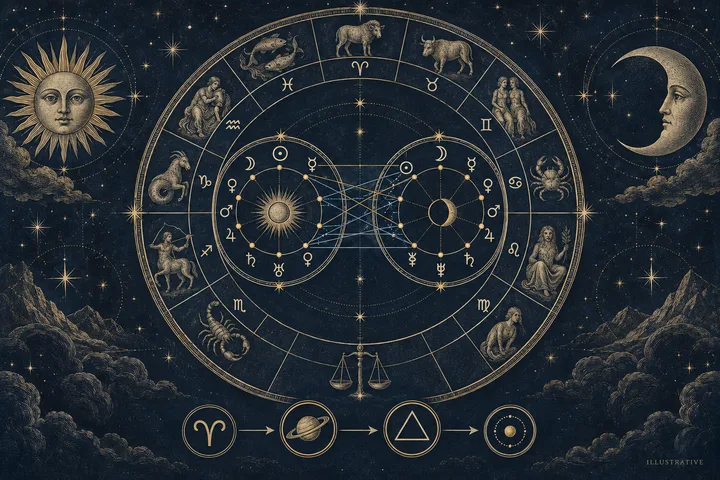
Read synastry in layers. Start with the planets, add their signs, identify the aspect, check the degree distance, and apply a named orb. Then weigh repeated themes and reliable house data. This keeps a vivid sign pairing from overpowering a weak contact, and it stops one dramatic square from becoming the whole story. This guide uses supplied placements, optional degrees, major interchart aspects, and a six-degree orb. It doesn't calculate natal positions or houses from birth details. Write down the placements you know, add degrees where available, and rank the tightest meaningful contacts first.
Why the order matters more than the most flattering placement
Synastry can look simple until you put two charts together. A person sees Venus in Libra and Mars in Leo, notices that both signs sound romantic, and starts building a conclusion. Another person sees a Moon-Saturn square and decides the bond must feel heavy. Both readings begin in the wrong place. A sign is not an aspect. An aspect is not a verdict. An orb is not a personality trait.
The reliable order is planet, sign, aspect, degree, orb, then pattern. That sequence gives every symbol a job. The planet names the function being activated. The sign describes its style. The aspect shows how the functions meet. The degrees tell you how close the contact is. The orb helps you decide whether to treat it as active and how much weight to give it. The pattern tells you whether the contact repeats a larger relationship theme.
This matters because synastry is a comparison of two horoscopes. It shows interchart aspects and where one person's planets fall in the other person's chart. The chart comparison becomes useful when you move from isolated labels to interaction. Cafe Astrology's interchart guide treats synastry as a study of contacts between two charts and advises readers to consider the sign and house placements of the planets involved, not only the aspect name. That leads to a useful editorial rule: context must follow contact, and contact must follow the actual planets.
The order also protects you from a common mistake. You can find a beautiful sign connection with no close aspect, or a close aspect whose signs make the exchange more complicated than the shorthand suggests. Neither result is useless. They simply belong in different parts of the reading. A sign pairing gives background tone. A close aspect gives an active channel between two chart functions. Treating them as equal makes the reading loud, but not clear.
So begin with a question that can be answered. Are you studying emotional ease? Look first at the Moons and contacts to Venus, Mars, and the angles. Are you studying attraction? Start with Venus and Mars, then include the Sun, Moon, and Ascendant when their degrees are known. Are you studying whether two people can talk through conflict? Mercury contacts deserve the first pass. The question chooses the planets. The planets choose the rest of the order.
This first pass should stay small. List the relevant planets for the question, then compare each one across the two charts. If the question is about affection, don't begin by reading every asteroid, midpoint, and minor aspect. The extra symbols may become useful later, but they can't tell you what the central exchange is until the main planets have been named.
You can think of this as moving from meaning to relationship. The Moon means one thing by itself. Your Moon meeting my Venus means something else. The aspect between them tells you whether the meeting flows, presses, joins, or pulls. The degree tells you how closely the two symbols touch. Each layer narrows the question until the interpretation has edges.
Sources: Aspects Between Charts: Cafe Astrology; An Introduction to Aspects and Chart Shaping: Skyscript; Synastry Aspects: Meanings, Orbs & Compatibility Guide: Tarot by Hand
First name the planets, before you interpret the signs
Planets are the actors in a synastry contact. The Sun brings identity, vitality, and the way a person wants to shine. The Moon describes feeling, habit, comfort, and the need for a safe inner life. Mercury carries thought, speech, listening, and the way two people make meaning together. Venus speaks to affection, pleasure, taste, and the way someone gives and receives value. Mars shows desire, initiative, anger, pursuit, and the force used to get something done.
The social planets widen the story. Jupiter can bring encouragement, faith, growth, and excess. Saturn can bring commitment, pressure, boundaries, and endurance. Uranus can awaken freedom, surprise, and disruption. Neptune can heighten sympathy, imagination, longing, and projection. Pluto can intensify desire, power, fear, and transformation. These are interpretive functions, not fixed roles that one person must perform at every moment.
That last point matters in synastry. In a Saturn-Sun contact, the Saturn person may set limits or ask for maturity while the Sun person feels seen, tested, or constrained. But the Sun person also affects the Saturn person. Cafe Astrology makes this role exchange explicit: each person whose planet is involved can take on that planet's role in the particular interaction. Don't reduce the contact to “she is Saturn” or “he is the Sun.” Ask what each person experiences when the other expresses that function.
Rank the planets by the question in front of you. For a new romantic connection, the personal planets usually deserve the first pass because they describe the daily exchange of feeling, speech, affection, and action. This doesn't make Jupiter, Saturn, or the outer planets unimportant. It means you need a lived channel before you can understand the wider one. A Venus-Neptune contact may feel enchanting, but you still need to see how Mercury handles plain questions and how Saturn handles time, promises, and limits.
If you only know signs, stop at this level and say so in your notes. You can compare sign expression. You cannot responsibly rank exact interchart contacts without degrees. The report offered on this site follows that boundary. It works from placements you supply, with optional degrees, and can examine selected major aspects using a six-degree orb. It doesn't invent a chart underneath missing information. Precision starts with knowing what you actually have.
A useful worksheet has a planet column, a sign column, an aspect column, a degree-distance column, and an interpretation column. That layout sounds plain. Good. Plain structure keeps you from smuggling a conclusion into the first label you write. It also lets both people see which part of the reading rests on supplied information and which part is interpretive synthesis.
Don't let the word “planet” make the reading feel abstract. The Moon can become the way one person seeks reassurance after a hard day. Mercury can become the sentence that lands badly or the question that finally clears the air. Venus can become the way someone shows appreciation. Mars can become who reaches first, who pushes, and who needs a pause. The planet names the door. The relationship shows what happens when someone walks through it.
Sources: Aspects Between Charts: Cafe Astrology; What’s Your Sign? An Intro to Synastry Charts: Astrology.com
Then add the signs as the style of the exchange
Once you know which planets meet, add the signs. Signs answer a different question from planets. Venus still describes affection in every sign, but Venus in Taurus seeks steadiness and sensual continuity in a different way from Venus in Aquarius, which may need friendship, room, and a less conventional rhythm. Mars still describes drive, but Mars in Cancer may act through protection and mood while Mars in Sagittarius may act through candor, movement, and appetite for experience.
Read both signs, not only the sign of the planet that seems more romantic. In a Moon-Mercury contact, the Moon person's sign colors emotional need and memory. The Mercury person's sign colors speech, thought, and the way they sort experience. In a Venus-Mars contact, Venus shows the style of attraction and pleasure while Mars shows the style of pursuit and desire. The two signs can cooperate, clash, or speak past each other even when the aspect itself is easy.
Use element and mode as quick orientation, not as the final reading. Fire signs tend to bring heat, confidence, and movement. Earth signs favor substance, timing, and tangible proof. Air signs bring ideas, conversation, and social perspective. Water signs bring feeling, intuition, and emotional absorption. Cardinal signs initiate. Fixed signs sustain and resist change. Mutable signs adapt, translate, and keep options open. These patterns help you form a first sentence about the contact. They don't replace the planets or the aspect.
Sign relationships can also warn you about a subtle case: the out-of-sign or dissociate aspect. A contact may fall within the degree distance of an aspect while the signs don't make the expected relationship. Skyscript describes dissociate aspects as more varied and potentially complicated. In practice, mark one as a qualified contact. Let the degrees speak, but don't pretend the sign symbolism is seamless.
A good sign reading sounds specific. “Her Venus in Virgo and his Mars in Pisces may express attraction through care on one side and emotional surrender on the other” gives you a starting picture. “They are incompatible” shuts the door before the chart has spoken. Keep the sign layer open until you add the actual aspect and its strength.
Also notice whether the signs repeat an element or mode across several contacts. Repetition can make a theme easier to recognize, but it can also make the couple overuse one style. Two people with strong earth emphasis may build patiently yet postpone an uncomfortable conversation. Two people with strong fire emphasis may act quickly and repair later. Let the sign layer suggest a habit, then wait for aspects to show where that habit meets another person's chart.
A sign is a style, not a sentence. Libra doesn't guarantee harmony, Scorpio doesn't guarantee secrecy, and Aquarius doesn't guarantee distance. The planet tells you what is being expressed. The aspect tells you how it meets the other chart. Sign language becomes useful when it stays attached to that structure.
Sources: An Introduction to Aspects and Chart Shaping: Skyscript; Synastry Aspects: Meanings, Orbs & Compatibility Guide: Tarot by Hand; What’s Your Sign? An Intro to Synastry Charts: Astrology.com
Next identify the aspect, because geometry shows the meeting
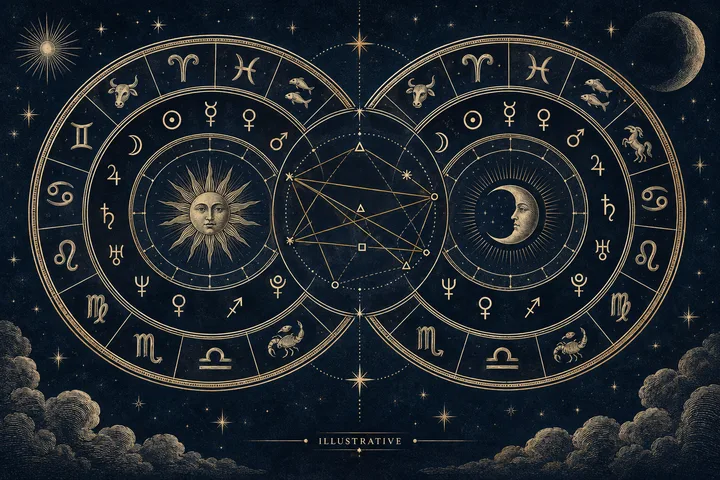
An aspect is the angular relationship between two chart points. In synastry, it tells you how one person's planet meets another person's planet or angle. The major aspects are conjunction at 0 degrees, sextile at 60, square at 90, trine at 120, and opposition at 180. Minor aspects can add texture, but major aspects should anchor a first reading because they describe the clearest channels of exchange.
The conjunction joins the two functions. It can feel immediate, familiar, or consuming, depending on the planets. The opposition pulls two functions across a polarity. It can create attraction and complementarity, but also a contest over how the relationship should move. The square creates friction that demands action. The trine allows an easy flow that people may take for granted. The sextile offers cooperation and opportunity, but often needs a choice or effort before it becomes visible.
Don't label an aspect as simply good or bad. Skyscript's introduction stresses that tense aspects can bring difficulty and development, while harmonious aspects can create ease that goes unused. Tarot by Hand makes the same practical point: a square can become a recurring fight or a source of energy, while an easy aspect can be overlooked. In a relationship reading, the useful question is not “Is this a positive aspect?” It is “What does this aspect ask the two people to do?”
The planets decide the subject. The aspect decides the motion. Venus square Mars may bring strong attraction with different timing, tastes, or approaches to pursuit. Mercury trine Moon may help one person put feelings into words and the other receive them. Saturn opposite Venus may bind affection to questions of duty, distance, or fear of rejection. The same aspect changes its meaning when the planets change. Never read “square” or “trine” in isolation.
Astrological tradition also gives weight to exactness. The closer an aspect is to its exact angle, the more forcefully it tends to register. Campion's aspect guide calls the conjunction the most powerful aspect and describes the major aspects in a broad order of strength, while also noting that the planet pair and closeness matter. Use that as a ranking principle, not a mechanical score.
When you write the aspect sentence, include both the geometry and the lived question. “Moon square Mars” is a useful index. “Moon square Mars may bring quick emotional reactions, so how do you pause before a defensive reply?” is an interpretation that can be observed. The second sentence doesn't soften the square. It gives the square somewhere to go.
The aspect also describes exchange, not blame. In a conjunction, both people may feel merged into the same subject. In an opposition, each may believe the other holds the missing half. In a square, each may push the other into action. In a trine, one person may make a gift feel so natural that neither names it. This language keeps the reading relational. It asks what happens between two people, not which person is the problem.
Sources: An Introduction to Aspects and Chart Shaping: Skyscript; Synastry Aspects: Meanings, Orbs & Compatibility Guide: Tarot by Hand; What’s Your Sign? An Intro to Synastry Charts: Astrology.com
Use degrees and a six-degree orb to separate signal from noise
Degrees turn a general chart comparison into a testable one. If one Venus is at 14 degrees Taurus and the other person's Mars is at 18 degrees Cancer, the separation is 64 degrees. That is a sextile with a four-degree orb. If the same Venus were at 14 degrees Taurus and Mars at 27 degrees Cancer, the separation would be 73 degrees. The signs may still suggest a relationship, but the major sextile is no longer within the six-degree working orb used for this report.
An orb is the allowed distance from the exact aspect. A conjunction at 0 degrees can remain operative when the planets are several degrees apart. A square can remain operative around 90 degrees. The farther the contact sits from exactness, the softer and less immediate the expression usually becomes. Campion states the rule plainly: the more exact the aspect, the stronger the influence; a looser aspect is weaker. Skyscript describes orb as the margin of deviation that keeps an aspect valid.
Why six degrees? It is a clear editorial limit for a supplied-placement comparison. It keeps the reading focused on selected major aspects and prevents every nearby angle from competing for attention. It is not the only astrological convention. Astrology.com recommends six degrees or less as a preferred range, while Skyscript gives wider examples for some major aspects and narrower ones for minor aspects. The sources show why conventions differ. Record the rule before you interpret, then apply it consistently.
For a practical ranking, sort contacts into three bands. First come exact or very tight major aspects, especially between personal planets or a personal planet and an angle. Next come major aspects within the six-degree orb. Last come sign-based affinities, wider contacts outside the chosen orb, and minor aspects you have a reason to study. This isn't a compatibility score. It is a reading order.
The Sun and Moon may deserve a wider orb in some traditions because astrologers treat them as especially prominent lights. Sensitive points may be handled more narrowly. Out-of-sign contacts may need a qualification. Applying and separating motion can add another layer when the chart data and interpretive method support it. But don't quietly change the rules halfway through the reading. A narrow, named method gives the reader a result they can follow and compare.
If the degree is unknown, use a different label. Say “possible sign-based relationship” or “aspect cannot be ranked from the supplied data.” That is better than guessing whether the planets are one, five, or nine degrees apart. The reader can always add degrees later. A guessed orb has already bent the reading.
Keep the arithmetic visible when you make a note. Convert each sign and degree to its position on the 360-degree zodiac, find the smaller separation between the two positions, and compare that number with the exact angle. A 64-degree separation is four degrees from a sextile. A 116-degree separation is four degrees from a trine. This small habit prevents a chart wheel's visual closeness from doing the interpretive work for you. It also makes two reports easier to compare when they use different colors, symbols, or aspect tables.
Sources: An Introduction to Aspects and Chart Shaping: Skyscript; Synastry Aspects: Meanings, Orbs & Compatibility Guide: Tarot by Hand; What’s Your Sign? An Intro to Synastry Charts: Astrology.com
A worked example: read one Venus-Mars contact in the right order
Consider an example. Maria has Venus at 14 degrees Taurus. Daniel has Mars at 18 degrees Cancer. We are using only these supplied placements for the example. No birth chart is being calculated, and no houses are being assumed. The first question is the planet pair. Venus and Mars connect affection, pleasure, desire, pursuit, and physical chemistry. That gives the contact a clear subject.
Now add the signs. Maria's Venus in Taurus may value steadiness, touch, patience, and proof that affection can last. Daniel's Mars in Cancer may act protectively, indirectly, and through emotional attunement, though it may also act from changing moods. The signs suggest that both people may want closeness, but they may show desire differently. Taurus asks, “Can I trust this to remain?” Cancer asks, “Is it safe to open?” That is a useful first picture, not a conclusion.
Next identify the aspect. Four degrees separate the placements, and Taurus to Cancer forms a sextile by degree. The contact is within the six-degree orb. The sextile suggests an opening that can be used. Attraction may grow through ordinary care: cooking together, checking in, making a plan, touching without rushing, or creating a private rhythm that both people can return to. The aspect does not promise effortless chemistry. It says the two functions can cooperate when they choose a bridge.
Now assign the roles without freezing them. Maria may experience Daniel's Mars as tender, protective, or sometimes hard to read. Daniel may experience Maria's Venus as calming, sensual, and dependable, or as too slow when he wants reassurance now. Both people can carry the contact. The Venus person isn't only receiving Mars. The Mars person isn't only pursuing Venus. Each person changes the other's way of expressing desire.
Finally, look for repetition. Does Maria's Moon also contact Daniel's Venus or Mars? Does Daniel's Mercury connect with her Moon, making emotional signals easier to name? Does Saturn add a close contact that asks them to define pace and responsibility? If several contacts repeat the same theme, the Venus-Mars sextile gains context. If another close contact challenges it, the reading becomes more honest. The right order has taken us from subject to style, geometry, strength, and pattern without inventing a personal story.
Notice what the example does not say. It doesn't say Maria and Daniel will date, stay together, or feel the contact in one identical way. It gives them a shared vocabulary for attraction and pace. That is enough for a responsible chart example. The chart layer can be precise without pretending to know a couple's choices. It describes a field of exchange, then leaves room for consent, timing, and lived experience. The choice still belongs to both people.
Then rank the whole chart by repetition, not by drama
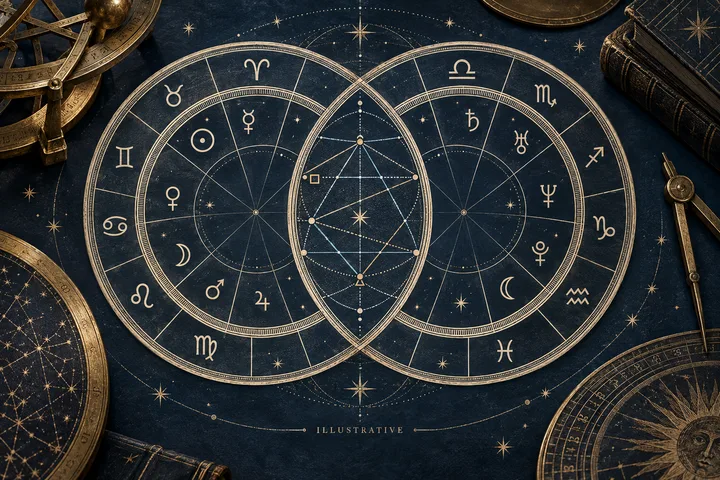
One vivid contact can describe a real part of the bond. It cannot carry the whole reading. After you inspect the tightest contacts, ask which themes repeat. Several contacts involving the Moon may make emotional safety central. Repeated Venus contacts may place affection, taste, money, or reassurance in the foreground. Several Mercury contacts may show that the relationship lives or struggles through language. Mars repetition can bring action, sexual charge, conflict, and repair into the same room.
Personal planets usually give the clearest first picture of daily relating. Cafe Astrology advises readers to pay close attention to inner-planet interaspects and to relationship significators when the relationship is committed. Tarot by Hand similarly puts the personal planets first, then treats Saturn and the outer planets as context that can deepen, widen, test, or unsettle the central exchange. Put those observations together and a useful ranking emerges: begin with the personal exchange, then ask what the wider planets add.
A repeated theme matters more than a dramatic label. Suppose a couple has Venus trine Jupiter, Venus square Saturn, and Mercury sextile Moon. The trine may bring warmth and generosity. The square may make affection feel tested or delayed. The Mercury-Moon contact may give them a way to talk about the fear underneath the delay. Reading only Venus-Jupiter would make the chart too sweet. Reading only Venus-Saturn would make it too grim. The pattern shows a relationship that may need both warmth and deliberate reassurance.
Aspect type matters inside the pattern. A cluster of squares may demand clear action and honest friction. A cluster of trines may create ease but leave a difficult topic untouched. An opposition may become a strong relational axis because each person carries one side of a polarity. A conjunction may fuse functions so closely that the pair feels natural one day and overwhelming the next. Ask what repeats and what the repeated pattern requires.
This is also where you resist numerical shortcuts. A list of aspect points or a harmony total can hide the reason a contact matters. A synastry reading should tell you who is meeting whom, through which function, in what style, with what pressure, and around what choice. That explanation gives you something to observe in the relationship. A score gives you a number to stare at.
When two interpretations compete, rank the one supported by more than one layer. A close Moon-Mercury aspect with compatible sign styles and a confirming house overlay deserves more attention than a wide, isolated outer-planet contact. A tense personal-planet aspect repeated by Saturn may need a practical conversation sooner than a loose trine promises ease. Repetition doesn't make an outcome inevitable. It tells you where to look first.
Sources: Aspects Between Charts: Cafe Astrology; An Introduction to Aspects and Chart Shaping: Skyscript; Synastry Aspects: Meanings, Orbs & Compatibility Guide: Tarot by Hand
Use houses last, then weigh the strongest exception
House overlays can show where one person's planet enters the other person's life. A partner's Moon in your fourth house may draw attention to home, family, memory, and private comfort. Venus in the fifth may color pleasure, romance, creativity, and play. Saturn in the seventh may bring the weight of commitment, fear, duty, or endurance into partnership. These meanings can deepen a synastry reading, but houses need dependable Ascendant and house-cusp data.
The order matters because a house placement tells you where a planet lands, not how the two planets function together. If you begin with “his Venus in her eighth house,” you may reach for intimacy, trust, and shared resources before checking what his Venus actually aspects. The planet and its aspects should lead. The house then tells you where the exchange is likely to be felt. A close Venus-Saturn square in the sixth house asks a different practical question from the same square in the fifth, but it remains a Venus-Saturn square first.
Cafe Astrology says sign and house placements should be considered together, and its interchart material separates those placements from the planet-to-planet aspect itself. That is a strong reason to keep houses in the later layer. They add setting. They don't erase the actors, their styles, or the geometry between them.
If birth times are missing or uncertain, don't force a house story. You can still read supplied planet signs and degree-based interchart aspects. You can note that angle contacts and house overlays remain unconfirmed. That is not a smaller form of astrology. It is a cleaner one. A report based on known placements should say exactly what it reads and leave unsupported layers alone.
The same care applies to the Ascendant, Descendant, Midheaven, and IC. These angles can make a contact immediate and visible, especially when a planet sits close by degree. But an angle depends strongly on birth time. Use it when the input is reliable. If it isn't, return to the planetary contacts you can actually name.
The rule is planet, sign, aspect, degree, orb, pattern, and house. The important exception is that a sign relationship may remain meaningful even when a degree-based aspect is too wide or absent. Astrology has long used sign relationships as a way to understand elemental, modal, and whole-sign resonance. Two planets in signs that naturally cooperate may recognize each other even without a tight major aspect. Two planets in signs that challenge one another may need translation even when no exact aspect dominates.
But this exception should stay in its lane. A sign-based affinity is not the same strength as a close aspect. If Venus in Libra and Mars in Aquarius have no major aspect within six degrees, you can describe an air-sign ease around social intelligence, aesthetics, and freedom. You should not call it a Venus-Mars sextile unless the degrees support that claim. If Mercury at 29 degrees Aries and Moon at 2 degrees Scorpio sit close by a numerical opposition, the signs complicate the contact. Skyscript describes this kind of dissociate aspect as more varied and potentially complicated, which is a reason to label it carefully rather than discard either layer.
This is where experienced reading beats rigid sorting. Keep two notes. One says “degree contact.” The other says “sign relationship.” Then let them agree, qualify, or disagree. A tight aspect in signs that don't match the expected geometry may feel sharp but difficult to explain. A warm sign relationship without a close aspect may describe a background ease that needs other contacts to become active. Both notes can be true.
The strongest exception also protects the reader from false certainty. Charts don't need one perfect aspect to become meaningful. Nor does the absence of a famous aspect empty the comparison. A relationship can be shaped by repeated sign themes, house overlays, angles, and the way several moderate contacts gather around one subject. The point of a method is to rank the evidence, not to make every chart pass or fail a single test.
So make the distinction visible in your final notes. Write “Venus and Mars share an air-sign tone, which may support social ease.” Write “Venus sextile Mars, 4 degrees, within the six-degree orb,” only when you have the degrees to support it. Plain labels create trust.
Sources: Aspects Between Charts: Cafe Astrology; An Introduction to Aspects and Chart Shaping: Skyscript; Synastry Aspects: Meanings, Orbs & Compatibility Guide: Tarot by Hand
Turn the reading into one useful conversation
A synastry reading earns its place when it helps two people notice a pattern and choose how to meet it. After you rank the contacts, translate the strongest theme into behavior. A Moon-Mercury contact may suggest a conversation about how each person asks for comfort. Venus-Mars tension may invite a talk about pace, initiation, touch, and what each person experiences as desire. Saturn contacts may call for clear agreements about time, responsibility, exclusivity, money, or the shape of commitment.
Don't use the chart to infer an intention the person has not shown. If a Neptune contact feels romantic and hard to define, ask what is actually being promised. If Uranus brings excitement and irregularity, ask whether both people want the same amount of freedom. If Pluto intensifies attachment, ask what happens when one person says no. The chart can name a pattern. The conversation tests how the pattern is lived.
A useful final note has four parts. Name the strongest contact and its exactness. Explain the planet functions in ordinary language. State the strongest supportive expression and the strongest pressure point. Then name the small behavior that would let the relationship work with the contact. “Your four-degree Venus-Mars sextile can support attraction through steady, caring action, but your different pace may need direct requests” is more useful than “You have great chemistry.”
This is the practical value of a six-degree method. It gives you a manageable set of contacts to discuss. It doesn't pretend to calculate a complete natal chart from missing birth details. The Synastry Comparison Report can compare supplied Moon, Venus, and Mars signs, optional degrees, and selected major aspects within the stated scope. You can use the result as a map for a conversation, not as a sentence handed down about the relationship.
Start that conversation with one question: “Which part of this reading feels most familiar in the way we connect, and what would make it easier to handle?” Listen to the answer. Then compare it with the chart layer you actually know.
If the chart points to ease, ask how you can keep using it instead of assuming it will run itself. If it points to friction, ask what repair would look like in a real week. If the chart points to longing or uncertainty, ask what information would make the connection more grounded. The best reading ends with a choice you can make together. You might choose a slower pace, a clearer boundary, a weekly check-in, or a direct question about what each person wants next. That small choice turns symbolic language into shared practice.
Sources: Aspects Between Charts: Cafe Astrology; What’s Your Sign? An Intro to Synastry Charts: Astrology.com; An Introduction to Aspects and Chart Shaping: Skyscript
A little more clarity
Should I read signs or aspects first in synastry?
Read the planets first, then their signs, and then the aspect. Signs describe style, while aspects show the active relationship between two chart functions. A beautiful sign pairing without a close aspect can describe background resonance. A close aspect gives you a stronger channel to interpret. Add houses only after the planetary contact is clear and the birth-time data supports them.
What orb should I use for synastry aspects?
Choose an orb before you begin and use it consistently. This guide uses a six-degree orb for selected major aspects because it keeps the comparison focused. Astrologers use different rules, including wider orbs for the Sun and Moon and narrower ones for minor aspects, so record your method instead of treating one convention as universal. Exact contacts belong at the top of your list.
Can I read synastry without exact birth times?
Yes, if you stay within the data you know. You can compare supplied planet signs and degrees and read major interchart aspects. Without reliable birth times, don't claim calculated houses or angle contacts. A clear placement-only reading is stronger than a house interpretation built on uncertain inputs. You can return to the house layer if accurate times become available.
Sources & further reading
- Aspects Between Charts: Cafe Astrology
Supports reading each person's planet role, considering sign and house context, and giving close inner-planet synastry contacts early interpretive attention.
- An Introduction to Aspects and Chart Shaping: Skyscript
Defines major aspect geometry and orbs, explains why exactness changes strength, and discusses the added complexity of aspects in dissociate signs.
- What’s Your Sign? An Intro to Synastry Charts: Astrology.com
Places degree distance and tighter orbs in synastry context, helping readers distinguish a close active contact from a broad sign-based resemblance.
- Synastry Aspects: Meanings, Orbs & Compatibility Guide: Tarot by Hand
Offers a practical comparison of personal-planet contacts, Saturn and outer-planet context, aspect meanings, and orb choices for a readable synastry ranking.
Synastry Comparison Report
Enter known placements for two people. Get an input-by-input comparison, selected aspect calculations and a clear record of what remains uncertain.
Compare our placements