Begin with the question and the evidence card
The first mistake in a synastry reading usually happens before the chart is interpreted. A reader spots Venus near Mars, feels the symbolism, and starts explaining the chemistry. The record stays unfinished. That makes every later conclusion harder to trust.
Start with the question you actually want the comparison to answer. Is it emotional ease, attraction, conflict, communication, or responsibility? Write that question at the top of the page. It sets the reading's order without deciding its conclusion.
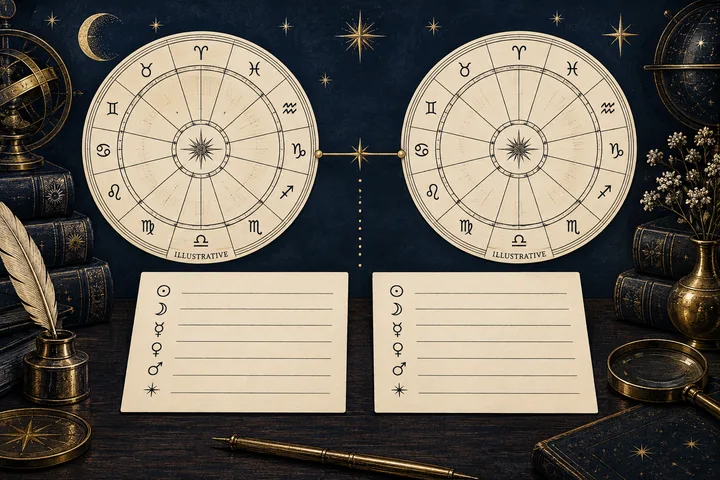
Now make an evidence card with one block for each person. Use the same fields on both sides: planet, sign, degree, source, zodiac reference, and status. A line might read: "Venus, Gemini, 2°, supplied placement, tropical, confirmed." Another might read: "Moon, Taurus, degree unknown, supplied sign, tropical, sign-level." Do not add a degree because the chart wheel looks precise. Do not add a planet because a standard report normally includes it.
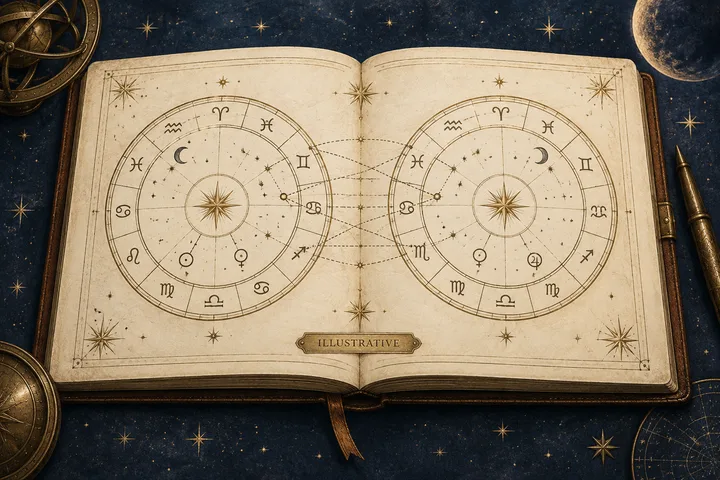
Synastry is a comparison of two birth charts, with the charts placed together so their inter-chart aspects can be read. That definition gives you the first rule of the card: preserve the two charts as two charts. Person A's Moon meeting Person B's Venus is not the same statement as Person B's Moon meeting Person A's Venus, even when the angle between them is similar. [0]
Leave a blank column called "why it matters." Fill it only after the raw fields and geometry are complete. That pause keeps observation, calculation, and interpretation from collapsing into one confident sentence.
Label what is known, unknown, and only possible
A useful record does not hide uncertainty in a closing note. It places the limit beside the affected placement. "Mars, Virgo, degree unknown, aspect not confirmed" tells you what to do next. "Birth data may affect the result" tells you almost nothing.
Separate four statuses. Confirmed means the supplied placement and relevant degree support the line. Sign-level means you know the sign relationship but not the exact angular contact. Conditional means a range of possible data could create or remove the contact. Unavailable means the requested layer cannot be read from the supplied information.
Birth time deserves its own field. Astrodienst's birth-time guidance says the time and place are used to calculate the Ascendant and houses, and that a less precise time reduces precision. [3] If a time is missing, keep house overlays and angles out of the confirmed column. A planet's sign can remain useful, but the house story is not ready.
The Moon needs care near a sign change. If the supplied date leaves its sign uncertain, record both possibilities and mark every Moon aspect that depends on the choice as conditional. If the sign is known but the degree is not, record the sign relationship and stop short of an exact aspect.
Also preserve the chart setting. Write tropical or sidereal if the source gives it. Note whether the material describes natal placements, synastry, or a composite chart. A composite chart is a separate relationship-chart technique, not a second name for synastry. [2]
Sources: Overview: Available Chart Types in the Extended Chart Selection, Astrodienst; Birthtime/Hour, Astrodienst
Record geometry before you describe chemistry
An aspect is a relationship between planetary positions. In the five-major-aspect system, the key angles are conjunction at 0°, sextile at 60°, square at 90°, trine at 120°, and opposition at 180°. The orb is the distance between the actual separation and the exact angle. [1]
Keep one line for each cross-chart contact. Write the planet owner, receiving planet, exact separation, aspect name, orb, and status. For example: "Maria's Moon to Luca's Venus, 63°, sextile, 3° orb, confirmed." The ownership note matters because the same two planets can describe different experiences when their roles reverse.
If you are working by hand, convert each supplied sign and degree to its position on the zodiac circle. Find the smallest angular separation, compare it with the five chosen angles, and record the nearest match. If the difference from 90° is 3°, write square, 3° orb. If it is 7° and your rule stops at 6°, leave it out.
This is not decorative arithmetic. It is the audit trail that lets another reader see why a contact survived.
Sources: Aspects in Astrology: The Five Major Configurations, transcript
Use one worked comparison to catch false certainty
Consider an example. Maria's Venus is supplied as 2° Gemini. Luca's Mars is supplied only as Virgo, with no degree. The evidence card can say that Gemini and Virgo form a sign relationship. It cannot confirm a Venus-Mars square, because Luca's degree determines the actual separation.
If Luca's Mars is later supplied as 8° Virgo, the separation is 96°, which falls within a six-degree square rule. If it is 20° Virgo, the separation is 108°, outside that rule. The sign pair did not change. The aspect status did.
This small audit separates a sign reading from an aspect reading. The sign tells you something about style and element. The degree tells you whether the two planets meet at a chosen angle. Keep both lines. Do not use one as a substitute for the other.
The same check catches a visual error. Two planets in one sign are not automatically conjunct by degree. A planet at 29° of one sign and another at 2° of the next may be close around the zodiac, yet the sign-based and degree-based readings can differ. Write down which aspect tradition you are using before you decide whether the contact belongs on the confirmed list.
Record the chart evidence in three layers: supplied placement, confirmed geometry, and interpretive status. For each person, write the planet, sign, degree if known, zodiac reference, and data source. Then list only cross-chart contacts that meet your stated aspect rule, keeping the planet owner visible. Mark every line confirmed, sign-level, conditional, or unavailable. This matters because a shared sign is not automatically an exact aspect, and a missing birth time can remove houses and angles from the reading. Use one illustrative comparison to test the sheet, but never let an imagined chart become a personal claim. Rank the surviving pattern by closeness, planet relevance, and repetition. Your next action is simple: make the evidence card before you write what the connection means.
Choose the orb once, then keep the rule steady
Your evidence card needs an orb rule at the top. This report uses a six-degree maximum for selected major aspects. That is a working editorial scope, not a universal commandment. Astrology sources describe orbs as variable, and synastry often uses tighter limits because two charts create many possible inter-aspects. [0, 1]
Write the exact separation, the named aspect, and the orb on every confirmed line. The number tells the reader why this contact survived the filter and another one did not.
Do not widen the orb when a favourite interpretation falls just outside it. Do not tighten it only to remove a difficult contact. If you want to compare methods, make a second card with a different rule and label it. Never mix the two cards in one ranked reading.
Rank the contacts next. Give the first places to close personal-planet contacts that answer the reader's question. Add Saturn when commitment, limits, or responsibility matter. Bring in Mercury for a communication question. Outer-planet contacts can add weight, but they should not bury the immediate pattern unless the chart and method give them a clear role.
Sources: Partner horoscopes, synastry and orbs, Astrodienst; Aspects in Astrology: The Five Major Configurations, transcript
Keep the chart layers in their proper order
A clean synastry note moves from placement to sign, from sign to aspect, and from aspect to house only when the house data is sound. The planet names the function. The sign describes its style. The aspect shows how the two functions meet. The house adds the life area, but it depends on a chart setup that supports house calculation.
This order prevents a common shortcut: using a sign match as proof of an aspect, or using a house overlay as proof of a person's intention. A Taurus Moon may describe a steadier emotional style than a Gemini Moon. A close Moon-Venus aspect describes another layer of contact. A reliable Venus overlay adds the life area. None of these statements replaces the others.
Use the chart type supplied by the source. A synastry chart presents both partners' positions and an aspect table. A composite chart calculates a separate midpoint relationship chart. [2] If your assignment contains only supplied Moon, Venus, and Mars placements, stop at those placements and selected aspects. Do not create houses, angles, or composite symbolism to make the report feel complete.
The strongest reading is often narrower than the chart wheel. Three confirmed contacts that answer the question are better evidence than fifteen loose lines with no status.
Sources: Partner horoscopes, synastry and orbs, Astrodienst; Overview: Available Chart Types in the Extended Chart Selection, Astrodienst
Turn the ranked contact into a question you can observe
Interpretation becomes useful when it gives the couple a sharper question. It should not replace the couple's judgment. Once the card has a leading contact, write one observable question beside it.
A close Moon-Venus contact can lead to: "What makes each of us feel cared for, and which gestures do we miss?" A Moon-Mars square can lead to: "When one person needs space, what does the other do first?" A Venus-Saturn contact can lead to: "Where does responsibility support affection, and where does it begin to feel heavy?" These questions stay close to the planet roles without turning them into fixed labels.
Use the signs to make the question concrete. Taurus may look for steadiness and tangible proof. Cancer may seek privacy, memory, and emotional presence. Leo Mars may respond visibly, while Scorpio Moon may need depth and time. Those are interpretive possibilities inside the example, not facts about a real couple.
The status still governs the wording. A sign-level contact suggests a broad question about style. A close degree contact supports a more focused question about ease or friction. A conditional contact belongs in a question that begins with "If this degree is correct..." That phrasing keeps the reading precise without draining it of meaning.
Finish with a ranked note and one next action
A finished evidence card should let another reader trace the main conclusion back to the raw record. It can be short. The work happened before the prose.
Write the final note in four parts. First, state the supplied placements and method. Second, name the highest-ranked confirmed contact and explain the planet roles. Third, name the strongest exception or missing layer. Fourth, give one question for the couple to observe.
An illustrative ending might read: "The leading evidence is a close Moon-Venus sextile, which supports an easier exchange of comfort. A Moon-Mars square adds pressure around emotional timing. No house overlay is included because one birth time is unknown. Ask how each person responds when the other needs space." The example makes a supported claim, keeps the exception visible, and stops before it turns into a compatibility verdict.
Your practical audit is clear. Check every degree against the aspect label. Check planet ownership. Mark the remaining lines confirmed, sign-level, conditional, or unavailable. Then choose the single question that belongs to the strongest surviving theme.
If you want help comparing supplied Moon, Venus, and Mars placements, the Synastry Comparison Report can organise those inputs, optional degrees, and selected major aspects under a stated six-degree orb. It does not calculate a natal chart from birth details or add houses that were not supplied. Compare the evidence first. Interpret it second.
Sources: Partner horoscopes, synastry and orbs, Astrodienst; Aspects in Astrology: The Five Major Configurations, transcript
Sources & further reading
- Partner horoscopes, synastry and orbs, Astrodienst
Supports the definition of synastry as a comparison of two charts and the use of tighter orb practice for inter-chart aspects.
- Aspects in Astrology: The Five Major Configurations, transcript
Supports the major aspect angles, the distinction between sign-based and degree-based contacts, and variable orb traditions.
- Overview: Available Chart Types in the Extended Chart Selection, Astrodienst
Supports the distinction between synastry position and aspect tables and the separately calculated composite chart method.
- Birthtime/Hour, Astrodienst
Supports recording birth-time precision and withholding Ascendant and house claims when the birth time is unknown or imprecise.
Synastry Comparison Report
Enter known placements for two people. Get an input-by-input comparison, selected aspect calculations and a clear record of what remains uncertain.
Compare our placements