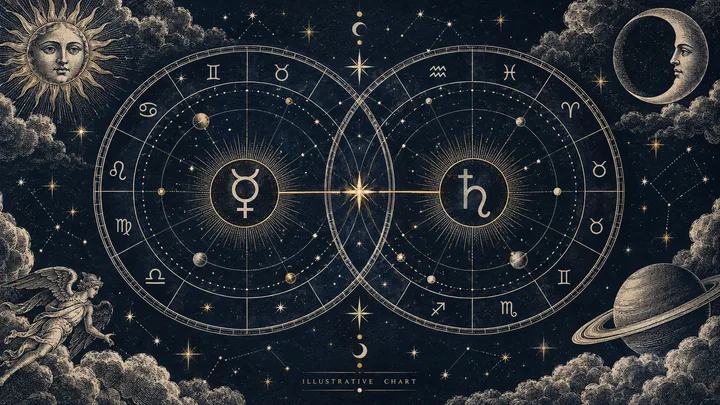
Read the strongest non-romantic contact as the relationship's main working language, not as proof that romance is missing. A close Moon contact can make emotional safety, habit, or changing moods central. A strong Sun, Mercury, Jupiter, Saturn, Uranus, Neptune, or Pluto contact can make identity, speech, growth, duty, freedom, mystery, or transformation the bond's loudest theme. Rank the contact by aspect, orb, planet function, and repetition, then test it against Venus, Mars, and the pattern you actually live. The worked example compares an illustrative Moon-Mars contact with a wider Venus-Mars contact. The closer Moon-Mars contact leads, but it doesn't erase attraction. The Synastry Comparison Report is narrower: it compares supplied Moon, Venus, and Mars placements, with optional degrees and selected major aspects within a six-degree orb. It doesn't calculate a natal chart from birth details.
The strongest contact tells you what the relationship keeps doing
A synastry chart can make romance look deceptively simple. You spot Venus touching Mars, Moon touching Venus, or the Sun meeting the Moon, and you assume the love story lives there. Often it does. But sometimes the tightest aspect links planets that do not carry the first romantic associations. Mercury may sit exactly on Saturn. Jupiter may square the Moon. Uranus may oppose Venus. Pluto may conjunct the Sun. The contact can feel enormous, even when the aspect table gives you no neat phrase such as chemistry or tenderness.
Start with the repeated action. What does this person bring out in you every time? Do you talk for hours, then edit every sentence before you say it? Do you make bigger plans together than either of you makes alone? Do you feel awakened, unsettled, exposed, or compelled to change? That recurring action is the bridge between the symbol and the relationship. The strongest contact describes the part of the bond that demands attention. It does not, by itself, name the bond's status or guarantee its future.
In astrology, planets carry functions. The Sun speaks to life force, will, and identity. The Moon describes emotional life and instinct. Mercury concerns thought and communication. Venus concerns attraction, pleasure, and relating. Mars acts, asserts, and pursues. Jupiter expands meaning, faith, and possibility. Saturn concentrates, limits, and gives form. Uranus disrupts and liberates. Neptune dissolves boundaries and opens the subtle realm. Pluto transforms. When two charts connect, the planet from one chart conditions the planet from the other, and the experience need not feel equal in both directions.
That last point matters. If your Saturn is exactly conjunct their Mercury, you may feel responsible for the conversation, careful with your words, or aware of what needs to be made practical. They may experience you as a serious listener, a critic, a teacher, or a person whose silence says plenty. The same contact has two viewpoints. Keep both in view. Synastry describes an exchange, not a villain and a victim.
The word strongest needs a method. In this field guide, rank a contact first by aspect type, then by orb, then by the planets involved, and finally by repetition elsewhere in the charts. A conjunction, opposition, square, trine, or sextile is a major aspect. Its exactness matters. A 1-degree conjunction usually deserves more attention than a 5-degree trine, though the planets and the natal charts can change the order. Astrologers differ in their allowances, so state yours. This publication's report uses a six-degree orb for selected major aspects and accepts optional degrees; it does not calculate natal positions from birth details. A stated method makes the reading easier to trust and easier to repeat.
The central judgment is simple. A non-romantic planet can lead a romantic synastry reading when its contact is close, angular in effect, or woven into several other contacts. Romantic planets still answer a different question. Venus and Mars show attraction and desire. The Moon shows how closeness is received. Saturn may show what must be built or carried. Mercury may show whether the bond can speak itself into understanding. Don't make one planet answer every question.
People call a contact non-romantic because the planet isn't Venus or Mars. But relationships are made from more than desire. A shared language, a shared faith, a shared duty, or a shared crisis can become the place where intimacy takes shape. The chart reader's job is to identify that place without dressing it up as destiny. If the strongest contact points to work, ask what kind of work. If it points to freedom, ask what kind of freedom. The answer becomes specific when the symbol meets a repeated scene.
This gives you a useful first distinction. The strongest contact tells you where the relationship has weight. The personal planets tell you how affection, desire, and emotional recognition move through that weight. Also ask which person feels the contact first. The planet person may notice the other person's effect before either of you has language for it. That difference often explains why one partner calls a contact obvious while the other barely notices it.
Sources: Aspect, Astrodienst Astrowiki; Planet, Astrodienst Astrowiki; Synastry Chart for Couples, AstroStyle
Read the planet pair before you read the sign pair
A sign tells you how a planet behaves. A planet tells you what kind of life function is being activated. In synastry, begin with the second question. Moon-Mars is first a meeting of feeling and action. Venus-Jupiter is first a meeting of affection and enlargement. Saturn-Mercury is first a meeting of language and structure. Only then should you ask how Aries, Cancer, Libra, or Capricorn colors the exchange.
Mercury contacts can make the relationship mentally alive. Mercury with Jupiter may connect detail with vision. One person asks the precise question; the other sees the larger meaning. Mercury with Uranus can bring startling ideas, quick shifts, and a bond that thrives on originality. Mercury with Neptune may speak through image, music, intuition, or implication, but it needs clear checks when assumptions begin to replace words. Mercury with Saturn can make speech careful and useful. It can also make one person feel judged. The aspect and the natal condition decide whether structure becomes trust or silence.
Jupiter contacts often enlarge the planet they touch. Jupiter to Mercury can encourage study, travel, debate, and a sense that every conversation could open a new door. Jupiter to the Moon can create emotional generosity and faith in one another's growth. Jupiter to Saturn asks expansion to meet limits. That can become wise planning, or a dispute between risk and caution. Jupiter to Venus can bring pleasure, goodwill, and an easy taste for abundance. Still, too much Jupiter can promise more than two people can carry. Expansion needs a container.
Saturn contacts deserve patience. Saturn can make a bond feel consequential from the beginning. When Saturn touches Mercury, the couple may organize plans, solve hard problems, or help each other speak with discipline. The Saturn person may become the one who asks, What is the plan? The Mercury person may bring the question, the message, or the idea that keeps the connection moving. In a square or opposition, the same exchange can become correction, delay, or fear of saying the wrong thing. The aspect doesn't remove the gift. It shows the work required to use it.
Uranus, Neptune, and Pluto are often called outer or spiritual planets in modern astrology. Their contacts can feel larger than ordinary preference because they touch liberation, surrender, and transformation. Uranus to Venus may describe attraction that breaks an old pattern. Neptune to the Sun may create idealization, devotion, or a softening of identity. Pluto to the Moon may bring emotional intensity and a demand for honesty. These contacts need context. People of the same generation may share outer-planet sign placements, so a close cross-chart degree contact carries more personal force than a broad sign overlap.
The sign changes the delivery. Mercury-Saturn in Gemini might ask for concise facts, while Mercury-Saturn in Pisces might ask for a gentle structure around feelings and impressions. Jupiter-Moon in Taurus may enlarge comfort, food, money, and bodily ease. Jupiter-Moon in Sagittarius may enlarge travel, belief, and the emotional need for open horizons. Uranus-Venus in fixed signs may unsettle a settled attachment. In mutable signs, it may keep attraction mobile and experimental. These are interpretive frames, not verdicts.
You can make the sign layer concrete by asking what each person does with the planet's need. Fire signs may express Jupiter through initiative, celebration, or risk. Earth signs may express it through resources, routines, and tangible help. Air signs may enlarge the bond through ideas, networks, and conversation. Water signs may deepen it through memory, empathy, and emotional attunement. These are broad colors, so let the actual sign and aspect narrow the picture. A Saturn contact in air may need better agreements. In earth, it may need a workable schedule. In water, it may need emotional boundaries.
Now add rulership if you have the degrees and chart framework to support it. A Saturn contact to Mercury becomes more specific when Mercury's sign and ruler repeat the same theme elsewhere. A Jupiter contact to the Moon gains weight if Jupiter also rules the Moon's sign or if another contact repeats expansion and feeling. This is how a single aspect becomes a pattern. It also keeps you from overreading a dramatic but isolated line in the aspect table.
The practical rule is to write the planet pair as a clear sentence before you write the signs. For example: Her Moon receives his Mars, so his actions change her emotional weather quickly. Or: His Saturn gives her Mercury form, so conversation becomes the place where they meet responsibility. That sentence is more useful than calling the aspect good or bad. It gives you a test. If the proposed action never appears in ordinary life, lower the contact's practical priority and revisit the orb, the natal condition, and the possibility that another pattern is carrying the bond.
Sources: Aspect, Astrodienst Astrowiki; Synastry Chart for Couples, AstroStyle; Introduction to Relationship Astrology 2: Synastry, Philip Graves
Use aspect, orb, and direction to rank the contact
Once you know what the planets signify, look at the angle between them. An aspect is the angular relationship between two chart factors. The major aspects are conjunction at 0 degrees, sextile at 60, square at 90, trine at 120, and opposition at 180. An orb is the distance from exactitude that an astrologer allows. A conjunction at 0 degrees 40 minutes is not the same reading as a conjunction at 5 degrees 50 minutes, even though both may be listed as conjunctions.
Use the six-degree ceiling as a working boundary for the supplied report, not as a claim that every astrologer uses one universal rule. Within that ceiling, rank tighter contacts first. A 1-degree Moon-Mars square can shape daily emotional timing more strongly than a 5-degree Venus-Mars trine. But don't turn the orb into a machine. The Moon and Sun often receive wider attention than slower or less personal factors. Outer-planet contacts need especially careful judgment when the same aspect belongs to a whole age group.
The aspect describes the manner of exchange. A conjunction fuses the functions. The two planets share a room, so to speak, and their themes can be hard to separate. An opposition creates a polarity. One person may carry one end while the other person carries the other, and the bond asks for integration. A square creates pressure that demands action. A trine carries natural flow, but ease can become passivity. A sextile offers a usable opening that grows when the pair chooses to engage it.
A clean ranking separates volume from importance. The loudest aspect may be the one you notice first, but the most important aspect is the one that explains the largest recurring pattern with the least invention. A tight contact to the Sun, Moon, or a personal planet usually deserves immediate attention. A close social or outer-planet contact needs a second check for personal activation and repetition. Then ask whether the rest of the chart confirms that meaning instead of treating the first striking line as the whole story.
Don't translate square into failure or trine into success. A Mercury-Saturn trine may support steady conversation, but the pair can still avoid the difficult subject. A Mercury-Saturn square may produce criticism, but it may also force the couple to make language precise enough for trust. A Jupiter-Moon conjunction can feel generous, yet it can also amplify moods or excess. A Uranus-Venus opposition can keep desire vivid, while it may also make ordinary consistency feel too tight. The planets tell you what is moving. The aspect tells you how.
If the chart provides motion, note applying and separating aspects. An applying aspect is moving toward exactness; a separating aspect has passed exactness. Some astrologers give an applying contact more force or immediacy. Use this as a secondary modifier, not the headline. In a supplied-placement report, you may not have reliable birth-time or motion data for every factor. Say what you know. Don't manufacture a direction from a sign label or a rounded degree.
Then keep the two people distinct. If Person A's Saturn aspects Person B's Mercury, the Saturn person may experience the contact through duty, standards, or containment. The Mercury person may experience it through speech, thought, and the felt response of being received. The contact is one aspect, but it is not one experience. A synastry comparison becomes much more accurate when every interpretation names both planet persons.
A useful ranking sentence has four parts: whose planet, which planet, what aspect, and how close. For example: Her Saturn squares his Mercury within 1 degree, so her standards press on his way of speaking and his words test her ability to listen without correcting. That is a strong interpretation because it stays close to the chart. It doesn't promise that they will stay together. It gives them a place to watch.
If the strongest contact is a minor aspect, compare it with the nearest major aspect before you let it lead. A tight quincunx can describe a real adjustment, but a close major contact may carry the main rhythm. If an out-of-sign aspect appears near a sign boundary, record both layers. The geometry still matters, while the signs add another color. Precision creates room for nuance. It lets you say, This contact is present but quiet, instead of forcing a dramatic interpretation because a calculator printed a symbol.
Sources: Aspect, Astrodienst Astrowiki; Planet, Astrodienst Astrowiki; Introduction to Relationship Astrology 2: Synastry, Philip Graves
Bring the natal condition and house layer back in
A synastry contact never arrives in an empty chart. Each planet already has a sign, house, dignity, and natal aspect pattern in its owner's chart. The partner's planet activates that existing condition. This is why the same Jupiter-Saturn conjunction can feel like shared ambition for one couple and a battle over timing for another. The cross-chart aspect is real, but it enters a life with a history.
Start with the natal planet receiving the contact. If a person's Mercury already carries Saturn aspects, another person's Saturn may echo a familiar mental discipline or fear of error. If that Mercury is strong by sign and supported by helpful aspects, Saturn may sharpen it. If Mercury is already under strain, the same contact may feel heavier. You don't need to label a planet as good or bad. Ask how practiced, supported, and available its function is.
Then inspect the planet making the contact. The Saturn person brings their own Saturn story. They may be learning boundaries, carrying family duty, or building a craft that requires patience. The Mercury person doesn't receive a generic Saturn. They meet this person's Saturn, with its sign, house, and natal aspects. This is the strongest exception to a quick planet dictionary: the planet's meaning is stable, but its condition changes how it can act.
House overlays answer where the contact tends to appear. They require accurate birth times for both people if you want to use house cusps with confidence. A partner's Mercury in your third house may fill the relationship with messages, errands, learning, and daily talk. In your tenth house, that Mercury may influence career plans or public direction. A partner's Saturn in your fourth house may bring family duty, commitment, or pressure into the home. In your eleventh, Saturn may structure shared goals and friendships.
The house person and planet person also have different experiences. If their Jupiter falls in your ninth house, you may feel your worldview widening around them. They may simply be acting from their own Jupiter nature. If their Pluto falls in your eighth house, you may feel the bond touching trust, intimacy, and shared resources, while they may experience themselves as intense without knowing why the effect lands so deeply for you. Name both sides.
Keep the report layer exact. The Synastry Comparison Report compares supplied Moon, Venus, and Mars signs, optional degrees, and selected major aspects using a six-degree orb. It does not calculate houses or add Saturn, Mercury, Jupiter, Uranus, Neptune, or Pluto positions from birth details. If you already know house placements from a separate chart, they belong to a fuller reading, not to this report. Sign-only input can describe style. It cannot establish a degree-based aspect or show where in life the contact concentrates.
That limit changes the order of your questions. With signs only, start with the planet pair and the sign relationship. You can say that one person's Moon meets the other person's Mars through a certain emotional style, but you shouldn't claim a close conjunction, square, or trine unless the degrees support it. With degrees, calculate the angular distance and record the orb before writing the meaning. If a placement is rounded, preserve a range rather than choosing the most dramatic aspect. A contact that could be four or seven degrees wide shouldn't be treated as a confirmed six-degree aspect. Precision protects the reading from false emphasis.
If a reader's strongest contact involves Saturn, Mercury, Jupiter, or an outer planet, use the method here as a reading guide, but don't imply that the report has calculated that placement. Moon, Venus, and Mars already give a focused three-part comparison: emotional response, attraction and relating, and desire or action. Their cross-chart aspects can show how care, pleasure, pursuit, irritation, and repair meet. That is enough when the report names the contacts the supplied data actually supports.
A focused report also changes what you leave out. Suppose the supplied data shows a close Moon-Mars square and a wider Venus-Mars sextile. You can describe the emotional and physical rhythm, compare the two aspect types, and ask how the couple handles irritation, pursuit, and repair. You cannot use that report alone to announce a Saturn commitment theme, a Mercury communication pattern, or a Pluto power dynamic. Those may belong in a wider synastry reading if their placements and degrees are known. For this comparison, restraint is part of the method. The clearest reading is the one that gives each supported contact enough room to speak. Missing data isn't a blank check for a stronger claim.
Look for echoes. Suppose the leading contact is Jupiter square Moon. If the Moon also connects to Venus, and Jupiter rules the sign containing Venus, the expansion-feeling theme repeats. Suppose Saturn conjunct Mercury is joined by a Saturn contact to the other person's Sun. Now the relationship may repeatedly ask for seriousness, definition, and accountability. A repeated theme outranks a single dramatic phrase because it appears through more than one route.
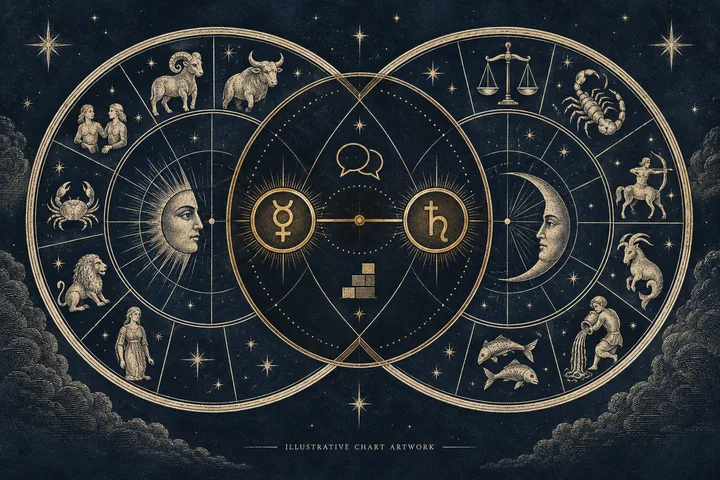
This is where the reading moves from list to pattern. The chart doesn't ask you to count every line. Notice which principle keeps returning, where it enters each person's life, and whether the personal planets can carry it warmly. A non-romantic contact leads when it has closeness and support from the larger configuration. If it has no echo, treat it as a note in the margin. If it repeats through the planet pair, its ruler, a house overlay, or a second aspect, let it shape the reading.
Sources: Aspect, Astrodienst Astrowiki; Synastry Chart for Couples, AstroStyle; Introduction to Relationship Astrology 2: Synastry, Philip Graves
A worked example: Moon-Mars leads Venus-Mars
Imagine Maria and Alex have supplied placements showing Maria's Moon closely conjunct Alex's Mars, while Maria's Venus and Alex's Mars form a wider trine. The signs and degrees in this example are deliberately left open. The point is the ranking method, not a personal chart calculation or a claim about two real people. The Moon-Mars contact is the stronger line because it is closer and because it joins emotional need with direct action.
The first pass says the relationship's daily charge may come through feeling and response. Maria may register Alex's initiative in her body and mood before she can explain it. Alex may feel that Maria's reactions give his drive an immediate audience. This can be protective, lively, and sexually alert. It can also make ordinary frustration flare quickly. A Moon-Mars contact is not automatically tender or difficult. It is active.
Read the direction next. If Alex's Mars touches Maria's Moon, Maria may feel pursued, energized, defended, or pressed by Alex's way of acting. Alex may experience himself as simply direct, while Maria experiences the same directness as a change in emotional weather. Reverse the planets and the emphasis changes. The Moon person is not passive, and the Mars person is not automatically aggressive. Name what each planet person brings before assigning a role.
Now read the wider Venus-Mars trine. It still matters. It can give attraction a natural channel through pleasure, play, touch, and the ease of wanting one another. But it may not explain why a small delay becomes a large feeling, why a practical request lands as a challenge, or why the couple repairs best after movement rather than more analysis. The closer Moon-Mars contact explains the charge. Venus-Mars describes one way desire can flow through it.
The right conclusion is not that the Moon-Mars contact cancels romance. It is that romance may depend on how the couple handles its emotional speed. If Alex acts before Maria has named what she feels, the contact can turn heat into pressure. If Maria tells Alex whether she needs comfort, space, or a concrete action, the same contact becomes responsive courage. The Venus-Mars trine can help them return to warmth, but it cannot do the listening for them.
Change the aspect and change the work. A Moon-Mars conjunction fuses feeling and action, so the pair may react quickly and recover quickly. A square can make each person's timing grate against the other's, yet it can also force clear requests. An opposition may divide the roles, with one person expressing the feeling and the other taking action, until they learn to share both. A trine can make instinctive cooperation easy, though ease may hide a pattern that needs naming.
What if the Venus-Mars trine were closer and the Moon-Mars contact wider? Reverse the emphasis. Venus-Mars would become the clearer first expression of attraction, while Moon-Mars would remain a background emotional trigger. This is why degree matters. A planet pair doesn't have a fixed volume independent of the orb. Rank what is actually close, then ask which contact explains the largest repeated scene.
What if Maria feels the Moon-Mars contact far more than Alex does? That is possible. Her Moon receives Alex's Mars, so his actions may alter her sense of safety more visibly than he understands. Alex may experience the contact as urgency, desire, or a need to do something useful. Ask both people what happens before you turn one person's experience into the relationship's shared label.
Notice what the example does not say. It doesn't say Maria is destined to learn from Alex, or that Alex is meant to stay, or that one tense conversation proves the aspect. It gives the symbol a fair trial in ordinary life. Over several conversations, do they become clearer or more guarded? When they plan, do they feel held or managed? When attraction is warm, can they keep talking about the hard thing? These observations don't replace the chart. They tell you which expression of the chart is active now.
The worked example offers a decision guide. If the non-romantic contact is tight and the romantic contact is wider, read the non-romantic theme first. Then ask whether the romantic contact gives that theme warmth, desire, tenderness, or play. Finally, watch whether the difficult expression is being met in real life. Every contact has a job. Keep the jobs separate.
Turn the leading contact into a useful relationship decision
A chart reading earns its place when it changes what you notice. If Moon-Mars leads, stop asking whether the relationship has enough chemistry and watch how feeling turns into action. If Jupiter-Moon leads, watch whether encouragement becomes support or overpromising. If Uranus-Venus leads, watch whether freedom makes attraction brighter or makes steadiness feel too tight. If Neptune touches the Sun or Venus, watch where devotion is clear and where projection fills in missing facts. If Pluto leads, watch how intensity affects honesty, privacy, and power.
Use three questions for every leading contact. What does this planet pair make easy? What does it make hard? What small behavior would use its gift without feeding its shadow? Moon-Mars can make quick response easy, but emotional pause harder. Ask, Do you want comfort, space, or action? before guessing. Jupiter-Moon can make generosity easy, but the couple may promise more than they can deliver. Put dates and limits beside the dream. Uranus-Venus can make surprise easy, but consistency may need to be chosen on purpose. Keep one shared ritual that remains steady.
Don't turn the chart into a test of whether someone is worth dating. It can help you name a pattern before it becomes a fight. You can say, We keep meeting through plans and corrections. Can we make room for affection that isn't a problem to solve? Or: We inspire each other, but our promises outrun our time. What can we actually do this month? Those are better questions than, Is this aspect good?
When the contact is between social planets, remember that the relationship may share a wider cultural or age-based theme. Jupiter and Saturn move slowly compared with Mercury, Venus, and Mars. A Jupiter-Saturn contact can still matter greatly when it is close and personally activated, but the chart reader should look for the natal and cross-chart repetitions that make it specific. The sign alone won't carry the whole interpretation. The degree, aspect, house layer, and personal connections do the narrowing.
When the contact is between outer planets, ask whether the aspect is close enough and personal enough to lead. A broad Uranus-Pluto aspect may describe a generation more than a private bond. A tight Uranus conjunct Venus, especially with supporting personal-planet contacts, can be unmistakably relational. Neptune touching Mercury may make the couple poetic and intuitive, but it also asks for plain language around plans. Pluto touching the Moon may deepen intimacy, but it asks the couple to name control when control enters the room.
Let the strongest exception stay visible. A non-romantic contact can be exact and still fail to describe the relationship's felt center if the natal planets are weakly connected to the person's relational life, if the contact is duplicated across a generation with no personal activation, or if the chart data is too incomplete to support the layer you want to read. A close contact earns priority. It doesn't earn the right to erase everything else.
There is another boundary worth keeping. A chart can describe a pattern without excusing harmful conduct. Saturn does not make control noble. Neptune does not make confusion romantic. Pluto does not make fear proof of depth. Read the symbol with conviction, but keep the human choice visible. If the observable relationship is unsafe, the decision belongs to the people involved and to the facts of what is happening. Astrology can name a pressure, a lesson, or a recurring theme. It cannot ask you to surrender judgment.
The most useful final paragraph of a synastry reading has three parts. Name the leading theme. Name the romantic or emotional factor that supports or complicates it. Give the couple one observation and one conversation to try. For Maria and Alex, the conclusion might be: Fast emotional reactions are the spine of this bond, while the Venus-Mars trine supplies warmth and desire. Notice whether action arrives before reassurance. Then ask each person to name the feeling and the practical help they want before either person moves to solve it.
If you have supplied placements but no degrees, begin with sign relationships and planet pairs, then label the reading as sign-level. If you have optional degrees, rank the Moon, Venus, and Mars contacts that fall within the report's stated six-degree ceiling. If one placement is rounded, preserve the uncertainty. Don't manufacture a tighter aspect than the data supports. Precision tells you how much weight the interpretation can carry.
Your next step is small. Write the three closest supported Moon, Venus, and Mars contacts. Beside each, record the planet pair, aspect, orb if known, and one behavior you actually recognize. Rank them. Then choose one conversation that would make the leading theme more conscious. Use the Synastry Comparison Report if you want this supplied-placement comparison organized in plain language. It doesn't calculate houses or birth-chart positions from birth details. If you disagree about the interpretation, compare two recent moments before arguing over the symbol. Keep the contact's higher expression practical: Moon-Mars might mean naming the feeling before acting; Venus-Mars might mean protecting warmth while working through friction. Then decide whether the chart is helping you see the relationship more clearly.
Sources: Planet, Astrodienst Astrowiki; Synastry Chart for Couples, AstroStyle; Introduction to Relationship Astrology 2: Synastry, Philip Graves
A little more clarity
Does a strong Moon, Saturn, Jupiter, or outer-planet contact mean the relationship is not romantic?
No. It means that planet's function may be the relationship's loudest working theme. A close Moon contact can make emotional safety and response central, while Saturn can give romance form and Jupiter can enlarge shared hopes. Read the non-romantic contact first, then check Venus, Mars, and the complete supported pattern. A strong contact describes a dynamic. It doesn't decide the relationship's label or outcome.
Sources & further reading
- Aspect, Astrodienst Astrowiki
Supports the definitions and relative interpretive use of major aspects, orbs, aspect types, and out-of-sign aspects.
- Planet, Astrodienst Astrowiki
Supports the planetary functions used to distinguish Mercury, Venus, Mars, Jupiter, Saturn, and the outer planets.
- Synastry Chart for Couples, AstroStyle
Supports reading sign-based synastry angles, the mix of easy and challenging aspects, and the need for accurate birth times for house comparison.
- Introduction to Relationship Astrology 2: Synastry, Philip Graves
Supports the two-sided nature of synastry, house overlays, tighter synastric orbs, planet-person distinctions, and pattern-based interpretation.
Synastry Comparison Report
Enter known placements for two people. Get an input-by-input comparison, selected aspect calculations and a clear record of what remains uncertain.
Compare our placements