A grand trine can feel close before it has become close
The first mistake is easy to understand. You meet someone, the talk runs on its own, and you notice the same three signs repeating across the two charts. There is warmth. There is rhythm. You don't have to explain every thought. A synastry grand trine seems to name that experience perfectly.
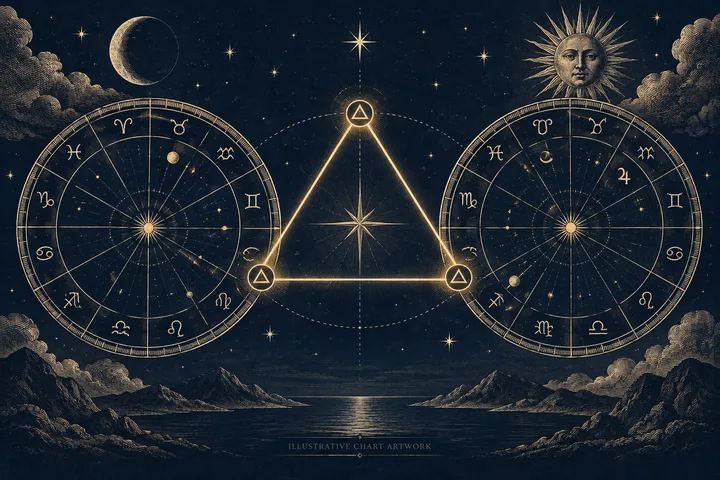
It does name something real. Trines describe a smooth exchange between chart factors. A grand trine joins three points by three trines, creating a closed triangle. In synastry, those three planets can be divided between the two charts. If one person's Moon receives another person's Venus and Mars, and all three planets trine one another, that is a synastry grand trine. It is also a natal Venus-Mars trine in the second person's chart, so both layers deserve a name. The cross-chart figure describes the exchange; the natal pattern describes the way one person already carries part of it.
The word shared needs care here. The figure is shared because the contacts cross two charts. The meaning is not necessarily felt in equal measure or at the same moment. One person may experience relief, another desire, and a third layer of the pattern may appear only when the pair faces a practical choice. Shared geometry still has personal entry points.
But ease is not the same thing as closeness. Ease describes how readily the contact flows. Closeness describes how much of life the two people actually share, reveal and tend. Those are related questions. They aren't the same question.
This distinction matters because a grand trine can operate quietly. You may understand each other without discussing the understanding. You may fall into familiar roles without deciding whether those roles suit you. The connection feels natural, so nobody asks what it needs. Comfort becomes the evidence. Then comfort becomes the whole interpretation.
Closeness has a time dimension that an aspect picture cannot supply by itself. A first conversation can show resonance. A month of ordinary decisions shows whether the resonance survives repetition. Who follows up? Who remembers? Who can stay present when the mood changes? Those observations don't cancel the chart. They show where the chart is being lived.
This is especially important in a comparison built from supplied placements. A list of signs can identify a promising language between the charts, but it can't tell you how often the people speak that language. Let the chart describe the opening. Let conduct describe the pattern's reach.
Astrodienst describes the grand trine as three planets placed at trine angles, usually linking one element, and also warns that the comfort of the pattern can make its gifts easy to take for granted. Skyscript gives the same basic shape and emphasizes the free flow of planetary energy. Those descriptions support a reading of capacity and style. They don't turn the shape into a verdict about the relationship.
Read the ease as an opening. Then ask where it enters ordinary life.
Read a synastry grand trine as a channel of easy exchange, not as proof that two people are equally invested or deeply intimate. First confirm that three planets from the two charts form three real trines, using known degrees and a consistent orb. Then name the planets, the element, and the life areas they touch. A Moon, Venus and Mars grand trine speaks differently from a Saturn, Uranus and Neptune pattern. Next, inspect the rest of the synastry. A square, opposition, Saturn contact, angle contact or strong house overlay may give the flowing pattern weight, friction or a place to show itself. The supported reading is simple: a grand trine can make connection feel natural. It still needs attention, honest exchange and repeated choice to become closeness. Compare the exact placements you know, and leave unknown degrees or houses out of the conclusion.
Sources: Grand Trine - Astrodienst Astrowiki; Grand Trine - Skyscript Glossary
Confirm the pattern before you interpret the feeling
A grand trine is not three attractive sign combinations gathered by impression. It is a geometric pattern. Start with the degrees.
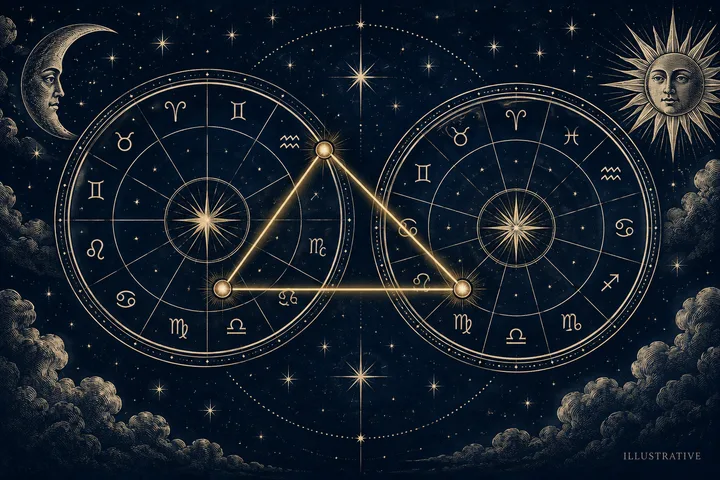
A trine measures 120 degrees of zodiacal longitude. Three planets form a grand trine when each pair is close enough to that angle for the orb system you have chosen. In a practical comparison, write every position in degrees from 0 to 360. Then compare the three pairs. If the first pair is 118 degrees apart, the second is 121 degrees apart and the third is 121 degrees apart, the pattern is coherent under a six-degree orb. If one link is 134 degrees, you may have a suggestive sign relationship, but you don't have a clean grand trine for this reading.
The six-degree orb belongs to the report scope here. Use it consistently. A tighter contact deserves more weight than a contact sitting at the edge of the allowance. Exactness doesn't erase the meaning of the planets, but it changes how loudly the pattern speaks. A grand trine built from three contacts within one degree is more concentrated than one held together by three wide contacts.
For each pair, measure the shorter distance around the zodiac and compare it with 120 degrees. A 116-degree separation is a four-degree trine. A 126-degree separation is a six-degree trine. A 131-degree separation is eleven degrees away and falls outside this report's working orb. The sign names can still suggest an elemental relationship, but the technical label must follow the measured distance.
There is also a difference between a complete figure and a loose collection of trines. Three pairs can each look pleasant when read one at a time, yet one pair may be too wide to close the triangle. The eye likes completion. The astrologer has to check it. Write the three pairings down instead of trusting the shape on a screen.
If one planet is the only point with a degree you don't know, the uncertainty travels through every link that depends on it. That doesn't make the known contacts useless. It changes the verbs you use. Say may connect, appears to echo or could complete. Then reserve the firm interpretation for the contacts you can actually inspect.
Check the source of each placement as well. This report compares supplied placements and optional degrees. It doesn't calculate natal positions from birth dates, and it doesn't recover a missing birth time. Without degrees, you can discuss a possible same-element pattern, but you shouldn't label it a confirmed grand trine. Without birth times, you should leave house and angle claims aside.
Then ask what kind of pattern you actually have. In a same-chart grand trine, all three planets belong to one person's natal chart. In a synastry grand trine, the triangle is assembled from contacts between two charts. A synastry figure can also contain one person's natal trine plus a cross-chart contact. These layers are not interchangeable. A natal pattern describes a person's established way of carrying energy. A synastry pattern describes what happens in the exchange. The same three planets may belong two-to-one across the charts and still form a valid synastry grand trine, provided every pair makes the required trine.
The distinction prevents a common overstatement. If one person has a natal Water grand trine and the other person adds a planet that touches it, call the result a synastry grand trine only when the added planet completes all three trines with the selected points. If it makes just one contact, you have activation or resonance with a natal pattern, not a new grand-trine figure. Name the exact layer and count the links.
Skyscript's aspect glossary defines the trine as 120 degrees and notes that astrologers use an orb when the aspect is not exact. Astrodienst likewise treats the aspect as an angular relationship and places aspect patterns inside the larger chart picture. The technique is not busywork. It tells you which claim you have earned.
If the degrees are missing, the useful next action is not to guess. Record the signs you know, mark the figure as unconfirmed, and compare only the placements that are supplied. Precision creates trust.
Sources: Grand Trine - Astrodienst Astrowiki; Aspect - Skyscript Glossary; Synastry - Skyscript Glossary
Read the planets before you read the triangle
The triangle is the shape. The planets are the subject.
A grand trine involving the Moon, Venus and Mars has a different emotional texture from one involving Mercury, Saturn and Jupiter. The first may describe an easy meeting between feeling, affection and desire. The second may describe a smooth exchange between thought, structure and meaning. Neither pattern is automatically more intimate. Each answers a different question.
Begin with the planet from person A and name what it brings. Then name the planet from person B and describe what it receives or stimulates. Avoid treating the contact as a single blended substance. In synastry, the people remain distinct. The Moon person may feel emotionally recognized. The Venus person may feel appreciated. The Mars person may experience desire, movement or irritation. A flowing aspect makes the exchange easier; it doesn't make both people feel it in exactly the same way.
Consider a fully specified illustrative example. Imagine Maria has Moon at 14 degrees Cancer and Mercury at 13 degrees Pisces, while Daniel has Venus at 15 degrees Scorpio. Those three positions sit about 121, 118 and 121 degrees apart, so all three trines fall within the six-degree orb used here. The figure is not a claim about real people. It is a synastry grand trine with two planets in Maria's chart and one in Daniel's, while also containing a natal Moon-Mercury trine in Maria's chart. That distinction matters. Daniel's Venus completes the cross-chart figure, but it doesn't erase the natal pattern already present in Maria's chart.
Now read the points in order. Maria's Moon brings feeling and instinctive response. Her Mercury brings words and interpretation. Daniel's Venus brings affection, pleasure and the way he values connection. The flowing geometry suggests that feeling, language and affection can meet smoothly. It doesn't tell you that Maria and Daniel feel the pattern equally, or that either person has supplied a commitment plan. The example is useful because every sign and degree is visible. Nothing is smuggled into the chart.
The owner of a planet also matters because the same contact can organize attention differently for each person. The Moon person may register safety first. The Venus person may register liking first. The Mars person may register movement and appetite first. The triangle belongs to the exchange, but the experience still arrives through separate lives.
The planets also tell you what ease may hide. Venus trine Mars can make attraction pleasant and unforced, yet the pair may never discuss what desire means to them. Moon trine Mercury can make conversation feel instinctive, yet one person may still avoid a difficult subject. Saturn in the figure can bring steadiness and patience, but it may also make the connection feel settled before it has been tested. Uranus can bring quick recognition and unusual freedom, but the same lightness may resist routine.
Cafe Astrology's synastry guidance treats trines and sextiles as flowing contacts that help planetary energies blend, while its planet-by-planet material keeps the meaning tied to the planets involved. That's the right discipline here. Don't ask whether the grand trine is good. Ask what kind of exchange it makes easier, and what the pair must still choose to do.
A reader who starts with the planets gets a reading. A reader who starts and ends with the triangle gets a mood.
Sources: Grand Trine - Skyscript Glossary; Synastry: Love and Relationship Astrology - Cafe Astrology
Let the element describe the style of ease
Once the planets are clear, read the element. The element doesn't replace the planets. It tells you the medium through which their exchange moves.
A Fire grand trine often makes initiative feel natural. The couple may encourage action, play, risk and renewed confidence. They can lift one another quickly. The shadow is speed without reflection. They may keep moving because stopping would require naming a fear or a disagreement.
An Earth grand trine can make practical life easier. The pair may share habits, standards, patience or a talent for making plans real. Care can arrive as food, money, repair, work and reliability. The shadow is assuming that useful care automatically communicates feeling. Two people can run an efficient life while leaving tenderness unspoken.
An Air grand trine can make conversation, humor and ideas flow. The partners may give each other room to think. They can move from one subject to another without losing the thread. The shadow is staying in interpretation. They may understand the pattern, explain the pattern and still avoid the vulnerable sentence that would change the relationship.
A Water grand trine can make emotional recognition, sympathy and imagination feel immediate. The couple may sense a mood before it is spoken. They may share a private language of care. The shadow is porousness. One person may assume the other feels the same thing, or protect the ease by leaving a need indirect.
These are tendencies, not fixed outcomes. A Fire pattern still needs emotional skill. An Earth pattern can be deeply romantic. An Air pattern can speak honestly. A Water pattern can set clean boundaries. The element tells you where the current runs easily. It doesn't decide whether the people will use that current well.
You can turn the element into a small diagnostic. Fire asks whether enthusiasm leaves room for follow-through. Earth asks whether reliability includes warmth. Air asks whether insight becomes disclosure. Water asks whether empathy includes clear language and limits. The question keeps the symbolic meaning connected to an observable choice.
Elemental agreement can also become a blind spot when both people reward the same habit. Two Air-heavy people may keep talking. Two Earth-heavy people may keep solving. Two Water-heavy people may keep sensing. Two Fire-heavy people may keep starting. The grand trine shows the gift, while the missing mode often points toward the practice that would balance it.
Skyscript links Fire with enthusiasm and new possibilities, Earth with practical work, Air with thought and communication, and Water with sympathy, compassion and intuition. Use those associations as a first layer, then return to the planets. Venus in an Earth grand trine won't behave like Mars in an Earth grand trine, even though both share the same element.
For a couple, the element also suggests a practical question. What does this pair do easily together? If the answer is laugh, name what makes the laughter safe. If the answer is plan, ask whether the plan includes feeling. If the answer is sense each other, practice saying the sense aloud. The grand trine becomes closer when its natural language becomes a shared practice.
Sources: Grand Trine - Astrodienst Astrowiki; Grand Trine - Skyscript Glossary
Use the wider synastry to find what gives the ease weight
A closed grand trine can feel complete. A relationship is not a closed figure. The wider synastry shows whether the easy exchange has anchors, pressure, visibility and consequence.
Read the grand trine beside the personal planets first. Moon, Venus and Mars contacts can tell you whether the smooth pattern reaches feeling, affection and desire. Mercury can show whether the pair can put the experience into words. The Sun can bring recognition and vitality. These contacts do not need to be folded into the grand trine itself to matter. They provide context.
Then inspect Saturn. A flowing Saturn contact can give the connection endurance, patience and a reason to keep showing up. A hard Saturn contact can bring weight, fear or a sense of obligation. Neither is automatically better. Saturn asks whether the warmth can take form. When the grand trine is pleasant but the relationship remains vague, Saturn may be the missing question: what are we building, and what does each of us promise to carry?
Look for tension as well. A square or opposition touching one of the trine planets may become the point where the easy current meets life. That contact can be uncomfortable, but it can also give the pattern direction. Cafe Astrology's synastry material treats flowing aspects as supportive and challenging aspects as places that require work, while also allowing friction to create energy and growth. The point isn't to add difficulty for drama. It's to see what makes the connection move.
A fourth planet can turn a grand trine into a kite pattern when it opposes one point and sextiles the other two. In a chart pattern, that opposition may provide a focal line. In synastry, the same geometry deserves careful naming. Is the fourth planet in one person's chart? Does it belong to the other? Which person feels the pressure, and which person carries the outlet? Don't call every extra soft contact a kite. Confirm the shape and describe the people involved.
House overlays can show where the grand trine becomes visible, but only when you have reliable birth times and complete chart data. If a partner's Venus falls in the other's fifth house, the flowing contact may find expression through romance, creativity and pleasure. If the house is unknown, leave that layer open. A report that fills missing houses with confidence has left astrology behind and entered invention.
Also resist the urge to let the most pleasant pattern outrank every other contact. A close Moon-Saturn square may matter more to daily security than a wide three-planet triangle. A Venus-Mars conjunction may speak more directly to attraction than a grand trine that never touches either planet. Rank by exactness, planet, repetition and lived relevance. Don't rank by shape alone.
A useful ranking note can fit in three lines. Put exact personal-planet contacts first when the question concerns feeling, attraction or communication. Put Saturn and angle contacts next when the question concerns steadiness, visibility or responsibility. Keep outer-planet links as background unless they repeat the same theme or closely touch a personal planet. This isn't a universal scoring system. It's a way to stop the grand trine from becoming the loudest symbol simply because it has a memorable name. If two contacts are equally close, let the reader's question decide which one leads. A person asking why affection feels natural needs Venus and the Moon before a distant generational pattern. A person asking why the bond works in public life may need the angles and house overlays, provided the birth data supports them.
Repetition matters when several contacts return to the same theme. If the grand trine includes Venus and the wider synastry also brings Venus to the other person's Moon or Saturn, affection has more than one route into the relationship. If the figure is the only contact touching the personal planets, its ease may be real but more self-contained. The chart gains meaning through pattern density, not through a single impressive label.
You can make that ranking visible in the final paragraph of a reading. Say, the grand trine explains the ease of your conversations, while the Saturn contact explains why the conversations may become dependable. Or say, the triangle supports emotional flow, while the square shows where assumptions need words. A reader can then see the hierarchy instead of receiving a flat catalogue of aspects.
Astrodienst's synastry guidance describes chart comparison as a study of interaspects and house placement, and it notes that harmonious contacts can inspire while a lack of friction may become lethargic. That is a useful ranking principle. The grand trine tells you where energy blends. The surrounding chart tells you whether anyone acts on it.
Read the pattern as a central current, not the entire river.
Sources: Grand Trine - Astrodienst Astrowiki; Synastry: Love and Relationship Astrology - Cafe Astrology; Synastry - Skyscript Glossary
The strongest exception: ease can protect distance
The strongest exception is not that every grand trine fails. It is that a grand trine can work beautifully and still leave intimacy underdeveloped.
Two people may be kind, compatible and easy together. They may share music, humor, sex, work or a strong intuitive bond. Yet they may keep the relationship inside the zone where neither has to risk a plain request. The pattern protects the peace. The peace protects the distance.
This can happen when the planets involved describe a skill the people already possess. A Mercury grand trine may make clever conversation effortless. A Venus grand trine may make affection graceful. A Mars grand trine may make desire and action quick. The partners can become excellent at the pleasant part of the connection. That doesn't mean they know how to disappoint each other safely, repair after a hurt or ask for a different future.
Consider an example. Imagine Maria and Daniel have a close cross-chart grand trine linking Maria's Moon, Daniel's Venus and Maria's Mercury. They talk for hours. Maria feels understood, and Daniel feels welcomed. But the pattern never touches Saturn, the angles or either person's Mars. When Maria asks for a clearer plan, the conversation turns warm and philosophical. Daniel isn't necessarily deceptive. The chart's easy language is simply not the same as a commitment structure. The useful reading says the pair has emotional and verbal flow, with a missing bridge between understanding and decision.
The answer is not to distrust the grand trine. It is to give it a task. Ask one direct question. What do we want this ease to support? Name the action. Make the plan. Return to the conversation after the good feeling has passed. A soft aspect becomes intimate through repetition, not through intensity alone.
This is also why no single aspect can tell you who is more invested. Synastry describes interaction. It doesn't erase free will, circumstance or the distinct natal patterns each person brings. A person may receive a Venus contact warmly and still have a natal Saturn pattern that makes disclosure slow. Another may feel a Moon contact immediately but need solitude before naming it. The same pattern can be shared and unevenly experienced.
Cafe Astrology treats flowing contacts as supportive, while its Saturn material emphasizes commitment and safety unfolding over time. That gives the exception its shape: a graceful current still needs a container.
Sources: Synastry: Love and Relationship Astrology - Cafe Astrology; Saturn in Synastry - Cafe Astrology
A practical reading order for your own comparison
You don't need to read every object in a synastry report at once. A short order keeps the grand trine in proportion.
First, list the three planets and the person who owns each one. Write their signs and exact degrees if supplied. Confirm all three trines under the six-degree orb used for this comparison. If one degree is missing, mark that link as unconfirmed.
Put the information in a small table if you are comparing several patterns. The first column names the planet and person. The second gives the sign and degree. The third names the cross-chart contact. This simple record stops one vivid contact from swallowing the rest of the comparison, and it makes a later revision easier when a degree is corrected.
Second, name the element and the subject. Don't write only Water or Earth. Write emotional recognition, affection and desire if those are the planets involved. The pattern's subject should fit the planets, not a generic sign-pair description.
Third, separate what the chart shows from what you are adding as a story. The chart may show an easy Moon-Venus exchange. The story may say, they must be in love. Keep the first statement. Test the second against the rest of the chart and the relationship's conduct. Strong astrology doesn't need a bigger claim than the symbols can carry.
Fourth, rank the contacts by closeness and relevance. A one-degree trine leads a five-degree trine. A pattern with one wide side may still be interesting, but it shouldn't carry the same weight as a tight triangle. Then ask what situation you are trying to understand. A grand trine between outer planets may describe a broad shared atmosphere, while a Moon or Venus contact may speak more directly to affection. The most elaborate pattern isn't always the most useful one.
Fifth, read the personal-planet context. Check the Sun, Moon, Mercury, Venus and Mars contacts between the charts. Ask whether the grand trine reaches identity, feeling, speech, affection and desire. You aren't counting points. You're finding the lived areas where the pattern can speak.
Sixth, inspect Saturn and the major tense aspects. What gives the connection form? What asks for effort? What might interrupt the easy flow? A difficult contact doesn't cancel the grand trine. It tells you where the relationship must become conscious. Write the strongest exception here, before the conclusion: practical ease may still leave feeling unspoken, or emotional flow may still lack a plan.
Seventh, add houses and angles only when the birth times support them. If the data doesn't support a house claim, don't substitute a guess. Then compare the reading with the question that brought you to the chart. If you asked whether the connection feels emotionally close, lead with Moon contacts and emotional behavior. If you asked why conversation is easy, lead with Mercury and the relevant element. Don't let an attractive figure answer a different question merely because it is memorable.
Finally, turn the interpretation into one decision aid. If the pattern is Moon-Venus-Mars, decide how you'll keep affection and desire spoken rather than assumed. If it's Mercury-Saturn-Jupiter, decide how you'll turn shared ideas into a plan. If it's a Water pattern with little Saturn, decide how you'll make emotional impressions explicit. The action should grow from the planets.
The report offered here works from placements you supply, with optional degrees and selected major-aspect calculations using a six-degree orb. It does not calculate a natal chart from birth details or calculate houses. That scope is enough for a careful comparison of Moon, Venus and Mars placements and the aspect patterns they form. If you want to compare your known placements, use the report as a way to organize the evidence, not as a replacement for the conversation the chart invites.
The strongest conclusion is not that a grand trine means closeness. It is that it can make closeness easier to practice. Choose the planet at the center of the pattern and make its promise visible this week. If it is the Moon, say what helps you feel safe. If it is Venus, name the affection you actually notice. If it is Mars, make a clear request instead of waiting for chemistry to speak for you. Let the chart open the conversation. Let your choices give it depth. That is how you recognize a bond's ease without mistaking a smooth beginning for a finished relationship.
Sources: Grand Trine - Astrodienst Astrowiki; Aspect - Skyscript Glossary; Synastry - Skyscript Glossary
A little more clarity
Does a synastry grand trine mean the relationship is meant to last?
No. It shows a strong pattern of easy exchange between three chart factors. It can support warmth, cooperation or recognition, but it doesn't decide duration. Read the planets, degrees, Saturn contacts, tense aspects and real choices alongside it. A grand trine can make closeness easier. It can't make either person choose it.
What if the grand trine is based only on signs and not exact degrees?
Treat it as a possible pattern, not a confirmed one. A trine is an angular relationship of about 120 degrees, and this report uses a six-degree orb. Without degrees, you can discuss the same-element symbolism and the signs involved, but you shouldn't claim that all three aspects are exact enough to form a working grand trine.
Can a grand trine in synastry feel boring?
It can feel quiet, familiar or easy to the point that nobody names what is happening. That doesn't make it empty. The pattern may lack the friction that forces attention, especially if the wider synastry offers little tension or structure. Give the ease a task, such as a direct conversation, a shared plan or a regular way to show affection.
Which planets matter most in a synastry grand trine?
There is no universal ranking that makes one three-planet pattern the best. Moon, Venus and Mars bring feeling, affection and desire into the reading. Mercury brings speech and understanding. Saturn can add form and endurance. The right question is what the actual planets make easier, then whether the wider synastry helps that ease become part of shared life.
Sources & further reading
- Grand Trine - Astrodienst Astrowiki
Defines a grand trine as three planets linked by 120-degree trines and explains its ease, elemental emphasis and risk of taking comfort for granted.
- Grand Trine - Skyscript Glossary
Describes the triangular configuration and connects Fire, Earth, Air and Water grand trines with distinct styles of expression.
- Aspect - Skyscript Glossary
Defines the trine as 120 degrees, explains major aspect geometry and notes that astrologers use orbs for non-exact contacts.
- Synastry: Love and Relationship Astrology - Cafe Astrology
Explains how flowing synastry aspects support blending and how tense contacts can require work while adding useful relationship energy.
- Synastry - Skyscript Glossary
Defines synastry as chart comparison and places interchart aspects inside the wider tradition of judging interaction between two nativities.
- Saturn in Synastry - Cafe Astrology
Explains Saturn interaspects as themes of commitment, safety, weight and connection that unfold over time.
Synastry Comparison Report
Enter known placements for two people. Get an input-by-input comparison, selected aspect calculations and a clear record of what remains uncertain.
Compare our placements