The IC is a private foundation, not a family certificate
The common assumption is simple: if someone’s planet touches your IC, they must belong to your family story. That idea is appealing because the IC is intimate. It sits at the bottom of the chart, opposite the Midheaven, and astrologers associate it with home, roots, ancestry, early experience, and the private self. A contact there can feel uncannily familiar. You may relax around the person before you know why. You may also feel exposed, protective, or pulled toward a kind of closeness you didn’t plan. But familiarity is not proof of biography. The strongest reading is narrower and more useful: the person’s planet activates the place where you seek inner ground. That place includes family history, but it also includes your present home, your need for shelter, your emotional habits, and the private conditions that let you rest.
Astrology.com describes the IC as the bottom of the sky and links it with intimate family life, domestic foundations, roots, private life, ancestors, and the qualities of nurture. Its fourth-house guide adds home, family history, cultural patterns, traditions, and the physical place where a person puts down roots. Those meanings overlap, but they aren’t identical. A partner can touch your IC through a quiet evening, a conversation about where you belong, a shared domestic rhythm, or a difficult reaction to your need for privacy. None of those scenes requires the person to repeat your childhood. The chart is showing a doorway. It isn’t handing you a complete backstory.
This matters because an IC contact can become distorted in two opposite ways. One reader may turn it into a romantic family myth: “We feel like home, so we must be meant to build a family.” Another may turn it into a diagnosis: “You remind me of my parent, so this relationship is only an old wound.” Both conclusions outrun the symbol. The IC can carry warmth, grief, loyalty, fear, inheritance, memory, and the wish to start again. The planet tells you how the activation arrives. The sign tells you its style. The lived relationship tells you what the contact is actually doing. Keep those layers separate.
Think of the IC as a room rather than a person. It can be the kitchen where someone finally eats without performing, the bedroom where privacy becomes necessary, the family table where old loyalties surface, or the quiet corner where nobody has to explain themselves. A partner’s planet enters that room with a particular motion. Venus may arrange flowers. Mars may start a renovation or an argument. Mercury may open a box of old letters. Saturn may repair the door and ask who has the key. The image helps because it keeps the reading concrete. You’re not asking which relative the partner represents. You’re asking what changes in the private room when this person arrives, and whether that change supports the life the house person wants to live now.
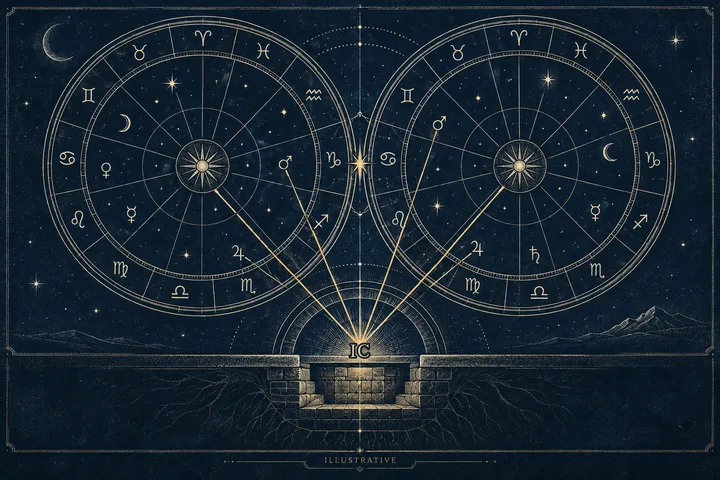
So begin with a clean sentence. “Her Venus contacts his IC” means that her Venus symbolism enters his private foundation. It may bring affection, beauty, pleasure, reconciliation, or a desire to make the shared space feel more welcoming. It does not mean she is his mother, that he will marry her, or that their families will blend. “His Saturn contacts her IC” means that Saturn enters her foundation. It may bring steadiness, duty, limits, or a sober confrontation with what security requires. It may also feel heavy. The sentence tells you where to look. It doesn’t decide what you’ll find.
Read a synastry contact to the IC as an activation of the chart owner’s private foundation. It can describe the way one person stirs feelings about home, safety, roots, memory, belonging, and the life that exists behind closed doors. It doesn’t, by itself, prove that you share a family pattern, that you’ll build a household, or that the planet person resembles a parent. Start with the exact contact and the house system. Then identify the planet, its sign, its degree, and the side of the synastry you’re reading. A Moon or Venus contact may soften the private space. Mars, Saturn, Uranus, Neptune, or Pluto can make it more charged, demanding, or difficult to name. Read the contact beside the owner’s natal Moon, 4th-house ruler, and other close aspects. Finally, compare the symbol with ordinary life. Does this person help you feel at home, or do they simply stir an old definition of home?
Sources: IC (Imum Coeli) in Astrology: Meaning, MC, More; The Fourth House: The House of Family and Home
First identify which contact you’re actually reading
A synastry contact to the IC can mean several different things, and readers often blend them together. A person’s planet may conjunct the other person’s IC. It may form a square, trine, opposition, or sextile to the IC. It may fall in the other person’s fourth house without touching the exact degree. Or the two charts may show a planet in one person’s fourth house while the reverse overlay lands elsewhere. These are related observations, not interchangeable ones. The tighter the aspect to the angle, the more directly the contact tends to announce itself. A broad fourth-house overlay can still matter, especially when it involves the Moon, Venus, Sun, Mars, or a chart ruler, but it needs a wider reading.
Keep the angle contact and the house overlay in separate lines of your notes. “Her Moon is two degrees from his IC” describes a degree-based relationship to his angle. “Her Moon falls in his fourth house” describes where her Moon lands in his chart under the chosen house system. The two may coincide, but they need not. A Moon can sit in the fourth house several degrees from the IC, or close to the IC while a different house system places the cusp elsewhere. This distinction prevents the phrase “fourth-house feeling” from doing the work of a precise aspect. Read the angle first when it is secure, then use the overlay as context.
The planet person and the house person also have different jobs in the interpretation. The house person owns the IC and usually feels the contact as an alteration in private life, safety, memory, or belonging. The planet person brings the planet’s function into that room. A Mercury person may ask questions that make the house person name family rules. A Mars person may energize repairs, provoke conflict, or make the home feel more active. A Venus person may offer tenderness or make domestic comfort visible. This doesn’t mean the planet person experiences nothing. It means the symbolism has an asymmetrical entry point. Begin with the IC owner’s experience, then ask how the planet person might express the contact.
Read both directions before you call the contact mutual. If Maria’s Moon is conjunct Daniel’s IC, Daniel may feel Maria’s moods in his private foundation. Maria may instead experience herself as the person who instinctively responds to his hidden needs, or she may simply feel that her emotional nature becomes unusually visible around him. If Daniel’s Moon also aspects Maria’s IC, the two-way pattern deserves separate attention. It does not cancel the asymmetry. Each person can be affected in a different way by the same relationship. A house overlay is a map of where the planet person lands. It is not a scorecard that says both people feel exactly the same intensity.
The same rule applies to the IC sign. A Taurus IC may seek steadiness through touch, food, money, land, or a calm physical setting. A Gemini IC may need conversation, movement, and mental room before privacy feels safe. A Scorpio IC may protect the inner life carefully and test trust over time. Don’t use the sign as a script for childhood. Use it as a style of foundation. Then ask whether the planet person supports that style or presses against it. A contact becomes clearer when you can say both parts: what the IC needs, and what the incoming planet asks it to do.
The aspect describes the meeting between the planet and the angle. A conjunction fuses them. It can make the planet hard to keep separate from the IC story. A trine may let the planet flow into the private foundation with less friction. A sextile can offer an opening that both people must use. A square may make the contact active through pressure, disagreement, or the need to change an inherited pattern. An opposition can pull the private foundation toward the relationship’s visible or interpersonal axis, because the IC is opposite the MC and participates in the chart’s vertical line. No aspect is automatically good or bad. The question is whether the contact helps the person build a truer foundation.
Don’t flatten these differences into a single phrase such as “strong IC synastry.” A conjunction puts the planet on the threshold itself. A square may force a choice between an old private habit and the planet person’s way of acting. A trine can feel natural enough that neither person notices the support until distance or stress reveals its absence. An opposition may make the private theme visible through public decisions, work demands, reputation, or the question of how the couple appears to others. The aspect is not a verdict on ease. It tells you where the energy moves and what kind of attention the contact asks for.
Use the exact degree when you have it. Astrodienst explains that an aspect remains operative within an orb, the accepted distance from an exact angle, and that the conjunction, opposition, square, trine, and sextile are the major aspects. This publication’s report uses a stated six-degree orb for selected major aspects, but a six-degree contact is not the same as a one-degree contact. Treat closeness as a ranking tool. A close conjunction to the IC deserves priority. A loose contact should support a pattern rather than carry the whole reading. If you don’t have degrees, describe the placement as a possible house or angle contact, not as an exact aspect.
Sources: Aspect; Time of Birth
Read the planet as an action in the private room
Once you know the contact, read the planet as something that happens in the IC person’s private world. The Sun can bring recognition, warmth, or a strong sense that the relationship belongs inside the person’s real life. It can also expose the house person’s need to be seen at home, not only admired in public. The Moon tends to make the contact feel immediate and bodily. It may encourage caretaking, shared meals, emotional memory, or a quick sense of familiarity. Venus can beautify the private space and soften old defenses. It may also make comfort so attractive that the couple avoids harder conversations. These are interpretive possibilities. Rank the one that matches the natal IC and the way the relationship behaves.
Mercury brings words into the foundation. The two people may talk about childhood, neighborhoods, family sayings, private fears, or the details of daily life. The contact can help the house person narrate an experience that has been hard to explain. It can also make the home noisy with analysis. Mars brings heat, initiative, and friction. It may help two people act on domestic plans, defend a private boundary, or finally confront anger that has been kept underground. Jupiter may enlarge the sense of home, family, generosity, or emotional permission. It can feel protective and hopeful, though it may also encourage assumptions about a shared future before practical life has caught up.
The inner planets are easiest to read when you translate them into verbs. The Sun notices and illuminates. The Moon responds and needs. Mercury names and questions. Venus welcomes and values. Mars acts and contests. Those verbs are more useful than a string of adjectives such as “intense,” “comforting,” or “fated.” If Venus touches the IC, ask what the Venus person welcomes into private life. If Mars does, ask what they start, defend, or disturb. If Mercury does, ask what becomes sayable. This approach also prevents a planet from becoming a fixed character. A Venus person isn’t automatically kind at home. They may bring harmony, taste, avoidance, or a demand for pleasantness. The whole chart and the actual exchange decide which verb is alive.
Saturn deserves a careful reading. In the private room, Saturn can make the relationship serious. The planet person may help the house person build structure, keep promises, or face the work of creating safety. But Saturn can also feel like judgment, emotional restraint, duty, or the weight of an inherited rule. Read it through behavior. Does the Saturn person respect the house person’s boundaries and show up consistently? Or do they make the house person feel inspected and responsible for carrying the whole foundation? The same symbol can describe a strong wall or a locked door. The aspect, sign, natal condition, and lived pattern decide which image fits.
Uranus, Neptune, and Pluto can make the IC contact feel larger than the immediate relationship. Uranus may disrupt an old home pattern or make the private life more unconventional. Neptune may create tenderness, spiritual recognition, longing, or projection. Pluto may draw buried family material to the surface and make the relationship a site of deep change. Don’t turn any outer-planet contact into a guaranteed trauma story. The Astrology.com IC guide describes outer planets touching the IC as possible prompts to revisit the past and work through what has held a person back. “Possible” is doing important work there. Confirm the interpretation through the person’s experience, not through dramatic language.
When several planets touch the same IC, don’t read them as a pile of equal meanings. Find the planet with the tightest aspect, then ask whether the other contacts repeat, modify, or contradict its message. A two-degree Moon conjunction with a six-degree Saturn square might begin with emotional familiarity and then reveal the conditions under which that familiarity feels safe. A Venus conjunction with a wider Mars trine could add attraction and movement without replacing Venus as the central tone. This ranking matters because a list of planet meanings can sound rich while saying nothing about what the couple should notice first.
Sources: IC (Imum Coeli) in Astrology: Meaning, MC, More; The Fourth House: The House of Family and Home; Romantic Compatibility Synastry House Overlays
A worked example: Moon to IC is about felt safety first
Imagine Maria has a Capricorn IC at 14 degrees, and Daniel’s Moon sits at 12 degrees Capricorn. The charts show a two-degree conjunction. We can say that Daniel’s Moon is closely conjunct Maria’s IC if the birth times and chart positions are reliable. We cannot say that Daniel is literally connected to Maria’s family, that he will become her husband, or that he automatically understands her childhood. We can say that Daniel’s emotional responses enter Maria’s private foundation with force. His moods, care, withdrawal, and need for reassurance may land in the place where Maria decides whether she is safe enough to lower her guard.
The Capricorn symbolism gives the contact a particular tone. Maria may feel safest when care is dependable, contained, and practical. Daniel’s Moon may show itself through responsibility, planning, work, or a preference for keeping feelings under control until trust is earned. If he brings soup when she is ill, remembers the repair that needs doing, and lets her have quiet without treating it as rejection, the contact may help her build a more secure private rhythm. If he goes cold whenever she needs comfort, the same Capricorn language may awaken her fear that love must be earned through competence. The aspect doesn’t choose between these expressions. The people do.
The example becomes more useful when you compare the first impression with the second impression. At first, Maria may say, “He feels familiar.” That is the felt response. Next, she can ask, “What exactly feels familiar?” Perhaps Daniel’s calm resembles the quiet she needed as a child. Perhaps his reserve resembles the distance she learned to work around. Perhaps he offers a new version of Capricorn safety, one with limits but also warmth. These are different possibilities, and the chart alone cannot choose among them. A reading earns its confidence by moving from sensation to pattern to choice. The Moon-to-IC contact explains why the question has heat. The conversation explains whether the answer becomes healing, repetition, or neither.
Now add the rest of the chart instead of stopping at the conjunction. Is Daniel’s Moon also trine Maria’s Venus? Does his Saturn square her Moon? Does Maria’s 4th-house ruler receive a supportive aspect from his Sun? These details change the ranking. A warm Moon-to-IC contact with repeated supportive links can describe emotional familiarity that grows through ordinary care. A Moon-to-IC contact beside hard Saturn or Pluto contacts may describe a powerful bond that also tests the house person’s old defenses. The IC contact remains important, but it becomes one sentence in a paragraph, not the whole novel.
Suppose Maria’s chart also shows Daniel’s Mercury within four degrees of her IC, while his Moon-to-IC conjunction is two degrees. The Moon contact leads because it is tighter and speaks directly to felt security. Mercury adds the way the experience becomes conscious: through questions, stories, and discussions about family rules or the shape of home. If Daniel talks easily but fails to offer emotional steadiness, Mercury may explain the conversation without proving safety. If he listens, remembers what Maria says, and changes a daily habit in response, the two contacts begin to tell one coherent story. Rank first, then combine.
Notice what this example does not do. It doesn’t invent either person’s birth history. It doesn’t claim that Maria had a strict family or that Daniel had to grow up too soon. Capricorn may suggest a style of safety, but it cannot supply missing facts. Ask better questions instead. What does Maria need in order to relax at home? How does Daniel respond when she needs care rather than solutions? Which private habits create steadiness, and which ones recreate distance? Those questions turn the symbolism into something a couple can observe and discuss.
Sources: Romantic Compatibility Synastry House Overlays; IC (Imum Coeli) in Astrology: Meaning, MC, More
Separate the contact from the family story it may stir
The family story is sometimes relevant. The fourth house includes ancestry, heritage, traditions, parents, and the conditions that shaped the early home. If an IC contact also connects with the Moon, the 4th-house ruler, the South Node, or a cluster of personal planets, the relationship may genuinely bring inherited patterns into focus. You may notice how each person defines loyalty, privacy, care, authority, or belonging. You may see one person protecting a tradition while the other wants to break it. That is a rich astrological reading. It is still not permission to fill in facts that the chart data and the relationship have not supplied.
Use a three-part test. First, name the chart symbol without interpretation: “Her Mars is within four degrees of his IC.” Second, name the emotional or domestic theme it could activate: “Her directness may energize his private boundaries and home decisions.” Third, check the observable pattern: “When they plan time at home, does he feel defended, pressured, motivated, or irritated?” The third step keeps the reading alive. If the behavior doesn’t support the first interpretation, revise it. Astrology is not weakened by that discipline. It becomes more precise.
This is also where projection enters. The IC is deep enough to invite recognition, and recognition can become certainty very quickly. Someone may feel that a new partner knows the oldest part of them. That feeling deserves respect. It doesn’t deserve a verdict. The partner may be touching a genuine need for home, or they may be activating a memory that makes the present relationship feel older than it is. Ask whether the person is meeting the need now. Warmth in the present matters more than resemblance to a remembered role.
A useful journal prompt is, “What do I expect this person to understand without my saying it?” Write the answer in plain language. Maybe you want them to know when you need silence. Maybe you want them to notice the work you do to make a home. Maybe you want them to protect you from a family member, or to prove that love won’t disappear when you stop being useful. Then ask whether you have actually told them. An IC contact can make unspoken expectations feel obvious, but obvious to one person is still hidden from the other. The reading becomes practical when it turns a private expectation into a clear request. If the request can’t be met, you learn something about the relationship without needing to invent a myth around the chart.
Family symbolism also has a present-tense side. The fourth house isn’t only the house you came from. It describes the base you are making now, including the rituals, rooms, belongings, and boundaries that let you feel rooted. A partner may activate that future-facing work without resembling anyone from your past. They may invite you to move, redecorate, share meals, welcome friends, or keep certain parts of life private. That is still an IC story because it concerns the conditions of belonging. Notice the difference between inheritance and construction. One asks, “What did I receive?” The other asks, “What am I willing to build?” A good synastry reading leaves room for both.
A strong exception belongs here. Sometimes a partner really does become involved with family life, shared property, caregiving, cultural traditions, or the creation of a home. In that case, the IC contact may describe the relationship’s actual domestic importance. But the event comes first. The chart helps you read its meaning. It doesn’t announce the event in advance. This distinction protects the beauty of the symbol. Home can be chosen, built, repaired, and redefined. It isn’t only inherited.
Sources: IC (Imum Coeli) in Astrology: Meaning, MC, More; Romantic Compatibility Synastry House Overlays
Check chart data before you trust an angle contact
An IC contact depends on chart angles, and angles depend on birth time. This is not a minor technical footnote. Astrodienst notes that the Ascendant advances by roughly one degree every four minutes on average, and that the birth time matters when the Ascendant, Midheaven, or a house cusp is near a sign boundary. The same principle matters in synastry. If a recorded time is rounded, guessed, or remembered as “sometime in the morning,” the IC degree may shift enough to change a close conjunction into a wider one, or to move a planet across a house boundary. Treat the contact as uncertain until you know how firm the time is.
House systems add another layer. In quadrant systems, the IC and the fourth-house cusp are paired. In equal-house systems, the MC and IC can be embedded inside the tenth and fourth houses rather than forming their cusps, as the Astrodienst house-system reference explains. Whole-sign practice can place the IC in a house other than the fourth. That doesn’t make one system useless and another correct for every question. It means you should state the system you’re using and notice whether the interpretation survives a reasonable comparison. If the contact disappears as soon as the house system changes, lower its rank.
When the birth time is secure, record the essentials before interpreting. Write down the IC sign and degree for each person. Note the house system. List any partner planet within the chosen six-degree orb of the IC, with the exact difference in degrees. Mark whether the aspect is a conjunction, opposition, square, trine, or sextile. Then note the planet’s sign and its own close aspects. This small table prevents a familiar phrase from taking over the reading. It also makes the comparison reproducible when you revisit the chart later.
When the birth time is missing, don’t pretend an angle contact exists. You can still compare supplied Moon, Venus, and Mars signs, and you can still discuss planet-to-planet aspects when the degrees are available. You cannot responsibly present a calculated IC, house overlay, or exact angle aspect from incomplete birth information. The Synastry Comparison Report follows that boundary: it uses supplied placements and optional degrees, selects major aspects with a stated six-degree orb, and doesn’t calculate a natal chart from birth details. If you want a personal IC reading, bring accurate chart data first.
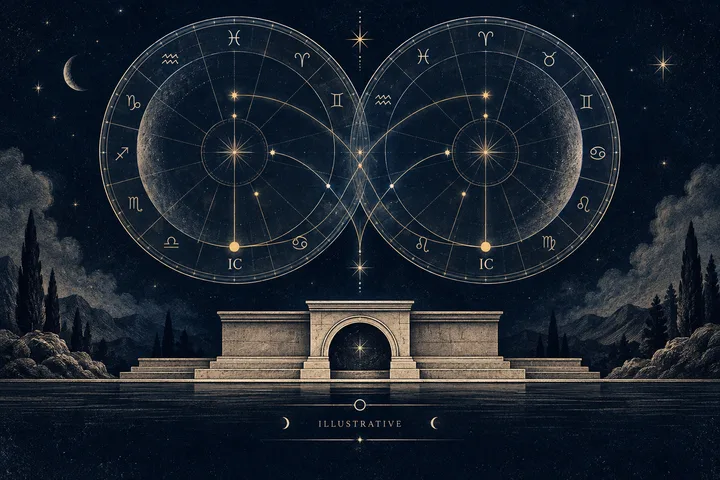
Also record whose chart is in the center of the bi-wheel. “Her Venus on his IC” and “his Venus on her IC” are different statements, even when the same two people appear in both charts. The centered chart belongs to the house person for that overlay, while the outside planet belongs to the planet person. This simple label prevents a common reversal: assigning the private reaction to the person whose planet is actually doing the activating.
Handle uncertainty with two columns. In the first, write what remains stable if the birth time shifts: a supplied planetary sign, a confirmed planet-to-planet aspect, or a theme repeated elsewhere. In the second, write what depends on the angle: the IC degree, a house placement, or an exact conjunction. Build the conclusion from the first column, then describe the second as conditional. For example, “Your partner’s Moon appears close to your IC if the recorded time is accurate, which would intensify the private familiarity already suggested by the Moon-Venus contact.” That sentence stays useful without turning an uncertain angle into family history.
Here’s how that looks in practice. Suppose the recorded time could vary by twenty minutes. Your partner’s Moon remains in Taurus, and the Moon makes a confirmed trine to your Venus, but the IC shifts from late Gemini to early Cancer. Keep the Moon-Venus reading firm: affection may flow through steadiness, touch, food, or familiar routines. Treat the IC claim as a live possibility: the Moon may also touch the foundation where you seek safety, but the exact strength depends on the time. You haven’t lost the reading. You’ve separated what the chart can support now from what better data could sharpen.
Sources: Aspect; Time of Birth; Romantic Compatibility Synastry House Overlays
Let the IC contact answer one practical question
The best use of an IC contact is to ask what kind of private life it brings into focus. Venus may ask whether affection can make room for honesty. Mars may ask whether domestic disagreement can stay separate from the fear of losing belonging. Saturn may ask whether structure feels dependable or punitive. Neptune may ask whether tenderness can survive clear language. The planet gives you the question. Daily life gives you the answer.
Rank the evidence before you write the conclusion. Start with the aspect and its exactness. Then read the planet, its sign, and its close links to the Moon, Venus, Mars, the 4th-house ruler, or the angles. Next compare the wider overlay pattern in both directions. Only then let repeated behavior settle the emphasis. A close Moon-to-IC conjunction that matches a real pattern of emotional ease deserves more weight than a loose contact that produces no recognizable experience. And a fourth-house overlay without a close IC aspect is useful context, not a substitute for the angle contact. This order keeps the most vivid symbol from outranking clearer evidence simply because it sounds more intimate.
If the couple already shares a home, the question changes slightly. Don’t ask whether the IC contact predicts cohabitation. Ask what part of the existing home life it describes. Venus may show the pleasure of making the space beautiful together. Mars may describe repairs, arguments about territory, or the courage to set rules with relatives. Saturn may show the work of rent, ownership, chores, and long-term duty. Neptune may describe a sanctuary, but also the need to say plainly who is responsible for what. The real household gives the symbol a stage. Read the contact through that stage, not as a promise that the stage must appear.
Turn that ranking into one conversation. The IC person might say, “I feel unusually private with you. What helps me feel safe here?” The planet person can answer with a concrete promise rather than a grand interpretation. Discuss time at home, visits from relatives, privacy, chores, sleep, guests, money, cultural traditions, and the pace of emotional disclosure. Then choose one small test, such as setting a notice rule for guests or protecting an hour of solitude. Watch what changes. The symbol earns its place when the couple can respond to what it brings up.
So the decision is clear. Read the IC as foundation, privacy, memory, and belonging, not as a certificate of shared ancestry or a promise of a future household. If the contact brings tenderness, practice receiving it. If it brings pressure, name the boundary. If it stirs an old family role, separate that role from the person in front of you. Then ask one ordinary question: what would make our private life more mutual this week? The chart can show where the door is. Repeated care, honest limits, and both people’s choices decide what happens inside, in ordinary life, over time.
Sources: The Fourth House: The House of Family and Home; Aspect; Romantic Compatibility Synastry House Overlays
A little more clarity
Does a synastry contact to the IC mean we feel like family?
It can create familiarity, emotional recognition, or a strong response around home and belonging. It doesn’t prove that you share a family pattern or that the other person should take a family role. Read the planet, aspect, sign, and lived behavior together.
Which planet is strongest on the IC in synastry?
A close personal-planet contact usually deserves the first look. The Moon can activate emotional safety, Venus affection and comfort, Mars private conflict or initiative, and Saturn structure or pressure. Strength depends on exact degree, aspect, natal condition, and the rest of the synastry.
Can I read a synastry IC contact without an exact birth time?
You shouldn’t treat an IC degree or house overlay as reliable without a dependable birth time and place. You can still compare supplied planetary signs and degrees, but label the angle reading as unavailable rather than inventing it.
Does an IC contact show that we will live together?
No single contact decides that. An IC contact can describe how the relationship touches private life, home, roots, and security. Shared housing or family involvement becomes part of the interpretation only when real choices and circumstances bring those themes into the relationship.
Sources & further reading
- IC (Imum Coeli) in Astrology: Meaning, MC, More
Supports the IC as the bottom of the sky, opposite the MC, tied to intimate family life, domestic foundations, roots, and private experience.
- The Fourth House: The House of Family and Home
Supports fourth-house meanings of home, roots, family history, ancestry, traditions, nurture, and the private place where the self is grounded.
- Aspect
Supports the definition of aspects, angular relationships, and orbs as the accepted degree range around an exact aspect.
- Time of Birth
Supports the need for accurate birth time when calculating the Ascendant, Midheaven, IC, and other house cusps.
- Romantic Compatibility Synastry House Overlays
Supports reading house overlays as areas where relationship interaction is concentrated, including the emotional impact of fourth-house and near-IC overlays.
Synastry Comparison Report
Enter known placements for two people. Get an input-by-input comparison, selected aspect calculations and a clear record of what remains uncertain.
Compare our placements