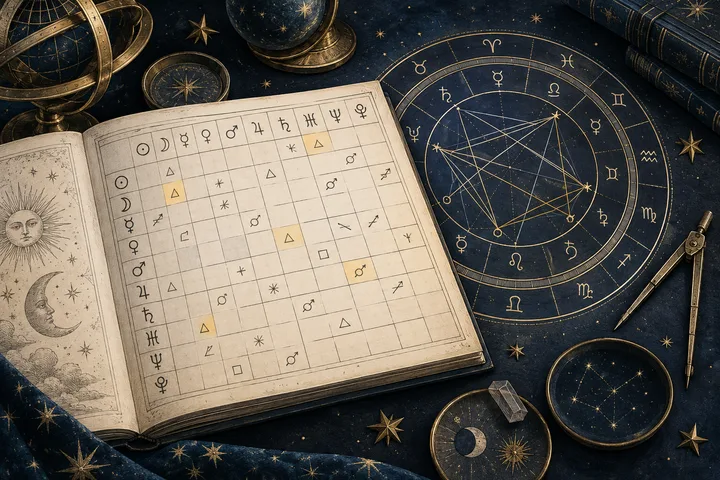
Use the table to make the wheel answer one question
Imagine Maria has her Moon at 14° Taurus, while Daniel has Venus at 17° Virgo. Their synastry table might show Moon trine Venus with an orb of 3°. The wheel could look crowded, with lines crossing through symbols that you’re still learning to identify. The row is easier. It names the two chart factors, gives you the relationship between them, and tells you how close that relationship is.
That’s why the table should lead. An aspect is an angular relationship between two chart factors. The major aspects are the conjunction at 0°, sextile at 60°, square at 90°, trine at 120°, and opposition at 180°. The aspect table translates the geometry into a sentence-like record: one person’s Moon, the other person’s Venus, trine, 3° orb. Once you can say the row aloud, you have something to interpret. The useful question here isn’t ‘What does every line mean?’ It’s ‘Which contact deserves my attention first, and what does the wheel add to it?’
The wheel answers a different question. It shows where the contact sits among the signs, whether several lines gather around one planet, and, when the data allows it, which houses receive the other person’s planets. It’s useful after you know what you’re looking for. Before that, the rings, symbols, and crossing lines make you solve several problems at once.
This order also keeps you from mistaking design for meaning. A thick line may catch your eye because of a software setting, not because it is the central story. Read the words in the row before you react to the color. A red line can mark a square, but a square is a form of tension between two planets, not a relationship verdict. A blue line can mark a trine, but ease still needs conscious use.
Keep one small reading sheet beside the chart. Copy the planet pair, aspect, orb, and signs into separate columns. Add two more: ‘what might this feel like?’ and ‘what could we try?’ For Moon trine Venus, the first answer might be easy comfort and the second might be a deliberate check-in after a hard day. The symbol has now met ordinary life.
Sources: Aspect - Astrodienst Astrowiki; Orb - Astrodienst Astrowiki; The Meaning of the Aspects in Astrology - Cafe Astrology
What information does one row actually contain?
Read a row from left to right, even when the software places the names in a different order. First, identify the planet or point from one chart. Second, identify the planet or point from the other chart. Third, name the aspect. Fourth, read the orb. Fifth, compare the signs. This is the basic sentence of synastry.
The planet tells you what is meeting. The Moon brings feeling, habit, safety, and the body’s instinctive response. Venus brings affection, pleasure, taste, and the way someone gives or receives love. Mars brings desire, initiative, heat, anger, and the urge to act. Mercury brings words and interpretation. The Sun brings identity, vitality, and the sense of being seen. Saturn adds boundaries, duty, time, and pressure. Jupiter adds faith, generosity, and room to grow. These are starting meanings, not finished judgments.
The aspect tells you how the meeting happens. A conjunction blends the planets so closely that they can act as one combined force. An opposition sets two ends of an axis against each other and often makes the relationship itself the place where the tension becomes visible. A square creates friction that asks for action. A trine lets the planets support one another with less effort. A sextile offers cooperation that usually becomes stronger when someone chooses to use it.
The orb tells you how exact the contact is. If the mathematical distance from the exact aspect is 3°, the orb is 3°. A 0°42' conjunction is tighter than a 5°38' conjunction. In this comparison scope, use a six-degree orb for selected major cross-chart aspects. Treat that as a working boundary, not a claim that every astrological practice uses the same limit.
Then look at the signs. Signs describe the style in which the planets meet. A Moon-Venus trine between earth signs may feel steady, practical, and embodied. The same planets in fire signs may share warmth, play, and quick enthusiasm. Don’t replace the aspect with the signs, though. If the degree relationship is a square, the square remains part of the reading. You’re adding texture, not erasing structure.
Finally, notice the order of the planets. In a cross-chart contact, both people participate, but the experience may not feel identical. The Moon person may feel emotionally reached, while the Venus person may feel drawn to soothe or please. Describe the exchange without turning it into a claim about who cares more. The aspect shows a pattern of contact. It doesn’t measure equal investment.
You can make the row more precise by writing two translations. The first names the inner experience: ‘Maria may feel steadied by Daniel’s affection.’ The second names the visible behavior: ‘Daniel may offer practical help when Maria needs reassurance.’ If the second sentence has no plausible everyday expression, the interpretation is still too abstract. Astrology becomes readable when the symbol can meet a moment in the kitchen, the car, or a difficult text exchange.
Don’t let a planet’s shorthand become a complete personality. Venus isn’t only romance, Mars isn’t only sex, and Saturn isn’t only restriction. Their meaning changes with the other planet, the aspect, the sign, and the question. A Venus-Saturn contact may describe limits around affection, but it can also describe loyalty, patience, or the work of making love dependable. Keep the first meaning open long enough for the rest of the row to guide it.
A row also has a direction of attention. Ask what the first planet is trying to do and what the second planet receives, wakes up, or challenges. Then reverse the sentence. This is especially helpful with Saturn, Mars, and the Moon, where one person may feel the contact as pressure while the other experiences it as motivation or care. Both descriptions can belong to the same aspect.
Sources: Aspect - Astrodienst Astrowiki; The Meaning of the Aspects in Astrology - Cafe Astrology; Synastry: Love and Relationship Astrology - Cafe Astrology
How to rank aspects when the table is long
A synastry table can contain dozens of rows. You don’t need to interpret them in the order the software prints them. Rank them. The strongest first pass considers the planets involved, the aspect type, the orb, and repetition across the chart.
Start with close major aspects between the personal planets and luminaries: Sun, Moon, Mercury, Venus, and Mars. These contacts usually speak most directly to recognition, feeling, communication, affection, desire, and daily interaction. Next, read close contacts from Saturn and Jupiter to personal planets. They can describe steadiness, responsibility, encouragement, growth, and the pressure that shapes a bond over time. Then consider Uranus, Neptune, Pluto, nodes, angles, and minor aspects when the data and purpose of the reading support them.
This is a ranking system, not a ban. A wider contact can matter if it repeats a theme already visible elsewhere. A close contact can remain minor if it doesn’t connect to the relationship question you’re asking. The table gives you candidates. Interpretation decides which candidates form a pattern.
Use three passes, but give each pass a different job. First, find the close major contacts involving the Sun, Moon, Mercury, Venus, or Mars. Second, ask what those contacts describe in behavior: comfort, pursuit, speech, boundaries, or shared direction. Third, look for confirmation or resistance. If Moon-Venus and Venus-Jupiter support warmth while Mars-Mercury adds heat, the chart has a leading ease theme with a communication complication. You’re sorting evidence, not adding rows like points on a scoreboard.
A useful table review can fit on a page. Write the leading contact, the contact that reinforces it, and the contact that interrupts it. Beside each, write one observable situation. ‘Affection comes easily’ is vague. ‘She reaches for touch after a hard day, while he tries to solve the problem first’ gives the symbols somewhere to land. The chart doesn’t replace the conversation. It gives the conversation a more exact starting point.
If two themes compete, don’t force a single mood. Rank them by function. One theme may describe why the pair feels drawn together, while another describes what happens when they need to make a decision. For instance, Venus-Jupiter can show generosity in shared pleasure, while Mercury-Saturn can govern the tone of serious talks. Those contacts aren’t cancelling each other. They’re answering different questions about the same bond.
You can also separate atmosphere from event. A slow-planet contact may color the relationship with intensity or change, while a close Mercury or Mars contact may show how that atmosphere enters a conversation. Read the outer planet as context, then let the personal planets show the scene you can actually observe. Your final order is simple: lead, support, friction, background.
Sources: Aspect - Astrodienst Astrowiki; Orb - Astrodienst Astrowiki; Synastry: Love and Relationship Astrology - Cafe Astrology
What conjunctions, squares, trines, and oppositions say
The major aspect tells you the shape of the exchange. It doesn’t decide whether the exchange is pleasant or difficult before you name the planets. A Venus-Saturn square and a Mercury-Saturn square share a square’s pressure, but they don’t ask for the same response.
A conjunction joins. The two planets share a channel, so the contact can feel immediate and familiar. In synastry, a close Sun-Moon conjunction can create recognition, as though the two people quickly understand something essential in one another. A Mars-Mars conjunction can bring shared pace and heat, but it can also put two strong wills in the same room. The planets decide what the blend needs.
A square presses. It shows energies that don’t move in the same direction without effort. Venus square Mars can create attraction and irritation together. Mercury square Mars can make conversation lively, fast, and easy to turn into an argument. The square isn’t a sentence to leave. It’s a task to name. What needs to change in the moment when the two planets collide?
A trine flows. It offers a natural bridge between the planets, often through shared elements or an instinctive sense of cooperation. Moon trine Venus may help two people offer comfort in ways the other can receive. The strongest exception is that a trine can become so easy that neither person develops it deliberately. Ease is a resource. It still needs attention.
An opposition polarizes. Each person may carry one side of a question, and the relationship becomes the mirror that makes the question visible. Venus opposite Mars can feel magnetic, but it may also create a rhythm of pursuit and retreat. Moon opposite Saturn can bring a serious bond in which care meets caution, though the Moon person may experience the Saturn person as withholding if warmth isn’t expressed plainly. The task is balance, not victory.
Astrologers often call squares and oppositions hard aspects and trines and sextiles soft aspects. Those labels can help you scan a table, but they shouldn’t end the reading. Challenging aspects can create movement, courage, and growth. Flowing aspects can support trust and pleasure, but they may also be taken for granted. Ask what the contact does in the relationship. Then ask what the couple can do with it.
Use the aspect as a verb. A trine can happen naturally. A sextile works when you engage it. A square needs a response. An opposition brings the question through another person.
Start with the aspect table. This is a table-audit method, not a tour of every symbol on a crowded wheel. The table gives you the cleanest list of contacts between two charts, while the wheel shows where those contacts sit in the zodiac and, when houses are available, in lived areas of life. Read each row in this order: the two planets, the aspect, the exact degree or orb, and the signs. Then group the rows into a theme. A close Moon-Venus trine, for example, speaks first about emotional ease and affection. A wider Mars-Saturn square may still matter, but it describes a different task: how desire, timing, effort, and restraint meet. Don’t count green or red lines, and don’t let one dramatic symbol decide the whole reading. Rank close major aspects involving the personal planets, check whether several rows repeat the same theme, and use the wheel as a visual check. If you know signs and optional degrees but not houses, you can still read the exchange clearly. You just shouldn’t pretend to know the house story.
Sources: Aspect - Astrodienst Astrowiki; The Meaning of the Aspects in Astrology - Cafe Astrology; Synastry: Love and Relationship Astrology - Cafe Astrology
A worked example: read the planets before the story
Consider an example with supplied placements only. Maria’s Moon is at 14° Taurus. Daniel’s Venus is at 17° Virgo. Maria’s Venus is at 2° Sagittarius. Maria’s Mercury is at 28° Gemini. Daniel’s Mars is at 3° Pisces. These are illustrative inputs for learning the method. They aren’t a personal chart calculation.
The table’s first notable row is Maria Moon trine Daniel Venus, orb 3°. Start with the planets. Maria’s emotional nature meets Daniel’s style of affection. Then name the aspect. The trine suggests an easy exchange. Then add the signs. Taurus and Virgo are both earth signs, so the ease may show through reliability, physical comfort, practical help, food, touch, or a shared preference for a calm rhythm. The reading is now specific without becoming a promise.
The second row is Maria Venus square Daniel Mars, orb 1°. Venus describes attraction and relating. Mars describes desire, initiative, and the way a person moves toward what he wants. The square can make attraction vivid while creating friction around pace, pursuit, or what counts as a satisfying response. Sagittarius Venus may want candor, freedom, and a sense of adventure. Pisces Mars may act through feeling, mood, or indirect signals. That doesn’t mean the pair cannot connect. It tells you where translation matters.
The third row is Maria Mercury trine Daniel Mars, orb 5°. The same Daniel Mars repeats, but the contact changes from friction to flow. Mercury brings words and interpretation; Mars brings action and heat. A trine can help speech and initiative cooperate, so a direct conversation may give desire somewhere useful to go. Because this is a wider contact, treat it as supporting evidence rather than the leading fact. It may help the couple say what the Venus-Mars square makes urgent.
You can verify every label instead of trusting the software. Taurus 14° is 44° of zodiacal longitude, and Virgo 17° is 167°, a difference of 123°, so the Moon-Venus trine has a 3° orb. Sagittarius 2° is 242°, and Pisces 3° is 333°, a 91° difference, so Venus-Mars is a 1° square. Gemini 28° is 88°; against Pisces 3° at 333°, the shorter separation is 115°, which is 5° from a trine. The arithmetic keeps the story honest.
The arithmetic has one small trap. Zodiacal longitude wraps at 360°. If one planet is at 29° Pisces and another at 2° Aries, their separation is 3°, not 357°. Always choose the shorter distance around the circle before comparing it with an aspect angle. Then measure the remainder from 0°, 60°, 90°, 120°, or 180°. This is why a raw sign label can mislead you near the beginning or end of a sign.
Write the calculation in a form another reader could check: position one, position two, separation, exact aspect, orb. If minutes are available, keep them. If they aren’t, don’t invent them to make the result look more exact. A transparent three-degree trine is more trustworthy than a polished sentence built on hidden rounding.
Notice how the Moon-Venus trine changes the reading. It doesn’t erase the Venus-Mars square, and the Mercury-Mars trine doesn’t excuse rushed speech. The leading interpretation is mixed but ranked: natural tenderness first, vivid desire with different pacing second, and a usable communication resource third. The strongest exception is that the helpful Mercury-Mars flow is wider than the tight Venus-Mars square. It supports the relationship, but it may not appear automatically when attraction is most charged.
The reusable test is short: name the contact, show the degree math, describe its likely expression, and name the stronger contact that qualifies it.
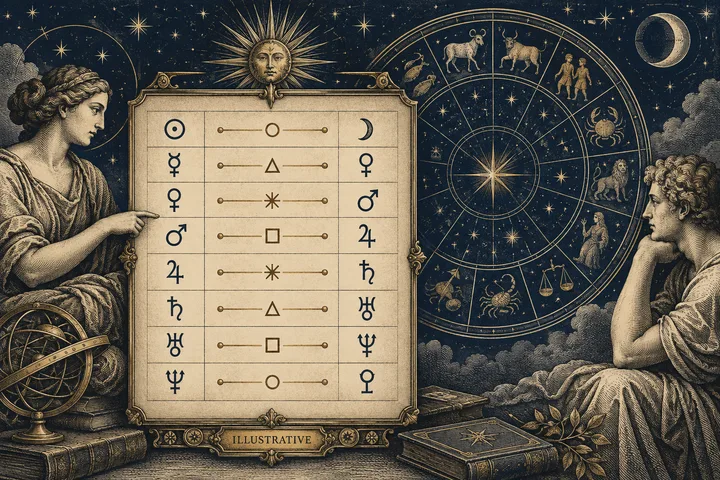
When the wheel and table seem to disagree
Sometimes the wheel appears to contradict the table. Check the display rules before you make a symbolic judgment. The line style may be unfamiliar, the planets may sit in signs that don’t look like the textbook aspect, or the two displays may be using different rules.
Check the degrees first. A sign relationship gives you a broad pattern, but an aspect is measured by degree. A planet at 28° Aries and another at 2° Cancer are about 64° apart, so they’re near a sextile by degree, with a 4° orb, even though Aries and Cancer are traditionally square by sign. Astrologers may call this a dissociate aspect. The degree geometry and the sign relationship are both visible, so name both and say which layer your method ranks first.
Next, compare the display settings line by line: zodiac, aspect list, maximum orb, house system, and whether the table includes points as well as planets. A report that permits an eight-degree square will show contacts that a six-degree report leaves out. Neither display has to be broken. They’re answering with different boundaries.
If you’re comparing two reports, record the settings first: tropical or sidereal zodiac, aspect list, maximum orb, house system, and whether the table includes points. Then compare like with like. A disagreement that disappears after the settings match belongs to the report’s frame, not to a new relationship theme.
Make sure the chart type is the same, too. A natal table lists relationships within one chart. A synastry table lists cross-chart contacts. Natal Mercury square Saturn describes one person’s pattern of thought, speech, restraint, and effort. In synastry, Mercury square the other person’s Saturn describes an exchange, with each person taking part in the contact.
If a row exists in one display but not the other, copy the raw positions into your notes. Record degrees to the minute when the tool provides them, and mark rounded values as rounded. Then ask whether the difference comes from a missing point, a different orb, or a different aspect family. Read the shared contact first and label the disputed item as conditional.
The same boundary applies to placements supplied from memory. ‘My Venus is in Leo’ supports a sign discussion. It cannot establish a Venus square Mars without degrees for both placements. House overlays belong to a separate layer too. They require reliable birth times and a stated house system, so if your inputs stop at Moon, Venus, and Mars signs with optional degrees, leave houses out.
Sources: Aspect - Astrodienst Astrowiki; Orb - Astrodienst Astrowiki; The Meaning of the Aspects in Astrology - Cafe Astrology
How orbs change the strength of a contact
Orb is the distance between the exact aspect and the actual positions. If two planets are 93° apart, they form a square with a 3° orb. If they are 96° apart, the square has a 6° orb. The angle stays the same kind of aspect, but the closeness changes how prominently many astrologers read it.
For this comparison guide, use a six-degree orb for selected major cross-chart contacts. Read a 0°30' contact as especially tight. Read a 5°50' contact as a supporting influence. The shared rule gives the table a consistent scale, even though astrologers may choose different limits for different planets or practices.
A tight aspect often feels automatic. It can run before either person has named it. A wider aspect may be easier to notice consciously, especially when the couple has enough life experience to see the pattern from the outside. The exact experience varies with the planets, the charts, and the person. Orb is a ranking tool, not a volume knob with a fixed universal setting.
Use the orb in context. A close Moon-Venus trine deserves attention even if it is the only soft contact in the table. A 6° outer-planet aspect may matter when it repeats through other contacts or connects to a personal planet. A 2° minor aspect shouldn’t automatically outrank a 5° major aspect. Let closeness decide prominence, then state wider contacts as supporting or conditional rather than equal to the lead.
Sources: Aspect - Astrodienst Astrowiki; Orb - Astrodienst Astrowiki; The Meaning of the Aspects in Astrology - Cafe Astrology
What a table leaves out, and what the wheel can add
An aspect table is powerful because it is narrow. That’s also its limit. It identifies contact, but it doesn’t show every layer of context. The wheel can add sign placement, chart emphasis, house overlays, and patterns made by several contacts. Each layer needs the right inputs.
Signs add style. If two people have a trine by degree but the planets sit across a sign boundary, the exchange may feel less textbook than the symbol suggests. If the signs share an element, the planets may find a familiar language. If they share a modality, the tension may move in a recognizable way. Read signs after the aspect, because they describe how the contact speaks rather than whether the contact exists.
Houses add lived territory. If one person’s Venus falls in the other person’s fifth house, an astrologer may explore romance, play, pleasure, and creative expression through that overlay. But house placement depends on birth time and the chosen house system. When those inputs aren’t supplied, leave the house layer out. A clean sign-and-aspect reading is stronger than a detailed house reading built on missing information.
Patterns add structure. Three or more contacts can form a larger shape, such as a cross-chart T-square, but don’t announce a named pattern because three lines happen to cross in a picture. Confirm the geometry and the definitions being used. Then ask what the pattern adds beyond its individual aspects. If it adds nothing, keep the simpler reading.
The wheel can show whether one planet receives several contacts. In this example, Daniel’s Mars receives Maria’s Venus square and Mercury trine. That concentration makes Mars a useful organizing point: desire and speech both meet the same person’s way of acting. It doesn’t make Mars a guilty party. It shows where the chart keeps directing attention.
The two displays also reveal different kinds of absence. A table makes a listed contact obvious. The wheel makes a cluster or an isolated planet easier to notice. That can suggest a useful question: which parts of the relationship feel unspoken, underused, or outside the main pattern?
The strongest exception is a dramatic wheel built from data you can’t verify. It may show angles, houses, minor aspects, or rounded positions. In that case, use the wheel for visual placement and clusters, but don’t turn those extras into facts. Also check for duplicate rows: Maria’s Venus square Daniel’s Mars and Daniel’s Mars square Maria’s Venus describe one cross-chart contact. A synastry aspect describes interaction between natal chart factors, not a calendar date.
Sources: Aspect - Astrodienst Astrowiki; The Meaning of the Aspects in Astrology - Cafe Astrology; Synastry: Love and Relationship Astrology - Cafe Astrology
Turn the reading into a useful relationship question
A synastry table becomes useful when it changes the question you ask each other. In the worked example, tenderness comes easily, while words, timing, and desire can heat up. Don’t ask, “Are we compatible?” Ask, “When we feel close, what helps us stay close during a charged conversation?” That question respects both the trine and the squares.
For a Moon contact, ask what makes each person feel received. For Venus, ask how affection becomes visible. For Mars, ask how each person starts, pursues, disagrees, and cools down. The planets give you the subject. Your life together supplies the evidence.
Choose a question that can be answered with an example. ‘Do you understand my Moon?’ is hard to test. ‘When I’m upset, do I want comfort, space, advice, or touch?’ gives both people something real to answer. The chart can suggest the subject, but the answer belongs to the two of you. That protects the reading from becoming a label either person has to defend.
Use a challenging aspect to name a skill, not a flaw. Mercury square Mars may call for slower replies and fewer assumptions. Venus square Saturn may call for warmer reassurance alongside clear limits. Use a flowing aspect to name a practice, not a guarantee. Moon trine Venus may make kindness natural, but kindness still needs to appear on difficult days.
Keep the reading mutual. One person’s planet may describe what she brings into the contact, while the other person’s planet describes what he receives or activates. Neither role is a fixed identity. Synastry describes interaction. It doesn’t decide what either person must do or whether a relationship deserves your time.
Translate the leading contact into ordinary words, then test it against the table. ‘Comfort and affection can meet easily’ is more useful than ‘Moon trine Venus.’ If another contact qualifies that sentence, name it. With signs but no degrees, discuss sign style without calling an exact aspect present.
Your final note can be brief: leading theme, strongest exception, one practice, one question. For this example: tenderness comes naturally, desire and speech can heat up quickly, pause before replying, and ask what helps each person feel heard.
Open the conversation with the symbol translated into a possibility, not an accusation: ‘I wonder if we show care differently when things get tense. What do you notice?’ Let the answer correct or deepen the reading. A good synastry interpretation stays alive when it meets real experience.
Sources: The Meaning of the Aspects in Astrology - Cafe Astrology; Synastry: Love and Relationship Astrology - Cafe Astrology
A little more clarity
Should I read the synastry wheel or aspect table first?
Read the aspect table first. It gives you the planet pair, aspect, and orb in a clean row. Then use the wheel to check signs, clusters, and house overlays when those inputs are available. The table helps you rank the contacts. The wheel adds context.
What does a 6° orb mean in synastry?
A 6° orb means the planets are six degrees away from the exact angle of the aspect. In this guide, it is the outer limit for selected major cross-chart contacts. Treat a 6° aspect as a supporting influence, especially when a tighter contact already carries the main theme.
Can a square be positive in a synastry chart?
Yes. A square creates friction, but friction can produce movement, honesty, and growth. Read the planets involved, the signs, and the orb. Then name the skill the tension asks for. A square describes work between two energies, not a final judgment about the relationship.
Can I read synastry without houses or exact birth times?
You can read known sign placements and cross-chart aspects when the degrees are supplied. You can’t responsibly add house overlays without the needed birth-time inputs. A sign-and-aspect reading still shows how the listed planets meet, while keeping the missing house layer out of the interpretation.
Sources & further reading
- Aspect - Astrodienst Astrowiki
Defines major aspects, orbs, aspect patterns, and the way planets and signs contribute to interpretation.
- Orb - Astrodienst Astrowiki
Explains orb as the allowed distance from an exact aspect and notes that astrologers use different orb rules.
- The Meaning of the Aspects in Astrology - Cafe Astrology
Supports the distinctions between conjunction, square, trine, sextile, opposition, and the effect of closeness.
- Synastry: Love and Relationship Astrology - Cafe Astrology
Supports reading cross-chart conjunctions, oppositions, flowing aspects, squares, signs, and planet-specific synastry themes.
Synastry Comparison Report
Enter known placements for two people. Get an input-by-input comparison, selected aspect calculations and a clear record of what remains uncertain.
Compare our placements