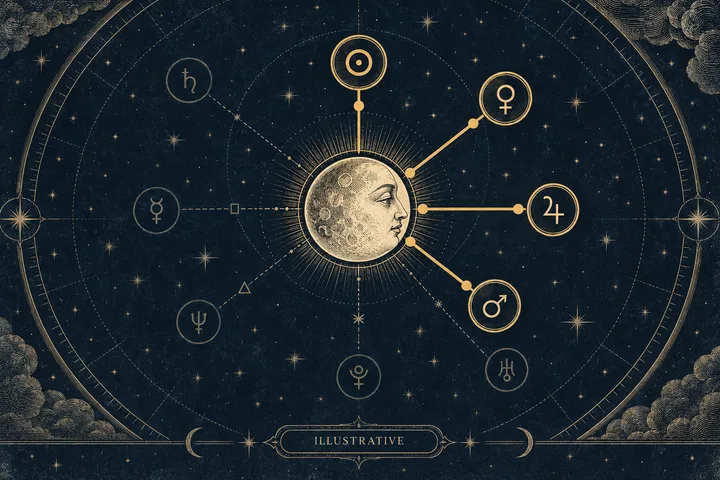
Read a Moon-centered synastry cluster as one emotional story, not a pile of separate meanings. Start with the tightest major aspect to the Moon. Then name the planet making that contact, read the Moon’s sign, compare the next closest contacts, and test the pattern against ordinary behavior. A close Venus or Jupiter contact may describe ease and care. Mars, Saturn, Uranus, Neptune, or Pluto can add heat, pressure, distance, idealization, or depth. The Moon person often feels the cluster as a direct change in safety, habit, and emotional response, while the other person may feel like the one who activates, supports, challenges, or unsettles that inner life. Use a six-degree orb for this report, give the smallest orbs the most weight, and do not let one dramatic contact erase the rest of the chart. The useful question is not whether the cluster proves a bond. It is what emotional pattern it repeats, and what both people can do with it.
Why one Moon can become the center of the synastry story
A Moon-centered cluster forms when several contacts from one person’s chart converge on the other person’s Moon. You might see a partner’s Venus conjunct your Moon, their Mars trine it, and their Saturn square it. You might see one person’s Moon receiving contacts from the other person’s Sun, Mercury, and Uranus. The chart can look crowded around one symbol. The reading should not.
The Moon describes the private rhythm of a chart: what feels familiar, what soothes the nervous system, how a person responds before they have time to explain themselves, and the habits that make daily life feel like home. When another person’s planets touch it, the relationship enters that private room. That does not automatically make the bond permanent. It does mean the contact is likely to show up in felt experience, routine, memory, care, and instinctive reactions.
The first principle is simple. The Moon is the receiver, not the whole relationship. A cluster around it tells you where the relationship has emotional leverage. It does not replace the rest of the synastry. Venus still describes attraction and values. Mars still describes desire, pursuit, anger, and action. Mercury still describes how feeling becomes language. Saturn still marks responsibility, limits, and time. Read every planet through the Moon, then return each planet to its own job.
This is why a cluster can feel stronger than one isolated aspect. Several planets repeat the same doorway. The relationship may keep returning to questions of closeness, reassurance, privacy, home, family, timing, or emotional labor. But repetition is not the same as certainty. Rank the contacts before you interpret them. Otherwise the loudest symbol, often Uranus, Pluto, or a dramatic conjunction, can crowd out the contact that actually explains the couple’s daily life.
For a clean comparison, record whose Moon is involved, the other person’s planet, the aspect, the exact degree distance if you have it, and the signs. If you only know sign placements, you can describe the sign relationship, but you cannot honestly call the contact close. That distinction matters. A synastry reading becomes useful when it tells you not only what a symbol means, but why this symbol deserves more attention than the next one.
Sources: Synastry: Moon - Moon Aspects Between Two Charts; Synastry: Moon - Mercury Aspects Between Two Charts; What Is a Synastry Chart? Birth Chart Compatibility
Start with the tightest contact, not the most dramatic planet
Begin with degree distance. An aspect is an angular relationship between two chart factors. The orb is the allowed distance from the exact angle. A conjunction is built around zero degrees, a sextile around sixty, a square around ninety, a trine around one hundred twenty, and an opposition around one hundred eighty. In this comparison, use a six-degree orb for major planet-to-planet contacts. A contact at one degree is the anchor. A contact at five degrees is part of the weather. It should not lead the forecast.
A tight aspect does not always feel pleasant. It feels present. A close Moon-Saturn square can describe emotional weight more clearly than a loose Moon-Jupiter trine describes comfort. A close Moon-Uranus conjunction can explain sudden shifts in closeness even when the couple also has soft Venus contacts. Strength and ease are different measures. Keep them separate from the first sentence.
Next, rank by aspect type. Conjunctions merge the planets and make the contact hard to ignore. Squares create friction that demands adjustment. Oppositions pull two poles into awareness, often through the other person. Trines allow energy to move with less effort. Sextiles open a door that both people still have to use. These are not moral grades. A square can produce honesty and growth. A trine can remain passive. The aspect tells you how the planetary functions meet. It does not decide how maturely the pair will use them.
Then consider whether several contacts form a clear chain. Suppose the partner’s Venus is one degree from the Moon, Mercury is three degrees from the Moon, and Mars is five degrees from the Moon. The Venus contact leads with affection and value. Mercury gives the feeling words. Mars adds urgency and heat. Suppose instead Saturn is one degree away and Venus is five degrees away. The first story is responsibility, inhibition, or endurance. Warmth is present, but it is not the headline.
Use a small table in your notes, even if it never appears in the final reading: planet, aspect, orb, sign, and repeated theme. Sort by orb. Circle the two closest major aspects. Underline any planet that appears in more than one contact. This is the quickest way to keep the cluster from becoming a list. A cluster is not important because it contains many lines. It is important when the lines reinforce a specific emotional pattern. Add one more column for the everyday area where the contact appears: affection, conversation, conflict, home, sex, work, or repair. That column keeps the reading grounded. If a supposed Moon cluster never touches daily life, it may be a loose background pattern rather than the relationship’s main story. If several contacts point to the same area, you have found the place where the symbolism is most likely to become visible.
Sources: Synastry: Moon - Mercury Aspects Between Two Charts; What Is a Synastry Chart? Birth Chart Compatibility; Aspect
Read the Moon person and planet person as two roles
In synastry, the Moon person is the person whose Moon receives the contact. The planet person is the person whose planet makes the contact. These labels describe roles in the aspect, not fixed personalities. The Moon person may feel the contact as an immediate bodily or emotional response. The planet person may feel like they are bringing a particular function into the Moon person’s inner life. Both people experience the contact, but they may not experience it in the same order.
With Moon-Venus, the Venus person may express affection in a way that comforts the Moon person. The Moon person may feel seen without needing to explain every need. With Moon-Mercury, the Mercury person may ask questions, name patterns, or offer solutions, while the Moon person wants to be heard before being advised. A supportive contact can still miss its mark if Mercury answers a feeling that was only asking for witness.
With Moon-Mars, the Mars person activates the Moon person quickly. That can feel alive, protective, sexual, or irritating. The Moon person may react before understanding what happened. With Moon-Saturn, the Saturn person can bring steadiness and commitment, but may also become the person who sets the emotional temperature. The Moon person may feel held, judged, or both. The aspect and the signs tell you which side deserves more weight.
With Moon-Uranus, the Uranus person can awaken a new emotional rhythm. The Moon person may feel fascinated, liberated, or unable to settle. With Moon-Neptune, the Neptune person may evoke tenderness, imagination, and spiritual feeling, while the Moon person may also struggle to know what is actually being offered. With Moon-Pluto, the Pluto person may draw out deep material that neither person can keep at the surface. Depth is not the same as safety. Name both.
The most helpful phrasing stays specific. Say, “The Saturn person may become the one who sets the pace for emotional availability,” rather than, “Saturn controls the Moon.” Say, “The Moon person may seek reassurance when Uranus changes the rhythm,” rather than, “Uranus is unreliable.” Astrology describes a field of response. It does not remove choice, accountability, or the need to observe what each person actually does.
Sources: Synastry: Moon - Moon Aspects Between Two Charts; Synastry: Moon - Mercury Aspects Between Two Charts; What Is a Synastry Chart? Birth Chart Compatibility; Synastry: Moon - Uranus Aspects
Let the Moon’s sign tell you what kind of safety is being touched
The Moon’s sign is the room where the cluster takes place. The planets describe what enters the room. The sign shows what the Moon needs in order to relax, trust, and respond freely. A Moon in Taurus may seek steadiness, physical comfort, and reliable rhythms. A Moon in Gemini may need words, movement, and room to change its mind. A Moon in Cancer may protect memory, home, and emotional continuity. A Moon in Aquarius may need friendship, space, and a bond that allows individuality.
Do not reduce this to a sign stereotype. Ask a sharper question. What does this Moon treat as proof that life is manageable? Earth Moons may listen for consistency. Water Moons may listen for emotional attunement. Fire Moons may listen for warmth, courage, and a sense that feeling can move into action. Air Moons may listen for understanding, perspective, and freedom to speak. The same Venus contact will land differently in each room.
Sign compatibility can support the aspect, but it does not cancel the degree. A Moon in Virgo may form a tight trine to a partner’s Venus in Capricorn. The earth connection can make affection practical, calm, and easy to build into daily life. A Moon in Virgo may also square a partner’s Mars in Sagittarius. The mutable square can turn small routines into arguments about urgency, criticism, or who gets to decide what is reasonable. Read the sign as texture, not as a verdict.
Pay attention to element and modality. The element describes the emotional medium: fire, earth, air, or water. The modality describes how the Moon handles change: cardinal Moons initiate, fixed Moons hold, and mutable Moons adapt. A cluster can repeat one of these qualities. Several planets in cardinal signs may make the relationship emotionally active and quick to respond. Several fixed contacts may make it loyal and hard to shift. Several mutable contacts may keep the emotional field flexible, but harder to stabilize.
The sign also reveals what repair may require. A Libra Moon may need a fair conversation and a gentler tone. A Capricorn Moon may need a plan it can trust. A Pisces Moon may need tenderness without interrogation. A Leo Moon may need warmth that is expressed, not assumed. Once you know the sign’s need, return to the cluster and ask which planet supports it, which planet strains it, and which planet makes it impossible to ignore.
Sources: What Is a Synastry Chart? Birth Chart Compatibility; Synastry: Moon - Uranus Aspects
Rank the planets around the Moon by the job they perform
A good Moon cluster reading names the planets in order. The Moon is asking, “What does this person bring into my emotional life?” The answer depends on the planet. The Sun brings identity, vitality, and the need to be recognized. Mercury brings language, questions, interpretation, and the daily exchange of information. Venus brings affection, pleasure, values, and the style of giving and receiving love. Mars brings desire, heat, conflict, initiative, and the pressure to act.
Jupiter can enlarge the Moon’s emotional world. The couple may laugh, travel, celebrate, or feel that care can grow. But Jupiter can also enlarge expectation. Saturn can give a bond structure and staying power. It can also make the Moon person feel measured, delayed, or responsible for being composed. Uranus brings surprise and freedom. Neptune brings longing, imagination, and porous boundaries. Pluto brings intensity, compulsion, and the urge to transform what has been hidden.
Do not call a planet good or bad before you identify the task it creates. Venus may ask, “How do we make affection visible?” Mars may ask, “How do we disagree without turning activation into injury?” Saturn may ask, “What can we promise and keep?” Uranus may ask, “How can closeness include space?” Neptune may ask, “What are we sensing, and what are we actually saying?” Pluto may ask, “What truth can no longer stay buried?” Those questions turn symbolism into useful interpretation.
If the same planet touches the Moon more than once, promote it. A partner’s Mars conjunct the Moon and square the Moon’s ruler carries more weight than a single loose Mars contact. If different planets repeat one theme, promote the theme. Venus and Jupiter may both support warmth. Saturn and Pluto may both increase gravity. Mercury and Uranus may both make the emotional field mentally active. The reader needs the pattern, not every possible keyword.
One practical rule helps: read the closest planet first, the fastest planet next, and the planet that repeats a theme third. The closest planet describes the strongest channel. The fastest planet often shows what the couple notices in ordinary exchanges. The repeated planet shows what keeps returning. This is a guide, not a mathematical law. If a slower planet is exact while a faster planet is wide, the slower contact can still dominate the life of the relationship.
Sources: Synastry: Moon - Moon Aspects Between Two Charts; Synastry: Moon - Mercury Aspects Between Two Charts; What Is a Synastry Chart? Birth Chart Compatibility
Use the major aspects to describe how the cluster behaves
The conjunction fuses. When a partner’s planet is conjunct the Moon, that planet enters the Moon person’s immediate emotional field. Moon-Venus can feel tender and familiar. Moon-Mercury can make private material speakable. Moon-Mars can make reactions fast and physical. Moon-Saturn can make the bond serious from the beginning. The conjunction does not promise ease. It makes the planetary meeting central.
The square presses. A Moon square another person’s planet often shows where two functions want different things at the same time. Moon-Mercury may turn feeling into debate. Moon-Mars may turn hurt into attack or defense. Moon-Saturn may make comfort collide with restraint. The square gives the relationship a problem to solve. If the pair solves it, the contact becomes a skill. If they keep blaming the symbol, it becomes a loop.
The opposition mirrors. The planet person can seem to carry a quality the Moon person both needs and resists. Moon-Uranus opposition may make freedom and closeness face each other across the relationship. Moon-Saturn opposition may alternate between seeking structure and pushing against it. The contact can become a conversation between two poles. It needs conscious translation, because each person may assume the other should already understand the missing half.
The trine flows. It can describe an instinctive fit, shared timing, or emotional permission. Moon-Mercury trine can make personal conversation easy. Moon-Venus trine can soften daily life. Moon-Jupiter trine can enlarge trust. Yet a trine may stay invisible because nobody has to work for it. Name the gift, then name the practice that keeps it alive. Ease is a resource, not a guarantee.
The sextile opens. It offers a usable path, but the pair must walk through it. Moon-Saturn sextile can support dependable care when both people accept responsibility. Moon-Uranus sextile can make unusual routines feel refreshing instead of disruptive. Moon-Mars sextile can turn feeling into action without constant friction. In a cluster, sextiles often tell you how to work with the harder contact. They are the handles on the door.
Sources: Synastry: Moon - Mercury Aspects Between Two Charts; What Is a Synastry Chart? Birth Chart Compatibility; Aspect
Worked example: one Moon, three different emotional instructions
Imagine Maria has the Moon at 14 degrees Taurus. Consider an example in which Alex’s Venus is at 15 degrees Taurus, Mars is at 18 degrees Cancer, and Saturn is at 11 degrees Aquarius. The personal chart positions here are illustrative inputs, not a calculated couple’s chart. The point is to show how a reader can sort a cluster when several contacts converge on one Moon.
Start with Alex’s Venus conjunct Maria’s Moon at a one-degree orb. This leads the reading. Venus speaks the language of affection, taste, pleasure, and values. In Taurus, the contact may be felt through calm presence, touch, food, reliability, and the quiet pleasure of sharing a familiar space. Maria may feel that Alex understands what comfort means without needing a long explanation. Alex may experience Maria’s emotional style as attractive and worth protecting.
Next, Mars at 18 degrees Cancer forms a sextile to the Taurus Moon at a four-degree orb. This is not as exact as Venus, but it gives the relationship a way to act on care. Alex may respond to Maria’s moods with practical effort, food, physical closeness, or a quick defense of the shared space. Because Mars is in Cancer, the action is personal and protective. The shadow is that protection can become touchiness. A small disagreement about routine may carry a larger feeling about belonging.
Saturn at 11 degrees Aquarius forms a square to the Taurus Moon at a three-degree orb. This is the strongest challenge in the example, and its three-degree distance puts it ahead of the wider Mars sextile. Saturn may make Maria feel that her needs must be justified, timed, or earned. Alex may believe he is offering structure or long-term seriousness. Maria may experience the same behavior as coolness or delay. The Venus contact says, “You are precious.” The Saturn contact asks, “What can we sustain?” Both belong in the story.
The ranked interpretation is therefore not, “Alex is romantic but difficult.” It is more precise: affection is the entry point, emotional action is available, and the central work is making reliability feel warm rather than conditional. The Taurus Moon needs consistency. Venus offers it naturally. Saturn tests it. Mars can help when care becomes an act instead of a promise. The practical question is whether Alex’s limits arrive with explanation and respect, and whether Maria can name a need before Saturn’s silence turns it into a judgment.
Notice what this method avoids. It does not add a score. It does not claim the bond is destined. It does not pretend to know how Maria and Alex behave outside the example. It reads the supplied placements as symbolic instructions and then gives the couple a question they can actually answer: when comfort and responsibility collide, do we create a dependable rhythm or make one person prove that the need is valid?
The strongest exception: a beautiful cluster can still miss the lived relationship
The strongest exception is simple. A Moon cluster can be symbolically vivid and still fail to describe the relationship’s main problem if the chart inputs are incomplete or the wider chart changes the emphasis. A close Moon-Venus contact may describe tenderness, but it cannot tell you whether the couple communicates honestly, shares time, or keeps promises. A Moon-Saturn contact may describe gravity, but it cannot prove that commitment is mutual. The astrology gives a field. The people give it a life.
Missing degrees matter. If you know only that one person’s Moon is in Virgo and the other person’s Venus is in Virgo, you can discuss sign resonance. You cannot rank that contact against a Moon-Mars aspect without exact positions. If the Moon degree is uncertain because the birth time is uncertain, treat contacts to angles and house cusps with extra care. A basic placement comparison can still use supplied signs and optional degrees, but it should not invent precision that was never provided.
The wider natal chart matters too. A Moon person with natal Saturn close to the Moon may already know the language of restraint. The partner’s Saturn contact may echo that pattern, but it is not the only source of the feeling. A Moon person with strong Uranus emphasis may welcome a partner’s unusual rhythm. Another person may find the same contact destabilizing. Synastry activates natal material. It does not erase it.
The outer planets deserve careful ranking. Moon-Neptune can feel soulful, gentle, and deeply receptive, but it can also blur the line between intuition and assumption. Moon-Pluto can open a powerful bond, but intensity should not be used to excuse control, fear, or emotional punishment. Moon-Uranus can make a relationship alive and liberating, but intermittent closeness still needs to be discussed. The exception is not a reason to distrust the aspect. It is a reason to read the aspect in full.
So test the interpretation against three observations: what happens when one person needs comfort, what happens when plans change, and what happens after conflict. If the cluster says emotional safety but ordinary life feels evasive, the behavior deserves attention. If the cluster says pressure but the couple repairs quickly and respects limits, the challenging contact may be functioning as a growth edge. Let lived pattern refine the symbolism. That is not a retreat from astrology. It is how astrology becomes specific. The Moon asks for evidence in the form of repeated care, not grand language alone.
Sources: Synastry: Moon - Moon Aspects Between Two Charts; What Is a Synastry Chart? Birth Chart Compatibility; Synastry: Moon - Uranus Aspects
Turn the cluster into a relationship decision guide
A Moon cluster becomes useful when it changes what you ask. Do not ask, “Is this good synastry?” Ask, “What does this contact make easy, and what does it make necessary?” The answer should name one gift, one pressure, and one practice. For Moon-Venus, the gift may be natural affection, the pressure may be taking comfort for granted, and the practice may be saying appreciation aloud. For Moon-Mars, the gift may be quick protective action, the pressure may be reactive conflict, and the practice may be pausing before answering from hurt.
For Moon-Saturn, ask what commitment looks like in a week, not only in a promise. Who follows through? Who carries the difficult task? Can the Moon person state a need without being treated as weak? Can the Saturn person set a limit without withdrawing warmth? For Moon-Uranus, ask how much space keeps the bond alive and how much unpredictability makes it hard to trust. For Moon-Neptune, ask what has been said clearly and what has only been felt.
For Moon-Pluto, ask whether depth produces honesty or surveillance. Can both people keep private ground? Can a difficult truth be spoken without punishment? For Moon-Jupiter, ask whether generosity remains generous when one person is tired or says no. For Moon-Mercury, ask whether conversation makes feeling more understandable or turns every feeling into a problem to solve. These questions give each planet a real-world test.
When several contacts cluster, choose one shared ritual that answers the dominant need. A couple with a Moon-Saturn-Mercury emphasis might schedule a weekly check-in with a clear end time. A Moon-Venus-Mars cluster might protect ordinary physical affection and make repair immediate after a sharp exchange. A Moon-Uranus-Neptune cluster might name plans clearly while leaving room for surprise. The ritual should fit the sign and aspect. Small repetition builds the emotional environment the chart describes.
The decision guide is not a compatibility verdict. It helps you decide what to watch and what to practice. If the closest contact is supportive, protect it from neglect. If the closest contact is difficult, give it language before it becomes resentment. If the chart data are incomplete, gather the missing degrees instead of forcing a conclusion. A strong reading leaves the reader with a better question and a more honest next move.
Sources: Synastry: Moon - Mercury Aspects Between Two Charts; What Is a Synastry Chart? Birth Chart Compatibility; Aspect
Return to the Moon with one practical action
The question was how to read a synastry aspect cluster around one person’s Moon. Read it from the inside out: find the closest major contact, identify the planet’s job, read the Moon’s sign as a need for safety, and describe the aspect as a style of contact. Then ask whether the next closest contact supports, complicates, or repeats that first story.
For the illustrative example, the reading is simple: closeness feels warm and tangible because Venus rests on the Taurus Moon, while the work is making Saturn’s limits feel dependable rather than withholding. That sentence has a center, a reason, and a task. It leaves room for Maria and Alex to decide whether the symbolism matches their experience.
Make the interpretation observable. Ask the Moon person what helps them settle after a difficult day, and ask the planet person what they believe they’re offering. Compare the answers after a real disagreement, not only during a calm reading. If intention and impact differ, start there. A Moon cluster is most useful when it turns a crowded chart into one clear conversation and one practice the couple can repeat.
Sources: Synastry: Moon - Moon Aspects Between Two Charts; Synastry: Moon - Mercury Aspects Between Two Charts; What Is a Synastry Chart? Birth Chart Compatibility; Synastry: Moon - Uranus Aspects
A little more clarity
What counts as a synastry aspect cluster around the Moon?
It is a group of contacts in which several planets from one person’s chart aspect the other person’s Moon, usually within a stated orb. The cluster may include conjunctions, squares, trines, sextiles, or oppositions. Read the contacts together, but rank them by exactness and aspect type. A tight Moon-Saturn square and a wide Moon-Venus trine do not carry equal weight. The Moon person is the person whose Moon receives the contacts, while each planet person brings a different function into that emotional field.
Is the closest Moon aspect always the most important one?
It is the best place to start, not an automatic final answer. A close aspect is usually more immediate than a wide one, but the planet, aspect type, Moon sign, and repeated themes still matter. A close Saturn contact may describe the central work while a slightly wider Venus contact describes the warmth that makes the work possible. Rank the closest contacts first, then test the reading against the relationship’s daily pattern.
Can a difficult Moon aspect be meaningful in synastry?
Yes. Squares and oppositions can show where two people must learn translation, timing, and repair. Moon-Mars may create strong activation that needs a safer way to handle anger. Moon-Saturn may bring commitment and endurance alongside emotional restraint. Moon-Uranus may bring freedom and excitement alongside an unsettled rhythm. A challenging contact is meaningful when you can name both its gift and its demand. It is not a verdict about the relationship.
What if I know the signs but not the exact degrees?
Describe the sign connection, but do not claim a close aspect. Exact degrees let you calculate the orb and rank one contact against another. Without them, you can discuss themes such as a same-sign Moon-Venus resonance or a possible cross-sign relationship, but the result remains broader. A supplied-placements comparison can use known signs and optional degrees. It does not calculate missing natal positions, houses, or angles from birth details.
Sources & further reading
- Synastry: Moon - Moon Aspects Between Two Charts
Supports the reading of Moon-Moon harmony, friction, daily habits, home concerns, and emotional timing in synastry.
- Synastry: Moon - Mercury Aspects Between Two Charts
Supports the distinction between emotional expression and problem-solving in Moon-Mercury contacts.
- What Is a Synastry Chart? Birth Chart Compatibility
Supports the bi-wheel comparison method and layered reading of houses, signs, planets, and aspects.
- Aspect
Supports major aspect angles, orb language, and the interpretation of several aspects as an aspect pattern.
- Synastry: Moon - Uranus Aspects
Supports the reading of Moon-Uranus excitement, emotional distance, changing routines, and unusual domestic patterns.
Synastry Comparison Report
Enter known placements for two people. Get an input-by-input comparison, selected aspect calculations and a clear record of what remains uncertain.
Compare our placements