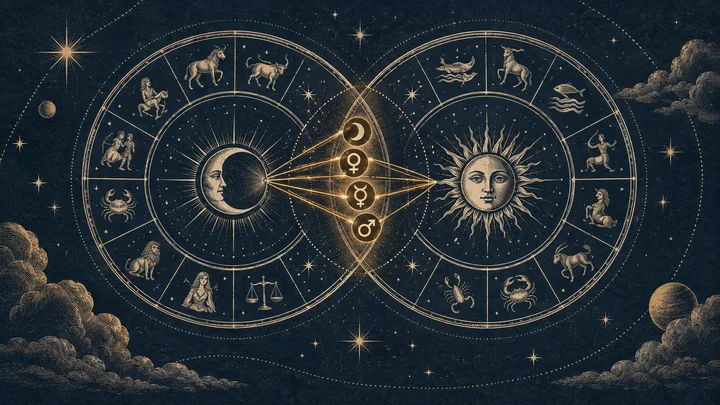
Read several close personal-planet contacts as one concentrated theme before you interpret them one by one. A contact within one degree deserves priority, but its meaning still comes from the planets and aspect involved. Moon contacts describe emotional exchange. Venus shows affection, pleasure, and relating. Mars adds pursuit, heat, and friction. Mercury brings words and mental contact. Start with the tightest aspect, group contacts that repeat the same message, then test whether the pattern is easy, tense, or mixed. For example, a close Moon-Venus contact plus a close Venus-Mars contact may describe warmth and desire working together, while a close Moon-Mars contact can make the same bond reactive when needs and action collide. Use the whole cluster to choose one practical question: what must this connection learn to do well?
What does a one-degree cluster actually tell you?
A one-degree cluster tells you that several chart factors are speaking loudly at the same time. It doesn't tell you that they all say the same thing.
In synastry, you compare one person's chart with another person's chart and study the angular relationships between their planets. An aspect is measured by the distance between two positions on the zodiac. The exact angle might be 0 degrees for a conjunction, 60 for a sextile, 90 for a square, 120 for a trine, or 180 for an opposition. The orb is the distance allowed on either side of that exact angle. A contact at 0 degrees 42 minutes is much tighter than one at 5 degrees 42 minutes, even if both fall within the same policy.
The phrase within one degree can mean two different things. It can mean that each separate contact has an orb of one degree. Or it can mean that a group of planets occupies a one-degree span. Those are not identical. If Person A's Moon at 14 degrees 10 minutes Taurus touches Person B's Venus at 14 degrees 52 minutes Taurus, that is a conjunction with a 42-minute orb. If Person B's Mars sits at 15 degrees 05 minutes Taurus, it also joins the same neighborhood, but the Moon-Mars distance is 55 minutes and the Venus-Mars distance is 13 minutes. You have a cluster, a chain of contacts, and a hierarchy within it.
Astrodienst describes an orb as the deviation from exactness at which an aspect remains valid, and its synastry guidance recommends a smaller orb than a natal chart because a comparison contains twice as many planets and can become crowded. Deborah Houlding's historical review also distinguishes near-exact, or partile, contacts from wider, platick ones. Contemporary astrologers use different limits, so state your rule before you interpret. This article uses a six-degree maximum orb for the report's selected major synastry aspects, while giving contacts within one degree the highest weight.
That distinction keeps you from making the first common mistake: treating closeness as a complete interpretation. Tightness tells you where to look. It doesn't tell you whether the contact feels soothing, demanding, erotic, awkward, or all four in sequence. The planet pair supplies the subject. The aspect supplies the manner. The sign supplies the style. The chart roles and repeating pattern supply the context.
Think of the cluster as a sentence, not a pile of adjectives. The tightest contact is often the verb. The other contacts modify it. If Venus is exactly conjunct Mars, affection and desire may arrive together. If the same Venus also squares Saturn at two degrees, pleasure meets restraint. If Mercury trines both planets, conversation can give the attraction a usable channel. A good reading preserves all three facts without flattening them into a single label such as intense or compatible.
The first decision is therefore simple. Count the contacts, then stop counting. Ask what repeats. A cluster matters because it concentrates attention around a relationship theme, not because three lines on a chart automatically equal three separate events.
There is another reason to resist simple counting. Personal planets move at different speeds, and a group can be close in one chart while the cross-chart contacts spread across another. A person's natal Venus may sit beside their Mars, yet those two planets can contact different planets in a partner's chart. The visual impression of a bundle doesn't replace the aspect table. It only tells you where a bundle may exist.
Use a contact map when the cluster grows dense. Put one person's planets down the left side and the other person's across the top. Fill in only the selected major aspects, adding the exact orb beside each one. Then circle repeated planets and repeated functions. The map makes asymmetry visible. You may find that one person's Moon receives three contacts while the other person's Moon receives none. That difference belongs in the reading because it changes who may feel the pattern most quickly.
Sources: Aspect - Astrodienst Astrowiki; Interaspect - Astrodienst Astrowiki; Planet - Astrodienst Astrowiki
Which layer comes first: orb, planet, or aspect?
Use this order: verify the aspect, rank the orb, identify the planets, then read the signs and chart roles. That sequence keeps a vivid phrase from outrunning the chart data.
First, verify what the contact is. Do not call two planets conjunct because they share a sign, and do not call a sign pairing an aspect without measuring the degrees. A planet at 28 degrees Leo and another at 2 degrees Sagittarius may look like a trine by sign, yet their degree distance is close to a square. Houlding's discussion of partile and platick aspects makes the practical point clear: sign relationships provide a broad frame, while degrees show the actual angular contact.
Second, rank the orb. Put the closest contact at the top. A useful working order is 0 to 1 degree, 1 to 3 degrees, 3 to 5 degrees, and 5 to 6 degrees. This isn't a law of nature. It's a reading discipline. It prevents a loose sextile from stealing the page from an exact square just because the word sextile sounds easier. It also keeps you from giving a 5-degree contact the same weight as a 20-minute contact.
Third, identify the planets. Personal planets bring the pattern into lived experience. The Sun speaks to identity, life force, and the way a person shines. The Moon describes feeling, habit, comfort, and the need for care. Mercury describes thought and communication. Venus shows attraction, pleasure, affection, and the way someone gives and receives value. Mars describes assertion, pursuit, heat, anger, and the force used to get a need met. These are functions, not fixed personality verdicts.
Fourth, read the aspect. A conjunction blends the planets so closely that their jobs can become hard to separate. A trine lets their functions cooperate with little prompting. A sextile offers a useful opening that still needs choice. A square creates pressure, irritation, and work, but it can also supply movement. An opposition makes the two ends visible to each other and often turns the relationship into a balancing act. The aspect does not replace the planets. It tells you how their conversation sounds.
This order also answers a subtle question. Should you always begin with the most exact aspect? Usually, yes. But the most exact contact is not always the most important one in the whole chart. A one-degree Mercury-Mercury conjunction may describe easy mental recognition, while a two-degree Moon-Saturn square may organize the emotional experience more strongly. Exactness ranks attention. Planetary weight, luminary involvement, repetition, and the condition of the planets rank the final interpretation.
A practical report can make that hierarchy visible. Label each contact with the planet pair, aspect, exact orb, and one-line function. Then write a synthesis below the table. The table answers what is present. The synthesis answers what it means together.
Suppose a reader gives you only sign placements and says that three planets are all within one degree. You can explain the possible conjunction pattern, but you cannot quietly turn that statement into a full calculated chart. Ask whether the degrees are tropical or sidereal, whether the minutes are known, and whether the stated positions belong to the same chart or to two different charts. These questions aren't bureaucracy. They protect the reading from a false level of certainty.
If the positions are clear, write the arithmetic in ordinary language. A conjunction at 0 degrees 48 minutes has a 48-minute orb. A square at 2 degrees 15 minutes has a 2-degree-15-minute orb. The reader doesn't need a lecture on geometry, but they deserve enough detail to reproduce the ranking. Precision creates confidence when it remains readable.
Sources: Aspect - Astrodienst Astrowiki; Interaspect - Astrodienst Astrowiki; The Classical Origin and Traditional Use of Aspects
How do you combine Moon, Venus, Mars, Mercury, and the Sun?
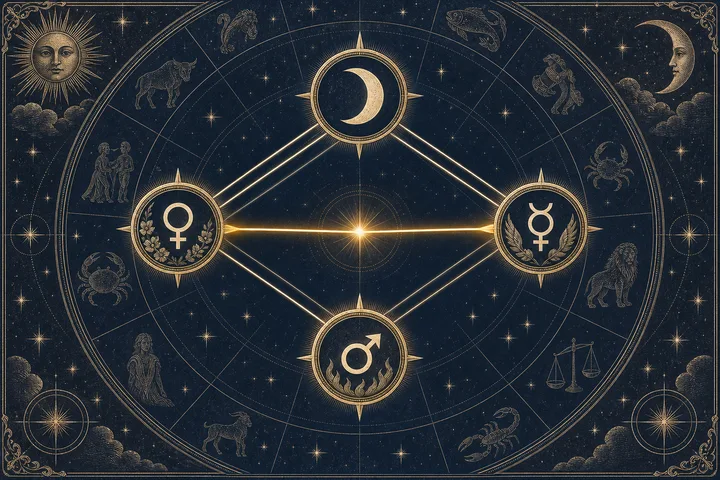
Read the personal planets by the need they carry. When several of them fall within one degree, ask which need leads and which needs support it.
The Moon is the first place to look for felt safety. In a synastry contact, one person's Moon may respond to the other person's planet as though that planet has entered the private room of the psyche. Moon-Venus can feel tender, familiar, and naturally considerate. The Venus person may offer beauty, affection, or reassurance that the Moon person can receive. But the contact still needs the signs and the rest of the chart. A Virgo Moon and Pisces Venus may care deeply while showing care in very different forms.
Venus is the bridge between attraction and value. Venus contacts often show what feels pleasant, appealing, or worth preserving. Venus-Mercury can make compliments, jokes, and aesthetic tastes part of the bond. Venus-Mars brings the love principle into contact with desire and pursuit. It can be sweet. It can be hot. It can also reveal different speeds, especially when one person wants a graceful invitation and the other prefers a direct move.
Mars makes the pattern active. Mars contacts show how energy meets energy. Mars to the Moon can stir protective action, impatience, or a powerful urge to respond. Mars to Venus can animate desire and courtship. Mars to Mercury can sharpen banter or turn disagreement into a contest. In a tight cluster, Mars may act as the trigger that makes a quieter Venus or Moon theme visible in daily life.
Mercury tells you whether the relationship can name what the other planets are doing. A close Mercury contact can give the pair language for attraction, discomfort, plans, and repair. It doesn't guarantee agreement. A square can produce a lively debate or a repeated misunderstanding. What matters is whether the chart's communication channel can carry the emotional and physical charge without distorting it.
The Sun gives the cluster identity and vitality. A personal planet contacting the other person's Sun can make that person feel seen, noticed, or drawn into the other's life direction. Sun-Moon often joins identity with emotional rhythm. Sun-Venus can make appreciation central. Sun-Mars can encourage courage and competition. If the Sun is part of a one-degree chain, the pattern may feel central to how the two people recognize each other, not merely like a private mood.
When all five are involved, resist the temptation to produce a grand romantic verdict. Instead, name the sequence. Perhaps Moon receives, Venus values, Mars moves, Mercury explains, and the Sun gives the pattern a sense of importance. Or Mars acts first, Moon reacts, Venus tries to restore ease, and Mercury must learn to speak before resentment builds. The planets become useful when you give them jobs in a scene.
This is also where sign condition matters. Fire can make a contact quick and expressive. Earth can make it practical and measured. Air can move it through words, ideas, and social exchange. Water can deepen memory, sensitivity, and emotional permeability. Cardinal signs start. Fixed signs hold. Mutable signs adapt. These are modifiers. They do not overturn the planet pair or aspect, but they show the style in which the pattern seeks expression.
The Sun and Moon deserve a special pause because they are not interchangeable with the other personal planets. The Sun wants to express a center. The Moon wants to belong, settle, remember, and feel. When a partner's Venus touches the Sun, appreciation can feed confidence. When Venus touches the Moon, affection can enter the body's sense of comfort. When Mars touches the Sun, action can energize identity or challenge it. When Mars touches the Moon, action may feel protective one day and intrusive the next. The same orb size does not make these contacts equivalent.
Mercury can act as a translator in a cluster. It may connect a Venus theme to a Mars theme by giving each person a phrase for preference and pursuit. It may also expose a gap. A person can feel a deep Moon-Venus bond and still struggle to explain what reassurance means. A close Mercury contact does not solve that gap automatically. It shows where language can become part of the remedy, or part of the recurring trouble.
A personal-planet chain also has a center of gravity. If every contact runs through one person's Venus, that Venus may organize the exchange around attraction, taste, and value. If every contact lands on the other person's Moon, the other person may carry the felt impact. If the chain joins both Suns, recognition and pride may shape the encounter. Name the center. Readers understand a pattern faster when they know which planet gathers the threads.
Sources: Planet - Astrodienst Astrowiki; The Classical Origin and Traditional Use of Aspects
What does a worked cluster look like in practice?
Imagine Maria has Moon at 14 degrees 10 minutes Taurus, Venus at 15 degrees 02 minutes Taurus, and Mars at 14 degrees 58 minutes Taurus. Consider an example in which Alex has Sun at 14 degrees 35 minutes Taurus and Mercury at 15 degrees 20 minutes Taurus. These are illustrative placements, not a calculated personal chart.
The first pass sees a crowded Taurus zone. The second pass measures it. Maria's Moon is conjunct Alex's Sun within 25 minutes. Maria's Moon is conjunct Alex's Mercury within 1 degree 10 minutes. Maria's Venus is conjunct Alex's Sun within 27 minutes. Maria's Venus is conjunct Alex's Mercury within 18 minutes. Maria's Mars is conjunct Alex's Sun within 23 minutes and Alex's Mercury within 22 minutes. The pattern is not six unrelated conjunctions. It is a concentrated exchange around Taurus themes, with the Moon, Venus, and Mars from one chart meeting the Sun and Mercury from the other.
Now give each contact a role. Maria's Moon meeting Alex's Sun can make his presence feel emotionally legible to her, while her emotional responses become visible to him. Her Venus meeting his Sun can add admiration and warmth. Her Mars meeting his Sun can add activation, pursuit, and the possibility that her directness wakes up his will. Her planets meeting his Mercury pull feeling, affection, and action into conversation. He may put words to what she senses, enjoys, or wants.
The Taurus setting changes the tempo. This cluster may prefer touch, reliability, food, money decisions, shared routines, and proof that survives the mood of the day. It may take time to shift. That can feel reassuring when both people want steadiness. It can feel stubborn when one person asks for movement and the other protects an established pattern. The sign gives the pattern a body. It doesn't decide how either person will behave.
The ranking matters. The Moon-Sun, Venus-Sun, and Mars-Sun contacts are all under half a degree, so the Sun acts as a strong organizing point. Alex may experience Maria's Moon, Venus, and Mars as different faces of one concentrated presence. The Venus-Mercury contact at 18 minutes is also very close, so affection and language deserve special attention. The Moon-Mercury contact at 1 degree 10 minutes remains relevant, but it ranks below the closer contacts. A good reading says this plainly instead of claiming that every line has equal force.
The synthesis might read like this: Maria's emotional nature, affection, and desire all land on Alex's identity and voice. He may feel seen, appreciated, and stirred into action. She may feel that he gives a name and a center to several parts of her relational life. The gift is coherence. The pressure is concentration. When one person becomes the channel for comfort, pleasure, desire, and self-expression all at once, a small disappointment can touch several layers together.
That last sentence is the useful turn. The cluster does not only describe chemistry. It suggests a decision about pacing. The pair should protect separate sources of pleasure, rest, and self-direction, so one unanswered message doesn't become a verdict on emotional safety, attraction, and identity at the same time. In a report, that is stronger than saying the contacts are powerful. It tells the reader what to watch.
Then test the example against the rest of the chart. Is there a Saturn contact that asks for patience? Is Mercury under pressure from Mars elsewhere? Does the Moon have another supportive contact? Are the signs actually the same, or does the conjunction cross a sign boundary? Do the degrees include minutes, or are they rounded? Each answer can refine the story. None should be invented.
Notice what the example does not say. It doesn't say Maria and Alex must date, that they will stay together, or that one cluster proves a special destiny. It says the chart comparison highlights a particular exchange. That exchange becomes useful when the pair can recognize it in a real scene. The chart names the pattern. Their choices show its maturity.
A different cluster would change the reading even if its degrees were just as exact. Imagine Maria's Moon at 14 degrees Taurus meeting Alex's Mars at 14 degrees Taurus, while her Venus meets his Saturn within half a degree. The pattern could still contain attraction and concentration, but the lived sequence would change. Her Moon may react to his action, while her Venus asks whether affection can become dependable. Exactness gives both contacts weight. Planet roles decide the story.
You can also compare a chain with a bridge. A chain links several planets through close contacts. A bridge connects two otherwise separate themes. For instance, Moon-Mars may show reactive energy and Venus-Saturn may show caution, while Mercury trine both can provide the bridge that lets the pair discuss fear without turning it into accusation. This is why a reading should scan for one integrating contact after it identifies the loudest cluster.
When should a tight contact outrank a wider one?
A tight contact usually outranks a wider one when the planets and aspect types are comparable. But the smallest number doesn't win by itself. Exactness tells you where to look first; the question, the planets, and the repeated function tell you what deserves the most attention.
A contact within one degree belongs at the center of the first pass. Contacts within one to three degrees still carry clear weight. A major contact between three and six degrees can remain useful when it involves the Sun or Moon, repeats the same theme, or explains the practical concern the reader brought to the chart. A wide contact should support the pattern. It shouldn't rescue one that has no other testimony.
This is why a two-degree Sun-Moon contact can matter more to a question about emotional recognition than an exact minor aspect between less central points. The luminaries bring identity and feeling into the room. Astrodienst's aspect guidance also places the conjunction first among the major aspects, while its synastry guidance recommends tighter orbs because comparing two charts creates more contacts to sort. The rule is not 'closer always wins.' It is 'closer earns attention, then the chart decides the rank.'
Repetition adds a second kind of weight. Three contacts involving Venus may keep returning you to affection, pleasure, taste, and value. Three contacts involving Mars may keep returning you to pursuit, anger, courage, or sexual charge. Several planets contacting one person's Moon may make that person feel the exchange quickly, while several contacts landing on the other person's Mars may show more visible activation. Repetition tells you which paragraph needs room. It doesn't prove a fixed outcome.
Aspect type tells you how the repeated function moves. A tight square doesn't become harmless because a looser trine exists. The trine can show where cooperation comes easily. The square can show where the pair must adjust. An opposition can make each person hold one side of a shared tension. Name both the opening and the work. Ease without effort can drift; pressure without a channel can exhaust.
The strongest exception is relevance. If the reader asks why conversations shut down, a close Mercury-Saturn contact deserves priority even if a wider Venus-Jupiter trine sounds more romantic. The trine may describe pleasure or generosity, but Mercury-Saturn speaks more directly to the question. A contact earns its final rank by answering something real in the relationship, not by winning an abstract contest over degrees.
Sign boundaries create another exception. A conjunction can be close by degree while crossing from one sign into the next. Traditional sources have treated degree-based contact and sign-based relationship as related but distinct layers, and astrologers differ on how much weight to give the sign change. Choose one rule and say what it changes. The contact may remain close, while the two planets speak through different sign styles. That is a refinement, not a reason to erase the aspect.
Rounded data need the same honesty. If the chart lists 14 degrees without minutes, you can discuss a likely close contact, but you cannot claim that it is 42 minutes from exact while another is 18 minutes away. Keep the degree as supplied, mark the orb as approximate, and let the planetary roles carry more of the reading. Precision means matching the language to the input.
Applying and separating language can add a further shade when the technique and data support it. An applying aspect is moving toward exactness; a separating aspect has passed it. In a comparison of natal positions, that distinction can describe a developing or established quality within the symbolism, but it shouldn't become a forecast for when the relationship will happen. Keep it secondary. The natal contact remains the main evidence.
Consider an example with two very different contacts. A Mercury-Saturn square at 1 degree 40 minutes may deserve the lead in a reading about missed messages, even if a Venus-Jupiter trine sits at 4 degrees 30 minutes. The square names the pressure the question is asking about. The trine can then show what helps the pair recover warmth after a hard exchange. Reverse the question and the order can change: if the reader is asking what makes shared pleasure easy, Venus-Jupiter may become the opening while Mercury-Saturn explains why ease sometimes turns formal or cautious. The same chart supports both readings because relevance selects the doorway.
In practice, mixed orbs read best when the prose has a visible order. Lead with the closest contact. Let the next contact modify it. Place wider contacts later, with verbs such as adds, colors, or confirms. Then state the one exception that could change the rank. The result is not a scorecard. It is a weighted picture of what the relationship is asking you to notice.
Sources: Aspect - Astrodienst Astrowiki; Interaspect - Astrodienst Astrowiki; Planet - Astrodienst Astrowiki
How can you turn the cluster into a useful synastry reading?
End with behavior the pattern can illuminate, not a verdict about the relationship. A chart contact earns its place in a reading when it helps you ask a better question of the bond you are actually living.
State the shared theme in one sentence, with enough detail to recognize it. 'Several close contacts make the relationship intense' is too loose. 'One person's Moon, Venus, and Mars all meet the other's Mercury within two degrees, so feeling, affection, and desire need clear language' gives the reader a pattern and a task. The sentence names what repeats without pretending that the planets have erased the people.
Separate the roles without turning them into labels. The planet person often describes the function being expressed, while the receiving person describes where it lands in experience. If Maria's Venus contacts Alex's Mercury, Maria may bring affection, taste, or appreciation into the exchange, while Alex may experience the contact through thought, speech, and interpretation. Both people still participate. Alex shapes the tone with his words, and Maria receives those words through the Venus function she brought to the contact.
Now give the pattern a gift and a pressure. A Moon-Venus cluster may offer tenderness but ask for care around reassurance. A Venus-Mars cluster may offer attraction but need agreement about pace and consent. A Mercury-Mars cluster may produce brave, lively conversation but require rules for conflict. A Sun-Moon cluster may create recognition while making differences feel personal. The pressure isn't a curse. It's the part of the pattern that asks for skill.
Imagine Maria and Alex planning a weekend. Maria wants a slow meal and a familiar place. Alex wants to decide quickly and move on to the next activity. Their Taurus cluster can make shared comfort a strong bond, but it can also make one plan carry the weight of security, desire, and being understood. The useful question is not whether the chart is good. It's whether they can name the different needs before either person digs in.
Suppose Maria sends a direct message after feeling ignored. Alex hears the Mars tone and answers defensively, while Maria hears his Mercury reply as a judgment of her Moon. The same cluster that creates recognition can compress the distance between feeling and reaction. Their repair is concrete: pause, name the feeling, state the request, and answer the request before debating the wording. Astrology gives the pattern a map. The people still have to walk it.
For a supplied-placement report, keep the inputs visible. Record the zodiac system, each planet's sign and degree, the selected aspect list, and the orb policy. The Synastry Comparison Report uses supplied Moon, Venus, and Mars signs, optional degrees, and selected major-aspect calculations with a stated six-degree orb. It doesn't calculate natal positions from birth details or houses. That scope is enough for a careful personal-planet comparison when the inputs are clear.
Missing data changes the kind of decision you can make. With exact degrees and minutes, you can rank the cluster's contacts closely. With rounded degrees, you can describe the likely pattern while leaving fine order open. With signs alone, you can discuss sign relationships and planetary roles, but you cannot claim a degree-based aspect. Let the report's confidence follow the chart's detail.
Reverse the chart order when the lived experience seems uneven. Person A's Mars on Person B's Venus is the same geometry as Person B's Venus on Person A's Mars, yet the role language changes depending on whose action and whose values you are describing. One person may feel pursued; the other may feel attractive or provoked. Write both sides. Mutuality is more honest than giving one person all the agency.
Then choose one small action that matches the pattern. For Moon, Venus, and Mars gathered around a partner's Mercury, ask, 'Can we say what we need before feeling turns into pursuit, withdrawal, or a test?' For Moon-Mars under pressure, agree on a pause phrase before the next argument. For Venus-Saturn, talk about what dependable affection looks like in time, touch, money, or practical help. The action should meet the repeated function, not decorate the reading.
A useful final comparison is between a cluster that gathers around one person's planet and a cluster that spreads its emphasis across both charts. Imagine Maria's Moon, Venus, and Mars each contacting Alex's Mercury within a narrow range. Alex may become the person through whom her feelings, affection, and desire get named, so clarity in conversation becomes central. Now imagine the same three planets contacting Alex's Sun instead. Recognition, pride, and the way each person takes up space may matter more than verbal translation. The contacts are equally close, but the practical question changes from 'Can we say it clearly?' to 'Can we make room for both people's will?'
That comparison also keeps the reading from overusing the word intense. Intensity can mean emotional immediacy, physical charge, mental preoccupation, or a strong need to be recognized. The planet receiving the cluster tells you which kind is most likely to matter first. The aspect tells you whether the exchange flows, presses, or swings between the two. The sign tells you the style. A Taurus cluster may seek steadiness and tangible proof; a Gemini cluster may seek movement and conversation. Name the kind of intensity you mean, then tie it to something the reader can observe.
Several contacts within one degree deserve concentrated attention. They don't decide a life, and they don't make every feeling equally urgent. Read the tightest contact as the lead, let the repeated function tell you what the cluster is about, and let the strongest exception keep the reading honest. Then bring one clear question to the relationship and listen for an answer you can see in ordinary behavior. That final step turns a dense chart pattern into something you can practice, observe, and revise together.
Sources: Interaspect - Astrodienst Astrowiki; Planet - Astrodienst Astrowiki; The Classical Origin and Traditional Use of Aspects
A little more clarity
Is a one-degree synastry orb always stronger than a five-degree orb?
Usually, a one-degree contact deserves more weight because it is closer to exactness. But strength also depends on the planets, aspect type, luminary involvement, repetition, and the question you are trying to answer. A one-degree Mercury-Saturn square may explain communication pressure more directly than a five-degree Venus-Jupiter trine explains affection. Treat the orb as a ranking tool, not a complete meaning by itself.
What if several contacts are close but the birth degrees are rounded?
Keep the interpretation at the level the data support. Rounded degrees can show a likely close contact, but they may not let you rank contacts by minutes or decide whether an aspect falls just inside a chosen orb. Record the supplied degree, state that the orb is approximate, and avoid false precision. You can still read the planet roles, signs, and broad aspect pattern while leaving the exact hierarchy open.
Sources & further reading
- Aspect - Astrodienst Astrowiki
Defines aspects, orbs, major aspect angles, and the relative importance of conjunctions.
- Interaspect - Astrodienst Astrowiki
Explains interaspects as the basis of synastry and recommends smaller orbs for comparisons.
- Planet - Astrodienst Astrowiki
Summarizes the astrological functions of the Sun, Moon, Mercury, Venus, and Mars.
- The Classical Origin and Traditional Use of Aspects
Clarifies degree-based aspects, partile and platick contacts, applying and separating aspects, and historical orb practice.
Synastry Comparison Report
Enter known placements for two people. Get an input-by-input comparison, selected aspect calculations and a clear record of what remains uncertain.
Compare our placements