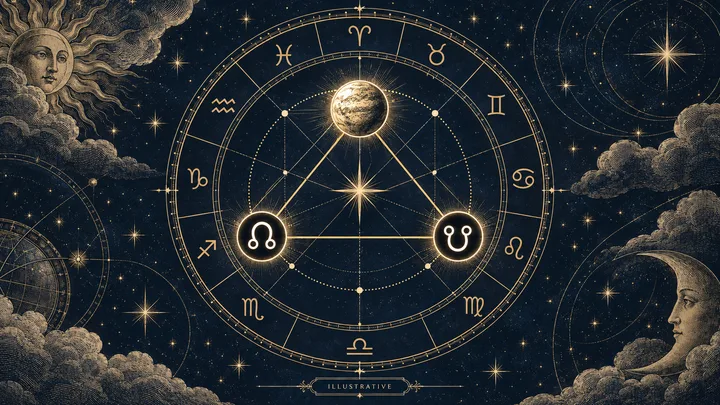
The first distinction: function or direction?
When you see Venus square Mars in synastry, begin with Venus and Mars. Venus describes attraction, taste, affection, pleasure, and the way someone values closeness. Mars describes desire, pursuit, heat, assertion, and the way someone moves toward what they want. The square puts those functions into a live angle. It can create friction, fascination, and a need to learn how desire and affection can share one room. The aspect tells you how the functions meet. The planets tell you what functions are meeting.
A lunar node contact asks a different first question. It asks how one person’s function touches the other person’s nodal axis. The North Node and South Node aren’t planets. They’re opposite points where the Moon’s orbit meets the ecliptic, and astrologers read them as an axis. The South Node describes familiar material, practiced responses, and patterns a person can fall back on. The North Node describes qualities and experiences that call for development. That gives the contact a direction in time and experience, even when you read it in a relationship that has no promise of permanence.
That difference changes the sentence you write. For a planet-to-planet aspect, you might say, ‘Her Venus and his Mars create a direct exchange between affection and desire.’ For his Venus on her North Node, you might say, ‘His way of loving brings her toward qualities represented by her North Node.’ The second sentence includes a subject, a direction, and a developmental edge. It doesn’t reduce Venus to a prize or the node to a verdict.
The clean reading keeps both owners in view. Daniel still has Venus; Maria still has the nodal axis. His affection is the moving part, while her chart supplies the direction that gives the contact its particular meaning.
Imagine Maria has her North Node at 12° Libra, and Daniel’s Venus is at 13° Libra. The 1° conjunction matters because it is close, but the interpretation is not simply ‘Daniel is romantic for Maria.’ Venus remains Daniel’s way of relating. The nodal contact says that his affection may invite Maria into Libra themes such as reciprocity, listening, negotiation, and shared choice. Whether she accepts that invitation depends on her natal chart and on what the relationship actually asks of her.
Sources: Nodes (North Node & South Node) Astrology Meaning; Your North Node, Destiny, and Aspects: Inner Planets; The lunar nodes in synastry, minus the destiny marketing
What a lunar node is doing in the chart
Before you interpret a nodal aspect, name the object correctly. The lunar nodes are mathematical points, not physical planets. The North Node is also called the ascending node or Dragon’s Head. The South Node is the descending node or Dragon’s Tail. They always stand opposite each other, so a chart never has a North Node story without a South Node counterpoint. A North Node at 12° Libra implies a South Node at 12° Aries. The axis is the unit.
Modern astrology often reads the North Node as the direction of growth and the South Node as what comes naturally, what has been accumulated, or what can become overused. Traditional language can add another layer. Some traditions describe the North Node as increasing or amplifying and the South Node as reducing or releasing. Those ideas can coexist with a developmental reading when you keep the question precise: what is being enlarged, and what is being released or made conscious?
In synastry, the nodal person is the person whose node receives the other person’s planet. That role matters. If Maria’s North Node receives Daniel’s Venus, Daniel is the Venus person and Maria is the North Node person. Daniel may embody, model, or awaken Libra qualities for Maria. Maria may experience him as a person who makes a new relational language feel more immediate. Daniel may simply be expressing his own Venus. The contact can be powerful for Maria without carrying equal meaning for Daniel.
The opposite contact has a different flavor. If Daniel’s Venus sits on Maria’s South Node, he may feel instantly familiar to her. His manner of affection can fit a pattern she already knows. That can feel tender and safe. It can also let the relationship repeat an old script without asking either person to change. Familiarity isn’t a flaw. It becomes a problem only when the couple mistakes ease for the whole story.
The node also has a sign and, when reliable birth data supports houses, a house. The sign shows the style of the developmental movement. The house shows the life area where the movement concentrates. A node in Libra in the seventh house gives a different field of experience from a node in Libra in the tenth. If you don’t have dependable birth time and house data, don’t invent a house interpretation. Work with the supplied sign and degree, and state the missing layer plainly.
The axis works best as a movement between competence and experiment. The South Node is not a villain waiting to be discarded, and the North Node is not a finish line that makes every choice correct. A person carries the South Node’s skill forward. The question is whether that skill can serve a wider life.
In synastry, one relationship can touch both ends at once. A partner’s planet may feel familiar at the South Node, while another contact asks the same person to negotiate, trust, or make room for difference. Read the axis as a route. Ask where the connection begins, where it settles under stress, and what keeps comfort from becoming a closed loop.
Sources: Nodes (North Node & South Node) Astrology Meaning; Your North Node, Destiny, and Aspects: Inner Planets; North Node in Astrology
What a planet aspect is doing in synastry
Planet-to-planet synastry begins with two functions meeting across two charts. The Moon brings emotional rhythm, instinct, memory, and the need for safety. Venus brings affection, pleasure, attraction, and values. Mars brings initiative, sexuality, anger, courage, and pursuit. Mercury brings speech, thought, and the way two people name what is happening. The Sun brings identity, vitality, and the wish to be seen. The planet tells you what is alive in the exchange.
Then read the aspect. A conjunction fuses or concentrates the two functions. An opposition sets them across an axis and asks for balance. A square creates pressure that demands action or adjustment. A trine lets the functions move easily through shared elemental ground. A sextile offers cooperation that becomes more useful when someone chooses to engage it. These are interpretive shapes, not moral grades. A square isn’t a relationship sentence, and a trine isn’t a guarantee of emotional depth.
A planet aspect is mutual in geometry but not identical in experience. A partner’s Moon does not become your Moon because it aspects your Venus. Their Moon activates your Venus, and your Venus answers it. One person may feel wanted while the other feels exposed. The aspect describes the bridge; each person crosses it from a different shore.
Orbs matter here too. An aspect is measured by how far the actual angle sits from its exact angle. A 1° conjunction is a close contact. A 5° square is wider. Astrologers set different orbs by tradition, planet, aspect, and chart style. For this publication’s comparison report, selected major aspects use a stated six-degree orb when optional degrees are supplied. That is a calculation boundary, not a claim that every contact inside six degrees carries the same force. Read closeness as one rank signal, not the whole interpretation.
Consider an example. Maria’s Moon is 18° Cancer, and Daniel’s Venus is 20° Pisces. The 118° separation sits near a trine, within a two-degree orb. Start with the planet meanings: Daniel’s affection can support Maria’s emotional life, and Maria’s feelings can give Daniel’s Venus a receptive place to land. Then ask what the signs add: water signs make the exchange sensitive and intuitive. Finally, check whether either planet is under pressure elsewhere. A single easy aspect can describe a lovely room. It can’t tell you whether the house is livable.
Notice the order of those sentences. ‘Venus trine Moon’ is already a complete first layer. You don’t need the nodes to make it meaningful. If Maria’s North Node also receives Daniel’s Venus, the nodal contact becomes a second sentence about where that affection leads her. It doesn’t rewrite the trine. This prevents a common collapse in synastry writing, where every symbol gets poured into one large claim about the bond and the reader can no longer tell which placement carries which observation.
The same discipline applies when a planet aspects a node. Write the measurable layer first: Daniel’s Mars is within a close conjunction to Maria’s North Node. Then describe Mars: his initiative, desire, and way of taking action enter her growth story. Add the sign and axis. Finally, ask what the couple does with that charge. Does Maria take clearer action for herself, or does Daniel make every decision while she calls the imbalance growth? Symbolism earns its place when it changes the question you ask about behavior.
Aspect type gives the next refinement. A conjunction brings the planet directly into the nodal field, so the contact can feel immediate and hard to separate from the relationship’s first impression. A square may make the planet’s function press against the growth direction, producing frustration that calls for a new response. A trine or sextile may make the North Node quality easier to access, but ease can also reduce urgency. An opposition can reveal the axis most clearly because the planet stands across from one end and near the other. In each case, keep the planet’s function in view.
Sources: Your North Node, Destiny, and Aspects: Inner Planets; The lunar nodes in synastry, minus the destiny marketing; Aspect
How the same planet changes at the North and South Nodes
A planet does not lose its meaning when it touches a node. The node changes the planet’s role in the reading. It turns the planet into a carrier of familiar material, future-facing material, or the tension between them. Read the planet first. Then ask whether the contact draws the person toward the North Node or back toward the South Node.
Venus on the North Node often makes love, beauty, pleasure, and shared values part of the growth edge. The Venus person may show the North Node person a way to relate that feels attractive but unfamiliar. The invitation might involve fairness, softness, self-worth, or the courage to want something openly. It can feel exciting. It can also feel destabilizing if the North Node person has relied on an old pattern for protection. The Venus person doesn’t have to be perfect to activate this theme. They only have to express Venus in a way that reaches the degree.
Venus on the South Node often brings recognition. The North Node person may feel that the Venus person fits an old emotional grammar. Affection can move quickly, with less explanation. Yet the same ease can make the relationship repeat a familiar imbalance. Perhaps one person always accommodates and the other always chooses. Perhaps the couple enjoys private tenderness but avoids defining shared values. The South Node contact asks what the pair knows already and whether that knowledge still serves them.
Mars on the North Node can put action at the growth edge. The Mars person may stir courage, independence, sexual confidence, or the willingness to make a clear move. The North Node person may admire that directness and resent it in the same week. Mars on the South Node can feel instinctive and charged. It may awaken old competition, old pursuit, or an old way of fighting. In both cases, Mars still describes action. The node describes whether that action feels like a new road or a well-worn track.
The Moon gives another useful contrast. A Moon on the North Node can expose the North Node person to an emotional register they’re learning to inhabit. A Moon on the South Node can feel deeply known, as if the two people share a private household from the first conversation. But the South Node Moon contact may also pull the relationship into caretaking, retreat, or emotional repetition. Don’t decide from the symbolism alone. Watch how the contact behaves when one person asks for comfort and the other person has a limit.
The planet’s condition in its own natal chart is the strongest exception to a simple nodal story. A Venus person with a natal Venus-Saturn square may express love cautiously, even when their Venus lands on someone’s North Node. A Mars person with a strong natal Mars may activate a partner’s North Node through bold action, but the same force may overwhelm the partner. The node points to a theme. The natal planet tells you the instrument’s actual sound.
Read a planet aspect as an exchange of living functions: Moon with Venus speaks to feeling and affection, while Mars with Mercury speaks to action and words. Read a lunar node aspect as a meeting between one person’s planet and the other person’s developmental axis. It can show familiarity at the South Node, a stretch toward new qualities at the North Node, or tension between the two. The node doesn’t replace the planet’s meaning, and it doesn’t certify a soulmate bond. Start with the exact contact, name the planet and the node involved, then read the node’s sign and house in the natal chart. After that, return to the planet’s natal condition and the rest of the synastry. A supplied placement report can compare known Moon, Venus, and Mars signs and optional degrees, but it won’t calculate a natal chart, houses, or missing birth information from scratch.
Sources: Nodes (North Node & South Node) Astrology Meaning; Your North Node, Destiny, and Aspects: Inner Planets; North Node in Astrology
Degrees, orbs, and the difference between a contact and a story
The most useful nodal reading starts with numbers. Record the node’s sign and degree, the planet’s sign and degree, and the calculation method if the source gives one. True Node and Mean Node can produce slightly different degrees. Near a boundary, that difference can change a tight contact, so the method belongs in your notes. If the degree is missing, work at sign level and stop there.
For a conjunction, compare the two degrees in the same sign or across a sign boundary when the angular distance is close enough and the signs support the reading. For an opposition, remember the axis. A planet opposing the North Node is sitting near the South Node. You don’t get two unrelated meanings. The opposition makes the nodal polarity visible. It can show a planet pulling between familiar ground and the direction the North Node asks the person to develop.
Use a narrow orb for a node contact when you want the interpretation to carry real weight. A one-degree conjunction deserves priority over a five-degree conjunction, especially when the rest of the chart offers competing themes. A wider contact may still belong in a broad report, but it shouldn’t lead the reading unless another factor reinforces it. Avoid treating a shared generational node sign as a personal synastry contact. The sign is common across a cohort. The degree contact is where the personal exchange begins.
Imagine Maria’s North Node is 12°10' Libra. Daniel’s Venus is 13°02' Libra. The difference is 0°52', a close conjunction. Daniel’s Venus is worth leading with among the nodal contacts. Now change Daniel’s Venus to 17°40' Libra. The sign story remains, but the degree contact is 5°30' wide. Under a six-degree report orb it may be listed, yet it should rank below a 1° Moon-to-node contact or a close Venus-Mars aspect. The interpretation becomes a background suggestion, not the relationship’s headline.
Sign boundaries deserve a quiet, careful note. Suppose a planet sits at 29° Virgo and a node at 1° Libra. The longitude difference is only 2°, so the contact is close by degree, yet the signs don’t tell the same story as a Virgo-to-Virgo conjunction. Some astrologers keep the aspect and let both sign meanings speak; others give more weight to the sign relationship and hold the contact lightly. State your choice. The important point is to separate angular closeness from sign coherence instead of pretending they are the same measurement.
A second comparison helps with oppositions. If Maria’s North Node is 12° Libra and Daniel’s planet is 12° Aries, Daniel’s planet is opposite the North Node and near Maria’s South Node. Read the contact as one axis with two poles. Maria may recognize the planet’s Aries quality immediately, while the opposition asks her to balance independence with Libra’s partnership work. Calling this simply a North Node opposition misses the South Node side that gives the aspect its pull.
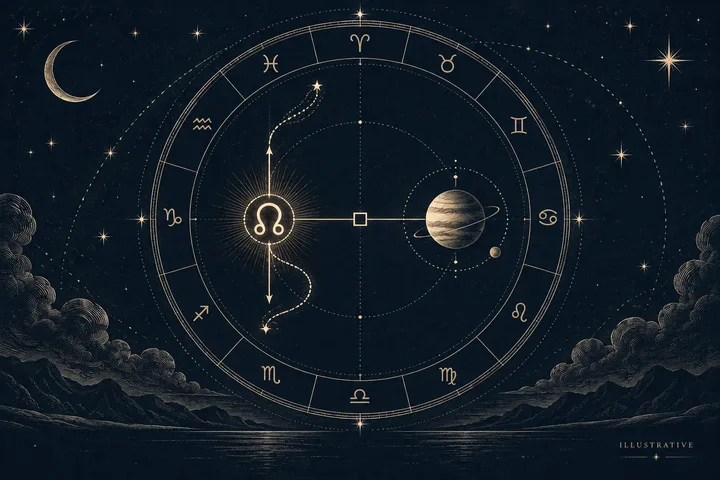
A report is most useful when it puts the actual degrees and orb beside each aspect. You can see why one contact leads and another follows, then return to the chart for meaning. The comparison can organize supplied Moon, Venus, and Mars signs with optional degrees. The table gives order. Your reading still has to explain what the order means.
Sources: Your North Node, Destiny, and Aspects: Inner Planets; The lunar nodes in synastry, minus the destiny marketing; North Node in Astrology
A guided reading sequence for one nodal contact
Here is a sequence you can repeat. It keeps the node important without letting it take over. Start with the receiving chart. Name the person whose node is contacted, then name the other person’s planet. Next, write the exact aspect, the degree difference, and whether the contact is to the North Node or South Node. If you cannot answer those questions, you have a theme to verify, not a conclusion to publish.
Second, read the planet in plain language. If it’s Venus, ask how the person gives affection, makes choices about value, and experiences attraction. If it’s the Moon, ask what kind of emotional response enters the relationship. If it’s Mars, ask what action, desire, or conflict pattern gets activated. Keep this sentence separate from the nodal sentence. That separation stops you from turning a nodal contact into a vague claim about destiny.
Third, read the node’s sign and house if the house is reliable. The sign gives the style of movement. The house gives the life area. A North Node in Libra may develop through cooperation, but a Libra North Node in the second house and one in the seventh do not ask the same practical question. If no dependable house is available, leave the house out. A smaller true reading beats a larger invented one.
Fourth, bring in the South Node. What familiar response sits opposite the North Node? If the North Node is Libra, the South Node is Aries. The question becomes less sentimental and more useful: does this contact help the person carry healthy independence into partnership, or does it make them abandon themselves to keep the peace? Nodal growth doesn’t mean rejecting the South Node. It means using its existing skill without letting it run the whole relationship.
At this stage, write one sentence for each pole. ‘This contact makes direct action familiar’ belongs to the Aries South Node. ‘This contact asks for shared decision-making’ belongs to the Libra North Node. The two sentences may pull against each other, and that is the point. A reading becomes clearer when it names the old competence and the new practice instead of describing the whole axis as a cloud of karmic feeling.
Fifth, compare the contact with the natal planet and the rest of synastry. A Venus-to-node contact can describe direction, but Venus-Mars can describe chemistry, Moon contacts can describe emotional fit, and Saturn can describe the work of continuity and responsibility. Those layers answer different questions. Rank them instead of adding them into a single mystical feeling. A good reading tells you which symbol carries which job.
Finally, turn the interpretation into an observable question. Ask, ‘Since this relationship began, what new behavior has become possible?’ If the contact is to the South Node, ask, ‘What feels easy because we’ve repeated it, and does it still help us?’ If it is to the North Node, ask, ‘What are we learning to do that neither of us could do comfortably before?’ The chart gives language. The lived answer gives the test.
You can make the sequence more precise with a three-line note. Record what the planet person brings, what the node person is invited to develop, and what that invitation costs. A North Node Venus contact may invite reciprocity while exposing fear of dependence. A South Node Mars contact may offer quick courage while reviving a fight pattern. Naming both gift and cost turns symbolism into a conversation prompt.
Keep the roles fair. The nodal person may feel the developmental pull, while the planet person feels attraction, recognition, or an unusual response from their ordinary style. They may not be trying to teach anything. Describe the asymmetry without turning either person into a tool in the other person’s story.
Sources: Nodes (North Node & South Node) Astrology Meaning; Your North Node, Destiny, and Aspects: Inner Planets; The lunar nodes in synastry, minus the destiny marketing
How to integrate a nodal aspect with the rest of the chart
A nodal contact is rarely the whole synastry. It becomes useful when you place it inside a hierarchy. Lead with close major aspects involving the personal planets and angles when the birth data supports them. Then identify repeated themes. If Daniel’s Venus is on Maria’s North Node and also trines her Moon, the nodal invitation has an emotional channel. If his Venus is on her North Node but squares her Saturn, the new relational direction may come with fear, delay, duty, or a demand for maturity. The node doesn’t cancel the square.
Look for convergence. Several contacts that speak to the same planet or axis deserve more attention than one isolated symbol. Maria’s North Node may receive Daniel’s Venus, while Daniel’s Moon aspects her North Node ruler. That creates a stronger web around the theme of relating and emotional safety. But don’t count contacts like points in a compatibility score. Three loose aspects do not automatically beat one exact contact. Ask whether they tell one coherent story and whether the story appears in the people’s choices.
A useful way to test convergence is to name the repeated verb. Do the contacts repeatedly ask the couple to speak, choose, build, soften, or separate? If Venus-to-node and Moon-to-node contacts both point toward emotional reciprocity, that verb might be ‘include.’ If Mars and Saturn dominate, it might be ‘pace.’ The verb keeps the synthesis practical. It also stops a reader from mistaking a pile of similar symbols for several independent proofs.
Then look for contradiction. Contradiction is information. A South Node contact may feel familiar while Saturn makes the bond slow and cautious. A North Node Mars contact may push one person toward courage while a tight Moon-Saturn contact makes emotional exposure difficult. Don’t smooth those differences into the word ‘karmic.’ Explain the tension. The reader needs to know what the connection offers and what it asks.
The strongest meaningful exception is a chart with a dramatic nodal contact but little support for the planet’s expression. A partner’s Venus on your North Node can feel significant, yet if the contact is wide, the Venus person’s natal Venus is heavily conflicted, and the synastry has no sustaining links, the nodal image should remain a secondary theme. It may describe a lesson or turning point. It doesn’t become proof that the relationship can carry daily life.
Keep the two people distinct. The same contact can be growth for one person and recognition for the other. The North Node person may feel invited toward a new way of living. The planet person may feel seen, desired, or simply themselves. Don’t infer equal investment from the geometry. Ask who owns the node, who owns the planet, and which person’s chart you’re describing in each sentence.
A synastry wheel and an aspect table answer different needs. The table gives the contact, aspect type, and orb. The wheel shows the axis in the sign field and beside other bodies. Use the table to rank; use the wheel to integrate. Keep extra points separate from the main comparison so one crowded picture doesn’t outrank a clear personal-planet contact.
When you rank the chart, use a simple priority test. First ask whether the contact is close enough to matter under the chosen orb. Next ask whether the involved planet is personal and whether the same theme repeats elsewhere. Then ask whether the contact answers the reader’s actual question. Someone asking why the connection feels familiar may need the South Node and Moon first. Someone asking why the relationship keeps demanding a new kind of commitment may need the North Node, Saturn, and the chart ruler of the node’s sign. Relevance is part of interpretation.
Don’t confuse the order of reading with a claim about importance for all couples. In one chart, a 0°40' Moon-South Node conjunction may explain the instant sense of home. In another, a 1° Mars-Saturn square may explain why every practical plan becomes a contest. The nodal contact still matters, but the reader needs the symbol that best explains the problem in front of her. Good synastry is selective. It gives the clearest answer first and preserves the other layers for context.
Sources: Your North Node, Destiny, and Aspects: Inner Planets; The lunar nodes in synastry, minus the destiny marketing; Aspect
What to do with the reading
Use a planet aspect to name the interaction you can see. Use a nodal aspect to ask what that interaction is teaching, repeating, or making possible. That is the practical difference. The planet gives you behavior. The node gives you orientation. Together they can turn an attractive but vague synastry impression into a question you can actually live with.
If the contact is to the North Node, choose one small experiment in the sign’s direction. With Libra, practice a decision that includes both people without erasing either person. With Capricorn, make the promise concrete and keep it. With Gemini, ask the question you normally leave unspoken. The point isn’t to perform a sign. It’s to notice whether the relationship helps the North Node person develop a real capacity rather than merely admire it in the partner.
If the contact is to the South Node, name the comfort and the cost. Perhaps you understand each other without words. Good. Now ask whether that ease supports honest growth or protects an old loop. A South Node Venus contact might offer warmth that deserves to be valued, while also making it tempting to avoid a hard conversation about money, exclusivity, or shared plans. Keep the gift. Question the automatic part.
If the contact is tense, don’t call it bad. A square or opposition can show where the planet presses against the nodal direction. The friction may become the engine of development when both people can name it. If the contact produces fear, contempt, coercion, or repeated harm, the chart doesn’t ask you to romanticize that behavior. A symbolic growth theme never outranks your right to safety and clear choice.
For a known-placement comparison, gather Moon, Venus, and Mars first. Add degrees when you have them. Mark close major contacts under the report’s six-degree setting, then separate node contacts from planet-to-planet contacts. Read the top two or three themes in order. A clean table makes the ranking visible; it doesn’t replace the judgment.
End at a decision point. Are you going to practice the new behavior the North Node contact describes? Are you going to enjoy a South Node comfort while setting a boundary against its stale version? Are you going to gather missing degrees before giving the contact more weight? Choose one. The best synastry reading doesn’t leave you staring at a dramatic symbol. It tells you what to watch next.
A short journal entry can make the symbolism concrete. Write the exact contact at the top. Under it, finish three sentences: ‘This feels familiar when...’; ‘This asks me to try...’; and ‘I know it is helping when...’. Keep the answers observable. ‘We talk through a decision instead of one person disappearing’ is more useful than ‘the energy is higher.’ ‘I say what I want before I become resentful’ gives a North Node Venus contact somewhere to go. ‘We enjoy our routine without using it to avoid change’ honors the South Node without surrendering to it.
You can also use the same note to compare the two layers. Write ‘planet aspect’ beside the behavior you already recognize, and ‘node contact’ beside the change or repetition you’re tracking. For example, a Moon-Venus trine might describe the ease of comforting each other. Venus conjunct a North Node might describe why that ease encourages one person to ask for closeness more openly. The first explains the exchange. The second gives the exchange a direction to examine.
If you’re reading for a couple, let both people answer separately. The same aspect may not land in the same place. One partner may feel the other’s Venus as an invitation into softness. The Venus person may feel that their own way of loving finally has room. Compare the answers. Differences don’t disprove the aspect. They show whose chart is receiving which symbol. That is often the most useful discovery in a synastry reading.
Then decide what needs more data. Missing degree means no exact-orb claim. Uncertain birth time means no houses or angles. Signs alone support sign-level symbolism, not a precise calculated aspect. Partial information can still open a good question. Precision means knowing where to stop.
The cleanest handoff is simple. Bring the known placements, add the degrees you trust, and mark what remains unknown. A comparison can then show whether a Moon, Venus, or Mars contact reaches a lunar node and how close that contact is. You still make the human decision. The chart helps you name the pattern, the invitation, and the habit that needs a closer look. Start there. Keep the question close to the contact: what does this person awaken, and what will I choose to do with it? That question leaves room for attraction, growth, comfort, limits, and change. It also gives the reading a useful ending.
Sources: Nodes (North Node & South Node) Astrology Meaning; Your North Node, Destiny, and Aspects: Inner Planets; North Node in Astrology
A little more clarity
Is a lunar node aspect stronger than a planet aspect in synastry?
Not automatically. They describe different layers. A close node contact can make a relationship feel meaningful, familiar, or growth-oriented, while a planet aspect describes how two functions actually interact. Rank the contact by exactness, the planet involved, the node involved, and support from the rest of the synastry. Don’t turn one nodal aspect into a score or a promise.
How do I read Venus conjunct someone’s North Node?
Read Venus first as affection, attraction, values, pleasure, and self-worth. Then read the North Node as the receiving person’s growth direction. The Venus person may embody or awaken qualities that the North Node person is learning to develop. Check the exact degree, the North Node sign and reliable house, the South Node opposite it, and Venus’s natal condition. The contact can be compelling without deciding how long the relationship lasts.
Can I interpret a node aspect without birth times?
You can interpret a supplied sign and degree contact, but you shouldn’t claim house or angle meanings without dependable birth-time data. You also need to know whether the degrees use the True or Mean Node when precision matters. A placement comparison can work with known Moon, Venus, and Mars signs and optional degrees. It doesn’t calculate a full natal chart or create missing houses.
Sources & further reading
- Nodes (North Node & South Node) Astrology Meaning
Defines the lunar nodes as opposite points, explains North Node growth and South Node familiarity, and notes their traditional Dragon Head and Tail language.
- Your North Node, Destiny, and Aspects: Inner Planets
Explains North Node and South Node themes and compares conjunction, opposition, square, trine, and sextile treatment with personal planets.
- The lunar nodes in synastry, minus the destiny marketing
Provides a current synastry comparison of familiar South Node and developing North Node contacts, including the importance of close orbs and separate relationship questions.
- North Node in Astrology
Supports the mathematical-point definition, opposite nodal axis, developmental reading, and distinction between True and Mean Node calculations.
- Aspect
Defines astrological aspects and orbs and gives the major aspect family used to distinguish conjunction, opposition, square, trine, and sextile.
Synastry Comparison Report
Enter known placements for two people. Get an input-by-input comparison, selected aspect calculations and a clear record of what remains uncertain.
Compare our placements