Read the faster planet as the first movement in the contact and the slower planet as the deeper pattern that receives it. The faster planet may bring the feeling, question, desire, or action you notice first. The slower planet gives that moment its weight, boundary, pressure, or depth. Then reverse the lens: the faster planet can soften, wake, or give language to the slower one. Rank the contact by aspect and exact degree, using the report’s six-degree orb when degrees are supplied. Treat applying or separating motion as an added interpretive layer, not a prediction. Finally, compare both planets with their natal charts and ask what the pair actually does in daily life. A Venus-Saturn contact can describe affection meeting caution, but the real reading depends on whether that caution becomes loyalty, criticism, patience, or delay.
The short answer: spark first, pattern second
In synastry, the faster planet usually shows what arrives first. The slower planet shows what the arrival enters.
That order helps you read the contact without turning either person into a fixed role. The Moon may bring an immediate emotional need. Mercury may ask the question. Venus may offer warmth or attraction. Mars may push for action. Jupiter, Saturn, Uranus, Neptune, and Pluto move more slowly, so they give the exchange a larger field: growth, limits, disruption, longing, or depth.
‘Faster’ and ‘slower’ refer to a planet’s apparent motion through the zodiac. In the usual order, the Moon moves fastest, followed by Mercury, Venus, the Sun, Mars, Jupiter, Saturn, Uranus, Neptune, and Pluto. The order matters most when you are deciding which planet is applying to or separating from an aspect.
It also gives the contact a useful interpretive rhythm. A faster planet tends to make the symbolism personal and immediate. A slower planet tends to make it enduring, formative, or difficult to ignore. Do not confuse speed with importance. Orb, aspect, natal condition, repetition, and the couple’s actual pattern decide how much attention the contact deserves.
Imagine a woman’s Venus contacting a man’s Saturn. Her Venus may register his seriousness before either person has a name for it. His Saturn may feel responsible, cautious, tested, or unexpectedly softened by her affection. The contact is not simply ‘she loves and he withholds.’ It is an exchange. Her warmth changes his Saturn, and his response changes how freely she gives warmth.
Do not confuse the slower planet with the dominant person, either. The Saturn person can feel exposed by another person’s Sun or Venus. The Pluto person can feel changed by the other person’s Mars. The planet owner carries a function into the exchange, but both people experience the contact.
This is the governing rule: begin with the faster planet, read the slower planet as the receiving condition, and then follow the response in both directions. The Astrology Podcast’s synastry discussion makes the same point through touched planets and mutual reaction. Synastry describes a relationship dynamic. It does not hand down a verdict about the people in it.
Sources: Synastry - Astrodienst Astrowiki; Aspect - Astrodienst Astrowiki; Ep. 165 Transcript: Synastry: The Astrology of Relationships - The Astrology Podcast
Let the aspect describe the negotiation
Once you know the planet order, read the aspect. The planets tell you what meets. The aspect tells you how the meeting moves.
A conjunction blends the functions and can make them hard to separate. An opposition makes difference visible across an axis. A square creates pressure that asks for adjustment. A trine lets the functions cooperate with less resistance. A sextile opens a useful possibility that grows through choice and practice.
The aspect does not erase the faster-slower sequence. In a Venus-Saturn square, Venus may seek affection while Saturn measures risk. The square makes that difference active. In a Venus-Saturn trine, Venus may value Saturn’s steadiness, while Saturn finds a human warmth in Venus. The same planet pair remains. The style of negotiation changes.
A soft aspect can hide a problem because the pair moves so easily that nobody names the pattern. A hard aspect can become productive because it forces a conversation. So skip the lazy translation of trine into ‘good’ and square into ‘bad.’ Ask what each person must do with the contact. That question produces a reading you can use.
Sources: Aspect - Astrodienst Astrowiki; Ep. 165 Transcript: Synastry: The Astrology of Relationships - The Astrology Podcast
Use degrees and orb to rank the contact
An orb is the distance between an actual planetary angle and the exact aspect. If one planet is at 14 degrees Taurus and another is at 17 degrees Virgo, their trine has a three-degree orb. The smaller the orb, the more tightly the contact speaks.
For this publication’s Synastry Comparison Report, selected major aspects use a six-degree orb when degrees are supplied. That is a ceiling, not a promise that every qualifying aspect carries equal weight. A two-degree square leads before a six-degree square. A close contact deserves more attention than a wide one, even when the wide contact has more dramatic symbolism.
If you know signs but not degrees, describe the sign relationship and keep the aspect conditional. Two planets in compatible signs may share a style, but they may sit too far apart to form the exact trine or sextile you expected. Sign language gives the tone. Degrees tell you how directly the planets connect.
Astro.com explains that its synastry display uses half the natal orb because two charts create many more possible contacts. The practical lesson is simple: a crowded comparison needs hierarchy. Record the closest personal-planet contacts first. Then add close contacts to slower planets. Leave wide possibilities in the background until the lived relationship gives them a reason to speak.
Sources: Aspect - Astrodienst Astrowiki; Partner horoscopes - Astro.com FAQ; Ep. 165 Transcript: Synastry: The Astrology of Relationships - The Astrology Podcast
Treat applying and separating as an extra layer
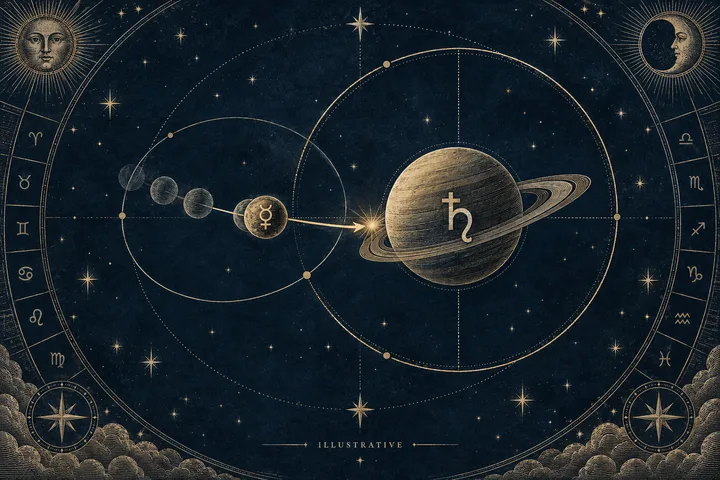
Applying means the faster planet is moving toward the exact aspect. Separating means it has passed exactness and is moving away. Astrodienst’s aspect reference defines the distinction this way and notes that some astrologers give applying aspects more weight.
In a natal synastry comparison, this is not the same as watching a current transit unfold. The two birth charts are fixed records. Applying or separating can add a sense of developing or established symbolism when the underlying planetary motion and degrees are known, but it cannot tell you when a relationship event will happen. It cannot promise that a bond will deepen, end, or reach a particular milestone.
A close applying Mercury-Saturn contact may describe communication moving toward a serious theme. A close separating Venus-Saturn contact may describe affection carrying a familiar memory of caution or commitment. Those are interpretive shades. They do not outrank the planets, aspect, orb, or natal context.
If the faster planet is retrograde, do not force a simple forward story onto the contact. Its apparent motion may revisit or retrace the matter. If motion is not supplied, leave applying or separating out. An honest unknown keeps the reading clean.
Sources: Aspect - Astrodienst Astrowiki; Ep. 165 Transcript: Synastry: The Astrology of Relationships - The Astrology Podcast
Read each planet pair in both directions
The planet pair gives you the subject. The chart owner gives you the doorway.
Moon to Saturn can feel protective and lasting. It can also feel emotionally rationed if the Saturn response becomes judgment or control. Mercury to Jupiter can create generous conversation and a shared appetite for meaning. It can also let broad promises outrun practical details. Venus to Uranus can wake desire and freshness. It can also require a clear agreement about freedom and availability.
Jupiter enlarges. Saturn contains. Uranus interrupts. Neptune dissolves edges and heightens imagination. Pluto intensifies. These verbs are starting points, not final descriptions. The personal planet makes the slower planet visible in ordinary life, while the slower planet changes the conditions under which the personal planet acts.
Now reverse the reading. If your Venus touches his Saturn, ask what you feel when his caution meets your affection. Then ask what he feels when your affection touches his responsibility, fear, or standards. If his Venus touches your Saturn, the first doorway changes. You may feel your duties and boundaries stirred by his warmth, while he experiences your reserve as a test. ‘Venus-Saturn’ is the shorthand. ‘Her Venus to his Saturn’ is the beginning of interpretation.
The strongest synastry reading holds both accounts at once. It names the asymmetry without assigning blame. Then it asks what response would let the contact become more skillful.
Sources: Synastry - Astrodienst Astrowiki; Aspect - Astrodienst Astrowiki; Ep. 165 Transcript: Synastry: The Astrology of Relationships - The Astrology Podcast
Work a contact through the natal charts
A synastry contact does not create a planet’s whole meaning. It activates a function that already has a natal history.
Before interpreting Venus-Saturn, ask how each person already handles affection, standards, responsibility, and time. Is Saturn trusted or feared? Does Venus give freely, wait for proof, or protect its choices? Before interpreting Moon-Neptune, ask whether each chart already knows how to blend empathy with clear boundaries. The natal charts set the baseline. Synastry shows who enters it and what gets stirred.
Look for repetition next. Venus-Saturn plus Moon-Saturn repeats a question about safety and commitment. Mercury-Uranus plus Mars-Uranus repeats a question about pace, interruption, and room to act. Repetition outranks a lone keyword because it shows the theme returning through more than one channel.
Then look for support. A Mercury-Jupiter contact may help a couple discuss a difficult Saturn pattern. A Moon-Venus contact may offer tenderness when Mars brings heat. A supportive Saturn contact may give shape to Uranian excitement. The helpful contact does not cancel the difficult one. It shows the resource available for meeting it.
House overlays can locate a contact in a life area when accurate birth times and a chosen house system are available. They are an added layer. If your comparison uses supplied Moon, Venus, and Mars placements with optional degrees, stay with the data you have. Do not add houses simply because the chart feels incomplete.
Sources: Synastry - Astrodienst Astrowiki; Ep. 165 Transcript: Synastry: The Astrology of Relationships - The Astrology Podcast
Worked example: Venus trine Saturn
Consider an example. Maria has Venus at 12 degrees Gemini. Daniel has Saturn at 15 degrees Aquarius. The three-degree distance forms a close trine under a six-degree orb. These are illustrative inputs, not a personal chart calculation.
Start with Maria’s Venus because it is the faster planet. She may notice Daniel’s steadiness, seriousness, or ability to make affection feel durable. His Saturn enters her Venus field. She may experience his standards as reassuring, or she may wait for his approval before relaxing into warmth.
Read Daniel’s Saturn next. Maria’s Venus touches his responsibility and restraint. Her affection may soften his caution. It may also show him what he has avoided promising. If he answers with patience and clear plans, the trine can support loyalty. If he answers with criticism or endless delay, Maria may begin to feel that affection must be earned through performance. The aspect offers ease. It still needs a good response.
The air signs add a style of connection through conversation, ideas, friendship, and respect for each person’s mind. The close orb makes the contact worth ranking. The trine lowers friction, but it does not settle questions about exclusivity, time, distance, money, or family. Those questions belong in the relationship, where the symbolism becomes visible.
Now change one variable. If Maria’s Venus at 12 Gemini squared Daniel’s Saturn at 15 Pisces, the same three-degree orb would make the contact prominent, but the negotiation would be harder to avoid. She might experience his caution as a brake on pleasure. He might experience her lightness as a refusal to take affection seriously. Neither response is guaranteed. The square simply makes the difference louder.
Change the planet owner and the first doorway changes again. If Maria carried Saturn and Daniel carried Venus, Maria might first feel Daniel’s affection pressing on her standards and duties. The planet pair stays the same. The lived sequence does not.
Turn the symbolism into one useful decision
A good reading ends with something you can observe. Start with the faster planet’s need. Name the slower planet’s gift or pressure. State the aspect’s negotiation. Check the degree and, when genuinely available, the motion. Then choose one question or behavior that tests the interpretation without forcing either person into a role.
For a fast planet to Saturn, ask what commitment looks like in behavior. For Neptune, ask which hopes have clear support. For Uranus, ask how freedom can coexist with reliable contact. For Pluto, ask how both people can speak honestly without turning pressure into proof of love. For Jupiter, ask where generosity needs a limit.
If you are comparing known placements, record the planet pair, sign, degree, aspect, orb, motion if supplied, and chart owner. The Synastry Comparison Report fits that scope. You can provide Moon, Venus, and Mars signs, add optional degrees, and use selected major-aspect calculations with a six-degree orb. It does not calculate natal positions from birth details or houses.
Your decision is not whether the chart approves the relationship. It is what the contact asks you to practice. A Moon-Saturn pair might need a clear agreement about reassurance and space. Mercury-Neptune might need important plans repeated in plain words. Venus-Uranus might need a shared definition of freedom. Watch what happens when the subject arises. Notice who reaches, who retreats, and what helps both people return.
Keep the order. Faster planet first. Slower planet second. Aspect, orb, and motion next. Natal context after that. End with one observable conversation or behavior. The chart gives you a pattern to examine. You decide how to live it.
Sources: Synastry - Astrodienst Astrowiki; Aspect - Astrodienst Astrowiki; Partner horoscopes - Astro.com FAQ; Ep. 165 Transcript: Synastry: The Astrology of Relationships - The Astrology Podcast
Sources & further reading
- Synastry - Astrodienst Astrowiki
Supports synastry as a comparison of two charts and reading the relationship through interacting planetary functions and natal context.
- Aspect - Astrodienst Astrowiki
Supports the faster and slower planet distinction, reciprocal energy, aspect-first interpretation, and applying or separating definitions.
- Partner horoscopes - Astro.com FAQ
Supports synastry as a comparison of partner charts and the use of narrower displayed orbs because synastry contains many possible contacts.
- Ep. 165 Transcript: Synastry: The Astrology of Relationships - The Astrology Podcast
Supports reading the touched planet and the mutual response, using synastry to understand relationship dynamics, and opening communication through the symbolism.
Synastry Comparison Report
Enter known placements for two people. Get an input-by-input comparison, selected aspect calculations and a clear record of what remains uncertain.
Compare our placements