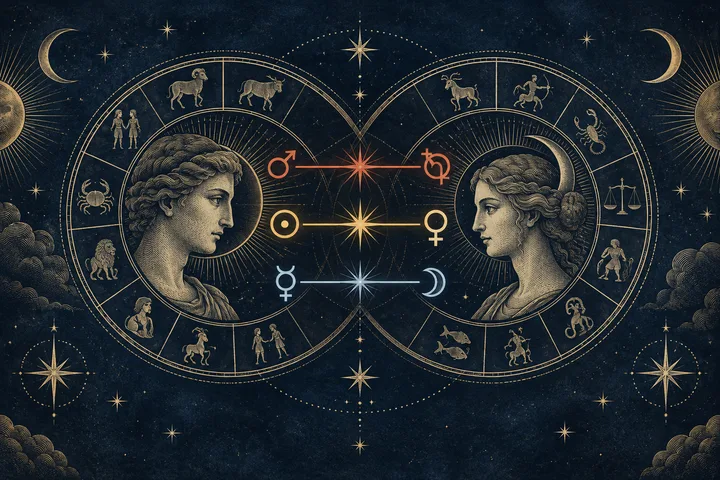
When three synastry contacts tell different stories, rank them in this order: first, the relationship theme repeated across contacts; second, the personal planets involved; third, the aspect itself; and fourth, the exactness of the orb. A close Moon-Saturn square, for example, deserves more attention than a loose Venus-Jupiter trine if the relationship keeps returning to safety, distance, and responsibility. But don't declare the square the whole relationship. Read it beside the other contacts, then ask which pattern appears in real life. Astrology.com notes that a tighter orb usually strengthens an aspect, while Cafe Astrology emphasizes the planets, signs, and roles each person brings to an interchart contact. Your final judgment should name the dominant theme, the supporting theme, and the tension that needs a conversation. The aim isn't to crown one aspect. It's to understand the relationship's actual pattern.
Start with the story that repeats
Three contacts can make a synastry reading feel like a quarrel. One contact says tenderness. Another says friction. A third says, stay and build. Which one wins?
The strongest answer usually isn't the prettiest contact or the most dramatic one. It's the story that appears more than once and touches the part of relationship life you're trying to understand. If the question is emotional safety, begin with the Moon and the planets touching it. If the question is attraction, look at Venus and Mars, then ask whether the rest of the chart supports that heat. If the question is endurance, give Saturn a seat at the table. The topic sets the first weight.
This matters because a synastry chart isn't a contest between isolated symbols. It is a conversation among planets, signs, and aspects. A Venus trine Mars may describe easy attraction. A Moon square Saturn may describe a serious emotional test. A Mercury sextile Mercury may show that the two of you can talk through the test. The reading becomes useful when those three statements meet. Attraction opens the door. Emotional pressure tells you what the door leads into. Communication shows whether you can remain in the room.
Astrologers have long read synastry through layers rather than one placement. Astrology.com describes synastry as a comparison of two natal charts and points readers toward planets, signs, houses, and aspects. Cafe Astrology adds a practical distinction: each person can take on the role of the planet they bring to the contact, so the same aspect can feel different from either side. Those principles give us a workable ranking method.
Start by writing each contact in plain language. Don't write only Moon square Saturn. Write, one person's emotional needs meet the other person's caution, duty, or limits. Don't write only Venus trine Mars. Write, affection and desire find an easy rhythm. Then ask what these sentences have in common. They may all describe closeness. They may all describe timing. They may all point to a need for reassurance. That shared thread outranks a single attractive phrase.
Your first conclusion should sound like this: the chart's main story is emotional seriousness, supported by physical chemistry and made workable through direct conversation. Or this: the main story is mutual stimulation, while the difficult contact shows where pace and reassurance differ. A good reading chooses. It doesn't hide behind a pile of meanings.
That is the answer to the ranking problem. Find the repeated subject first. Then test which contact carries it most clearly. The remaining contacts don't disappear. They become supporting evidence, context, or the exception that keeps the reading honest.
Sources: Astrodienst Astrowiki: Aspects; Astrology.com: An Intro to Synastry Charts and Astrological Compatibility; Cafe Astrology: Aspects Between Charts
Separate the four kinds of evidence
Before you rank contacts, separate the evidence they contain. Most confusion comes from treating four different questions as if they were one. What planets are involved? What angle do they make? How close is the angle? Does another contact repeat the same theme?
The planet tells you what part of life is being activated. The Moon speaks to instinct, comfort, and the ways a person receives care. Venus speaks to affection, values, pleasure, and the style of giving and receiving love. Mars brings desire, initiative, anger, courage, and the way energy moves toward a goal. Saturn brings boundaries, duty, time, and the weight of consequences. Mercury brings language, thought, and daily coordination. These are not interchangeable.
The aspect tells you how the two planets meet. A conjunction joins them and tends to make the contact immediate. An opposition creates a polarity that asks for balance. A square creates pressure and recurring work. A trine gives an easy current. A sextile offers an opening that grows through participation. Astrodienst's Astrowiki lists these as the main aspects and describes the orb as the distance from exactness that allows an aspect to operate.
The orb tells you how sharply the contact speaks. A contact at one degree has a different force from one at five degrees. That doesn't mean the five-degree contact is useless. It means you shouldn't describe it with the same confidence. Astrology.com gives a practical preference for six degrees or less in the aspects it discusses and states that a smaller orb strengthens the connection. In this report's scope, selected major aspects use a six-degree orb.
The repeated theme tells you whether a contact belongs to a larger pattern. Moon square Saturn plus Moon sextile Venus isn't two unrelated facts. Both return you to the Moon's emotional world. One asks how safety meets restraint. The other shows where affection can soothe or support. Venus trine Mars plus Mars sextile Jupiter returns to desire, pleasure, and forward movement. Read the contacts together, but don't count them as two identical votes.
A simple worksheet helps. For every contact, record the planet pair, the person connected to each planet, the aspect, the orb if known, the sign expression, and the lived question it may describe. Then add one line called repeated theme. If you can't fill that line without forcing the interpretation, keep the contact in the background.
This separation also prevents a common mistake: letting a famous aspect name do all the work. Sun-Moon can feel important, but its expression still depends on signs, aspect type, orb, and the condition of both charts. Venus-Mars can bring heat, but heat isn't the same as shared values or emotional steadiness. Saturn can bind, but binding isn't the same as ease. Evidence becomes clearer when each layer keeps its proper job.
Sources: Astrodienst Astrowiki: Aspects; Astrology.com: An Intro to Synastry Charts and Astrological Compatibility; Cafe Astrology: Aspects Between Charts
Give personal planets the first practical weight
When the question concerns how two people actually relate, personal planets usually deserve the first practical weight. The Sun, Moon, Mercury, Venus, and Mars describe the parts of the person that show up quickly in closeness. They speak to identity, feeling, speech, affection, desire, and action. An outer-planet contact can be powerful, but it may describe a wider generational tone unless it lands tightly on a personal planet or another sensitive point.
This isn't a rule that erases Saturn, Uranus, Neptune, or Pluto. It is a way to keep the reading close to the reader's question. If you're asking why a partner feels hard to reach, a close Saturn-Moon contact deserves serious attention. If you're asking why the bond feels electric and unpredictable, Uranus to Venus or Mars may be central. If you're asking whether the two of you can name the problem, Mercury contacts may outrank a beautiful Venus aspect.
Cafe Astrology's interchart guidance makes the personal role explicit. Each person whose planet is involved may play that planet's part in the interaction. In a Saturn-Sun contact, one person may feel like the evaluator, limit-setter, or adult in the room, while the other feels watched, shaped, or challenged in their self-expression. That role distinction gives the aspect a lived direction. It also explains why the same contact can feel supportive to one person and heavy to the other.
Rank the planet pair by the question, not by a universal popularity list. Moon-Venus matters when care and affection are the concern. Mercury-Mercury matters when the couple is trying to coordinate daily life. Venus-Mars matters when attraction and pursuit are in focus. Sun-Saturn matters when identity and responsibility collide. Mars-Saturn matters when one person's drive meets the other's caution, timing, or refusal.
Then ask whether the contact is mutual in theme. If one person's Venus touches the other's Mars, the attraction may not feel identical on both sides. The Venus person may feel desired or aesthetically appreciated. The Mars person may feel activated and compelled to act. The contact can still be strong, but the two people may tell different stories about it. A sound reading preserves both perspectives.
Use sign placement to refine the planet's expression. Venus in Taurus and Venus in Aquarius don't seek pleasure or loyalty in the same way. Mars in Cancer and Mars in Sagittarius don't pursue a goal with the same rhythm. Cafe Astrology notes that the same interchart aspect expresses differently depending on the signs involved. That is why planet pair comes before aspect label, and why aspect label comes before a final judgment.
Personal-planet priority keeps the reading human. It asks, what part of each person is meeting what part of the other? That question gives the chart a relationship to describe, not just a collection of symbols to admire.
Sources: Astrology.com: An Intro to Synastry Charts and Astrological Compatibility; Cafe Astrology: Aspects Between Charts
Read the aspect as a style of contact
After identifying the planet pair, read the aspect as the way the energy moves. Don't turn trines into automatic blessings or squares into automatic failures. A soft aspect can go unused. A hard aspect can become the place where two people grow strong together. The angle describes the work or ease between the planets. It doesn't decide what the people do with it.
A conjunction fuses. It makes the two planetary functions difficult to separate. Moon conjunct Venus can make affection feel instinctive and nourishing. Mars conjunct Saturn can combine drive with restraint, producing disciplined effort or bottled frustration. The sign and orb decide which expression leads. A close conjunction is often the first contact to study, but not always the healthiest or most comfortable one.
An opposition polarizes. It places two needs across from each other, which can create attraction and awareness as much as tension. Sun opposite Moon may pull one person's outer direction against the other's emotional rhythm. The pair may feel seen and challenged at once. The question isn't whether the opposition is good. It is whether the couple can let both ends of the axis exist without making one person wrong.
A square presses. It can show recurring friction, different timing, or two instincts that want control of the same situation. Astro.com describes the square as a difficult aspect that can keep returning until the forces find a way to reconcile. In synastry, that repetition can become exhausting, but it can also make a relationship active and honest. A square asks for a practice, not a verdict.
A trine flows. The planets recognize one another through a shared element or a natural ease, and the people may understand each other without much explanation. That ease is valuable. It can also become invisible. If nobody names the gift, the trine may remain a pleasant background current rather than a deliberate strength. A sextile works similarly but asks for more initiative. It offers a door. Someone still has to open it.
When contacts disagree, compare their function. A Venus trine Mars may make desire easy, while Moon square Saturn makes vulnerability cautious. These aren't contradictory claims. They describe different rooms in the relationship. The chart says, attraction can arrive faster than emotional trust. That is a stronger reading than either the romantic promise or the difficult warning by itself.
The aspect becomes most useful when you turn it into a sentence a couple could recognize. Trine: we tend to meet here without forcing it. Square: we return to this issue until we change the pattern. Opposition: we need both sides of this tension. Conjunction: this theme is woven into the bond. Sextile: we can build this if we choose it. Those sentences help you rank contacts by consequence, not by reputation.
Sources: Astrodienst Astrowiki: Aspects; Astrology.com: An Intro to Synastry Charts and Astrological Compatibility; Astrodienst: A Brief Introduction to Astrology, Aspects
Let the orb sharpen the ranking
Orb is the distance between an actual contact and its exact aspect. If one person's Venus is at 12 degrees of Gemini and the other person's Mars is at 14 degrees of Gemini, the conjunction has a two-degree orb. If the second planet is at 18 degrees, the orb is six degrees. Both contacts may belong in a reading, but the first one speaks with a tighter voice.
Astrology.com states the practical point plainly: the smaller the orb, the stronger the connection. Astrodienst also defines an orb as the accepted range around an exact angle, while noting that astrologers do not all use one fixed size for every aspect. That gives you two useful habits. Record the orb when you have it. Don't pretend that an aspect at the edge of your chosen range carries the same weight as an exact contact.
Use the six-degree limit consistently when you work with a placement-only comparison that includes selected major aspects. A one-degree Moon-Venus contact can lead the emotional reading. A six-degree Venus-Jupiter contact may support it, but it should not automatically take over. The broader contact may still matter if it repeats a theme found elsewhere. Exactness strengthens evidence. Repetition gives it context.
The orb does not work like a mathematical score. Don't assign one point for a conjunction, two points for a square, and three points for a close trine, then announce a winner. That method looks neat and reads badly. Astrology is relational. A close contact between two planets with little connection to the reader's question may matter less than a slightly wider contact that repeats the main theme across several placements.
Pay attention to missing degrees. If you know only the signs, you can discuss sign-based resonance and possible aspect relationships, but you can't claim a verified six-degree contact. If one person has degrees and the other doesn't, mark the aspect as unconfirmed. A meaningful sign pairing can remain meaningful without being promoted to a precise aspect.
A useful ranking note might read: first, a two-degree Moon square Saturn because it directly repeats the question about emotional distance; second, a four-degree Mercury trine Venus because it offers a way to speak with warmth; third, a sign-based Venus-Mars connection because its exact geometry isn't available. That wording is precise and still leaves room for the chart to breathe.
When an aspect falls outside the chosen orb, move it to the margin. You can mention it as a possible background echo if the signs or other contacts support it, but don't use it as a load-bearing beam. Loose evidence can decorate a reading. Close, repeated evidence should carry it.
Sources: Astrodienst Astrowiki: Aspects; Astrology.com: An Intro to Synastry Charts and Astrological Compatibility
Count themes once, then look for reinforcement
Three contacts can describe one theme. That doesn't make the theme three times as strong. It makes the theme more legible. This distinction keeps a synastry reading from becoming a popularity contest between repeated phrases.
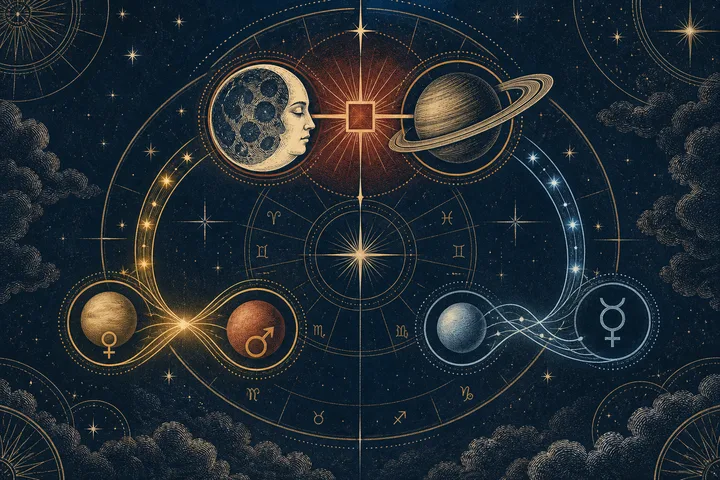
Suppose the Moon receives a square from Saturn, a trine from Venus, and a sextile from Mercury. The chart doesn't contain three separate emotional stories. It contains one emotional field with pressure, tenderness, and language around it. Saturn may show where fear or responsibility tightens the bond. Venus may show what softens it. Mercury may show how the couple can name what they need. The repeated Moon theme deserves priority, but each contact earns a different job.
Double-counting happens when a reader calls every contact proof of the same conclusion. Moon-Venus, Venus-Jupiter, and Sun-Venus may all be described as love, warmth, and support. That doesn't mean the relationship has three independent guarantees. One may speak to comfort. One may speak to generosity. One may speak to admiration. Keep the meanings distinct, then ask what larger pattern they build.
The same caution applies to difficult contacts. Moon-Saturn, Venus-Saturn, and Mars-Saturn may all place Saturn in the reading, but they don't mean the same thing. Moon-Saturn tests emotional safety. Venus-Saturn tests affection, values, and reception. Mars-Saturn tests initiative, anger, timing, and desire. The common Saturn theme is seriousness or restraint. The planet being met tells you where the seriousness lands.
A good report can name a primary theme and two reinforcements. Primary: emotional trust develops slowly because a close Moon-Saturn contact keeps the question of safety alive. Reinforcement one: Venus trine Moon offers tenderness once trust is present. Reinforcement two: Mercury sextile Saturn gives the couple a practical way to make promises and keep them. This is a layered conclusion. It neither ignores the difficult contact nor lets it erase the support.
Astrodienst's aspect reference places different levels of significance on the major aspects, while its broader guidance insists that the planets involved matter before interpretation begins. That combination supports a disciplined method: don't rank the angle alone, and don't rank the repeated theme alone. Rank the planet theme, the aspect style, and the orb together.
Once you've counted the themes once, stop counting. Move to expression. Ask how the pattern shows up in daily life, what helps it work, and what could make it harder. Synastry becomes clearer at that point. It stops asking which symbol wins and starts asking what the relationship is learning to do.
Sources: Astrodienst Astrowiki: Aspects; Astrology.com: An Intro to Synastry Charts and Astrological Compatibility; Cafe Astrology: Aspects Between Charts
Work through three contacts in one example
Imagine Maria and Daniel are comparing known placements. This is an illustrative example, not a calculated personal chart. Maria's Moon is at 14 degrees Taurus. Daniel's Saturn is at 16 degrees Aquarius, making a two-degree square. Maria's Venus is at 9 degrees Cancer, and Daniel's Mars is at 12 degrees Scorpio, making a three-degree trine. Maria's Mercury is at 21 degrees Gemini, and Daniel's Mercury is at 26 degrees Libra, making a five-degree trine.
At first glance, the contacts tell three stories. Moon square Saturn sounds guarded. Venus trine Mars sounds magnetic. Mercury trine Mercury sounds easy to talk through. A shallow reading might choose the romantic contact and call the relationship naturally compatible. A fearful reading might choose Saturn and call it emotionally cold. Both readings throw away useful information.
Start with the question. If Maria asks, why do I feel close to Daniel but still hold something back, the Moon-Saturn square moves to the front. The Moon describes her emotional body in this example. Saturn describes Daniel's way of bringing caution, structure, or responsibility into the bond. The two-degree orb makes the contact sharp. The central story becomes, closeness is real, but emotional safety may need time and proof.
Now read the Venus-Mars trine. It doesn't cancel the square. It shows why the connection has a living pull despite the caution. Maria's Venus in Cancer seeks warmth, protection, and emotional presence. Daniel's Mars in Scorpio moves with depth and intensity. The water-sign trine can make desire feel instinctive. But because it doesn't answer the Moon-Saturn question, it belongs second in the ranking. It explains attraction, not the whole emotional contract.
Then read Mercury trine Mercury. This is the practical support. A five-degree orb is wider than the Moon-Saturn and Venus-Mars contacts, but it directly addresses how the pair can work with the tension. They may find it easier to compare perceptions, name the fear beneath a reaction, or plan a hard conversation. The Mercury contact doesn't make them emotionally identical. It gives them a language for difference.
The final reading is not that Saturn defeats Venus and Mercury. It is this: the bond carries real attraction and a potentially helpful mental rhythm, but emotional trust is the part that sets the pace. If Maria wants immediate reassurance and Daniel responds by becoming more controlled, the square will lead the moment. If Daniel can speak plainly and Maria can ask without testing him, Mercury can support the Moon. If they make room for affection instead of using chemistry to skip vulnerability, Venus and Mars can keep the relationship warm.
Notice the ranking. First, the close contact that answers the reader's main concern. Second, the contact that explains the bond's pull. Third, the contact that offers a usable resource. The order could change if the question changed. If the question were, why is the attraction so strong, Venus-Mars would move first. If the question were, can we discuss difficult subjects, Mercury-Mercury would lead. Context chooses the lens.
Know when a hard aspect outranks a soft one
The strongest meaningful exception is simple: a hard aspect can outrank a soft aspect when it is closer, more personal, and more visible in the relationship. A square isn't weaker because it feels difficult. It may be the contact that keeps shaping every other contact.
Imagine a loose Venus-Jupiter sextile and an exact Moon-Pluto square. The sextile may offer goodwill, pleasure, and the chance to enjoy one another. The Moon-Pluto square may bring emotional intensity, fear of loss, or a need to understand what sits beneath the surface. If the couple is asking why calm moments keep turning into deep emotional tests, Moon-Pluto answers the question more directly. The sextile remains important as a resource, not as the ruling story.
Astrodienst's introductory material describes the opposition as dynamic and potentially motivating, not simply bad. It also describes the square as a blocked or difficult relationship between planetary forces. That language helps correct a common habit: treating ease as proof and tension as disqualification. In a living relationship, tension can reveal the work. Ease can reveal the gift. Neither one tells you whether the people will meet the moment.
A hard aspect rises in the ranking when four things line up. It is close by degree. It involves a personal planet or a central relationship significator. It repeats a theme elsewhere. And the reader's actual question points straight at it. When only one of those conditions is present, keep the contact in proportion.
The reverse is also true. A close difficult aspect doesn't erase a wider, meaningful supportive pattern. Moon square Saturn may describe hesitation, while Moon trine Venus describes the affection that makes working through hesitation possible. You shouldn't soften the square into a promise. You shouldn't turn it into a sentence of doom. Name the difficulty and name the resource beside it.
This is where conviction and care meet. You can say, this is the most consequential contact in the question, without saying, this contact decides the relationship. Synastry describes the pattern of meeting. It doesn't remove choice, communication, or the need to observe how the pattern is lived.
The strongest exception keeps the ranking method honest. The goal isn't to reward soft aspects or punish hard ones. The goal is to identify the contact with the most explanatory power, then show what the other contacts add, challenge, or make possible.
Sources: Astrodienst Astrowiki: Aspects; Astrodienst: A Brief Introduction to Astrology, Aspects
Keep signs, roles, and missing data in view
Aspect ranking can go wrong when the sign layer disappears. The angle tells you how two planets meet. The signs tell you the style in which they meet. A Moon square Saturn in fixed signs may hold its position for a long time. The same square in mutable signs may shift, explain, and reopen the issue. The tension remains, but its rhythm changes.
Cafe Astrology specifically advises readers to consider the sign and house placements of the planets in an interchart aspect. In a full synastry chart, houses add another layer by showing where one person's planets land in the other's life. A placement-only report has a narrower scope. It can compare supplied signs and optional degrees, but it doesn't calculate houses. That boundary protects the interpretation from pretending to know more than the inputs provide.
The planet person and the receiving person also matter. In a Venus-Mars contact, the Venus person may feel appreciated, courted, or valued, while the Mars person feels desire, urgency, or the need to act. In a Saturn-Moon contact, the Saturn person may believe they are offering steadiness, while the Moon person experiences judgment or emotional restraint. Neither experience cancels the other. Rank the contact, then describe both roles.
Missing degrees should lower certainty, not end the reading. If you know both signs but no degrees, discuss the sign relationship as a possible theme and avoid calling an aspect exact. If you know one degree but not the other, you can describe the supplied placement and mark the contact as unverified. If the Moon's degree is uncertain because the birth time is approximate, don't build the entire conclusion on a Moon contact that may move across signs or aspects.
This is especially important with a Moon. The Moon moves quickly enough that an uncertain birth time can change the degree and, on some dates, the sign. The emotional story may still be worth exploring, but the wording needs to show its scope. Say, if the supplied Moon sign is correct, this suggests. Don't say, your exact Moon square proves.
A precise report records the inputs before the meanings. Write the supplied Moon, Venus, and Mars signs. Add degrees only where they are actually available. State the selected major aspects and six-degree orb. Note that houses, a full natal calculation, and unprovided placements remain outside the comparison. This is not a retreat from astrology. It is good chart practice.
The more limited the data, the more you should rank themes that survive the limitation. Sign-level resonance, clearly supplied personal planets, and repeated patterns can still guide a thoughtful conversation. Unverified geometry belongs lower in the hierarchy until the missing information is supplied.
Sources: Astrology.com: An Intro to Synastry Charts and Astrological Compatibility; Cafe Astrology: Aspects Between Charts
Turn the ranking into a useful report and conversation
A ranked reading should help the reader decide what to look at next. It shouldn't leave them with a dramatic sentence and no way to test it in the relationship. After you identify the primary contact, translate it into an observable pattern.
For a Moon-Saturn contact, ask when one person reaches for comfort and the other responds with advice, caution, silence, or practical help. For Venus-Mars, ask whether attraction creates mutual pleasure or whether one person pursues while the other receives. For Mercury contacts, ask whether the pair can state the problem before defending a position. The chart gives the theme. Daily life gives it a voice.
Then name the supporting contact as a resource. A hard Moon contact may be easier to work with when Mercury can explain what the Moon feels. A Mars-Saturn tension may become productive when Venus or Jupiter offers warmth and generosity. A Uranus contact may stay exciting when both people make room for freedom instead of treating independence as betrayal. Support doesn't erase pressure. It gives pressure a better outlet.
Next, state the strongest exception. If the reading says emotional distance leads the story, mention the close Moon-Venus contact that can soften it. If the reading says chemistry leads, mention that a weak or unconfirmed degree means you shouldn't overstate the aspect. If a hard contact dominates, say what would make it constructive. Readers trust a conclusion that can carry its own complication.
Finally, give the reader a conversation. Not a test. Not a demand for a verdict. A real question that matches the chart theme. Try, when you need space, what kind of reassurance still helps you feel connected? Or, when we disagree, do you want comfort first, a plan first, or time before either? Those questions make the astrological reading useful without pretending that a chart can speak another person's private intention for them.
Before you close the report, read the ranking once from each person's side. The same contact may feel like pursuit to one person and pressure to the other. If those accounts differ, keep both in the interpretation and make the conversation address the gap. A hierarchy is useful only when it preserves the contact's direction as well as its intensity.
The report should end with a decision about attention, not a louder opinion. Choose the contact that best answers the reader's question, name the lived pattern it describes, and write one observation that would confirm or complicate it. For example, a Moon-Saturn reading becomes testable when you notice what happens after a request for comfort: does the other person listen, fix, withdraw, or set a useful boundary?
Use the same sequence for the other layers. With Venus-Mars, watch whether desire moves both ways and whether affection survives a difference in pace. With Mercury, notice whether the pair can state the problem before defending a position. With Saturn, ask whether responsibility feels mutual or whether one person has quietly become the gatekeeper. These observations don't replace the chart. They give its symbols somewhere to land.
A compact report can hold the whole judgment in four lines: primary theme, supporting resource, pressure point, and next conversation. Put the planet pair, aspect, and orb beside each line when those inputs are known. In the three-contact example, Moon square Saturn leads the emotional-safety question, Venus trine Mars explains the pull, and Mercury trine Mercury supplies language. If the reader's question changes, the order changes with it.
If you want a comparison built from known placements, the Synastry Comparison Report can organize supplied Moon, Venus, and Mars signs, optional degrees, and selected major aspects using a six-degree orb. It doesn't calculate a natal chart from birth details or assign a relationship score. Its value is a careful comparison of the evidence you actually have.
The conversation to initiate is specific: when you need closeness and I respond differently, what helps you feel met? That question leaves room for the Moon, Venus, Mars, Mercury, and Saturn stories to speak without forcing one of them to become the whole relationship. Let the ranking tell you where to look first. Let the answer come from what the two of you do there.
Give the answer room to change as the relationship answers back. A chart contact can describe pressure, a gift, or an invitation. The people still decide how consciously they meet it. Rank the symbols carefully. Then ask the question that lets ordinary life answer.
Sources: Astrodienst Astrowiki: Aspects; Astrology.com: An Intro to Synastry Charts and Astrological Compatibility; Cafe Astrology: Aspects Between Charts
Sources & further reading
- Astrodienst Astrowiki: Aspects
Supports definitions of major aspects, aspect orbs, aspect significance, and the need to read the planets involved before interpreting the angle.
- Astrology.com: An Intro to Synastry Charts and Astrological Compatibility
Supports synastry as chart comparison, the practical preference for tighter orbs, and the Moon, Venus, Mars, and Saturn relationship themes used here.
- Cafe Astrology: Aspects Between Charts
Supports reading planet roles, signs, houses, personal-planet interaspects, and the two-sided experience of an interchart contact, especially when the same aspect feels different to each person.
- Astrodienst: A Brief Introduction to Astrology, Aspects
Supports the interpretive distinction between dynamic oppositions, pressured squares, and flowing trines without treating difficult aspects as automatic failure or harmonious aspects as guaranteed success.
Synastry Comparison Report
Enter known placements for two people. Get an input-by-input comparison, selected aspect calculations and a clear record of what remains uncertain.
Compare our placements