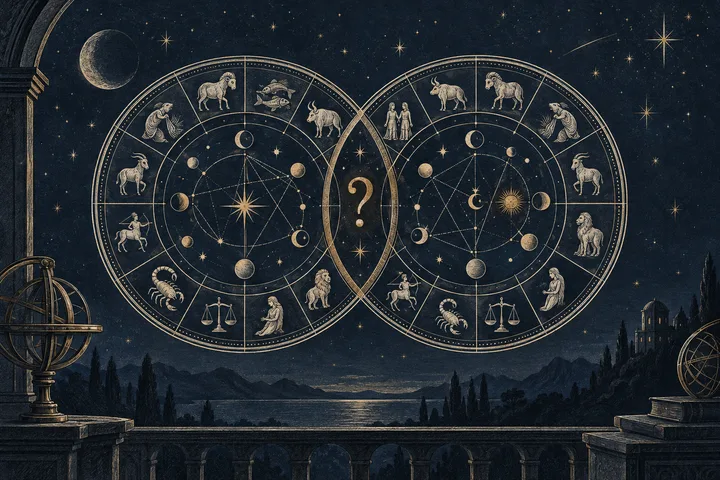
Imagine a beautiful reading built on one shaky detail
Imagine Maria and Daniel comparing a synastry interpretation after a promising third date. The report says their connection is unusually deep. It points to a Moon-Venus contact, a powerful house overlay, and a bond that will keep drawing them back to each other. Maria feels seen. Daniel then mentions that his recorded birth time may be off by an hour. The report's confident tone does not change. That is the moment to pause.
The question isn't whether the interpretation sounds beautiful. It's whether the chart detail can carry the weight placed on it. A statement can be meaningful and still be too certain for its inputs. This guide protects the reading by separating what the supplied chart can show from what depends on a degree, a clock time, a place, or the reader's synthesis.
What do you actually know about the two charts?
Begin with an inventory. Record each person's birth date, local birth time, time-zone setting, and birthplace. Mark the time as exact, rounded, remembered, or missing. Then separate sign placements from degrees and minutes. A supplied Venus in Gemini is one kind of fact. Venus at 14 degrees Gemini is a more precise input. A Venus-Mars trine is a conclusion that still needs both positions and an orb.
Location needs a careful distinction. Date and time establish the moment used for planetary positions. Location supplies the local horizon and meridian, along with the geographic and time-zone context used for the Ascendant, Midheaven, and houses. At the same instant, changing the place doesn't simply rewrite every planet. It can change the chart's angles and house map. That difference matters when a reading treats a house overlay as if it were as secure as a sign placement.
Use three labels while you read: stable, degree-dependent, and time-dependent. Stable can include a sign that remains fixed across the known time range. Degree-dependent includes an aspect whose distance must be checked. Time-dependent includes the Moon near a boundary, an Ascendant, a Midheaven, or a house cusp. This small inventory stops one reliable detail from lending borrowed certainty to the rest of the story.
When a synastry reading sounds absolute but its chart data is approximate, ask what is known, what is estimated, and which part of the interpretation depends on the missing detail. Start with the supplied sign placements. Then check whether exact degrees support the claimed aspect, whether the stated orb is six degrees or another method, and whether the reading relies on houses, angles, or a Moon position that could change. A strong interpretation names its inputs, shows its astrological logic, and ranks the evidence instead of treating every line on a chart as equal. If the birth time is uncertain, keep the reading to placements and cross-chart aspects that remain stable. The next step is simple: write down the claim, the data behind it, and the question the symbolism gives you to discuss together.
Sources: Astrology.com: What Do Houses Mean in Your Birth Chart?; Astrooly: Why Birth Location Matters in an Astrology Chart
Which part of the interpretation needs a birth time?
Ask whether the reading depends on an angle or a house before you give it emotional weight. The Ascendant is the sign rising on the eastern horizon. The Descendant, Midheaven, and Imum Coeli are also chart angles. Houses divide the chart into life areas, including the seventh house of one-to-one relationships and the fifth house of romance and pleasure. These are rich symbols, but they need a usable time and place.
Suppose Daniel's report uses 2:00 p.m., while his family remembers only around lunch. Maria's Venus in his seventh house is now conditional. It may remain a useful possibility, but it isn't the same kind of statement as Daniel having Venus in Leo. Ask what happens if the time moves by thirty minutes. If the house or angle changes, lower that claim's rank or present it as a range.
A time range can still give you something. If the Ascendant stays in one sign, you may discuss that sign carefully while leaving its exact degree and house contacts open. If the range crosses a sign boundary, keep both possibilities visible. Never choose the more romantic version simply because it makes the report read better.
Sources: Astrology.com: What Do Houses Mean in Your Birth Chart?; Astrooly: Why Birth Location Matters in an Astrology Chart
Is the aspect real, and what orb is being used?
An aspect is the angular distance between two chart points. The major aspects include the conjunction at about zero degrees, sextile at sixty, square at ninety, trine at one hundred twenty, and opposition at one hundred eighty. The name describes the geometry. The interpretation begins only after that geometry is established.
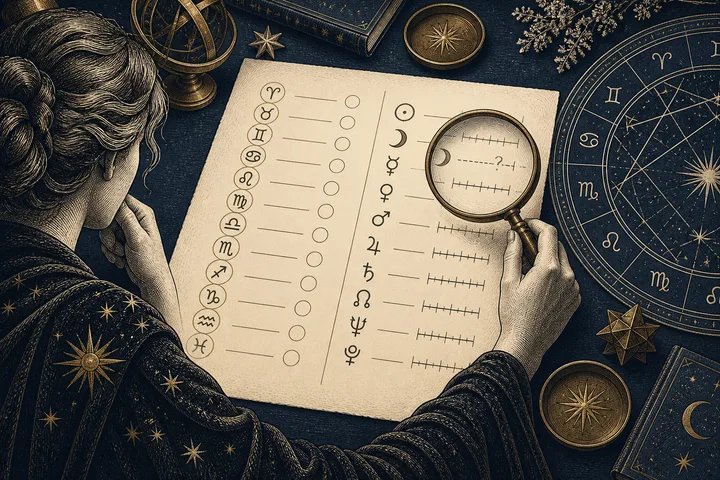
An orb is the allowed distance from exactness. If one person's Venus is at 14 degrees Gemini and the other's Mars is at 18 degrees Libra, the trine has a four-degree orb. If the positions are only described as mid Gemini and late Libra, that number isn't available. Ask which degrees create the contact and which orb rule the reader chose.
Astrologers use more than one orb tradition. Campion's table assigns different ranges to different aspects, while Skyscript describes both modern aspect orbs and older planet-based orbs. This comparison uses a six-degree orb for selected major aspects when degrees are supplied. That is a working rule, not a claim that every contact within six degrees carries equal force. A one-degree contact leads. A six-degree contact needs supporting context.
Sources: Nicholas Campion, An Introduction to Aspects and Chart Shaping; Skyscript Glossary: Orbs or Rays
What survives when degrees are missing?
Missing degrees change the level of the reading, not necessarily the whole reading. You can compare signs, elements, and modalities. You can ask whether one person's Venus style feels familiar to the other's Moon. You cannot rank a precise interaspect until the positions that form it are known.
Consider Maria's Venus in Cancer and Daniel's Moon in Scorpio. The water-sign link offers a clear starting language: care may arrive through emotional attention, protection, memory, and loyalty. It does not prove a Venus-Moon trine. Their degrees might support a close trine, a wider relationship, or no major aspect. Keep the sign story and the aspect story in separate sentences.
The most useful wording is conditional and specific. Say, 'Your water-sign placements can support emotional recognition.' Then add, 'A close trine would strengthen that flow, while a square would describe a more demanding way of meeting the same sensitivity.' Do not fill the blank with a guessed degree or a default noon chart and forget that it was guessed. A clean sign comparison leaves room for a later refinement.
Sources: Nicholas Campion, An Introduction to Aspects and Chart Shaping; Cafe Astrology: Aspects Between Charts
How should you rank the contacts?
Synastry becomes readable when you stop giving every contact equal authority. Moon, Venus, and Mars are central here because they speak to emotional response, affection and values, desire, initiative, and ordinary closeness. The Sun and Mercury can add identity and communication. Jupiter, Saturn, and the outer planets can widen or weight the pattern. The question isn't how many contacts appear. It's which ones actually organize the reading.
Rank a tight personal-planet contact near the top. Put a wider contact below it. Put a repeated sign pattern after clear degree-based aspects unless the pattern appears across several placements. Keep a house overlay or angle contact conditional when the birth time is uncertain. Cafe Astrology's synastry guidance also treats the two people as active participants in the planet roles, so don't describe one person as the whole cause of a contact.
Three labels help: central, supporting, and conditional. Central contacts are tight and relevant. Supporting contacts repeat or soften the main theme. Conditional contacts depend on an uncertain time, Moon position, house, angle, or wide orb. This ranking is the article's main protection against a confident paragraph turning a pile of symbols into a single dramatic verdict.
Sources: Nicholas Campion, An Introduction to Aspects and Chart Shaping; Cafe Astrology: Aspects Between Charts
What does a difficult aspect ask of both people?
A tense aspect describes pressure or difference between two planetary functions. It doesn't decide whether two people should date. A square can make a pattern visible because the friction asks for a response. An opposition can bring attraction and polarity while creating a repeated seesaw. A conjunction can intensify harmony or conflict because both planets share one field.
Take a supplied Venus-Mars square. Venus may seek one style of affection while Mars acts from another rhythm of desire. The square can show heat, irritation, pursuit, and creative tension. It may become lively when both people can name the difference. It may become tiring when each person treats the other's style as a personal insult. The chart gives the shape of the friction. The couple gives it a practice.
The strongest exception is a difficult contact surrounded by support. Moon or Mercury contacts may help the pair recognize and discuss the tension. Saturn may add steadiness. The reverse also matters: a soft Venus trine cannot erase avoidance, contempt, or broken agreements in daily life. Read the aspect as a question about practice, not a sentence about destiny.
Sources: Nicholas Campion, An Introduction to Aspects and Chart Shaping; Cafe Astrology: Aspects Between Charts
What should you do when two tools disagree?
Compare the inputs before comparing the interpretations. Did one tool use a different birth time, time zone, zodiac reference, house system, or orb? Did one include minor aspects? Did the other use a default time? A disagreement often shows you which part of the story depends on a method choice.
If one tool includes a five-degree trine and another excludes it with a three-degree rule, call the contact method-sensitive and lower its rank. If both tools show the same sign placements and the same tight personal-planet aspect, that common result deserves more attention. If only the houses differ, lead with the planet-to-planet geometry and hold the house overlay back.
For this publication's Synastry Comparison Report, the inputs are supplied Moon, Venus, and Mars placements, with optional degrees and selected major aspects under a stated six-degree orb. It doesn't calculate natal positions from birth details or houses. That scope is useful precisely because it prevents a report from hiding a calculation it never made.
Sources: Astrooly: Why Birth Location Matters in an Astrology Chart; Nicholas Campion, An Introduction to Aspects and Chart Shaping; Skyscript Glossary: Orbs or Rays
How can a chart claim become a useful question?
Start with the planet function, then bring it into the room. If the strongest contact involves Moon and Venus, ask, 'What helps each of us feel cared for, and what do we do when care arrives in an unfamiliar form?' If Venus and Mars lead, ask, 'How do we show interest, set pace, and make room for each person's desire?' The chart offers a lens. It doesn't reveal a hidden intention.
Read the contact from both sides. A Venus-Mars square may feel like pursuit to one person and pressure to the other. Moon-Saturn may feel like reliability to one person and distance to the other. That difference doesn't cancel the contact. It tells you what to ask next: what does each person want this pattern to provide, and what does each person actually do when the need appears?
If the evidence is only sign-level, ask about the shared element or style. If a close aspect is confirmed, ask how its energy moves under stress. Then listen for the exception. A chart signature can suggest reserve while the person acts generously. Easy aspects can coexist with poor repair. The interpretation earns its place when it makes observation sharper.
Sources: Skyscript Glossary: Orbs or Rays; Cafe Astrology: Aspects Between Charts
What is the right next step with approximate data?
Make a three-line record. Write one stable statement, one conditional statement, and one observation for the couple. For example: 'Our Venus signs suggest different ways of showing affection. The house overlay depends on his approximate birth time. I want to notice how we respond when one of us asks for reassurance.' That record is short enough to use and precise enough to revisit.
Then enter the supplied Moon, Venus, and Mars placements, adding exact degrees where you have them. Compare selected major contacts under the stated six-degree orb. Let the tightest supported pattern lead. Keep uncertain Moon positions, houses, and angles in a conditional row. If a reliable birth record appears later, revisit only the claims that depend on it. Keep the stable layer that remains.
So what should you ask when a reading sounds certain? Ask the claim to show its inputs. Ask the aspect to show its degree and orb. Ask the house or angle to show the time and place that support it. Then ask what the symbolism helps you discuss together. Approximate data calls for a smaller claim, not a silent guess. A narrower reading can still be rich. It is simply easier to follow, test, and use.
Sources: Astrooly: Why Birth Location Matters in an Astrology Chart; Nicholas Campion, An Introduction to Aspects and Chart Shaping; Skyscript Glossary: Orbs or Rays
Sources & further reading
- Astrology.com: What Do Houses Mean in Your Birth Chart?
Explains the symbolic role of houses and identifies the Ascendant as the starting point of the house framework.
- Astrooly: Why Birth Location Matters in an Astrology Chart
Distinguishes planetary positions from location-dependent angles, house cusps, and time-zone context.
- Nicholas Campion, An Introduction to Aspects and Chart Shaping
Defines major aspect geometry and explains why tighter aspects carry more weight than looser ones.
- Skyscript Glossary: Orbs or Rays
Shows that astrologers use different modern and traditional approaches to aspect orbs and application.
- Cafe Astrology: Aspects Between Charts
Explains planet roles in interchart aspects and the modifying importance of signs and houses.
Synastry Comparison Report
Enter known placements for two people. Get an input-by-input comparison, selected aspect calculations and a clear record of what remains uncertain.
Compare our placements