
Start with the family question, not the chart
Family influence rarely arrives as a neat astrology question. It arrives when your partner takes a call during dinner, sends money home without discussing it, cancels a weekend because a parent needs help, or expects you to join a family system you barely understand. You may wonder whether this is devotion, fear, habit, or a promise they made long before you met. That is the real question. Synastry comes second.
The first thing to ask is simple: what does family actually ask of them? Name the task. Are they providing money, transport, care, translation, emotional support, or a place to stay? A vague answer such as family comes first can hide very different arrangements. One person may visit a grandparent every Sunday and still make room for a partner. Another may speak warmly about family while handing every difficult decision to them. The chart can't tell those stories apart by itself. Your conversation can.
Ask next: what do they choose, and what do they feel unable to refuse? Choice matters because family influence isn't measured by contact alone. A close family can be generous and respectful. A small family can still govern every move. Listen for the difference between I want to help and I have no choice. Then ask what they expect from you. Do they want you to attend every event, share costs, move closer, provide care, keep secrets, or simply understand why plans change? The request may be reasonable. It may also be larger than the relationship has agreed to carry.
You also need your own answers. What kind of family involvement feels warm to you? What feels intrusive? Which duties are yours, which belong to your partner, and which would belong to both of you only after a clear agreement? Don't wait for a crisis to discover that one of you imagines a private partnership while the other imagines an open household with relatives involved in every decision.
Consider an example. Maria's partner calls a parent every night and sends part of a paycheck home. Maria initially reads the pattern as emotional dependence. Her partner explains that the money covers medication after a recent illness and that the calls calm them both. The behavior still affects Maria, but the meaning has changed. Now the useful questions are practical: how long might the support last, what amount can this partner give, and how will they protect time together? A chart can help them explore why the subject feels loaded. It can't set the budget.
This is the first guardrail for a family reading. Describe the observable arrangement before you describe the symbol. If you skip that step, you may use synastry to confirm a fear you brought into the conversation. If you take it, the chart has something real to illuminate.
Before opening the chart, write the issue in one sentence: a parent needs weekly transport, a sibling expects a loan, or every holiday belongs to the wider family. Then add the decision in front of you, the cost of saying yes, and the repair you need if plans change. That brief keeps the reading tied to a real choice.
Sources: Aspects Between Charts, Cafe Astrology; Romantic Compatibility Synastry House Overlays, Cafe Astrology
Gather the information that changes the reading
The next question is technical: what do you actually know? Synastry is a comparison of two birth charts. Astrologers compare the planets in one chart with the planets, angles, and houses in the other. That means the quality of the family reading depends on the chart data you have, and on the layer you are prepared to read.
For a full house-based discussion, you need accurate birth date, birth place, and birth time for both people. Birth time establishes the Ascendant and house cusps. It also gives you the Imum Coeli, or IC, the angle associated with the bottom of the chart and the fourth-house axis. Without a reliable time, don't pretend to know whose fourth house is being activated. A sign-only comparison can still say something useful about Moon, Venus, and Mars, but it cannot supply a dependable house overlay.
Write down the data before interpreting anything. Note whether each placement is a sign only or includes a degree. Record the house system if you are using houses. Keep the two charts separate. Your Moon in Taurus is not the same piece of information as your partner's Moon in your fourth house. The first is a natal sign placement. The second is a cross-chart house placement, and it depends on both charts and a chosen house framework.
Degrees let you rank aspects instead of treating every connection as equal. In this guide, use a six-degree orb for selected major aspects: conjunction at 0 degrees, sextile at 60, square at 90, trine at 120, and opposition at 180. The orb is the distance from the exact angle. A Moon at 14 degrees Taurus and Saturn at 18 degrees Leo form a square with a four-degree orb. That is a closer contact than the same planets separated by eight degrees. State the orb you used. Readers should be able to reproduce the selection.
An aspect is not a complete interpretation. It links two planetary jobs. The Moon speaks to feeling, instinct, comfort, and the need for belonging. Saturn speaks to limits, duty, time, authority, and the weight of an obligation. A Moon-Saturn contact may describe a serious bond around care and responsibility. It may also describe emotional restraint or a fear that affection must be earned. Which expression leads depends on the signs, houses, natal condition, and lived behavior.
The same rule applies to family labels. Astrology has a long tradition of linking family symbolism with parents and caregivers, but real families don't always fit one parent-one planet formulas. Ask who raised the person, who provided care, who held authority, and who made home feel safe or unsafe. A fourth-house reading should follow those facts. It shouldn't force a mother, father, or blood relative into a role that belongs to someone else.
Record each birth date, place, time confidence, and available planetary degree before you begin. Mark unknowns. A placement-based report can compare Moon, Venus, and Mars signs and selected aspects, while a house reading needs dependable times.
Sources: Aspects Between Charts, Cafe Astrology; The Moon in 4th House: Synastry, Transit, Natal, Astrology.com; Saturn in 4th House: Synastry, Transit, Natal, Astrology.com; Birth Charts for Beginners: Four Things You Need to Know, Astrology.com
Read the natal foundation before comparing partners
Before asking what your partner activates in you, ask how each of you carries home already. This is the natal layer. It prevents a common mistake: attributing every family feeling to the relationship when the feeling has been part of the person's private world for years.
Begin with the fourth house. It describes home, family roots, ancestry, privacy, belonging, and the emotional foundation beneath public life. Look at the sign on the cusp, planets in the house, the ruler of the cusp, and the ruler's sign, house, and aspects. Then look at the Moon. The fourth house is a field of life. The Moon is a planet with its own needs and story. They overlap, but they are not interchangeable.
The cusp sign shows the style of foundation that feels familiar. Aries may want directness and room to act at home. Taurus may value continuity, comfort, and material steadiness. Gemini may need conversation and movement in family life. Cancer may seek strong belonging and protection. These are starting tones, not verdicts. The house ruler tells you where the family theme travels. If Libra is on the fourth-house cusp, Venus becomes the ruler. Venus's house and aspects can show whether home questions pull toward partnership, money, work, or another part of life.
Planets in the fourth house add a stronger voice. The Moon can make family feeling immediate and central. Venus may seek peace, beauty, and affection in the private sphere. Mars can bring heat, defense, initiative, or conflict. Jupiter can expand the household, the family network, or the wish to offer shelter. Saturn can place duty, structure, restraint, or early responsibility near the root of the chart. None of these placements names a bad family. Each describes a way the person may meet security and obligation.
Then ask the natal Moon three questions. What calms this person? What makes them feel excluded? How do they ask for care? Moon in an earth sign may look for steadiness and practical proof. Moon in an air sign may need words, perspective, and room to think. Moon in a fire sign may want warmth, movement, and honest response. Moon in a water sign may need emotional presence and a safe place for changing feelings. The Moon's house tells you where those needs show up. Its aspects show what complicates them.
Consider this example. Maria has Moon in Virgo in the sixth house, while her partner has Moon in Cancer in the fourth. Maria may show care by fixing schedules, meals, and small problems. Her partner may experience care as shared time at home and loyalty to family rituals. Neither person is less loving. They are using different evidence. If the family needs frequent gatherings, one may call that closeness while the other first notices the labor involved. A good conversation asks both: what does this event mean to you, and what work will it require from us?
This natal comparison gives you the baseline. If the partner already carries a strong fourth-house or lunar emphasis, family influence may be a central life theme before you enter the picture. If the chart points elsewhere, family can still matter, but you should be careful about making it the master key. Read the whole foundation before you decide what the relationship is activating.
The natal layer can reveal a difference in timing. One person may be ready to build a home now because private security is a conscious priority. The other may still be defining home through work, friends, travel, or a chosen community. That difference deserves a question about pace. Don't make a partner prove love by adopting your image of family on your schedule.
Sources: Aspects Between Charts, Cafe Astrology; The Moon in 4th House: Synastry, Transit, Natal, Astrology.com
Compare the fourth-house overlay and the Moon
Now you can ask the synastry question directly: where does each person's energy land in the other's private world? A planet falling in a partner's fourth house is called a house overlay. The house person experiences the planet through that area of life. The planet person brings the planet's style into the house person's home, roots, family memories, and need for safety.
The overlay works in both directions, but not always in the same way. Your Moon in your partner's fourth house may make their family stories matter to your emotional life, while they may feel that you understand their private self without much explanation. Their Mars in your fourth house may energize your household, push you to act, or stir arguments about territory and family boundaries. Their Venus there may make shared space feel sweeter. Their Saturn there may bring seriousness, duty, and a question about what the two of you are building.
Don't stop at the planet label. Ask three follow-up questions. What does the planet person do? What does the house person feel? What does the family situation require in real life? Moon can nurture, but it can also create a pull toward emotional merging. Mars can defend the home, but it can also trespass. Saturn can keep a promise, but it can also make the home feel like a test. The same placement needs context.
The Moon deserves special attention because family influence often begins as a feeling. Moon-Moon contacts can show different rhythms of comfort. A trine may make emotional habits easier to understand. A square may expose different responses to stress, family contact, or privacy. A conjunction can create strong recognition, but it can also amplify the same mood in both people. Read the signs and houses before calling the contact harmonious or difficult.
Then look at contacts to the IC when accurate birth times make that possible. A partner's planet near your IC can touch the deepest private layer of the chart. The experience may feel familiar, protective, exposing, or disruptive. A Sun contact can bring identity and visibility into the home. Venus can invite affection and peace. Pluto can intensify family material and power questions. The symbol shows where the pressure or warmth enters. It does not tell you whether either person will use it wisely.
Consider an example. Maria's partner has Mercury in her fourth house, while her Moon falls in theirs. The partner wants to talk about family history, logistics, and the rules of a future home. Maria feels the family stories in her body and wants emotional reassurance before discussing plans. If they only read Mercury as communication and Moon as sensitivity, they miss the exchange. One needs a clear plan to feel safe. The other needs a sign that the plan protects the relationship. Their task is to offer both.
Watch for repetition across layers. If your partner's Moon falls in your fourth house and also trines your Venus, family contact may be easier to receive because emotion and affection speak together. If their Mars falls there while squaring your Moon, the same private territory may feel active and reactive. Repetition increases importance. It tells you which theme deserves attention first; it doesn't tell you what either person will choose.
For each important overlay, write a useful pair: this contact can help us by..., and it may press us when.... Finish with one observation that would distinguish the two expressions. If Saturn can mean steady care or emotional weight, the test might be whether duties are named and shared. A symbol becomes useful when it creates a way to notice, not merely a label to repeat.
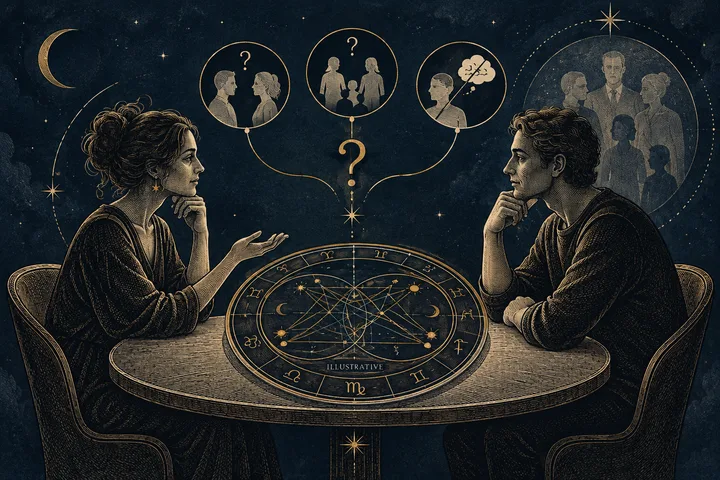
Ask about the partner's actual family role before you ask the chart to explain it. What does family need from them? What do they volunteer, what do they resent, and what space do they protect for your relationship? Once you have those answers, synastry can give the pattern a useful name. Start with each person's natal fourth house and Moon for home, roots, and emotional security. Then compare planets falling into the other's fourth house, especially the Moon, Venus, Mars, and Saturn. Add close major aspects, using a six-degree orb, only after you know what the relationship is already showing. This order matters. A chart can describe why family themes feel tender or heavy, but it shouldn't replace a direct conversation or turn a partner's relatives into a fixed fate. If you only know Moon, Venus, and Mars signs, stay with emotional needs, affection, and initiative. House overlays and angles require accurate birth times.
Sources: Romantic Compatibility Synastry House Overlays, Cafe Astrology; The Moon in 4th House: Synastry, Transit, Natal, Astrology.com; Saturn in 4th House: Synastry, Transit, Natal, Astrology.com
Rank aspects by planet, degree, and behavior
Once you understand the natal foundation and house overlays, rank the inter-aspects. This is where many readings become noisy. A list of twenty contacts can sound impressive while hiding the one pattern that actually matters. For family influence, start with the Moon, Saturn, Venus, Mars, and the fourth-house ruler or IC when the birth data supports them.
Use the closest major aspect first. A conjunction blends the two planetary functions. A square creates pressure that asks for conscious work. An opposition places two needs across from each other and asks for integration. A trine can make a response feel natural and supportive. A sextile offers an opening that grows through use. These are broad meanings. The planets decide what kind of family question is being carried.
Moon-Saturn is the clearest example of why ranking matters. In a supportive expression, Saturn gives the Moon steadiness, containment, and follow-through. The couple may be able to hold difficult family duties without panic. In a strained expression, the Moon may feel judged, managed, or left to earn tenderness. Saturn may feel burdened by feelings that never become a plan. The strongest exception is a mature relationship in which both people name the duty, share it fairly, and leave room for rest. The aspect does not force the heavy version.
Moon-Venus can soften family contact through affection and goodwill. It may help partners offer comfort in different languages. But if one person expects constant sweetness, the contact can hide practical disagreements. Moon-Mars can make a couple protective and active when a family member needs help. It can also turn a discussion about relatives into a fight about control. Venus-Saturn can support loyalty and lasting care, yet it may feel formal when warmth is withheld. Mars-Saturn can organize action under pressure, or make every request feel like a command.
Now bring in the signs. A Saturn contact in Capricorn may emphasize duty, hierarchy, and long-range planning. In Libra, the question may center on fairness, agreement, and the obligations created by partnership. A Moon contact in Pisces may absorb the emotional atmosphere of a family gathering. In Aquarius, the person may need distance or a less traditional arrangement to feel loyal without feeling captured. Sign symbolism refines the planet's job. It doesn't erase the actual situation.
Then use degrees. If the Moon and Saturn are within two degrees, give the contact more weight than a six-degree contact of the same type. If a contact is wide, let it remain background unless other factors repeat it. Check whether several indicators tell the same story. For example, Saturn in the partner's fourth house, a close Moon-Saturn square, and a natal fourth-house Saturn would make responsibility a repeated theme. One loose aspect should not carry that conclusion alone.
When the planets disagree, give each one a separate question instead of forcing them into one verdict. The Moon asks, what helps each person feel emotionally safe when family pressure rises? Venus asks, what kind of care feels loving rather than intrusive? Mars asks, who takes action, and how does conflict begin when plans change? Saturn asks, what duty lasts, who carries it, and where does the couple need a limit? Imagine a pair with a warm Moon-Venus contact but a close Mars-Saturn square. They may genuinely enjoy one another and still clash when a parent needs urgent help. The softer contact describes the goodwill available. The harder contact identifies the moment that needs a procedure: who answers the call, who explains the delay, and when the couple returns to its own plans. This layered reading is more useful than calling the chart easy or difficult.
A useful ranking has three levels. First comes an exact or close contact involving the planets that describe the question. Second comes a house or angle activation that repeats the same subject. Third comes a sign resemblance or a loose contact that adds color but cannot carry the reading. This keeps one dramatic symbol from overpowering the chart. It also gives you language for uncertainty: the theme is present, but the evidence is light.
Imagine the question is whether family duties will crowd out shared time. Suppose one partner's Saturn falls in the other's fourth house, the house person's Moon is three degrees from that Saturn, and their Venus signs are compatible but make no close aspect. The Saturn contacts rank first because they repeat responsibility and emotional weight in the private sphere. The Venus signs rank third. They may help the couple value one another, but they cannot answer who gives notice before a family visit. The useful output is a small decision table: contact, present family issue, likely pressure, and question to ask. For this pair, the question is how much notice each person needs and whether the duty has an end date.
If several contacts compete, keep the question narrow. Don't ask which aspect explains the whole family. Ask which contact best describes the present decision about a holiday, a loan, a visit, or a living arrangement. The Moon may explain the feeling, Saturn the duty, Mars the action, and Venus the value at stake. A ranked reading lets each planet do its own job and stops one vivid symbol from becoming a verdict.
Before you discuss the result, write one sentence that joins symbol and choice: this Saturn pattern asks us to decide how family duty affects our evenings. That sentence is specific enough to test and modest enough to revise. The reading has a job now. It must help the couple decide what to protect, what to share, and what to revisit.
Sources: Aspects Between Charts, Cafe Astrology; The Moon in 4th House: Synastry, Transit, Natal, Astrology.com; Saturn in 4th House: Synastry, Transit, Natal, Astrology.com; Birth Charts for Beginners: Four Things You Need to Know, Astrology.com
Turn the reading into a fair family agreement
Start with the part that affects your week. Ask: what family event, duty, or expectation are we trying to handle? Put a date and a task on it. Then ask who owns the decision. If a sibling needs a ride, the family member closest to that request may own the transport plan. If the two of you are paying for it, both of you own the budget. If you are invited to help, you still get to answer for yourself. Clear ownership keeps care from becoming silent labor.
Use the chart language lightly and specifically. You might say, our Moon-Saturn contact makes me think responsibility could become emotionally heavy for us. Can we decide how we'll share it? Or, your planet in my fourth house makes family matters feel close to me. What privacy do you want us to keep between us and your relatives? This wording leaves room for an answer. It doesn't announce a diagnosis.
Make three agreements. First, an information agreement: what family details can be shared with you, and what remains private? Second, a time agreement: how much notice do you need before plans change, and what time belongs only to the relationship? Third, a resource agreement: what money, transport, housing, or care can each person offer without resentment? These agreements are more useful than a compatibility percentage because they turn a symbol into a choice.
If the conversation heats up, return to one concrete question: what are you asking me to do, by when, and what will you do yourself? The answer shows whether the family need has become a shared plan or an unspoken assignment. Your partner may need support, a boundary with a relative, or the courage to admit that they promised more than they can give.
For a placement-based comparison, you can bring the known Moon, Venus, and Mars signs into this discussion. Moon helps name reassurance and belonging. Venus helps name values, affection, and what makes care feel welcome. Mars helps name initiative, defense, and conflict around action. If degrees are available, a synastry comparison can add selected major aspects using a stated six-degree orb. If birth times are missing, keep houses and angles out of the report. The result can still help you ask better questions because it stays inside its actual scope.
The point is to make the relationship visible inside the family system. Care needs limits, loyalty needs honesty, and neither person should guess what the other agreed to carry. Set a review date because a temporary illness can become a long recovery, a sibling can find work, or a parent can move. Fair doesn't always mean equal. It means both people understand the cost, consent to the plan, and can reopen it when the facts change.
Here is the conversation to initiate: I want to understand how your family responsibilities fit with what we're building. What do you want to keep doing, what are you asking me to share, and what boundary should we set together? Hear the answer before you bring in the chart. If you use the Synastry Comparison Report, enter only the Moon, Venus, and Mars signs you actually know, add degrees when available, and keep the stated six-degree orb for selected major aspects. Let the symbols deepen the talk. Let the agreement guide the relationship.
Sources: Aspects Between Charts, Cafe Astrology; Romantic Compatibility Synastry House Overlays, Cafe Astrology; The Moon in 4th House: Synastry, Transit, Natal, Astrology.com
A little more clarity
Can synastry show whether a partner's family will interfere?
Synastry can highlight family and privacy themes through fourth-house overlays, the Moon, the IC, and related aspects. It can't decide how relatives will behave or whether your partner will set boundaries. Ask what interference looks like in practice, then use the chart to explore why the subject feels safe, urgent, or difficult.
What if I don't know both birth times?
Stay with the placements you can support. You can compare Moon, Venus, and Mars signs, and you can read their inter-aspects when degrees are known. Don't claim fourth-house overlays, IC contacts, or accurate house cusps without dependable birth times. Missing house data narrows the reading; it doesn't erase the useful sign and aspect layers.
Is Moon-Saturn synastry always difficult for family matters?
No. Moon-Saturn can describe emotional restraint or a sense of duty, but it can also support patience, reliability, and shared care. Read the aspect by sign, house, degree, and expression. The deciding evidence is whether the couple names responsibilities, shares them fairly, and leaves room for tenderness and rest.
Sources & further reading
- Aspects Between Charts, Cafe Astrology
Supports reading synastry as interchart comparison, with planetary roles, signs, houses, and inner-planet contacts considered together.
- Romantic Compatibility Synastry House Overlays, Cafe Astrology
Supports two-way house overlays and reading where one person's planets fall in the other person's houses.
- The Moon in 4th House: Synastry, Transit, Natal, Astrology.com
Supports the Moon's emotional and security symbolism and its fourth-house connection in natal and synastry readings.
- Saturn in 4th House: Synastry, Transit, Natal, Astrology.com
Supports Saturn's family, home, responsibility, boundary, stability, and heaviness themes in fourth-house synastry.
- Birth Charts for Beginners: Four Things You Need to Know, Astrology.com
Supports the five major aspect angles and explains degrees and orb as part of reading planetary relationships.
Synastry Comparison Report
Enter known placements for two people. Get an input-by-input comparison, selected aspect calculations and a clear record of what remains uncertain.
Compare our placements