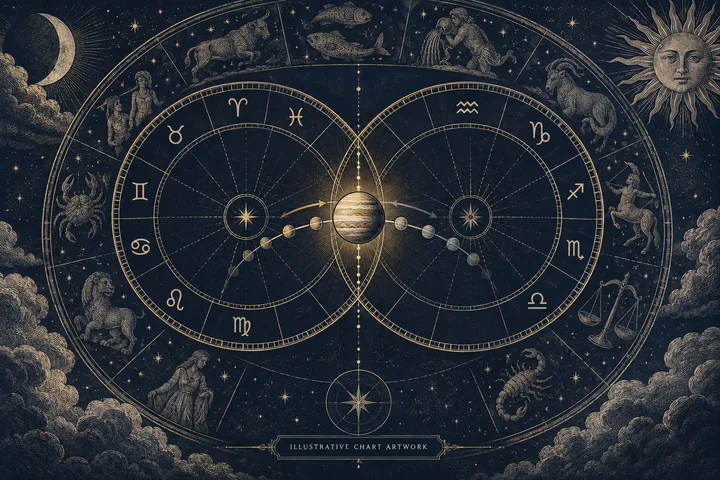
How should you read a close synastry contact when a planet stations?
A station does not change the natal distance between two planets. Read the contact first as a fixed relationship between the two supplied birth placements, then ask whether a verified station adds a timely point of emphasis to one or both planets. In the illustrative Venus–Moon conjunction used below, the natal contact remains the baseline; any station reading depends on who owns the contacted planet and how close the station is by degree. For this comparison, the inputs are known natal placements and a checked station position. No birth chart is calculated, and no relationship outcome follows from the contact.
The practical order is: identify each natal planet and its chart context; establish the aspect and its orb; then add station timing only after confirming the exact degree, date and time convention, and whether the planet is turning retrograde or direct. Astrological traditions differ: some give a station special weight, while others read it through the planet's broader condition. Here, stationing is treated modestly as an attention and timing layer, not as a universal strength multiplier. The distinction between a natal contact and a transit is the organizing rule throughout: the natal aspect describes the fixed comparison, while the station can only be considered after its timing and degree are verified against those placements. A station near one endpoint does not automatically speak equally to both people, and a sign-level resemblance alone does not establish a precise transit contact. The sections that follow keep those claims separate.
What is already fixed when two natal planets form a close contact?
Synastry compares two natal charts. A cross-aspect is an angular relationship between a planet in one chart and a planet in the other; it keeps the identity of both endpoints. If one person's Venus is compared with another person's Moon, those are still two distinct natal placements, each belonging to its own chart. The Astrology Podcast's “Synastry: The Astrology of Relationships” frames the practice as comparing charts while considering the planets in their individual contexts. That framing is useful here because a station may add a new timing question, but it does not replace either natal planet or transfer one person's placement to the other.
The geometry is the first stable fact. Zodiacal longitude assigns each placement a position along the zodiac; the angular separation between the two positions determines whether they form a conjunction, opposition, square, trine, sextile, or another aspect recognized by the astrologer. An orb is the distance by which an aspect departs from its exact angle. For a conjunction, the exact angle is zero degrees, so two planets close together by longitude form a closer conjunction than two farther apart. The exact separation can be calculated from supplied degrees. Its interpretation, including which aspects matter most and what orb to allow, belongs to the chosen astrological method.
A Venus–Moon conjunction makes a clear example because it lets the reader track one aspect type without changing the basic geometry midway through the comparison. The example is illustrative: it does not describe actual people, and no degrees are needed to establish the point here. If exact degrees are supplied, calculate the angular gap and state the orb used. If only signs are known, a shared sign can support a sign-based comparison within traditions that use one, but it cannot establish how close the planets are by degree. Two planets can occupy the same sign while lying far apart; placements on opposite sides of a sign boundary can also sit close together in longitude. The label “close” therefore needs degree data and an explicit orb convention, not just a sign match.
Cafe Astrology's “Aspects Between Charts” gives interpretive guidance that considers both contributed planets, their signs, and chart context. Applied carefully, that means the Venus side and Moon side should be described separately before their conjunction is synthesized. Venus can be read through its own natal sign and condition, while the Moon is read through its own sign and condition; the aspect then supplies the specific connection an astrologer is examining between them. This is not a claim that either person must behave in a particular way. It is a disciplined way to avoid turning a two-planet contact into a single label for the whole relationship.
The birth chart context also belongs to each endpoint. A planet's sign gives one interpretive layer; its house placement, if reliably known, locates another layer in that person's chart. A planet's other natal aspects may qualify the initial reading as well. “Synastry: The Astrology of Relationships” emphasizes retaining the chart context around a contact, while “Aspects Between Charts” discusses sign and house context in its reading guidance. Together they support a sequence: establish the individual planet descriptions, identify the cross-aspect, and then interpret how those descriptions meet. The conjunction is not a free-standing verdict, and neither planet should be treated as though it speaks for every part of its owner's chart.
A missing birth time limits some kinds of context more than others. Without a dependable time, house cusps and angles may be uncertain, so an astrologer should not confidently assign a placement to a house or claim an exact angle contact from incomplete time data. A planetary longitude can still be usable when the underlying birth date, time range, location, and ephemeris calculation establish it sufficiently; for some planets, the position changes little across the uncertain interval, while for faster-moving placements it may change enough to matter. The right response depends on the actual source data, not a blanket assumption that every placement is either certain or unusable. If the available record does not support a reliable degree, the exact orb remains undetermined.
This distinction matters because geometry and symbolism answer different questions. The angular calculation describes the relationship between supplied placements; the interpretive tradition assigns meaning to the aspect, signs, and planetary roles. The first can be checked arithmetically when coordinates are adequate; the second should be presented as a reading with its method clear. Cafe Astrology's “Aspects Between Charts” is an interpretive reference, not a universal rulebook. A clear account can report the measured gap, name the aspect practice, and leave the exact angular claim open when degrees are unavailable.
This distinction matters because the geometry and the symbolism answer different questions. The angular calculation describes where the two supplied placements stand relative to each other. The interpretive tradition supplies meaning to the aspect, signs, and planetary roles. The first can be checked arithmetically when the input coordinates are adequate; the second should be presented as an astrological reading, with its method clear. “Aspects Between Charts” is an interpretive reference rather than a universal rulebook, so its account can inform a reading without making one exact symbolism mandatory across all schools.
A close natal contact is therefore a stable reference point for later timing analysis. If a planet in the current sky stations near one of the natal endpoints, the birth placements and their cross-chart distance remain what they were. What changes is the added temporal relationship between the moving planet and the natal chart, a separate question to test against the station's actual position. Keeping those layers distinct prevents an event in the sky from being mistaken for a change in the two people's natal geometry. It also lets an astrologer say precisely what is known: the aspect, if the degree evidence supports it; the interpretive assumptions; and which missing chart details limit the reading.
Sources: Synastry: The Astrology of Relationships; Aspects Between Charts
What does ‘station’ mean in a chart calculation?
A station is the turning instant at which a planet’s apparent motion in zodiacal longitude changes direction. In a geocentric chart calculation, the relevant position is the planet’s apparent longitude as seen from Earth, and the station is located where the longitudinal speed changes sign. A retrograde station is the turn from direct motion to retrograde motion; a direct station is the turn from retrograde motion back to direct motion. The planet does not physically stop in its orbit. The word describes a point in the changing appearance of its motion from the chart’s chosen viewpoint.
The technical account in Kerykeion’s “Retrograde Station Factory” defines station detection through a change in apparent longitudinal motion. Its documentation page could not be opened during research, so it serves as corroboration for that narrow definition rather than a full specification of every calculation choice. NASA Earth Observatory’s “Planetary Motion: The History of an Idea That Launched the Scientific Revolution” explains the observational basis: a planet can appear to move backward against the stellar background from an Earth-centered perspective even as the bodies continue along their orbits. Together, those sources distinguish the chart event from a literal halt in physical motion.
To reproduce a station degree, first identify the coordinate frame and longitude convention used by the ephemeris or table. A tropical zodiac measures longitude from the equinox-based zodiac; a sidereal zodiac uses a star-referenced zodiac and an adopted offset. Those conventions can assign different zodiacal labels or degrees to the same sky position. The planet’s apparent geocentric longitude also depends on the observing origin and the calculation’s stated reference frame. The table’s own description therefore matters: a degree without its coordinate convention is an incomplete report of the calculation.
The station is an instant, not a whole day or a stretch of several days in which the planet literally has no motion. Its speed approaches zero at the direction change, but it varies continuously around that point. Astrodienst Astrowiki’s “Stationary” notes that the duration called stationary is not exact because the velocity changes continuously and the threshold for applying that label is a choice. A software display may mark the instant at the zero crossing, while an astrologer or table may also designate a practical interval around it. Those are different reporting choices; the interval should not be mistaken for a second, physically separate event.
Sources may differ on a station date or duration because one gives an instant, another rounds to a civil date, and a third labels a planet stationary under a chosen speed threshold. A date-only listing cannot establish the exact instant or degree. For a comparison, use a source that supplies time, zodiac convention, and coordinate definition, then preserve those details when checking against natal longitudes.
Civil dates depend on time zone. A station close to midnight in one zone can fall on the previous or following calendar date in another, even though both entries refer to the same instant. This is a conversion between a universal timestamp and local civil time, not a different motion event. When recording an event, retain the source’s time zone or UTC offset alongside the date and time. If a table gives only a date and leaves its zone unstated, the date alone is not enough to resolve a near-midnight discrepancy; avoid silently treating it as a universal timestamp.
A displayed zodiac position also depends on whether the source reports apparent or mean positions and on its treatment of observational corrections. The assigned evidence does not document every such setting, so a reader should not infer them from a label like “station” alone. Kerykeion’s “Retrograde Station Factory” is useful for identifying the motion-change criterion, while the table or ephemeris used for a specific degree must supply its own coordinate and time conventions. When those details are absent, record the omission and avoid claiming that two software displays are directly comparable.
The zodiacal degree is the longitude coordinate at that instant under the stated zodiac convention. It is not the planet’s speed, and it does not itself state how long the planet will remain near the degree. The station instant answers when the longitudinal direction changes; the longitude answers where that event is located in the chosen zodiac. A separate velocity threshold may define a broader stationary interval, and a separate ephemeris convention may affect the displayed degree. Keeping these quantities apart makes the calculation legible: event time, local date, coordinate system, longitude, and any threshold used for a displayed interval.
These details establish a calculation, not an interpretation. “Retrograde station” and “direct station” identify the apparent turn; they do not say that a planet becomes more powerful, favorable, difficult, or personally meaningful. In synastry, a verified station longitude can be compared with supplied natal positions. The coordinate event alone cannot tell whether both people experience a contact alike.
A careful chart note can therefore say, for example, that a source lists a planet’s geocentric longitude at its retrograde station under a named zodiac and a stated time zone. If the source uses a threshold to label a stationary period, record that threshold or quote its interval as the source presents it. If another source uses a different frame or rounds the timestamp differently, do not blend the entries into one supposedly universal display standard. The precise convention lets another reader understand what was compared and repeat the check, while leaving interpretation open to the astrological framework applied next.
Sources: Retrograde Station Factory; Stationary; Planetary Motion: The History of an Idea That Launched the Scientific Revolution
Does a station always intensify the planet?
No single rule makes “stronger” the only useful reading of a station. Some astrologers give a stationary planet added emphasis, treating the slow turn as a marked condition. Other readings center the station as a pivot in motion or interpret it through the planet’s broader condition in its chart. Kerykeion’s “Planetary Stations in Astrology: The Power of the Pause” presents station symbolism alongside traditional planetary condition and context, supporting a contextual reading rather than a universal multiplier. The available Astrodienst Astrowiki excerpt for “Retrograde Motion” also presents distinct interpretive accounts, so a responsible reading should name the tradition it is using instead of suggesting that all astrologers agree.
The emphasis reading has a coherent rationale within the traditions that use it: a planet at a conspicuous turning point may deserve more attention in delineation than a planet moving steadily through the same degree. In that framework, “potent” means the astrologer assigns the planet greater symbolic weight while interpreting the chart. It is not a measured increase in physical force, a guarantee that the planet’s themes will dominate a relationship, or evidence that both people will notice the same thing. The word carries a method-specific judgment, so readers need to know which tradition is making that judgment and how it weighs other chart factors.
A pivot reading makes a different claim. The station marks the transition between direct and retrograde motion, or between retrograde and direct motion; an astrologer may use that change of direction as an image of turning, review, or resumption. This interpretation focuses on the change in phase rather than treating the station as a simple volume control. Its merit is that it stays close to the event’s structure: something changes direction at a definite point. Its limit is that the astronomical turn does not prove that a person, relationship, or external event will undergo a matching reversal. The symbolic image is an interpretive choice, not a result supplied by the coordinate calculation.
A condition-based reading asks what sort of planet is stationing and how that planet is situated in the chart being interpreted. Kerykeion’s “Planetary Stations in Astrology: The Power of the Pause” links station symbolism with planetary condition and context. This gives the astrologer a reason to examine the planet’s established natal role and surrounding factors before deciding how much weight to give its station. A station then becomes one condition among those considered, not a self-contained verdict. Two planets can share the same motion phase yet be read differently because the astrologer’s tradition assigns them different roles or evaluates their chart conditions differently.
These readings differ in interpretive hierarchy: does station status itself carry substantial weight, or does it direct attention to the planet's natal condition and contacts? An astrologer can regard a station as noteworthy while still asking what the planet signifies, whose chart contains it, and what qualifies the interpretation. Naming the approach makes the disagreement intelligible without presenting one convention as universal.
Direction alone cannot decide whether a synastry contact is favorable or difficult. “Retrograde” names apparent motion in one direction; “direct” names apparent motion in the other. Neither label identifies the two natal planets involved, their aspect, their individual conditions, or the interpretive rule used for the station. A station direct is not automatically a relationship repair, and a station retrograde is not automatically a problem. Those claims would turn a motion label into a forecast without showing the intervening reasoning. A measured contact and its chart ownership must be considered before assigning any relationship meaning.
Nor does a station make a contact mutual merely because it occurs in the shared sky. A current station can be compared with one person’s natal planet, the other person’s, or both; those are distinct geometric relationships. If the station falls near one supplied endpoint but not the other, a method may give the first person’s contacted planet greater immediate emphasis. If it lies near both, an astrologer may consider a shared period of attention. Neither pattern establishes matching feelings, intentions, or reactions. The station’s direction does not erase the difference between two chart owners or supply evidence about what either person experiences.
A modest, usable interpretation is to treat the station as an attention and timing cue. It can prompt a reader to look more carefully at the contacted planet, verify which chart owner it belongs to, and ask whether the chosen tradition gives station condition added weight. The cue is strongest as a question for interpretation when the station’s source convention is clear and a close degree contact is actually demonstrated. If the source tradition is vague, or the degrees do not show a close connection, a claim of special intensification has little stated basis. The reader can retain the natal synastry contact as the stable reference and describe the station layer as tentative or absent.
The strongest case for a more emphatic reading is a practitioner working consistently within a tradition that treats stationary planets as especially potent, with the station clearly calculated and closely related to the natal contact under that tradition’s rules. That practitioner can reasonably assign the planet greater interpretive weight. The claim should remain at that level: greater weight within a specified astrological framework. It does not follow that every astrologer must use the same hierarchy, that the contact becomes favorable or unfavorable by direction alone, or that the station predicts a shared event. Stating the scope protects the force of the reading from being confused with a universal synastry law.
The alternative is not to ignore stations. It is to interpret what they can contribute without asking them to carry the whole chart. First establish the underlying natal contact and the role of each planet. Then decide whether the adopted tradition treats the station as a strength condition, a pivot, or a prompt to reassess planetary condition. Finally, test whether the specific station actually bears on one or both endpoints. This sequence distinguishes a symbolic emphasis from a geometric fact and leaves room for traditions to disagree. It also gives a reader a clear reason to reduce the emphasis when the interpretive framework is unstated or the supposed contact is not close by the supplied coordinates.
An interpretive claim is more credible when its chain of reasoning is visible: the reader can identify the stationing planet, the chart owner or owners it contacts, and the source tradition that assigns significance to the turn. If one of those links is missing, “intensified” may sound decisive while naming no testable interpretive step. A more careful account states what is known, what the tradition proposes, and what remains an open question about this particular contact.
A planetary station does not change the angle between two natal planets. It can add a time-specific interpretive focus when you know whether the station is natal or transiting, whose chart or placements it reaches, and how close it is to each endpoint. Start with the natal contact and each planet’s role; then compare the station’s degree with the supplied natal degrees using a stated method. A close match may support giving that planet more attention within an astrological tradition, but it does not prove that both people feel the same thing or predict a relationship outcome. If degrees, timing conventions, or chart details are missing, keep the station emphasis provisional and retain the natal contact as your reference.
Sources: Planetary Stations in Astrology: The Power of the Pause; Retrograde Motion
Who owns the station: one person's natal chart or the current sky?
Ownership answers a different question from proximity. A natal station belongs to a planet in one person's birth chart and describes that planet as part of that person's enduring chart condition. A transiting station belongs to the current sky: it is a temporary event that can be compared with either person's natal placements. In a synastry reading, keep those cases separate. The first concerns the chart owner's natal planet; the second concerns when a moving planet forms a contact to one or both natal endpoints. Neither case, by itself, reports what the other person feels or intends.
The Astrology Podcast's “Synastry: The Astrology of Relationships” frames synastry as an interaction between two charts while retaining the context of each chart and its planets. Applied to stations, this means the astrologer should name whose chart contains the stationary planet before assigning it a role. “A station in A's natal chart” and “a current station contacting A's natal Venus” sound similar, but they describe different chart layers. One is a natal condition carried in A's chart; the other is a present timing relationship between the sky and a natal placement. If the owner is left unstated, the reading can quietly slide from one meaning to the other.
Case one: the station is natal to person A. The planet's stationary condition belongs to A's natal chart and can be considered when interpreting that planet's role in A's chart and in the contact A contributes to synastry. The Astrology Podcast's synastry discussion supports reading each contributed planet in its chart context, while Kerykeion's “Planetary Stations in Astrology: The Power of the Pause” describes station symbolism as a condition that some astrological approaches weigh in context. Together, these sources support a tradition-based interpretation of A's natal planet. They do not turn the natal station into a current event, establish a temporary period for the couple, or show that person B shares A's natal condition. Any claim that the condition colors A's contribution is an interpretation of A's chart, not evidence about B's inner response.
A natal station also does not mean the two-person contact itself is stationary or newly activated. The cross-chart relationship remains the relationship between the two natal placements. A reader may consider A's natal station when describing A's side of that relationship, but should not relabel the whole contact as an event happening now. There is no current transit implied merely because a birth chart contains a stationary planet. The timing question therefore stays open unless a separate transiting position is identified and compared with the natal charts.
Case two: the current sky has a station near A's natal endpoint. Here the station belongs to neither person's natal chart; it is a shared-sky event. The endpoint it contacts belongs to A. An astrologer can describe a temporary transit-to-A relationship and, within a stated interpretive tradition, examine whether that timing draws attention to the natal planet A contributes to the synastry contact. “Temporary” is the important boundary: the transit adds a period-specific layer to the reading, while the natal placements remain the background relationship. Kerykeion's “Planetary Stations in Astrology: The Power of the Pause” offers a contextual way to interpret a station, but it does not establish that a station near A's endpoint produces a matching event or awareness in B.
The same-sky event may be part of the couple's shared circumstances. They might both be navigating the same calendar period, conversation, or external setting. That possibility does not make the exact chart contact equal for each person. If the station is tied by the chosen interpretive method to A's endpoint, the chart evidence supports discussing that contact on A's side. It cannot identify B's feelings, explain B's behavior, or establish that both people experience a common emotional shift. Those are claims about personal experience, and a transit-to-A alone does not supply them. The most precise wording keeps the levels visible: a shared period in the sky, a specific contact to A's natal planet, and an interpretation whose personal meaning remains to be tested in context.
Case three: the transiting station is related to both natal endpoints. This creates two transit-to-natal relationships during the same period, one involving A's placement and one involving B's. An astrologer can examine each contact separately, then consider whether their overlap supports reading the period as a shared synastry topic. Kerykeion's “Planetary Stations in Astrology: The Power of the Pause” supports contextual station interpretation; The Astrology Podcast's “Synastry: The Astrology of Relationships” supports retaining both chart owners' contexts. Together, they justify a two-sided interpretive inquiry, not a conclusion that the contacts mean the same thing to both people. The planets may differ, occupy different natal roles, or be weighed differently in each chart.
When both endpoints are involved, “shared” should describe the structure of the question, not presume a shared reaction. Each person has a separate natal placement and chart context. The same transiting planet can therefore raise distinct interpretive questions for A and B, even if the astrologer treats the period as one joint theme. A close relationship to both endpoints may warrant comparing those two readings and asking whether a present situation brings the theme into conversation. It does not establish synchronized emotions, agreement, conflict, or a relationship outcome. The strongest responsible statement is about the timing overlap and the possibility of examining both sides; what either person experiences still comes from their own account and circumstances.
The practical distinction is temporal as well as personal. Natal ownership points to a lasting chart condition assigned to one chart owner; transit ownership points to a temporary sky event whose contacts can be owner-specific, even though the event itself is common to everyone under that sky. A transit close to one endpoint supports a more focused timing interpretation for that endpoint. A transit connected with both supports considering a shared period while preserving the two separate chart readings. In either case, do not infer the uncontacted person's experience from the contacted person's chart. The useful record names the station's owner (natal chart or current sky), the endpoint owner or owners, and whether the claim concerns a natal condition or a temporary timing layer.
Sources: Synastry: The Astrology of Relationships; Planetary Stations in Astrology: The Power of the Pause
How close is close when the station reaches one or both natal endpoints?
Degree distance changes how specifically a station can be connected to a natal contact, but no universal station-to-synastry orb is established here. The arithmetic of supplied longitudes can be exact within their stated coordinates; the interpretive threshold for treating a station as significant depends on the astrologer's method. The example below is hypothetical throughout. It shows how to compare the station separately with each endpoint, then decide what the measured proximity can and cannot support. It does not set a general orb or imply that people with these placements exist.
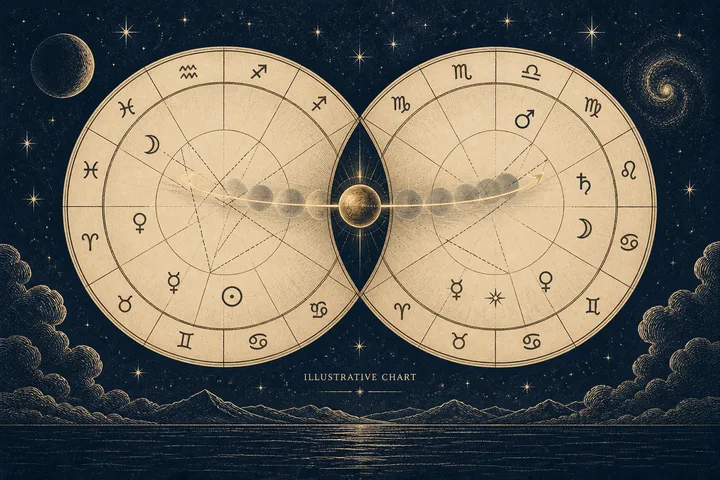
Suppose, hypothetically, person A has natal Venus at 14°20′ Taurus and person B has natal Moon at 14°45′ Taurus. Their zodiacal longitudes are separated by 0°25′, so the example's natal Venus–Moon conjunction has a 0°25′ orb. Now suppose transiting Venus stations at 14°10′ Taurus. From that station longitude to A's Venus is 0°10′; to B's Moon it is 0°35′. Those are two distinct endpoint comparisons. Both are close in this constructed example, but the station is closer to A's Venus than to B's Moon. An astrologer who gives station contacts weight could therefore describe a stronger owner-specific emphasis at A's endpoint while also considering whether the station period brings the Venus–Moon pair into a shared interpretive focus.
The subtraction does not dictate the interpretation. It tells the reader how the supplied coordinates relate: the natal conjunction has one separation, and the moving station has a separate distance to each natal planet. From those measurements, a tradition may decide that both endpoints are sufficiently near to merit attention, or may give the tighter 0°10′ contact greater weight. Another method could rank contacts differently or use a broader context. The measured values remain available for comparison whichever rule is chosen. Thus “closer to A” is a statement about the coordinates, while “more personally emphasized for A” is the astrologer's interpretive application of those coordinates.
This distinction also prevents an equal-contact assumption. The station is not exactly conjunct both natal endpoints in the example: its separation from A's Venus is smaller than its separation from B's Moon. Treating the two hits as identical would erase information the supplied degrees provide. Yet the difference does not tell us that A will notice more, feel more, or respond in a particular way. It only gives a reason, within a chosen interpretive practice, to begin with the more exact endpoint when describing the transit's chart ownership. If the reading then considers both endpoints as a pair, it should identify that as a second interpretive step rather than a conclusion embedded in the arithmetic.
Now move the hypothetical station to 12° Taurus while leaving the natal placements unchanged. Its distances become 2°20′ from A's Venus at 14°20′ and 2°45′ from B's Moon at 14°45′. The station remains in Taurus and the natal placements remain a close same-sign conjunction, but the station is no longer at the near-contact distances of the first version. The exact gap to each endpoint is still calculable. Whether either gap merits station emphasis is a separate question for the method being used; the shared sign label alone cannot answer it. If an astrologer describes 12° Taurus as strongly contacting both endpoints, the account should state the interpretive rule that supports that weight instead of presenting it as a result forced by the subtraction.
A same-sign-only comparison is less specific still. Imagine the hypothetical natal placements are known only as Venus in Taurus and Moon in Taurus, with no degrees supplied. The sign information permits a sign-based discussion of the two planets and their shared sign, but it does not locate either endpoint precisely enough to calculate an exact conjunction orb or the station's distance from each. The current station's sign may show that it occupies Taurus, yet “all are in Taurus” does not establish that it is tightly aligned with either natal planet. Positions at opposite ends of a sign can be many degrees apart while sharing the label. Without the coordinates, the reader should leave the exact contact unconfirmed rather than substitute sign identity for degree proximity.
A station's shadow period adds another possible source of overstatement. The table “Retrograde Stations: Dates, Signs and Degrees by Planet” distinguishes station positions from shadow boundaries. Those are different timing entries: overlap with a shadow can tell the reader that a planet is moving through a degree range associated with the retrograde cycle, but shadow overlap alone does not establish a close station-to-endpoint contact. In the hypothetical example, if a station is described as occurring within a broader period that revisits the natal degrees, that period should not replace the station's own longitude in the endpoint comparison. The reader needs to know whether the claim concerns the exact turn, a wider stationary interval under a stated convention, or a shadow passage. Those timing labels cannot be collapsed into one distance rule.
The difference matters because each label answers a different question. The station longitude lets the astrologer calculate its separation from a natal endpoint at the turning instant. A shadow boundary marks a cycle interval in the source's system. A practical stationary interval may use a chosen speed threshold. One can discuss more than one of these layers, but must say which is being used. If the station itself is distant while only a shadow boundary or broad cycle passes through the natal degree, the interpretation may still treat the wider cycle as meaningful; it should not call that a close station conjunction. The wording should preserve the distinction between a cycle that revisits a degree and the station point's own measured proximity.
There is no basis in the cited station table for turning its listed degrees into a universal station-to-synastry orb. “Retrograde Stations: Dates, Signs and Degrees by Planet” supplies event and shadow data under its presentation conventions; it does not prescribe how many degrees from another chart's planet count as personally significant. Nor should a separate report's selected-aspect orb be imported here as if it were a station rule. A reader can report the arithmetic precisely, state that the chosen tradition treats a particular separation as noteworthy, and avoid claiming that all astrologers must assign it the same weight. That phrasing preserves both the reproducible comparison and the genuine interpretive choice.
The one-endpoint and two-endpoint readings also deserve different wording. In a hypothetical variation where a station is very near A's endpoint but appreciably farther from B's, the geometrical basis is owner-specific. The astrologer might give A's contacted planet greater emphasis for that period and then ask how, if at all, that focus intersects the natal synastry contact. The chart comparison does not license a statement about B's parallel feelings. Conversely, if a station is comparably close to both endpoints under the selected method, it can support examining the pair as a shared topic in timing. “Shared topic” means both placements enter the astrologer's comparison; it does not mean matching intensity, simultaneous awareness, or identical meanings.
The hypothetical 14°10′ example sits between those simple cases: it is near both endpoints, but not at equal distances. A careful interpretation can preserve both facts. It may give first attention to A's tighter 0°10′ contact, retain B's 0°35′ proximity as a second relevant contact if the chosen practice allows it, and consider the pair together without flattening the difference. If another astrologer uses a threshold that includes one distance but not the other, that disagreement concerns the method's interpretive cutoff, not the arithmetic. Stating the rule makes the difference discussable: readers can see which endpoint the astrologer included and why, rather than hearing a vague claim that the station simply “hits the relationship.”
The practical reading sequence is therefore narrow. First, keep the hypothetical natal Venus–Moon conjunction distinct from the transiting station's two endpoint distances. Next, report each distance independently and identify which person owns each natal planet. Then name the interpretive method that assigns weight to those distances, without claiming a universal station orb. Finally, phrase the conclusion at the level the coordinates support: a closer endpoint-specific emphasis, a possible two-sided timing topic, or only same-sign context when exact degrees are missing. The calculation can establish the geometry of the supplied example; it cannot determine either person's feelings or decide how strongly a tradition should interpret that geometry.
Sources: Retrograde Stations: Dates, Signs and Degrees by Planet
How should timing and motion phase be recorded?
Record three things separately: the exact station instant, the station's zodiacal degree, and any broader interval your source calls a retrograde shadow or zone. A station is the turn in apparent motion; it is not the whole period in which a planet travels through degrees later revisited during a retrograde cycle. The table “Retrograde Stations: Dates, Signs and Degrees by Planet” lists station entries apart from shadow boundaries, making the distinction visible in practice. Cafe Astrology's “Retrograde Cycles/Stations” likewise separates station dates from pre- and post-retrograde zone dates. A reader who writes only “during Mercury retrograde” has named a cycle, but has not identified whether a contact is exact at the turn, occurs elsewhere in the cycle, or falls only within a wider boundary.
A shadow interval is the span of degrees the planet crosses before and after its retrograde loop: the pre-retrograde boundary marks the first passage over the degree range, and the post-retrograde boundary marks the later passage beyond it after the planet resumes direct motion. These boundaries describe the path through zodiacal degrees, not a second station and not a conjunction orb. The Shymea table gives start and end boundaries alongside the station data; Cafe Astrology's listing labels corresponding zone dates. Use the terms and convention supplied by the chosen ephemeris. If an astrologer elects to interpret the shadow, record that broader interval as its own layer. Do not quietly treat every day in the shadow as if the planet were stationary at the turning degree.
The direction of the turn tells you which side of the retrograde loop you are examining. At a station retrograde, apparent motion changes from direct to retrograde. The event marks the beginning of the backward-looking leg in the geocentric zodiacal sequence. At a station direct, apparent motion changes from retrograde to direct, marking the end of that leg. The Astrodienst Astrowiki entry “Retrograde Motion” describes apparent slowing before a change of direction, while its entry “Stationary” notes that the duration assigned to a stationary phase depends on a chosen velocity threshold. Those narrow observations counsel precision: an instant can be calculated, but the surrounding period called “stationary” may depend on a stated convention. The words “station retrograde” and “station direct” therefore identify different turns; neither alone supplies a psychological description.
This distinction shapes the question an astrologer may choose to ask. For a direct-to-retrograde turn, one might use a “pause before reversal” image: what is being reconsidered, reviewed, or approached differently in the chosen symbolic framework? For a retrograde-to-direct turn, one might use a “pause before resumption” image: what is ready to move outward or be handled again? These are interpretive prompts, not source-established universal meanings of the two phases. The Astrodienst “Retrograde Motion” entry records differing interpretive approaches, which is a reason to name the framework being used rather than announce a shared rule. An astrologer who prefers to read stationing through planetary condition, as in Kerykeion's “Planetary Stations in Astrology: The Power of the Pause,” can ask about condition and context instead of assigning a fixed story to direction.
For a synastry timing note, identify whose natal endpoint is being compared with the transiting planet, then add the date and time zone used by the event source. “Retrograde on 4 March” can be incomplete if one calendar reports the instant in a zone that places it on 3 March elsewhere. Cafe Astrology's “Retrograde Cycles/Stations” states its time convention; the local civil date may change when that instant is converted, even though the astronomical instant and zodiacal position have not changed. A time-zone conversion changes the clock reading and potentially the displayed calendar date, not the station's underlying degree. For events near midnight, give the zone or a full timestamp rather than relying on a date without context.
The exact degree is often more useful than the sign label when the task is to assess a contact. A sign describes a thirty-degree region; it cannot tell you whether the station is near a particular natal planet within that region. A station table's degree and zodiac convention let the reader compare a specific instant with supplied natal coordinates. The timing record should therefore preserve degree and minutes when the source provides them, alongside the sign, timestamp, time zone, and whether the motion turns retrograde or direct. If only signs are known, the temporal note can say that the transit shares a sign, but it should not present that as an exact station-to-planet contact. The broader label “in Taurus during the cycle” and the narrower statement “stations at a specified Taurus degree” answer different questions.
A useful record can be compact without collapsing those distinctions: name the event source and its coordinate convention; write the station's date, time zone, zodiacal degree, and direction; then list shadow boundaries separately if the interpretation uses them. State whether the reading concerns the turn itself, a chosen stationary threshold, or the full shadow interval. Cafe Astrology's calendar illustrates why source conventions matter for date labels, while the Shymea table illustrates how a station degree can sit beside separate shadow dates. Neither listing sets a universal orb for a synastry contact. The record documents what happened in the ephemeris and which period the astrologer chose to examine; it does not, by itself, establish how much interpretive weight a relationship reading should assign.
Some astrologers treat a shadow or broader stationary period as meaningful context. Label the selected span and keep the exact station separate: proximity to the turn and timing within a wider cycle are different claims. Neither dictates symbolism. If using the pause metaphor, identify it as an interpretive image and say which planet and chart owner it concerns. This makes the timing useful without turning a date label into a claim about what either person must feel.
Sources: Retrograde Stations: Dates, Signs and Degrees by Planet; Retrograde Cycles/Stations; Retrograde Motion
What does the contacted planet contribute to the reading?
Once the station's timing and contacted endpoint are identified, the planet tells you what kind of symbolic question to bring to the synastry contact. Traditional astrology associates Venus with values, attraction, affection, and patterns of relating; the Moon with needs, comfort, habit, and emotional sustenance. These are symbolic vocabularies, not measured personality traits. The Astrology Podcast's “Synastry: The Astrology of Relationships” presents chart comparison as an interaction read with each planet's own context, and Cafe Astrology's “Aspects Between Charts” likewise considers the contributed planets and their chart settings. Applied here, those sources support asking what the two planets represent in their respective charts before describing the contact. They do not justify claiming that a station reveals either person's private feelings.
Consider only a generic Venus–Moon contact, with no invented birth data. The useful first questions are not “Who loves more?” or “Is this bond secure?” They are narrower: what does each chart owner value or offer in affection, and what does the other associate with comfort, care, and familiarity? The contact connects two symbolic functions. A station close to one endpoint may invite an astrologer, within a stated tradition, to give that endpoint's planetary role special attention for the relevant period. If Venus is contacted, the interpretive prompt may concern values, affection, or how care is expressed. If the Moon is contacted, it may concern needs, routines, or what makes support feel comfortable. The endpoint's owner matters because the natal planet belongs to that person's chart, even when the two planets are being read together.
That distinction keeps the reading from assigning a single generic “relationship energy” to the pair. Suppose the station is interpreted as emphasizing the Venus endpoint. The astrologer might ask whether the current question concerns preferences, generosity, pleasure, or the way appreciation is communicated. If the Moon endpoint is the closer or chosen focus, the prompt may shift toward habits of care, rest, home rhythms, or the conditions under which someone feels at ease. These are candidate meanings drawn from traditional planetary symbolism, not conclusions about what either person is doing. A chart comparison can suggest which topic to discuss; it cannot answer the discussion on either partner's behalf. If the lived situation does not involve affection or comfort, that mismatch is useful information for revising the first symbolic hypothesis.
The order of interpretation matters. First name which planet the station contacts and who owns that natal planet. Next read that planet's role within its own chart, using only the context actually available. Then relate it to the other planet in the cross-chart aspect. The Astrology Podcast's synastry discussion supports retaining each person's chart context, while Cafe Astrology's “Aspects Between Charts” explains the interpretive practice of considering both contributed planets. Together they caution against treating the aspect as a free-floating label. If birth time or other chart details are missing, do not invent houses or angles to make the symbolism feel more personal. The planet names still offer a limited vocabulary, but a thinner chart context means the reader should keep the prompt correspondingly open.
Mercury illustrates why a station does not create the same conversation for every contact. In traditional symbolic language, Mercury concerns exchange, speech, listening, information, and the ways people make sense of what is said. A Mercury contact may therefore prompt questions about how plans are explained, how messages are interpreted, or what details need clarification. A station involving Mercury would be approached through that planet's role and owner, not automatically translated into a Venus-style question about affection or a Moon-style question about comfort. The interpretation should also distinguish the chosen motion phase from the planet's symbolic topic: a “pause before reversal” image might lead an astrologer to ask what communication is being reconsidered, but that remains an optional metaphor, not an established effect of Mercury stationing on a couple.
Mars offers a different contrast. Its traditional vocabulary includes assertion, initiative, pursuit, effort, and action. A Mars contact can therefore make it useful to ask how each person starts, stops, or directs activity, or how disagreement is handled in observable terms. If a station is read as drawing attention to a contacted Mars, the question is about this planet's chart role and the actual matter under discussion. It does not show that someone is angry, sexually interested, competitive, or about to act. Those claims would require evidence from that person's words and conduct. The same station phase can frame different questions depending on whether the contacted symbol is Mars, Mercury, Venus, or the Moon; the phase locates the event in time, while the planet supplies the tradition's topic vocabulary.
The planetary pairing also changes the prompt: Venus–Moon can raise affection and comfort; Mercury–Mars, exchange and action; Venus–Mercury, values and communication. These are broad symbolic combinations, not predictions. State which endpoint is contacted, whose chart it belongs to, and what question the pairing suggests. A motion-phase metaphor remains optional; the interpretation changes with the planetary roles, which have no single universal relationship meaning.
A practical way to test a planet-specific prompt is to turn it into a question both people can answer from experience. For Venus–Moon, each might describe what counts as a valued gesture and what makes care feel comfortable. For Mercury, they might compare how they prefer to clarify plans or handle misunderstood messages. For Mars, they might name how they raise a concern or agree on a next action. These questions translate symbolic associations into observable language without claiming that the chart has already supplied the answers. Each person may offer a different account, and the difference is part of the conversation rather than proof that one chart reading is correct. If neither person recognizes the proposed theme, the astrologer can reconsider the planet's chart context or simply set that interpretation aside.
The strongest reading is therefore specific but provisional in its symbolism. It says which planet is contacted, which chart owner contributes it, what traditional topic that planet represents, and what concrete question follows. It does not turn Venus into a guarantee of affection, the Moon into proof of emotional safety, Mercury into a diagnosis of communication, or Mars into evidence of conflict. Cafe Astrology's inter-chart guidance and The Astrology Podcast's synastry discussion support interpreting the two planets in context; they do not supply deterministic traits or relationship outcomes. A station can make one planet's role a timely focus in the astrologer's chosen method. The other person's own account, the surrounding chart context, and what is actually happening remain necessary to judge whether the symbolic question fits.
Sources: Synastry: The Astrology of Relationships; Aspects Between Charts
What would make a station reading too strong?
A station reading becomes too strong when it moves beyond what its inputs and chosen tradition can support. Keep three levels distinct. A calculated fact is a dated station degree under a named coordinate and time convention, compared with supplied natal longitudes. A tradition-based interpretation assigns symbolic weight to that geometry. A claim that both people experienced the same event, felt the same thing, or will reach a particular outcome is a further relational inference. The first can be checked against a source; the second can be stated as an interpretive choice; the third needs evidence from the relationship itself. Clarity about these levels lets an astrologer take station symbolism seriously without presenting its meaning as a measured effect or a guaranteed shared experience.
The most defensible order is to retain the natal contact as the baseline, then add station emphasis only if the event and both endpoint distances are sufficiently known. The source titled “Retrograde Stations: Dates, Signs and Degrees by Planet” supplies event entries and shadow boundaries under its own conventions; “Retrograde Cycles/Stations” states calendar conventions for its listings. Those details make a comparison traceable, but neither source sets a universal synastry threshold. NASA’s “Planetary Motion: The History of an Idea That Launched the Scientific Revolution” helps distinguish apparent motion from a planet physically stopping; it says nothing about relationship symbolism. If the event date, time zone, zodiac convention, or station degree is mismatched, the proposed hit may be a bookkeeping error. In that case, remove the station emphasis until the underlying comparison is reconciled, while leaving the independently established natal aspect in place.
Missing endpoint degrees also change the rank of the claim. If you know only signs, you may have a broad same-sign context, but you cannot establish that the station passed close to either natal planet. If one degree is available and the other is not, any supported emphasis belongs to the known endpoint; it cannot be promoted into a mutual contact by assuming the missing value. Even when both degrees are available, a wide separation should not be described as an exact or close hit merely because the sign matches. Since the station sources list positions rather than a relationship-specific orb, an astrologer must identify the interpretive threshold being used and apply it consistently. If that threshold excludes the distance, downgrade the station claim rather than adjusting the rule to preserve a preferred story.
Ownership is another test of whether the wording fits the geometry. A station near one person's natal planet gives that astrologer a reason, within the stated method, to foreground that person's planet in the reading. It does not establish a corresponding emphasis in the other person's chart unless the other endpoint also qualifies under the same method. If both endpoints are very close by the chosen standard, the strongest exception is to consider a shared period of focus: both placements participate in the timing comparison, so a conversation about their interaction may be apt. “Shared” still describes the astrologer's frame. It does not mean equal intensity, simultaneous awareness, or a mutual event. Kerykeion’s “Planetary Stations in Astrology: The Power of the Pause” presents stationing as meaningful in some astrological approaches, while recognizing condition and context; this supports taking the symbol seriously, not treating it as a verdict.
A reading should also be revised when its proposed symbolism does not fit the people or question at hand. If the interpretation points to communication but the actual issue concerns how time is divided, do not insist that the chart has secretly identified a communication problem. Ask what observable situation led to the reading, whether the contacted planet is relevant to it, and what each person says is happening. The Astrology Podcast’s “Synastry: The Astrology of Relationships” frames synastry as chart interaction with planetary context; it does not report that a transit reveals private intentions or resolves a couple’s disagreement. Lived interaction is therefore the basis for relationship decisions. The chart can suggest a question worth asking, while an answer from either person can confirm, complicate, or displace that prompt. If neither recognizes the symbolism, set that interpretation aside instead of treating disagreement as proof that it must be operating invisibly.
Traditions may give stations substantial symbolic importance. That can justify attention, but it does not identify a shared event, show who is more affected, or settle what the pair should do. A useful conclusion names its basis: the natal contact is the stable comparison; verified, close station data may add time-specific emphasis under a stated approach; incomplete or conflicting data reduce that emphasis; and the people’s actual exchange informs practical decisions. The reading should also say what could weaken it. If only one endpoint is close, explain why a shared-focus interpretation needs additional support. If sources show different dates, check whether the difference is merely a time-zone label; if degrees differ, identify the governing convention before interpreting. These checks expose unstated assumptions without requiring one school to adopt another's thresholds. A reading remains meaningful when it names the evidence or account that could change its emphasis.
Sources: Planetary Stations in Astrology: The Power of the Pause; Retrograde Stations: Dates, Signs and Degrees by Planet; Retrograde Cycles/Stations; Planetary Motion: The History of an Idea That Launched the Scientific Revolution
What should you do with the reading now?
Use the contact to choose one timely conversation prompt, if the station comparison is supported; otherwise, keep the natal contact as your reference and leave the transit hit unconfirmed. Each person can name one concrete form of care, communication, or response that matters in the situation, then compare those answers with what is happening now. Let the conversation clarify the choice in front of you. The Synastry Comparison Report organizes supplied Moon, Venus, and Mars signs, optional degrees, and selected major aspects under its stated six-degree scope. It does not calculate natal charts or houses, or assess planetary stations. Compare your supplied placements if that is the chart layer you want to examine. Keep the prompt specific to the planet and to a present choice: what kind of response would help, what has each person actually offered, and what would they like to change? Each person can answer in their own words before either uses the symbolism to interpret the other. If their accounts differ, treat the difference as something to discuss rather than evidence that one chart owner is wrong. A station can mark a period to pay attention within the chosen reading; it does not set a deadline or require a decision. If exact natal degrees are unavailable, simply leave the station comparison open and use the conversation to understand the natal contact in ordinary terms.
A little more clarity
Can a station close to both natal planets prove a shared experience?
No. Closeness to both endpoints can support investigating a shared period of focus within the chosen method, but it does not establish identical feelings, awareness, or outcomes.
Sources & further reading
- Synastry: The Astrology of Relationships
Astrological framing for reading contacts between two natal charts while retaining each planet's own chart context; use as interpretive method, not outcome evidence.
- Aspects Between Charts
A synastry aspect is read by considering both contributed planets, their signs and chart context; secondary interpretive guidance only.
- Planetary Stations in Astrology: The Power of the Pause
Some astrology traditions treat stationing as a condition or pivot and weigh it through planetary context; interpretations vary, so this supports a bounded tradition-specific reading rather than a universal law.
- Retrograde Station Factory
Technical documentation defines station detection at a change in apparent longitudinal motion and its computation scope.
- Retrograde Stations: Dates, Signs and Degrees by Planet
Station table separates exact station date/degree from retrograde shadow boundaries and states coordinate/time conventions; use only the displayed data and method.
- Retrograde Cycles/Stations
Station dates and degrees can be distinguished from pre- and post-retrograde zone dates, with a stated time zone; useful for event bookkeeping, not a universal synastry orb.
- Stationary
Astrodienst Astrowiki describes direct/retrograde stationary phases and notes that their duration depends on the chosen velocity threshold; supports caution about treating a station as a long fixed interval.
- Retrograde Motion
Astrodienst Astrowiki describes apparent slowing before a change of direction and presents distinct interpretive traditions; establishes that stationary labels and meanings require an explicitly chosen framework.
- Planetary Motion: The History of an Idea That Launched the Scientific Revolution
NASA explains retrograde as apparent backward sky motion within an orbital perspective; this supports only the observational mechanics, not astrological meanings.
Synastry Comparison Report
Enter known placements for two people. Get an input-by-input comparison, selected aspect calculations and a clear record of what remains uncertain.
Compare our placements