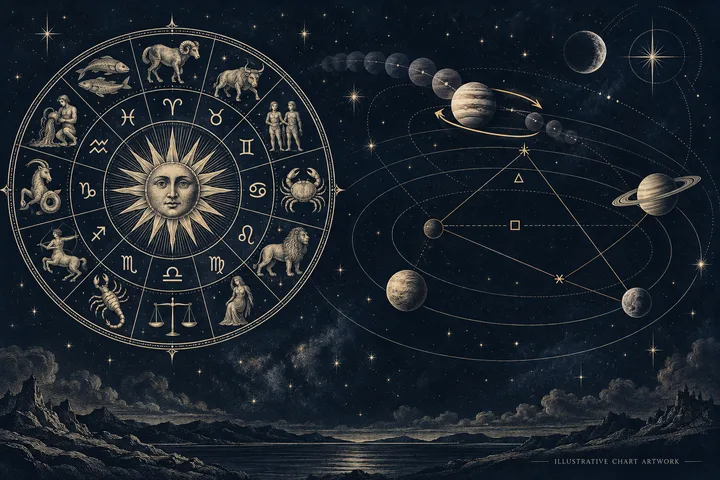
Imagine Maria sees the same square twice
Imagine Maria comparing her Mars with a partner's Venus. In one chart file, the planets sit 3 degrees apart in a square. In another, the same two degrees appear, but Maria's Mars is moving toward exactness. The aspect geometry has not changed. The reading has.
The first chart describes a contact that is already there. A square joins the two planetary jobs through friction, and the closeness gives it a sharp edge. The motion adds a direction. If Mars is applying to Venus, pursuit, desire, irritation, and action keep pressing toward a point of greater contact. The pair may feel that the issue is becoming harder to leave vague. They need a way to act on attraction without letting urgency make every difference feel like a challenge.
Now turn the picture around. If Mars has passed exactness and is separating, the same square can describe a pattern that has already announced itself. The couple may be learning what happens after the spark, after the argument, or after one person pushes and the other person changes pace. The contact isn't gone. It is still within the chosen orb. But its story has moved from approach to aftermath.
That is why planetary motion can matter more for interpretation than for aspect geometry. Motion doesn't create a new natal relationship between the placements. It tells you how to read the relationship already shown by the degrees. It can rank the contact's phase and reveal whether a planet's expression turns inward, returns, stalls, or gathers force.
This article uses a practical synastry scope. The aspect is counted from supplied degrees, with a six-degree orb for the major contacts discussed here. The method does not calculate either person's natal chart, houses, or current sky positions. A report can only describe applying, separating, direct, retrograde, or stationary motion when those chart inputs are known. That boundary makes the interpretation cleaner, not smaller.
The decision for Maria is simple. She should not ask whether the square is good or bad. She should ask what the square is doing, which planet is moving faster, and what behavior follows from that condition. Geometry names the meeting. Motion gives it a phase.
This distinction also helps when two chart reports seem to disagree. One may list the aspect because the planets are within orb. Another may add an applying or separating symbol because it tracks relative daily motion. Keep the geometric fact, check the motion convention, and ask what interpretive claim the label is meant to support.
Sources: Application - Skyscript Glossary; Aspect - Skyscript Glossary; Retrograde - Skyscript Glossary
What aspect geometry can tell you, and what it cannot
Aspect geometry is the first layer because it gives the chart a shared language. Astrologers measure the distance between two planetary positions along the zodiac. A conjunction brings the planets together. A sextile places them about 60 degrees apart. A square joins them across 90 degrees. A trine joins them across 120 degrees. An opposition sets them 180 degrees apart. The aspect describes the kind of relationship between the two planetary functions.
In synastry, one person's planet contacts another person's planet. Venus meeting a partner's Mars is not the same conversation as Venus meeting the partner's Saturn. The first combines attraction, pleasure, response, and desire. The second asks how affection meets restraint, duty, fear, patience, or commitment. The angle then tells you how those jobs meet. A trine may make the exchange easy to enter. A square may make the exchange active and tense. An opposition may make the pair alternate between two strong positions.
The orb tells you how close the aspect is to exactness. This publication's report scope uses a six-degree orb for selected major aspects. At 0 degrees 40 minutes, a conjunction is tighter than one at 5 degrees 40 minutes. Both may qualify under the stated rule, but they don't deserve identical emphasis. A close aspect is usually the first contact to examine. A wide one needs support from signs, repeated contacts, or the wider chart before it becomes a leading theme.
Geometry still has limits. It cannot tell you whether a planet is applying or separating. Two planets can be 3 degrees apart today, yet one pair can be moving toward exactness while another has just passed it. The angle is the same. The phase is different. Geometry also cannot tell you whether a planet is direct, retrograde, or stationary. Those are motion conditions, and they belong to a later interpretive layer.
There is another useful limit. A close angle can cross sign boundaries. A planet at 29 degrees of one sign and another at 2 degrees of the next may form a tight conjunction by longitude, but the signs may give that conjunction a more complicated tone. The aspect exists by distance. The signs explain the style of the contact. Don't erase either layer. Name the exact degree relationship, then explain the sign setting that carries it.
A good reading therefore moves in order. First, identify the planets. Second, identify the angle. Third, measure the orb. Fourth, check the signs. Fifth, inspect motion. Sixth, compare the contact with the Moon, Venus, and Mars layers around it. If you start with motion before knowing what is moving toward what, you risk giving a dramatic label to a contact that was never close enough to lead the reading.
This order is especially useful for couples who begin with a sign-pair search. Sign language can show why two people recognize one another or miss one another, but degrees show whether a particular planet-to-planet contact is close. Motion then answers the more refined question: is this contact becoming more exact, moving away from exactness, or holding its ground? Each layer earns its place.
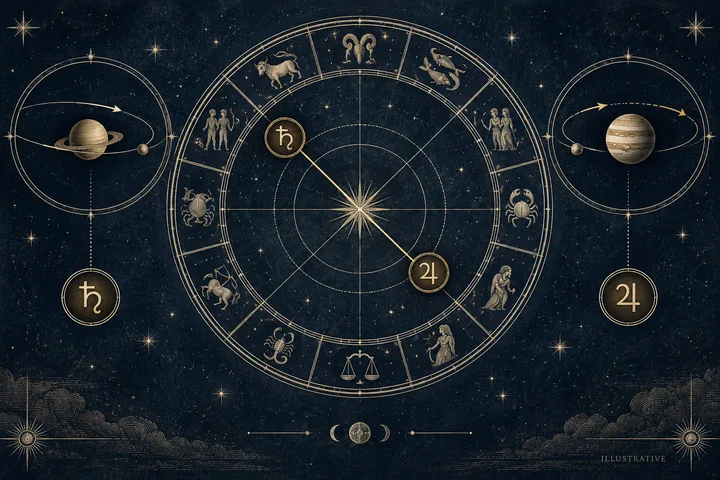
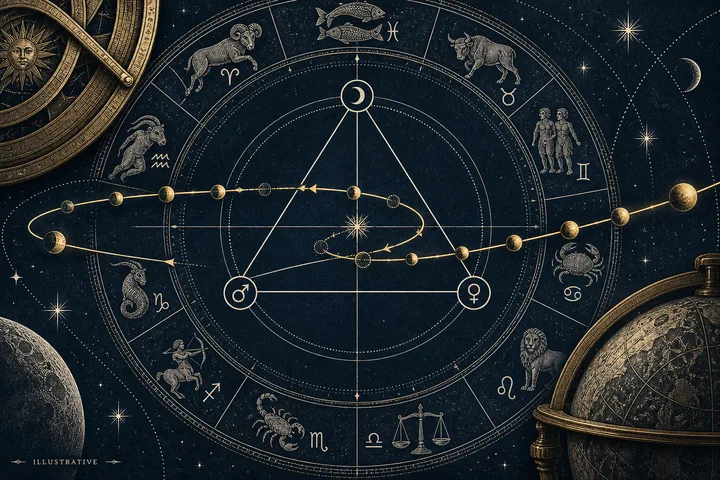
The same rule applies to a contact that looks impressive in a graphic but has no visible degree data. The artwork can help you see the relationship between symbols, yet it cannot tell you the exact orb or motion phase. Treat the picture as an orientation tool. Treat the supplied positions and stated calculation method as the evidence for the technical reading.
A synastry aspect is first a geometric relationship between two supplied planetary degrees. A conjunction is near 0 degrees, a square near 90 degrees, a trine near 120 degrees, and so on. But the planets are not frozen symbols. Their apparent motion tells you whether the contact is applying, separating, slowing toward a station, or reversing through retrograde motion. That movement can change the emphasis from an emerging pattern to an established one, from direct expression to return and review, or from clean perfection to a contact that needs a different route. In a placement-based report, use geometry to decide whether the aspect exists, then use motion to rank its condition and interpretive weight. If degrees are missing, keep the reading at the sign and placement layer. If motion is not supplied, don't pretend to know the applying or separating status. Compare the known Moon, Venus, and Mars placements first, then ask which exact contact deserves a real conversation.
Sources: Aspect - Skyscript Glossary; Retrograde - Skyscript Glossary
What applying status actually records
Applying status is a statement about direction, not intensity. A contact is applying when the planets are within the selected orb and their relative longitudes are closing toward exactness. It is separating after the point of exactness, while the distance is widening but still remains within orb. The distinction describes movement through the aspect, not a score for how much the couple cares.
That wording matters because one planet usually moves faster. The faster body makes the application; the slower body receives it. If the slower body is retrograde, the two can move toward one another in a way a simple left-to-right glance misses. A report that gives only the zodiac positions can show the angle but not this relationship between speeds. The motion field must tell you more than a symbol beside a planet.
Suppose a supplied report lists Moon at 18 degrees Gemini and Mars at 21 degrees Sagittarius. The 177-degree distance places them within a six-degree opposition. To call it applying, you need the direction of the relevant longitudes. If the distance is shrinking, the contact is approaching exactness. If it is growing, the contact is separating. The numbers alone don't settle the question.
This is where the traditional language of application earns its keep. It describes a matter that is moving toward a meeting, while separation describes the trace left by one. In synastry, translate that idea into a pattern of expression. An applying Moon-Mars opposition may keep the need for a response in front of both people. A separating one may show that they already know the clash and are learning what to do after it appears. Neither statement predicts an argument.
The useful test is not ‘Which phase is better?’ It is ‘What would this phase make easier to notice?’ Applying status can clarify pressure, anticipation, and the need to choose a pace. Separating status can clarify memory, consequence, and the need to change a familiar response. A close separating contact may matter more than a wide applying contact because closeness and repetition give it greater weight.
Don't borrow horary's yes-or-no judgment when you read a couple's natal comparison. The same terms can guide sequence without deciding the relationship. If a report supplies no relative-motion data, leave the phase unnamed. That isn't an incomplete reading. It is a clean distinction between an observed angle and an unverified condition.
A reader can record the phase in one line: ‘Venus at 12 degrees Taurus and Mars at 15 degrees Leo form a three-degree square; the source marks the contact as separating.’ That line preserves the raw material. The interpretation can then ask what has become familiar, rather than pretending that the label tells the whole story.
Sources: Application - Skyscript Glossary; Retrograde - Skyscript Glossary; Separation - Skyscript Glossary
Why direction must be checked before symbolism
Retrograde is the condition most likely to expose a bad shortcut. From Earth, a retrograde planet appears to move backward through zodiacal longitude. Astrological tradition connects that motion with returns, reversals, delay, and recurrence. In a synastry report, those meanings belong to the planet carrying the contact. They don't replace the planet's job or the aspect's shape.
Consider an example. Maria's Venus is retrograde and forms a close square to her partner's Mars. Venus still speaks through attraction, values, pleasure, and receptivity. Mars still presses through desire, initiative, and pursuit. The retrograde Venus may take a looping route through those matters: she revisits what she wants, compares the present with an earlier standard, or needs private certainty before making affection visible. That is a different delivery system, not an absence of feeling.
Put the retrograde condition on Mars instead and the emphasis shifts again. The Mars person may return to an old way of pursuing, pause before acting, or discover that desire changes when action becomes real. The Venus person may call this mixed. The chart reader should ask a better question: does the Mars function need more time, a clearer aim, or a safer way to act? A label becomes useful only when it opens that question.
The technical danger comes first. A planet that looks as if it is moving toward exactness may actually be separating once its direction is included. A planet near a station may barely change longitude, so a casual comparison of sign positions gives no trustworthy phase. This is why an ephemeris or a source that reports signed motion matters. You need the planet's direction and, when relevant, its speed.
Speed adds another distinction. A planet can be direct yet slow, or retrograde yet moving quickly away from a contact. Traditional astrology treats speed as part of planetary condition, and reference tables give very different average daily motions for the planets. In practice, you don't need to turn a placement comparison into an astronomy lesson. You do need to avoid treating every direct planet as equally forward or every retrograde planet as equally delayed.
Read the condition in three passes. First, preserve what the report actually states: direct, retrograde, stationary, or unknown. Second, connect it to the planet's function: what is reviewing, pursuing, receiving, or returning? Third, check whether the behavior fits the rest of the contact. If retrograde Venus touches a close Moon contact, the emotional subject may be attachment and reassurance. If it touches Saturn, the subject may be value, duty, or trust. The motion does not supply the noun.
The strongest exception is a retrograde label that explains nothing in the contact. If the closest repeated personal-planet pattern points elsewhere, keep the motion as a modifier. It may describe the person's private route through the theme while another contact describes why the theme dominates the relationship. Retrograde is meaningful. It isn't automatically the headline.
Sources: Retrograde - Skyscript Glossary; Separation - Skyscript Glossary
What a station adds, and where it stops
A station is the threshold where a planet's apparent daily motion turns from direct to retrograde or from retrograde to direct. The planet seems to hang near its degree before it changes course. In interpretation, that lingering can make a planetary question feel concentrated. It can also make a quick applying-or-separating judgment unreliable if the source ignores the turn.
The practical comparison is not ‘stationary equals stronger.’ It is ‘stationary changes the time scale.’ A planet that barely moves can remain close to the same contact while the rest of the chart moves around it. The couple may return to one question because the planetary function has not found a clean next step. That is why a station can matter more than a small difference such as 2 degrees 30 minutes versus 3 degrees 10 minutes.
Imagine Maria's Venus is stationary near a contact with her partner's Moon. Venus describes taste, affection, and value; the Moon describes care, comfort, and immediate feeling. The station may make small choices linger. Who initiates reassurance? How much time together feels nourishing? What does a gift mean? The chart doesn't tell Maria what her partner intends. It shows why an ordinary exchange might stay emotionally present longer than either expects.
The planet still decides the subject. A stationary Mars can hold action, anger, desire, or competition at the threshold. A stationary Saturn can make responsibility or distance hard to move around. A stationary Jupiter can magnify the question of trust, generosity, or excess. These are different readings. The shared idea is pause and concentration, not one universal result.
A station also has a boundary. It isn't permanent, and it doesn't outrank every other factor. A close Moon-Venus conjunction, a repeated Venus-Mars cross-contact, or a stronger sign condition may explain the relationship more directly. Use station status to refine the leading contact. Don't let a dramatic technical word choose the headline for you.
For this placement-based report, station status must arrive with the supplied data. The report can compare known signs and optional degrees under its stated six-degree orb. It doesn't calculate natal positions from birth details or recover a planet's speed from a date alone. If the source gives no station or motion field, leave it open. Write down the verification question instead: was either planet near a turn when this chart was calculated?
That question protects the reader from false precision. The raw degree can establish an angle. The station can explain why the angle seems to linger. The relationship supplies the evidence of how that symbolism is lived. Keep all three separate, then bring them together only when each one has earned its place.
Sources: Application - Skyscript Glossary; Retrograde - Skyscript Glossary
A worked comparison: same Mars-Venus square, three readings
Use one fictional example so the method stays concrete. Suppose an illustrative report gives Maria's Mars at 14 degrees Libra and her partner's Venus at 17 degrees Capricorn. The longitude difference is 93 degrees. Under a six-degree orb, that is a Mars-Venus square. The signs add a Libra-Capricorn contrast: negotiation, fairness, and social balance meet structure, timing, and practical control. The square asks how desire becomes a workable choice. The degree pair establishes the geometry. It does not establish the phase.
Version one includes a motion record showing the 93-degree separation shrinking to 92 degrees 48 minutes over the next interval, with Mars direct and the aspect moving toward the 90-degree square. That is enough to call it applying. The contact may feel like it is gaining heat. Maria may push for a clear answer, a plan, or a visible response, while her partner's Venus wants affection to fit a schedule or a standard. Their useful decision is to agree on a pace before either person starts proving a point.
Version two includes a record showing the separation widening from 93 degrees to 93 degrees 12 minutes, with the aspect moving away from exactness. That is separating. The same degree positions now describe a familiar exchange rather than a contact still approaching its peak. Maria may know that she becomes impatient when affection stays abstract. Her partner may know that practical concerns make spontaneous desire harder to show. The work is to change the response after the tension appears.
Version three keeps the 93-degree geometry but marks Mars as stationary within the report's motion data, with its signed daily longitude close to zero and a retrograde turn ahead. The exact aspect hasn't changed. The tempo has. Maria may want contact but hesitate at the moment of pursuit. Her partner may read the pause as a lack of desire, while Maria experiences it as a need to be sure. The chart doesn't choose the outcome. It shows why the same square can feel urgent, delayed, or unresolved when the motion input changes.
The geometry remains the anchor in all three versions. Mars still describes how one person moves toward what they want. Venus still describes attraction, taste, pleasure, and the way affection is received. The square still creates friction between those functions. Motion changes the phase and the delivery. That is the point. A motion modifier should sharpen the interpretation, not replace it.
Those labels belong to the chart snapshot, not to the relationship calendar. If the same people compare their natal charts again months later, their natal applying or separating status has not changed simply because the relationship has entered a new chapter. A different transit chart may show a new moving contact, but that is a separate layer and needs its own date, time, place, and ephemeris data.
If degrees are unknown, you cannot honestly claim this exact square. You can compare Mars and Venus by sign, element, modality, and any supplied aspect label. If only the aspect is supplied, use the stated orb and method from the report. If applying or separating is unknown, don't choose one because it makes the story more dramatic. Say that the motion layer remains unranked, then focus on the sign-based pattern and the observable relationship question: how do we handle different speeds of desire?
The worked comparison also shows why a report should preserve the raw inputs beside the interpretation. Maria can return to 14 degrees Libra and 17 degrees Capricorn and see where the three-degree orb came from. She should also see the motion field: the observation interval, the signed daily longitudes or an explicit applying/separating label, and any station or retrograde mark. Without that field, a reader can reproduce the angle but not the phase. A clear trail makes the symbolism easier to discuss because nobody has to argue with a hidden calculation.
Notice what this comparison does not say. It does not predict whether Maria and her partner will stay together. It does not assign a percentage to their attraction. It gives them a sharper question about timing, pressure, and repair. That is enough. A useful chart reading narrows attention until the couple can see what choice is actually in front of them.
Sources: Application - Skyscript Glossary; Aspect - Skyscript Glossary; Retrograde - Skyscript Glossary; Separation - Skyscript Glossary
When motion matters less than the contact around it
Planetary motion matters. It does not matter in isolation. A close, exact Moon-Venus contact usually deserves more attention than a distant minor aspect simply because one planet happens to be stationary. The Moon, Venus, and Mars layer should be read as a system. Ask how care, affection, and desire move together before you let one technical modifier dominate.
Start with repetition. If one person's Moon receives contacts from the other person's Venus and Mars, the relationship may return again and again to the same emotional center. A retrograde condition on one planet can deepen the way that theme is processed, but the repeated personal-planet contacts tell you why the theme matters. Motion gives texture. Repetition gives weight.
Next, look at the orb. A 0-degree 30-minute trine may be the clearest ease in the chart even if it is separating. A 5-degree 50-minute square may qualify under the chosen rule but need confirmation from other factors before it leads. Don't use applying status to rescue a wide, unsupported aspect. Don't use a station to turn a faint contact into the central story.
Then check the sign condition. A Venus in its own sign may have a steadier way to express affection than a Venus struggling to find its style, even when both form the same square. A retrograde planet can be dignified. A direct planet can be poorly placed. Motion and sign condition answer different questions. Motion tells you the phase and direction of expression. Sign condition tells you how resourced or constrained the planet may be in its sign.
Houses can add another layer when reliable birth times are available, but this report scope does not calculate them. Don't invent a house overlay from a date alone. A partner's Mars may contact your Venus without anyone knowing which house receives it. Keep the reading at the planet, sign, degree, aspect, orb, and motion layers you actually have.
The best ranking is therefore narrow. First, read close major contacts between the personal planets. Second, note repeated contacts and cross-links. Third, use applying, separating, retrograde, or station status to refine the living pattern. Fourth, add dignity, reception, houses, or outer-planet contacts only when those inputs are known and relevant. This order prevents a fascinating technical detail from hiding the relationship's main language.
A couple can use this ranking as a filter when a report produces a crowded list. Circle the three closest personal-planet contacts. Mark which ones repeat the same theme. Then add motion labels only to those contacts. If a stationary outer planet appears elsewhere, keep it in reserve unless it directly touches the pattern you are trying to understand. More data is not automatically more meaning.
If the same motion condition appears across several contacts, read it as a pattern rather than repeating the label. Several retrograde personal planets may make review a shared relationship language. Several separating contacts may point to a bond shaped by what has already been experienced. The repetition deserves attention, but it still needs a planetary subject. Review of what? Separation from which kind of contact? Keep the nouns visible.
Here is a quick audit for a crowded report. Give each contact four notes: closeness, repetition, planetary condition, and lived match. Closeness asks how far the aspect is from exactness. Repetition asks whether the same two people meet through another contact, such as one person's Moon receiving both the other's Venus and Mars. Condition records direct, retrograde, slow, or stationary motion. Lived match asks what the couple can actually point to in daily life. The motion label should rise in priority only when it explains that last note.
This audit produces a better sentence than a pile of keywords. ‘The three-degree Moon-Mars square is separating, but it repeats the wider pattern of one person's needs meeting the other's action. The separation points to a known friction; the repeated contact keeps it central.’ That reading has rank. It tells the couple what to watch and why this aspect earned attention.
Sources: Aspect - Skyscript Glossary; Retrograde - Skyscript Glossary; Stations / Stationary Planets - Skyscript Glossary
How to read motion, then turn it into a useful conversation
A synastry reading should help two people notice a pattern and make a better choice. It should not declare that an applying square means the relationship must fail, or that a retrograde Venus means someone cannot love directly. Motion describes a mode of contact. The couple still decides how that mode becomes behavior.
Use direct language. Say, “This applying Mars-Venus square can make desire feel urgent, so agree on pace before pressure becomes proof.” Don't say, “This aspect guarantees a volatile romance.” Say, “Retrograde Venus may process affection through return and review, so ask what has changed since the last conversation.” Don't say, “She will always pull away.” The first kind of sentence leaves room for choice while staying astrologically precise.
The planet person and receiving person also need care. In a Venus-Mars contact, Venus is not the passive one and Mars is not automatically the aggressor. Each planet has a job, and the aspect describes how those jobs meet. A separating aspect may show that the receiving partner is still carrying a prior experience. An applying aspect may make both people feel the contact, even if one planet is technically the faster mover.
Ask what the motion makes visible in ordinary life. Does one person keep returning to a question? Does affection arrive after a pause? Does conflict intensify when plans are vague? Does one person need action before they can name a feeling, while the other needs emotional safety before action feels welcome? These questions translate the chart into a conversation without flattening the astrology.
The strongest exception is a relationship whose observed behavior contradicts the first symbolic reading. If a supposedly urgent applying contact is expressed through patience and clear consent, don't force urgency onto the couple. Recheck the motion, the degrees, the aspect type, the person carrying each planet, and the surrounding chart. Astrology should refine what the people can observe. It should not make them deny it.
A chart can show a recurring invitation. It cannot do the conversation for you. If the contact describes different speeds, ask which speed each person needs and what compromise would still feel honest. If it describes a return, ask whether the return brings repair or only repetition. If it describes a station, ask what has stayed unresolved. Those are useful questions because they turn motion into choice.
When you compare two charts, begin with the data you actually have. Write down each person's Moon, Venus, and Mars sign. Add degrees if available. Mark the aspect type and orb. Record whether each planet is direct, retrograde, or stationary only when the chart source states it. Note the source's method because two programs can use different orbs or draw different aspect sets.
Then work through the contact in six passes. First, name the two planets and keep the planet-person language clear. Second, name the angle: conjunction, sextile, square, trine, or opposition. Third, state the orb in degrees and minutes if supplied. Fourth, describe the sign relationship. Fifth, identify applying or separating status and any retrograde or station condition. Sixth, compare the contact with the rest of the Moon, Venus, and Mars pattern.
A compact example might read like this: “Her Venus at 12 degrees Taurus squares his Mars at 15 degrees Leo, a three-degree fixed-sign square. The supplied chart marks Venus as retrograde and the contact as separating. Attraction is present, but affection may move through review while the couple learns what happens after pursuit. Watch whether reassurance arrives through steady action or repeated tests.” That paragraph distinguishes data from interpretation. It also gives the couple something to observe.
If the degree is missing, stop before the exact aspect claim. If the birth time is missing, don't add houses or angles. If the motion is missing, don't call the aspect applying. If the planet's condition is unclear, describe the known sign and aspect layers, then name the missing input. Precision is not a refusal to read. It is the habit that keeps one strong observation from being buried under invented detail.
A placement-based Synastry Comparison Report can help you organize this process. Supply the known Moon, Venus, and Mars placements and optional degrees. The report can compare the selected contacts under the stated six-degree orb and explain what the available layers support. It does not calculate a natal chart from birth details, determine houses, or certify a relationship's future. Its value is in ranking what the supplied placements actually show.
Use that report as a comparison aid, not as a substitute for the chart inputs. Before you read the interpretation, check whether both degrees are present, whether the orb is stated, and whether motion status is supplied. Then circle the sentence that best describes the practical pattern. If it says desire is urgent, discuss pace. If it says affection returns to an old question, discuss what has changed. If it says the contact is unresolved, decide what evidence would count as movement.
Keep the conversation small enough to answer. Don't bring every planet into the room at once. Choose the contact with the clearest data and the strongest lived echo. One person can name the planetary need, the other can describe how it lands, and both can suggest one behavior that would honor the difference. If the chart points to return, name the old question. If it points to pressure, name the pace. If it points to a pause, name the decision waiting underneath it. This keeps the astrological language alive without turning it into a script either person has to obey.
Finish with one grounded question. For an applying contact, ask what the pair is moving toward. For a separating contact, ask what they have already learned. For a retrograde planet, ask what needs to be revisited before a direct choice. For a station, ask what refuses to move until it is named. Then let the answer guide the next conversation, not the other way around.
Sources: Retrograde - Skyscript Glossary; Separation - Skyscript Glossary
A little more clarity
Does retrograde motion change whether a synastry aspect exists?
No. The aspect exists by the angular distance between the supplied planetary degrees and the stated orb. Retrograde motion changes how the planet approaches, expresses, revisits, or leaves that contact. Check geometry first, then read motion as a condition of the aspect.
Sources & further reading
- Application - Skyscript Glossary
Defines applying aspects and explains why retrograde or an approaching station can alter whether an aspect perfects.
- Aspect - Skyscript Glossary
Defines major aspect angles and explains that aspects remain meaningful within an allowed orb.
- Retrograde - Skyscript Glossary
Defines apparent retrograde motion and records traditional meanings involving returns, reversals, and recurrence.
- Separation - Skyscript Glossary
Defines separation as motion away from exactness and explains how retrograde turns can reverse or repeat the phase.
- Stations / Stationary Planets - Skyscript Glossary
Defines planetary stations and describes the interpretive emphasis of a planet that appears to linger near a degree.
Synastry Comparison Report
Enter known placements for two people. Get an input-by-input comparison, selected aspect calculations and a clear record of what remains uncertain.
Compare our placements