
Imagine a first meeting that feels unusually personal
Imagine Maria has a Taurus Ascendant at 12 degrees. Daniel's Venus is at 14 degrees Taurus. His Venus falls in her first house, and it sits two degrees from her Ascendant. Maria notices his voice, his clothes, and the way he looks at her before she knows much about his life. Daniel may feel drawn to her style and physical presence. She may feel more attractive around him. The contact is visible in the room, not only in a private thought.
Now move Daniel's Venus to 27 degrees Taurus while Maria's Ascendant stays at 12 degrees Taurus. The planet may still be in her first house, depending on the house system, but it is fifteen degrees from the angle. Under this report's six-degree scope, that is a first-house overlay, not an Ascendant conjunction. Maria may still feel more aware of her style, confidence, or social manner around him. The effect is broader and less pointed.
That is the distinction to carry into any chart. The house overlay describes the territory being activated. The angle contact describes a sharper meeting with the point of encounter. Neither placement tells Maria or Daniel what they must do. Venus can invite affection or self-consciousness; Mars can bring initiative or irritation; Saturn can steady the bond or make one person feel measured. Conduct decides which expression takes hold.
This scene is illustrative, not a report about a real couple. Use the degrees you actually have, keep the birth-time question visible, and check the reverse chart before calling a contact mutual. If the degrees are missing, leave the Ascendant conjunction open.
First, separate the Ascendant from the first house
The Ascendant is a point. It marks the eastern horizon at the moment of birth and begins the first house in many house systems. It describes the way you approach the world, your first reactions, your body language, and the image people meet before they know your deeper story. It is an angle, alongside the Descendant, Midheaven, and Imum Coeli. Angles give a chart structure and direction.
The first house is a field of experience. It includes the Ascendant, but the house extends beyond that one degree. It describes self-expression, appearance, instinctive behavior, new beginnings, and the way you move into life. A planet in the first house becomes part of that field. In natal astrology, it can describe a quality you carry openly. In synastry, another person's planet enters that field and activates it through contact.
This is why the phrases are easy to confuse. The Ascendant is the cusp or point. The first house is the area that follows it. A planet can be in the first house without being close to the Ascendant. A planet can also be close to the Ascendant while technically falling on the other side of the cusp, in the twelfth house, depending on the house system and the astrologer's treatment of planets near an angle. The angle contact still deserves attention because the degree relationship is exact even when the house label changes.
House systems add another layer. Astrodienst describes whole-sign houses as complete zodiac signs, while equal and unequal systems divide the chart in different ways. The Ascendant and Descendant remain the horizon axis, but the intermediate house boundaries can move. If one chart says a partner's planet is in your first house and another puts it in the twelfth, check the house system before forcing a dramatic interpretation. The planet's distance from your Ascendant remains a separate measurement.
Use plain labels when you compare charts. Write down the Ascendant sign and exact degree, the partner's planet sign and degree, the house placement under your chosen system, and the orb between the planet and the Ascendant. That small record prevents a common mistake: treating every first-house overlay as an Ascendant conjunction.
Treat the Ascendant as the threshold and the first house as the room. A planet can color the room without standing on the threshold. Say that Venus activates the first house when the placement is broad, and say Venus conjuncts the Ascendant when the degrees support it. If both are true, name both.
A partner's planet on your Ascendant is an exact contact to the angle that begins your chart. A partner's planet in your first house is a house overlay, so it describes how that person's energy enters your sense of self, appearance, behavior, and everyday presence. The two can happen together, but they aren't the same. A planet can sit in your first house several degrees away from the Ascendant and still color your interactions without producing the sharp, immediate recognition of a close conjunction. Start with the degree distance to your Ascendant. If the planet is within the report's six-degree orb, read the angle contact first, then read the house placement. If it is farther away but still inside the first house, give the overlay the lead. Read the planet, its sign, and its aspects before deciding how it behaves. Then compare the same person's planets in the other chart. Synastry works in both directions.
Sources: House One - Astrodienst Astrowiki; Equal House System - Astrodienst Astrowiki; Synastry: Planet Overlays in Houses (Transposed Houses) | Cafe Astrology
What a planet conjunct your Ascendant brings
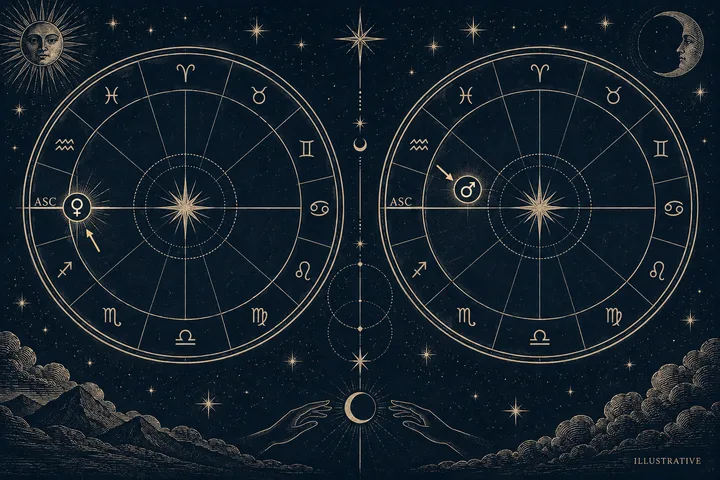
A conjunction joins two chart factors in the same area of the zodiac. In synastry, one person's planet meets the other person's angle. The planet person brings a style of action, feeling, desire, thought, or pressure. The Ascendant person receives that energy at the doorway of identity and encounter. The result often shows up quickly. You can notice it in first impressions, posture, clothing, physical chemistry, conversation, or the simple feeling that the other person has entered your personal space.
Cafe Astrology describes Ascendant contacts as immediate and apparent, with the response involving the Ascendant person's whole body ego and manner of coming across. That language is useful because it keeps the interpretation broader than appearance. The Ascendant isn't a beauty score. It is the way a person inhabits the world. A partner's planet can make that way of inhabiting the world feel encouraged, challenged, exposed, energized, or changed.
The planet decides the flavor. The Sun can bring visibility and recognition. The Moon can make the encounter feel familiar, tender, or emotionally revealing. Mercury can make the Ascendant person feel observed, questioned, or mentally animated. Venus often highlights charm, taste, affection, and attraction. Mars can make the body more alert and the interaction more direct. Jupiter can encourage confidence and growth. Saturn can make the Ascendant person feel taken seriously, judged, steadied, or restricted. Uranus wakes up independence and surprise. Neptune can soften boundaries and invite idealization. Pluto intensifies presence and can expose power dynamics.
Those are starting meanings, not final sentences. Read the planet's sign. Venus in Virgo doesn't express affection like Venus in Leo. Mars in Cancer doesn't press forward like Mars in Aries. Then read the planet's natal condition and aspects. A Venus-Ascendant conjunction supported by Jupiter may feel generous and affirming. The same conjunction tied tightly to Saturn may include caution or self-consciousness. A Mars-Ascendant contact can energize mutual action, but a hard Mars-Saturn pattern elsewhere may turn that energy into frustration.
The Ascendant person often feels the contact through self-perception. The planet person may experience it through attraction to the Ascendant person's presence or through a wish to affect how that person moves, looks, or responds. Read both people as whole charts, not as fixed roles.
Sources: Synastry - Astrodienst Astrowiki; Synastry | Cafe Astrology
What a first-house overlay adds
A first-house overlay answers a different question: Where does this person show up in my life? When a partner's planet falls in your first house, you may experience that person's energy as part of your self-presentation and immediate environment. Their presence can change how you dress, speak, initiate plans, or notice your own body. You may feel more visible around them. You may also feel more self-conscious. The planet tells you what kind of presence has entered the room.
Cafe Astrology compares a partner's planet in a house to a kind of ongoing transit through that house. This is a strong practical image. When you spend time with the planet person, that house topic becomes active. A first-house planet can make identity and action more conscious. It may encourage the house person to begin something, take up space, adopt a style, or confront a quality that was previously less visible.
House overlays also show asymmetry. The house person owns the field. The planet person activates it. If Daniel's Moon is in Maria's first house, Maria may notice herself becoming more emotionally expressive around Daniel, while Daniel may simply feel that Maria's presence invites his feelings forward. If Maria's Venus is in Daniel's first house, Daniel may feel especially appreciated or attractive in her company, while Maria may be the one offering warmth and aesthetic attention. The same contact can be mutual in effect but different in experience.
Look at the whole overlay pattern before making a claim. One first-house planet does not cancel a strong fourth-house, seventh-house, or eighth-house emphasis. The first house tells you how the relationship enters the self. Other houses tell you where it settles, what it asks for, and which parts of life carry the bond.
The house person may also become more aware of being watched, admired, challenged, or mirrored. That can feel flattering when Venus or Jupiter is involved. It can feel exposing when Pluto or Saturn is involved. With Neptune, the house person may project an ideal image onto the planet person or see herself through a dreamier lens. The practical question is simple: after the first impression, does the contact help you see yourself more clearly or only make you want to be seen in a particular way?
In romantic synastry, attraction adds heat, but the underlying house principle stays the same: the partner's planet activates the way you meet life.
Sources: Synastry - Astrodienst Astrowiki; Synastry | Cafe Astrology; Synastry: Planet Overlays in Houses (Transposed Houses) | Cafe Astrology
The degree and orb decide which layer leads
If you want a clean reading, measure before you interpret. Convert both positions to the zodiac's 360-degree circle, then find the shortest distance between the partner's planet and your Ascendant. For an Ascendant at 12 degrees Taurus, a planet at 14 degrees Taurus is two degrees away. A planet at 10 degrees Taurus is also two degrees away. A planet at 27 degrees Taurus is fifteen degrees away. The first two are close conjunctions. The third is a first-house placement only if the house system places it there.
This report uses a six-degree orb for selected major aspects. Under that scope, a planet within six degrees of the Ascendant is read as conjunct the Ascendant. The exact degree still matters inside the orb. Two degrees is tighter than five. A tight contact tends to be more concentrated and easier to recognize. A wider contact can operate, but it may need supporting aspects or repeated house emphasis before it becomes the loudest story in the chart.
Do not treat the six-degree rule as a universal law of astrology. Different astrologers use different orbs, and some give angles special treatment. The useful discipline is consistency. State the orb you are using, apply it to both charts, and don't quietly widen it when a desired interpretation depends on doing so. The Ascendant's degree is especially sensitive to birth time. A small time error can move the angle enough to change a close conjunction or house boundary.
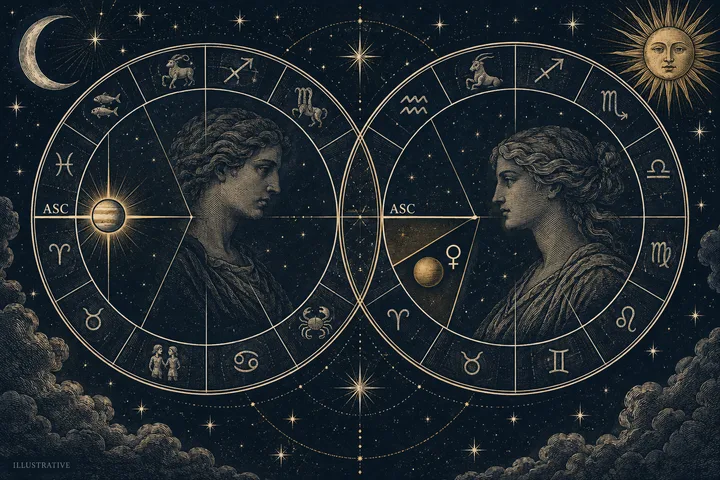
Consider three readings of the same Venus. At one degree from the Ascendant, Venus-Ascendant conjunction leads. At five degrees, the conjunction still leads, but the first-house overlay reinforces it. At ten degrees, if Venus remains in the first house under the selected system, the overlay leads and the angle contact drops away. The third case may still feel attractive. It simply needs to be named accurately.
The strongest interpretation comes from repetition, not from counting labels. Venus in the first house, conjunct the Ascendant, and trine the Moon points toward one coherent attraction story. Venus in the first house with no close angle contact and a tense Saturn pattern needs a more mixed reading.
When the planet is close to a cusp, record the uncertainty instead of pretending the boundary is absolute. Some astrologers give special weight to planets near an angle even if their house label falls on the previous side. Others stay strict about the cusp. You can preserve both observations: state the technical house position, then state the angular distance. Your reader can see exactly why the interpretation includes both layers.
A close contact may stand out at first meetings. A wider overlay may emerge through routine.
Sources: Synastry - Astrodienst Astrowiki; House One - Astrodienst Astrowiki; Equal House System - Astrodienst Astrowiki
Read the planet, then test the story against the chart
Once you know whether the contact is angular, house-based, or both, read it in a set order. Start with the planet. Ask what it wants to do in a relationship. The Sun seeks expression and recognition. The Moon seeks emotional safety and response. Mercury seeks exchange. Venus seeks pleasure, harmony, and affection. Mars seeks action and desire. Jupiter seeks meaning, generosity, and growth. Saturn seeks structure, responsibility, and endurance. The outer planets bring wider, slower forces that can feel compelling but may also describe a generation unless they make close personal contacts.
Next, read the sign. The sign shows the style in which the planet enters the Ascendant person's field. A Mars in Libra may act through dialogue, charm, or negotiation. A Mars in Scorpio may press toward intensity and privacy. A Mercury in Gemini may stimulate quick talk. A Mercury in Capricorn may bring planning and judgment. Keep the sign visible. A house meaning without a sign meaning becomes a cardboard cutout.
Then check aspects. Astrodienst's synastry guidance treats the comparison as more than a list of house placements. Planets and axes can aspect one another, and the pattern of easy and difficult aspects changes how energy flows. Cafe Astrology describes conjunctions as powerful interaction, flowing aspects as easier blending, and squares as friction that may require work while still creating energy. Your Venus on a partner's Ascendant may feel warm, but Venus square their Saturn changes how freely that warmth moves.
Finally, compare the contact with real behavior. Does the Venus person actually offer affection? Does the Mars person respect the Ascendant person's pace? Does Saturn provide steadiness, or does the interaction feel like constant correction? Astrology gives you a language for the pattern. Your choices become wiser when the language stays connected to what you can observe.
Notice the expression in daily life. Venus may arrive as compliments or shared pleasure. Mars may become teamwork, sexual interest, or irritation. Saturn may create reliability or leave one person performing for approval. Also check whether the contact is mutual. One person may receive the angle contact while the other receives a house overlay or a different chart emphasis. That isn't a contradiction. It is the relationship's two-way map.
If the first keyword doesn't fit, check the planet's difficult side, natal condition, and other aspects before forcing the interpretation.
Sources: Synastry - Astrodienst Astrowiki; House One - Astrodienst Astrowiki; Synastry | Cafe Astrology
A practical comparison you can use before requesting a report
The rule has one important exception. A close Ascendant conjunction usually leads, but several planets in the first house can make the overlay the relationship's louder daily theme. Suppose Daniel's Saturn is four degrees from Maria's Ascendant, while his Sun, Mercury, and Venus also occupy her first house. Saturn may mark the first impression with seriousness, yet the repeated overlay may better describe how Maria dresses, speaks, and carries herself around him. Rank the tight contact first, then notice what repeats.
Use a short worksheet. Record the Ascendant sign and degree, the partner's planet and degree, the shortest distance between them, the chosen orb, and the house placement under the chosen system. If the degrees cross 0 Aries, measure across the zodiac's end and beginning. The worked example above shows why this small calculation matters: a planet can remain in the first-house field after it has moved beyond the angle orb.
The house system and birth time matter most near a boundary. Whole-sign houses place the entire Ascendant sign in the first house, while other systems use the Ascendant degree or unequal cusps. A planet can therefore keep a close angular relationship while receiving a different house label. A planet just across the cusp may be called twelfth-house in a quadrant system and still be read as rising when it is very close to the Ascendant. Record both facts. Don't make one label carry the whole meaning.
Then rank the interpretation. First, read the tight planet-Ascendant contact. Second, read the first-house overlay through the planet's sign, natal condition, and aspects. Third, compare supporting interaspects and the reverse direction. A Venus contact may show admiration, pleasure, or a wish to shape appearance. Mars may bring initiative, desire, or irritation. Saturn may offer steadiness or make one person feel measured. Watch which expression the two people actually live.
If you know signs but not degrees, leave the angle question open. A confirmed house placement can support a first-house reading, but it cannot prove a conjunction without both degrees. The Synastry Comparison Report can compare supplied Moon, Venus, and Mars signs, optional degrees, and selected major aspects within its stated six-degree orb. It doesn't calculate a natal chart from birth details or certify a relationship outcome.
So the answer is clear. A planet on the Ascendant is a precise, concentrated contact with the chart's point of encounter. A planet in the first house activates a wider field of identity and presentation. They can describe the same planet at once, but they earn different words. Decide which one you have, name the strongest supporting factor, and ask whether the contact helps you feel more like yourself or makes you perform for the connection.
Sources: Synastry - Astrodienst Astrowiki; House One - Astrodienst Astrowiki; Synastry | Cafe Astrology; Synastry: Planet Overlays in Houses (Transposed Houses) | Cafe Astrology
A little more clarity
Is a planet conjunct the Ascendant stronger than a planet in the first house in synastry?
Usually, yes, when the conjunction is close and the birth time is reliable. An exact angle contact is more concentrated than a broad house overlay. But a first-house placement can become more influential when several of the partner's planets occupy the house, when the planet is central in the natal chart, or when other synastry aspects repeat the same theme. Read the close angle first, then test it against the full pattern.
Can a planet be in the first house without conjuncting the Ascendant?
Yes. The first house covers more than the Ascendant degree. A partner's planet can fall inside that house while sitting farther than the chosen orb from the Ascendant. In that case, interpret the first-house overlay, the planet's sign, and its other aspects. Don't rename it an Ascendant conjunction just because both factors share the first-house area.
Sources & further reading
- Synastry - Astrodienst Astrowiki
Defines synastry as comparison of charts, including interaspects and planets falling in a partner's houses.
- House One - Astrodienst Astrowiki
Explains the first house and Ascendant as the field of self-expression, approach, appearance, and instinctive response.
- Equal House System - Astrodienst Astrowiki
Explains how whole-sign and equal-house divisions place the first house differently in relation to the Ascendant degree.
- Synastry | Cafe Astrology
Describes Ascendant contacts as immediate and apparent and outlines conjunction, flowing, and difficult synastry aspects.
- Synastry: Planet Overlays in Houses (Transposed Houses) | Cafe Astrology
Explains two-way house overlays as planets activating a partner's house and emphasizes that the energy can affect both people differently.
Synastry Comparison Report
Enter known placements for two people. Get an input-by-input comparison, selected aspect calculations and a clear record of what remains uncertain.
Compare our placements