Start with the week you’re actually living
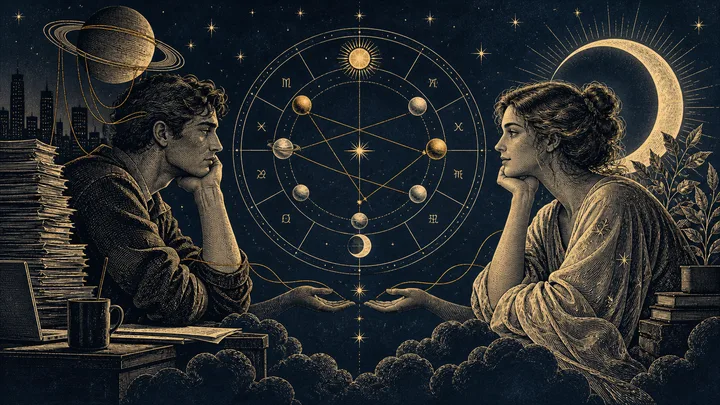
Imagine Maria has just started a six-week project at work. Her days run late. She checks messages during dinner, sleeps badly, and keeps saying the pressure will ease next week. Her partner, Elena, doesn’t want a grand relationship reading. She wants to know what to do tonight. Should she give Maria room? Ask for more contact? Stop taking the short replies personally?
That is the right doorway into synastry. A placement comparison is most useful when it meets a real decision. It shouldn’t float above the relationship as a collection of pretty symbols. It should help you name the part of the bond that is under strain and choose a kinder, clearer response.
The first answer is practical. Ask Maria what the work season is changing. Is she short on time, emotional bandwidth, sleep, physical desire, or all four? Those are different problems. A partner who has no time may still have warmth. A partner who has no emotional space may need quiet before conversation. A partner who feels responsible for everything may hear a loving request as one more demand.
Then bring in the charts. Synastry compares two birth charts by placing their planets and points in relation to each other. It can show where two people recognize one another, where their needs meet, and where one person’s way of coping presses on the other’s. The chart adds a language for the pattern. It doesn’t remove the need to observe the pattern in daily life. Astro.com describes synastry as a comparison of horoscopes that examines interchart aspects and house overlays, and it stresses that each person’s individual chart should be understood before the comparison. [1]
For this article, the report scope is narrower and honest. You can compare supplied Moon, Venus, and Mars signs, with optional degrees for selected major aspects. The report uses a six-degree orb for those selected aspects. It doesn’t calculate a natal chart from birth details, derive houses, or produce a relationship score. If all you know is that one person has Moon in Cancer and the other has Mars in Libra, you can still begin a sign-level reading. You just shouldn’t pretend you know an exact aspect or house overlay.
The guiding question is simple: what does unusual work stress activate between us, and what response would help rather than add weight?
A useful comparison gives you a better question to ask each other. That’s its first success.
Sources: Synastry - Astrodienst Astrowiki; Partner horoscopes - Astrodienst FAQ; Synastry - Cafe Astrology
Gather only the chart information you can stand behind
Before you interpret anything, make a small record. Write down each partner’s Moon, Venus, and Mars sign. If degrees are available, write those too. Keep the planets separate. “Her Venus is in Virgo” is not the same information as “her Moon is in Virgo,” even though both placements use the same sign language.
A sign is a 30-degree segment of the zodiac. In a natal chart, each planet occupies a sign and a degree. Astrodienst’s reference explains that signs describe how a planet operates, while the planet describes the function being expressed. That distinction keeps a comparison from becoming a personality label. Venus in a sign speaks to the style of affection and value. It doesn’t replace the whole person. [9]
Record the data in a table if that helps you see it:
Partner A: Moon, sign and degree if known; Venus, sign and degree if known; Mars, sign and degree if known.
Partner B: Moon, sign and degree if known; Venus, sign and degree if known; Mars, sign and degree if known.
Then add the current question in one sentence. “We’re deciding how to stay connected while A works twelve-hour days” is better than “Are we compatible?” The first sentence gives the chart something to illuminate. The second asks it to deliver a verdict it cannot responsibly carry.
If birth times or degrees are missing, narrow the reading. You can compare signs and some broad themes. You can’t make a confident claim about houses, an Ascendant contact, or an exact Moon aspect. The Moon deserves special care because it moves quickly. A missing degree can change whether a close contact exists, especially when you’re working with a tight orb.
You also need a boundary around the comparison. Use the placements you have supplied. Don’t quietly fill gaps with a birth date, an assumed rising sign, or a chart copied from a different website. The reading becomes stronger when its limits are visible because you know which statements are firm and which are invitations to observe.
This is where many couples go wrong. They gather too much symbolism and too little lived evidence. Ask for three examples from the stressful week: one moment when care landed, one moment when care missed, and one moment when the couple repaired a miss. Those examples will keep the astrology attached to the relationship instead of letting it become a private game of labels.
Once the record is clean, begin with the Moon. Stress tends to reveal the Moon’s ordinary needs before it reveals the dramatic parts of a chart.
Sources: Partner horoscopes - Astrodienst FAQ; Element - Astrodienst Astrowiki; Quadruplicities - Astrodienst Astrowiki
Read the Moon for the need beneath the withdrawal
The Moon is the first layer because it describes the ways a person seeks safety, settles inwardly, and responds from habit. When work becomes unusual, the Moon often shows up in the daily details: whether someone wants to talk while cooking, needs silence after arriving home, reaches for physical closeness, or protects a small pocket of private time.
Don’t reduce the Moon to “emotional.” Ask a sharper question. What kind of reassurance can this person receive when their nervous system is full? A fire Moon may need a direct, energizing sign that the relationship is still alive. An earth Moon may trust practical help and a predictable plan. An air Moon may need words, perspective, or room to think aloud. A water Moon may need tenderness, privacy, and proof that feeling deeply won’t create another task.
These are starting images, not conclusions. The sign’s element and modality refine the picture. Fire signs are Aries, Leo, and Sagittarius. Earth signs are Taurus, Virgo, and Capricorn. Air signs are Gemini, Libra, and Aquarius. Water signs are Cancer, Scorpio, and Pisces. Astrodienst describes the elements as different temperaments and the modalities as cardinal, fixed, and mutable ways of moving through experience. [5][6]
Consider an example. Maria has Moon in Virgo. Under pressure, she may try to regain safety by fixing the next thing, sorting the schedule, or making the problem more manageable. Elena has Moon in Pisces. Under pressure, she may need emotional softness and a sense that the relationship can hold uncertainty without turning it into a checklist. Neither Moon is wrong. They simply reach for relief through different doors.
The misunderstanding arrives quickly. Elena asks, “Can you tell me how you’re feeling?” Maria hears another open-ended demand and starts cleaning the kitchen. Maria says, “I’ll send you the plan,” believing she is offering care. Elena hears a document where she wanted presence. The Moon comparison doesn’t prove that Maria is cold or Elena is needy. It gives the couple a precise translation problem: practical containment versus emotional attunement.
A Moon-to-Moon sign comparison can show whether the couple’s comfort habits resemble one another or require translation. Similar elements may make instinctive understanding easier. Different elements can still work beautifully, but the partners need to name what comfort looks like instead of waiting for it to be obvious.
Then look for cross-chart Moon contacts. A Moon-Venus contact can soften the atmosphere because one person’s emotional needs meet the other’s style of affection. A Moon-Mars contact can bring quick emotional activation, physical attraction, and sharper reactions when one person moves too forcefully. A Moon-Saturn contact can create seriousness and a sense of responsibility, but it can also make the Moon person censor needs if the Saturn tone feels heavy. Cafe Astrology’s relationship references describe these contacts as meaningful layers, with supportive and difficult expressions depending on the aspect and the individual charts. [2][4][7]
The decision aid is small. Complete this sentence separately: “When I’m overloaded, the first sign I still feel close to you is...” Then complete: “The thing that makes me feel managed is...” Compare the answers. You’re looking for a request, not a diagnosis.
The Moon tells you what must feel safe. Venus tells you how love can still reach the person who is tired.
Sources: Synastry - Cafe Astrology; Moon Saturn Aspects - Cafe Astrology; Element - Astrodienst Astrowiki; Quadruplicities - Astrodienst Astrowiki; Synastry: Moon-Mars Aspects - Cafe Astrology
Compare Venus with the care that can fit inside a hard week
Venus shows the language of affection, pleasure, value, and receiving. In a stressful work season, that language gets compressed. A long date may be impossible. A grand gesture may exhaust the person who has to receive it. Venus helps you ask what still feels loving when the calendar has almost no empty space.
Look at each Venus sign on its own first. Venus in an earth sign may appreciate food, reliability, useful help, and a calm physical setting. Venus in an air sign may feel loved through conversation, humor, and mental companionship. Venus in a fire sign may need enthusiasm, play, and a reminder that desire and admiration haven’t disappeared. Venus in a water sign may value emotional presence, tenderness, and a private bond that doesn’t need an audience.
Again, the point isn’t to hand a person a script. It’s to create a few testable options. Ask, “Would you rather I bring dinner, sit beside you without talking, send a warm message, or protect an hour for us this weekend?” The answer may surprise you. Venus is personal. The sign narrows the field, but the person chooses what lands.
The comparison becomes more useful when you notice the mismatch between giving and receiving. Maria’s Venus in Capricorn may express devotion by taking a task off Elena’s list. Elena’s Venus in Gemini may offer affection through a stream of messages, jokes, and quick questions. Maria may feel crowded by the messages. Elena may feel abandoned by the silence. Both are giving in their own Venus language. Neither is automatically receiving in the other’s language.
This is the moment to stop asking which partner loves more. Ask which form of love is currently legible. A stressed person may not have the capacity to decode an elaborate gesture, while a small familiar action can reach them immediately. Care becomes more generous when you make it readable.
Cross-chart Venus contacts add another layer. Venus-Moon contacts often bring tenderness and familiarity. Venus-Venus contacts can show shared values and similar relationship styles, while challenging aspects may require the partners to look past different ways of showing love. Venus-Mars contacts add attraction and initiative, but they can also expose timing problems when one person wants closeness and the other approaches too directly. Cafe Astrology places Venus at the center of romantic attachment in synastry and describes Venus-Mars contacts as both magnetic and capable of friction. [2][8]
Suppose Maria’s Venus is in Capricorn and Elena’s Mars is in Aries. At the sign level, Elena may want to act now, while Maria may want to make a workable plan before she commits energy. During an ordinary month, that difference can feel exciting. During a brutal work week, Elena’s push for a spontaneous night out may feel like pressure, while Maria’s request to schedule affection may feel unromantic to Elena.
The useful adjustment isn’t to erase the difference. It’s to give each style a place. Choose one planned act of care and one spontaneous act that can be declined without punishment. That protects Capricorn’s need for structure and Aries’ need for movement. It also turns a sign description into an agreement you can actually test.
When affection has a shape, Mars can show whether the couple can act on it without turning initiative into pressure.
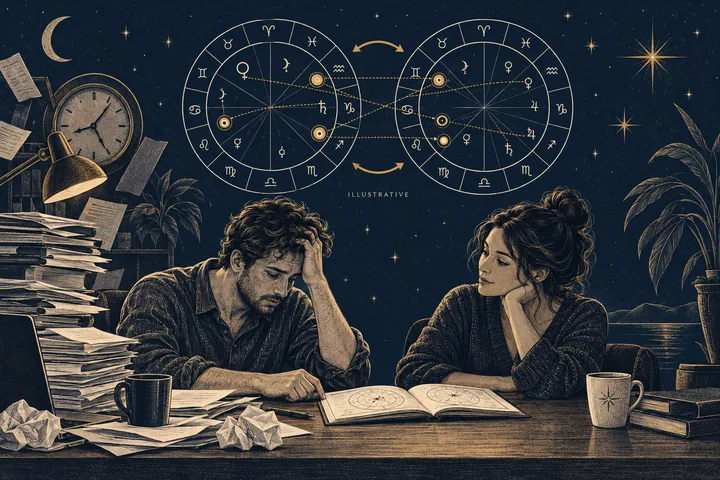
Use a placement comparison to ask how stress changes the way you seek comfort, offer affection, take initiative, and carry responsibility. Don’t use it to excuse silence, rank one partner as the problem, or predict what the relationship must become. Start with the known signs for your Moon, Venus, and Mars. Add degrees only when you have them, then check major cross-chart aspects with a six-degree orb. Read the Moon first because unusual work pressure often changes rest, reassurance, and home life before it changes desire. Read Venus next for the care that still lands as love. Read Mars for action, irritation, and sexual timing. Read Saturn for the weight of duty and the structure that can either steady the couple or make one person feel managed. The useful result is a shared sentence and a small test: “When work is heavy, I need X, and I can still offer Y.”
Sources: Synastry - Cafe Astrology; Synastry: Venus-Mars Aspects Between Two Charts - Cafe Astrology; Element - Astrodienst Astrowiki
Use Mars to separate initiative from pressure
Mars describes drive, assertion, desire, pursuit, and the way heat enters conflict. A work-stress reading needs Mars because exhaustion changes timing. One partner may want physical closeness as a way to reconnect. The other may need a shower, sleep, or ten quiet minutes before the body can feel available. If you read only for chemistry, you miss the real question: how do we approach one another when energy is uneven?
Start with the two Mars signs. Cardinal Mars often wants to begin, solve, or move the situation forward. Fixed Mars may need time to settle into a choice and may resist being rushed. Mutable Mars may adapt, change plans, or need several conversations before the next move becomes clear. The element colors the action: fire acts boldly, earth acts concretely, air acts through ideas and words, and water acts through emotional instinct and protection.
Maria’s Mars in Scorpio, for example, may want focused, private reconnection. Elena’s Mars in Sagittarius may want to get out of the house and change the mood. If they treat those preferences as evidence of unequal desire, the week gets harder. If they treat them as two routes back to vitality, they can choose a route that fits the energy available.
Now compare Mars with Venus. A Venus-Mars contact can keep attraction alive during a difficult season, but it won’t decide when either partner has enough capacity. A flowing aspect may make the adjustment feel natural. A square or opposition may make timing and approach more obvious points of friction. Cafe Astrology’s Venus-Mars guide frames the hard aspects as strong attraction with a need to learn how harmony and conflict interact. [8]
Then compare Mars with the other person’s Moon. The Mars person may activate the Moon person’s feelings quickly. That can be enlivening, sexy, and intimate. It can also feel invasive when the Moon person needs gentleness. A direct question, a hand on the shoulder, or an urgent request can land differently depending on whether the Moon person has room to respond.
This is where consent and ordinary courtesy belong inside the reading. Astrology can describe a pattern of approach and response. It never turns a no into a yes. It never makes anger, intimidation, or repeated disregard romantic. A chart can help you choose better timing. It cannot excuse behavior that harms the other person.
Create a two-part signal. “Green” means you can ask for closeness or make plans. “Yellow” means offer one option and wait. “Red” means no relationship task tonight beyond basic care and a clear return time. You don’t need to make the signal mystical. Mars works well with a simple action rule because it likes clarity.
The strongest exception is a couple with very easy Venus-Mars contacts that still feels disconnected during the work crisis. Chemistry can survive while availability falls. In that case, don’t keep hunting for a more dramatic aspect. Look at sleep, workload, resentment, and the promises the couple has made. The chart may describe the spark. The calendar decides whether the spark gets oxygen.
If Mars tells you how energy moves, Saturn asks who is carrying the weight and whether the arrangement can last.
Sources: Synastry - Cafe Astrology; Synastry: Moon-Mars Aspects - Cafe Astrology; Synastry: Venus-Mars Aspects Between Two Charts - Cafe Astrology; Mars Saturn Aspects in Synastry - Cafe Astrology
Read Saturn for duty, limits, and the shape of support
Saturn enters a work-stress comparison as the planet of duty, boundaries, time, pressure, endurance, and structure. It can describe the part of the relationship that keeps showing up when romance has to share the room with deadlines, bills, health, family, or fatigue. Saturn is not automatically cold. A good Saturn agreement can make support dependable.
Ask what responsibility is being carried and by whom. Is one partner doing more paid work while the other takes on meals, errands, or emotional planning? Has the stressed partner clearly asked for help, or has the other partner begun managing everything without consent? Is there a date when the arrangement will be reviewed? Saturn likes terms. Without terms, sacrifice hardens into resentment.
The sign of Saturn can describe the style of the pressure and the method a person uses to contain it. Saturn in an earth sign may focus on work, money, time, and practical results. Saturn in an air sign may make rules, plans, or mental distance. Saturn in a water sign may carry emotional or family duty quietly. Saturn in a fire sign may take responsibility for direction, leadership, or keeping morale alive. These are interpretive starting points, not verdicts about character.
In synastry, Saturn contacting the other person’s personal planets can feel weighty. A Saturn-Moon contact may create a serious bond and a strong sense of obligation, yet the Moon person may feel they must edit their needs to avoid disapproval. A Saturn-Mars contact may frustrate action when one person pushes and the other slows, but flowing aspects can also give Mars the steadiness to keep going. Cafe Astrology describes both the demanding and stabilizing sides of Moon-Saturn and Mars-Saturn contacts. [3][4]
Consider an example. Elena’s Saturn is in Taurus, and it makes a close trine to Maria’s Mars in Virgo. During the project, Elena handles groceries and protects Maria’s sleep. Maria keeps the one weekly promise she can manage: Sunday breakfast, no work messages for one hour. The Saturn support gives Mars a stable base. It doesn’t ask Maria to perform gratitude every day, and it doesn’t ask Elena to disappear into unpaid labor.
Now change the aspect to a hard Saturn-Mars contact. Elena may feel that Maria’s last-minute work demands keep breaking the household structure. Maria may feel that every attempt to act is met by a rule. The same practical question becomes urgent: which limit protects the relationship, and which limit merely expresses fear? Saturn improves a bond when its structure serves life. It damages trust when it becomes a gate one partner must keep passing.
Write three Saturn sentences together: “This season lasts until...” “The support I can reliably offer is...” “We will revisit the arrangement on...” That is not less romantic than a promise to always be there. It is more loving because it tells the truth about time and capacity.
Saturn is also the strongest reason not to make the report the chart expert in the room. If one person knows astrology better, she should translate the symbols into questions, not pronounce the other person’s inner truth. The chart can suggest where structure matters. Both partners decide what structure feels fair.
The four layers now point to one integrated reading.
Sources: Synastry - Astrodienst Astrowiki; Synastry - Cafe Astrology; Mars Saturn Aspects in Synastry - Cafe Astrology; Moon Saturn Aspects - Cafe Astrology
Integrate the layers instead of collecting separate meanings
A placement comparison becomes useful when the planets stop speaking in separate rooms. Moon, Venus, Mars, and Saturn may describe one repeating loop. The Moon names the need. Venus shows the form of care that can reach it. Mars shows how the couple approaches action and desire. Saturn sets the limit that keeps the response sustainable.
Use this order when you read:
First, name the stress event. “Maria is working late for six weeks.” Second, name the Moon need. “Maria needs quiet before she can feel present.” Third, name the Venus bridge. “A warm meal and a short message land better than a surprise plan.” Fourth, name the Mars timing. “Ask before initiating physical closeness.” Fifth, name the Saturn agreement. “Protect one evening, and review the plan each Sunday.”
The example is intentionally illustrative. It does not represent a calculated chart. Its job is to show how a couple can move from symbol to observation to choice without inventing personal placements.
Here’s a fuller comparison. Imagine Partner A has Moon in Virgo, Venus in Capricorn, and Mars in Scorpio. Imagine Partner B has Moon in Pisces, Venus in Gemini, and Mars in Sagittarius. At the sign level, Partner A may restore order through practical action, prefer dependable affection, and seek deep private contact. Partner B may absorb the emotional atmosphere, offer love through words and variety, and recover through movement, humor, or a change of scene.
The first reading might say, “You’re mismatched.” That reading is too lazy. The stronger reading says the stress season creates a translation problem between containment and release. Partner A may need a plan and a quiet room. Partner B may need reassurance that quiet isn’t rejection and may benefit from a short walk or a light conversation before a deeper talk. The couple can meet if they stop demanding that relief look the same for both people.
Now imagine a close Moon-Mars contact between the charts. The work pressure may make small actions feel large. A rushed question can provoke tears or anger. The contact doesn’t mean the couple is doomed. It means timing matters and repair needs to happen quickly. Add a supportive Venus-Saturn contact, and the couple may have a durable way to return to tenderness after the flare-up. Add a hard Mars-Saturn contact, and they need especially clear rules around requests, delays, and criticism.
Notice the ranking. A sign comparison gives the broad style. A close major aspect gives a sharper interaction. The individual natal chart gives context for how each planet already functions. The lived pattern gives the final test. No single placement outranks the whole relationship, and no single beautiful aspect cancels a repeated breach of trust.
Astrodienst’s synastry guidance makes a similar structural point: harmonious aspects can ease exchange, difficult aspects can create friction that demands effort, and the individual charts and maturity of the people matter. That lets you read a square as work to be done rather than a sentence handed down from the heavens. [0]
The strongest exception is the couple whose charts look easy but whose current arrangement is unfair. A flowing Moon-Venus contact may help them feel affection. It does not divide household labor. A warm Venus-Mars contact may preserve desire. It does not make chronic absence acceptable. When the chart and the lived relationship disagree, trust the repeated behavior and use the chart to ask better questions about the gap.
That is the point where interpretation should become an experiment.

Sources: Synastry - Astrodienst Astrowiki; Synastry - Cafe Astrology; Element - Astrodienst Astrowiki; Quadruplicities - Astrodienst Astrowiki; Synastry: Venus-Mars Aspects Between Two Charts - Cafe Astrology
Turn the reading into one relationship experiment
Don’t leave a synastry reading as a paragraph you admire and never use. Choose one experiment for seven days. A good experiment is small enough to attempt, specific enough to observe, and reversible enough to revise.
For a Moon-centered problem, try a daily arrival ritual. The person coming home gets twenty minutes without questions. Then she gives one clear signal: “I can talk for ten minutes,” “I can sit with you,” or “I need to sleep and I’ll check in at eight.” The ritual respects a Moon need for decompression without turning silence into a disappearance.
For a Venus-centered problem, create a menu of low-cost affection. It might include a voice note, a cup of tea, a hand on the back, a shared show, or a planned breakfast. Each partner marks two options that feel loving and two that feel like pressure during the work season. The menu turns different Venus languages into something both people can read.
For a Mars-centered problem, ask before you initiate. “Do you want closeness, company, or space?” sounds ordinary. That’s its strength. It gives desire a clear doorway and lets the tired partner answer without defending the relationship. If the answer is no, agree on a later check-in so a pause doesn’t become a vague rejection.
For a Saturn-centered problem, write the temporary division of labor. Name the tasks, the owner, and the review date. Avoid the phrase “help with.” A partner who owns dinner is responsible for deciding, buying, and making dinner. A partner who owns the bedtime reset doesn’t need to be reminded by the person already carrying the rest of the evening.
At the end of the week, ask three questions: What reduced pressure? What created pressure even though it was meant kindly? What should we keep, change, or drop? Record the answers without defending your sign. An experiment is a meeting with reality. Let reality teach you.
If the same wound appears, look at the chart layer that describes it, then look at the behavior that maintains it. A Moon pattern may need more emotional translation. A Venus pattern may need a new form of appreciation. A Mars pattern may need better timing and boundaries. A Saturn pattern may need a fairer structure or a firm limit on what one person can carry.
This is also a useful place to use a report. If you already know the placements and optional degrees, a Synastry Comparison Report can organize Moon, Venus, and Mars sign themes and selected major aspects using the stated six-degree orb. Bring the result into the conversation as a map of questions. Compare our placements. Then test one answer in ordinary life.
The report can’t tell you whether Maria will finish the project, whether Elena will wait forever, or what the relationship must become. It can help them see why the same week feels like a need for quiet to one person and a need for reassurance to the other. That is enough to begin a better exchange.
Before you read the final pattern, make sure the stress itself isn’t hiding a different question.
Sources: Partner horoscopes - Astrodienst FAQ; Synastry - Cafe Astrology; Mars Saturn Aspects in Synastry - Cafe Astrology; Moon Saturn Aspects - Cafe Astrology
Know when work stress is the context, not the explanation
Unusual work stress can explain a change in availability. It doesn’t explain everything. The chart is most helpful when you use it to separate a temporary season from a familiar relationship habit.
Ask how long the pattern has lasted. Ask whether the stressed partner names the impact without being forced. Ask whether she accepts reasonable limits, repairs missed agreements, and makes room for the other person when capacity returns. Stress may shrink someone’s range. It shouldn’t erase mutuality.
This distinction matters in astrology because a vivid contact can make a difficult dynamic feel meaningful. A hard Moon-Mars aspect may describe emotional heat. A Saturn contact may describe a bond that feels serious. A strong Venus-Mars contact may describe desire that survives conflict. None of these contacts turns neglect into devotion or control into commitment.
The practical test is reciprocity over time. During the six-week project, Maria may need Elena to carry more at home. In return, Maria can give Elena a truthful schedule, name when she is unavailable, and keep one modest promise. If Maria misses the promise, she can acknowledge it and repair it. The exact balance may change by week. The principle doesn’t.
A useful chart reading should make this visible, not blur it. The Moon asks whether both people have a place for their needs. Venus asks whether affection travels in both directions. Mars asks whether initiative respects the other person’s body and timing. Saturn asks whether the arrangement can continue without quietly assigning one partner the role of parent, manager, or emotional container.
The strongest meaningful exception is a genuine emergency. A crisis can temporarily make reciprocity uneven. Illness, job loss, a family emergency, or a safety problem can narrow what one person can offer. The reading then shifts from “Is this fair today?” to “What support exists, what consent has been given, and when can we reassess?” Compassion needs a boundary so it can survive.
You don’t need to force a chart answer when the observable answer is already clear. If one partner keeps using work as a reason to avoid every conversation, refuses any review, and punishes ordinary needs, that pattern deserves a direct conversation and a limit. If both partners are trying, the chart can help them choose a more fitting method of care.
In other words, astrology can deepen discernment. It shouldn’t replace it.
Now return to the opening question: what should Maria and Elena do tonight?
Sources: Synastry - Astrodienst Astrowiki; Synastry - Cafe Astrology; Mars Saturn Aspects in Synastry - Cafe Astrology; Moon Saturn Aspects - Cafe Astrology; Synastry: Venus-Mars Aspects Between Two Charts - Cafe Astrology
Return to the question with a clearer choice
Maria and Elena don’t need to decide whether their charts promise an easy relationship. They need to decide how to move through one demanding season without making the season the whole story.
Their placement comparison gives them a sequence. Begin with the Moon: what kind of safety does each person need when work consumes attention? Move to Venus: what small form of affection can still be felt as love? Move to Mars: when is it welcome to ask for contact, action, or sex, and when does initiative feel like pressure? Finish with Saturn: what temporary structure protects both partners, and when will they review it?
If Maria needs quiet and Elena needs reassurance, they can make both true. Maria can send one honest message before she goes offline: “I’m overloaded. I love you. I’ll be back at eight.” Elena can respect the quiet and trust the return time, then ask for the promised check-in. That exchange is small. It changes the meaning of silence.
If the couple’s Venus signs express care differently, they can stop testing love through the form each person prefers. Elena can choose one message instead of ten. Maria can accept the message as affection instead of treating it as another task. If their Mars contacts are hot or tense, they can ask before reaching for closeness. If Saturn is strong, they can write down who owns what and when the arrangement ends.
The chart doesn’t make the choice for them. It helps them see which choice they are making already. Are they translating needs, or making each other guess? Are they sharing a season, or handing one person the full cost of it? Are they using astrology to become more precise, or to avoid saying what hurts?
Take one action tonight. Name the need. Offer one form of care. Set one return time. Then revisit the reading after a week of lived evidence. That is how a placement comparison earns its place in a relationship: not by delivering a grand verdict, but by helping two people meet the next moment with more accuracy and less fear.
Compare our placements when you’re ready. Bring the Moon, Venus, and Mars signs you know, add degrees if you have them, and let the report give your conversation a useful starting map.
Sources: Synastry - Astrodienst Astrowiki; Partner horoscopes - Astrodienst FAQ; Synastry - Cafe Astrology; Mars Saturn Aspects in Synastry - Cafe Astrology; Moon Saturn Aspects - Cafe Astrology
A little more clarity
Can a synastry comparison explain why one partner withdraws during work stress?
It can suggest the kind of need beneath the withdrawal, especially through the Moon and its contacts, but it shouldn’t be used to guess intentions. Ask what the person needs, compare that answer with the Moon, Venus, Mars, and Saturn themes, and agree on a clear return time. A chart can offer language for the pattern. The partner still has to name it and act on it.
What should we compare first when work pressure changes our relationship?
Start with the Moon signs and any known close Moon contacts because stress often changes rest, reassurance, and home routines first. Then read Venus for the form of care that still lands, Mars for initiative and timing, and Saturn for duty and limits. Use supplied placements and optional degrees only. Don’t infer houses or exact aspects when the needed birth information is missing.
Sources & further reading
- Synastry - Astrodienst Astrowiki
Supports the definition of synastry as chart comparison, interchart aspects, house overlays, and the need to read individual charts first.
- Partner horoscopes - Astrodienst FAQ
Supports the distinction between synastry, composite charts, and the use of narrower orbs when drawing synastry aspects.
- Synastry - Cafe Astrology
Supports the interpretive roles of Venus, Mars, major aspects, and the different expressions of flowing and challenging contacts.
- Mars Saturn Aspects in Synastry - Cafe Astrology
Supports reading Mars-Saturn contacts through frustration, restraint, dependability, stability, and the condition of each natal chart.
- Moon Saturn Aspects - Cafe Astrology
Supports the serious responsibility and possible emotional inhibition associated with Moon-Saturn contacts in synastry.
- Element - Astrodienst Astrowiki
Supports the traditional fire, earth, air, and water groupings and their broad astrological temperaments.
- Quadruplicities - Astrodienst Astrowiki
Supports the cardinal, fixed, and mutable sign groupings used to refine how a placement acts.
- Synastry: Moon-Mars Aspects - Cafe Astrology
Supports the emotional activation, attraction, sensitivity, and volatility that can accompany Moon-Mars contacts.
- Synastry: Venus-Mars Aspects Between Two Charts - Cafe Astrology
Supports the attraction, timing differences, conflict themes, and need to balance harmony with assertion in Venus-Mars contacts.
- Zodiac Sign - Astrodienst Astrowiki
Supports the 30-degree sign structure and the interpretive distinction that signs describe how planets operate.
Synastry Comparison Report
Enter known placements for two people. Get an input-by-input comparison, selected aspect calculations and a clear record of what remains uncertain.
Compare our placements