Say exactly what is uncertain, how it could change the reading, and what remains steady. Use language such as, “If the supplied Moon sign is correct, this points to…” or “The sign is usable, but the aspect needs exact degrees.” Don’t turn a questionable input into a confident personality claim. First check the source, then test the nearest alternatives, then separate the stable interpretation from the conditional one. In a sign-only comparison, keep to the supplied Moon, Venus, and Mars signs and broad sign relationships. If degrees are available, apply the stated six-degree orb and show the degree distance. If the placement could cross a sign boundary, pause that interpretation until the person verifies the data. A good synastry report makes uncertainty visible without making the whole connection meaningless.
Start with the uncertainty, then keep the reading moving
You’re comparing two charts. One line says Moon in Libra. Another source says Moon in Scorpio. Or the sign looks settled, but the degree is missing and a Venus-Mars aspect may fall just inside or outside the working orb. The temptation is to choose the placement that makes the story feel clearest. Don’t. Clarity built on a guessed input is only polished confusion.
Phrase the uncertainty in one clean sentence. Name the placement. Name the reason it may change. Name the part of the interpretation that depends on it. Then continue with what the supplied data can support. “The Moon sign needs checking because the birth time is close to a lunar sign change, so the emotional style could be Libra or Scorpio. I’ll keep the Moon section conditional and read the confirmed Venus signs first.” That sentence gives the reader a path. It doesn’t leave her staring at a fog bank.
This is the right tone for synastry. It respects the chart and the person reading it. It also respects the difference between an astrological symbol and the input used to place it. A questionable placement isn’t a bad omen. It’s a question about the chart’s foundation.
Make the sentence do a different job from the chart note. First identify the input problem, then describe the two astrological readings, then tell the reader what decision can wait. That order keeps a sign dispute from swallowing a whole report. The reader should know whether she needs a better source, an unrounded degree, or simply a narrower interpretation for now.
For example: “If her Venus is in Gemini, affection may need conversation, wit, and room to change. If the supplied sign is actually Cancer, the same relationship may need more reassurance and emotional continuity. The shared question is how the couple signals care, not whether one person is secretly loving.” The example stays open without becoming weak. It ranks the question that matters next.
Use “may,” “could,” and “depends on” when they mark a real condition. Don’t use them as a nervous tic. “This may mean anything” tells the reader nothing. “This interpretation depends on whether Venus is at 29° Taurus or 0° Gemini” tells her exactly where the uncertainty lives. Precision gives uncertainty its shape.
For private notes, put the questionable line in brackets and add one sentence beside it that says what would change. “Moon sign changes; Venus-Mars contact does not” is more useful than a page of anxious qualifiers. It keeps the revision local and stops one vivid possibility from taking over the whole comparison before you’ve checked the data.
A synastry reading should answer the reader’s first question quickly: what can we say now? Then it should answer the next one: what would change if the input is different? That order keeps the report calm, direct, and honest to the astrology.
Sources: What if I don't know my birth time? The problem with astrology and how to work around it; What If You Do Not Know Your Exact Birth Time?; An Introduction to Aspects and Chart Shaping in Natal Astrology
Find out what kind of uncertainty you’re dealing with
Not every uncertain placement is uncertain in the same way. A reader may have copied the wrong sign from a chart app. A birth time may be rounded. A calculator may use a different zodiac setting. A planet may sit near the end of one sign or the start of the next. The repair depends on the cause.
The first thing to record is the source of the placement. Was it copied from a full chart report? Was it remembered from a horoscope column? Did a friend say, “You’re a Scorpio Moon,” without showing the chart? Was the degree included, or only the sign? These are different grades of evidence. A sign copied from a chart that shows the degree gives you something to inspect. A sign repeated from memory gives you a lead, not a settled input.
Next, record the calculation language if you have it. Tropical and sidereal charts can give different sign labels for the same birth moment. That doesn’t mean one label is a typo. It means the report has to state which zodiac it uses. A synastry comparison can’t quietly move between systems and still pretend that the sign pair means the same thing.
Birth time matters most for time-sensitive chart layers. CHANI notes that the Moon can change signs over a two-to-three-day period, while the rising sign shifts much faster and can change within a narrow time window. So a disputed Moon near a sign boundary needs a different check from a disputed Venus or Mars sign that stayed put throughout the possible birth-time range.
That gives you a useful order of operations. Check the date, place, time zone, and zodiac setting before you debate the interpretation. If one person’s chart was set to tropical and the other’s to sidereal, stop and standardize the comparison. If the birth time is approximate, ask whether the disputed planet is even sensitive to that time window. Don’t throw out stable placements because one angle is uncertain.
A report that uses supplied placements has a narrower job. It can compare the Moon, Venus, and Mars signs that the reader gives it. It can use optional degrees for selected major aspects. It can say what is missing. It cannot quietly recalculate a natal chart from birth details, settle a disputed placement by intuition, or turn a placeholder into a fact.
Write the input line plainly: “Supplied input: Venus in Virgo, source not stated, degree not provided.” That line may look dry. It does important work. It tells the reader which part belongs to her data and which part belongs to your interpretation. It also makes a later correction easy. If Venus becomes Libra, you change the relevant layer instead of rebuilding a fictional certainty around the first answer.
The practical goal isn’t perfect paperwork for its own sake. It’s a reading that can survive correction. When you know how an interpretation was built, a changed placement becomes a meaningful update rather than a crisis.
Sources: What if I don't know my birth time? The problem with astrology and how to work around it; What If You Do Not Know Your Exact Birth Time?; An Introduction to Aspects and Chart Shaping in Natal Astrology
Separate a sign question from a degree question
A sign and a degree answer different questions. The sign gives the style through which a planet works. The degree shows where that planet sits inside the sign and helps you measure its angular relationship with another planet. If the sign is uncertain, start with sign verification. If the sign is known but the degree is missing, you can still read the sign layer, but you shouldn’t invent an exact aspect.
Imagine a supplied Venus in late Taurus and a supplied Mars in early Leo. The sign pairing gives you a broad fixed-sign story: desire may be steady, proud, and resistant to being rushed. But whether the two planets form a square, and how close that square is, depends on their degrees. Venus at 28° Taurus and Mars at 2° Leo are separated by about 64 degrees, not a square. Venus at 20° Taurus and Mars at 20° Leo are 90 degrees apart, an exact square. Same signs. Different geometry.
This is why a sign-only report should say “the signs suggest” and a degree-based report should say “the aspect measures.” The first is a symbolic layer. The second is a calculation from supplied positions. Neither replaces the other. The degree aspect sharpens the relationship between the planetary functions; it doesn’t erase the signs that carry them.
When the disputed placement is close to a sign boundary, write both possibilities. “The supplied Moon is 29° Pisces, but the source may have rounded the chart. If the Moon is still Pisces, emotional safety may come through softness, imagination, and a porous response to the partner. If it has crossed into Aries, the same Moon may need direct action and fast emotional release. Verify the degree before ranking this as a core compatibility theme.” That is much stronger than calling the person “sensitive but impulsive” and hoping both signs will fit.
A degree can be wrong even when the sign is right. A rounded chart may say Venus 15° Libra when the underlying position is 14°42'. That difference may not change a sign-based reading, but it can alter a close aspect calculation. If a report calls two planets “conjunct,” show the actual degree distance when you have it. “Venus at 14°42' Libra, Mars at 19°10' Libra, orb 4°28'” lets the reader see the basis of the claim.
If the degrees are absent, phrase the limit directly: “I can discuss the supplied sign pairing, but I can’t confirm a degree-based aspect from signs alone.” Then keep going. You can still compare elemental tone, modality, and the planet’s role. You can still ask how affection, anger, reassurance, and pursuit show up between the two people. You just don’t give a close aspect a name it hasn’t earned.
This distinction also protects the reader from a common mistake: treating a colorful aspect label as more important than the planets involved. Venus-Mars matters because it joins attraction and desire. The square, trine, or opposition describes how those functions meet. If the geometry is uncertain, retain the Venus-Mars question and hold the aspect label lightly.
Good uncertainty doesn’t flatten the chart. It keeps each layer in its proper place.
Sources: An Introduction to Aspects and Chart Shaping in Natal Astrology; Orbs (or rays); Astrology Aspects Explained
Use the six-degree orb as a boundary, not a verdict
An orb is the distance between an exact aspect and the actual distance between two planets. A square is exact at 90 degrees. If the planets sit 94 degrees apart, the square has a four-degree orb. The smaller the orb, the tighter the contact. That is the basic math. The interpretive choice is what you do with it.
This report uses a six-degree orb for selected major synastry aspects. State that setting. Don’t present six degrees as a law of the sky or as a universal rule shared by every astrologer. Astrology sources describe different orb traditions. Skyscript distinguishes modern aspect orbs from traditional planetary rays, while other reference guides use different maximums for different aspects. The useful editorial choice here is consistency: apply the same six-degree rule to the same list of contacts for both charts.
Now consider the uncertainty. A supplied Venus at 11° and Mars at 17° may sit exactly six degrees apart. If one degree is rounded, the contact could be 5° or 7°. That changes whether the report includes it under the chosen setting. Your wording should show the edge: “This contact is near the six-degree limit. I’ll treat it as a supporting theme, not as the main conclusion, until the degrees are confirmed.”
Astrology.ac explains the practical value of showing the number rather than hiding it behind a generic aspect label: exactness tells you how close the contact is, while the aspect type tells you what kind of relationship the planetary functions form. That gives you a clean hierarchy. Name the planets first. Name the aspect second. Give the orb third. Rank the contact only after those three pieces are visible.
Use the shortest angular distance between the two supplied longitudes. That matters when a contact crosses the 0° Aries point. A planet at 28° Pisces and another at 2° Aries are four degrees apart, so they form a conjunction with a 4° orb, even though their sign labels look different. The sign relationship can add a separate interpretive layer, but it doesn’t erase the geometry.
Rounded degrees need their own wording. If a chart displays Venus at 15° and Mars at 21°, you know the shown values are six degrees apart, but you may not know whether the underlying values are 15°12′ and 20°48′ or 15°51′ and 21°42′. Don’t pretend that display precision is greater than the source provides. Say “the shown degrees place this at the six-degree boundary” and ask for the unrounded values before making the contact central.
A sign boundary and an orb boundary can appear together, but they are not the same problem. A planet can change signs while its aspect to another planet remains within the chosen orb, as the Cancer-Leo Venus example later shows. Or the sign can stay fixed while a rounded degree moves a contact from five degrees to seven. Name which boundary is moving. That one sentence prevents the reader from treating every uncertainty as a total chart failure.
A close square isn’t automatically a problem. A close trine isn’t automatically a gift. The aspect describes the meeting. The planets describe the subject. The signs describe the style. The orb helps you judge how sharply the contact may register. A four-degree Mars-Saturn square and a four-degree Moon-Venus square both deserve attention, but they don’t tell the same story because the planets don’t do the same work.
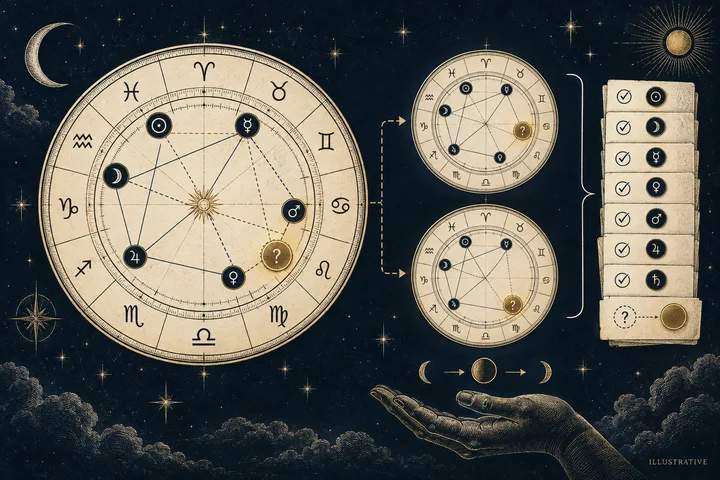
The report can use three useful labels. Confirmed means the supplied degrees place the contact clearly within six degrees and the sign data is settled. Borderline means the contact sits close enough to six degrees that rounding or a corrected degree could change its status. Withheld means the sign or degree input is too uncertain to name the aspect. These labels are easy for a reader to understand, and they prevent a long list of weak contacts from overwhelming the main reading.
Be careful with the word “exact.” In ordinary chart language, astrologers may call a contact exact when it is within a very narrow orb, often about one degree. Don’t use it for every aspect that happens to be inside six degrees. Say “within a six-degree orb” when that is what your method shows. The plain phrase is more trustworthy.
When a placement may be wrong, the orb is where uncertainty becomes visible. A sign-only change can alter the whole angle. A one-degree correction can move a contact across the report’s line. Your job is to show the line, then explain what deserves attention on either side of it.
Sources: Orbs (or rays); Astrology Aspects Explained
Rank the interpretation instead of giving every possibility equal weight
Uncertainty becomes exhausting when every branch gets the same space. A report says the Moon could be in one sign or another, Venus may aspect Mars, and the whole connection might be easy or difficult. The reader finishes with more options and no sense of priority. Don’t do that. Rank the evidence.
Start with the most stable layer. Confirmed supplied signs come first. If the Moon, Venus, and Mars signs are accepted but degrees are missing, read the planetary roles through those signs. That gives you the emotional style of the Moon, the affection pattern of Venus, and the pursuit or conflict pattern of Mars. Keep the language specific. “She may want reassurance before she opens up” is more useful than “the Moon is emotional.”
Next come confirmed major contacts. If the degrees are supplied and the contact is comfortably within the six-degree orb, interpret it after the sign layer. Explain the planet pair and the aspect together. A Moon-Saturn contact may bring emotional seriousness, caution, or a need to prove care through reliability. Whether it feels containing or heavy depends on the people and the rest of the chart material you actually have. Don’t let one contact speak for the whole relationship.
Then come conditional contacts. These are worth mentioning when they would materially change the picture, but they need a label. “If the reported 5° orb is correct, Venus and Mars form a close sextile and may make it easier for desire to find a practical opening. If the degree is off by more than one degree, the contact may sit outside this report’s six-degree scope. Treat the sextile as a possible amplifier, not the foundation.” That is a ranked interpretation. It tells the reader what to use now and what to verify next.
Last come withheld layers. If the chart source is unknown and the placement itself conflicts with another source, don’t build a house reading, rising-sign conclusion, or exact aspect story from it. A conditional sentence is not permission to keep using the disputed fact everywhere else. Place it in one clearly marked section and return to the confirmed material.
The ranking can be simple: first, what survives the correction; second, what depends on one input; third, what should wait. The surviving theme may be less dramatic than a fated conjunction. It is usually more useful. If both partners keep returning to the same question about reassurance, independence, pursuit, or conflict repair, that lived pattern gives the astrology somewhere concrete to land.
A strong report also names the strongest exception. Perhaps the supplied Venus signs look cooperative, but a possible Mars square would add heat and impatience. Or perhaps the Moon sign is uncertain, but a confirmed Venus-Mars contact still gives the couple a clear attraction theme. The exception doesn’t cancel the main reading. It tells the reader where the reading could bend.
Keep a small confidence ledger beside the prose: data that came from the supplied record, interpretation that follows from that data, and claims you’ve set aside. The ledger isn’t another layer of astrology. It’s a guard against letting an attractive possibility outrank a checked placement. Uncertainty identifies the moving part. Judgment decides which parts still carry weight.
Sources: What if I don't know my birth time? The problem with astrology and how to work around it; An Introduction to Aspects and Chart Shaping in Natal Astrology; Orbs (or rays)
A worked example, plus the strongest exception
Imagine Maria and Daniel comparing supplied placements before they talk about a recurring argument. Maria’s Venus is listed as 29° Cancer in one report and 0° Leo in another. Daniel’s Mars is supplied as 3° Libra. No one has confirmed which Venus degree is correct. The question isn’t, “Which sign makes Maria more romantic?” The question is, “What can this Venus-Mars comparison responsibly say while the input is unsettled?”
Begin with the stable facts. Daniel’s supplied Mars in Libra gives the comparison a Mars layer to work with: pursuit may involve charm, negotiation, fairness, and a strong reaction to overt conflict. Maria’s Venus is near a sign boundary, so the style of affection is the unstable part. At 29° Cancer, Venus may seek emotional safety, familiarity, and care that feels personal. At 0° Leo, Venus may want warmth, visible appreciation, play, and a clear sense that love is being celebrated.
Now check the relationship between the possible Venuses and Daniel’s Mars. Venus at 29° Cancer is 64 degrees from Mars at 3° Libra, so it forms a sextile with a 4° orb. Venus at 0° Leo is 63 degrees from that Mars, so it forms a sextile with a 3° orb. Both contacts fall within this report’s six-degree method. The calculation survives the sign change, but the meaning of Venus still changes.
That result is useful because it separates two questions that are easy to blur. The Venus-Mars sextile is supported by both supplied degree pairs, so it belongs in the reading as a confirmed contact under the stated method. The Venus sign remains conditional. Cancer Venus and Libra Mars may seek gentleness and relational balance, with Cancer protecting intimacy while Libra weighs the effect on the partnership. Leo Venus and Libra Mars may enjoy charm and social warmth, with Leo wanting unmistakable appreciation while Libra keeps weighing options.
The report should phrase it this way: “The Venus placement needs verification at the Cancer-Leo boundary. If Venus is 29° Cancer, read affection through emotional safety and personal care; if it is 0° Leo, read it through warmth, play, and visible appreciation. In either case, the supplied degrees place Venus and Mars in a sextile within the six-degree method, so I’ll keep that contact and make the Venus sign meaning conditional.”
Then connect it to the recurring argument. Consider this example: Maria says Daniel becomes polite when she wants affection, but she experiences that politeness as distance. Daniel says he is trying not to pressure her, but she hears him changing the subject. The astrology doesn’t prove why either person acts this way. It gives a language for the tension. Libra Mars may seek a smooth exchange and avoid making the moment harsher. Cancer Venus may need emotional presence before any solution feels loving. Leo Venus may need direct warmth rather than careful neutrality.
The conversation can test the branches without pretending to settle them. Maria might ask, “When I ask for reassurance, do you hear a demand you need to soften, or a request you can answer directly?” Daniel might ask, “Would you rather I stay close and name what I feel, or give you room before we return to it?” Their answers tell them which practical pattern is alive. The chart language helps them ask better questions. It doesn’t replace the answers.
End the example with the repair step. Verify the source and degree if possible. Until then, keep the Venus interpretation conditional, retain the confirmed sextile, and use the recurring situation as the test of relevance. That is a firm conclusion. It gives the reader somewhere to go.
Sometimes a disputed placement changes the sign, but both possibilities keep circling the same relationship issue. That doesn’t make the two signs interchangeable. It means the chart question may be broader than the label. A Moon in Libra and a Moon in Scorpio don’t ask for the same kind of emotional care, yet both can bring the reader to a question about trust, closeness, and what happens after conflict.
If both possibilities lead to the same practical conversation, name that shared question while keeping the astrological distinction intact. “The Moon sign remains unresolved. Libra would emphasize balance and dialogue; Scorpio would emphasize privacy and emotional depth. In either case, the couple needs to decide how much reassurance is enough and how they’ll handle silence after conflict.” The shared decision is real. The sign meanings remain separate.
This exception is strongest when another chart layer is confirmed. A settled Venus sign may show how someone gives affection. A settled Mars sign may show how they pursue or defend a position. The disputed Moon can then add a conditional emotional layer without carrying the whole report. But if the disputed placement is the only data you have, don’t use a practical overlap to smuggle in a confident sign conclusion.
People often bring chart questions to tender moments. A wrong placement can make them doubt their memory, their partner, or the whole bond. Your wording should lower confusion, not raise the stakes. “We need to verify this placement” is enough. You don’t need “this invalidates everything.” It doesn’t. You need a narrower reading until the input is clearer.
Hold two truths together. The alternative signs have different meanings. The relationship may still be asking one shared question. Good synastry can name both without pretending they’re the same.
The practical test is simple. Read each branch aloud and ask which observable situation it helps you describe more clearly. If one branch explains a recurring pattern and the other doesn’t, record that as a question for further checking, not as proof that the favored sign must be correct. Lived experience can guide your inquiry, but it doesn’t rewrite the input.
You can also mark the confidence of the next sentence. “Confirmed” belongs beside data you have checked. “Conditional” belongs beside a reading that changes with the alternative. “Withheld” belongs beside a claim that would be misleading without the missing placement or degree. Those labels make revision fast and keep a vivid possibility from taking over the whole comparison.
Turn the uncertainty into one conversation and one clean revision
End with a next step the reader can actually take. Ask for the chart source, check whether both charts use the same zodiac, and look for the degree rather than the sign alone. If the birth time is approximate, compare the earliest and latest plausible times and note which placements change. Keep a short record of the result: input, effect on the reading, and next check.
The conversation should be smaller than the uncertainty. Don’t send your partner a list of every open question. Say one useful thing instead: “I’m trying to understand what helps you feel cared for when we disagree. Do you want reassurance first, space first, or a clear plan for when we’ll return to the conversation?” Astrology gives language to the pattern. Their answer shows how the pattern is lived.
For this supplied-placement report, the boundary is part of the method. Use the Moon, Venus, and Mars signs the reader provides. Use optional degrees only when they’re present. Apply the same six-degree orb to the selected major aspects. Don’t calculate houses, rising signs, or a full natal chart from birth details. If another source conflicts, preserve both inputs until the reader can verify one.
Here’s a wording pattern you can reuse: “The supplied [planet] is listed in [sign], but [source or boundary] makes that placement uncertain. If [sign] is correct, read it as [specific meaning]. If [alternative] is correct, the emphasis shifts toward [specific alternative]. Because [degree or chart layer] isn’t confirmed, I won’t treat [aspect, house, or conclusion] as settled. The useful question for you both is [observable relationship question].” Use it once, then let later paragraphs add interpretation rather than repeat the template.
For a Moon example, the finished paragraph might say: “The supplied Moon is listed in Libra, but the birth time falls near a sign change. If Libra is correct, emotional repair may need balance, dialogue, and a fair exchange. If Scorpio is correct, privacy, trust, and emotional depth may matter more. I’m keeping the Moon meaning open while using the Venus and Mars layers to frame the conversation.” The useful part is not the label. It’s the exact question the branches create.
The pattern keeps the astrology precise. It doesn’t say anything is possible, and it doesn’t turn an open placement into a verdict about whether you should date, stay, or leave. It gives the couple a decision they can make with their own voices.
If you want to compare supplied Moon, Venus, and Mars placements with optional degrees, use the Synastry Comparison Report. Bring the placements you already have. The report can organize the sign layers, show selected major contacts under a six-degree orb when degrees are supplied, and keep missing data visible. It doesn’t calculate a natal chart from birth details.
If your partner asks which version of the chart to believe, begin with the record. Ask where the placement came from. Compare the chart settings. Check whether the degree is printed or rounded. If the disagreement remains, write down the two versions and the exact sentence each one changes. That turns anxiety into a small, traceable task.
A correction should stay local. If a Moon sign changes, revisit Moon aspects and conclusions that depend on the Moon. Leave a Venus-Mars contact alone if its supplied degrees still support it. A paragraph about the Moon may need revision while an attraction theme remains intact. The scale of the edit should match the changed input.
For working notes, use five columns: placement, supplied value, possible alternative, what changes, and what remains. “Moon, Libra, Scorpio, emotional style and Moon contacts change, Venus and Mars layers remain” is enough. You don’t need to publish the table, but another reader should be able to retrace the reasoning from the final prose.
Don’t use agreement with an interpretation as a substitute for chart data. A description can feel accurate because it names a live concern, because its language is broad, or because the relationship is already under pressure. That response still matters. It tells you where to ask a better question. It doesn’t settle a disputed degree.
Then ask the question that belongs to the couple: what do you need from each other when this theme appears in ordinary life? Ask it while the data is still being checked. Let the answer show whether the branch is useful, and let the verified input decide which astrological layer you keep. One clear question. One honest answer. Then make the smallest revision that the evidence requires.
Sources: What if I don't know my birth time? The problem with astrology and how to work around it; An Introduction to Aspects and Chart Shaping in Natal Astrology; Orbs (or rays)
A little more clarity
What should I say if I’m unsure whether someone’s Moon sign is correct?
Say why it’s uncertain and keep both meanings separate. Use: “The supplied Moon may be Libra or Scorpio because the source and birth time need checking. Libra would emphasize balance and dialogue; Scorpio would emphasize privacy and emotional depth. I’ll treat the emotional layer as conditional until the placement is verified.” Then read the confirmed placements first.
Can I interpret synastry without exact degrees?
Yes. You can read the supplied sign layers for the Moon, Venus, and Mars, and discuss broad sign relationships. You can’t confirm a degree-based aspect or its orb from signs alone. Say that plainly. If degrees are later supplied, calculate the selected major contacts using the report’s six-degree orb and show the distance.
What does a borderline six-degree aspect mean?
It means the contact sits near the method’s working boundary. Treat it as supporting evidence, not the main conclusion, especially if the degrees were rounded. Show the planet pair, aspect, and orb. If a small correction could move it outside six degrees, label it borderline and ask the reader to verify the degrees before leaning on it.
Should I use a guessed birth time to settle a disputed placement?
Use a guessed or placeholder time only to compare possibilities, and label it as a placeholder. Don’t present its Ascendant, houses, or time-sensitive placements as confirmed. Check the earliest and latest plausible times when you have a window. For a supplied-placement report, leave unconfirmed layers out and keep the interpretation tied to the data the reader actually provided.
Sources & further reading
- What if I don't know my birth time? The problem with astrology and how to work around it
Supports the distinction between time-sensitive chart factors and stable planet-sign work, including Moon sign boundaries and testing a plausible birth-time window.
- What If You Do Not Know Your Exact Birth Time?
Supports labeling a placeholder clearly, separating stable from changing factors, and checking the earliest and latest plausible times before interpreting sensitive chart layers.
- An Introduction to Aspects and Chart Shaping in Natal Astrology
Supports the meanings of aspects, the definition of an orb, the role of exactness, and the distinction between modern and traditional orb practice.
- Orbs (or rays)
Supports the working meaning of an orb, applying and separating language, and the fact that modern and traditional orb methods differ.
- Astrology Aspects Explained
Supports measuring angular distance, showing exactness and orb, naming the planet pair with the aspect, and distinguishing synastry contacts from whole-relationship judgments.
Synastry Comparison Report
Enter known placements for two people. Get an input-by-input comparison, selected aspect calculations and a clear record of what remains uncertain.
Compare our placements