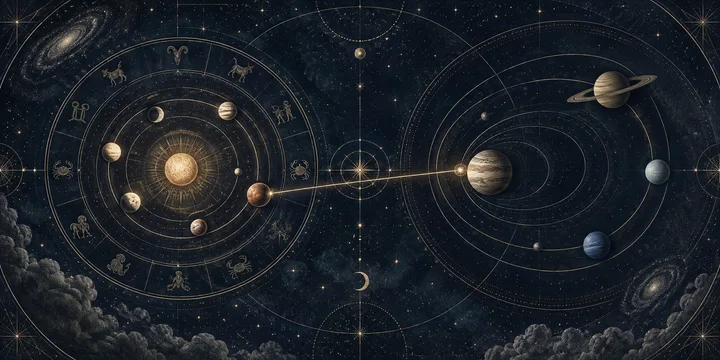
Start with the question behind the aspect
You may have opened a synastry list and found something like Venus opposite Neptune, Moon square Uranus, or Mars trine Pluto. The phrase can sound grand. It can also feel vague. Does it describe chemistry, confusion, fear, growth, or all four? The answer starts with a simpler question: which part of one person's life is being touched, and what kind of force is touching it?
In astrology, a personal planet carries a close human function. The Sun speaks to identity, vitality, and the way you stand in your life. The Moon speaks to feeling, comfort, and instinctive response. Mercury describes thought and speech. Venus describes attraction, pleasure, taste, and values. Mars describes desire, assertion, anger, heat, and action. These planets give the contact its immediate, recognisable subject.
Uranus, Neptune, and Pluto work on a wider scale. Astrodienst groups them as spiritual or trans-Saturnian planets because their slow movement links them with collective and invisible processes. Uranus breaks patterns and opens a door. Neptune dissolves a boundary and heightens receptivity. Pluto presses toward truth, power, release, and renewal. When one of them aspects a personal planet, the larger current enters an intimate room.
That is why these contacts often feel different from a simple sign comparison. A sign tells you how a planet tends to operate. An aspect tells you how two functions meet. The personal planet makes the experience personal. The outer planet makes it difficult to keep the experience small. You might meet someone and suddenly question a settled plan, see an old desire in a new light, or feel drawn into a conversation neither of you expected.
The contact doesn't tell you what the other person secretly intends. It describes an exchange between chart symbols. The person whose personal planet is involved may feel the contact in a direct, bodily, or emotional way. The outer-planet person may seem to carry the atmosphere that awakens it. Both people participate, and the expression can move in both directions. Avoid reducing the pair to a fixed planet person and a passive recipient.
Consider an example. Maria has Venus at 14 degrees Libra, and the other person's Neptune is at 12 degrees Aquarius. A trine exists by degree, with a two-degree orb. The first reading concerns the way Maria's style of affection and value may flow toward Neptune's imagination, compassion, and porous edge. The useful next question is whether their shared ideal becomes a lived practice.
This method gives you a steady beginning. Name the personal planet. Name the outer planet. Name the aspect. Add the signs and orb. Then describe the contact as an invitation and a tension, not a sentence handed down from the sky.
Sources: Aspect | Astrodienst Astrowiki; A Brief Introduction to Astrology: Aspects | Astrodienst
Check the information before you interpret
A meaningful reading needs meaningful inputs. For this article, the working material is a supplied list of planetary signs and, when available, degrees for both people. The Synastry Comparison Report has a narrower scope than a full natal-chart calculation: it compares supplied Moon, Venus, and Mars placements, with optional degrees, and examines selected major aspects within a six-degree orb when exact degrees are supplied. The wider planetary vocabulary below explains how to read the subject; it doesn't promise that the report calculates or compares every planet.
If you know signs but not degrees, you can still discuss a possible sign relationship. You cannot honestly call the contact exact, close, applying, or separating. You also cannot know whether the planets sit within a selected orb. That distinction matters most when the signs are not naturally connected by the aspect you are discussing. A sign-pair impression is a starting layer. Degree-based aspect work is the sharper layer.
Astrodienst defines an aspect as an angular relationship between chart factors and describes the orb as the permitted distance from exactitude. Its introductory material lists conjunction at 0 degrees, sextile at 60, square at 90, trine at 120, and opposition at 180. Those angles are the skeleton. The orb decides whether the skeleton is actually present in the comparison you are making.
Use one measuring rule from beginning to end. In the supplied comparison scope, a six-degree orb keeps the judgment clear. A contact at 1 degree deserves more weight than one at 5 degrees. A 7-degree contact falls outside this report's selected range, even if another program displays it. Don't quietly widen the rule to rescue an exciting interpretation. The reader needs a method she can repeat.
Birth time creates another boundary. Without reliable birth times, houses and angles may be unavailable or unstable. That doesn't erase planet-to-planet synastry, but it limits the layers you can claim. Don't assign a partner's planet to someone's seventh house from a placement-only list. Don't invent degrees from a birth date. State what you have, and let the interpretation stay inside that frame.
Here is a practical evidence record. Write “Person A Venus 14 Libra.” Write “Person B Neptune 12 Aquarius.” Write “120-degree angle, 2-degree orb, trine.” Then note the source of each placement and whether the degree is confirmed. If the degree is missing, write “possible sign-based trine, not verified by degree.” That sentence protects the reading from both false certainty and unnecessary dismissal.
This check may feel less romantic than jumping to meaning. It actually makes the meaning stronger. A close contact has a reason to lead the reading. A broad or unverified contact may remain a background possibility. Precision lets you decide which voice deserves the microphone.
Sources: Aspect | Astrodienst Astrowiki; Spiritual Planet | Astrodienst Astrowiki
Read the personal planet as the doorway
Once the contact is verified, begin with the personal planet. Ask what that person is trying to live, feel, say, enjoy, or do. The outer planet doesn't replace that function. It colours it, stretches it, unsettles it, or draws it into a deeper field. This order keeps the reading human. Venus is still Venus. Neptune changes the atmosphere around Venus.
A Sun contact reaches identity and direction. Uranus can make the Sun person feel more awake, independent, or unwilling to repeat an old role. Neptune can invite a softer identity, spiritual longing, or a projection onto the relationship. Pluto can expose a buried will and demand a more honest use of power. The same person may experience the contact as liberation, uncertainty, or a call to become more fully themselves.
A Moon contact reaches the nervous system of the bond. Uranus may bring emotional electricity and a need for space. Neptune may create tenderness, psychic sensitivity, and porous boundaries. Pluto may draw out intense attachment, protective instinct, or feelings that seem older than the current situation. The Moon person may not explain the contact neatly. She may simply notice that her usual emotional rhythm changes around the other person.
Mercury contacts speak through language, ideas, and interpretation. Mercury with Uranus can produce quick insight, unusual humour, and conversations that leap ahead. Mercury with Neptune can speak in images, music, intuition, and half-finished impressions. Mercury with Pluto can go straight to the hidden motive, the difficult question, or the sentence that nobody else wants to say. A brilliant exchange still needs clear agreements when practical details matter.
Venus contacts affect attraction, pleasure, money, taste, and the values that make closeness feel worthwhile. Venus with Uranus can keep desire fresh and make difference attractive. Venus with Neptune can open a romantic or artistic field that feels enchanted. Venus with Pluto can intensify attachment and reveal the stakes beneath preference. None of these contacts removes the need to name what you value and what you will not trade away.
Mars contacts enter action. Mars with Uranus can make the pair daring, restless, or quick to react. Mars with Neptune can direct energy toward art, devotion, fantasy, or a goal that lacks a clear shape. Mars with Pluto can concentrate desire and bring power dynamics into the open. The question is not whether the contact is hot. Ask where the heat goes, who chooses the pace, and how both people handle a no.
Imagine Maria again. Her Venus is the doorway, so start with her way of loving and valuing. Neptune does not mean the other person is a perfect dream. It means the bond can make beauty, empathy, and longing unusually vivid. The reading becomes useful when it asks how Maria can enjoy the tenderness while checking whether promises, money, time, and behaviour match the image.
Sources: A Brief Introduction to Astrology: Aspects | Astrodienst; What’s Your Sign? An Intro to Synastry Charts and Astrological Compatibility | Astrology.com
Let Uranus, Neptune, and Pluto change the tone
The three outer planets are not interchangeable. They can all feel powerful, but they ask different things of the personal planet. Uranus interrupts. Neptune blends. Pluto transforms. Put the personal planet in front of each one and the sentence changes. Sun-Uranus is not Venus-Neptune. Moon-Pluto is not Mercury-Uranus. The planet pair must stay visible in every paragraph of your interpretation.
Uranus brings surprise, invention, freedom, and a break from the expected path. In synastry, it may awaken a personal planet that had gone quiet. The Uranus person can seem exciting, strange, or impossible to predict. A Uranus contact often needs room. It thrives when both people can remain individuals, tell the truth about changing needs, and resist turning novelty into a promise of permanent intensity.
The difficult expression is not simply instability. It is shock without repair. One person may make sudden changes and call them freedom while the other absorbs the cost. A Uranus contact works better when the pair treats space as an agreement, not a disappearance. Ask what flexibility means in practice. How much notice is fair? What remains steady when plans change? Those questions give the electric bond somewhere safe to land.
Neptune opens imagination, compassion, mysticism, art, and longing. It can help two people sense each other beyond ordinary words. It can also soften edges that need to remain clear. The classic tension is projection: one person responds to the dream of the other, then feels betrayed when a human being appears. Neptune asks for devotion to reality as well as devotion to feeling.
The best Neptune reading includes both beauty and verification. If Venus meets Neptune, let music, tenderness, and shared ideals matter. Then check the practical record. Does affection arrive when promised? Are financial expectations spoken? Can each person say what she wants without fearing that clarity will break the spell? The contact becomes nourishing when imagination inspires care rather than replacing it.
Pluto intensifies. It brings depth, compulsion, power, fear, sexuality, crisis, and regeneration. A Pluto contact can make a personal planet feel seen beneath its social surface. It can draw out courage. It can also expose attempts to control, test, possess, or force disclosure. Pluto is not a synonym for abuse, and it is not proof of an eternal bond. It is an invitation to handle intensity with consent and honesty.
Astrodienst's planet references describe Uranus through liberation and disruption, Neptune through mysticism and the dissolving of limits, and Pluto through transformation. Those keynotes give you a reliable first pass. Your second pass must ask how the pair actually lives the symbolism. Uranus needs negotiated freedom. Neptune needs clear edges. Pluto needs clean power. That is the practical translation of the outer-planet tone.
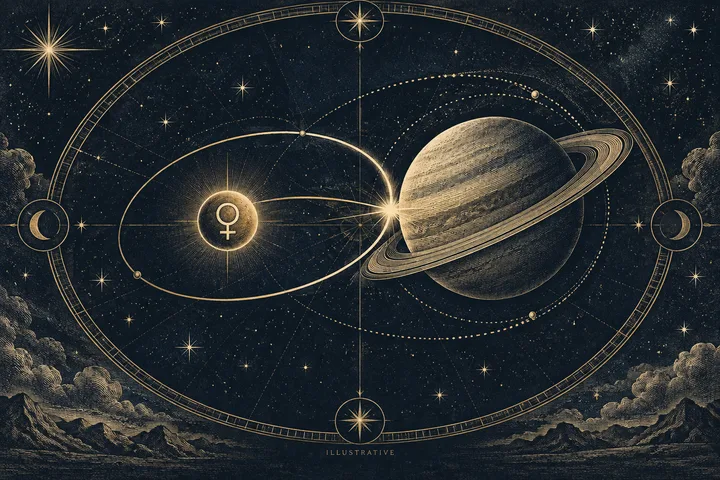
When one person's personal planet aspects the other person's Uranus, Neptune, or Pluto, the relationship touches a private function through a larger, less predictable force. The Sun may meet a call to change. Venus may idealize, awaken, or deepen desire. Mercury may pick up a new language for thinking. Mars may act with unusual courage or intensity. The aspect's meaning depends on the planet pair, the aspect type, the signs, and the exactness of the degree contact. A close conjunction, square, or opposition usually demands more attention than a loose sextile or trine, while the softer aspect can still matter when the same theme repeats elsewhere. Read the personal planet first, then the outer planet, then the aspect. Finally, ask what the contact invites both people to practice. This is a symbolic relationship pattern, not a dating verdict. A useful comparison names the attraction, the pressure, and the choice available to each person.
Sources: Spiritual Planet | Astrodienst Astrowiki; What’s Your Sign? An Intro to Synastry Charts and Astrological Compatibility | Astrology.com
Use the aspect to describe the way the energy moves
The planet pair tells you what is meeting. The aspect tells you how. A conjunction fuses the symbols. An opposition pulls them across an axis of awareness. A square creates friction that demands a response. A trine lets the functions flow with less resistance. A sextile offers an opening that grows through choice. These are not moral labels. A soft aspect can become passive. A hard aspect can become productive.
With a conjunction, the personal planet and outer planet occupy the same field. The effect is immediate. Venus-Uranus may make attraction feel fresh and startling. Mercury-Neptune may blur thought with image. Sun-Pluto may make identity questions impossible to keep at a distance. Because the energies merge, the people may need time to tell which desire belongs to whom. Name the blend before trying to separate it.
An opposition creates a mirror. The personal planet may experience the outer planet as coming from the other person, even when the contact activates both charts. Venus opposite Pluto can turn attraction into a conversation about trust, loyalty, and power. Mercury opposite Uranus can produce a lively debate that becomes exhausting when neither person can pause. The remedy is not to flatten the polarity. It is to give both ends a voice.
A square creates a live problem. Moon square Uranus may join a need for safety with an urge to break routine. Venus square Neptune may join deep romantic feeling with uncertainty about what has actually been agreed. Mars square Pluto may join force with force. The square can build skill because it keeps returning to the same place. It asks for behaviour, not just insight.
A trine gives the planets a natural route to one another. Mercury trine Uranus can make unusual ideas easy to share. Moon trine Neptune can create gentleness and emotional imagination. Mars trine Pluto can focus effort when both people want to build something demanding. Ease has a shadow, though. If nobody uses the gift deliberately, the contact may remain a mood instead of becoming a strength.
A sextile is an available door. It may not announce itself as loudly as a square or conjunction. Venus sextile Neptune can support art, tenderness, and a shared spiritual language when the pair makes time for them. Mars sextile Uranus can help the relationship try new plans without tearing down every old one. The opportunity is real, but it needs a choice, a habit, or a conversation.
For every aspect, read the orb next. A one-degree contact often leads. A five-degree contact can still support the story, especially when the same planet pair or theme repeats. Don't let the aspect name do all the work. “Square” tells you there is friction. It doesn't tell you whether the friction becomes resentment, practice, humour, or a useful new agreement.
Signs add the setting, but they don't overrule the measured angle. A Venus in Libra may seek balance and reciprocity, while Neptune in Aquarius may express ideals through friendship, vision, or a wider social cause. If their degrees form a trine, those styles can cooperate with ease. If the degrees form no selected aspect, keep the sign story separate from the aspect story. This small discipline prevents a lovely sign description from becoming a claim the chart data hasn't earned.
Sources: Aspect | Astrodienst Astrowiki; A Brief Introduction to Astrology: Aspects | Astrodienst
Rank the contact against the rest of the chart
One striking outer-planet contact can dominate a first reading. It should not dominate the whole relationship story by itself. Rank it. Start with exactness. Then ask whether the personal planet is central to the question. Venus and Mars contacts matter strongly when the question is attraction. Moon contacts matter when the question is safety and daily emotional life. Mercury contacts matter when the problem is communication. The Sun contact matters when identity and direction are in focus.
Next, look for repetition. Suppose Venus trine Neptune appears, but the same person's Venus also receives a close Saturn square and a Moon opposition. The Neptune contact may describe enchantment and shared imagination. Saturn adds the test of time, responsibility, and limits. The Moon opposition adds a direct emotional polarity. Together they tell a richer story than romantic certainty. The theme is affection that needs both tenderness and structure.
Then compare aspect types. A close square may demand more conscious work than a broad trine. A close opposition may make the other person feel like a powerful mirror. A conjunction may blend the symbols so thoroughly that the pair needs deliberate differentiation. This ranking is not a score. It is a reading order. Put the loudest, most relevant, best-supported contact first.
The strongest meaningful exception is generational repetition. Uranus, Neptune, and Pluto move slowly, so people born in nearby years may share the same outer-planet sign or even an outer-planet aspect. That shared background can describe a cohort more than a private bond. The contact becomes more personal when it is close by degree, links to a personal planet, and matches a lived theme that other chart layers repeat.
Here is the decision guide. If the contact is unverified by degree, keep it as a possibility. If it is verified but loose, use it as a supporting colour. If it is close and the planet pair matches the reader's question, make it a lead interpretation. If it is close and repeated by another aspect, make it a central theme. If the lived experience contradicts the symbol, return to the inputs and the rest of the chart before forcing a story.
Consider an example with three contacts: Person A Moon at 8 degrees Cancer, Person B Uranus at 10 degrees Aries, Person A Venus at 14 degrees Libra, Person B Neptune at 12 degrees Aquarius, and Person A Mars at 20 degrees Scorpio, Person B Pluto at 21 degrees Capricorn. The Moon-Uranus square has a two-degree orb. The Venus-Neptune trine has a two-degree orb. The Mars-Pluto sextile has a one-degree orb. The reading should lead with emotional rhythm, then affection and imagination, then focused desire and shared change.
Notice what this ranking does not do. It doesn't add the orbs and produce a compatibility percentage. It doesn't crown one aspect as fate. It shows which conversations deserve attention first. Ask about space and reassurance for Moon-Uranus. Ask about ideals and proof for Venus-Neptune. Ask about ambition, power, and shared goals for Mars-Pluto. The chart becomes useful when it helps the couple choose the next honest question.
Keep the direction of the contact in your notes. Person A's Venus trine Person B's Neptune is not the same sentence as Person A's Neptune trine Person B's Venus, even when the angle looks similar. Venus describes the person whose values and affections are being touched; Neptune describes the person carrying the imaginative or dissolving principle. The exchange remains mutual, but naming the direction keeps the planet functions precise.
Also separate repetition from double-counting. A Moon-Uranus square and an Uranus-Moon square are one cross-chart aspect, not two votes. Repetition means a different, independently verified contact supports the same theme, such as Uranus touching both the Moon and Mercury or a close Saturn aspect giving the same Neptune story structure. This keeps a dramatic outer planet from becoming louder simply because a report lists the same connection twice.
If the ranking still feels unclear, return to the reader's actual question. A person asking why plans keep changing needs the Uranus contact that touches the Moon or Mercury first. A person asking why affection feels idealised needs Venus-Neptune first. A person asking why desire carries so much weight needs Mars-Pluto first. Relevance is part of strength.
Sources: Aspect | Astrodienst Astrowiki; Spiritual Planet | Astrodienst Astrowiki; What’s Your Sign? An Intro to Synastry Charts and Astrological Compatibility | Astrology.com
Turn the symbolism into a conversation
A synastry reading earns its place when it changes what you can notice and discuss. Start with the event, not the label. If plans keep changing, describe the cancelled dinner, the late message, and the feeling that followed. Then ask whether a Moon-Uranus contact gives that pattern a language. The chart can show why an ordinary moment feels charged. It cannot replace the moment or decide what either person meant.
Use the outer planet to name the kind of pressure around the personal function. Uranus asks where freedom and surprise belong. Neptune asks where feeling, longing, and imagination need clearer edges. Pluto asks what wants honesty, release, or a new use of power. The same Venus behaves differently under each planet: Venus-Uranus may make difference exciting, Venus-Neptune may make affection luminous, and Venus-Pluto may make attachment feel impossible to keep casual.
The strongest practical question comes from the personal planet. With the Sun, ask whether both people can remain distinct. With the Moon, ask what creates safety after an emotional jolt. With Mercury, ask whether the pair can turn fast insight into plain agreements. With Venus, ask which values and pleasures genuinely meet. With Mars, ask how desire, anger, initiative, and refusal will be handled. This order keeps the reading close to lived experience.
Consider Maria's Venus-Neptune trine. Instead of asking whether Neptune makes the bond perfect, she can ask three plain questions: What do we enjoy together? Which promise has actually been kept? Where do we need clearer language? The answers show whether the contact is becoming tenderness and shared imagination, or staying only an attractive picture.
Let both people describe the contact before you settle on one story. Maria may experience Venus-Neptune as compassion and artistic ease. The Neptune person may experience herself as a source of inspiration, or may feel that Maria is responding to an image rather than to her whole self. Neither account cancels the other. Put both beside the aspect, then compare them with repeated behaviour.
A useful worksheet has four lines: the gift, the pressure, the higher expression, and the shadow. For a close Venus-Neptune contact, the gift might be shared beauty; the pressure, idealising an unproven promise; the higher expression, tenderness made dependable; the shadow, avoiding a needed conversation because clarity feels less romantic. Keep the language concrete.
Turn the four lines into one next conversation. Uranus might ask, “How much notice do we need when plans change, and how do we reconnect after space?” Neptune might ask, “Which part of this future is a plan, and which part is a wish?” Pluto might ask, “Can both people say no, keep privacy, and share decisions without punishment?” The question should fit the personal planet and the outer planet you actually found.
Describe the skill before the shadow. Moon square Uranus may ask for reliable reconnection after distance. Venus opposite Neptune may ask for a shared record of promises and follow-through. Mars square Pluto may ask for transparent decisions about pace, sex, money, or shared work. A difficult aspect can become useful when it makes a recurring pattern clear enough to practise differently.
The Synastry Comparison Report fits this final step when you already know the relevant Moon, Venus, and Mars placements and, optionally, their degrees. Within its six-degree scope, it can compare supplied placements and selected major aspects. It doesn't calculate natal positions from birth details or assign houses. Use it to identify the leading contact, then do the human work yourself.
Finish with one verified contact. Write one sentence for its attraction, one for its pressure, and one for the practice it asks of both people. Then ask, “How do we want to handle this in the next ordinary week?” The chart names the meeting between a personal need and a larger force. Your shared habit gives that meeting direction.
Sources: A Brief Introduction to Astrology: Aspects | Astrodienst; What’s Your Sign? An Intro to Synastry Charts and Astrological Compatibility | Astrology.com
A little more clarity
Are personal-planet and outer-planet aspects always intense in synastry?
They can feel significant, but intensity depends on the planet pair, aspect, orb, and repetition across the comparison. A close Pluto contact may press deeply, while a loose Uranus sextile may work quietly as an opening. The outer planet doesn't make every contact dramatic. Read the degree and the rest of the chart before ranking it.
Which personal planet matters most with an outer planet?
The most relevant planet depends on the question. Read the Moon for emotional safety, Venus for attraction and values, Mars for desire and action, Mercury for communication, and the Sun for identity and direction. The closest verified contact usually leads, but a repeated theme can matter more than one isolated aspect.
Can an outer-planet synastry contact be generational instead of personal?
Yes. Uranus, Neptune, and Pluto move slowly, so many people born in nearby periods share their signs or outer-planet relationships. A contact becomes more personal when it is close by degree, touches a personal planet, and matches other chart evidence or a lived relationship theme.
What should I do if I know the signs but not the degrees?
Treat the aspect as possible rather than verified. Record the sign relationship, but don't call it exact or assign a precise orb. You can still discuss the planets' symbolism. When degrees become available, check the contact again with the same orb rule, such as the six-degree scope used in this comparison.
Sources & further reading
- Aspect | Astrodienst Astrowiki
Supports definitions of major aspects, angular relationships, accepted orbs, and the interpretive difference between harmonious and challenging aspects in chart work.
- A Brief Introduction to Astrology: Aspects | Astrodienst
Supports the meanings of conjunction, opposition, square, trine, sextile, and the role of aspect orbs when astrologers judge planetary contact.
- Spiritual Planet | Astrodienst Astrowiki
Supports the distinction between personal planets and Uranus, Neptune, and Pluto as slow-moving spiritual or trans-Saturnian planets with collective themes.
- What’s Your Sign? An Intro to Synastry Charts and Astrological Compatibility | Astrology.com
Supports the basic synastry method of layering charts and reading planets, signs, houses, and aspects as relationship factors between two people.
Synastry Comparison Report
Enter known placements for two people. Get an input-by-input comparison, selected aspect calculations and a clear record of what remains uncertain.
Compare our placements