A partner’s planet activating your natal stellium adds a live person to a pattern rooted in your chart. It can make that pattern louder and more personal, but it doesn’t activate every planet equally. Start with the closest degree contact. Then read the contacted natal planet, the partner’s planet, the shared sign, and the stellium’s house if the data is reliable. A 1° conjunction to Venus in a Venus-Mercury-Saturn stellium leads with affection and conversation; a wider contact to Saturn shifts attention toward timing, standards, or trust. Read the cluster as a system, rank its contacts, and connect the symbolism to an actual moment between you. That gives you a useful reading without turning one aspect into a relationship verdict.
A partner activates a pattern that was already there
A natal stellium gathers several planets in one concentrated part of the chart. Many modern astrologers use the word for three or more planets in one sign or house. Traditional references often reserve it for a tighter group of planets joined in the same zodiac area. Both usages point to the same first idea: the planets work as a connected field, not as unrelated placements.
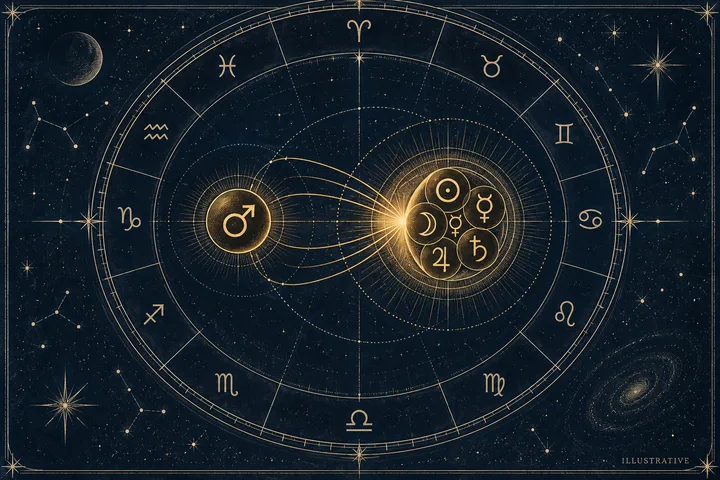
In synastry, a partner’s planet enters that field. Their Venus may draw out your values and appetite for closeness. Their Mars may push the pattern into action, desire, or conflict. Their Mercury may give words to something you usually carry privately. The planet doesn’t take control of your stellium. It acts as a trigger, while the natal cluster supplies the material that responds.
That is why the contact can feel larger than one aspect. A partner’s Venus conjunct your Mercury already speaks to affection and conversation. If your Mercury belongs to a Mercury-Saturn-Neptune cluster, the same contact also meets caution, imagination, and the fear of being misunderstood. The right reading is not that every planet receives equal force. It is that one doorway opens onto a room with several connected themes.
Sources: Aspects Between Charts; What Is a Stellium in Astrology?; Definition of Stellium or Satellitium in Astrology
Name the stellium before interpreting the activation
First write down the planets involved, their signs, their degrees, and their houses if the birth time is dependable. Then say which definition you’re using. A cluster of Mercury, Venus, and Saturn in Virgo may be a sign-based stellium. If all three also occupy the sixth house, the sign and house reinforce one another. If they share a house but span different signs, the house concentration matters while the sign expression changes from planet to planet.
Keep planets separate from points. A North Node, angle, asteroid, or house cusp can matter in a full reading, but adding every nearby symbol makes the stellium look stronger than the supplied chart shows. Call the core pattern what it is. If your partner’s Sun is close to one planet, describe that as the Sun’s contact with that planet, then explain whether it also reaches the rest of the cluster.
This check keeps the word stellium from becoming a magical switch. It names concentration. The interpretation still depends on the planets, their degrees, their sign, their house, and the other aspects around them.
Sources: Aspects Between Charts; What Is a Stellium in Astrology?; Definition of Stellium or Satellitium in Astrology
Let the closest degree contact lead
Rank the contacts instead of counting them. If your partner’s Mars is 10° Leo and your natal Venus is 11° Leo, that 1° conjunction leads. A second contact to Mercury at 15° Leo may support it. It does not replace it. The smaller the orb, the tighter the aspect, so record the actual distance before you attach a meaning to the cluster.
For this publication’s comparison report, selected major aspects use a six-degree orb. That gives the reading a clear working boundary. A 0°40’ contact and a 5°55’ contact both fit inside it, but they don’t deserve the same weight. A tight personal-planet contact usually speaks more directly than a loose outer-planet contact, especially when the rest of the synastry doesn’t repeat the outer planet’s theme.
The aspect describes the way the activation arrives. A conjunction fuses the energies. A square presses for a response. An opposition pulls the pattern across a polarity. A trine flows with less resistance, while a sextile offers an opening that someone must choose to use. Write four items in a row: natal planet and degree, partner’s planet and degree, aspect and orb, then the lived subject you want to observe.
Read the natal planet that receives the contact
The closest natal planet tells you where the activation lands first. A partner’s Jupiter on your Moon doesn’t activate every emotional theme with equal force. It meets your Moon, and your Moon carries the rest of the stellium into the exchange.
The planet gives you a starting vocabulary. The Sun brings identity and visibility. The Moon brings habits, safety, and memory. Mercury brings speech, planning, and interpretation. Venus brings attraction, pleasure, and values. Mars brings heat, pursuit, courage, and friction. Jupiter expands. Saturn concentrates, tests, and asks what can last. Read that first planet plainly before you add the chorus around it.
Then include the next stellium member if the same partner planet reaches it within the chosen orb or if a close natal aspect links it to the first planet. That order matters. It turns a vague statement such as ‘you activate my whole stellium’ into a traceable interpretation: this contact lands on Venus, then colors Mercury, while Saturn describes the condition that makes closeness feel safe or difficult.
Sources: Aspects Between Charts; Synastry | Cafe Astrology; What Is a Stellium in Astrology?
The visiting planet shows how the pattern is stirred
Now turn to the partner’s planet. It shows the mode of entry. Their Sun can make a concentrated talent visible. Their Moon can pull it into care, routine, and mood. Their Mercury asks questions and gives the pattern language. Their Venus adds appreciation, attraction, and preference. Their Mars adds movement, heat, and the need to act. Jupiter gives room and confidence. Saturn brings limits, time, and consequence.
Outer planets need a slower reading. Uranus may disrupt an old arrangement. Neptune may soften or blur it. Pluto may intensify what has been held below the surface. These contacts can matter, but a close personal-planet contact should usually lead when both appear. A strong feeling is not the same as a first-ranked aspect.
The planet person isn’t a simple giver, and the chart owner isn’t a passive receiver. Each person plays the planet’s role in the interaction. Your partner’s Mars may press for action, while your stellium decides whether that pressure becomes desire, argument, or useful effort.
A worked example shows the added layer
Consider an example. Maria has natal Mercury at 14° Virgo, Venus at 17° Virgo, and Saturn at 21° Virgo. For this example, treat them as a Virgo stellium in her sixth house. Her partner’s Mars is at 16° Virgo. That gives Mars a 2° conjunction to both Venus and Mercury, and a 5° contact to Saturn inside the report’s six-degree working orb.
Read the contacts in that order. Mars-Venus brings attraction, pursuit, and a strong response to one another’s preferences. Mars-Mercury adds quick talk, teasing, debate, and the chance that words become a form of desire. Mars-Saturn gives the exchange a harder edge around timing, work, standards, or limits. The cluster makes the contact feel concentrated, but it doesn’t erase the ranking.
The sixth-house setting makes the symbolism ordinary and visible. The couple may show care by cooking, organizing a week, sharing chores, or improving a routine. They may also turn the relationship into a project. The useful conclusion is specific: the partner’s Mars activates Maria’s Venus-Mercury-Saturn system, with attraction and conversation leading and pressure around standards following close behind.
Sign and house show where the contact lives
Degrees tell you whether the contact is active. Sign and house tell you how it speaks and where you’re likely to notice it. Mars activating a Capricorn stellium has a more strategic, measured tone than Mars activating a Gemini stellium, even when the aspect and orb match. Earth signs may seek proof and practical results. Air signs may need words and room to think. Fire may move through initiative. Water may respond through feeling, memory, and protection.
The house holding the natal stellium points to the life department receiving the invitation or pressure. A second-house cluster may bring money and self-worth into the exchange. A fifth-house cluster may center romance and creativity. A sixth-house cluster may turn affection into daily care and shared work. A tenth-house cluster may connect the bond with ambition or public direction.
You can also read the house where the partner’s planet falls, but only when the birth time supports accurate houses. If that information is missing, stay with the supplied signs, degrees, and planetary aspects. A narrower comparison is stronger than an invented house story.
Sources: Aspects Between Charts; Synastry | Cafe Astrology; Definition of Stellium or Satellitium in Astrology
The cluster has an internal order
A stellium isn’t flat. One planet may receive the closest contact. Another may rule the sign. A third may carry the most important natal aspects. These jobs can belong to different planets, and that difference explains why the same activation can feel simple in one moment and layered in the next.
Start with the planet the partner contacts most closely. Then find the sign ruler and the natal aspects that modify the contacted planet. In a Virgo Mercury-Venus-Mars cluster, Mercury helps organize the whole group because Mercury rules Virgo. If a partner’s Venus touches your Venus, Mercury still tells you how that affection gets processed: through words, analysis, plans, or practical detail.
Use this layer to refine the reading, not to create another ranking system that competes with the first one. The closest contact remains the anchor. Internal order explains why the anchor travels into other parts of the stellium.
Sources: Aspects Between Charts; What Is a Stellium in Astrology?; Definition of Stellium or Satellitium in Astrology
The strongest exception is repeated support
A wider contact can lead when the rest of the synastry repeats its theme. Imagine a partner’s Uranus sits 6° from your Mercury, while their Sun and Mercury make tight contacts to Venus and Mars in the same stellium. Uranus may then describe the unusual or liberating tone of the cluster, even though it isn’t the first contact you interpret. The repeated pattern gives it support.
Without that support, keep the wider contact secondary. A same-sign placement can echo the style of the stellium without forming a close conjunction. A house overlay based on an uncertain birth time can suggest a doorway, but it shouldn’t outrank known planetary degrees. Keep contact and resonance as separate words. Contact is a measurable aspect within your chosen scope. Resonance is a repeated symbolic theme.
This is the useful exception because it preserves both conviction and proportion. Don’t flatten the chart into one exact aspect. Don’t let every nearby planet lead because the story sounds dramatic. Rank the contact, then look for repetition.
Sources: Aspects Between Charts; Synastry | Cafe Astrology; What Is a Stellium in Astrology?; Definition of Stellium or Satellitium in Astrology
Turn the activation into one conversation
The point of the reading is not to collect a more impressive phrase. It’s to notice how the pattern behaves between you. If the closest contact reaches Venus, ask whether affection feels welcome or performed. If it reaches Mercury, ask whether you’re exchanging meaning or trying to win the interpretation. If it reaches Mars, ask whether the energy becomes shared action or a fight for control. If it reaches Saturn, ask whether reliability is growing or whether one person is waiting for a guarantee.
Choose one ordinary moment where the symbolism is visible. For Maria, that might be a shared task that becomes tense when her partner pushes for speed. She could say, ‘When we plan this together, I feel supported at first, then corrected. Can we divide the work without turning every difference into a problem?’ That question uses the Mars-Venus-Mercury-Saturn pattern without making the chart decide what the relationship means.
For a placement-only comparison, record the signs, the known degrees, the closest major contacts, and the missing information. The Synastry Comparison Report can rank supplied Moon, Venus, and Mars placements and selected aspects within its stated six-degree scope. It doesn’t calculate houses or natal positions from birth details. Compare what you have, then let the conversation test what the symbolism is showing.
A little more clarity
Does a partner’s planet activate every planet in my stellium equally?
No. Read the closest degree contact first, then include other stellium planets that fall within the stated orb or are tied to the first planet by close aspects. The whole cluster may become a louder theme, but each planet keeps its own meaning and weight.
Sources & further reading
- Aspects Between Charts
Supports reading each person through the planet role involved and considering sign and house context in synastry.
- Synastry | Cafe Astrology
Supports the meanings of major interchart aspect families and the need to rank personal-planet contacts.
- What Is a Stellium in Astrology?
Supports describing a stellium as three or more planets concentrated in one sign or house.
- Definition of Stellium or Satellitium in Astrology
Supports the tighter traditional description of a stellium as a close planetary group in one zodiac area.
Synastry Comparison Report
Enter known placements for two people. Get an input-by-input comparison, selected aspect calculations and a clear record of what remains uncertain.
Compare our placements