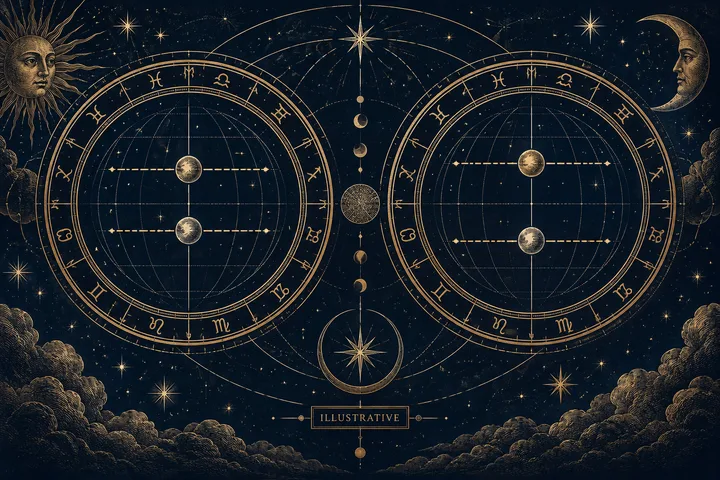
The difference is direction, not intensity
The names are close. The geometry isn't. A parallel joins two bodies at nearly the same distance north or south of the celestial equator, with both bodies on the same side. A contraparallel uses nearly the same distance, but one body is north and the other is south.
Write the direction beside the number. +14°20' and +14°55' form a north-north parallel. -9°10' and -9°42' form a south-south parallel. +18°05' and -18°37' form a contraparallel. The signs are not decoration. Remove them and you lose the distinction.
This is why astrologers compare a parallel with a conjunction and a contraparallel with an opposition. A parallel can blend the two planetary functions. A contraparallel can set them across a polarity. Those are interpretive likenesses, not replacement names. The contact remains a parallel or contraparallel because it was measured in declination.
The short rule is easy to keep: same side, parallel; opposite sides, contraparallel. Similar distance is the shared condition. North or south decides the category. Cafe Astrology's worked synastry method uses the same signed-value test and a one-degree orb, while its relationship guide places these contacts alongside, rather than inside, ordinary zodiac aspects.
A chart image may draw a line between planets that look far apart by sign. That line can be useful, but it doesn't tell you what kind of contact it represents. Read the legend. Then check the signed values. A surprising line is an invitation to investigate, not permission to call a hidden conjunction.
A parallel occurs when two planets sit at nearly the same declination on the same side of the celestial equator. A contraparallel occurs when they sit at nearly equal distances on opposite sides. Astrologers often read a parallel as conjunction-like and a contraparallel as opposition-like, but neither is a literal conjunction or opposition. The calculation uses declination, not zodiac longitude. To check one, write both signed declinations, compare the distance, and use a narrow orb, commonly one degree. Then rank the contact beside the planets, their zodiac aspects, and the relationship question you are actually asking. This Synastry Comparison Report works from supplied Moon, Venus, and Mars placements, optional degrees, and selected major aspects. It does not calculate declinations from birth details. If those values are not supplied, the contact stays unconfirmed.
Sources: Declinations in Synastry: Astrology of Relationships, Cafe Astrology; Determining Parallels and Contra-Parallels in Synastry, Cafe Astrology
Why the zodiac wheel can't answer this question
Most synastry starts with zodiac longitude. You compare where two planets fall around the signs, then look for conjunctions, oppositions, squares, trines, and sextiles. Declination adds a separate layer: how far north or south is each body from the celestial equator?
Imagine Maria has Venus at 3° Aries and the other person has Mars at 27° Scorpio. Those positions don't form a major standard longitude aspect. Now imagine their supplied declinations are +12°14' and +12°48'. The longitude picture is quiet, while the declination picture shows a north-north parallel with a 0°34' difference. Both statements can be true.
That example is the useful surprise. A declination contact can add a relationship thread where the ordinary aspect table says little. It can also repeat a theme you already see. Venus and Mars might form a zodiac trine and a parallel, giving attraction support in two coordinate systems. Or they might form a zodiac square and a contraparallel, describing both friction and polarity. The second view adds texture. It doesn't erase the first.
Astrolog separates standard aspects based on ecliptic longitude from aspects measured along the celestial equator. A sign degree and a declination degree may appear in the same report, but they don't answer the same question. 14° Libra is not 14° north. For this article, the practical point is simple: use the zodiac aspect table and the declination table as two layers, then ask whether they reinforce each other.
The two systems may also disagree. A Moon and Saturn could form a supportive longitude aspect while their declinations are contraparallel. Read the first contact as one layer and the second as another. Emotional cooperation may coexist with a sharper difference in timing, duty, or response.
Sources: Determining Parallels and Contra-Parallels in Synastry, Cafe Astrology; Distance Aspects, Astrolog
How to confirm one without guessing
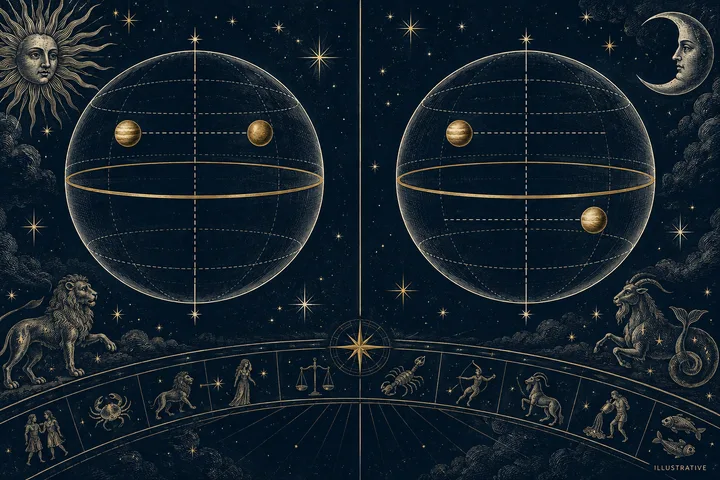
Start with the two bodies. For each one, record its declination and its direction, north or south. Then compare the numbers. Same direction means parallel. Opposite directions mean contraparallel. The absolute difference between the distances gives the orb.
Consider this example. Person A's Moon is -16°08'. Person B's Venus is -16°44'. The difference is 0°36', and both values are south. That is a south-south parallel. Change only Person B's direction to +16°44'. The distance stays close, but the category changes to contraparallel.
A one-degree working orb is a clear boundary for this technique. A 0°20' contact is close. A 0°58' contact remains inside the rule. A 1°42' contact belongs outside the main interpretation unless you name a wider convention. Cafe Astrology's practical examples use one degree, including the sixty-minute conversion that makes the check easy to reproduce.
The input must be visible. If a software table gives the signed values, keep the values and the settings with your notes. Parallel and antiparallel may be alternate labels in a report, but a contraparallel requires one north value and one south value. If both signed values are north or both are south, the contact is a parallel, not a contraparallel.
Don't infer a parallel from two sign placements. Sign and degree give you longitude. They don't give you north-south distance. If the declinations are missing, leave the declination contact unconfirmed and read the supplied placements through the methods they actually support.
Sources: Declinations in Synastry: Astrology of Relationships, Cafe Astrology; Distance Aspects, Astrolog
What a parallel can bring into synastry
A parallel puts two planetary functions on the same side of the equatorial axis. Astrologers often read that as blending, joining, or an easy current between the people. It may feel familiar. It may also make assumptions travel quickly.
A Sun-Moon parallel can link one person's self-expression with the other's emotional rhythm. The Sun person may feel received. The Moon person may respond with instinctive warmth. But closeness doesn't guarantee understanding. If the Moon person's needs stay unspoken, the contact can show recognition without supplying the words needed to care well.
A Venus-Mars parallel can draw affection and desire into the same room. One person may enjoy the other's style and initiative, and the attraction may move easily from interest to action. The pair still needs to ask whether the pace feels mutual. Ease is not the same as consent, and chemistry is not a promise about the future.
Moon-Venus parallels often suit ordinary intimacy: meals, touch, small kindnesses, and a feeling of being welcomed. Mercury parallels can make conversation quick and engaging. Mercury-Saturn may support careful planning, though the Saturn person can also sound heavy if every question becomes a correction. The planet pair tells you where to look. The rest of the synastry tells you how to rank it.
Outer-planet parallels need more sorting. Jupiter or Saturn can matter when the contact touches a personal planet and a clear relationship theme. Uranus, Neptune, and Pluto move through signs slowly, so a contact shared by many people needs personal-chart support before it earns the center of the reading. Cafe Astrology's synastry guide treats Sun-Moon, Venus-Mars, Moon-Venus, and Moon-Mars contacts as distinct relationship themes rather than one general score.
Sources: Determining Parallels and Contra-Parallels in Synastry, Cafe Astrology; Parallel and Contraparallel Aspects: The Declination Axis, Augurine
What a contraparallel adds
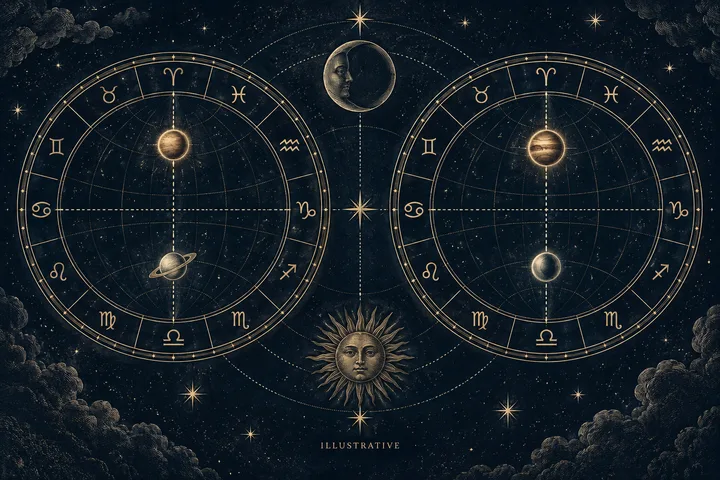
A contraparallel keeps the distances close but reverses the direction. Astrologers often read that as opposition-like: two functions meet across a difference, and the relationship has to find a workable balance between them.
A Venus-Mars contraparallel can bring strong attraction with a push-pull quality. One person may seek reassurance while the other moves through pursuit or challenge. That difference can create spark. It can also expose a mismatch in pace. The useful question isn't whether the contact is good or bad. Ask how both people handle a pause, a no, and a change of mind.
A Moon-Sun contraparallel may make the bond feel personal from the start. The Sun person's presence can stir the Moon person's needs, while the Moon person's responses can make the Sun person feel seen or constrained. Care and friction may arrive in the same exchange. A harmonious Venus link may soften the contact; a close Saturn or Mars link may sharpen it.
Saturn contacts deserve calm language. Saturn can describe duty, limits, endurance, and the work of making something real. In a contraparallel with a personal planet, the pair may need clearer agreements about responsibility or timing. The contact doesn't prove that one person is cold or controlling. Watch how standards are explained, shared, and revised.
The strongest exception is a tight contraparallel that stands alone. It can be vivid without being the chart's main story. An opposition in longitude, a close contraparallel, and repeated contacts to the same planets form a layered pattern. One unfamiliar aspect with no echo deserves less space. Astrologers describe the opposite-side contact as a possible polarity, but the relationship decides whether that polarity becomes conflict, complement, or both.
Sources: Declinations in Synastry: Astrology of Relationships, Cafe Astrology; Determining Parallels and Contra-Parallels in Synastry, Cafe Astrology; Parallel and Contraparallel Aspects: The Declination Axis, Augurine
How to rank the contact and use it well
A declination contact earns attention when it is close, clear, and relevant to the question. Start with the orb. A 0°12' contact has a stronger claim than a 0°59' contact. Then look at the planets. Moon, Venus, Mars, Sun, and Mercury usually speak more directly to daily relating than a loose outer-planet contact.
Next, look for an echo. A Venus-Mars parallel supported by a close zodiac aspect deserves more weight than a standalone contact with no related pattern. A contraparallel that repeats a question already visible in the Moon, Venus, or Mars placements can sharpen the reading. If it introduces a theme nowhere else, keep it as a secondary note.
Then bring the interpretation back to the question. Are you trying to understand attraction, emotional safety, communication, or a difference in pace? A Venus-Mars contact belongs in a conversation about desire and initiative. A Moon-Saturn contact belongs in a conversation about care and responsibility. The planet pair helps you choose the door. Behavior tells you what is behind it.
The Synastry Comparison Report has a defined scope. It uses supplied Moon, Venus, and Mars signs, optional degrees, and selected major aspects with a stated six-degree orb. It doesn't calculate a natal chart from birth details, houses, angles, or declinations. So if you want to discuss a parallel or contraparallel, bring the signed declination values separately. The report can organize the supplied relationship placements and selected aspects, but it cannot manufacture the missing coordinate.
This gives you three useful ranks. Put a close contact that repeats another clear pattern in the main interpretation. Put a close but unsupported contact in a secondary position. Leave a contact out when its values are missing or its orb depends on an unstated convention. Silence is better than false precision.
Your next step is short. Name the contact. Name the planets. State whether the values match on the same side or across opposite sides. Check the zodiac aspects that support or complicate it. Then ask one question you can answer through real exchanges: where do you cooperate naturally, or where do you keep meeting across a difference? Compare your placements when you want the supplied Moon, Venus, and Mars layers organized in one report.
A parallel says the functions gather on the same side. A contraparallel says they meet across a difference. Neither one decides what the relationship must become. Read the geometry accurately, rank it beside the rest of the synastry, and let the next conversation test the symbolism.
Sources: Determining Parallels and Contra-Parallels in Synastry, Cafe Astrology; Distance Aspects, Astrolog; Synastry in More Detail, Cafe Astrology
A little more clarity
Is a parallel the same as a conjunction in synastry?
No. A parallel matches declination on the same side of the celestial equator, while a conjunction matches zodiac longitude. Astrologers often read a parallel as conjunction-like because it can blend two planetary functions, but record it as a declination aspect and check the zodiac positions separately.
Is a contraparallel the same as an opposition?
No. A contraparallel matches declination across opposite sides of the celestial equator. An opposition is a 180-degree relationship in zodiac longitude. The contraparallel is often interpreted as opposition-like because it can create polarity, but the contacts use different coordinate systems.
What orb should I use for a parallel or contraparallel?
Use a narrow orb. One degree is a clear working rule for synastry, and several astrology references describe it as typical, while some traditions allow more room. State your convention. A contact outside it belongs in a note, not at the center of the reading.
Can I find a parallel from two zodiac signs alone?
No. You need both planets' declination values and their north or south directions. Sign and degree describe ecliptic longitude. Declination describes distance from the celestial equator. If those values are missing, compare the supplied sign placements, but leave the parallel or contraparallel unconfirmed.
Sources & further reading
- Declinations in Synastry: Astrology of Relationships, Cafe Astrology
Defines same-side parallels and opposite-side contraparallels, gives a typical one-degree orb, and describes relationship themes for planetary pairs.
- Determining Parallels and Contra-Parallels in Synastry, Cafe Astrology
Shows how signed declination values identify parallels and contraparallels and demonstrates a one-degree synastry orb.
- Distance Aspects, Astrolog
Separates standard longitude aspects from aspects measured along the celestial equator and other spatial planes.
- Parallel and Contraparallel Aspects: The Declination Axis, Augurine
Provides a complementary explanation of declination geometry and the conjunction-like or opposition-like reading of these contacts.
- Synastry in More Detail, Cafe Astrology
Places individual synastry contacts within a broader comparison rather than treating one aspect as a complete relationship verdict.
Synastry Comparison Report
Enter known placements for two people. Get an input-by-input comparison, selected aspect calculations and a clear record of what remains uncertain.
Compare our placements