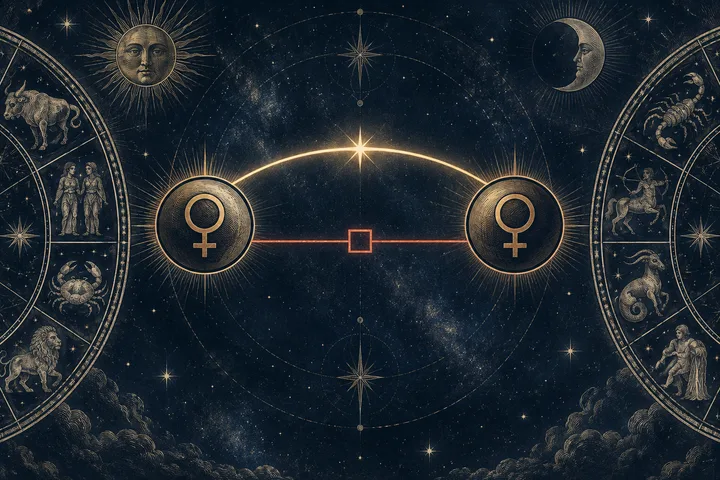
Imagine Venus and Mars meeting in two different skies
Imagine Maria and Daniel comparing a report that shows Maria's Venus square Daniel's Mars and a close Venus-Mars parallel. The square is 91 degrees, so its longitude orb is one degree. The parallel is close by declination, too. Maria says the attraction is real, but every discussion about pace turns sharp. Daniel says the tension passes quickly, yet the pull returns.
Their question isn't which aspect wins. It's which layer explains the part they need to understand first. The square belongs to the argument about timing. The parallel may describe the charge that keeps the connection vivid. This is an illustrative example, not a calculated personal chart.
Sources: Determining Parallels and Contra-Parallels in Synastry; Synastry in More Detail; The Parallel Aspect in Declination
First identify what each aspect measures
A square and a parallel measure different coordinates. A zodiacal square uses ecliptic longitude, the position that places a planet in a sign and degree. Compare the shortest separation with 90 degrees. At 91 degrees, the square orb is one degree. A parallel uses declination, the planet's distance north or south of the celestial equator. Same-side values form a parallel. Similar values on opposite sides form a contraparallel.
That is why the two contacts can coexist. Venus and Mars might form a longitude square while also sharing nearly the same north declination, even if their signs don't suggest a conjunction. The signs don't prove the parallel. The declination values do. Keep the two calculations in separate columns.
Usually, let the tight, documented square lead when the same planets also form a declination parallel. The square gives the contact a visible task, while the parallel shows why the planetary link may feel immediate or hard to ignore. Keep their measurements separate: a six-degree longitude orb and a one-degree declination orb aren't one scale. Reverse the order only when the parallel is exact, the square is wide or uncertain, and the question is about recognition or persistent pull. Record both geometries, then test the reading against one repeated behavior.
Sources: Determining Parallels and Contra-Parallels in Synastry; Synastry in More Detail; The Parallel Aspect in Declination; Aspects: Geometry, Orbs, and Exact Timing
Audit the report before you rank the layers
Begin with evidence, not drama. Write down the two planet names, both longitudes, both declinations with N or S, the square separation, the parallel separation, and the orb convention used by the report. A 90.5-degree square is tighter than a 95-degree square. Declinations of 18N42 and 19N10 differ by 28 minutes. Each figure is meaningful inside its own system.
The report scope used here allows selected major longitude aspects within a stated six-degree orb. A parallel needs a separately declared convention, often around one degree. If you have signs without degrees, you can discuss the planetary symbolism, but you can't rank the square precisely. If you have no declinations, you can't confirm a parallel. A clean audit might read: Venus 14° Gemini, Mars 15° Virgo, Venus 18N42, Mars 19N10. That gives you a one-degree square and a 28-minute parallel, each calculated from the right kind of data.
Also check that both contacts involve the same two planets across the charts. Maria's Venus to Daniel's Mars is a different comparison from Maria's Mars to Daniel's Venus, even though both use Venus and Mars. The planetary roles shift. Note who owns each body before you attach a behavior to it.
Sources: Synastry in More Detail; The Parallel Aspect in Declination; Aspects: Geometry, Orbs, and Exact Timing
Ask what the longitude contact makes visible
The square is the part of the comparison you can usually describe most plainly because its sign and degree position is visible on the zodiac wheel. In the Venus-Mars example, Venus seeks affection and reciprocity while Mars pursues, initiates, and acts. One person reaches. The other slows down. Pursuit can feel like pressure, and caution can feel like rejection.
Turn that symbolism into a scene you can recognize. What happens when one person wants more contact, a quicker answer, or a direct expression of interest? Do they ask, push, withdraw, or repair? A Moon-Mercury square may bring feeling and explanation into the same conversation. A Mercury-Mars square may show up as interruptions or a need for cleaner speech. The useful interpretation names the action. It also names the owner of each planet, because the Venus person and Mars person may experience the same contact from different sides.
The sign pair still matters here. Venus in an air sign may seek a spoken agreement before closeness feels safe; Mars in an earth sign may show desire by making a practical move. Those details belong to longitude and sign. Don't ask the parallel to supply them. Its job is different.
Sources: Synastry in More Detail; Aspects: Geometry, Orbs, and Exact Timing
Use the parallel as the second coordinate
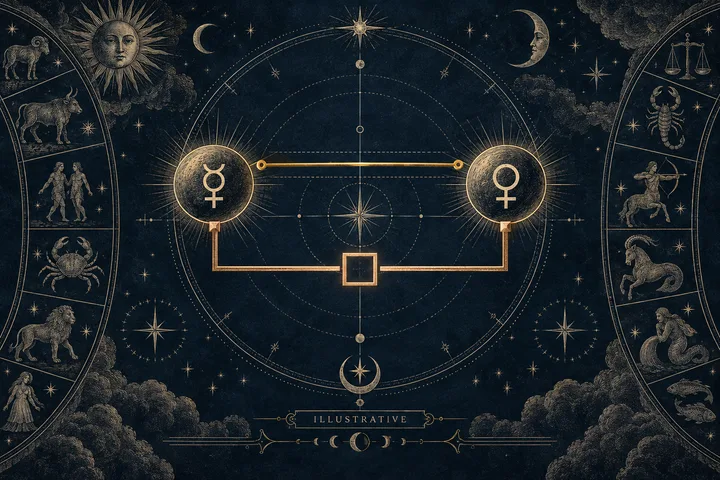
Astrologers often read a parallel as conjunction-like because declination brings the two planetary functions into a shared vertical relationship. In synastry, it can show easy recognition, spontaneous affinity, or a theme that remains active beneath the visible chart. Cafe Astrology describes a parallel that accompanies an interchart aspect as a reinforcing layer. It doesn't replace the longitude contact.
For Maria and Daniel, Venus-Mars parallel can explain why the attraction returns after an argument. With Moon-Venus, the added layer may describe warmth and welcome. With Moon-Mars, feeling and action may connect quickly. These are interpretive possibilities tied to the planet pair. The parallel adds texture. It doesn't turn a charged contact into a promise. And because a parallel has no sign of its own, keep the sign-based style of the square separate from the deeper blend suggested by declination.
Sources: Determining Parallels and Contra-Parallels in Synastry; Synastry in More Detail; The Parallel Aspect in Declination
Know when the parallel should move to the front
The parallel moves to the front in a narrow case. It must be exact or very close. The square must sit near the edge of its allowed orb, rely on rounded data, or remain unverified. And the reader's question must concern immediate recognition, attraction, or a pull that the wheel doesn't explain. Consider a Venus-Mars square at 95 degrees with a parallel separated by ten minutes. The declination contact deserves the opening inquiry; the wide square becomes a possible pace difference.
This isn't a universal promotion for parallels. If the square is tight and the parallel is merely broad, begin with the square. If either contact lacks the numbers needed to check it, say what is known and keep the rest conditional. Better data can change the order. For example, a sign-only report may suggest Venus-Mars tension from the signs, but it can't tell you whether the square is 0°40' or 5°40'. That difference matters when a close parallel is competing for attention.
Sources: Determining Parallels and Contra-Parallels in Synastry; Synastry in More Detail; The Parallel Aspect in Declination; Aspects: Geometry, Orbs, and Exact Timing
Translate each layer into a question
A good synastry reading should change the next conversation. For Venus-Mars, ask, ‘When I ask for time, what do you hear?’ and ‘When you pursue, what do you need from me?’ Those questions separate desire from pressure. For Moon-Mercury, ask, ‘Do you want comfort, an explanation, or a plan?’ The planets give the conversation a subject. They don't speak for either person.
Keep the two layers in different jobs. Let the longitude contact name the pattern you can work on. Let the parallel explain the felt charge, ease, or persistence around it. Then compare that reading with one repeated behavior. If the behavior isn't there, revise the interpretation instead of forcing the scene to fit the chart. If the question changes from attraction to communication, the lead can change too. A chart reading serves the question, not a permanent aspect leaderboard.
Sources: Synastry in More Detail; The Parallel Aspect in Declination
Finish with the smallest useful comparison
The practical sequence is short. Name the planet pair. Verify the longitude square and its orb. Verify the same-side declination parallel and its separate orb. Write the reader's question in plain language, then record one behavior that might answer it. This keeps a second coordinate system from becoming a second verdict.
The Synastry Comparison Report can organize supplied Moon, Venus, and Mars placements with optional degrees and selected major aspects within its stated six-degree scope. It doesn't calculate a natal chart from birth details or add houses. It can therefore help you compare the placements you already have, but it can't fill in a missing declination or certify an unreported parallel. Bring the placements you know, keep missing values visible, and use the comparison to choose a better question. That distinction keeps the reading useful.
Sources: Determining Parallels and Contra-Parallels in Synastry; Synastry in More Detail; The Parallel Aspect in Declination; Aspects: Geometry, Orbs, and Exact Timing
A little more clarity
Is a parallel stronger than a square in synastry?
Not by default. A square and a parallel use different coordinates, so compare each with its own orb convention. The useful lead is the verified contact that answers the reader's question most clearly.
Can a parallel cancel out a difficult synastry square?
No. It adds a declination link to the longitude pattern. Read the two contacts together, with separate meanings: one may describe the adjustment, while the other describes the ease, charge, or persistence around it.
What information do I need to compare a parallel and a square?
You need the two planet names, each zodiacal degree, both declination values with N or S, and the orb policy. Signs alone support broad symbolism. They don't confirm a precise square or parallel.
Sources & further reading
- Determining Parallels and Contra-Parallels in Synastry
Defines synastry parallels and contraparallels, gives their north-south distinction, and records a typical one-degree orb.
- Synastry in More Detail
Explains that parallels are read alongside interchart aspects and can reinforce the ordinary planetary contact.
- The Parallel Aspect in Declination
Describes declination as a separate coordinate from longitude, outlines same-side parallels, and gives a narrow parallel orb.
- Aspects: Geometry, Orbs, and Exact Timing
Defines the square as a 90-degree longitude aspect, explains orb calculation, and gives formulas for parallel and contraparallel contacts.
Synastry Comparison Report
Enter known placements for two people. Get an input-by-input comparison, selected aspect calculations and a clear record of what remains uncertain.
Compare our placements