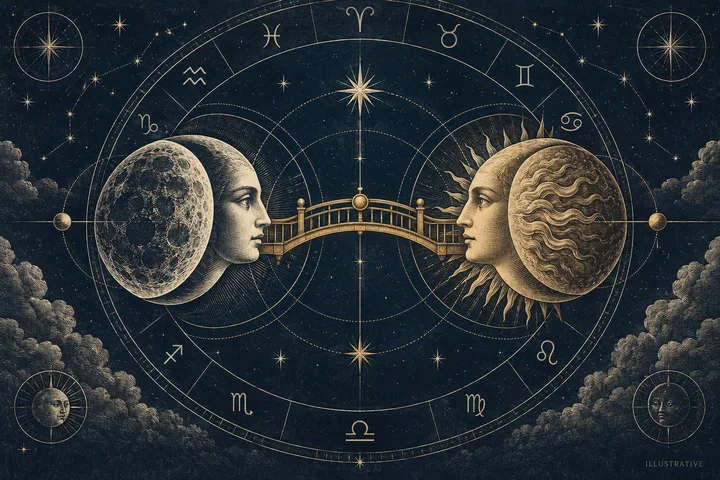
An opposition in synastry can show a negotiation because it puts two planets on the same axis, facing one another across 180 degrees. That creates contrast, but it also creates a clear field of encounter. The strongest reading comes from naming both needs, not choosing one winner. First confirm the contact by degree. In this report scope, use a six-degree orb. Then read the planets, the opposite signs, and any supporting aspects before deciding how the pattern might live in daily life. A Sun-Moon opposition may ask identity and emotional safety to take turns. A Venus-Mars opposition may ask affection and desire to respect different speeds. The useful question is not, “Are we too different?” It is, “What agreement lets both sides stay alive?” Compare your supplied Moon, Venus, and Mars placements, add degrees when you have them, and turn the clearest opposition into one conversation you can actually have.
1. What an opposition actually puts in the room
An opposition is a face-to-face aspect. Two chart points stand 180 degrees apart, on opposite ends of the zodiac wheel. In synastry, one person’s planet meets the other person’s planet across that distance. The aspect doesn’t erase the planets. It makes them visible to each other.
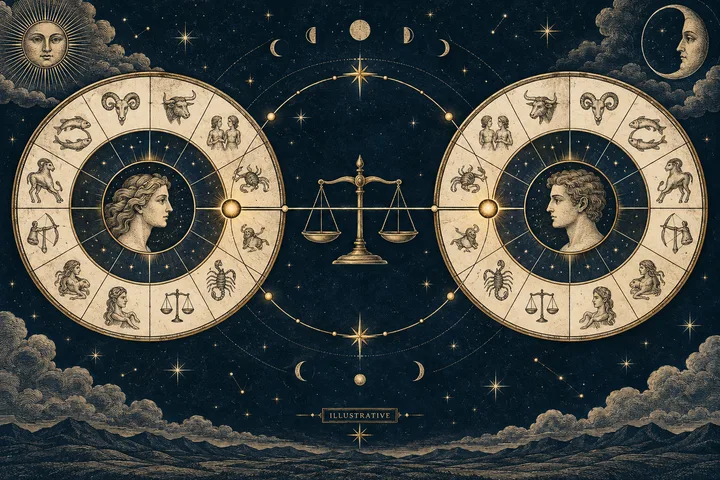
That distinction matters. A mismatch says the parts don’t fit. An opposition says the parts are connected, but they pull toward different expressions of a shared theme. Aries and Libra are not random enemies. They are two ends of the self-and-partnership axis. Taurus and Scorpio both care about security, though one may protect what is steady while the other seeks depth, truth, and total trust. Gemini and Sagittarius both work with meaning, but one gathers pieces while the other reaches for the larger story. The signs face each other because they belong to one field of experience.
The Faculty of Astrological Studies describes the opposition as stress, tension, and a see-saw between two sides, with the possibility of projecting one end onto other people. That last phrase gives the aspect its relational bite. Your partner may appear to carry the quality you have not learned to hold comfortably. You may admire it. You may resent it. Often you do both in the same week.
The opposition therefore creates three things at once. It creates attraction through contrast. It creates friction through different timing or priorities. And it creates a negotiation point where the couple must decide how much room each side gets. If you only call the aspect difficult, you miss the attraction. If you only call it complementary, you miss the work.
A negotiation also needs a subject. Don’t say that the couple must simply balance each other. Name what is being balanced. Is it closeness and independence? Speed and reflection? Pleasure and restraint? Visibility and privacy? The more exact the subject, the less likely you are to turn the opposition into a personality judgment. The chart shows a polarity. You supply the question that makes the polarity useful.
Think of the aspect as a shared table with two seats. One person cannot occupy both seats without making the relationship smaller. The question is whether you can keep the table useful. You need a language for the two planets, a clear sense of the signs, and a way to watch the pattern outside the chart. Synastry gives you the shape of the meeting. Your choices give it a life.
This is why an opposition should not receive a simple good-or-bad label. Astrology.com’s synastry guide treats aspects as descriptions of planetary interaction and notes that tense contacts can indicate challenges without making the chart wrong. The challenge is information. It tells you where two people may need conscious coordination.
The central judgment for this article is simple: an opposition is workable when both people can name the two needs and build a repeatable exchange between them. It becomes a mismatch in practice when one person’s need must disappear every time the tension rises. The aspect itself doesn’t make that decision. The pattern of response does.
Sources: What Is a Synastry Chart? Birth Chart Compatibility; Polarity in Astrology: Meaning and Opposite Signs; Introducing Astrology
2. How to verify the opposition before interpreting it
Start with the data. Do not begin with the story you want the aspect to tell. A synastry reading compares two supplied natal charts and looks at the relationships between their chart points. For this article’s report scope, work from known placements. Use Moon, Venus, and Mars signs, and add exact degrees when they are available. This is a placement comparison, not a new calculation from birth details.
An opposition has an exact angle of 180 degrees. To check one, convert each placement to a position on a 360-degree zodiac circle, then measure the shortest distance between them. If the distance is close to 180 degrees, you have a candidate opposition. In this publication’s report method, use a six-degree orb. That means the measured separation falls from 174 to 186 degrees when you account for the circular distance, or, more simply, the aspect is within six degrees of exact opposition.
The smaller the orb, the more immediate the contact usually feels in an interpretive reading. A one-degree opposition deserves priority over a six-degree opposition when both involve comparable planets. That doesn’t make the wider aspect meaningless. It changes its volume. A close contact may show up quickly and repeatedly. A wider contact may need the right topic, setting, or supporting aspect before both people feel its pull.
Do not call two signs opposed just because they feel different. Sign polarity is a useful first layer, but degrees tell you whether the planets actually see one another by aspect. A Venus in early Aries and a Mars in late Libra may occupy opposite signs while sitting farther from exact opposition than your chosen orb allows. Record the signs, record the degrees, and keep the distinction clean.
Next, identify whose planet belongs to whom. If her Moon opposes his Mars, the Moon person and Mars person may experience the contact differently. The Moon person may feel that the Mars person’s pace, anger, or directness enters the emotional space. The Mars person may feel pulled toward the Moon person’s vulnerability or stirred by what seems like hesitation. Neither description is a verdict. It is a way to track the direction of the exchange.
Then note what you are not using. Without reliable birth times, you should not claim house overlays or angles. Without degrees, you should not pretend to know the orb. Without a complete chart, you cannot rank the opposition against every other aspect. A clean reading says what it has, what it can compare, and what remains outside the frame. Precision makes the interpretation stronger. It doesn’t weaken the magic of the pattern.
The Faculty’s introductory guide places opposition at 180 degrees and links it with a see-saw, tension, and possible projection. Astrology.com’s synastry material also explains that each planet carries a specific degree and that a smaller orb generally strengthens an aspect. Together, those references support a practical rule: geometry comes first, then symbolism, then lived evidence.
Use this short record before you interpret: person A planet, sign, degree; person B planet, sign, degree; shortest separation; orb; opposite-sign axis; and the other major contacts you know. If the contact doesn’t survive that check, don’t force the word opposition onto it. Another aspect may explain the feeling better.
This record also prevents a common reading error: treating the same opposition as equally strong in every exchange. A close Moon opposition may be loud around home, rest, and reassurance, yet quiet during a shared work task. A Venus opposition may become obvious around gifts, money, public affection, or time together. The chart gives a broad symbol. The situation selects the doorway through which it enters. That distinction keeps the interpretation accurate and usable.
Sources: What Is a Synastry Chart? Birth Chart Compatibility; Introducing Astrology; Sun-Moon Synastry Aspects
3. Which planets are negotiating, and what do they need?
The aspect tells you how the planets meet. The planets tell you what is meeting. This is where a generic opposition reading becomes a useful synastry reading. Keep the language plain. Ask what each planet wants to do, protect, express, or pursue. Then place those functions across the same conversation.
The Sun speaks to identity, vitality, direction, and the way a person takes up space. The Moon speaks to emotional rhythm, comfort, instinct, and the conditions that help someone feel safe. A Sun-Moon opposition can draw two people together because each recognizes a missing half of a larger human experience. The Sun person may bring clarity, purpose, and visible movement. The Moon person may bring feeling, memory, and responsiveness. The negotiation is not “Who leads?” It is “How do direction and care take turns?”
Mercury speaks through words, thought, timing, and the way someone sorts information. An opposition involving Mercury can make conversation feel alert and charged. One person may name the immediate fact while the other pulls back to context. One may want to resolve the point now. The other may need to talk around it before the real issue appears. At its best, the contact creates a strong debate partner. At its worst, every difference becomes a contest over whose frame is real.
Venus describes attraction, affection, taste, values, and the way love is offered and received. Mars describes desire, initiative, sexual energy, anger, courage, and the way a person moves toward what they want. Venus opposite Mars is not a dry disagreement. It can be magnetic. One person’s manner of loving may awaken the other person’s appetite, while the difference in pace can produce pursuit and retreat. The negotiation asks how tenderness, pleasure, direct desire, and consent can remain present together.
Jupiter expands. Saturn defines, tests, and builds through time. Jupiter opposite Saturn can make one person feel that possibility needs air while the other insists that a plan needs limits. This contact can support real growth when hope and structure cooperate. It can also become a repeating argument if expansion is treated as irresponsibility or caution is treated as fear.
Uranus awakens difference, freedom, and surprise. Neptune softens boundaries, imagination, and longing. Pluto intensifies, exposes, and transforms. When an outer planet opposes a personal planet, the experience can feel larger than the immediate event. But don’t let the drama outrun the data. Ask whether the outer planet is close by degree and whether personal planets or angles reinforce it. A single broad generational contact shouldn’t carry the whole relationship story.
The order of interpretation matters. Read each planet by itself. Then read the pair. Then add the opposition. The Faculty of Astrological Studies uses a similar sequence in its teaching example: identify the planetary themes, combine them, and then consider how the aspect qualifies the meeting. This keeps you from treating the aspect glyph as a complete interpretation.
You can also ask which person feels more exposed by the contact. A Moon person may feel that the other planet enters a private room. A Sun person may feel that the other person questions their right to lead. Venus may feel judged for wanting harmony, while Mars may feel judged for wanting movement. Exposure doesn’t prove that one person is more affected. It tells you where a gentle question may open the reading.
A useful sentence frame is: “Person A’s need for ___ meets person B’s way of ___, and the opposition asks them to ___.” For Moon opposite Mars, that might become: “Her need for emotional pacing meets his instinct to act immediately, and the opposition asks them to create a conflict rhythm that protects both feeling and directness.” That sentence gives you a negotiation. It doesn’t hand either person a villain’s role.
Rank the planets by personal relevance. Sun, Moon, Mercury, Venus, and Mars usually describe the felt relationship more directly than a distant planet acting alone. When the opposition includes Venus or Mars, consider affection, attraction, conflict, and pace. When it includes the Moon, consider safety and repair. When it includes Mercury, consider the words that make the pattern better or worse. The planet names the currency of the negotiation.
Watch the difference between a planet’s need and its habit. Mars may need movement, but its habit may be pushing. The Moon may need safety, but its habit may be withdrawing before asking. Venus may need harmony, but its habit may be smoothing over a real disagreement. The aspect becomes more generous when each person learns to separate the honest function from the defensive strategy wrapped around it.
Sources: What Is a Synastry Chart? Birth Chart Compatibility; Introducing Astrology; Sun-Moon Synastry Aspects
4. What the opposite signs add to the reading
The sign axis shows how the two planets try to do their jobs. Opposite signs share a stage, but they don’t use the same method. This is why sign-pair language can feel accurate and still be too broad. You need the axis and the planet together.
Aries-Libra negotiates self-direction and partnership. Aries moves from personal impulse, courage, and direct action. Libra considers the other person, the agreement, and the balance of the exchange. In synastry, one person may say, “I know what I want.” The other may say, “We need to decide what this means for both of us.” Neither sentence is automatically selfish or evasive. The mature axis lets initiative and consultation alternate.
Taurus-Scorpio negotiates stability and depth. Taurus may protect peace, continuity, touch, and tangible trust. Scorpio may press toward emotional honesty, shared vulnerability, and the truth beneath the surface. The tension rises when one person calls the other dramatic while the other calls them closed. The better agreement protects calm without making calm an excuse for silence.
Gemini-Sagittarius negotiates information and meaning. Gemini asks what has happened, what changed, and what can be learned from the details. Sagittarius asks where the pattern leads and what larger belief or direction it serves. Together, the axis can make a couple curious and mentally alive. Under pressure, Gemini may feel preached at, while Sagittarius may feel trapped in fragments. The negotiation lets facts refine the vision and lets vision organize the facts.
Cancer-Capricorn negotiates private care and public responsibility. Cancer tends to track emotional belonging, home, and protection. Capricorn tracks duty, standards, time, and the work needed to make something last. In synastry, one person may want reassurance before action. The other may offer action as reassurance. The couple needs to translate those love languages instead of arguing about which one counts.
Leo-Aquarius negotiates personal radiance and collective purpose. Leo wants warmth, recognition, and a heart-led expression of individuality. Aquarius values distance, originality, and the future of the group. One may want a loving response in the moment. The other may need room to think before responding. The axis works when individuality receives real attention and freedom doesn’t become emotional absence.
Virgo-Pisces negotiates discernment and surrender. Virgo notices what needs fixing, names the practical step, and protects through care. Pisces feels the atmosphere, accepts complexity, and trusts what cannot be reduced to a checklist. In a relationship, Virgo can bring repair to the floor. Pisces can keep repair from becoming control. The danger comes when one person treats sensitivity as weakness or the other treats every boundary as a lack of compassion.
Astrology.com’s polarity guide names the six opposite sign pairs and presents polarity as a relationship in which each sign can help define the other. It also points to a shared element family across each axis: fire with air, or earth with water. Use that as context, not as a shortcut. A sign pair gives the axis. The planets give the subject. The degrees give the strength.
To interpret your own pair, write two verbs for each sign. For Aries, choose initiate and assert. For Libra, choose consult and balance. Then write the planet beside each verb. Venus in Aries opposite Mars in Libra is not simply “love versus conflict.” It may be affection that moves quickly meeting desire that checks the social field first. That is specific enough to discuss, and flexible enough to honor the people involved.
Also notice the shared modality. Cardinal axes may negotiate who starts and when. Fixed axes may negotiate control, loyalty, and how long a position can stand. Mutable axes may negotiate flexibility, meaning, and the point where adaptation becomes drift. The modality doesn’t replace the element or planet. It tells you how the disagreement moves. A fixed opposition may need a deliberate pause before either person can loosen their grip. A mutable opposition may need a deadline so the conversation doesn’t dissolve into possibilities.
Sources: Polarity in Astrology: Meaning and Opposite Signs; Introducing Astrology
5. How an opposition becomes a negotiation in daily life
The chart becomes useful when you can recognize the pattern in an ordinary moment. Imagine Maria has Moon in Cancer and her partner has Mars in Capricorn, within a close opposition. This example is illustrative. It isn’t a calculated personal chart.
Maria’s Moon may need emotional reassurance, privacy, and a sense that the bond is safe before she can move into a difficult conversation. Her partner’s Mars in Capricorn may respond to tension by taking charge, setting a plan, or trying to solve the problem quickly. At the first level, they frustrate each other. She experiences his action as pressure. He experiences her need for feeling as delay.
The mismatch reading stops there. It says they need different things and leaves the couple with a label. The negotiation reading keeps going. It asks what each person contributes to a shared repair. Maria can name the feeling and state what kind of reassurance would help. Her partner can slow the first move, listen without turning the conversation into a project, and then offer one concrete next step. The Moon gets safety. Mars gets a path forward.
Consider an example in which the conflict starts over a canceled plan. Maria wants him to acknowledge that the change hurt. He begins listing the reasons the plan had to change. Both are talking about the same event, but their planets are speaking different dialects. The agreement might be: first name the impact, then explain the logistics, then decide whether to reschedule. That three-part rhythm turns opposition into cooperation.
Now reverse the pressure. If Maria uses emotional closeness to keep him from making any decision, or if he uses efficiency to avoid acknowledging her hurt, the axis hardens. The issue is not that their needs differ. The issue is that one need is being used to cancel the other. An opposition becomes a mismatch in practice when the relationship can only function at one pole.
This same method works with other planet pairs. With Mercury opposite Mercury, agree on whether a hard conversation needs facts first, feelings first, or a pause before either. With Venus opposite Mars, agree on the pace of affection and the meaning of initiation. With Sun opposite Moon, agree on how one person can pursue a direction without making the other person feel emotionally abandoned. With Venus opposite Saturn, name the difference between devotion and restriction before resentment names it for you.
The practical test has four parts. Can both people describe the other person’s need without mocking it? Can each person ask for a change in behavior rather than demand a personality transplant? Can the couple create a sequence that honors both sides? Can they repeat that sequence after the next disagreement, when the opposition is activated again? If the answer is yes, you are seeing negotiation.
Astrology.com’s synastry guide says aspects describe the type of interaction between planets and also emphasizes that tense contacts can indicate challenges rather than a defective relationship. Its Moon-Sun opposition guide adds a useful relational practice: listen to the other person’s perspective, then work toward a fuller expression that can hold both sides. That is the everyday form of an opposition’s promise.
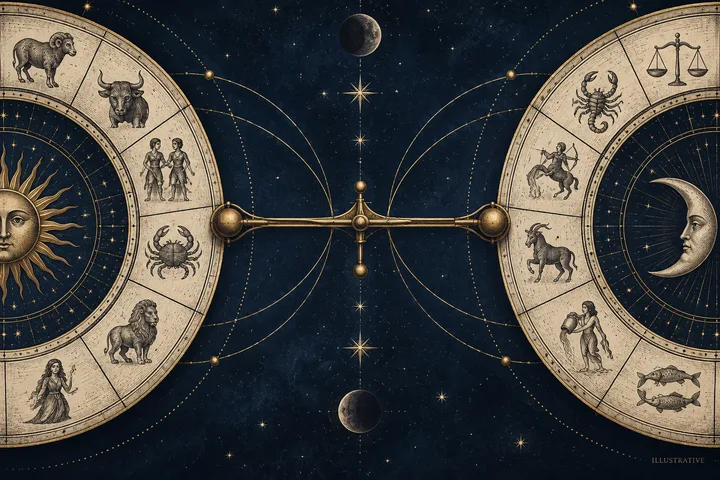
Make the pattern observable. Track who moves first, who needs more time, what each person assumes the other meant, and what helps the conversation return. Don’t use the chart to prove that your partner always acts a certain way. Use it to notice the moment when the two poles appear. Then choose the bridge before habit chooses the fight.
A good agreement has a beginning, a middle, and an end. It says what happens when the trigger appears, what each person does while the tension is active, and how the couple returns to ordinary warmth. “We’ll communicate better” is too vague. “If plans change, we’ll acknowledge the disappointment before we solve the logistics” gives the opposition somewhere to go. The agreement should be light enough to remember and real enough to change the next encounter.
Afterward, review the agreement without turning it into a courtroom. Ask what worked, what felt forced, and what each person still needed. An opposition improves through repetition. The first conversation may be clumsy. The second gives you evidence. By the third, you can tell whether the couple is learning the axis or merely describing it beautifully.
Sources: What Is a Synastry Chart? Birth Chart Compatibility; Sun-Moon Synastry Aspects; Moon Opposite Sun Aspects Natal and Transit
6. What strengthens the opposition, and what changes its meaning
No opposition should be read alone. The rest of the synastry tells you whether the axis has support, pressure, or a way out of the loop. You don’t need every aspect to begin. You do need enough context to avoid making one contact carry the whole relationship.
Start with orb. A close opposition takes priority over a broad one. Then ask whether the planets are personal. A Moon, Venus, or Mars opposition tends to enter daily feeling, affection, desire, and conflict more directly than a loose contact between two slow planets. A Sun or Mercury opposition can shape identity and conversation. The planet and the orb together establish the first rank.
Next, look for supportive contacts to either planet. A trine or sextile can give the couple an easier channel through which to express the tension. A helpful Mercury contact may give the pair words. A Venus contact may soften a sharp difference in values. A Saturn contact may give the relationship a container, provided structure doesn’t become control. Support doesn’t erase the opposition. It helps the couple stay present long enough to use it.
Then look for a second hard aspect. If a third planet squares both ends of the opposition, the pattern forms a T-square. That third planet becomes a pressure point and often shows where the tension seeks action. Don’t assume the T-square is automatically disastrous. It tells you the opposition has a more active outlet, and that the outlet needs a conscious form.
House overlays can add another layer, but only when the chart inputs support them. A planet falling in the other person’s seventh house, for example, may make partnership themes more visible. Yet a reliable house reading requires dependable birth times and a stated house system. If those inputs are missing, leave houses out. You can still give a strong reading from planets, signs, degrees, and aspects.
Consider timing within the aspect. Some astrologers also distinguish applying and separating contacts, especially when working with moving planets or a larger timing method. That distinction is outside this placement report unless the relevant chart data and technique are supplied. Don’t borrow a timing claim from a different calculation. Keep the scope honest and the interpretation useful.
The personal charts matter, too. If one person already carries a natal Moon-Mars opposition, a partner’s Mars contacting that axis may make an old pattern louder. If one person has strong earth placements, a Taurus-Scorpio opposition may feel different than it does to someone whose chart is saturated with water. Synastry doesn’t replace each natal chart. It shows how one chart activates the other.
The Kerykeion Sun-Moon synastry guide describes opposition as a meeting of complementary opposites, then separates its attraction, growth edge, and daily integration. That is the right habit. First name the pull. Then name the friction. Then ask what practice lets the two functions cooperate. A report that skips the middle becomes romantic fog. A report that skips the first part becomes a list of problems.
Rank what you find. One, the tightest personal-planet opposition. Two, the sign axis and the concrete need it describes. Three, supporting aspects that provide language, warmth, structure, or a constructive outlet. Four, wider or more symbolic contacts that enrich the picture but should not dominate it. This ranking keeps the article, and your own reading, from turning into a pile of equal keywords.
If the opposition is exact but the couple reports little tension, don’t force a crisis into the chart. The aspect may be familiar, well integrated, or expressed through a complementary division of labor. If the orb is wider but one theme repeats in unmistakable ways, record that observation without upgrading it into proof. Interpretation works best when the chart and the lived pattern speak to each other.
Sources: What Is a Synastry Chart? Birth Chart Compatibility; Introducing Astrology; Sun-Moon Synastry Aspects
7. The strongest exception: when opposition really does describe a mismatch
An opposition can invite negotiation. It cannot negotiate on behalf of two people who refuse to share the room. This is the strongest exception to the hopeful reading, and it matters because astrology should sharpen your judgment, not flatter your wish.
The aspect is not enough to decide whether a relationship works. Watch the behavior around the tension. A workable opposition allows difference to remain visible. Each person can say, “That is not my way, but I understand why it matters to you.” A destructive pattern demands surrender. One person must always wait, explain, reassure, give in, initiate, or carry the emotional cost.
Imagine Maria’s Moon opposite her partner’s Mars again. The chart can describe a useful exchange if he learns to slow down and she learns to name a request without making him guess. But if he repeatedly uses urgency to silence her, or if she repeatedly uses hurt to prevent any practical decision, the opposition is no longer serving a mutual negotiation. The real issue is the refusal of reciprocity.
The same boundary applies to Venus-Mars. Strong attraction doesn’t excuse pressure. The opposition may describe different desire rhythms, but both people still need clear consent and respect. It applies to Mercury, too. A lively debate is not permission for contempt. It applies to Saturn. Commitment is not permission for control. Astrology names the pattern. It doesn’t turn harmful conduct into spiritual depth.
This is where a simple decision guide helps. If both people can name the two needs, start with a conversation. If they can name the needs but only one person changes, treat the aspect as information about an unequal arrangement. If neither person can describe the other’s need without ridicule, stop trying to solve the chart and look at the relationship’s actual conduct. If the couple can build a repeatable agreement and keep it, the opposition has become a shared skill.
The strongest exception also protects you from the “opposites attract” cliché. Attraction is one expression of polarity. It is not the whole story. Astrology.com’s synastry guide says compatibility includes signs, planets, houses, and aspects, while the Faculty’s guide shows that an opposition carries tension and possible projection. Those layers argue for a reading that is both warm and discriminating.
There is another quiet warning. Sometimes the relationship becomes a stage on which each person performs the missing half of the axis, while neither develops it privately. The couple looks balanced from the outside, but the balance depends on dependence. If one person must always be decisive and the other must always soothe, the roles may feel complementary until life asks either person to change. A stronger expression lets both people practice both sides over time.
That private development is part of the negotiation, too. The Sun person can learn to notice feeling without waiting for the Moon person to supply it. The Moon person can learn to name a direction without waiting for the Sun person to choose it. Venus can state a value plainly. Mars can act without treating every pause as refusal. These are not demands to become someone else. They are invitations to reclaim a function that the partner may have been carrying in plain view.
Return to the opening question. How can an opposition show a negotiation rather than a simple mismatch? It does so when the two ends describe valid needs, the people can recognize those needs in each other, and the relationship has a practical way to let both operate. The next step is small. Write the opposition in one line, name each planet’s need, and ask your partner: “What would make room for your side without erasing mine?”
If you know only signs, begin with the axis. If you know degrees, check the six-degree orb. If you know Moon, Venus, and Mars placements, compare those first. The Synastry Comparison Report can organize those supplied placements and optional degrees, then highlight selected major contacts using this stated scope. It does not calculate natal positions from birth details, houses, or a relationship outcome. The useful result is a clearer question and a better conversation.
Bring the report to the conversation as a mirror, not a sentence. Show the axis. Read the two planets aloud. Each of you can name the part that feels familiar, the part that feels difficult, and the agreement you would like to try. Then leave the chart open and listen. A living opposition has something to teach both people, but it teaches through exchange. Keep the question open long enough for both answers to matter. Let the chart open the door, then let your choices decide what happens inside the room. That is where interpretation becomes daily practice, and practice becomes lasting mutual trust.
Sources: What Is a Synastry Chart? Birth Chart Compatibility; Introducing Astrology; Moon Opposite Sun Aspects Natal and Transit
A little more clarity
Is an opposition in synastry always bad for a relationship?
No. An opposition shows polarity, tension, and strong awareness between two chart points. It can bring attraction and a vivid sense of difference, especially when personal planets are involved. Read the planets, signs, orb, and supporting aspects together. Most important, watch whether both people can make room for the two needs in daily life. If one person must always surrender, the relationship is expressing the difficult side of the opposition.
Sources & further reading
- What Is a Synastry Chart? Birth Chart Compatibility
Supports synastry as layered comparison of two charts and explains how planets, signs, houses, and tense aspects shape a reading.
- Polarity in Astrology: Meaning and Opposite Signs
Supports the six opposite sign axes and the interpretation of polarity as a relationship between contrasting but connected sign functions.
- Introducing Astrology
Supports the 180-degree opposition, the see-saw image, tension, projection, and the sequence of combining planet meanings with each aspect’s qualifying meaning.
- Sun-Moon Synastry Aspects
Supports the Sun-Moon opposition as complementary polarity, attraction, projection, integration, and the need to hold genuine difference consciously within relationship.
- Moon Opposite Sun Aspects Natal and Transit
Supports reading a personal-planet opposition as a self-and-other polarity that can teach through relationship feedback, careful listening, and conscious integration over time.
Synastry Comparison Report
Enter known placements for two people. Get an input-by-input comparison, selected aspect calculations and a clear record of what remains uncertain.
Compare our placements