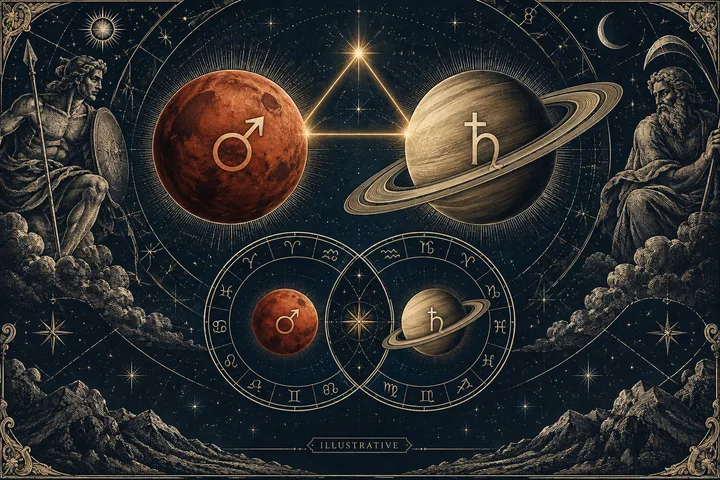
The October transit and synastry answer different questions
Imagine Maria and Alex are comparing a date on an astrology calendar with a Mars–Saturn aspect they have noticed between their charts. They need to know whether those are two names for the same thing. They are not. The October 16 transit describes a relationship between two moving planets. Synastry describes a relationship between points in two natal charts. Both may be called Mars trine Saturn, yet the first belongs to a date and the second belongs to a chart comparison.
That difference changes the useful question. For the calendar event, ask what a transiting Mars–Saturn trine symbolizes during its active period and whether it contacts a natal point. For synastry, ask how one person's Mars and the other's Saturn meet across their birth charts. One is about timing; the other is about a relational pattern. A chart can contain the synastry contact whether or not October 16 has arrived.
Cafe Astrology's October calendar labels the event ‘Transiting Mars Trine Transiting Saturn.’ Its Mars–Saturn synastry guide, by contrast, discusses Mars in one person's chart aspecting a partner's Saturn. That is the central distinction this article follows: identify the owners of Mars and Saturn before assigning meaning. If both are transiting, you are reading the sky. If each belongs to a different person's natal chart, you are reading synastry. If a moving planet contacts a natal placement, you have a third layer.
The distinction also prevents an easy interpretive mistake. A sky event does not establish that two people have a Mars–Saturn aspect in synastry, and a synastry contact does not make a particular date more important by itself. A couple could have a close natal contact and experience the transit without either moving planet closely contacting their natal Mars or Saturn. Another couple might have no Mars–Saturn synastry contact yet find that the transit activates one person's natal chart. These are different chart facts, so keep them separate until the placements show a connection.
The strongest reading is layered, not competitive. The transit describes the period. The cross-chart contact describes an interaction that belongs to the two charts. A transit to a natal point can show why the period may speak more directly to one person. Start by naming which layer you are examining. Then the shared symbolism becomes useful without turning a general event into a personal relationship verdict.
Sources: October 2026 Astrological Events; Mars Saturn Aspects in Synastry
What exactly happens in the October 16 sky?
Cafe Astrology's October 2026 event calendar lists transiting Mars trine transiting Saturn on October 16 at 4:32 a.m. The event entry does not identify a time zone. That means the careful way to repeat the time is as the calendar's published time, without converting it to Berlin, New York, or UTC. The calendar also offers a general reading centered on discipline, endurance, resisting control, and making measured use of effort. Those are interpretive themes for the event, not a description of what every person or couple will experience.
A separate daily ephemeris gives a useful, but narrower, piece of context. For 00:00 UTC on October 16, 2026, it places Mars in Leo and retrograde Saturn in Aries in the tropical, geocentric zodiac. It displays whole-degree sign positions and explains that the positions are rounded. This supports the broad sign picture at that timestamp. It does not establish the exact time of the trine, because midnight UTC is not the calendar's stated event time and rounded degrees do not provide the precision needed to recalculate the aspect.
The two records answer separate technical questions. The event calendar tells us which aspect the publisher lists and when its own entry places it. The ephemeris says where the planets stand at one standardized moment. Neither should be stretched into a claim that this publication calculated a chart, nor does an ephemeris settle the interpretation. The calendar is an astrological publisher's event listing; its generic words about the aspect remain one reading of the symbolism. The positions offer context for signs, not a personalized analysis.
Why give this much attention to the timestamp? Because ‘October 16’ can tempt a reader to treat one moment as a full-day relationship forecast. A transit is not a switch that every chart experiences in the same way at midnight or at a local clock hour. The exact event time depends on the calendar's time convention; its relevance to a person depends on natal contacts and the interpretive scope being used. The calendar does not supply a local time zone in the visible entry, so the article should preserve that boundary instead of implying more precision than the source provides.
Astrology King also separates its natal and transit discussions of Mars trine Saturn, listing the October date in its transit material. That separation reinforces a useful reading habit: identical aspect names can belong to distinct layers. Its broader interpretation is not independent timing confirmation, so the date claim here rests on the event calendar. Read the date as a reference point in the moving sky, then ask which natal placements, if any, it contacts. Without that second step, the transit remains collective astrological weather rather than a couple-specific statement.
Sources: October 2026 Astrological Events; Daily planetary positions 16 October 2026 – Astrological Ephemeris; Mars Trine Saturn Natal and Transit
What does a trine mean before you interpret it?
A trine is an aspect of 120 degrees between two points in a chart. The distance between the actual positions may fall short of exactness; astrologers call that difference the orb. If Mars sits at 14 degrees of one sign and Saturn at 14 degrees of a sign 120 degrees away, the trine is exact. If the distance is 124 degrees, the aspect is four degrees from exact, or has a four-degree orb. The specific positions matter. A sign-based glance may suggest the pattern, but degrees show how close it is under a chosen rule.
Astrologers commonly describe the trine as flowing or supportive. Astrology.com defines it as about 120 degrees and associates it with harmony and ease. That is a helpful first description, but it is not a complete interpretation. The aspect shows how two planetary principles relate; it does not decide whether the resulting habit is conscious, useful, or balanced. Ease may mean cooperation. It can also mean a pattern operates so comfortably that no one thinks to adjust it.
For Mars and Saturn, the symbolic conversation joins action with restraint. Mars describes initiative, assertion, and the push to act. Saturn describes limits, responsibility, time, and the structures that make an effort sustainable. In a trine, an astrologer may read those functions as capable of working together: action respects timing, and discipline gives energy a direction. The same configuration can also make delay feel normal or let the Saturn side set the pace without discussion. The trine offers a style of exchange, not a guarantee of satisfaction.
Orbs need care. Astrologers do not all use the same cutoff for every aspect, chart layer, or pair of planets. A natal trine may be read with a broader orb than a short-lived transit; a synastry reader may choose a more conservative limit for a personal-planet contact. No single threshold is a universal law. A useful comparison states its convention before drawing a conclusion. In this article, the report's stated six-degree orb applies only to selected major aspects in that product. It is a product rule, not a claim that every astrologer must accept a six-degree Mars–Saturn trine.
Separate sign geometry from degree exactness as well. Signs in the same element often form a trine by sign, and that can carry interpretive meaning. But a degree-based aspect can be wide or absent under a particular orb rule even when the signs belong to the same element. Conversely, planets near sign boundaries may form a close degree trine across signs that do not share an element. State whether the reading is by sign, degree, or both. Otherwise, the word ‘trine’ may conceal two different kinds of judgment.
A disciplined first pass uses three questions. What is the angle? How close is it under the declared orb? Which planets and chart points are involved? Then interpret the planetary symbolism. The order matters because a warm reading of easy Mars and Saturn can outrun the chart data. An exactness check does not erase the astrological meaning; it tells you how strongly this particular geometry is being emphasized within the chosen method. Only after that can the chart layer and planetary roles sharpen the interpretation.
Sources: Astrology Aspect Symbols and Meaning; Mars-Saturn Aspect: Conjunct Sextile Trine Square Opposition
How does Mars–Saturn synastry work between two people?
Synastry compares two natal charts. A Mars–Saturn synastry aspect appears when Mars in one person's chart forms an aspect to Saturn in the other's chart, or when the direction is reversed. That cross-chart relationship is different from Mars and Saturn aspecting each other inside one person's natal chart. It is also different from a moving planet making a transit to either person's chart. Before interpreting, write down the owner of each planet. ‘Maria's Mars trines Alex's Saturn’ says more than ‘Mars trine Saturn.’
Cafe Astrology's Mars–Saturn synastry reference reads harmonious contacts as potentially stabilizing, dependable, and predictable. In that interpretation, the Saturn person's steadiness may give the Mars person a structure in which to direct initiative. This is a meaningful strength. It locates the aspect in recurring exchanges: one person proposes or acts, while the other can help pace, organize, or sustain the effort. The contact may be useful in ordinary shared work, from keeping an agreed plan to carrying a task through after the first burst of energy.
The same source gives an important qualification: much depends on the condition of Mars and Saturn in each person's own natal chart. That statement keeps synastry from becoming a free-floating label. A cross-chart trine does not replace the individual charts. The Mars person brings a personal Mars style, and the Saturn person brings a personal Saturn style. If either planet is under strain in its own chart, the contact may not feel as straightforward as the aspect's easy geometry suggests. The natal charts supply the context each person brings into the exchange.
It also matters which person owns which planet. If Alex's Mars aspects Maria's Saturn, the initial reading describes Alex's initiative meeting Maria's timing, boundary, or responsibility function. Reverse the ownership, and the roles reverse. Do not translate Saturn into ‘the responsible one’ or Mars into ‘the impulsive one’ as permanent personality verdicts. These are interpretive roles within a particular contact. Each person has Mars and Saturn, and the relationship between them may differ across the two possible cross-chart pairings.
Direction does not make one partner the villain or the other the problem. Saturn can contribute patience and reliable limits; Mars can bring courage and movement. Yet a Saturn response that feels containing to one person can feel like a veto to the other. A Mars initiative that feels energizing can feel rushed when the Saturn person needs time. The trine suggests a route toward cooperation, but the way both people use that route still matters. The aspect should lead to a specific inquiry about how their pace works, not a label about character.
A sound synastry reading therefore starts with the cross-chart facts, then widens out. Note both signs and degrees, identify whose planet is whose, and check the orb. Consider each person's natal Mars and Saturn before leaning on a single aspect description. Then look at how the rest of the synastry changes or repeats the theme. Cafe Astrology's interchart guide treats aspects as relationships between charts; its aspect-specific material supplies one interpretation of this Mars–Saturn pairing. Together, they support a reading of interaction within a larger comparison, not a standalone verdict about two people.
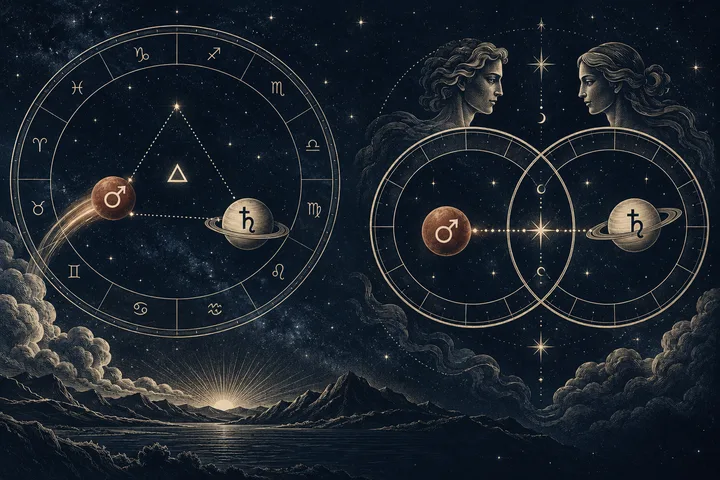
The October 16, 2026 Mars trine Saturn is a transiting-to-transiting aspect: Mars and Saturn form a trine in the moving sky on a particular date. Mars–Saturn synastry is a natal-to-natal contact: one person's Mars forms an aspect to the other person's Saturn, or the reverse. The same planets and 120-degree geometry can describe action meeting structure, but the chart owners, timing, and question differ. Read the transit as a period's shared astrological weather; read synastry as a recurring interaction between two birth charts. If you want to know why the date might feel personal, check whether either transiting planet aspects a natal point in either chart. The October calendar lists the event at 4:32 a.m. without stating its time zone, so keep that as the publisher's time rather than converting it. A trine can ease cooperation, but it cannot by itself promise harmony or define a relationship.
Sources: Mars Saturn Aspects in Synastry; Transits in Astrology: Predictions; Aspects Between Charts
Why does the same aspect mean something different by layer?
The geometry can stay the same while the chart question changes. A 120-degree relationship between moving Mars and moving Saturn describes a transiting pair. A 120-degree relationship between one person's natal Mars and another person's natal Saturn describes synastry. A 120-degree natal Mars–Saturn aspect inside one birth chart describes that person's own natal pattern. The angle is not the whole meaning. The identity and status of the two points establish the interpretive frame.
A helpful way to see this is to compare the time scale. Mars and Saturn move through the sky, so their transiting aspect is temporary in relation to the natal chart. It has a period of approach, exactness, and separation that astrologers may consider under their transit method and orb. A natal aspect, by contrast, belongs to a chart cast for birth and remains a structural part of that chart. Synastry draws on natal placements too, but compares them across two charts. It does not expire when a calendar date passes.
The difference changes the subject of the interpretation. For the October transit, Mars and Saturn describe a shared astrological climate. A traditional reading might consider the interplay of initiative and discipline in the period. For synastry, the question becomes how one person's Mars expression meets another person's Saturn expression over the course of their relationship. In a natal chart, the question is how one person integrates drive and restraint within their own life. These questions may share vocabulary, but their answers should not be substituted for one another.
Astrology King makes the distinction visible by presenting separate sections for natal Mars trine Saturn and the transit. That is useful as a category map, though it should not be treated as independent proof of the event's date. Cafe Astrology's transit explanation likewise describes moving planets forming relationships to natal planets and points. Its description helps define the natal-transit layer; the event calendar establishes the transiting-to-transiting event; the synastry guide describes a cross-chart contact. The synthesis is simple: moving-to-moving, moving-to-natal, or natal-to-natal across people.
Here is the practical map. When both points move, ask what the period's aspect signifies. When one moving point touches a natal point, ask what that transit may activate in the chart holder. When two natal points belong to different people, ask how their planetary functions interact in synastry. A person may read all three layers, but should label them separately. The fact that the same trine symbolism appears in more than one layer is a reason to compare carefully, not to collapse them into one claim.
This distinction also restrains overreading. The October event cannot tell you that a couple has an enduring ability to work together. A natal synastry trine cannot tell you that October 16 will be a turning point. A natal Mars–Saturn trine in one person's chart does not establish that a partner's Saturn will fit comfortably with that person's Mars. Each interpretation has a different evidence base within astrology: date and moving positions, natal placements and cross-chart geometry, or one natal chart's internal aspects.
When the layers do connect, describe the connection precisely. For example, a transiting planet might aspect one person's natal Mars while the couple also has a Mars–Saturn synastry aspect. That gives the reader a timing layer and a relational layer to consider together. It still does not mean the transit creates the synastry aspect, or that both partners feel the same influence. The next step is to track whose natal point is contacted and what the cross-chart contact actually is.
Sources: October 2026 Astrological Events; Mars Saturn Aspects in Synastry; Mars Trine Saturn Natal and Transit; Mars-Saturn Aspect: Conjunct Sextile Trine Square Opposition
Who owns Mars and who owns Saturn in the synastry contact?
Planet ownership is the first detail to recover from a synastry chart. If Person A's Mars trines Person B's Saturn, Person A is the Mars person in that aspect and Person B is the Saturn person. If Person B's Mars trines Person A's Saturn, those roles switch. The two people may also have both cross-chart contacts, each with a different aspect or orb. Saying ‘we have Mars trine Saturn’ can hide this direction and make the interpretation too vague to apply.
The Mars role describes how initiative, desire, assertion, and action meet the other person's Saturn themes of pace, boundaries, duty, and structure. In the supportive reading from Cafe Astrology, Saturn's steadiness can make Mars feel that the other person will be there when needed. That is more concrete than declaring the aspect good. It gives a question to test: does the Saturn person's consistency help the Mars person act with more confidence and follow-through? Does the Mars person's initiative help the Saturn person make a plan real?
The same exchange can feel different from each side. The Mars person may experience Saturn as dependable, or may notice that action has to pass through a filter of caution. The Saturn person may experience Mars as enlivening, or may feel pressed to respond before they are ready. Those are interpretive possibilities, not fixed outcomes. The trine's smoother geometry can help the pair negotiate a workable pace, but it can also let one person's preferred rhythm become the default simply because it seems efficient.
The direction can therefore guide a conversation without pretending to read anyone's private intentions. Ask each person to describe the practical moment: who initiates, who sets the conditions, and what happens when their timing differs? A chart can suggest what to notice, but the lived exchange tells you whether the symbolism feels collaborative. This is not a test of whether someone is committed or withholding. It is a way to make an abstract planetary pairing observable in routine actions and boundaries.
Use the signs to refine the style, not to replace the planet roles. The sign of Mars colors how a person tends to pursue, assert, or mobilize energy in the reading. The sign of Saturn colors how the other person approaches limits, responsibility, and durability. The signs may share an element and form a trine by sign, yet the exact degrees still determine the degree-based orb. An aspect reading becomes more specific when sign, degree, direction, and natal context all fit together.
Then check the houses only when the chart data support them. House overlays can describe life areas where the planets' interaction becomes noticeable, but houses rely on accurate birth time and a selected house system. A report built from supplied signs and optional degrees cannot infer a reliable house placement when birth-time data are missing. That does not make the sign-and-degree comparison useless. It simply leaves one interpretive layer unavailable. Keep the conclusion at the level the inputs actually allow.
Finally, resist assigning a moral rank to the roles. Mars is not automatically the pursuer and Saturn is not automatically the gatekeeper in every real-life exchange; those are shorthand symbols. A person can bring restraint through Mars or act decisively through Saturn's long-range purpose. The chart gives a language for relationship dynamics, not a script for who must behave in what way. The most useful synthesis is specific and reversible: identify the aspect's direction, compare both natal planets, and ask whether their actual pacing feels mutual.
Sources: Mars Saturn Aspects in Synastry; Transits in Astrology: Predictions; Aspects Between Charts
What changes when the transit touches one person's natal chart?
A transiting-to-transiting aspect becomes more personally specific when a moving planet also aspects a natal point. Cafe Astrology describes transits as the continued movement of planets forming relationships to points in an individual's natal chart. So for the October Mars–Saturn trine, you would ask whether transiting Mars or Saturn makes a notable contact to a person's natal Mars, Saturn, or another point relevant to the question. The answer depends on the natal degrees, not simply on being in a relationship when the date arrives.
This is a third layer. The October event remains Mars trine Saturn in the moving sky. A transit from one of those planets to a natal placement is a separate contact. Synastry remains the natal-to-natal relationship between two people's charts. If one partner's natal Mars is contacted by the transiting Saturn, that is a transit to that partner's chart; it does not turn the couple's synastry into a different aspect. Precise labels let you combine the readings without blending their meanings.
A careful sequence begins with the natal data. Find the natal planet or point by sign and degree. Then identify the moving planet's position for the relevant date and determine its aspect under the chosen orb. Consider whether the moving planet is applying to or separating from exactness if the method and data support that distinction. Only then interpret the natal planet, its house if the birth time is reliable, and the broader chart. The calendar's event time and the natal transit's exact contact may not be the same moment.
The daily ephemeris can help orient the signs at 00:00 UTC on October 16, but its rounded values cannot serve as a precision transit calculator. The event calendar supplies its own 4:32 a.m. listing without a stated time zone. These constraints matter if someone wants to compare an exact natal degree to the transit. A broad sign-level observation may be possible from the published table; a precise contact needs appropriately precise positions and a clearly specified time convention.
Two partners may respond to the same moving sky in different ways because it can contact different parts of their charts. One person's natal Mars may be close to a relevant degree while the other's is not. One may have a natal Saturn contact; the other may not. A relationship-level reading should not flatten these differences into ‘the couple is under a Mars–Saturn transit.’ It is more accurate to say which transiting point is contacting which person's natal point, then consider how that individual layer interacts with the synastry.
The transiting pair alone also does not automatically activate the pair's synastry contacts. To say the October transit emphasizes a particular cross-chart Mars–Saturn aspect, check the actual degrees and see which moving planet contacts which natal point. Do not assume that because Mars trines Saturn in the sky, it repeats the couple's own Mars–Saturn trine. A moving-to-moving aspect and a natal-to-natal aspect can happen together without forming a direct contact to each other's degrees.
This layered method improves a reader's question. Instead of asking, ‘Will this transit affect our relationship?’ ask, ‘Does transiting Mars or Saturn contact either of our natal points, and how does that timing sit beside the Mars–Saturn contacts between our charts?’ That version says what information is needed and separates the timing question from the relationship pattern. It also leaves room for each chart holder to have a distinct experience of the same date.
Sources: October 2026 Astrological Events; Daily planetary positions 16 October 2026 – Astrological Ephemeris; Transits in Astrology: Predictions
What changes when the same trine is natal rather than temporary?
A natal Mars–Saturn trine belongs to one person's own birth chart. It describes a way the chart's Mars and Saturn functions relate within that person's life, rather than a contact between two partners. Cafe Astrology's natal Mars–Saturn reference treats the trine as an easier coordination between assertion and discipline. In that interpretive tradition, a person may find it natural to pace effort, work patiently toward a goal, or give initiative a durable structure. It is a natal tendency to explore, not a promise about conduct in every situation.
That natal pattern can shape what each person brings to synastry. Someone whose natal Mars and Saturn already cooperate may have a familiar internal language for balancing urgency with limits. A person with a different natal relationship between those planets may experience that balance in another way. When either person's Mars then meets the other's Saturn, the cross-chart contact interacts with those individual patterns. This is why a synastry aspect should not be read as though both people arrive without their own natal histories or planetary arrangements.
Compare the two chart layers without making them compete. First, note the natal Mars–Saturn relationship inside Person A's chart. Then note Person B's natal Mars–Saturn relationship. After that, examine each cross-chart pairing: Person A's Mars to Person B's Saturn, and Person B's Mars to Person A's Saturn. Those may not mirror one another. One could be a trine while the reverse pairing forms another aspect or none under the selected orb. The pattern is richer than a single phrase.
The date-specific transit still has its own role. It can mark a period when action and structure become a useful collective theme in an astrologer's reading. If it contacts one natal chart, it may sharpen the timing for that person. It does not transform a temporary configuration into a lasting natal quality. Nor does the natal trine prove that the couple's shared handling of effort will be effortless. These are different layers with different persistence and different subjects.
Consider an illustrative person with an internal rhythm of starting carefully and finishing steadily. That description would belong to a natal Mars–Saturn reading. If that person's Mars aspects a partner's Saturn, the synastry asks how the two people's expressions meet, not whether the first person has good self-discipline. If the October transit then contacts a natal point, the transit adds a dated emphasis. Each phrase answers a distinct question, even when all three involve Mars and Saturn.
The counterweight is that natal interpretation can be just as simplified as synastry. A trine is often called easy, and that can sound as though the person never struggles to act or wait. But an easier channel may also operate automatically; the individual may not notice when patience becomes delay or discipline becomes rigidity. Other aspects, signs, houses, and the person's wider chart modify the reading. The aspect is an entry point, not a full portrait.
For a couple, this matters because one partner's personal habit can be mistaken for a relationship fact. A steady Saturn person may bring that quality to many settings, while the cross-chart connection determines how their Saturn interacts with this particular partner's Mars. A good reading separates what each person carries from what happens between them. If the October date feels relevant, add the transit after those natal layers are clear. That order prevents one visible event from explaining the entire chart.
Sources: Mars Trine Saturn Natal and Transit; Mars-Saturn Aspect: Conjunct Sextile Trine Square Opposition; Mars Saturn Aspects in Synastry
When can a flowing trine still feel restrictive?
A trine can make coordination easier without making every result satisfying. With Mars and Saturn, a dependable rhythm may feel safe and sustaining. It may also feel slow if the Mars person wants immediate movement, or overly cautious if the Saturn person needs repeated assurances before acting. The astrological idea of flow describes the relationship between planetary principles. It does not mean that both people experience every part of that relationship as equally pleasant.
The strongest exception to a simple ‘harmonious means good’ reading comes from the way ease can hide a pattern. If one person's timing routinely sets the pace, the arrangement may seem smooth because the other person has stopped challenging it. That inference is not a prediction that control will occur; it is a question the symbols invite us to test. Does restraint create space for thoughtful action, or does one person feel they need permission to move? Does initiative bring the pair forward, or does it repeatedly make the other person feel hurried?
Cafe Astrology's synastry interpretation emphasizes stability and dependability, while also saying each natal planet's condition matters. Astrology.com's general trine explanation leans toward luck and harmony. Read together, these sources support a favorable possibility but do not justify a guarantee. A more complete reading gives the constructive expression first, then identifies what could complicate it: unequal pacing, a strained natal Mars or Saturn, an orb that is wide under the chosen convention, or other chart contacts that pull the pair in a different direction.
Exactness changes emphasis, not certainty. A closer trine is conventionally treated as a more immediate or noticeable contact in many astrology readings, while a wider contact may carry less weight. But an exact aspect still does not tell you whether a relationship is loving, balanced, or lasting. It tells you that the geometry is close under the stated method. The quality of the expression comes from interpreting the planets, signs, houses when known, each natal chart, and the broader chart pattern.
Signs can alter the style, too. A Mars sign can pursue in a direct, steady, verbal, or strategic way; Saturn's sign can organize limits and commitments through a different temperament. These are conventional sign interpretations, and they need to be read as a whole rather than as caricatures. A fire-sign Mars trine a fire-sign Saturn does not mean the pair will always act quickly. The signs may describe a shared element of expression, while the planets still tell us which functions are interacting and the houses may show where those functions play out.
The calendar's generic transit description should also be held at its proper scale. ‘Discipline and endurance’ gives a symbolic direction for reading Mars with Saturn, but it cannot tell you which partner will act, which will wait, or what event will occur. That specificity comes from the natal chart contacts and the chart holder's context. A transiting-to-transiting aspect may invite a broad reflection on how energy and responsibility meet during a period. The natal transit tells a more personal story only when you identify the contacted point. Synastry then addresses the way the two natal charts relate. The three layers can inform one another, but they should be joined by actual chart contacts rather than by a shared planet name alone.
The lived pattern is the strongest check on an interpretation. Ask what happens when a plan changes, one person needs more time, or an initiative meets a boundary. Does the pair find a workable adjustment? Does the same person always compromise? These questions do not replace astrology; they help distinguish the constructive and restrictive expressions that Mars and Saturn can symbolize. A trine can describe the capacity to coordinate, while the couple's actual choices show how that capacity is being used.
A useful reading should also say what would change its emphasis. A tight orb may make the contact more prominent. A wide orb may lead the astrologer to give it less weight. Sign placements may clarify the style; reliable birth times may add house context. Stronger or repeated contacts elsewhere may reinforce or complicate the theme. If one person's natal Mars or Saturn is already under pressure, the easy cross-chart angle may not erase that natal experience. The interpretation remains open to nuance, while the central distinction between transit and synastry stays firm.
Sources: Astrology Aspect Symbols and Meaning; Mars Saturn Aspects in Synastry; Mars-Saturn Aspect: Conjunct Sextile Trine Square Opposition
A practical sequence for comparing the transit with your synastry
Use a two-clock reading map. First, decide whether your question concerns a date, an enduring chart comparison, or a date's contact with someone's birth chart. Then collect only the placements needed for that layer. This avoids the common tangle in which a calendar event is used to explain a synastry contact, or a cross-chart aspect is treated as a prediction about one afternoon. Begin with labels, not meanings.
For the date layer, record that Cafe Astrology lists transiting Mars trine transiting Saturn on October 16, 2026 at 4:32 a.m., and retain the fact that its entry does not identify a time zone. Use the 00:00 UTC ephemeris for broad tropical sign context only: Mars in Leo and Saturn retrograde in Aries, with degrees rounded. Do not quietly treat that table as an exact transit chart. If you need a precise natal contact, use appropriately precise positions and a stated time convention.
For the synastry layer, write down each person's natal Mars and Saturn sign and degree. Compare Person A's Mars with Person B's Saturn, then Person B's Mars with Person A's Saturn. One cross-contact does not imply the reverse contact. Calculate or verify the angular distance and state the orb rule. If all you know is sign, describe a sign-level relationship and avoid saying the degree-based trine is exact. If the optional degrees are available, the comparison becomes more specific.
Next, name the owners in plain language. ‘Her Mars trines his Saturn’ or ‘Person A's Saturn trines Person B's Mars’ makes the direction visible. Interpret Mars as the initiative side of that particular contact and Saturn as the structure side, then compare each person's natal Mars and Saturn for context. Do not let the shorthand roles harden into personality judgments. The same person has both planets, and each may function differently in different chart contacts.
Now check the personal timing layer. Ask whether transiting Mars or Saturn contacts a natal point in either chart around the date. Identify whose point is involved. The event itself is shared in the sky, but the natal contacts may differ from one person to another. If no relevant contact is present under the chosen orb, do not force the transit into the relationship reading. You can still interpret the general transit as a period theme, while keeping it separate from the pair's natal pattern.
Consider this example, which is illustrative only. Suppose two readers know that one person's Mars is in a fire sign and the other's Saturn is also in a fire sign, but neither has checked degrees. They can note a possible trine-by-sign theme and ask how initiative and pacing meet. They cannot yet claim a close degree trine or say the October transit activates the contact. They would need both degrees, then the relevant moving positions, before making those narrower statements. No personal chart data are being assumed here.
For a concise worksheet, record: chart layer; date and time convention if relevant; planet owners; sign and degree for each natal point; exact angle; declared orb; house context only if birth times support it; and the interpretive question. The list is intentionally short. It prevents the data from disappearing under a confident-sounding aspect label. When a detail is missing, mark it as missing and keep the reading at the level that remains supportable.
A missing birth time deserves a precise response. Planet signs and many planetary degrees can still be compared when the birth date and time data are reliable enough for those placements, but the Ascendant and house cusps depend closely on the clock time and location. Do not fill those gaps with a guessed house story. The article's question can still be answered at the level of known Mars and Saturn signs or degrees. If only signs are available, say that the aspect is being considered by sign; if the degrees are supplied, measure the angular distance under the declared orb. This keeps the chart reading useful without pretending that every layer is known. It also helps readers ask for the missing information that would actually refine their question, rather than collecting birth details by habit. For this comparison, the essential evidence is which planet belongs to whom, where those planets sit by sign and degree, and whether the question concerns a moving transit or a natal cross-contact.
The Synastry Comparison Report can help compare placements you supply, including optional degrees, with selected major aspects using its stated six-degree orb. That boundary matters. It does not calculate natal charts from birth details or determine houses. The six-degree rule belongs to the report's method, not every astrologer's practice. If you want to use the report, bring the placements you already know and treat its aspect result as one organized comparison of those inputs.
Finally, formulate the question you actually need answered. If it is ‘What does the October 16 transit mean?’ ask about the transiting pair. If it is ‘How does one person's Mars work with the other's Saturn?’ ask about synastry. If it is ‘Why might this period stand out for one of us?’ check the transits to each natal chart. Those questions can be related, but asking them separately leads to a cleaner interpretation.
Sources: October 2026 Astrological Events; Daily planetary positions 16 October 2026 – Astrological Ephemeris; Mars Saturn Aspects in Synastry; Transits in Astrology: Predictions; Aspects Between Charts
Choose the chart layer that matches your question
The key difference is ownership and timing. On October 16, transiting Mars and Saturn form a date-specific trine in the moving sky. Mars–Saturn synastry compares natal Mars in one person's chart with natal Saturn in the other's, or the reverse. If you want to know why the transit may feel personal, check its contacts to each person's natal chart. Those are three related layers, not interchangeable readings.
The practical next step is simple: write down which question you have, then list the relevant placements and degrees. For synastry, compare both possible Mars-to-Saturn directions and note the orb convention. For the transit, preserve the event calendar's time-zone limit and do not infer a personal effect from the date alone. A trine can describe an easier route between action and structure. It cannot decide what a couple will do with that route.
If your placements are known, the Synastry Comparison Report can compare what you supply and optional degrees under its stated six-degree orb for selected major aspects. It will not calculate natal positions from birth details or provide house placements. The report is useful when the question is how the supplied chart points relate. The October event is useful when the question is about timing. Keep those purposes distinct, and the same Mars–Saturn symbolism becomes clearer rather than confusing.
Sources: Mars Saturn Aspects in Synastry; Transits in Astrology: Predictions
A little more clarity
Is the October 16 Mars–Saturn trine a synastry aspect?
No. The calendar lists transiting Mars trine transiting Saturn, a moving-sky event. Synastry is a natal-to-natal comparison between two people. The same aspect name does not make the chart layer the same.
Does a Mars–Saturn synastry trine mean a couple will last?
No single aspect decides that. Astrologers may read the trine as supportive for pacing, steadiness, or sustained effort, but the signs, degrees, natal condition, other contacts, and lived expression all shape the interpretation.
Can the October transit affect one partner more than the other?
It can make different natal contacts to each person's chart. Check the degree of each natal point against the moving planets, then interpret each contact separately. The event itself does not guarantee that both partners experience the same emphasis.
Sources & further reading
- October 2026 Astrological Events
Lists transiting Mars trine transiting Saturn on October 16 at 4:32 a.m.; its visible event entry does not specify a time zone.
- Daily planetary positions 16 October 2026 – Astrological Ephemeris
Gives rounded tropical geocentric positions at 00:00 UTC, placing Mars in Leo and retrograde Saturn in Aries.
- Astrology Aspect Symbols and Meaning
Defines a trine as about 120 degrees and offers a popular astrology description of its flowing symbolism.
- Mars Saturn Aspects in Synastry
Interprets cross-chart Mars–Saturn contacts, including stabilizing possibilities and the importance of each natal planet's condition.
- Mars Trine Saturn Natal and Transit
Separates natal and transit interpretations of the same aspect, supporting the article's distinction between chart layers.
- Transits in Astrology: Predictions
Explains transits as moving planets forming relationships to planets and points in an individual's natal chart.
- Aspects Between Charts
Identifies interchart aspects as specific relationships between two charts in synastry.
- Mars-Saturn Aspect: Conjunct Sextile Trine Square Opposition
Provides a natal-chart interpretation of Mars–Saturn aspects, including the trine, distinct from synastry or transits.
Synastry Comparison Report
Enter known placements for two people. Get an input-by-input comparison, selected aspect calculations and a clear record of what remains uncertain.
Compare our placements