What relationship themes does the October 10 Venus square Mars bring into focus?
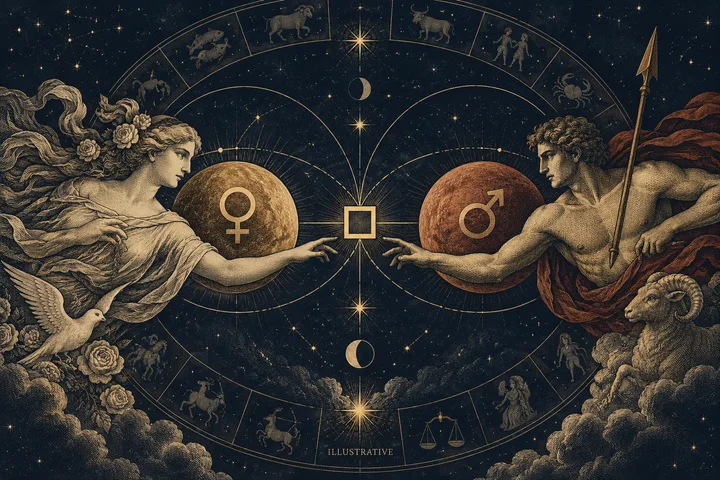
On October 10, 2026, Venus in Scorpio squares Mars in Leo: the symbolic meeting of relating, attraction, pleasure and values with initiative, appetite and pursuit. Astrologers can read that contact as friction between what is wanted and how it is pursued, or as creative activation that gives desire an outlet. Cafe Astrology’s “Venus Transits” describes both tension and stimulating, creative expression; Astrology.com’s “Astrology Calendar 2026” emphasizes experimentation and creative breakthroughs for this dated configuration. Those are alternative interpretive emphases, not promised responses. The exact collective transit does not determine what an individual or couple experiences. Its calculated timing is discussed below; the relationship meaning remains a symbolic reading, not a personal chart result. In the first lens, desire and action may pull at different rhythms; in the second, that same contact may animate experimentation. The dated calendar gives the constructive reading for the event, while Cafe Astrology’s general Venus-square-Mars entry supplies the explicit tension-and-stimulation contrast. Neither describes measured couple responses, so the interpretation stays at the level of symbolic possibilities.
On October 10, 2026, Venus in Scorpio squares Mars in Leo. Astrologically, Venus’s themes of attraction, pleasure and values meet Mars’s initiative and desire. The square can be read as friction between relating and acting, but Cafe Astrology also describes it as potentially stimulating and creative, while Astrology.com emphasizes experimentation. These are alternative symbolic interpretations, not predictions about what a couple will feel or do. The date describes a transit between moving planets; it does not answer how either planet contacts a person’s natal chart or how two natal charts compare. Use the symbolism as a prompt to consider what is wanted and how it is pursued, then look to what people actually say and choose.
Sources: Ephemeris - October 2026; Venus Transits; Astrology Calendar 2026
What is the exact event, and what does its timestamp establish?
The event is a square between Venus and Mars in the tropical, geocentric zodiac. Tropical longitude measures each planet’s position along the ecliptic from the equinox-based start of the zodiac; geocentric means the positions are described from Earth’s viewpoint. An exact square occurs when the planets’ ecliptic longitudes differ by 90 degrees. This is the coordinate geometry used for the event listing, not a statement about how long a relationship theme lasts or how strongly anyone will feel it. Zodiac sign and degree are coordinates on that circle; the aspect names the angular relationship between the two positions.
“Ephemeris - October 2026” records Venus square Mars on October 10, 2026, at 21:22 UT, with Venus at 7°20′59″ Scorpio. Its daily table labels positions as geocentric tropical ecliptic longitude, and its event timeline gives the time in UT. That makes the date, aspect, reference convention and Venus position reproducible from the listed data. The record is a calculation of planetary geometry. It does not itself supply a symbolic interpretation, identify an individual chart contact, or establish an experiential peak.
There is a small but material difference between the two published clock times. “2026 Astrological Aspects” lists the Venus–Mars square at 5:31 p.m. Eastern. Converting 21:22 UT in “Ephemeris - October 2026” to Eastern time for October 10 gives 5:22 p.m. The annual calendar is therefore nine minutes later than the converted ephemeris time. Both entries identify October 10 and the same approximate event degree, but neither source explains the discrepancy. The available records do not support choosing one cause or adjusting either value to make them agree. Reporting both preserves what each source actually says. The conversion is straightforward: on that date Eastern Daylight Time is four hours behind UT, so subtracting four hours from 21:22 gives 17:22, or 5:22 p.m. The 5:31 p.m. value is not a second time-zone rendering of 21:22 UT under that offset. It is a separate published listing. Because the annual calendar does not document its calculation basis in the supplied record, the difference should remain visible rather than be “corrected” through an assumed convention.
The ephemeris says its event times are refined to the minute by bisection. In practical terms, that describes a numerical method for narrowing down when the calculated angular separation reaches the exact aspect. It is useful information about the precision of the astronomical event record. It does not mean the symbolic influence begins or ends at a minute boundary, nor that a person’s relationship experience can be timed to that precision. The calendar’s nine-minute mismatch also cautions against presenting the clock reading as more settled than these sources warrant.
The timestamp establishes the listed moment of exact geometry under the stated coordinate convention. It lets a reader identify when Venus and Mars reach the 90-degree relation, and it gives a fixed reference point for later discussion of the signs and the aspect. It does not establish that the symbolism starts at that instant, peaks then in lived experience, or stops afterward. Those are different interpretive claims and require an explicit timing convention. Likewise, a clock time cannot turn a collective transit-to-transit event into a personal transit or a comparison of two natal charts. The date names the sky configuration; any further chart question depends on its own inputs and method. In particular, exactness is a property of the aspect at one calculated instant, whereas an interpretive period before or after exactness requires a separate rule about acceptable angular distance. The event time alone supplies no such rule. A reader should not infer an onset, a duration, or a uniform response from the word “exact.”
For this assignment, the sound technical statement is therefore narrow: the ephemeris places the square at 21:22 UT, with Venus at 7°20′59″ Scorpio, while the independent annual calendar publishes 5:31 p.m. Eastern. The converted ephemeris time is 5:22 p.m. Eastern, leaving an unresolved nine-minute difference. The sources agree on the calendar date and approximate degree. They do not establish a universal period of influence, a personal response, or a relationship outcome. Keeping those conclusions separate allows the event’s calculated precision to be useful without asking it to answer questions its timestamp cannot settle.
Sources: Ephemeris - October 2026; 2026 Astrological Aspects
Which chart layer does the October 10 square describe?
The October 10 event is a transit-to-transit aspect: two moving planets, Venus and Mars, form a square in the sky. “Ephemeris - October 2026” places that shared configuration on the date in question. The label tells you what is being compared, not whose personal chart is involved. Everyone can refer to the same dated sky event; the symbolism someone draws from it depends on the chart question and interpretive method.
A transit-to-natal reading compares a moving planet with a factor in one person’s birth chart. To ask whether the October Venus–Mars contact also touches a particular person’s natal Venus, Moon, or another factor, an astrologer needs that person’s natal placements and the chosen contact rule. Birth date, time, and place are one route to calculating a chart; a reader who already has reliable placements can supply those directly. A reliable birth time becomes especially important when the reading depends on houses or angles, which are sensitive to the chart’s time and location. Without those inputs, the shared transit alone cannot establish an individual contact.
Synastry changes the comparison again: it places factors from two natal charts in relation to one another. A question such as whether one person’s Venus forms an aspect to the other person’s Mars calls for both sets of relevant natal placements, and degrees if the reader wants to assess how close the aspect is. A transit can be considered alongside a synastry chart, but the two methods answer different questions: one tracks current sky positions against natal factors, while the other compares the two birth charts. Reliable birth times are needed for house and angle claims in either chart; they are not a blanket prerequisite for comparing supplied planetary signs.
For example, someone might ask whether the date’s moving Venus contacts a factor in their own chart, or whether their Venus and another person’s Mars form a natal interchart aspect. The first question needs the individual’s natal factor; the second needs both people’s relevant placements. Neither question can be answered from the calendar date by itself. This is the key boundary between a collective symbolic backdrop and a personal chart reading: the date supplies the moving sky configuration, while the chart-specific comparison requires the chart factors being contacted or compared.
The Synastry Comparison Report organizes placements that users provide: Moon, Venus, and Mars signs, with optional degrees, and selected major aspects calculated using a six-degree orb. It does not calculate natal placements from birth details. That input boundary matters because a transit date cannot fill in missing birth-chart data, and an interpretation of the shared event should not be mistaken for a report about either person. A shared transit can still serve as a general symbolic backdrop; it simply is not interchangeable with a personal transit or a two-chart synastry contact.
A quick way to keep the methods straight is to name the moving or natal factors before interpreting them. If both are current sky positions, the comparison is transit-to-transit. If one is current and one belongs to a single birth chart, it is transit-to-natal. If both belong to separate birth charts, it is synastry. Then check whether the question needs sign-level symbolism, degree-based aspect closeness, or houses and angles. That sequence prevents a calendar entry from being stretched into a claim about a private chart. It also shows what information is genuinely missing: for a sign comparison, the sign placements may be enough; for a close aspect, degrees matter; for houses and angles, reliable birth time and place enter the calculation. Naming the method first keeps each conclusion tied to the comparison actually performed.
Sources: Ephemeris - October 2026
What do Venus, Mars, and the square contribute to the interpretation?
An astrologer can move from the planets’ symbolic functions to a relational question in three steps: identify what Venus signifies, identify what Mars signifies, then consider the square between them. In “Venus Transits,” Cafe Astrology describes a Venus–Mars square through possible difficulty coordinating romantic and assertive or sexual needs, with competitiveness and tension among its possibilities. Those terms provide one symbolic vocabulary for the contact; they describe an interpretive framework, not a measured account of what couples experience.
In this framework, Venus represents relating, attraction, pleasure, and values: what draws someone, what feels agreeable, and what they value in exchange. Mars represents initiative, appetite, and pursuit: how desire is acted on, how someone presses forward, or how energy is asserted. These are functions used to organize interpretation, not labels for two partners, genders, or fixed personality types. Both functions can describe questions within one person’s experience, as well as themes an astrologer may consider when comparing charts. The meanings stay broad until they are connected to a specific chart factor and a clearly stated question.
A square names an angular relationship of 90 degrees between two chart positions. The geometry tells the astrologer how the positions relate; it does not itself dictate a relationship outcome. Astrologers often treat the square as dynamic because the two functions call for coordination rather than simply reinforcing one another. In a Venus–Mars reading, the interpretive prompt is therefore not “Which planet wins?” but “How do what is wanted or valued and the way it is pursued meet, support, or strain one another?” That question keeps the aspect relational without turning it into a verdict.
The sequence can be applied without assigning anyone a placement. First, ask what kind of connection, pleasure, or exchange is being sought. Second, ask what action or pace is being used to pursue it. Third, examine whether the approach serves the desired experience, creates a different one, or leaves the two aims in tension. If a chart factor or aspect is actually supplied, the astrologer can relate that symbolism to its chart context. If it is not supplied, the sequence remains a way to frame the symbolism of the event, not a claim that either person has a particular natal pattern.
Consider a hypothetical, non-chart illustration: one person proposes a quiet evening together, while the other suggests an energetic outing. The Venus-style question might be what kind of shared pleasure or closeness each hopes for; the Mars-style question might be how each proposes to make the evening happen. The mismatch could concern the desired atmosphere, the chosen activity, or merely the route to a shared aim. The example contains no astrological placements and does not stand as evidence about couples. It shows how the symbolic functions can generate a question precise enough to discuss instead of assigning a motive to either person.
Cafe Astrology’s entry discusses Venus transiting natal planets generally, so its descriptions should not be presented as a direct forecast of this date’s transit-to-transit event. The event’s calculated positions come from the ephemeris; the meanings in this section are interpretive synthesis. Keeping those jobs distinct makes the method reproducible: name the symbolic functions, state the geometric relation, ask what coordination it invites the reader to consider, and leave the lived meaning open until the relevant chart inputs and context are known. A challenging aspect may focus attention on coordination, but it does not imply that the relationship is bad or that a particular response must follow.
The order matters because reversing it can make interpretation circular. If someone begins with a desired conclusion, then treats every Venus symbol as proof of affection and every Mars symbol as proof of pursuit, the aspect adds little beyond the assumption already made. Starting with the functions instead allows more than one question: is the difference about the kind of pleasure sought, the speed or style of action, or how one person responds to the other’s initiative? A reader can compare these possibilities with the chart factors and the question actually asked, rather than assigning a single meaning to the word “square.”
Nor does a 90-degree relation describe the quality of communication between people by itself. It supplies a formal relation among chart positions. The astrologer’s next step is to interpret what those positions signify in context, then make the interpretive bridge explicit. In this example, the bridge is that desire and its pursuit may require active coordination. That is narrower than predicting conflict and more useful than calling the square simply “good” or “bad”: it identifies the topic the aspect brings forward while leaving its expression to the rest of the chart and the circumstances being considered.
Sources: Venus Transits
Why can this square signify both friction and activation?
Cafe Astrology’s “Venus Transits” gives the clearest tension-centered account of a Venus–Mars square. It says romantic needs may be difficult to coordinate with assertive or sexual needs, and describes competitiveness and relationship tension as possible expressions. The same entry also allows a different tone: the contact can be stimulating, creative and invigorating. These are not two separate aspects or a contradiction in the source. They are alternatives within one symbolic interpretation of Venusian desire meeting Martian initiative. A person could use the first vocabulary when considering a clash in what is wanted or how quickly someone acts, and the second when considering whether the contact energizes a shared activity. Neither possibility follows automatically from the geometry.
The scope of that reading matters. “Venus Transits” discusses Venus transiting natal planets generally. Its account can illuminate the symbolism comparatively, but it is not a direct forecast for the October 10 transit-to-transit event, where moving Venus and moving Mars form the square with each other. The distinction is between a source’s general interpretive vocabulary and a claim tailored to this particular event. Using the entry as if it described every person’s response would enlarge its scope without support. The appropriate use is narrower: it shows that a square may be read through difficulty coordinating desire and action while still leaving room for enlivening or creative expression.
Astrology.com’s “Astrology Calendar 2026” places its October 10 entry specifically on Venus in Scorpio square Mars in Leo, and emphasizes experimentation and creative breakthroughs. That emphasis is more deliberately constructive than the tension-and-stimulation range in “Venus Transits.” The calendar does not report observed couple behavior or establish that a breakthrough will happen; it offers an event-specific symbolic reading. Read together, the sources share a basic mechanism, desire meeting action, but direct attention to different questions. Cafe Astrology names the possible strain of coordination and also its invigorating quality. Astrology.com asks what experimentation or creative expression the contact might symbolize. Their difference is a difference of interpretive emphasis, not a dispute settled by relationship findings.
A useful way to keep both readings in view is to match the language to the question being considered. Tension language can help name two competing wants, a difference in pace, or a gap between the pleasure someone seeks and the way it is pursued. Creative language can prompt reflection on whether a new activity or form of expression might give both preferences room. That matching is an editorial application of the two sources’ symbolism, not an empirical result or a rule for predicting how a couple will respond. It also leaves the outcome open: a difference may remain difficult, become energizing, or simply fail to feel relevant in a particular situation.
The practical distinction is therefore between diagnosing a symbolic theme and deciding what it means in lived experience. If a reader recognizes competing preferences in an actual interaction, the tension-centered lens may describe the question more clearly. If both people are already open to trying something, the constructive lens may offer a useful prompt for considering a shared outlet. The transit cannot establish that either circumstance exists, and “creative breakthrough” should not be turned into a promise of resolution. These sources disagree in emphasis, not in observable relationship findings: neither establishes how any couple will respond. Keeping the readings side by side lets the symbolism remain specific without making it deterministic.
The contrast is useful because it separates two interpretive tasks that can otherwise blur together. A tension reading asks where coordination may be hard: whether the desired experience and the chosen approach fit, whether the pace feels mutual, or whether initiative is being received as welcome. A constructive reading asks what could be made or tried with the energy of that difference. One does not cancel the other. Experimentation might be a way to work with distinct preferences, but it could also expose that the preferences do not align; friction might identify something worth discussing, but it does not prove incompatibility. These are conditional ways of applying the sources’ language to a question, not claims that a transit causes a particular conversation or result.
The source comparison therefore gives the reader a choice of lens rather than a verdict to accept. Cafe Astrology’s range is especially useful when the question concerns how desire and action may feel mismatched or stimulating; Astrology.com’s dated emphasis is useful when considering experimentation as one possible expression of the same contact. Because the first source is general and transit-to-natal in scope and the second is an event-specific calendar entry, they should not be treated as equivalent evidence about outcomes. Their value lies in showing how different astrologers organize the symbolism, while the reader decides whether either framing illuminates a real question.
Sources: Venus Transits; Astrology Calendar 2026
How do Scorpio and Leo alter the symbolic emphasis?
The sign pairing adds a layer to the Venus–Mars square: the general aspect describes a dynamic between relating and pursuit, while Scorpio and Leo give astrologers a particular symbolic vocabulary for considering how that dynamic might be colored. Cafe Astrology’s “Venus in Scorpio, Mars in Leo” discusses the combination through water and fire imagery and the possibility of differing romantic and instinctual styles. In that vocabulary, Scorpio’s water symbolism can suggest inward depth, while Leo’s fire symbolism can suggest more outward expression. This is a way to frame contrasting styles for reflection, not evidence that people with these signs behave in a fixed way. Here the signs are occupied by transiting planets; they do not identify the personalities of either partner.
Astrology.com’s “Venus in Scorpio Traits & Meaning in Astrology” offers another symbolic vocabulary for Venus in Scorpio, including depth, intimacy, guardedness and trust. Because that page treats a natal placement, those terms should be borrowed selectively as interpretive possibilities rather than transferred wholesale to a transit. They can help specify what “Venus in Scorpio” might bring to an astrologer’s reading of desire or relating, but the transit alone does not show that anyone is guarded, seeks a particular kind of intimacy, or has difficulty trusting. The distinction is between naming a symbolic theme associated with a placement and asserting a fact about a person.
Together, the references make the sign layer more particular without replacing the aspect layer. The square still supplies the contact between Venus and Mars; the sign symbolism offers possible texture for thinking about that contact. For example, a reader might reflect on privacy versus visibility, or on a wish for depth alongside a preference for expressive display. Those are questions generated by the water/fire and sign language, not descriptions of a real couple and not predictions about what either person will choose. The combination page’s discussion of Mars in Leo can similarly inform a symbolic question about expressive initiative, but it does not establish that a partner will seek attention or act dramatically.
This keeps interpretation tied to the available inputs. A transit chart can support discussion of Venus in Scorpio and Mars in Leo as the signs occupied on the date, and astrologers may use the cited sources’ symbolic associations to develop possible readings. It cannot supply either person’s natal Venus, Mars, or other placements, nor show how either person expresses a sign. The combination source concerns natal Venus–Mars combinations, while the Astrology.com vocabulary concerns natal Venus in Scorpio; both are useful here only as bounded sign references. The sign combination therefore adds questions about symbolic emphasis, not a way to determine who is private, demonstrative, deep, guarded, or trusting. Actual expression remains a matter of each person’s chart context and lived choices.
The distinction also prevents sign keywords from doing more work than they can bear. “Depth” and “visibility” may help a reader formulate different possibilities, but neither word tells us what a particular person values in a relationship. Nor does the water/fire contrast mean that the two symbolic elements must oppose each other in every reading. An astrologer can use it to ask how inwardness and expression might meet in the interpretation, then check whether that question is relevant to the chart factors and the actual topic under consideration. If there is no supplied personal chart or lived context to connect, the interpretation remains at the level of the collective transit’s symbolism.
For this date, then, the sign pairing contributes a focused set of interpretive prompts: what forms of closeness or pleasure are being symbolized by Venus in Scorpio, and what forms of initiative or display are suggested by Mars in Leo? These prompts refine the reading of the square without turning signs into a compatibility score or a forecast. A reader comparing two natal charts would need those charts’ actual placements to ask how their personal Venus and Mars relate; this event’s transiting signs cannot stand in for that comparison. The added layer is useful precisely when kept at that scale: it makes the symbolic reading more specific while preserving the difference between a sign association and an observed behavior.
Sources: Venus in Scorpio, Mars in Leo; Venus in Scorpio Traits & Meaning in Astrology
What does Venus’s recent retrograde station add—and what does it not add?
The chronology adds a condition to the October 10 reading: Venus has recently changed apparent direction and is still retrograde when it squares Mars. “Ephemeris - October 2026” places Venus’s retrograde station on October 3 and marks Venus retrograde in its October 10 listing, the date of the square. That sequence establishes that the aspect occurs during the retrograde phase. It does not establish that a relationship has entered a particular phase, or that an individual is reconsidering a partner. The ephemeris records calculated planetary positions and motion; it does not assign a private event to them.
The distinction between motion and meaning matters here. In the geocentric chart, retrogradation describes a planet’s apparent reversal of direction as viewed from Earth; it is not a claim that Venus physically reverses its orbit. Cafe Astrology’s “Transits: Venus Retrograde” adds an astrological interpretation to that geometry: Venus retrograde can symbolize reassessing values and relationships. That review language is a convention within astrological interpretation, not a calculation contained in the ephemeris. Applied cautiously, it can invite a reader to consider whether the Venus themes already under discussion deserve reflection. It cannot show that anyone has returned, changed their mind, or experienced a relationship crisis.
Astrology.com’s “October 2026 Astrology: Key Dates for a Month of Revelation and Desire” offers a broader frame. Its monthly narrative places the October 10 square within a Venus-retrograde period and alongside other October configurations. This is one astrologer’s month-level synthesis, not an additional technical measurement of the square. The other configurations remain distinct events with their own positions and interpretations. Their appearance in the same monthly article does not make them effects of the Venus–Mars contact, and the article’s wider narrative should not be compressed into a prediction about what the square will do.
Read at these separate levels, the station qualifies the symbolism without overruling it. The square remains the specific Venus–Mars geometry on October 10; the retrograde condition supplies a possible reflective context for considering Venusian matters; the monthly article shows how one astrologer situates that context among other October themes. These are compatible layers, but the sources do not establish a universal rule that the station must carry more weight than the exact square, or that the square cancels the station’s interpretive relevance. Some astrologers may foreground the retrograde condition, while others may begin with the exact aspect. A careful reading can name both without pretending there is a source-backed hierarchy.
The limited conclusion is therefore about the question an astrologer might ask, not an event a reader should expect. Venus’s retrograde phase may make reflection on attraction, pleasure, or values a fitting symbolic prompt alongside the square’s already described tension or activation. Whether that prompt fits someone’s life depends on their chart and circumstances, neither of which the event listing supplies. The station alone does not indicate a returned partner, an impending rupture, or a hidden personal development. If those matters are relevant, they need to be understood from what the people involved actually know and communicate, not inferred from the calendar. The transit offers a symbolic frame; it does not supply the missing personal evidence.
The dates also help prevent a subtle conflation. The station is a change in Venus’s apparent direction on October 3; the square is a separate angular relation involving Venus and Mars on October 10. Their proximity places the square inside a retrograde period, but it does not turn the station into a second cause of the square or make the two events interchangeable. An astrologer may choose to read the condition of Venus alongside the aspect, just as a chart reading can consider more than one layer, but the interpretation should identify which layer is doing what work. The ephemeris supports the order and timing; the interpretive sources supply different symbolic frames. Keeping those contributions separate makes the reading easier to check and limits what can responsibly be concluded.
Nor does a month-level forecast settle how much personal importance to assign the station. Astrology.com’s article gives a coherent narrative for October as a whole, but a narrative can connect events without showing that every event has the same meaning for every reader. Its broader frame is useful for seeing how the square may be placed within an astrologer’s account of the month. It does not replace a chart-specific interpretation, and it does not establish that a reader will revisit any particular bond. Where one person treats the retrograde condition as central and another gives priority to the exact square, each is making an interpretive choice. The available sources justify describing the choices, not declaring one universally correct.
Sources: Ephemeris - October 2026; October 2026 Astrology: Key Dates for a Month of Revelation and Desire; Transits: Venus Retrograde
How long should the transit be treated as active?
The exact perfection gives a fixed geometric moment, not a universal start and end for symbolic influence. “Ephemeris - October 2026” lists the Venus–Mars square at 21:22 UT on October 10. That timestamp anchors when the two positions are exact by the ephemeris’s convention. To extend interpretation around that moment, an astrologer must state an orb: the permitted angular distance from exactness at which the aspect is still treated as active. The ephemeris’s event listing does not choose that interpretive threshold or declare a number of active days.
A reproducible timing method begins by choosing the orb and specifying whether the interval includes both the approach to exactness and the period after it. Then consult a consistent ephemeris for Venus’s and Mars’s longitudes over the dates in question. For a square, compare their angular separation with 90 degrees, accounting for the fact that angular separation is measured around a circle. The difference between the actual separation and 90 degrees is the distance from exactness. The aspect falls within the chosen orb while that difference remains at or below the declared limit. Because the planets keep moving, that distance changes; a threshold crossing can therefore be located before and after perfection rather than assumed from the exact timestamp alone.
The direction of change distinguishes applying from separating. An aspect is applying while its distance from the exact angle is decreasing; it is separating once that distance is increasing. Near a station, a planet’s apparent direction changes, so a reader should follow the listed positions through the relevant dates rather than assume a simple, uninterrupted approach and retreat. The chosen orb and the decision to count one or both sides of exactness determine the resulting interval. A tighter orb admits fewer positions; a wider orb admits more. Neither choice can be derived merely from knowing the perfection time, and the resulting dates describe a selected interpretive convention, not a measured duration of an effect.
For a reader who wants to reproduce the calculation, the steps are concrete: write down the astrologer’s stated orb; record the perfection time and aspect angle; obtain both planets’ positions from the same ephemeris at regular intervals around that time; calculate each angular separation; and mark where its distance from the exact angle crosses the selected threshold. Check the sequence on both sides of perfection to see whether the aspect is applying or separating, and note any station that changes the pattern. If only daily positions are available, the crossings can be bracketed between dates; claiming finer timing would require more finely spaced positions. This method yields a convention-specific interval, not a single window every astrologer must use.
Keep this transit-to-transit timing choice separate from a synastry orb. A synastry orb measures the distance between natal positions in two charts; it concerns a different comparison from two moving planets forming an October transit. The Synastry Comparison Report’s selected six-degree orb applies to its specified natal-placement major-aspect calculations. It does not establish the orb for this transit or define how long the October square should be read. A declared synastry method cannot be silently transferred to moving planets simply because both methods use angular distance.
Thus, an answer to “how long?” needs a stated interpretive rule as well as the event time. If an astrologer supplies an orb and says whether the applying and separating phases count, the positions can be checked against that rule to derive the corresponding dates. If no such rule is supplied, the responsible answer is the exact perfection time already established, with no invented number of active days. The geometry can be calculated consistently once its inputs and threshold are explicit; the symbolic window remains dependent on the astrologer’s chosen convention.
The practical value of declaring the rule is that another reader can repeat the steps and understand why the reported interval differs from a different astrologer’s. For example, two astrologers can agree on the ephemeris positions and the exact moment yet choose different allowable distances from 90 degrees. Their resulting boundaries will then differ without either having changed the underlying event time. Likewise, one may report only the period while the aspect applies, while another may include the separating phase. Unless the rule is stated, a date range can sound like a property of the transit itself even though it partly reflects an editorial or interpretive decision.
The same care applies to sampling positions. Use the same zodiac and coordinate convention throughout the comparison, since mixing position systems would make the measured separation inconsistent. A reader with software that reports only dates can identify the last date outside the chosen threshold and the first date inside it, then repeat the check after perfection to identify the later crossing. More frequent ephemeris entries narrow those brackets. This is a way to document a chosen orb consistently, not a claim that symbolic influence switches on at a precise instant when the mathematical boundary is crossed.
Sources: Ephemeris - October 2026
How can the two interpretations become a useful question rather than a forecast?
Use the contrast as a way to sort a real interaction, not to decide in advance what it means. Ask three separate questions: What experience does each person want? What approach are they using to pursue it? What happens when the approaches are discussed or adjusted? The desired experience and the chosen method can be related, but they are not identical. Someone may want closeness and initiate it through frequent messages; someone else may want the same closeness but prefer to arrange a specific evening together. Reading the difference as style leaves room to compare methods. Reading it as a difference in desire would require something more than the methods alone.
Consider a fictional illustration. Two people both want more unhurried time together. One proposes an elaborate evening out; the other suggests cooking at home and leaving the phones aside. Their plans differ, but the aim they have each stated is shared. The constructive lens can prompt a practical experiment: name the shared preference, try one plan, and ask whether it suited both. The tension lens can still help describe the coordination task: each person may be expressing initiative in a different form. Neither symbolic description tells us whether either plan is welcome. That is answered by the people involved, through what they say and choose.
Now consider a second fictional illustration. One person wants to make the relationship exclusive, while the other wants to continue dating without a commitment. They may both be warm, attentive, and willing to plan time together, yet the outcomes they want are different. Calling this a mere difference in approach would blur the central question. Trying a new date format cannot itself reconcile distinct preferences about exclusivity. The useful question is whether each person can state their preference plainly and whether the other accepts that answer as real. A chart cannot turn different stated aims into the same aim, or make one person responsible for persuading the other to want something different.
These examples suggest a simple distinction for applying the two symbolic lenses. The constructive reading is most useful as a prompt to explore options when both people have expressed compatible aims and remain open to the proposed experiment. The tension reading can help name a mismatch when the difficulty concerns what each person wants, or when negotiation repeatedly leaves one preference unaddressed. These are practical interpretations of the interaction, not outcomes established by the transit. They also need not be exclusive: two people can share an aim, struggle to coordinate, and still discover a workable approach; they can also begin with a difference in method and learn that their aims diverge.
Notice what has actually been communicated. A suggestion is not proof of a hidden motive. A pause is not, by itself, evidence of reluctance or commitment. A chart’s language about desire, initiative, tension, or experimentation does not establish what either person wants, whether they consent, or what they will choose next. Those facts belong to the conversation and the decisions made by the people themselves. If one person has not answered a direct question, the answer is unknown; a symbolic reading cannot fill that gap. If someone has set a boundary, treat the boundary as the relevant information rather than using the transit to reinterpret it as an invitation or temporary obstacle.
A reader can make the distinction concrete by writing down the desired outcome in one column and the proposed approach in another. Use only preferences each person has actually stated, and mark unspoken preferences as unknown rather than guessing. Then ask whether the disagreement is about the form of a shared goal or about the goal itself. If the goal is shared, a small, reversible experiment may clarify which approach works for both. If the goals differ, the next useful conversation is about that difference, not about finding a more persuasive technique. If neither person has made the relevant preference clear, the next step is clarification when appropriate, not a conclusion drawn from an ambiguous signal.
The strongest exception is that an apparent difference in method can conceal a difference in desired outcome. Someone may agree to a plan without sharing the other person’s larger aim, or may use indirect language because the stakes feel difficult to discuss. The reverse is also possible: an apparent clash may reflect a temporary constraint, incomplete information, or a misunderstanding rather than opposing aims. Do not force either explanation. Ask what each person has said, what remains uncertain, and whether both can respond freely to a proposed adjustment. Where the evidence is incomplete, keep both symbolic readings provisional and the practical interpretation open.
That is the useful limit of this transit as a reflection prompt. It can help a reader frame questions about desire and action, or compare an invitation to experiment with the possibility of friction. It cannot adjudicate the answers. A real interaction becomes clearer through expressed preferences, choices, and responses to negotiation; where those are missing or ambiguous, uncertainty is the honest conclusion. The reader need not turn every moment into a test of the chart. The symbolism is useful when it sharpens a question the people can actually examine together, and dispensable when it adds no clarity to the question already in front of them.
What should you do next?
Choose one concrete preference that matters to you, such as how you would like to spend time together, and state it plainly if a conversation is appropriate. Keep the request specific enough that the other person can answer it: suggest a day, a plan, or the kind of connection you are asking about. Then consider the response and the choices that follow on their own terms; the transit does not decode them for you. A clear answer may help you decide what to ask or offer next, while an unclear answer can remain unclear until you have more information. If there is no real question the date clarifies, you can leave the transit uninterpreted without losing anything useful.
If you already know placements for both charts, the Synastry Comparison Report can organize a comparison using the placements you supply, including Moon, Venus, and Mars signs, with optional degrees for selected major aspects. The report does not calculate natal charts from birth details or predict relationship success. You can compare the placements you already have at [Compare our placements](/compatibility-test).
A little more clarity
Does the October 10, 2026 Venus square Mars mean a relationship argument is coming?
No. Astrologers may use the square to explore friction between relating and acting, or to consider creative ways those energies might meet. Neither reading guarantees an argument, attraction or other event. The transit is a symbolic prompt; actual circumstances and choices provide the information for a personal decision.
Sources & further reading
- Ephemeris - October 2026
Supports the tropical geocentric event record: Venus stations retrograde October 3 at 8°29′11″ Scorpio; Venus squares Mars October 10 at 21:22 UT with Venus at 7°20′59″ Scorpio; the page states event times are refined to the minute by bisection. It does not supply an interpretive meaning or a duration for lived effects.
- 2026 Astrological Aspects
Independent annual calendar listing for the October 10 Venus square Mars at 5:31 p.m. Eastern; supports transparent reporting of a nine-minute difference from the 21:22 UT ephemeris time converted to 5:22 p.m. Eastern on that date. It does not explain the discrepancy.
- Venus Transits
Its Venus square Mars entry offers a symbolic interpretation in which satisfying romantic and assertive/sexual needs together may be challenging, with competitiveness and relationship tensions possible; it also explicitly allows the expression to be stimulating, creative and invigorating. This is interpretive language, not empirical evidence.
- Venus in Scorpio, Mars in Leo
Provides a sign-combination reading of water/fire contrast and potentially differing romantic and instinctual styles. It concerns natal Venus–Mars combinations, so only its symbolic contrast vocabulary is relevant; its generalized personality claims do not establish traits of people experiencing this transit.
- Astrology Calendar 2026
The October 10 entry identifies Venus in Scorpio square Mars in Leo and emphasizes experimentation and creative breakthroughs, supporting a constructive interpretive alternative to tension-focused readings. It does not provide a time standard or measured relationship outcomes.
- October 2026 Astrology: Key Dates for a Month of Revelation and Desire
Places the square in a month-wide Venus-retrograde narrative alongside other configurations. It supports describing retrograde as contextual framing within one astrologer’s monthly synthesis and distinguishing other October aspects as separate configurations, not adding them as causes of the Venus–Mars square.
- Venus in Scorpio Traits & Meaning in Astrology
Supplies contemporary symbolic vocabulary for Venus in Scorpio, including depth, intimacy, guardedness and trust. Its generalized descriptions concern natal placement interpretation and do not demonstrate how people respond to a transit.
- Transits: Venus Retrograde
Explains the apparent retrograde motion from Earth's changing viewpoint and presents reassessment of values and relationships as an astrological interpretation of Venus retrograde. This supports separating astronomical description from symbolic convention.
Synastry Comparison Report
Enter known placements for two people. Get an input-by-input comparison, selected aspect calculations and a clear record of what remains uncertain.
Compare our placements