If a synastry pattern disappears when you tighten the orb, move the pattern from headline to supporting note. Keep the contacts that survive, rank them by exact degree distance, and interpret those first. For this publication's Synastry Comparison Report, selected major aspects use a six-degree orb, supplied Moon, Venus, and Mars placements, and optional degrees. A contact at 5°55' qualifies. One at 6°05' does not belong in the core calculation. It may still offer background if a luminary, angle, or repeated theme gives it support. So when you are deciding what to show a partner, ask which parts have earned emphasis, what the wider contact adds, and whether the lived relationship gives that loose edge anything concrete to say.
Decide what deserves the headline
You are comparing two synastry reports before sharing one with your partner. One shows a complete triangle. The other shows two trines and leaves one side blank. Which version should lead?
Use the stricter method for the headline. A pattern that breaks under a tighter orb is no longer the main pattern in that method. Keep the close contacts, explain the wider edge, and let the report say exactly what changed. This is a question of weight, not permission. A wide contact may still belong in the story. It simply has to speak more softly than an exact or close aspect.
Sources: An Introduction to Aspects and Chart Shaping in Natal Astrology; How to Judge Aspects in Your Birth Chart
Calculate every side from the supplied degrees
An aspect is the distance between two chart points. The orb is the distance between that measured angle and the exact aspect. A square is 90°. A trine is 120°. If two supplied longitudes sit 123° apart, the trine has a 3° orb.
Write down both factors, their charts, the measured separation, the exact aspect, and the orb. Convert each sign position to a longitude from 0° to 360°. Take the smaller distance between the two longitudes, then compare it with the aspect angle. This makes the judgment reproducible when two websites draw different lines.
For example, 10° Aries is 10° and 13° Leo is 133°. Their separation is 123°, so the trine orb is 3°. The wheel may make that contact look like one part of a larger design, but the degree is the part you can rank.
Astrological traditions use different orb tables. Campion's guide explains that an orb measures deviation from exactness and notes that the Sun and Moon may receive more room. Astrology University also places tighter contacts first while allowing for wider contacts involving luminaries, angles, or repeated themes. State the method before you interpret it.
Sources: An Introduction to Aspects and Chart Shaping in Natal Astrology; How to Judge Aspects in Your Birth Chart
Use one working orb and name the boundary
The report's working rule is six degrees for selected major aspects among supplied placements, with optional degrees. A contact at 5°55' survives. A contact at 6°05' falls outside the core comparison. That boundary keeps the report readable and prevents the setting from changing whenever a more attractive pattern appears.
This scope matters. The report does not calculate natal positions from birth details, houses, or missing points. With signs alone, you can discuss sign-level style. With degrees, you can rank measured edges. You should not fill an absent degree with invented precision.
A different astrologer may use eight degrees, aspect-specific allowances, or wider orbs for the Sun and Moon. That can be a faithful method too. The issue is whether the reader knows which tradition and cutoff produced the label.
Sources: An Introduction to Aspects and Chart Shaping in Natal Astrology; How to Judge Aspects in Your Birth Chart; Estimation of aspect orbs by the computer
Work the pattern until its missing side is clear
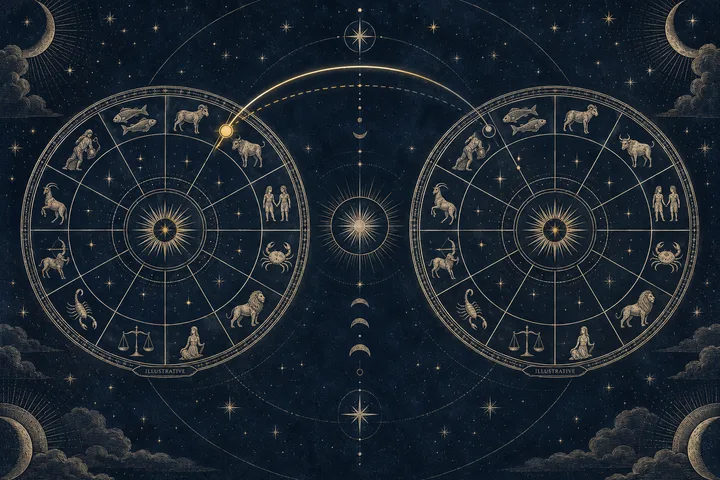
Consider an example. Imagine three supplied factors at 10° Aries, 13° Leo, and 17° Sagittarius. Their longitudes are 10°, 133°, and 257°. This is a geometric illustration, not a personal chart calculation.
Aries to Leo measures 123°, a trine with a 3° orb. Leo to Sagittarius measures 124°, a trine with a 4° orb. Aries to Sagittarius measures 113°, a trine by sign but with a 7° orb. An eight-degree setting can show all three sides. The six-degree setting keeps the first two and drops the third.
At six degrees, two trines remain. That is not a grand trine, because a grand trine needs three planets linked by three trines. The surviving contacts still have meaning, but the formal pattern has changed. Say so plainly.
Label each edge as natal or inter-chart when you work with a three-point figure. With two charts, one pair can belong within one person's chart while the other pairs cross between people. The geometry stays the same, but the reading does not. The same audit works for a T-square, grand cross, kite, or yod: list the required edges, tighten the orb, and count what remains.
Sources: An Introduction to Aspects and Chart Shaping in Natal Astrology; Aspects in Astrology: The Five Major Configurations
Rank the surviving contacts before the pattern name
Read the closest cross-chart contact first. Then read the next closest. After that, consider the planets and the aspect type. This order stops a loose configuration from overshadowing a sharper relationship exchange.
The planets name the territory. Moon contacts bring feeling, comfort, and instinctive response into focus. Venus contacts speak to affection, pleasure, values, and receptivity. Mars contacts bring desire, initiative, heat, and action into the bond.
The aspect names the movement. A conjunction combines. An opposition creates polarity. A square creates pressure that may demand skill. A trine offers ease that can be used or taken for granted. A sextile offers an opening that still needs participation.
Then look for repetition. If two close contacts both involve Venus, a wider Venus edge may echo a theme already present. It still does not become as close as the other two contacts. Repetition gives it context, not a new degree.
Sources: How to Judge Aspects in Your Birth Chart; Aspects in Astrology: The Five Major Configurations
Add signs and motion as secondary layers
Once you know which contacts survive, add sign style. A trine between fire signs may move through enthusiasm and quick action. A trine between earth signs may favor steadiness and practical follow-through. The sign describes how the planetary exchange behaves. It does not repair a side that misses the stated orb.
Applying means the planets are moving toward exact contact. Separating means they have passed exactness. Some astrologers give applying contacts more immediacy, while others treat the distinction as a refinement. Do not use motion to rescue the arithmetic. A 7° contact does not become a six-degree contact because it is applying.
If motion is unavailable, leave it out. A missing input is a boundary, not an invitation to guess. Keep the sequence clean: degree distance first, planet pair second, aspect dynamic third, sign style and motion after that.
Sources: An Introduction to Aspects and Chart Shaping in Natal Astrology; Aspects in Astrology: The Five Major Configurations; Estimation of aspect orbs by the computer
Give the strongest exception its proper place
A wider contact deserves a second look when it involves the Sun, Moon, or an angle, or when it repeats a theme already shown by close contacts. Many astrologers allow luminaries and angles more room because of their prominence. The exception is meaningful, but it does not change the measured distance.
A 7° Moon contact may add emotional context under a wider lunar allowance. In this report, it remains contextual if the selected comparison uses six degrees. You can say why it matters and still keep it outside the core aspect list.
Angles require care when birth time is uncertain. A rounded or missing time can change an Ascendant or Midheaven degree enough to alter the contact. Since this offering uses supplied placements and optional degrees, mark an unstable angle as unavailable for a precise pattern judgment.
Prominence is not a blank cheque. It earns a note, not a hidden rule change.
Sources: An Introduction to Aspects and Chart Shaping in Natal Astrology; How to Judge Aspects in Your Birth Chart; Estimation of aspect orbs by the computer
Turn the broken shape into a relationship question
A broken pattern gives you a narrower question. Instead of asking, 'Do we have a grand trine?', ask, 'Which exchange comes easily, and where does the missing side ask for practice?'
Imagine Maria and her partner have two surviving trines. One links her Moon with his Venus. The other links her Venus with his Mars. The third link is 7°10' wide and sits outside the six-degree scope. The reading now points to two conversations: how comfort becomes affection, and whether attraction becomes steady action.
For the Moon-Venus contact, ask who reaches for comfort and how the other responds. For Venus-Mars, ask whether chemistry becomes time, touch, plans, and follow-through. Those questions turn symbolism into something the couple can notice without assigning motives or predicting an outcome.
Keep a short record: the close contact, one observable scene that fits it, and one action to try. If the theme becomes clearer after a real conversation, keep it in view. If it stays abstract, stop enlarging it because the pattern name sounds impressive.
Choose headline, supporting note, or omit
Finish the comparison with a simple decision. Put the pattern in the headline only when every required side survives the declared orb. Put it in a supporting note when a wider edge adds a clear luminary, angle, or repeated theme. Omit it when it contributes only visual drama.
Before you decide, compare the reports' shared ground. A contact that qualifies under both settings belongs in the main reading. A contact shown only by the wider setting belongs in the method note. Check the zodiac, aspect list, maximum orb, and whether one report includes points or minor aspects the other leaves out.
Then write three sentences. Name the closest surviving contact and its subject. Name the next contact and the behavior it invites you to notice. State what the wider edge adds, if anything. Sign placements can describe style. Supplied degrees can rank measurable contacts. Missing degrees cannot support a precise closed pattern.
When you have enough information, the Synastry Comparison Report can help compare Moon, Venus, and Mars placements, optional degrees, selected major aspects, and the six-degree method.
Sources: An Introduction to Aspects and Chart Shaping in Natal Astrology; How to Judge Aspects in Your Birth Chart
A little more clarity
Should I ignore a synastry pattern if it disappears at a tighter orb?
Don't ignore every contact. Remove the formal pattern from the lead interpretation, keep the aspects that survive your chosen orb, and treat the wider edge as background. A luminary, angle, or repeated theme may justify a short note, but it doesn't change the measured degree distance.
What orb does this synastry comparison use?
The Synastry Comparison Report uses a stated six-degree orb for selected major aspects among supplied placements, with optional degrees. It doesn't calculate a full natal chart, houses, or missing birth data. Other astrologers may use different allowances, especially for the Sun, Moon, or angles, so name the method before interpreting the pattern.
Sources & further reading
- An Introduction to Aspects and Chart Shaping in Natal Astrology
Defines an aspect as a distance between chart points, explains orb as deviation from exactness, and describes the required geometry of major patterns such as the grand trine, T-square, kite, and grand cross.
- How to Judge Aspects in Your Birth Chart
Supports ranking tighter aspects first, interpreting planets before labels, and giving wider contacts attention when luminaries, angles, or repeated themes provide context.
- Aspects in Astrology: The Five Major Configurations
Provides a primary teaching reference for major aspect dynamics and the role of aspects in interpreting larger astrological configurations.
- Estimation of aspect orbs by the computer
Documents variation in historical and contemporary orb recommendations, including differences in synastry practice and approaches to applying and separating contacts.
Synastry Comparison Report
Enter known placements for two people. Get an input-by-input comparison, selected aspect calculations and a clear record of what remains uncertain.
Compare our placements