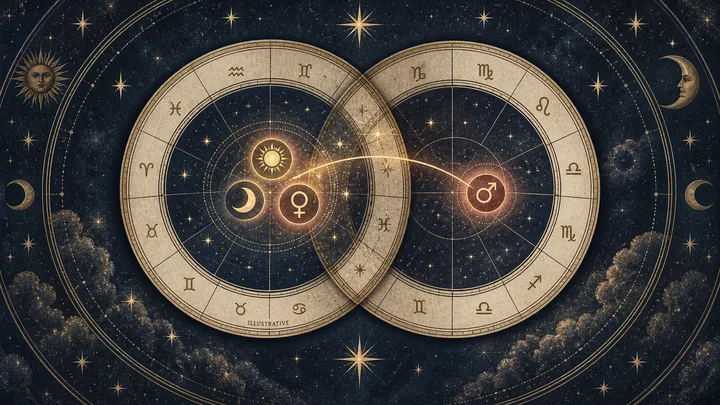
Imagine Maria, whose partner seems to touch every nerve
Imagine Maria has a natal stellium in Gemini: the Sun, Mercury and Venus gathered in one sign and working through one crowded part of her chart. She meets Daniel, whose Mars makes a close conjunction to her Venus. He is direct. He starts conversations, moves plans forward and turns a quiet evening into an argument or an adventure before she has decided which one she wants. Maria doesn't experience his Mars as a single clean note. She hears it through her Venus, but also through her Mercury and Sun. Desire, conversation and self-expression arrive together.
That is the case underneath the question. Why can one person's planet feel bigger than the aspect alone would suggest? The answer is not that a stellium guarantees obsession, harmony or a destined bond. It is that the receiving planet already belongs to a concentrated natal system. A partner who contacts one member of that system may stir the cluster's shared sign, house and internal relationships. The partner's planet becomes a visitor in a busy room, not a voice speaking into an empty one.
Maria might say that Daniel makes her feel more alive. She might also say that she can't think clearly around him. Both descriptions could belong to the same synastry pattern. A Mars contact can energize Venus, while the same contact presses Mercury to answer quickly and the Sun to defend its position. The interpretation changes with the planets involved and with the condition of the natal stellium. A cluster containing Venus and Jupiter offers a different field from one containing Venus and Saturn, or Mars and Pluto.
Keep Maria's story clearly illustrative. No personal birth chart has been calculated here. The point is to watch the sequence: identify the natal cluster, locate the partner's contact, notice which planet receives the closest aspect, then ask what the surrounding planets add. That sequence keeps the reading specific. It also prevents the common mistake of calling every strong feeling a synastry stellium.
First, decide what counts as the natal stellium
Astrologers use the word stellium for a concentration of planets. Astrodienst's Astrowiki describes it as a conjunction between more than two planets, while also noting that some astrologers use the term for more than three. Astrology.com uses three or more planets in one sign, with a wider count sometimes used when the Sun or Moon is included. The definitions overlap, but they aren't identical. State your rule before you interpret.
For this article, use a practical modern rule: three or more natal planets gathered closely by sign or house, with at least one meaningful chain of conjunctions. A sign-based cluster can spread across a house boundary. A house-based cluster can include planets in neighboring signs if the conjunctions remain intact. These are not interchangeable claims. Sign tells you the style of the energy. House tells you where it presses into life. The actual degrees tell you how tightly the planets are bound.
The planets matter more than the label. A Sun-Mercury-Venus group has a different center of gravity from a Moon-Saturn-Pluto group. The first may join identity, thought and affection. The second may join feeling, restraint and deep pressure. Those phrases are interpretive shorthand, not fixed verdicts. Read the aspects within the natal group before deciding whether its energy flows easily or requires work.
Also separate a true concentration from a chart that merely has two planets in the same sign. Two planets can form an important conjunction, but calling every pair a stellium makes the word too broad to help. A partner's planet can still matter enormously in a two-planet conjunction. The question here is narrower: what changes when that contact lands in a natal cluster with several planets already sharing one field?
If the chart data came from a source, record the planets and degrees rather than relying on a wheel image. If the birth time is uncertain, don't assign houses with confidence. A natal stellium can be judged by sign and planetary degrees even when house placement is unavailable, but house overlays and angularity need a reliable time. Precision makes the interpretation stronger.
A natal stellium changes synastry by giving the partner's planet more than one natal pathway into your chart. If their Venus, Mars, Moon, Mercury or Saturn closely aspects one planet in your stellium, it can also activate the other planets around it because those planets already work as a connected natal cluster. The feeling may be concentrated, immediate or hard to separate into one simple reaction. But the whole stellium isn't automatically contacted. Start with the exact planet-to-planet aspect, use a six-degree orb for this comparison, then read the stellium's sign, house and natal condition. A close Venus contact to a Sun-Venus-Mercury stellium describes a different experience from a wide contact to a Saturn-Pluto cluster. Use the reading to name what gets activated and what conversation it calls for. It can't decide the relationship for you.
Sources: Stellium - Astrodienst Astrowiki; Conjunction - Astrodienst Astrowiki
The partner's planet enters an existing system
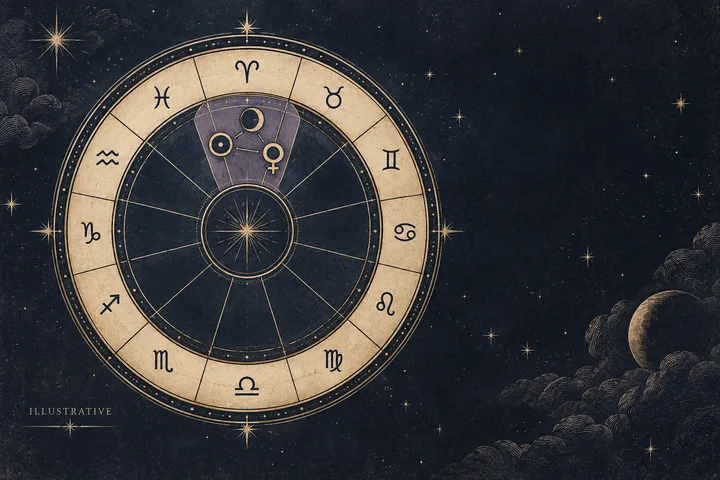
Synastry compares two natal charts side by side or by overlay. That matters because the partner's planet keeps its own meaning while it also activates something in the other person's chart. A Venus person brings Venus themes: attraction, taste, affection, pleasure and values. A Mars person brings heat, pursuit, action, irritation and desire. The natal stellium decides what those themes meet when they arrive.
A partner's planet does not erase the planet it contacts. If his Moon conjuncts your Mercury inside a Gemini stellium, the Moon still describes his emotional style, and your Mercury still describes your way of thinking and speaking. The contact creates an exchange. Because your Sun and Venus sit nearby, your mind may not remain separate from your identity or your affection. His moods can become part of the conversation. Your words can feel personal to him. Your response may involve more than one natal function at once.
This is why the receiving person can experience the contact as layered. The planet person may act in a way that repeatedly wakes the cluster. The stellium person may then respond through the whole group, even when only one member is technically within the chosen orb. A Venus contact can draw out the Sun's wish to be valued, Mercury's wish to name the feeling and Mars's wish to pursue it. That is a synthesis of chart factors, not a claim that Venus becomes every planet.
The strongest version of this effect appears when the partner's planet forms more than one close aspect to the cluster. Suppose his Venus is within six degrees of your Sun and Mercury, and your Venus sits just beyond that range. Venus then directly activates the Sun and Mercury, while your natal Venus remains part of the context but not an equally exact synastry contact. Rank the aspects. Don't flatten them into a single statement such as ‘he activates your stellium.’
The question to ask is simple: what does his planet touch first, and what does that first contact recruit? That gives you a usable interpretation. It also keeps the chart from becoming a bag of symbols where every planet means everything.
Sources: Synastry: Planet Overlays in Houses - Cafe Astrology; Comparative Astrology - Astrodienst Astrowiki
A worked example: Mars meeting a Sun-Venus-Mercury cluster
Consider an illustrative comparison rather than a real couple's chart. Your natal Sun is at 12 degrees Gemini, Mercury at 16 degrees Gemini and Venus at 20 degrees Gemini. A partner's Mars is at 17 degrees Gemini. Using a six-degree orb, his Mars is conjunct all three planets: five degrees from your Sun, exact with your Mercury and three degrees from your Venus. The contacts are not equal. Mercury receives the tightest hit, then Venus, then the Sun.
Start with Mars-Mercury. His way of acting meets your way of thinking and speaking. You may feel pushed to answer, decide or say the thing you were still shaping. This can be lively and sexually charged when both people enjoy candor. It can also become argumentative if his urgency makes your mind feel invaded or if your words sharpen his impulse to fight. The aspect describes activation. It doesn't choose the behavior.
Then read Mars-Venus. His pursuit touches your attraction pattern. The chemistry may be easy to notice because desire and response are speaking directly. Yet Venus also values peace, taste and reciprocity. Mars can make the bond exciting while making your standards visible. You may discover what you want because he acts. You may also discover what you don't want because he acts too quickly.
Finally, read Mars-Sun. His energy reaches your sense of self. You may feel seen, challenged or provoked into greater confidence. If the natal Sun is already central to the stellium, his Mars can make the whole cluster feel personal. A disagreement about timing may sound like a disagreement about your freedom, your intelligence or your desirability. The interpretation grows through the chain, but the chain starts with separate contacts.
Now change one detail. Keep the same natal cluster, but move his Mars to 25 degrees Gemini. It is five degrees from Venus, nine from Mercury and thirteen from the Sun. Within this article's six-degree scope, Mars contacts Venus only. You might still feel that he affects the whole Gemini part of your life because Venus is embedded there, but the precise reading is narrower. The attraction layer leads. The mind and identity layers become secondary context, not equal evidence.
This is the useful comparison. A stellium broadens the meaning of a close contact, but degree distance tells you how far that meaning travels. Use the cluster to add context. Use the orb to rank the contact.
Sources: Conjunction - Astrodienst Astrowiki; Aspect - Astrodienst Astrowiki
Which partner planet is doing the activating?
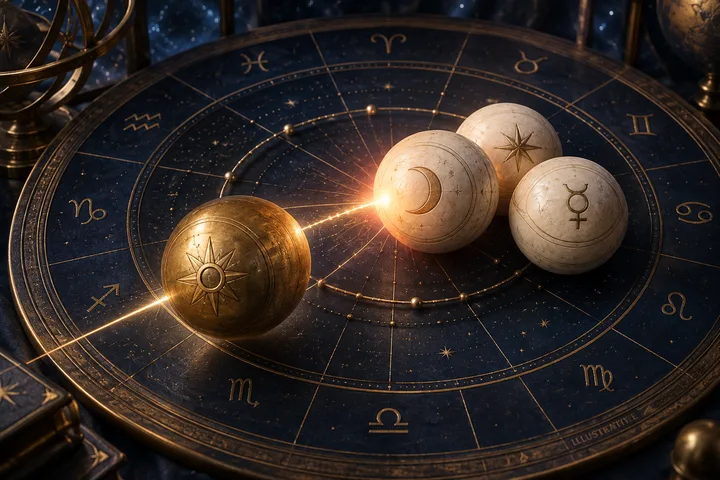
The partner's planet sets the first question. What kind of force is entering the natal cluster? The answer changes the felt experience even when the aspect and distance stay the same.
A partner's Sun can illuminate the stellium. If it contacts your Venus, you may experience his presence as affirming or personally attractive. If it contacts Saturn in the cluster, his identity may also bring your duty, fear or standards into view. A Sun contact tends to make the receiving pattern visible. It can feel warm. It can also make the relationship touch your pride.
A partner's Moon can bring emotional weather into the cluster. With natal Mercury, his moods may enter conversation. With natal Mars, his needs may stir your instinct to protect, defend or act. With natal Saturn, his vulnerability may meet your caution. A Moon contact often feels immediate because it works through response, habit and comfort. The house and natal condition still decide whether that immediacy feels safe, demanding or both.
A partner's Mercury activates thought, speech and interpretation. In a Sun-Mercury-Venus stellium, Mercury can make the relationship feel mentally intimate. In a Moon-Saturn-Pluto cluster, it may pull private material into words before either person feels ready. Ask whether the conversations clarify the cluster or merely keep it busy. More talk isn't always more understanding.
A partner's Venus draws attention to affection, attraction and values. In a Mars-Venus-Saturn cluster, Venus may soften Mars and invite Saturn to trust, or it may expose tension between desire and restraint. A partner's Mars adds heat, initiative and conflict. It can awaken Venus, press Mercury to answer and challenge the Sun to stand its ground.
Jupiter tends to enlarge what it touches. Saturn concentrates through commitment, delay or weight. Uranus brings surprise and freedom. Neptune can make the contact subtle, idealized or difficult to define. Pluto intensifies and exposes. These are starting meanings. They become useful only when joined to the natal planet, its sign and its existing aspects.
The same partner planet can feel different when it contacts different members of one stellium. Venus to the Sun may feel validating. Venus to Saturn may feel serious. Venus to Mars may feel desirous. If all three contacts are close, the relationship can carry all three tones. Rank them instead of searching for one label.
Sources: Stellium - Astrodienst Astrowiki; Conjunction - Astrodienst Astrowiki
The sign and house tell you where the cluster speaks
A natal stellium is not only a pile of planets. Its sign gives the shared language, and its house gives the life area where that language keeps returning. A partner's planet may therefore feel strong because it enters a sign you already inhabit deeply, a house you already prioritize, or both.
Take a Taurus stellium. A partner's Mars contacting the cluster may activate questions of pace, touch, money, reliability and physical comfort. Mars still pursues and provokes, but Taurus asks whether the pursuit can become steady enough to trust. In an Aquarius stellium, the same Mars contact may activate independence, friendship, ideas and the need for room. In Scorpio, it may press intimacy, privacy, loyalty and control. The sign doesn't replace the planet. It colors the way the planet is lived.
The house adds the setting. A third-house stellium can make a partner's planet show up through messages, errands, learning, siblings or daily conversation. A fifth-house stellium can turn the contact toward romance, pleasure, creativity and play. A seventh-house stellium may make partnership itself a central topic. An eighth-house stellium can bring shared resources, trust, vulnerability and boundaries to the surface. These are fields of experience, not guaranteed events.
Now reverse the angle. Your stellium can also fall into a house of your partner's chart. That overlay describes another layer of the exchange. Cafe Astrology's account of house overlays treats the planet person as bringing the planet's energy to the house person's life, while the house person tends to experience the planet through that house's concerns. The roles can move, but they shouldn't be confused. Your natal stellium may explain why his planet feels concentrated to you, while your planets landing in his fourth or seventh house may explain where he experiences you most strongly.
Don't assign that overlay if the birth time is missing or uncertain. The report this article supports uses supplied placements and optional degrees. It doesn't calculate houses from birth details. If you know only sign placements, stay with sign-based synthesis and planet-to-planet aspects. A clean limitation is better than a dramatic house claim built on a guessed Ascendant.
Sources: Stellium - Astrodienst Astrowiki; Synastry: Planet Overlays in Houses - Cafe Astrology
Degrees and orbs decide how much of the stellium is involved
The word ‘activated’ needs a measurement. Astrodienst defines an aspect as an angular relationship that operates within an allowed range called an orb. Astrologers use different orbs for different planets and traditions, so a synastry reading should name its rule. For this comparison, use a six-degree orb for selected major aspects. That scope is clear, repeatable and narrow enough to keep a broad stellium from swallowing the whole chart.
Begin with the closest contact. An exact conjunction between the partner's Venus and your natal Mars deserves more weight than a five-degree contact to your Sun and a nine-degree relationship to Mercury. The wider contact can still add color, but it shouldn't lead the paragraph. Exact and near-exact contacts tend to feel more immediate because the two chart factors are more tightly joined in the comparison.
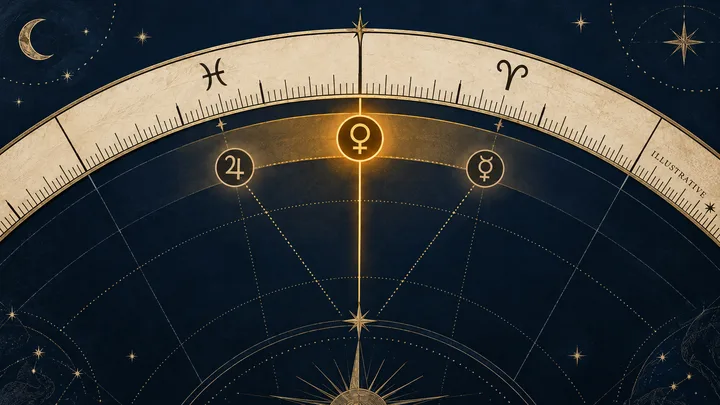
Next, check whether the partner's planet aspects more than one member of the cluster. A planet at 18 degrees can conjunct natal planets at 14, 19 and 24 degrees under a six-degree rule, but the contact at 19 degrees remains the anchor. You can describe the other contacts as a supporting chain. This is how you avoid calling the entire stellium equally triggered when the geometry says otherwise.
Then check the aspect type. A conjunction combines the energies directly. An opposition brings the partner's planet across an axis of attraction and tension. A square presses the two functions to act under friction. A trine may make the exchange flow with less resistance, while a sextile invites cooperation that still needs choice. Astrodienst lists conjunction, opposition, square, trine and sextile as the major aspects, with the conjunction treated as the strongest aspect in its glossary. The planets involved still determine whether that strength feels easy or demanding.
Finally, check for an out-of-sign or dissociate contact. Two planets can be close by degree while occupying signs that don't share the expected relationship. Astrodienst treats this as a special interpretive case rather than a reason to pretend the signs don't matter. If your method includes it, say so. The degree contact may operate, but the sign story changes. That is especially important when the partner's planet appears to activate a stellium across a sign boundary.
A useful worksheet has four lines: partner planet, natal planet contacted, exact distance, and aspect type. Add the sign and house only after those lines are complete. The order keeps the reading honest.
Sources: Conjunction - Astrodienst Astrowiki; Aspect - Astrodienst Astrowiki
The natal condition changes the tone, not the promise
A close contact tells you what is being stirred. The natal condition tells you what the stirred material already knows how to do. This is the strongest exception to the easy ‘stellium equals intensity’ reading. A crowded chart area is not automatically harmonious, romantic or overwhelming. Its planets may support one another, disagree with one another or carry a tension the person has learned to manage over time.
Suppose a partner's Moon contacts your natal Venus inside a Venus-Jupiter-Sun stellium. The Moon may feel welcome because it enters a cluster with clear routes toward warmth, affection and generosity. You may still need to ask whether Jupiter enlarges feeling past what daily life can hold, or whether the Sun wants recognition when the Moon wants quiet care. The contact has gifts and conditions.
Now replace Jupiter with Saturn. The partner's Moon may meet your capacity for commitment, but also your caution, fear of disappointment or habit of carrying responsibility. You might feel protective. You might also feel that his moods ask something of you. The Moon-Saturn contact doesn't decide that the relationship is cold. It says the emotional exchange touches a serious natal structure. How the two of you handle that seriousness becomes part of the lived picture.
A cluster can also contain its own hard aspects. If your natal Venus is square Saturn, a partner's Venus touching Venus may make affection feel both wanted and tested. His kindness can reach the tender place, but it can also bring the old question forward: can pleasure be trusted, or must it be earned? A partner's planet may not create the pattern. It may give the pattern a face, a voice and a current situation in which to work.
This is where a natal reading outranks a simple synastry slogan. Ask how the contacted planet behaves in the birth chart. Look at its sign, house, rulership if relevant, retrograde condition if supplied, and natal aspects. Then ask what the partner's planet adds. Synastry modifies the natal story. It doesn't replace it.
The strongest interpretation is often mixed. ‘His Mars activates your Venus’ is true but thin. ‘His Mars activates a Venus that already sits between a confident Sun and a quick Mercury, so desire becomes tied to being seen and answered’ gives the reader something to observe. Name the support and the pressure.
A natal stellium can broaden the way a partner's planet is experienced because the contacted planet belongs to a group. It can also make one life area more sensitive when the cluster occupies an emphasized house. What it can't do is tell you that the partner feels the same thing. His planet may be the activator while your stellium is the receiving field, and his own chart may describe a very different side of the exchange.
It can't prove compatibility in every practical sense, either. A powerful contact can describe attraction, recognition, pressure or growth while the couple disagrees about money, time, exclusivity, family or repair. The chart shows where energy gathers. It doesn't keep a promise, set a boundary or change a habit for you.
It also can't certify a soulmate story. The most vivid activation may reach a crowded, defended or unfinished part of the natal chart. A partner may feel unforgettable because he touches a major inner pattern. That can be meaningful. It still needs a human choice and a workable life.
The practical conclusion is firm: use the stellium to widen context, not to inflate certainty. The best reading says what the chart supports, names the exception and leaves the relationship decision with the people living it.
Sources: Stellium - Astrodienst Astrowiki; Conjunction - Astrodienst Astrowiki
Use this ranking when several interpretations compete
When a partner's planet touches a natal stellium, several readings can sound plausible at once. You need a rank order. Otherwise the interpretation becomes a cloud of attractive possibilities, and the reader leaves with no idea what to watch.
Rank one is the closest major aspect to a personal planet or luminary. Start with the exact contact and describe its lived function. Venus to Moon speaks first about affection and emotional response. Mars to Mercury speaks first about action meeting thought and speech. Saturn to Sun speaks first about identity meeting structure, responsibility or judgment. Keep the planet's job visible.
Rank two is the next close aspect to another member of the stellium. Explain how it modifies the first contact. If Mars touches Mercury most tightly and Venus second, the relationship may begin through verbal charge and then become physically or romantically significant. If Saturn touches Venus most tightly and the Sun second, affection may become a serious question about value, loyalty or self-respect.
Rank three is the shared sign and house. This is the setting that lets you understand why the contact keeps appearing in similar situations. It may show up in conversations, plans, intimacy, work or family matters. But it comes after the actual aspect. A fifth-house label shouldn't outrank a precise Mars-Saturn square simply because romance sounds more appealing.
Rank four is the wider natal pattern: rulership, retrograde motion if supplied, dignity in the tradition you are using, and the stellium's own aspects. These factors can explain why the contact feels easy, guarded, restless or intense. They refine the reading. They shouldn't bury the direct answer.
Rank five is the observable relationship question. What happens when the partner's planet is active? Do you speak more directly? Reach for reassurance? Want more freedom? Argue about timing? Share resources? This is where the astrology becomes useful. Compare the symbol with the repeated behavior, then decide what conversation would make the pattern healthier.
This order defeats the weaker habit of counting contacts. Three loose links don't automatically outweigh one exact conjunction. Synastry isn't a points system. It is a hierarchy of meaning.
Imagine Maria notices that Daniel's Mars makes her faster, sharper and more willing to initiate. She also notices that every disagreement becomes a test of whether she is being heard. The stellium reading gives her a language for the pattern, but it doesn't excuse the pattern. She still has to ask what Mars is doing in the relationship and whether the couple can use the energy without turning every meeting into a contest.
Keep one alternative explanation in the room: sometimes a partner's planet feels powerful because the situation itself is powerful. A new relationship can change sleep, attention, desire and decision-making. Shared work, distance, secrecy or a major move can concentrate the experience. The natal stellium may describe why that situation enters your identity, mind or values so quickly, but the context still matters.
The useful question isn't ‘Is this contact good or bad?’ Ask instead: ‘What does this contact ask us to handle well?’ Mars may ask for clean conflict rules. Saturn may ask for patience and explicit commitments. Uranus may ask for room. Neptune may ask for plain words. The planet names the work; the people choose the practice.
Use the strongest meaningful exception to pressure-test the reading. If the same partner planet also makes a supportive aspect to another part of your chart, the intense stellium contact may have a release valve. If the natal planet is already well integrated, the activation may feel productive rather than destabilizing. If your birth time is uncertain, house conclusions may weaken while sign and degree contacts remain useful.
A good synastry interpretation leaves you with a question you can answer through life. It doesn't trap you inside a label.
Sources: Conjunction - Astrodienst Astrowiki; Aspect - Astrodienst Astrowiki
Turn the reading into one honest conversation
After you rank the contacts, choose one conversation. Not five. A stellium can make a relationship feel full of themes, but the next step should stay small enough to take.
Before you compare the charts, write down the placements you actually know. List the natal stellium planets, their signs and their degrees if you have them. Then list the partner's Moon, Venus and Mars, along with any other planet you plan to study. Mark missing degrees instead of filling them in from memory. A reading becomes clearer when the chart record and the interpretation stay separate.
Next, circle the closest contact. Don't begin with the most romantic planet or the most dramatic house. Begin with distance. A three-degree conjunction to natal Venus leads a nine-degree contact to natal Mercury, even if Mercury sits in the same stellium. If the partner's planet misses the six-degree scope, call it background symbolism or leave it out of the direct aspect reading.
Then write two sentences for the contact. The first names the exchange in plain language: his Mars presses your Mercury to answer and act. The second names the natal context: Mercury belongs to a Gemini Sun-Mercury-Venus cluster, so the pressure can reach identity, attraction and self-expression as well as speech. This two-sentence habit stops the cluster from replacing the aspect.
After that, look for a counterweight. Is there a trine, sextile or supportive natal condition that gives the contact somewhere to go? Is there a square or opposition that makes the activation harder to carry? Is one person's birth time uncertain, weakening the house layer? The best exception may be the factor that keeps an intense connection from becoming a one-note story.
Finally, describe an observable moment. ‘You make me feel everything’ is too vague to test. ‘When you ask for an immediate answer, I feel desire and pressure at the same time, and I need ten minutes before I can speak clearly’ gives both people something to work with. Astrology becomes useful when a symbol can meet a moment without being forced to explain the whole relationship.
If you are comparing placements with a partner, agree on the question before you read the chart. Do you want to understand attraction, conflict, emotional safety, communication or pacing? The same stellium can answer each question differently because each question calls a different planet and house to the front. A focused question protects the reading from becoming an inventory of every possible meaning.
When degrees are missing, keep the language conditional. Say that the partner's Venus may be near the stellium, not that it certainly conjuncts every planet. When the birth time is missing, avoid houses and angles. You can still read the known signs and any reliable planet-to-planet aspects. Missing data narrows the chart. It doesn't make the known layer useless.
When the same planet contacts three stellium members, compare the order of exactness with the order of lived experience. A reader may feel Mars-Venus first because attraction is obvious, while Mars-Mercury is technically closer and explains the quick arguments underneath it. Let the chart lead, then let repeated behavior refine the emphasis.
If a partner's Venus activates your Sun-Mercury-Venus cluster, ask: ‘When you show affection, what kind of response are you hoping for from me?’ That question separates being admired from being understood. It gives the Venus person and the stellium person a chance to describe values instead of acting them out through guesses.
If his Mars activates your Mercury and Venus, ask: ‘When we disagree, do you want an answer now, or do we need time before we decide?’ The question respects Mars's speed and Mercury's need to process. It also tests whether attraction can survive a difference in pace.
If his Saturn activates your Moon or Venus, ask: ‘What does commitment look like in the next month, not in theory?’ Saturn responds to form. A clear plan may feel more loving than a grand promise. If his Uranus activates your stellium, ask: ‘How much independence helps this relationship stay alive, and what still needs consistency?’ Freedom becomes workable when it has language.
If the partner's planet touches a stellium in a private or hidden house, ask what can be said aloud. If the overlay lands in a practical house, ask how the pattern appears in routines, labor and time. If the cluster is near a house cusp and the birth time is uncertain, don't pretend the answer is settled. Name the sign and degree evidence, then leave the house question open.
The Synastry Comparison Report is useful at this point when you already have the placements you want to compare. It can organize supplied Moon, Venus and Mars signs, optional degrees and selected major aspects using a six-degree orb. It does not calculate a natal chart from birth details, assign houses, or decide whether a relationship will succeed. Use it to clarify the chart pattern before you have the conversation, not to avoid the conversation.
Compare the placement. Name the activation. Ask the question. Then listen to the answer.
Sources: Conjunction - Astrodienst Astrowiki; Aspect - Astrodienst Astrowiki; Synastry: Planet Overlays in Houses - Cafe Astrology
A little more clarity
Does a partner's planet activate an entire natal stellium?
Not automatically. Read the closest planet-to-planet aspect first, then note any other members of the stellium within the chosen orb. The rest of the cluster can add natal context, but it shouldn't be described as equally contacted unless the degrees support that claim. In this guide, the comparison uses a six-degree orb for selected major aspects.
Is a synastry contact to a natal stellium always intense or romantic?
No. The experience depends on the partner's planet, the natal planets involved, the aspect type, the sign and house, and the condition of the stellium. A Venus contact can invite affection, while Saturn may bring seriousness and Uranus may bring disruption or freedom. Intensity describes concentration. It doesn't guarantee compatibility or a lasting relationship.
Sources & further reading
- Stellium - Astrodienst Astrowiki
Supports the definition of a stellium as a concentration of more than two planets and its emphasis on the sign or house involved.
- Conjunction - Astrodienst Astrowiki
Supports the interpretation of conjunction as a direct blending of planetary energies and the term stellium for several conjunctions.
- Aspect - Astrodienst Astrowiki
Supports the major-aspect sequence and the definition of an orb as the allowed degree range around an aspect.
- Synastry: Planet Overlays in Houses - Cafe Astrology
Supports the distinction between planet-person and house-person roles and the two-way effect of house overlays in synastry.
- Comparative Astrology - Astrodienst Astrowiki
Supports synastry as a method of comparing or overlaying two natal charts in relationship astrology.
- Stellium in Astrology: Meaning, Houses, Definition - Astrology.com
Supports the modern sign-and-house reading of three or more planets as an intensified area of chart emphasis.
Synastry Comparison Report
Enter known placements for two people. Get an input-by-input comparison, selected aspect calculations and a clear record of what remains uncertain.
Compare our placements