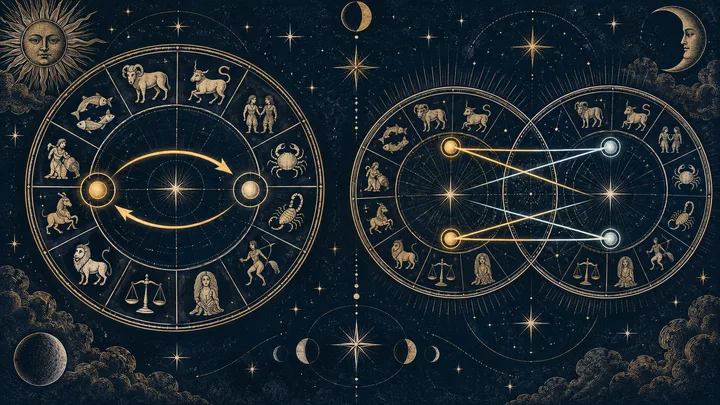
Mutual reception and a mutual synastry aspect describe two different kinds of connection. Mutual reception is a rulership exchange: one person’s planet occupies a sign ruled by the other person’s planet, and the exchange runs both ways. A mutual synastry aspect is a degree relationship between two planets across two charts, such as a conjunction, square, trine, or opposition. The first tells you how the planets host, answer, or depend on each other through signs. The second tells you how directly their functions meet through angle. They can occur together, but neither one creates the other. For a useful reading, identify the planets, check the signs, measure the degrees, then rank the exact aspect before asking how reception modifies it.
Start with the difference you can use
When two chart factors look connected, the first question is simple: what kind of connection are you seeing? If Venus in one chart is in Gemini and Mercury in the other chart is also in Gemini, you may see a shared sign theme. That alone is not mutual reception. You need a cross-chart exchange in which one planet occupies the sign ruled by the other planet. The sign has to belong to the planet you are tracing.
A mutual synastry aspect asks a different question. How many degrees separate the two planets? A conjunction brings them together at roughly 0 degrees. A sextile places them near 60 degrees. A square uses 90 degrees, a trine 120 degrees, and an opposition 180 degrees. The aspect is present when the actual separation falls within the chosen orb. It is geometry, not rulership.
That distinction matters in a comparison report. A close aspect tells you where the two chart functions meet. Reception tells you whether sign rulership creates an exchange around that meeting. They can appear together, but one never proves the other.
The word mutual needs care, too. Both people experience a synastry contact, but the planets do not exchange signs simply because the relationship feels reciprocal. Ask which evidence is on the page: a ruler relationship, an angular distance, or both. Once you separate those tests, you can rank the interpretation instead of letting one vivid label carry the whole reading.
A report becomes easier to discuss when the reader can point to the evidence. ‘Your Venus is in his Mars-ruled sign’ names reception. ‘Your planets are 2 degrees from a square’ names geometry. Those are different reasons, and each leads to a different question about how the relationship moves.
Sources: Definition of Mutual Reception in Astrology | AstroLibrary; Aspect - Astrodienst Astrowiki; A brief comparison of the use of reception by historical authors | Skyscript
What mutual reception actually requires
Mutual reception begins with sign rulership. Each zodiac sign has a ruling planet in the system you choose. In traditional Western rulership, Mars rules Aries and Scorpio, Venus rules Taurus and Libra, Mercury rules Gemini and Virgo, the Moon rules Cancer, the Sun rules Leo, Jupiter rules Sagittarius and Pisces, and Saturn rules Capricorn and Aquarius. Modern practice may add Uranus, Neptune, and Pluto as co-rulers for Aquarius, Pisces, and Scorpio. State your rulership scheme before you interpret the exchange.
The basic domicile example is easy to test. Imagine Maria has Mars in Gemini, while Daniel has Mercury in Aries. Mars is in Gemini, the sign ruled by Mercury. Mercury is in Aries, the sign ruled by Mars. Their planets are in mutual reception by domicile. Mars sends its action through Mercury’s sign, and Mercury sends its speech and thought through Mars’s sign. The two functions exchange rooms.
Notice what this example does not say. It does not say Mars and Mercury form an aspect. Gemini and Aries are separated by 60 degrees as signs, but the planets may sit at degrees that do not make a sextile within the selected orb. If Maria’s Mars is at 2 degrees Gemini and Daniel’s Mercury is at 28 degrees Aries, the distance is not a tight 60-degree contact. The reception still exists by sign rulership.
Traditional astrologers can also discuss reception through other essential dignities, including exaltation, triplicity, term, and face. Modern relationship reports often use the simpler domicile exchange because it is clear and reproducible. Neither approach should be smuggled into the reading. If the report uses only sign rulers, call it domicile mutual reception. If it uses a wider dignity system, name the dignity involved.
The host-and-guest image helps here. A planet in another planet’s sign is received by that ruler, as if it has entered the ruler’s house. In mutual reception, both planets host one another. That does not make them identical. Mars remains Mars and Mercury remains Mercury. The image simply shows why the planets can share resources, answer one another, or become more dependent on the same exchange.
In synastry, the exchange crosses a relationship boundary. One person’s planet is not being read only inside that person’s chart. It is being read in relation to the other person’s ruler. That can make the other person’s planet feel relevant to the first person’s expression. Still, relevance is not the same as control. Reception describes a link, not ownership of another person’s choices. It can show why one person’s style seems to call for the other person’s response. It cannot tell you that the response must be kind, loyal, or permanent. The dignity relationship gives the planets a channel; it does not remove choice from the reading.
Sources: Definition of Mutual Reception in Astrology | AstroLibrary; Reception - Skyscript Glossary
What a mutual synastry aspect actually measures
Synastry places one person’s chart beside another person’s chart and looks for contacts. A synastry aspect forms when a planet in one chart stands at a meaningful angular distance from a planet in the other. The planets do not have to be in each other’s signs. They only have to meet the chosen aspect angle closely enough for the method being used.
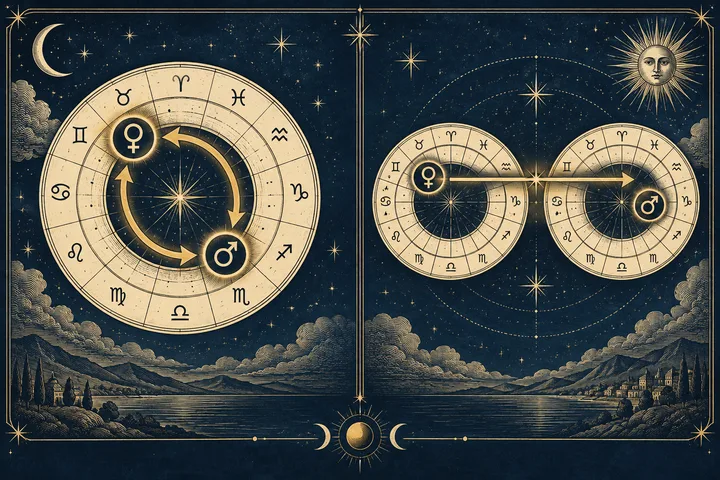
Consider an example. Maria’s Venus sits at 14 degrees Cancer. Daniel’s Mars sits at 16 degrees Libra. The planets are about 92 degrees apart, so they form a square with a 2-degree orb. Venus describes affection, taste, attraction, and the way someone gives value. Mars describes desire, initiative, heat, and the way someone pursues. The square gives those functions a direct but pressurized line between the charts.
Every synastry aspect belongs to the pair of planets, so both people participate in it. But the aspect is not called mutual because the planets occupy one another’s signs. That wording belongs to reception. Here, mutual simply means that one chart’s Venus and the other chart’s Mars form the same measured relationship when you read the pair from either side.
Aspects also have different jobs. A conjunction combines. A sextile offers a usable opening. A square creates friction that can demand action. A trine allows a fluent exchange that may need little effort. An opposition makes a polarity visible. These meanings guide the first interpretation, but the planets and their condition decide what kind of conjunction, square, trine, or opposition you are actually reading.
Do not let the aspect name do all the work. A Venus-Saturn trine may support loyalty and steadiness, yet it can also make a bond feel dutiful if affection becomes a responsibility. A Moon-Mars conjunction may create quick emotional response, but the result depends on the signs and the rest of the chart. The angle describes the meeting. The planets describe what meets. A reader can then add the signs, which show the manner of the meeting, and the orb, which shows how close the contact is to exact. That is enough to move from a label such as ‘square’ to a sentence that actually helps someone understand the relationship.
A synastry aspect is not a one-line personality label. It describes an interaction between two chart functions. Rank the contacts, then read the planets, signs, and orb together. That gives the couple a pattern to observe instead of a label to wear.
Sources: Aspect - Astrodienst Astrowiki; A brief comparison of the use of reception by historical authors | Skyscript
How to read the two connections together
When reception and aspect appear in the same pair, let the aspect establish the contact and let reception qualify its operation. Do not begin by declaring the exchange harmonious. Begin with the planets. Venus and Saturn do not tell the same story as Venus and Mars. A mutual reception involving the Moon and Saturn has a different emotional texture from one involving Mercury and Jupiter.
Imagine Maria has Mercury in Sagittarius and Daniel has Jupiter in Gemini. Mercury occupies Jupiter’s sign, and Jupiter occupies Mercury’s sign, so the pair is in domicile mutual reception under the traditional rulers. Now add the degrees. If Mercury and Jupiter sit near an opposition, the relationship combines exchange with polarity. The people may rely on one another’s thinking while disagreeing about facts, timing, teaching, travel, or what counts as proof.
The opposition does not cancel the reception. The reception does not erase the opposition. Instead, the exchange can give the tension a shared language. They may keep returning to the same debate because the planets are linked by both sign rulership and aspect. At its best, each person supplies the missing perspective. At its hardest, each person feels that the other has taken over the conversation.
A trine or sextile changes the route, not the principle. Mutual reception can make the contact feel more personally invested because the planets are already tied through rulership. A square can show a repeated problem that also contains a resource. The right reading is neither ‘reception fixes the aspect’ nor ‘the aspect makes reception irrelevant.’ The right reading asks what the exchange helps the aspect do.
If the planets are personal, bring the interpretation back to ordinary life. Mercury and Jupiter may show how the couple discusses meaning. Venus and Mars may show how desire and affection meet. Moon and Saturn may show how care, safety, and duty become linked. The chart does not choose the conversation for you. It shows where the conversation has the most symbolic weight.
Use a plain sentence when you combine them: ‘The aspect shows the meeting point; reception shows the kind of welcome or obligation around it.’ Then name the method. A sign-based exchange may be a background layer, while a stricter traditional judgment may ask whether the planets also behold one another. Precision keeps the layers from swallowing one another.
Sources: Definition of Mutual Reception in Astrology | AstroLibrary; Reception - Skyscript Glossary; Aspect - Astrodienst Astrowiki
A worked comparison: reception without a close aspect
Consider an example with known sign placements but no exact birth degrees. Maria has Mars in Gemini. Daniel has Mercury in Aries. Under traditional domicile rulership, Mars rules Aries and Mercury rules Gemini, so the pair forms mutual reception. You can interpret that relationship from the supplied signs. Mars pursues through Gemini’s questions, words, choices, and quick shifts. Mercury thinks and speaks through Aries’s directness, speed, and willingness to initiate.
What you cannot claim from those signs alone is a measured Mars-Mercury sextile. The signs point toward a possible relationship in the zodiac, but the aspect depends on the exact positions. If the planets are near the early degrees of their signs, the sextile may be close. If one is late and one is early, the separation may be wide or may fall outside the aspect you are testing. The same sign pair can carry different degree stories.
This is where reception earns its place. Even without a close aspect, the rulership exchange gives Mars a way to use Mercury’s resources and Mercury a way to use Mars’s resources. In lived terms, one person’s action may provoke a conversation, while the other person’s question may change the next move. The exchange describes a route between functions. It doesn’t decide whether either person will take it.
If the couple supplies degrees later, reopen only the question those degrees can answer. Measure the separation, name the aspect if one exists, and record the orb. A close sextile would add direct activation to the exchange. No close aspect would leave the sign-based relationship as the quieter background layer. The interpretation changes because the input changed.
There is also a tradition question. AstroLibrary defines mutual reception as planets in each other’s essential dignity and says the link can exist without an aspect. Skyscript’s traditional glossary describes reception through an aspect, while its historical survey records both sign-only and aspect-based treatments. Neither usage needs to be hidden. State the method in the report: ‘mutual reception by domicile’ names the sign exchange, while a stricter traditional reception judgment also asks whether the planets behold one another.
That single sentence prevents a false disagreement between reports. One astrologer may be cataloguing sign dignity. Another may be asking whether the planets also behold one another by aspect. Check the zodiac, rulership scheme, aspect list, orb, and branch of astrology before you compare their conclusions. Different settings can produce different labels without changing the placements.
For a sign-only comparison, write the result in layers: ‘Mars and Mercury exchange domiciles; their exact degree contact is not supplied; a stricter traditional reception judgment therefore remains open.’ That is precise without draining the reading of meaning. It tells the couple what the placements support now and what additional input would sharpen the next question.
A chart wheel can help you notice the pattern, but it shouldn’t decide the terminology for you. Use the rulership table for reception, the degree table for aspect, and the report settings for tradition. Then name the actual result. The same pair may be a sign exchange, a close aspect, both, or neither.
Sources: Definition of Mutual Reception in Astrology | AstroLibrary; Reception - Skyscript Glossary; A brief comparison of the use of reception by historical authors | Skyscript
A worked comparison: aspect without mutual reception
Now reverse the method. Maria has Venus at 14 degrees Cancer, and Daniel has Mars at 16 degrees Libra. The planets form a square with a 2-degree orb. That is enough to discuss a close Venus-Mars synastry contact in a degree-based report. The contact can describe attraction, initiative, irritation, and the way affection meets desire. It deserves attention because the angle is close and the planets are personal.
Venus in Cancer is not in a sign ruled by Mars, but Mars in Libra is in Venus’s domicile. That makes this one-way domicile reception: Venus receives Mars, while Mars does not receive Venus by domicile. In the traditional aspect-based use of reception, the close square supplies the contact that lets you name that reception. The square still stands on its own. It may show strong pull and strong difference at the same time. People can want one another and still disagree about pace, reassurance, privacy, or how openly desire should be expressed.
This example protects you from a second mistake: treating every compelling aspect as mutual reception. A close aspect can be vivid without a two-way exchange of dignities. Its meaning comes from the planets, the angle, the signs, and the wider chart context. Here, rulership adds a directional layer, not a second matching Venus-Mars domicile.
If another pair in the same comparison does form mutual reception, rank the contacts instead of blending them. A tight Venus-Mars square may describe what happens quickly between the two people. A wider reception between Mercury and Jupiter may describe the relationship’s way of making sense of itself. Both matter, but they answer different questions.
A useful comparison can hold attraction and difficulty in the same sentence. You do not need to turn a Venus-Mars square into a promise, and you do not need to soften it into a warning. Say what the contact brings: energy, pursuit, friction, desire, or a need to negotiate timing. Then ask whether another reception or aspect gives the pair a way to work with that energy.
The absence of reception isn’t the absence of connection. The square already connects the planets through a different rule. If the couple feels both drawn and irritated, ask how each person handles that charge. Don’t keep searching for a reception label after the aspect has already answered the technical question.

Sources: Aspect - Astrodienst Astrowiki; A brief comparison of the use of reception by historical authors | Skyscript
How degrees, orbs, and missing data change the reading
A reception reading can often begin with sign placements. An aspect reading cannot be finished without degrees. That is why a comparison based on supplied Moon, Venus, and Mars signs should label its scope clearly. Sign-only inputs can reveal rulership, element, modality, and broad sign relationships. They cannot prove a close conjunction, square, trine, or opposition.
An orb is the number of degrees by which a contact may differ from exact and still count as an aspect. Methods vary. This report uses a six-degree orb for selected major synastry aspects, so a contact is treated as active when its angular distance falls within six degrees of the exact aspect angle. A tighter contact gets more weight than one at the edge of the orb. The rule is stated so another reader can reproduce the choice.
Suppose a couple gives you Venus at 12 degrees Leo and Mars at 18 degrees Aquarius. That is a 174-degree separation, so it falls within six degrees of an opposition. The contact can be recorded as a 6-degree Venus-Mars opposition, but it should not be written with the same force as a 1-degree opposition. The aspect type is the same. The strength of the contact is not.
If one chart has rounded degrees and the other has exact degrees, keep the uncertainty visible in the wording. Do not invent a tighter orb. Say that the contact is possible within the supplied data, or ask for more precise placements. Missing birth time can also affect houses and angles, but this comparison does not calculate houses from birth details. Stay with the placements and degrees actually supplied.
The missing-data rule protects the reader from false precision. If you know that a planet is in a sign, you can discuss its sign expression and rulership relationships. If you know the degree, you can test an aspect. If you know the birth time, you may be able to add houses and angles, but that is outside this report’s scope. Each extra layer needs its own input.
Use the same standard for both charts. If Maria’s degree is exact but Daniel’s is rounded, the contact may be narrower or wider than the display suggests. Record the uncertainty instead of quietly choosing the most dramatic version. A comparison becomes more useful when both people know which conclusions are firm and which are waiting for better data.
Keep whole-sign contact and degree contact in separate notes. Two planets in signs that relate by sextile, square, trine, or opposition may describe a broad field of exchange even when their degrees are too far apart for the selected orb. That broader relationship can belong in the background. The degree aspect earns the stronger wording because it shows how sharply the pattern is activated.
Sources: Aspect - Astrodienst Astrowiki; A brief comparison of the use of reception by historical authors | Skyscript
The strongest exception: mutual reception is not automatically easy
Mutual reception is useful language, but it is not a promise of ease. The planets may exchange signs and still carry difficult responsibilities. Saturn receiving Venus does not turn every conversation into tenderness. Mars receiving Mercury does not guarantee calm speech. The exchange shows access between the functions. It does not remove the nature of the planets, the condition of their signs, or the pressure of an aspect.
The dignity involved changes the strength of the claim. Start with domicile, the planet’s own sign. A domicile exchange is the clearest form of mutual reception because each planet occupies the other’s home. Exaltation can create a meaningful exchange too, but it carries a different tone and weight. Triplicity, term, and face belong to the traditional dignity system as well, yet they’re narrower tools and need to be named rather than folded into a vague statement that the planets are simply ‘strongly connected.’
That ranking matters in synastry because readers often treat every two-way sign link as equal. They aren’t equal. ‘Venus in Mars’s domicile and Mars in Venus’s domicile’ is a specific claim. ‘The planets share a dignity relationship through triplicity’ is another. If a report uses traditional rulers only, keep the conclusion at domicile. If it includes the full essential-dignity table, record the exact dignity and whether both planets receive each other in the same way.
A hard aspect can make reception more important, not less. If two planets square while also receiving one another, the pair may keep meeting the subject they share. The square supplies pressure and motion. Reception supplies a channel through which the planets can answer each other. That channel can become a skill when both people name the pattern and practice a better response. It can also become a loop when each person uses the connection to excuse the same interruption, criticism, pursuit, or withdrawal.
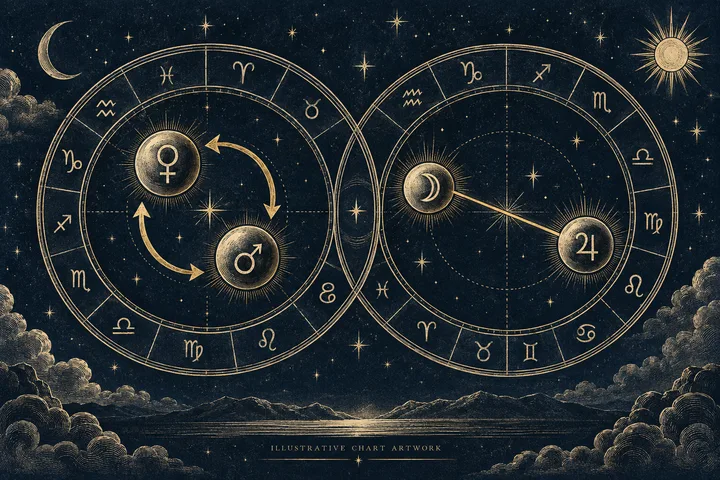
Imagine Maria’s Venus and Daniel’s Mars form a close square, with Daniel’s Mars in Libra, Venus’s domicile. That gives the pair one-way domicile reception, not mutual reception. Attraction may be strong, yet affection and initiative may arrive at different speeds. Maria may seek reassurance before moving closer. Daniel may pursue more directly and read hesitation as rejection. Reception doesn’t settle that difference. It tells you that Mars has entered Venus’s sign and can draw on Venusian resources. The square tells you why the route may feel charged.
The strongest exception is practical as well as technical. If the chart contact doesn’t match the recurring situation, don’t force it. Ask what happens in actual conversations, decisions, and moments of closeness. Then return to the planets. One couple may turn a Mercury-Mars link into lively problem-solving. Another may turn it into interruption and defensiveness. The contact gives the theme. Choice, maturity, timing, and the wider chart give it form.
This is why the final interpretation should describe both the resource and the work. ‘Reception helps’ is too broad. Say what it may help with: keeping a conversation open, finding a shared method, translating desire into action, or returning to care after strain. Then name the task shown by the aspect and signs. Mutual reception can help a difficult contact find cooperation, but it can’t make every use of that cooperation wise. Watch the behavior that gives the symbolism its shape.
Sources: Definition of Mutual Reception in Astrology | AstroLibrary; Reception - Skyscript Glossary
A ranking method for your own comparison
Build the comparison in two columns. In the first, write each person’s Moon, Venus, and Mars sign, followed by the exact degree when you have it. In the second, record what the data can actually establish: sign expression, rulership exchange, aspect, and orb. ‘Cancer and Libra’ is only a starting pair. ‘Maria’s Venus at 14 degrees Cancer and Daniel’s Mars at 16 degrees Libra’ gives you a relationship you can test.
Check reception before you attach a meaning to it. Ask whether Planet A is in Planet B’s domicile and whether Planet B is in Planet A’s domicile. If both answers are yes, record mutual reception by domicile. If you’re using exaltation, triplicity, term, or face, record that dignity separately. A shared element, a sign similarity, or two signs that look visually close on a wheel doesn’t create reception.
Now inspect degree geometry. Measure the shortest angular distance between each selected cross-chart pair. Compare it with 0, 60, 90, 120, and 180 degrees, using the report’s stated six-degree orb. Record the exact gap instead of writing only ‘close.’ A 1-degree square and a 6-degree square belong to the same aspect family, but the first usually has the sharper voice. If the degrees are rounded, mark the result as uncertain rather than choosing the tighter reading.
Rank the findings in this order: a tight major aspect involving personal planets, the signs and condition of those planets, then reception as a modifying relationship. This isn’t a law that erases the rest of the chart. It’s a clean starting order for a report that would otherwise give equal space to every line in an aspect table. A wider contact can rise in rank when it repeats a larger pattern or matches the couple’s central question.
Then translate the top contact into something the couple can observe. If Mercury and Jupiter are in mutual reception, ask how you handle different beliefs, explanations, or decisions about timing. If Venus squares Mars, ask what happens when one person seeks reassurance and the other moves faster. If both patterns appear, ask whether the shared language helps you repair the friction or only restarts the debate.
A useful report can show its work in one compact sentence: ‘The Venus-Mars square is the closest major contact at 2 degrees; Cancer and Libra describe different needs around closeness; Mars is in Venus’s domicile, so reception runs one way; watch how pursuit and reassurance negotiate pace.’ The sentence doesn’t predict the relationship. It tells the reader why the interpretation took its shape.
Use the same method across both charts. Don’t give one person exact degrees and the other person rounded signs, then write as if the inputs have equal precision. Don’t count the same contact twice because the aspect table lists Venus-Mars and Mars-Venus separately. And don’t let a beautiful chart wheel outrank the degree data. The wheel helps you notice. The table lets you verify.
If you’re comparing reports from different tools, compare their settings before comparing their conclusions. Check the zodiac, the rulership scheme, the aspect list, the orb, and whether the report includes minor aspects or declination contacts. Two reports may look different because one displays a dignity relationship and the other displays only measured angles. Once the settings match, rank the contacts again.
When several contacts involve the same planet, read the repeated planet as the thread. A Venus-Mars square plus Venus-Saturn reception doesn’t describe two unrelated stories. Venus is the point where attraction, reassurance, restraint, and desire meet. Start there, then ask which contact is closest and which one best answers the couple’s actual question. This keeps a long aspect list from becoming a collection of equal-sounding fragments.
Sources: Definition of Mutual Reception in Astrology | AstroLibrary; Aspect - Astrodienst Astrowiki; A brief comparison of the use of reception by historical authors | Skyscript
What to do next with a synastry report
Use a report as a worksheet, not a verdict. For each important cross-chart pair, record the planets, each sign, the dignity relationship, the exact angular distance, and the chosen orb. Add one sentence about the lived question that made the pair interesting. This keeps a dramatic label from floating free of the evidence.
The report’s scope matters. This comparison uses supplied placements and optional degrees. It can discuss sign expression, rulership, selected major aspects, and a stated six-degree orb. It does not calculate houses or angles from birth details. If a placement is rounded, say so. If a degree is missing, leave the aspect unconfirmed rather than filling the gap with a guess.
Now write two separate conclusions. The first answers the technical question: ‘The planets exchange domiciles,’ or ‘The planets form a Venus-Mars square at 2 degrees.’ The second answers the interpretive question: ‘That exchange may help the couple return to dialogue,’ or ‘That square puts desire and reassurance on different tempos.’ Separating evidence from meaning makes both sentences stronger.
Choose one behavior to observe over the next few conversations. With Mercury and Jupiter linked, watch how you explain decisions, beliefs, or timing. With Venus and Mars in a close square, watch what happens when one person seeks reassurance and the other moves toward action. A useful observation has a beginning, a repeated pattern, and a point where either person can choose a different response.
If the pattern does not match the symbolism, don’t force the chart to win. Check the inputs first. Then check whether another personal-planet contact is closer, whether the dignity method changed, or whether the question belongs to a different chart layer. A mismatch is information. It may show that the chosen pair was interesting but not central.
The next step should fit the missing piece. Need to know whether the contact is exact? Confirm the degrees. Need to understand emotional timing? Compare Moon contacts with Venus and Mars. Need to know how the symbolism behaves? Test one recurring conversation instead of adding ten more aspects. Narrow questions produce cleaner readings.
Before you close the report, write one observation prompt. For a Mercury-Jupiter exchange, ask, ‘When we disagree about timing or meaning, do we become more curious or more certain?’ For a Venus-Mars square, ask, ‘What happens between the first request for reassurance and the next move toward closeness?’ The prompt should be specific enough to notice and open enough to allow a different answer next time.
The final decision is modest and useful. Name what is established, rank what is strongest, and choose the one question that better data or closer observation can answer. Mutual reception is a sign-based exchange in the method used here. A mutual synastry aspect is a measured angle across two charts. They can meet in one pair, but they never become the same thing.
Sources: Definition of Mutual Reception in Astrology | AstroLibrary; Aspect - Astrodienst Astrowiki; A brief comparison of the use of reception by historical authors | Skyscript
A little more clarity
Can mutual reception exist without a synastry aspect?
Yes. Mutual reception comes from sign rulership, so it can exist even when the two planets are not within the chosen orb of a conjunction, sextile, square, trine, or opposition. Exact degrees are still needed to decide whether an aspect is present. In that case, reception remains the supported conclusion and the aspect question stays open.
Is a mutual synastry aspect the same as mutual reception?
No. A mutual synastry aspect is a degree relationship between planets in two charts. Mutual reception is a two-way rulership exchange. They can appear together, but one does not prove the other. Use the aspect list for geometry and the rulership table for reception. Keeping those records separate makes the final interpretation easier to check.
Which should I read first, reception or the aspect?
Read the planets and the closest major aspect first when exact degrees are available. Then use mutual reception to explain how the planets may support, depend on, or complicate that contact. With sign-only placements, begin with rulership and state that degree-based aspects remain unconfirmed. Revisit the ranking if exact degrees arrive later or the recurring relationship pattern points to another planet pair. In practice, let the evidence set the order, and keep each conclusion proportional to the data you have.
Sources & further reading
- Definition of Mutual Reception in Astrology | AstroLibrary
Supports the distinction between mutual reception by essential dignity and a link that can exist even when planets are not in aspect.
- Reception - Skyscript Glossary
Supports the traditional host-and-guest framework for reception and distinguishes mutual reception by sign from reception through other dignities.
- Aspect - Astrodienst Astrowiki
Supports aspects as angular relationships and defines the orb as the permitted deviation from an exact angle.
- A brief comparison of the use of reception by historical authors | Skyscript
Supports the distinction between sign-based and aspect-based reception and the variation among traditional authors.
Synastry Comparison Report
Enter known placements for two people. Get an input-by-input comparison, selected aspect calculations and a clear record of what remains uncertain.
Compare our placements