
Imagine the attraction that seems to have no aspect
Imagine Maria has Venus in Aries and Daniel has Mars in Libra. They like each other quickly. Maria makes the first move. Daniel responds with charm, style, and a strong sense of timing. They can disagree about pace, yet the interest keeps returning. When they compare their charts, they find no close Venus-Mars major aspect. No conjunction. No square. No trine within the six-degree orb used for this comparison.
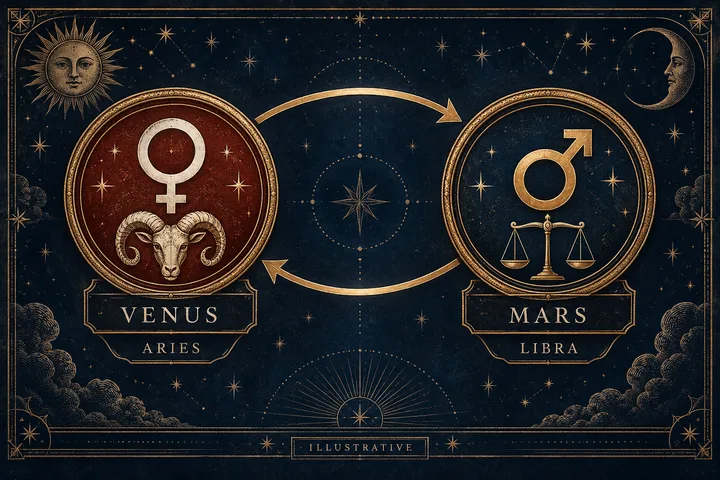
The first reaction is often disappointment. If there is no aspect, what is holding the story together? In this case, the answer is not hidden in a made-up degree or a compatibility score. It is in the signs. Aries belongs to Mars. Libra belongs to Venus. Maria's Venus is in Daniel's Mars sign, and Daniel's Mars is in Maria's Venus sign. The planets have exchanged homes.
That is mutual reception by domicile, sometimes called an exchange of signs. It gives Venus and Mars a route to one another through rulership, even when their exact degrees do not meet by a major aspect. The connection is real within the chosen astrological method. It is also limited. Mutual reception doesn't erase different speeds, different needs, or difficult planetary conditions.
This distinction matters because synastry has two separate questions. Can the planets see one another through aspect? And can they recognize, host, or support one another through rulership? A chart can answer yes to one and no to the other. Good interpretation keeps both answers visible.
For relationship planets, the exchange can feel like a shared language. Venus still describes affection, pleasure, taste, and what a person values. Mars still describes pursuit, desire, heat, assertion, and the way a person acts. Mutual reception doesn't merge those jobs. It lets each planet draw on the other's sign territory, so the two roles may stay relevant to each other even without a tight angular contact.
The strongest conclusion is simple: mutual reception can connect two planets without a major aspect, but it should be read as a supporting bond, not as a secret substitute for close geometry. That rule will keep the rest of the reading honest.
Sources: TAP Ep. 287 Transcript: Reception: A Mitigating Factor in Birth Charts; Reception - Skyscript Glossary; Understanding Planetary Dignity and Debility, Part 6: Reception
What mutual reception actually means
Start with rulership. In the traditional scheme, Mars rules Aries and Scorpio, Venus rules Taurus and Libra, Mercury rules Gemini and Virgo, the Moon rules Cancer, the Sun rules Leo, Jupiter rules Sagittarius and Pisces, and Saturn rules Capricorn and Aquarius. Modern astrologers may assign Uranus, Neptune, or Pluto as co-rulers or primary rulers of some signs. That choice changes which exchanges qualify. State the scheme before you interpret it.
Mutual reception happens when planet A occupies a sign ruled by planet B, while planet B occupies a sign ruled by planet A. Venus in Aries and Mars in Libra is the clean relationship example. Venus is in Mars's domicile. Mars is in Venus's domicile. Each planet is a guest in the other's house.
The guest and host image is useful because it explains the quality of the contact. A planet in another planet's sign operates in a field shaped by that ruler. If the exchange runs both ways, each planet has a reason to attend to the other. Astrologers may read that as mutual interest, cooperation, familiarity, or an ability to trade resources. The exact expression still depends on what the planets are doing elsewhere.
This is not the same as two planets simply sharing an element or modality. Venus in Aries and Mars in Libra qualify because of the rulers. Venus in Taurus and Mars in Virgo may share earth, but that alone is not mutual reception. Nor is a sign pairing enough if you use a different rulership system and the rulers no longer exchange signs.
The word mutual does important work here. It means the exchange has two directions. Venus in Aries is received by Mars because Aries is Mars's domicile. That fact alone describes reception, but not mutual reception. Mars must also be in Taurus or Libra, a Venus domicile, for the exchange to return. In a synastry comparison, keep the chart order straight. If Maria's Venus is in Aries and Daniel's Mars is in Libra, check Maria's planet against Daniel's sign, then Daniel's planet against Maria's sign. Don't let the word mutual hide a missing second test.
The exchange also differs from a conjunction. A conjunction joins planets in the same sign or very near the same degree. Mutual reception places the planets in different signs, often far apart in the zodiac, and links them through the rulers of those signs. A conjunction says, These functions are sharing a room. Mutual reception says, These functions are using one another's homes. The two images can appear together, but neither definition should swallow the other.
Reception also has wider forms. One planet can be in the other's sign, exaltation, triplicity, term, or face. Traditional authors did not treat every form as equal. Domicile reception is usually the clearest exchange of authority. Exaltation can add a high regard or a strong expectation. Triplicity, term, and face can refine the picture, but they carry less weight in a basic synastry guide.
For this article, keep the main claim narrow. Mutual reception means reciprocal sign dignity. It can create a relationship between planets even without a major degree aspect. It does not automatically make both planets strong, benefic, mature, or easy to live out. A useful reception gives the planets a channel. The planets' condition tells you what can travel through it.
That last sentence is the safeguard against overreading. A road connects two places. It doesn't tell you whether the road is smooth, blocked, steep, or crowded. Mutual reception is the road. Aspect, dignity, house placement, speed, and condition describe the journey.
Yes. In a sign-based synastry reading, mutual reception can connect two relationship planets even when they do not make a major aspect by degree. The link comes from rulership: each planet occupies a sign ruled by the other. For example, Venus in Aries and Mars in Libra exchange domiciles, so affection and desire have a shared route even if their degrees do not form a conjunction, sextile, square, trine, or opposition. Read that exchange as cooperation and mutual relevance, not as a replacement for an aspect. First verify the zodiac system and sign placements. Then rank the connection: a close major aspect gives the clearest contact, a sign-based aspect adds visibility, and the reception explains why the planets may still work together when the degree geometry is quiet. Finally check dignity, house context, retrograde motion, and the rest of the synastry. The practical next step is to compare the known Moon, Venus, and Mars signs, add degrees if you have them, and keep the interpretation specific to the planet pair.
Sources: TAP Ep. 287 Transcript: Reception: A Mitigating Factor in Birth Charts; Reception - Skyscript Glossary; Understanding Planetary Dignity and Debility, Part 6: Reception; Mutual Reception
Why the missing major aspect changes the strength
A major aspect is a relationship of angular distance. In the working method for this report, the major aspects are conjunction, sextile, square, trine, and opposition, tested with a six-degree orb when degrees are supplied. The orb is the allowed distance from an exact angle. A Venus at 14 degrees of Aries and a Mars at 18 degrees of Libra are 184 degrees apart, so they form an opposition within a four-degree orb. A Venus at 4 degrees of Aries and a Mars at 25 degrees of Libra are not within that six-degree opposition orb, even though the signs still face each other.
If Maria and Daniel have no major aspect by degree, do not say their planets have no relationship at all. Ask what kind of relationship is present. There are useful levels to rank.
The first level is mutual reception without a major aspect. The signs exchange rulers, but the planets do not make a close major aspect by degree. This gives a background connection. The planets can matter to one another, yet the exchange may appear indirectly through habits, preferences, or recurring themes rather than through an immediate push and pull.
The second level is mutual reception with a sign-based aspect but no close degree aspect. Traditional sign relationships can show that two signs see one another through conjunction, sextile, square, trine, or opposition by sign. The planets may occupy compatible or tense sign positions, even though their degrees are too far apart for the selected orb. This adds a visible style to the exchange, but it remains broader than a degree-based contact.
The third level is mutual reception with a close major aspect. Now the rulers exchange signs and the planets meet by degree. The connection is easier to locate in experience because the planets both recognize one another through rulership and directly engage through angle. A close applying aspect, in a traditional timing framework, adds another layer of movement. This article is about the no-major-aspect question, but the comparison helps you avoid treating every reception as equal.
The common mistake is to leap from the first level to the third. Someone sees Venus in Aries and Mars in Libra, notices the mutual reception, and writes as if the pair must behave like an exact Venus-Mars opposition. It doesn't. The reception links their meanings. It doesn't supply a degree contact that isn't there.
The reverse mistake is just as crude. Someone sees no major aspect and dismisses the pair. That misses the sign-based exchange. A quiet angle can still sit inside a meaningful rulership relationship. The right reading holds both facts at once: the planets are connected, and the connection is less immediate than a close aspect.
If degrees are missing, report the scope plainly. You can identify the sign exchange. You cannot rank the degree orb, applying direction, or exactness. If the sign itself is uncertain because a planet sits near a sign boundary, confirm the birth data before calling the exchange. Precision makes the interpretation stronger.
The absence of an aspect also changes how you write the timing. A close applying contact can describe something moving toward a clear meeting in a traditional judgment. A sign-only exchange does not give you that same degree-based movement. It describes a standing relationship between the planets. Use words such as connects, supports, repeats, or provides a route. Save words such as exact, immediate, and unavoidable for evidence that can carry them.
Sources: TAP Ep. 287 Transcript: Reception: A Mitigating Factor in Birth Charts; Reception - Skyscript Glossary; Mutual Reception; Mutual Reception Meaning in Classical Astrology
A worked Venus-Mars comparison
Consider an example with supplied placements only. Maria's Venus is in Aries. Daniel's Mars is in Libra. No degrees are available. We can identify a domicile mutual reception under traditional rulership, but we cannot test the six-degree orb or determine whether the planets form a major aspect. That is enough for a first reading, not a complete synastry judgment.
Venus in Aries tends to express affection with directness. It may value quick warmth, honest pursuit, and the pleasure of taking initiative. Mars in Libra tends to act through negotiation, attraction, social awareness, and response to the other person's style. These are not fixed personality labels. They are planet-in-sign descriptions. The chart owner still expresses them through the rest of the natal chart and through the actual relationship.
The exchange puts Venus in Mars's territory and Mars in Venus's territory. Maria's way of loving can activate Daniel's desire to act. Daniel's way of pursuing can speak to Maria's Venusian appetite for spark and attention. Each planet carries the other planet's sign language. This can make a relationship feel easy to restart after a pause, or make attraction return whenever one person takes a clear step and the other answers.
But the exchange can also show the friction it is trying to solve. Aries wants a clean move. Libra weighs the effect on both people. Venus in Aries may read hesitation as lack of interest. Mars in Libra may read blunt pursuit as pressure. Mutual reception gives them a shared route, but it doesn't choose the traffic rules. They still need to decide how direct is kind, how much deliberation is fair, and when a graceful compromise becomes avoidance.
Now add a second possibility. Suppose degrees later show Maria's Venus at 2 degrees of Aries and Daniel's Mars at 20 degrees of Libra. The sign exchange remains. The degree separation is too wide for a six-degree opposition. The interpretation stays relational but broad. The planets may describe an underlying attraction style without producing the constant charge of a close Venus-Mars opposition.
Suppose instead Maria's Venus is at 16 degrees of Aries and Daniel's Mars is at 19 degrees of Libra. The opposition is within three degrees. Now the same mutual reception has a direct channel. Maria's desire for a clear move meets Daniel's instinct to engage through the other person. Attraction can be stronger and more obvious, but so can the tug between self-assertion and compromise. The aspect doesn't replace the reception. It gives the reception a louder voice.
The comparison teaches the useful method. Keep the sign exchange fixed. Change only the degree information. If the reading changes from background relevance to active tension or attraction, you have found the role of the aspect. If your interpretation stays exactly the same in every version, you probably aren't giving geometry enough weight.
You can make the comparison even more concrete by separating trigger from pattern. A close Venus-Mars aspect may describe the immediate trigger: a glance, a message, a kiss, a challenge, or a quick change in pace. The mutual reception can describe the pattern underneath: each person's style gives the other a familiar route into action. Without the aspect, the pattern may surface through repeated choices rather than a constant charge. Maria may keep making direct invitations. Daniel may keep answering through a thoughtful adjustment. The exchange is visible in what they do with one another's style.
Now imagine the same signs with different lived behavior. Maria's Venus in Aries doesn't obligate her to pursue Daniel. Daniel's Mars in Libra doesn't obligate him to reciprocate. The placements describe available symbolism, not a confession from either person. If Daniel avoids clear plans, the chart can help describe the tension between his Mars sign and Maria's Venus sign. It cannot rewrite avoidance as romantic mystery. This is why a good synastry article ends with an observable question.
The same method works with Moon-Venus or Moon-Mars. Moon-Venus mutual reception can connect comfort and affection through sign rulers, even without a major aspect. Moon-Mars mutual reception can connect emotional response and action. Neither one proves emotional safety, sexual ease, or lasting commitment. It tells you where to look and what two planetary functions may keep handing one another the conversation.
How dignity and difficulty change the exchange
Mutual reception is not a blanket blessing. The condition of each planet matters. A planet in its own domicile has a different level of authority from a planet in detriment, fall, or no essential dignity. When two planets exchange signs, ask what each planet can actually offer from the sign where it stands.
Take the classic hard case: a planet in the other's difficult sign, with the second planet in the first planet's difficult sign. The exchange still exists by rulership, but neither planet may have much comfort in the other's house. Two people can understand each other's problem and still lack the resources to solve it. Mutual recognition is not the same as ease.
Venus in Aries and Mars in Libra is a good example because both planets are in signs opposite their traditional domiciles. Venus rules Taurus and Libra, while Mars rules Aries and Scorpio. In this exchange, Venus is in Mars's sign and Mars is in Venus's sign, but each planet is also in detriment by traditional dignity. That can describe a bond with real mutual relevance and a less settled way of expressing love or desire.
The reading becomes more constructive when another layer helps. A close harmonious aspect, strong house placement, support from benefics, or a planet with better dignity can give the exchange more usable strength. A hard aspect doesn't cancel reception either. It can describe a difficult contact that still has a reason to engage, negotiate, or protect the other planet's interests.
Exaltation reception deserves its own care. If one planet is in a sign where the other is exalted, and the second planet is in a sign where the first has dignity, some astrologers call that mutual reception by mixed dignity. It can show admiration, aspiration, or a tendency to place the other on a pedestal. It may feel uplifting. It may also create expectations neither person can maintain.
Minor dignities can refine rather than lead. Triplicity can speak to a shared elemental resource, especially when sect is part of the chosen traditional method. Terms and faces can add a narrow note. Don't let a weak dignity outrank a clear Venus-Mars sign exchange or a close major aspect. Rank the evidence. That is the difference between a chart reading and a catalogue of technical terms.
Retrograde motion and combustion, if you are using them, belong in the planet's condition rather than in the definition of mutual reception. A retrograde Venus can turn affection inward or make its values more reflective. A retrograde Mars can alter the timing and direction of action. Those factors modify how the planet carries the exchange. They don't create mutual reception by themselves.
Your useful question is not, Is mutual reception good? Ask instead, What can each planet give, what does it struggle to give, and what does the other planet keep asking for? That question produces a reading you can use.
It helps to write the condition in two columns. Under Venus, note the sign, ruler, dignity, degree contact, and the behavior it describes. Under Mars, do the same. Then draw the exchange between the columns. This small act stops a reception from becoming a floating compliment. It forces you to say what is exchanged and what remains difficult. For Venus in Aries and Mars in Libra, the columns might show direct affection beside diplomatic action, with mutual relevance between them and a shared difficulty around pace. That is already more useful than saying the couple has a powerful connection.
Don't use one difficult dignity as a final sentence. Venus in Aries may have trouble softening its directness, but that doesn't make affection impossible. Mars in Libra may hesitate before acting, but that doesn't make desire absent. The reception can show that each planet has access to the other's language even when neither speaks it perfectly. Add supportive contacts if they are actually present. Otherwise name the difficulty and let it stay difficult.
There is a second reason not to overpromise. Essential dignity describes the planet's condition within a sign, while synastry describes an exchange between two people's charts. A planet can be technically connected and still be badly placed for the topic at hand. If you have only the three personal-planet signs, you can discuss the exchange and its symbolism. You cannot infer the whole chart's strength, house emphasis, or life outcome. A narrow reading is not a small reading. It is a trustworthy one.
Sources: Reception - Skyscript Glossary; Understanding Planetary Dignity and Debility, Part 6: Reception; Mutual Reception; Mutual Reception Meaning in Classical Astrology
What the exchange can say about a relationship
A synastry reading translates planet-to-planet links into a field of interaction. It doesn't hand you a verdict about whether to date someone. Mutual reception is especially useful when a couple notices a repeated theme that a list of major aspects doesn't explain.
With Venus and Mars, look for the meeting between attraction and action. Who tends to express warmth first? Who responds by making a plan, changing the pace, or adjusting the social setting? A reception can show why the two roles keep returning to each other. It can also show where one person expects the other to carry a style of love or pursuit that doesn't come naturally.
With Moon and Venus, look at comfort and affection. The exchange may help one person's emotional habits find a language in the other's values. One person may offer care in the form the other recognizes as loving. But if their signs have different needs, the connection can remain indirect. Care may be present without being delivered in the preferred form.
With Moon and Mars, look at the link between feeling and response. The Moon notices and absorbs. Mars moves. Mutual reception can help one person's action answer the other's emotional cue. It can also make reactions quick. If the Moon feels pushed or Mars feels managed, the same route becomes a loop of provocation and defense. Check the actual behavior before assigning a noble meaning to the pattern.
A reception between relationship planets can bind two topics without making them identical. Venus doesn't become Mars. Mars doesn't become Venus. The person with Venus may not want to pursue, and the person with Mars may not know how to soothe. The exchange simply makes those roles more available to one another than a disconnected pair would be.
This is where house overlays would add context, but the brief's comparison scope may not include calculated houses. If you know reliable birth times and are working in a full synastry chart, the houses ruled by Venus and Mars can show which life areas are drawn into the exchange. If you only have supplied Moon, Venus, and Mars signs, stay with those planets and signs. Don't invent house topics.
The strongest practical use is conversation. If Venus-Mars reception is present without a major aspect, ask how each person prefers interest to be shown. If Moon-Venus is present, ask what comfort looks like when one person is tired. If Moon-Mars is present, ask what should happen after a sharp reaction. Astrology gives the pair a map of the question. The people still answer it.
An exchange can explain persistence. It cannot certify reciprocity in daily life. If one person never responds, never repairs, or keeps the other guessing, the chart cannot turn that behavior into mutual care. Read the astrology beside the lived pattern, with the lived pattern carrying the decision.
The same caution protects the reader from confusing intensity with compatibility. A reception may keep two planets in conversation, but conversation can be warm, argumentative, seductive, or exhausting. Venus and Mars can trade attraction and irritation. Moon and Mars can trade comfort and reaction. Moon and Venus can trade tenderness and unmet expectations. Name the tone from the signs, aspects, and condition you actually know. Never inflate the link because the technique sounds uncommon.
When the planets don't make a major aspect, look for repetition in small moments. Who changes the plan? Who chooses the setting? Who reaches out after a disagreement? Who asks for comfort, and what form does that comfort take? These questions turn an abstract reception into something a couple can observe. If the answers support the chart's symbolism, the interpretation gains weight. If they don't, revise the interpretation. Astrology is most helpful when it sharpens attention rather than replacing it.
You can also compare the direction of the exchange. Venus in Mars's sign may describe how affection enters the field of desire. Mars in Venus's sign may describe how desire enters the field of affection. The mutual reception makes both directions available, but they may not feel identical. One person may experience the bond as encouragement to act. The other may experience it as pressure to define feelings. Reversing the planet roles changes the lived emphasis, even when the signs are the same pair.
Sources: TAP Ep. 287 Transcript: Reception: A Mitigating Factor in Birth Charts; Reception - Skyscript Glossary; Understanding Planetary Dignity and Debility, Part 6: Reception
The clean reading sequence and the next step
When two relationship planets appear to connect without a major aspect, use a fixed sequence. It prevents the rare-sounding technique from taking over the entire reading.
First, name the planets and their jobs. Venus is not just romance. The Moon is not just feelings. Mars is not just sex. Say which pair you are reading and what each planet contributes: affection and values, emotional response and comfort, pursuit and desire, or another clear combination.
Second, verify the sign exchange. Write the sign of each planet. Identify the ruler of each sign under one stated system. Then check both directions. If Venus is in Aries, Mars must be in Libra for domicile mutual reception. If only Venus is in Mars's sign, you have one-way reception, not mutual reception. That difference matters.
Third, test geometry if degrees are available. Measure the angular distance. Check the conjunction, sextile, square, trine, and opposition against the six-degree orb used for this report. Record the exact or approximate orb instead of saying close when you can be precise. If degrees are absent, stop at sign-level analysis.
Fourth, rank the connection. A close major aspect leads. A sign-based aspect without degree contact comes next. Mutual reception without a major aspect remains meaningful, but it works as a background exchange. This ranking answers the reader's real concern: why does the pair matter, and how loudly should it speak?
Fifth, assess condition. Check dignity, retrograde motion, sect or other traditional factors only if your chart data and method support them. Ask whether each planet can act well in its sign. Note the strongest help and the clearest strain. Don't pile on every possible technique. More labels don't create more truth.
Sixth, translate the pattern into one observable question. For Venus and Mars, ask how interest becomes action. For Moon and Venus, ask how care is recognized. For Moon and Mars, ask what happens between feeling and reaction. A good interpretation ends in a choice the couple can make, not in a grand claim about fate.
If you are comparing known placements, enter the Moon, Venus, and Mars signs for both people and add degrees when you have them. A Synastry Comparison Report can organize the supplied placements, test selected major aspects with a stated six-degree orb, and show which conclusions depend on degree data. It won't calculate a natal chart from birth details, assign houses, or decide whether a relationship will succeed. Use it to make the comparison clearer.
Return to Maria and Daniel. Their Venus-Mars exchange explains why affection and pursuit keep finding one another. The missing major aspect lowers the volume. It doesn't erase the melody. Their next step is not to declare the connection exceptional. It is to ask a plain question: when one of us shows interest, what response makes the other feel met? Then watch the answer in real life.
If the answer is clear and mutual, the reception has given you a useful language for what is happening. If the answer is evasive, one-sided, or repeatedly painful, the chart has given you a different kind of information: the symbolic link is not enough to carry the relationship. Either way, you have made a decision based on a ranked reading rather than on the most flattering label.
Keep a short record of the comparison. Write the two placements, the rulership system, the degree information you do or don't have, the strongest contact, and the practical question. That record prevents a later report from quietly changing its orb or zodiac system to produce a more dramatic result. It also lets you return to the chart when new information arrives. Add degrees if you find them. Revise the ranking if the geometry changes.
If the two people use different labels for the same placement, settle that before reading. One chart may use tropical signs and another sidereal signs, or one source may use traditional rulers while another uses modern co-rulers. A mutual reception depends on the signs and rulers you choose. Write those inputs down. The interpretation should follow from them, not from whichever chart display looks most dramatic.
That written method also makes disagreement easier to understand. Two astrologers may use the same placements yet rank reception differently because one requires an applying aspect and the other reads sign exchange on its own. Name the method, then compare the results. You don't need to force one vocabulary into the other.
Mutual reception is valuable precisely because it is not loud by default. It notices the relationship between two planetary functions when a list of major aspects would leave a blank space. Read that blank carefully. Sometimes it contains a background exchange. Sometimes it contains a sign-level tension. Sometimes a degree contact appears after all. The method is to check, rank, and translate. Then let the relationship show you whether the symbolism has found a living form.
Sources: TAP Ep. 287 Transcript: Reception: A Mitigating Factor in Birth Charts; Reception - Skyscript Glossary; Understanding Planetary Dignity and Debility, Part 6: Reception; Mutual Reception
A little more clarity
Is mutual reception still valid if two planets do not aspect each other?
Yes, in the common sign-based definition. Two planets can be in each other's ruled signs without forming a major aspect by degree. That exchange creates a background relationship through rulership. In stricter traditional work, reception is often judged more fully when an aspectual contact also connects the planets, so separate the sign-level exchange from the stronger degree-based form.
Is mutual reception stronger than a major aspect in synastry?
Usually, you should not rank it above a close major aspect. A close conjunction, sextile, square, trine, or opposition gives the planets direct angular contact. Mutual reception adds a rulership bond and can explain cooperation or persistence, but it doesn't replace the aspect. Read both, then check each planet's dignity and condition.
Can Venus and Mars be in mutual reception without a Venus-Mars aspect?
Yes. Venus in Aries and Mars in Libra exchange domicile signs under traditional rulership, so they have mutual reception even if their degrees fall outside the selected major-aspect orb. The pair can still connect affection, values, desire, and pursuit. Without a close aspect, describe the bond as underlying or indirect rather than constant and electrically immediate.
What should I do if I know the signs but not the degrees?
Read the sign exchange and stop there for geometry. You can identify domicile mutual reception when both sign placements are known, but you can't confirm a six-degree aspect, exact orb, or applying relationship without degrees. Treat the result as a sign-level comparison and add degrees later if you want a more precise ranking.
Sources & further reading
- TAP Ep. 287 Transcript: Reception: A Mitigating Factor in Birth Charts
Supports the three-level distinction between sign exchange without aspect, sign-based aspect, and close degree-based aspect, plus the idea that reception can mitigate without erasing difficulty.
- Reception - Skyscript Glossary
Defines reception and mutual reception through dignity, the guest-host metaphor, and the mutual satisfaction associated with reciprocal reception.
- Understanding Planetary Dignity and Debility, Part 6: Reception
Supports ranking domicile, exaltation, and minor dignity receptions and explains why planetary condition still controls how much benefit an exchange can offer.
- Mutual Reception
Supports the concise definition of two planets placed in each other's essential dignity and the use of mutual reception as a link when planets are not in aspect.
- Mutual Reception Meaning in Classical Astrology
Supports reciprocal domicile reception as a two-way exchange and the caution that mutual reception creates a route for cooperation without automatically making either planet strong.
Synastry Comparison Report
Enter known placements for two people. Get an input-by-input comparison, selected aspect calculations and a clear record of what remains uncertain.
Compare our placements