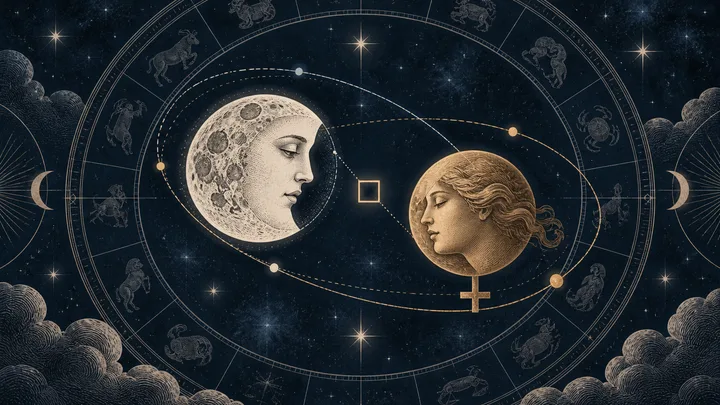
What a Moon-Venus square can say about a missed gesture
How can a loving gesture miss the person it was meant to reach? In synastry, a Moon-Venus square can give that gap a symbolic shape: one person's way of offering affection may not match the other person's need for emotional comfort. Imagine one partner arriving with a lively plan to celebrate, while the other had hoped for quiet company after a difficult day. The offer may carry warmth, yet its form may not answer the need in front of them. That difference is worth asking about. It isn't, by itself, a verdict on either person's care.
The Moon-Venus square describes a possible translation problem between two chart functions. In a synastry reading, the Moon belongs to one person's chart and Venus to the other's; their square places those functions in a tense relationship. The Moon side can bring questions of comfort and emotional security. The Venus side can bring a style of affection, pleasure, or appreciation. When the two meet through a square, an astrologer may look for a mismatch between what feels soothing and what feels loving. The aspect offers language for exploring the exchange, not a literal cause of it.
The Kerykeion guide, “Synastry Moon-Venus Aspects,” describes the square as a possible mismatch between emotional safety needs and the Venus person's values or affection style. It gives the example of quiet presence meeting social or material gestures, and notes that an affectionate style may not land as intended. That reading fits the imagined celebration only as one possibility: perhaps the plan expressed delight, while the other person wanted stillness. The scene doesn't establish what anyone truly felt. It helps show how intention and impact can differ without either one making the other false.
Satyori's “Moon Square Venus Synastry” also discusses mismatched timing, needs, and expressions of love, and advises readers to distinguish intent from impact. But its stronger statements about genuine affection, compelling attraction, or deepening effort go beyond what the symbolic contact alone can settle. A square can't prove that someone cares; it can't prove that they don't. Nor can it reveal why a person chose a particular gesture or foretell what the relationship will become. Those questions belong to what the people say and do, not to the aspect in isolation.
So begin with the exchange itself. What was offered? What was needed at that moment? Did both people describe the moment in similar terms, or did one experience a caring effort as pressure, distraction, or simply the wrong kind of attention? Then ask what chart information is actually available. Without degrees, a sign pairing may suggest a square relationship, but it doesn't verify the angular contact or its closeness. A verified square can add a useful symbolic vocabulary for a recurring mismatch. It shouldn't replace the conversation, or turn one missed gesture into proof of a whole relationship pattern.
A Moon-Venus square can symbolize friction between one person’s emotional comfort needs and another’s way of offering affection. A caring gesture may miss its intended mark, but the aspect alone can’t prove affection, explain anyone’s motives, or predict a relationship’s future. Verify the degrees and stated orb, then weigh the symbolism against available chart context and what both people say and do.
Sources: Synastry Moon-Venus Aspects - Learn Astrology; Moon Square Venus Synastry
Why a loving offer can miss the Moon's need
The Moon points to instinctive feeling, familiar comfort, and what may help someone feel settled. Venus points to attraction, pleasure, values, and ways of relating or showing appreciation. Neither planet is a complete portrait. Read together, they can help name a difference between what feels comforting and what feels loving to offer. A Moon-Venus square can symbolize friction between an emotional need and an affectionate style. It doesn't tell us who cares more, whether someone misunderstood on purpose, or how either person always behaves. It frames a question: what did the moment call for, what was offered, and how did the offer land? Imagine one person has had a hard day and wants quiet company: someone nearby, little pressure to explain, time to settle. The other arrives with a lively plan, a thoughtful treat, or an invitation to go out. That offer may come from warmth and a wish to bring pleasure into the evening. Yet the first person may experience it as too much activity when what they wanted was calm. Care and need can both be real. Their forms differ in that moment. This is an illustration, not a rule about how a square must appear. A different exchange could reverse the apparent roles. Someone might seek reassurance through steady presence while their partner offers praise, humor, or a graceful attempt to smooth things over. Those gestures can be affectionate and still miss the reassurance the moment calls for. The chart doesn't tell us what either person meant. A conversation does. The contemporary guide “Synastry Moon-Venus Aspects” describes the square as a possible mismatch between emotional safety needs and the Venus person's values or style of affection, where a gesture may not land as intended. That's an interpretation, not proof of a couple's experience. The guide contrasts quiet presence with social or material gestures. The point isn't that one form is better. An offer can express care on one register while the recipient is asking for another. To use that reading carefully, keep three moments separate. First, identify the need as the person describes it: comfort, reassurance, room to feel, welcome, or something else. Second, describe the offer without judging it: attention, a plan, a gift, praise, or an attempt to restore harmony. Third, ask how it was received. Someone can value an intention and still say the gesture didn't help. Another can feel cared for by an unexpected offer. Reception isn't a verdict on the giver's character. This sequence keeps Moon and Venus from collapsing into a vague idea of “love languages.” The Moon's symbolism isn't just a list of emotional demands, and Venus isn't a menu of romantic gestures. Each planet has a wider role in chart interpretation. Here, the narrower comparison is between familiar emotional settling and attraction, pleasure, value, or relating. Use those words as prompts, not labels for a partner. Imagine someone wants to be included in a small decision because shared consideration feels comforting. Their partner chooses a polished surprise, hoping to delight them. It may be generous and enjoyable, yet not answer the wish to be consulted. Or someone may want play, beauty, and a pleasant change of scene, while a partner shows care through practical steadiness. That steadiness may matter, while the person also longs for delight. Neither scene reveals a fixed Moon or Venus type. Each shows how distinct needs and offers can cross. The overview “Synastry Chart: Birth Chart Compatibility” treats comparison as layered: signs, planetary functions, aspects, and other chart factors contribute different information. That supports keeping the planets distinct before interpreting their contact. A square places the functions in a challenging relationship by aspect; it doesn't make them identical or dictate a single behavior. Signs, natal context, other contacts, and the people involved all shape how a theme is understood. Start with the exchange itself, not a planetary label. What was wanted? What was offered? What meaning did each person give it? If the answers differ, the chart may offer useful language for reflecting on that contrast. But the interpretation should remain open to what both people say. Quietness might mean someone needs space, or something else; a gift might express affection, apology, celebration, or simple enjoyment. The aspect can't choose among those meanings. This matters because an astrological description can become an assumption about intent. “Venus offered affection” is symbolic shorthand, not testimony. “The Moon needed comfort” is also a reading, not direct access to someone's inner life. Ask rather than decide for them. One person might say, “I wanted to make tonight enjoyable,” while the other says, “I needed a calm evening beside you.” Both accounts can coexist. Their difference gives the pair something precise to discuss. The square is best understood as a possible mismatch in emphasis: comfort may not arrive in the form that gives pleasure, or an affectionate offer may not answer the emotional question at hand. It doesn't reduce the contact to incompatibility. Nor should “different needs” excuse a pattern in which one person's requests never matter. The chart can help name a theme; the exchange shows whether each person listens, clarifies, and adjusts. A useful next question is small and specific. Instead of asking whether a partner is naturally caring, ask what response would help in a particular situation. “When I come home upset, would you sit with me first, then suggest a plan?” is more actionable than “You never understand what I need.” The other person can make a matching request: “When I plan something for us, could you ask whether I want company or a quiet night?” These are illustrative prompts, not scripts. The aim is to replace guessed meaning with a request the other person can answer. If both people recognize the contrast in recurring moments, the Moon-Venus symbolism may be a fitting lens. If they don't, don't force it. A square can suggest where two chart functions may rub; it can't establish that a gesture was loving, unwelcome, or misunderstood. Begin with what each person says they needed and offered. Then see whether the astrological language clarifies the difference or obscures it.
Sources: Synastry Moon-Venus Aspects - Learn Astrology; Synastry Chart: A Guide to Relationship Astrology
First verify what the word square means in this comparison
Before interpreting what the square may mean, establish whether the two placements actually form one. In synastry, that means comparing the zodiacal positions of one person’s Moon and the other person’s Venus, using their degrees as well as their signs. “Cancer Moon square Aries Venus” can be a useful shorthand, but it does not tell you how close the contact is. A sign pairing suggests the geometry; the degrees verify it. A square is an angular relationship near 90 degrees. An exact square measures 90 degrees between two points along the zodiac. The difference between the measured separation and 90 degrees is the orb. Smaller orb means closer to exact; a wider orb means farther from exact. In An Introduction to Aspects and Chart Shaping in Natal Astrology, Skyscript defines an aspect as the precise distance between chart points and lists the square at 90 degrees. It defines orb as the distance a planet may deviate from an exact aspect, and notes that closer aspects are generally treated as stronger than looser ones. That gives us the basic geometry. The allowed deviation still depends on the convention being used. For this comparison report, selected major aspects use a six-degree orb. That is the method to apply when deciding whether a supplied Moon-Venus pair qualifies for this report. The square’s exact point is 90 degrees, so a contact from 84 through 96 degrees falls within six degrees of exact. At 84 degrees, the orb is six degrees. At 96 degrees, it is also six degrees. A separation of 83 degrees or 97 degrees sits outside this particular allowance. These boundaries describe the report’s convention; they are not a universal rule for every astrologer or every chart. Here is a fictional arithmetic example, not a real couple’s chart. Imagine one person’s Moon at 12° Cancer and the other person’s Venus at 14° Aries. Convert each position to a place on the 360-degree zodiac: Cancer begins at 90°, so 12° Cancer is 102°; Aries begins at 0°, so 14° Aries is 14°. Subtracting gives a difference of 88 degrees. The contact is two degrees from an exact square, so its orb is 2°. Under the report’s six-degree method, it qualifies as a square and is relatively close to exact. The calculation can be stated more simply once the positions are known. Find the shorter distance between them around the zodiac, then compare that distance with 90 degrees. If the Moon is at 102° and Venus at 14°, the direct subtraction gives 88°. If the positions instead produced a difference greater than 180°, use the other direction around the circle: subtract that difference from 360°. This “shorter separation” step matters because the zodiac is circular. Two points near either side of 0° Aries can be close together even though subtracting their labels in the wrong order gives a large number. The orb is the absolute difference between the shorter separation and the exact angle. For a square, calculate the distance between the separation and 90°. Thus 88° gives a 2° orb, while 84° gives a 6° orb. At 84°, the contact is still inside the stated method, exactly at its boundary. It would be misleading to describe both examples as equally exact: one is two degrees from the square, the other six. The report’s threshold answers whether a contact is included; closeness helps describe how tightly it matches the exact aspect. Neither number, by itself, establishes how strongly a real pair experiences the symbolism. Orb choices vary. Skyscript’s natal aspect table allows an 8° orb for a square. In Introduction to Relationship Astrology 2: Synastry, Philip Graves recommends a narrower 4.5° allowance for the inter-chart square, while giving different allowances for other aspects. Those are distinct interpretive conventions. The natal table and the synastry recommendations are not rival measurements of the same couple under one agreed standard; they show astrologers drawing different boundaries for different reading contexts. This report uses six degrees for selected major aspects, so its result should be described in those terms rather than silently switching to either source’s orb. The figures also show why “in orb” does not mean “exact.” A pair at 84° passes the report’s inclusion rule, though it is at the edge. A pair at 88° is closer to the 90° point. Under Graves’s narrower 4.5° synastry suggestion, the 84° example would not qualify, while the 88° example would. Under Skyscript’s wider natal table, both would fit. Those differences do not change the underlying separations. They change how a reader chooses to classify and weigh them. State the convention first, then report the degrees and orb so another reader can follow the same calculation. This is also why a sign-only comparison has limits. Sign names cover broad 30-degree spans, while the aspect is measured between exact positions within those signs. A pairing associated with a square may indicate a possible relationship between the placements, but it cannot establish whether their actual separation is 84°, 90°, 96°, or outside the report’s allowance. If degrees were not supplied, call it a sign-level possibility, not a verified square with a known orb. If one degree is missing, the exact angular separation cannot be checked from the information at hand. The Moon deserves particular care when its degree is unknown. The Moon moves through its sign during the month, so a Moon sign without a degree does not locate that placement precisely enough for an exact orb calculation. The sign can still contribute to a symbolic comparison, but it cannot supply the missing angular measurement. Don’t infer a degree from a birth date here, and don’t present a sign pairing as though the report calculated a natal chart. The report works from placements and optional degrees that are supplied; it does not calculate missing positions from birth details. A practical result can be sorted into four plain categories. A close verified contact has supplied degrees, a computed separation near 90°, and a small orb under the chosen convention. A wider in-orb contact still passes the method’s boundary but lies farther from exact, so it deserves more measured emphasis. A sign-level possibility has compatible sign geometry but lacks the degrees needed to verify the contact. Insufficient information means one or both placements are unknown or incomplete enough that even that sign-level comparison cannot be made. These categories keep the reader from turning a plausible label into a fact the inputs do not support. Use the category that fits the data before moving to interpretation. If you have both degrees, record whose Moon and whose Venus they are, the shorter separation, the exact angle, and the orb. If you only have signs, say that the pairing may describe square-like tension by sign, while leaving exactness open. If the Moon’s degree is unknown, preserve that uncertainty rather than filling in a number. Once the contact is verified, its meaning can be explored alongside the signs and the rest of the available chart. The calculation settles one narrow question: whether these two points form a square under a stated method. It does not settle what either person intended or how the relationship functions.
Sources: An Introduction to Aspects and Chart Shaping in Natal Astrology; Introduction to Relationship Astrology 2: Synastry
Why the two people may not experience the contact in the same way
A cross-chart aspect links a planet in one person's chart with a planet in another person's chart. In a Moon-Venus square, the Moon belongs to one person and Venus to the other, so the symbolism connects two different roles: one person's emotional instincts and the other's style of relating or showing appreciation. It doesn't follow that both people feel the contact in the same way. In Introduction to Relationship Astrology 2: Synastry, Philip Graves says the factors can be experienced unequally: a link may feel positive to one person, burdensome to the other, or pass almost unnoticed by one of them. The chart describes a connection to examine, not a shared account of what each person feels.
Write the direction down before interpreting. “A Moon square B Venus” means Person A's Moon forms the square with Person B's Venus. The question for A is how B's manner of relating meets A's emotional instincts. The question for B is how A's emotional expression meets B's way of valuing or offering affection. Those are related questions, but they aren't interchangeable. Synastry Moon-Venus Aspects - Learn Astrology describes the square as a tension between the Moon person's emotional needs and the Venus person's relational values, and notes that Venus's way of showing love may not land as intended for the Moon person. That description gives a starting point. It doesn't tell us what either individual actually feels in a particular exchange.
This distinction is easy to lose when people say only “we have a Moon-Venus square.” The phrase names a kind of contact, but leaves out whose Moon and whose Venus are involved. If A's Moon squares B's Venus, that does not mean B's Moon also squares A's Venus. The reverse contact, A's Venus square B's Moon, must be checked separately from the placements and degrees. If it is present, it adds another link with roles reversed. It may reinforce a theme, complicate it, or describe a different kind of interaction. It still doesn't prove that both people experience matching feelings or respond in the same way.
Imagine A seeks a quiet moment after a tiring day, while B offers a lively outing as an affectionate gesture. In one possible reading, A's Moon describes a wish for quiet emotional presence; B's Venus describes an offer shaped by pleasure, company, or shared activity. The offered care could miss A's immediate need. Now consider the same exchange from B's side: B may see the invitation as a warm bid to connect, then feel confused if A declines. These are illustrative possibilities, not fixed roles or claims about anyone's chart. The value of the directional reading is that it lets the reader ask two different questions: what kind of comfort was needed, and what kind of affection was offered? The answer still comes from the people involved.
A second imagined exchange shows why roles shouldn't become personality labels. Suppose A's Moon is the one in the square, but A is the person who plans a thoughtful dinner, while B's Venus person asks for a direct conversation instead. The astrology doesn't require A to be the one asking for care or B to be the one giving it. Each planet marks a symbolic function in a chart, not a permanent job in the relationship. A's Moon may help frame questions about A's comfort needs; B's Venus may help frame questions about B's style of appreciation. People can surprise the shorthand, giving care in one moment and needing it in another.
The Graves essay makes a second point that sharpens this reading: a synastry contact is filtered through the person whose chart contains the planet, including that planet's natal context. Its method recommends recording whose factor is whose and comparing the two charts carefully. This is an interpretive approach, not a guarantee about how a couple will respond. For a supplied-placement reading, it gives a practical reason to keep the roles visible and avoid statements such as “the Moon person always feels more” or “the Venus person is always the giver.” Neither follows from the aspect alone. A person's own account, and the pattern of actual exchanges, may support, refine, or challenge the symbolic reading.
When the reverse contact is also present, read both directions as separate statements. A Moon square B Venus asks how B's affection style meets A's emotional needs. A Venus square B Moon asks how A's affection style meets B's emotional needs. Even if both contacts are close, the two people need not experience them equally; the two links can also differ in exactness. Don't collapse them into a claim of mutual understanding or mutual friction. Instead, note each planet, each person, and each verified contact, then compare those notes with examples both people recognize. A sign-only resemblance or an unverified aspect doesn't establish a degree-checked square; when degrees are unavailable, keep the interpretation at the level the supplied information supports.
For a real conversation, each person can answer the same simple questions in turn: What did you mean by that gesture? What did you receive from it? What would have helped in that moment? If their accounts differ, the difference is useful information about that exchange, not proof that either person is wrong or secretly uncaring. The chart can offer language for the contrast between emotional comfort and affectionate expression. It can't speak for either person. Record whose Moon and Venus are linked, keep any reverse contact distinct, and let both people describe how the moment landed.
Sources: Introduction to Relationship Astrology 2: Synastry; Synastry Moon-Venus Aspects - Learn Astrology
How sign expression changes the same aspect geometry
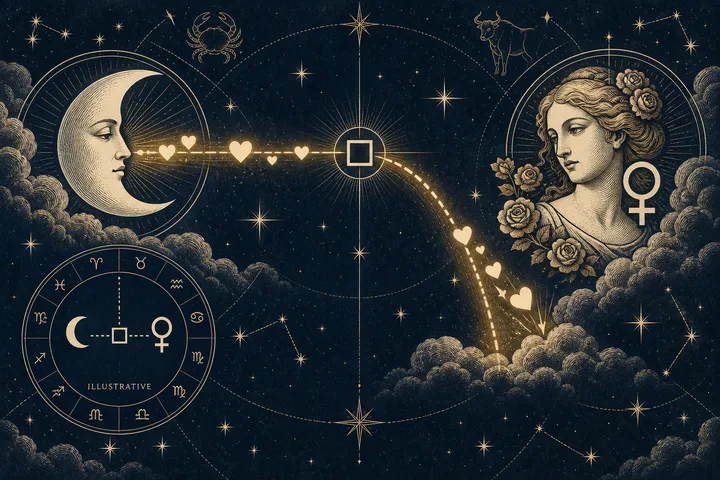
The 90-degree relationship describes the aspect; the two signs describe the symbolic styles involved. A Cancer Moon and Aries Venus, for example, can be read as a possible contrast between a wish for continuity or reassurance and a direct, initiating way of expressing interest. That is an interpretive illustration, not a prediction about everyone with those placements. Other signs change the needs and offers while leaving the aspect geometry intact. Keep those layers separate. First, the square names a relationship of tension between two chart functions. Second, the Moon sign colors the way emotional comfort may be sought or recognized. Third, the Venus sign colors what a person may value, enjoy, or offer as affection. Only then should you ask how those symbols might meet in an actual exchange. The signs give the interpretation texture; they do not replace the degrees that verify the aspect, and they do not tell you what either person intended. Consider this fictional example. One person has a Cancer Moon and the other an Aries Venus, with supplied degrees that place the planets in a verified square. Imagine the Moon person has had a tiring day and hopes for a quiet evening, familiar routines, or a little reassurance that the connection is steady. The Venus person, wanting to show delight, suggests an impromptu outing or makes a bold, playful invitation. The offer may be warm and sincere. Yet it may not answer the need in that particular moment. The mismatch lies in the form of care being offered and the form of comfort being sought, not in a verdict about either person's character. This reading draws on conventional sign symbolism, not a universal script. Cancer is commonly associated with belonging, memory, protection, and a felt sense of safety; Aries with initiative, immediacy, and directness. In the example, those themes help us ask better questions: Did the invitation feel energizing or disruptive? Would the Moon person have welcomed the same plan after rest or with more notice? Could reassurance have made the adventure easier to receive? The useful point is not that Cancer always wants to stay in and Aries always wants to go out. That would turn a symbol into a stereotype. Other placements, personal history, timing, and the specific relationship shape expression. Astrology.com’s “Synastry Chart: A Guide to Relationship Astrology” treats signs and aspects as distinct layers in a chart comparison, alongside planetary roles and other context. That layered approach supports a more careful reading than assigning a fixed behavior to a sign. A practical way to apply the symbolism is to move from abstraction to a testable question. Name the Moon person's possible comfort theme in ordinary words, while leaving room for correction. Name the Venus person's possible style of showing pleasure or interest, again as a possibility. Then describe one concrete moment without interpreting motive: “You planned something spontaneous when I was hoping for a quiet night.” Ask what each person meant and experienced. If the description fits, the chart offers a vocabulary for discussing the difference. If it does not, revise the interpretation. The same square geometry can carry another pair of sign expressions. Imagine a Taurus Moon and Aquarius Venus in a fictional, degree-verified square. A reader might explore a contrast between comfort through steadiness, familiarity, or tangible continuity and affection expressed through friendship, unusual ideas, or room for individual choice. A last-minute change of plans could feel unsettling to one person and refreshing to the other. But that is only a prompt for inquiry. A Taurus Moon does not prove resistance to change, and an Aquarius Venus does not prove emotional distance. Ask what each person values and how the moment landed. Now compare a Leo Moon and Scorpio Venus, also imagined rather than drawn from anyone's chart. The Moon symbolism might invite questions about warmth, recognition, and heartfelt response; Venus in Scorpio might invite questions about privacy, depth, and focused intimacy. A visible show of appreciation could feel generous to one person and too exposed to the other. A private expression might instead feel affirming to the Leo Moon person. The symbols help generate alternatives. They cannot select one as fact without the people's own descriptions. These comparisons show why sign labels alone do not explain a missed gesture. “Earth versus air” or “fire versus water” can offer a broad first orientation because elements group signs with related symbolic qualities. Yet an element pairing is not a verdict, a compatibility score, or a complete account of how two people relate. If the signs suggest different tempos or priorities, describe those differences directly. Then return to the actual exchange. Use it only to clarify a specific difference, such as predictability versus flexibility in one moment. The Moon-Venus discussion at Kerykeion’s “Synastry Moon-Venus Aspects” makes the same central distinction in more specific terms: emotional comfort needs and a partner’s values or affection style can differ, so an intended gesture may not land as hoped. Its quiet-presence-versus-social-or-material-gesture example is a useful illustration of intent and impact. It is not a rule for every square. Keep the source’s useful distinction, then check it against the signs, degrees, full available chart context, and lived exchange you are actually considering. A sign-focused interpretation also needs to respect direction. In the example above, the Cancer Moon belongs to one chart and the Aries Venus to the other. That is not interchangeable with the first person's Venus square the second person's Moon. If both directional contacts exist, each is a separate comparison with its own signs and degrees. Do not assume the same offer-and-need story applies in reverse, or that both people experience the contact in equal measure. Record whose planet is whose before interpreting the signs. Here is a concise reading sequence you can use without turning the signs into biographies. Confirm the Moon and Venus signs and, where available, their degrees. Verify the angular contact under the stated orb before calling it a square. Describe the Moon sign's possible comfort style and the Venus sign's possible affection style in tentative, ordinary language. Offer one concrete but clearly imagined exchange that could express the tension. Then ask whether a real, specific moment resembles that exchange, and invite both people to describe it in their own terms. If it does not fit, revise it. This method keeps four things visible: geometry, symbolic function, sign expression, and lived meaning. Geometry tells you what aspect is present under the chosen method. The Moon and Venus functions explain why emotional comfort and affection are being compared. The signs give those functions distinct qualities. The conversation establishes whether the reading helps with this particular relationship. No step can stand in for the next. Sign symbolism may suggest why a direct offer and a wish for reassurance could cross, but only the people can say whether that happened, what they meant, and what would feel caring next time.
Sources: Synastry Chart: A Guide to Relationship Astrology; Synastry Moon-Venus Aspects - Learn Astrology
What changes when you read the square beside the rest of the chart?
A Moon-Venus square earns more weight when it is close under the chosen orb and when the rest of the available chart gives the same question somewhere to land. It remains one contact, though. A trine elsewhere cannot erase it, and a square cannot decide the whole relationship. Read the contact in an order: verify its distance and direction; see how each planet is described in its own chart; compare only the other close, relevant contacts you actually have; then ask whether the symbolic pattern fits repeated experience. That order keeps one vivid aspect from becoming the entire story. Start with the degrees and the people attached to them. A close square is a stronger emphasis within the stated method than a contact at the edge of its orb. The older essay “Introduction to Relationship Astrology 2: Synastry” recommends tighter orbs for inter-chart aspects and says to keep track of whose factor is whose. If you have degrees, record the actual separation, the orb, and the direction: Person A's Moon to Person B's Venus is not the same entry as Person A's Venus to Person B's Moon. Direction matters because a synastry contact links two distinct chart functions. The Moon person's comfort needs meet the Venus person's way of relating in one direction. If the reverse contact is also present, read it separately. Don't assume both people feel the same friction, or that one person must be the sensitive one and the other the giver. “Introduction to Relationship Astrology 2: Synastry” argues that one person's chart factor can be altered through contact with the other's and that each person may experience the connection differently. That is a useful interpretive caution: ask each person what happened rather than assigning their inner account from the aspect alone. The next question is what each planet is doing in its own chart. A planet's natal aspects and sign condition describe the context through which a synastry contact is interpreted. The older relationship-astrology essay explicitly says that an inter-chart link is experienced through the natal configuration of the planet involved. It means a Moon-Venus square should not be treated as a free-standing personality label. If the Moon has other close contacts, those may change the emotional context being brought into the exchange. If Venus is strongly involved in other natal patterns, those may matter to how affection is expressed. Without those placements, say that the natal context is unknown. Don't fill the gap with a story. Then widen the view selectively. A synastry chart can contain many possible links. The essay “Introduction to Relationship Astrology 2: Synastry” recommends restricting attention to contacts likely to be significant rather than interpreting every possible connection. For an affection mismatch, Moon, Venus, Mercury, and sometimes Mars are more directly relevant than a long detour through every planet and point. A Moon-to-Moon contact can add a comparison of emotional rhythms: how two people's instinctive responses or familiar ways of seeking comfort relate. The older essay treats Moon-to-Moon contacts as links between like emotional principles and notes that hard aspects can bring tension. Use that as a prompt to compare actual preferences. Do both people tend to seek reassurance in similar ways, or does one want to talk while the other needs quiet? Those are questions to ask, not behaviors to infer from a placement you haven't verified. Mercury contacts can add a communication layer. The older essay says aspects to Mercury impact communication, especially verbal communication. In this reading, a relevant Mercury-to-Moon or Mercury-to-Venus contact may offer another symbolic angle on how feelings or affection are expressed and understood. A close contact involving Mercury may describe a resource to explore; a tense one may describe another point of translation. The useful test is concrete: when one person names a need, can the other hear what is being asked? When a gesture misses, can they discuss the difference without turning it into a verdict about character? Venus-Mars contacts add a different theme. The same older essay associates Venus-Mars aspects with attraction and physical energy, and it treats even difficult aspects as capable of appeal. Keep the claim at that interpretive level. A Venus-Mars contact may add desire, initiative, or heat to the picture; it does not answer whether emotional comfort and affection style align, and it does not guarantee attraction or compatibility. If the article's question is why a caring offer missed, this contact is context, not the explanation by itself. Bring it in only if it helps distinguish what is being offered from what the Moon needs. Consider an illustrative comparison, not a calculated couple. In the first version, a close, verified Moon-Venus square stands by itself among the supplied contacts. One person describes wanting steady reassurance; the other says they often show affection through lively plans or visible gestures. The chart offers a fitting symbolic contrast, but the conversation establishes whether that description matches their experience. In the second version, the same square appears alongside a close Mercury contact that both people find reflected in their ability to name needs and clarify intentions. It doesn't cancel the square, and it doesn't promise that translation will happen. It simply gives the reader another relevant layer to compare with what the two people actually do. Now reverse the emphasis. Suppose a chart has several contacts that an astrologer might read as supportive, but one person repeatedly states a need and the other dismisses it or refuses any adjustment. The supportive symbolism cannot stand in for the missing response. Nor should a square be used to excuse a repeated mismatch as inevitable. Astrological context helps organize questions; the lived pattern tells you whether a proposed interpretation fits. This is why the order ends with conduct. A chart can suggest a tension or a possible resource, while repeated exchanges show whether there is mutual willingness to work with it. A simple ranking prevents cherry-picking. First, establish the verified contact, its direction, and its closeness under the declared orb. Second, add the natal context of the Moon and Venus if those placements and aspects are available. Third, consider only close cross-chart contacts that bear on the same issue, such as Moon-to-Moon for emotional rhythm, Mercury links for communication, or Venus-Mars for desire and initiative. Fourth, compare that reading with a specific recurring moment and each person's account. If a later layer is missing, leave it unknown. If one layer seems to conflict with another, preserve the conflict instead of choosing whichever interpretation sounds more reassuring. This ranking also explains why supportive and difficult contacts are not simple votes for or against a relationship. A trine may be read as ease in one area; it doesn't guarantee care, honesty, or follow-through. A square may mark friction; it doesn't guarantee failure or prove that the friction is central. “What Is a Synastry Chart? Birth Chart Compatibility” describes tense aspects as possible challenges without making them a total negative judgment. The older synastry essay likewise cautions against assuming that a high number of easy contacts is automatically the best relationship pattern. The defensible conclusion is narrower: read contacts as distinct themes, weigh their relevance and strength, and don't convert a tally of easy and hard aspects into a verdict. For the reader, the practical result is a more honest sentence: “This close contact may describe a difference between the comfort one person seeks and the affection the other tends to offer; another relevant contact may help us explore how we talk about it.” That statement says what the chart can contribute and what remains to be learned. It doesn't claim that a supportive aspect will repair the mismatch, or that the square explains every instance. The best reading is not the one that makes every detail fit; it's the one that states what supports the interpretation, what complicates it, and what you still need to ask each other.
Sources: Introduction to Relationship Astrology 2: Synastry; Synastry Chart: A Guide to Relationship Astrology; Synastry Moon-Venus Aspects - Learn Astrology
When does a useful symbolic reading stop fitting the relationship?
A Moon-Venus square earns its place in a reading when it helps name a specific, recurring difference and still leaves room for both people to describe what happened. It loses that value when the chart is used to excuse disregard, declare hidden affection, assign blame, or explain every disagreement. A close contact may coexist with ease, warmth, and successful translation. The opposite can also happen: a chart that looks supportive cannot guarantee that care is offered or received. The aspect is a useful question, not a verdict. Ask whether its symbolism helps you see the exchange more clearly, then let the answer remain open to what both people actually say and do.
This distinction matters because interpretation can slide from possibility into certainty without anyone noticing. Satyori’s “Moon Square Venus” describes affection as present but tangled in mismatched timing and needs. That is one possible reading of the symbolism. The same page also makes much stronger claims: that attraction is strong, that the contact can feel addictive, and that the friction tends toward deeper, more resilient love when people work with it. Those outcomes do not follow from the geometry of a square alone. They may describe some astrologers’ interpretation, but the aspect by itself cannot establish a couple’s affection, intensity, willingness, or future. Keep the useful question about how an offer lands; set aside any promise that the configuration guarantees a particular feeling or reward.
A fair reading should make room for the strongest exception. Imagine two people whose supplied charts show a close Moon-Venus square, yet whose daily exchanges include attentive listening, clear appreciation, and easy repair when a gesture misses. The contact may still symbolize a difference in instinct or style, but it would be a poor summary of their whole relationship to call affection persistently out of reach. Their lived pattern gives the symbolism a different emphasis: perhaps the contrast is real but manageable, occasional, or expressed in ways that do not trouble either person. A square signifies tension in the interpretive tradition; it does not require constant conflict. If the people themselves report that a supposed mismatch does not describe their experience, do not insist that the chart knows better.
Now consider the reverse. A reader may find a supportive contact elsewhere in the comparison and use it to soften a painful pattern: perhaps one person repeatedly dismisses a clearly stated need, while the other keeps adapting alone. A harmonious symbol cannot turn that record into mutual care. Astrology.com’s “What Is a Synastry Chart? Birth Chart Compatibility” presents synastry as layered: astrologers consider signs, houses, planets, and aspects, and it notes that tense aspects can indicate challenges without meaning something is wrong with the couple. That layered approach is useful, but it does not make every contact equally decisive or override what the people report. A supportive factor can describe a resource to draw on; it cannot certify that both people will use it. Nor should the square be made responsible for conduct that needs to be discussed plainly.
Use three questions to test whether the interpretation still fits. First, what does the symbolism suggest? For a verified contact, it may suggest a contrast between one person’s way of seeking comfort and another’s way of expressing affection. Second, what repeated observation supports that reading? Name an actual kind of exchange, such as a gesture intended as appreciation that repeatedly leaves the other person wanting a different form of attention. Third, what would change your mind? If the gesture is welcomed, if the apparent difference proves to be a one-time misunderstanding, or if both people describe the pattern differently, revise the interpretation. These questions separate a chart’s symbolic suggestion from corroborating experience and from evidence that calls for a different reading. They also prevent one dramatic moment from becoming a rule about two people.
This test is especially important when a reading assigns motives. A square does not reveal that a Venus person is withholding care, that a Moon person is too demanding, or that either person secretly wants more than they admit. It cannot tell you whether a gift was meant to avoid a conversation, whether a request was made clearly, or whether one person had the capacity to respond in that moment. Those are questions for the people involved. The older relationship-astrology essay “Introduction to Relationship Astrology 2: Synastry” cautions that synastric factors need not be felt mutually or evenly. That supports care in assigning roles, not a license to fill in someone’s inner life. Ask each person what they intended and experienced; do not use the chart to overrule either answer.
The reading should also change when its chart basis changes. A close, degree-verified square under the chosen orb gives a firmer basis for discussing the contact than a sign-only resemblance or a wider contact near the method’s boundary. Even then, the configuration is one thread, not the whole weave. The natal condition of each planet and other relevant cross-chart contacts may refine the interpretation when those placements are actually available. If the Moon degree is unknown, the exactness may remain unresolved; don’t quietly upgrade a possibility into a confirmed aspect. This is not a reason to discard sign symbolism. It is a reason to say what kind of statement you are making: a sign-level reflection, a verified aspect interpretation, or a broader reading that includes more chart context. Each has a different reach.
The practical verdict is modest but useful: keep the square when it helps both people recognize a real difference and find a mutual adjustment; revise or set it aside when it obscures the relationship they are actually living. Ask what was offered, what was needed, and whether both people are willing to try a clearer exchange. If one person’s account repeatedly conflicts with the reading, listen to that account. If the chart suggests friction but the couple experiences warmth and repair, let that exception stand. A sound interpretation stays responsive to the people and the chart details available. It does not turn tension into doom, or effort into a promise of growth. It gives the pair a way to reflect, then leaves their choices and repeated conduct where they belong: with them.
Sources: Moon Square Venus Synastry; Synastry Chart: A Guide to Relationship Astrology; Introduction to Relationship Astrology 2: Synastry
What can you do with the comparison now?
Write down whose Moon and whose Venus are involved, their signs, and any supplied degrees. If you know signs but not degrees, treat the contact as a possible sign-level pattern, not a verified square or measured orb. Synastry Moon-Venus Aspects describes how the contact may symbolize different emotional needs and affection styles; it cannot tell you what either person intended in that moment.
Next, choose one recent exchange. Name the gesture, the need and how it landed. Keep those details separate: “I brought you a gift” is an action; “I wanted you to feel appreciated” is an intention; “I needed you to stay and listen” is a need. The chart can offer language for the mismatch, but the people involved supply its meaning.
Then ask each other, in turn: “What were you hoping I’d understand? What did I receive? What small gesture would help next time?” Each person should answer and listen, so translation doesn’t become one person’s job. Try one concrete adjustment, then notice whether both people make room for it.
Verdict: a verified Moon-Venus square may name friction, while its closeness, chart context, and lived pattern shape its weight. Compare supplied placements and optional degrees in the Synastry Comparison Report to organize the symbols. It won’t calculate missing natal positions or houses from birth details.
A little more clarity
Can a Moon-Venus square prove that someone cares?
No. It can offer a symbolic way to explore a possible difference between emotional comfort and affection style. It can’t establish a person’s feelings or intentions; consider what both people say and do.
Can I verify a Moon-Venus square without degrees?
No. Signs may suggest a square relationship, but degrees are needed to check the angular separation and orb. Without them, keep the reading at the sign level.
Sources & further reading
- An Introduction to Aspects and Chart Shaping in Natal Astrology
Defines square geometry and orb, and shows that orb allowances vary by interpretive convention.
- Synastry Moon-Venus Aspects - Learn Astrology
Describes a possible mismatch between emotional comfort needs and affection style, including gestures that may not land as intended.
- Moon Square Venus Synastry
Discusses mismatched timing, needs, and expressions of love; its stronger claims about guaranteed outcomes are not established by the aspect alone.
- Synastry Chart: A Guide to Relationship Astrology
Supports reading synastry in layers, distinguishing signs, planetary roles, aspects, and other chart context.
- Introduction to Relationship Astrology 2: Synastry
Presents a directional, selective approach to synastry and notes that inter-chart factors may not be experienced equally.
Synastry Comparison Report
Enter known placements for two people. Get an input-by-input comparison, selected aspect calculations and a clear record of what remains uncertain.
Compare our placements