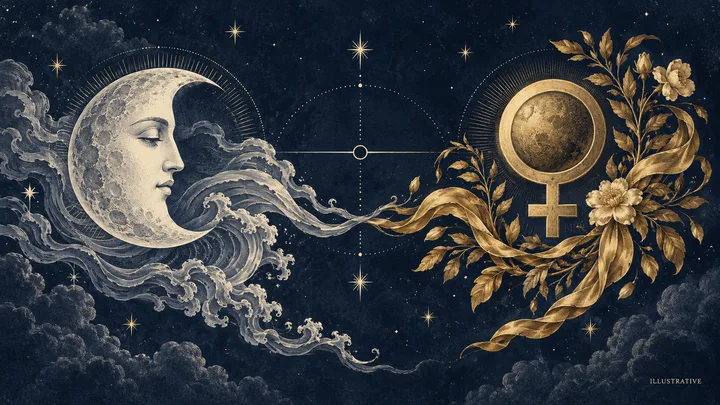
A Moon-Venus opposition in synastry can reveal a real bond expressed through different comfort languages. The Moon person often seeks emotional safety through instinct, familiarity, and immediate care. The Venus person may offer love through pleasure, reassurance, beauty, compromise, or a social gesture. Both can be caring, yet one person's soothing move may feel too light, too public, too expensive, too quiet, or simply mistimed to the other. Read the opposition as a polarity to translate, not a verdict against the relationship. First confirm that the aspect is a true 180-degree contact within the report's six-degree orb. Then read the two signs, the exactness of the aspect, each planet's other contacts, and the couple's observable pattern during stress. The useful next step is simple: ask, “When you are upset, what kind of care helps first?”
The central message is translation, not a lack of love
A Moon-Venus opposition usually says that comfort and affection are facing each other across a relational axis. They can see each other. They can even want the same warmth. But they don't always reach for it in the same form. This is why the aspect can feel tender one day and strangely lonely the next. One partner offers what feels loving to them. The other receives something different from what they needed.
The Moon describes instinctive feeling, emotional memory, habits, home, and the kind of safety a person seeks before they have found the right words. Venus describes attraction, pleasure, taste, values, social grace, and the way a person gives and receives affection. When these planets meet in synastry, one person's emotional life touches the other's style of loving. Astrology.com describes the Moon as a place of comfort and security and Venus as a love language. That pairing is the foundation of this reading, whether the contact is easy or tense.
The opposition adds a second fact. It creates polarity. Cafe Astrology describes an opposition in synastry as a contact that can attract and complement, while also producing a see-saw effect in which one person's planetary expression counters the other's. In a Moon-Venus opposition, this can look like a repeated exchange: the Moon person brings a feeling, and the Venus person answers with a value, gesture, or attempt to restore harmony. Then the Moon person wonders why the answer didn't touch the feeling itself.
That doesn't make the Venus person careless. It may mean their first instinct is to make the situation nicer, calmer, or more pleasant. The Moon person may need time, a familiar routine, physical closeness, or a quiet witness instead. Neither response is automatically superior. The question is whether the couple can learn the difference before disappointment turns into a character judgment.
So the strongest interpretation is not “you love differently and therefore cannot work.” It is “your care may need translation.” That claim has a practical edge. When the same hurt appears more than once, stop debating who is more loving. Name the care each person offered, name the care the other person was actually seeking, and compare the two. The gap is the aspect speaking.
Separate a missed cue from a true values clash. A missed cue says, “You offered care in a form I couldn't use right then.” A values clash says, “We disagree about what this choice means.” The first needs translation and timing. The second needs negotiation. Moon-Venus opposition can reveal both, but it shouldn't turn every disagreement about money, privacy, or social life into a temporary communication problem.
Sources: Planetary Aspects - Cafe Astrology; Synastry: Moon-Venus Aspects Between Two Charts - Cafe Astrology; Synastry - Cafe Astrology
What the Moon person may experience
The Moon person is not simply the more emotional partner. That shortcut is too vague to help. In synastry, the Moon person is the person whose Moon receives the other person's Venus. Their personal rhythms, needs, moods, and private habits are being contacted by the other person's way of expressing affection. The effect can be immediate because the Moon works through instinct. Something about Venus may feel comforting, attractive, familiar, or deeply wanted before the Moon person has explained why.
In an opposition, however, the Moon person may also feel that Venus is close to the answer but not quite in the right place. Imagine needing quiet after a difficult day and receiving a cheerful invitation to go out. Imagine wanting a partner to sit beside you while you process and receiving a polished solution, a gift, or a change of subject. The Venus gesture may be generous. The Moon still may not feel held.
This is where taking each other for granted can enter the pattern. Cafe Astrology specifically associates challenging Moon-Venus contacts with missing praise, undervaluing favors, clashing habits, and feeling misunderstood. The Moon person may say, “You do things for me, but you don't notice what I feel.” The Venus person may say, “I keep trying to make you happy, but nothing seems to count.” Both statements can be true inside the same exchange.
The Moon person's sign shows what kind of emotional atmosphere helps them settle. A Moon in Taurus may need steadiness, food, touch, and a predictable evening. A Moon in Gemini may need conversation and room to name several changing thoughts. A Moon in Cancer may seek privacy, tenderness, and a sense of home. A Moon in Capricorn may first need practical containment before vulnerability feels safe. These are examples of sign language, not fixed rules. The rest of the natal chart matters.
The Moon person should watch one habit in particular: treating a missed comfort cue as proof that affection isn't real. The opposition can make difference feel personal. Before reaching that conclusion, ask for the needed form directly. “Please stay with me and don't solve this yet” gives Venus a usable instruction. It also separates the emotional need from the accusation, which gives the relationship a better chance to answer it.
The Moon person's other lesson is to notice the quiet forms of nourishment already present. Does Venus remember an appointment, protect a shared ritual, choose the meal you like, or make room for your pleasure? Those acts may not replace emotional presence, but they can reveal the value underneath the style. Ask for the missing piece without erasing the piece that is there.
Track when the feeling appears. Some Moon reactions belong to a passing mood, a tired body, or an old memory that the present moment has touched. Some Venus gestures belong to a long-held value about fairness, beauty, or partnership. The chart helps you ask which layer is active without making every moment carry the full weight of the natal story.
Sources: Synastry: Moon-Venus Aspects Between Two Charts - Cafe Astrology; Synastry - Cafe Astrology; What Is a Synastry Chart? Birth Chart Compatibility - Astrology.com
What the Venus person may be trying to offer
The Venus person is often cast as the one who doesn't understand. That reading misses half the opposition. Venus may be offering genuine affection through the forms that feel natural to Venus: warmth, praise, a pleasant setting, a thoughtful object, a compromise, physical sweetness, humor, or an invitation back into shared enjoyment. The Venus person may see these acts as obvious evidence of care. When the Moon person stays unsettled, Venus can feel rejected.
Venus has a strong relationship with harmony, but harmony is not always the same as emotional contact. A Venus person may try to soften a hard moment because conflict feels corrosive. They may choose a beautiful meal, a reassuring message, or a practical indulgence. Those gestures can be loving. Yet if the Moon person is asking to be witnessed in discomfort, a quick return to pleasantness can feel like pressure to stop feeling.
Cafe Astrology makes this distinction in its wider synastry discussion: a challenging Venus-Moon contact can tempt Venus to turn on charm when the Moon is having problems instead of confronting the problem sincerely. That is a useful warning, not a sentence. Venus can learn that peace built on silence doesn't last. The Moon can learn that a lighter gesture may be an attempt to stay connected, not an effort to erase the feeling.
Read Venus's sign for the style of offering. Venus in Libra may reach for fairness, conversation, and a mutually agreeable plan. Venus in Leo may offer praise, loyalty, and a grand-hearted display. Venus in Virgo may show love through useful help and careful attention to details. Venus in Aquarius may give space, perspective, or an unusual solution. Each can miss the Moon if the Moon needs a different first language.
The Venus person's task is not to abandon their style. It is to add a translation step. Before offering the familiar Venus response, ask what the Moon person wants from the moment: listening, touch, privacy, food, action, reassurance, or time. That question may feel less romantic than an instinctive gesture. It is often more intimate. It says, “I want to love you in a way you can actually receive.”
Venus also needs permission to have preferences. Translating care doesn't mean becoming an on-call emotional service. If Venus needs a calm tone, a pause, or a shared pleasure after a hard conversation, that need belongs in the reading too. The Moon person can receive care more fully when they don't treat every difference as a demand for instant agreement. Mutuality begins when both styles get a place at the table.
A person who needs beauty, privacy, fairness, or lightness may withdraw when every exchange becomes an emotional emergency. That isn't a reason to hurry the Moon. It is a reason to give the relationship two channels: one for naming the feeling, and another for deciding how much closeness or pleasure the moment can hold.
Sources: Planetary Aspects - Cafe Astrology; Synastry: Moon-Venus Aspects Between Two Charts - Cafe Astrology; Synastry - Cafe Astrology
Why the opposition can feel magnetic and frustrating
Oppositions have a particular pull. The two planets occupy opposite ends of the zodiac, so each person encounters a quality that may feel both familiar and foreign. Cafe Astrology calls this the polarity and attraction of the opposition. The pair can complement each other because one person carries a response the other lacks or underuses. They can also compete because each response interrupts the other's preferred rhythm.
The Moon may be drawn to Venus because Venus makes life feel sweeter, more valued, or more beautiful. Venus may be drawn to the Moon because the Moon offers emotional depth, softness, and a private kind of belonging. The attraction can build through small moments. A familiar meal. A hand on the shoulder. A room made comfortable. A look that says the other person has noticed. Then the same contact can become frustrating when the couple faces fatigue, money, family, or a decision about time.
The see-saw pattern often begins with a good intention. The Moon becomes vulnerable. Venus moves toward harmony. The Moon experiences the move as avoidance and becomes more intense or withdrawn. Venus experiences that reaction as criticism and reaches harder for charm, compromise, or distance. Each person's attempt to restore balance increases the other's sense of being missed. The aspect becomes a loop, not because either person lacks feeling, but because the first response doesn't meet the actual need.
This is why a Moon-Venus opposition can reveal comfort languages better than a generic statement about compatibility. The issue becomes observable. Who needs emotional acknowledgment before a plan? Who needs a plan before emotional acknowledgment can land? Who wants public affection, and who wants private reassurance? Who spends to create pleasure, and who feels safest when spending stays modest? The opposition turns these differences into a live conversation.
The bond grows when the couple stops trying to win the argument over the correct form of care. There isn't one. The better goal is sequence. First meet the Moon's need for safety. Then let Venus restore pleasure, perspective, and choice. Or reverse that order when the Venus person needs reassurance before they can stay present. Good synastry work doesn't flatten the polarity. It teaches the two ends to cooperate.
Timing often decides whether the same gesture heals or irritates. A joke can reconnect two people after the feeling has been acknowledged. Before that, it can sound like a refusal to take the feeling seriously. A plan can feel loving after the person has been heard. Before that, it can feel like an attempt to move them along. The opposition is about sequence as much as style.
Compare repeated misses by setting. A cue missed at bedtime may concern bodily rest; the same cue during a money decision may expose values. Note the trigger, first response, and disputed meaning. That tells you whether the pair needs a comfort ritual or a negotiation about priorities.
Sources: Planetary Aspects - Cafe Astrology; Synastry: Moon-Venus Aspects Between Two Charts - Cafe Astrology; What Is a Synastry Chart? Birth Chart Compatibility - Astrology.com
How signs change the comfort language
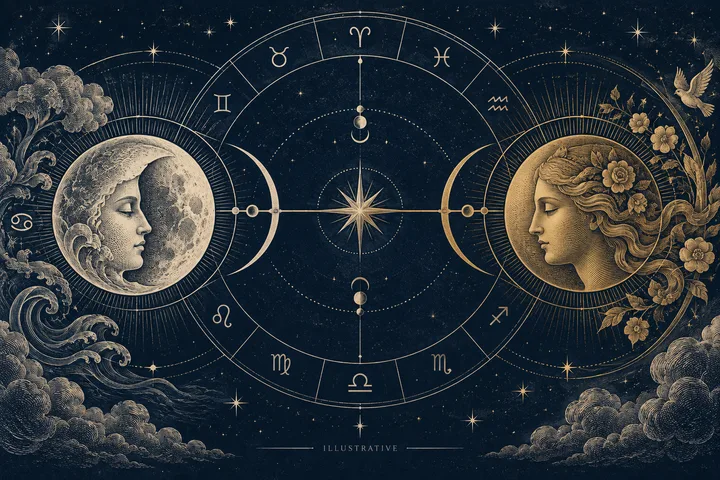
A Moon-Venus opposition is not complete until you read the signs. The aspect tells you that the planets face one another. The signs tell you what each side is trying to protect, enjoy, or express. In a standard zodiac opposition, the signs share a mode but differ in element and orientation. Aries-Libra, Taurus-Scorpio, Gemini-Sagittarius, Cancer-Capricorn, Leo-Aquarius, and Virgo-Pisces each create a different argument about comfort and affection.
Consider Aries Moon opposite Libra Venus. The Moon may need directness, speed, and permission to respond honestly. Venus may seek courtesy, balance, and a graceful exchange. Aries Moon can hear diplomacy as delay. Libra Venus can hear blunt feeling as unnecessary conflict. Their translation is to say the truth plainly, then make room for tact. Neither must become the other sign.
Consider Taurus Moon opposite Scorpio Venus. The Moon may settle through consistency, physical ease, and known routines. Venus may express devotion through intensity, privacy, exclusivity, and emotional depth. Taurus can experience Scorpio's pressure as too much. Scorpio can experience Taurus's calm pace as resistance or emotional withholding. Their task is to separate steadiness from avoidance and intensity from control, then ask what level of closeness the moment can hold.
Consider Gemini Moon opposite Sagittarius Venus. Gemini Moon may need to talk through details, questions, and changing impressions. Sagittarius Venus may offer honesty, humor, movement, or a wider meaning. Gemini can feel brushed aside by a big-picture answer. Sagittarius can feel trapped in endless processing. A useful bridge is to give the Moon a defined listening window, then let Venus help the pair decide what the feeling changes.
Consider Cancer Moon opposite Capricorn Venus. Cancer Moon may seek tenderness, privacy, and emotional continuity. Capricorn Venus may show love through responsibility, planning, and reliable work. The Moon can call the practical response cold. Venus can call the emotional response unstructured. They need both forms. Comfort first, then the plan. This sign pair makes the article's central point plain: a person can love through duty while the other person needs love to sound warm before duty can be felt as love.
The other sign pairs deserve the same care. Leo-Aquarius can contrast personal warmth and loyal display with space, friendship, and a wider social view. Virgo-Pisces can contrast useful detail with compassion, surrender, and atmosphere. The signs don't tell you which partner is right. They show the kind of translation each pair is likely to practice. Read the actual planets and their rulers before turning a sign pair into a slogan.
You can make the sign reading more exact by asking what each sign fears losing. Aries may fear being slowed or managed. Libra may fear needless harshness. Taurus may fear instability. Scorpio may fear a bond without depth. Gemini may fear being trapped in one conclusion. Sagittarius may fear emotional enclosure. Cancer may fear abandonment. Capricorn may fear helplessness. These are possible pressures, not diagnoses. They show why the same comfort attempt can land with such force.
Sources: Planetary Aspects - Cafe Astrology; Synastry: Moon-Venus Aspects Between Two Charts - Cafe Astrology; Synastry - Cafe Astrology
Degrees, orb, and the difference between a contact and a theme
Before you interpret the meaning, confirm the geometry. An opposition is an aspect of 180 degrees. In a synastry comparison, the Moon in one chart must be opposite the other person's Venus by degree, not merely placed in two signs that seem unlike each other. A sign-pair impression can start the inquiry. It cannot replace the contact.
This report uses a six-degree orb for selected major aspects. That means a Moon at 12 degrees Taurus and Venus at 17 degrees Scorpio are five degrees apart from exact opposition, so the aspect qualifies within this stated scope. A Moon at 12 degrees Taurus and Venus at 25 degrees Scorpio are thirteen degrees apart. They may still share a broader sign polarity or other symbolism, but this report would not treat that pair as a six-degree Moon-Venus opposition.
Exactness matters because a close aspect tends to demand attention. The closer the planets are to 180 degrees, the more clearly the exchange may show up in ordinary interactions. A wider contact can still describe a background theme, especially when the same signs or other aspects repeat it, but it should not outrank a tighter personal-planet contact without a reason. Cafe Astrology's glossary defines an orb as the range in which an aspect operates and notes that exact aspects carry the greatest impact.
The planetary roles show which person carries which side of the exchange, while the degrees show how exact and prominent the contact may be. The Moon person and Venus person are not interchangeable labels. If your Moon opposes your partner's Venus, read your emotional needs meeting their style of affection. Then reverse the lens. Synastry is reciprocal even when the planetary roles differ. If the contact is close, both people may feel the attraction and the mismatch, but not in the same words or at the same moment.
Keep the orb in proportion. Don't build the whole relationship story around one wide aspect, and don't erase a close aspect because the signs look easy on paper. A clean method is to record the planets, signs, degrees, exact orb, and any other major contacts before interpreting.
If the Moon degree is unknown, be precise about what changes. You may still compare the supplied Moon sign with Venus by sign and discuss a possible opposition only if the degree range confirms it. You cannot honestly call the aspect exact, assign a reliable orb, or rank it above known contacts. Missing precision narrows the reading. It doesn't make every astrological layer useless. You can still study the sign polarity, the Venus person's stated style of care, and any other supplied Moon or Venus contacts. Label those as sign-level or contextual observations, then leave the exact aspect unranked until the missing degree is known.
Sources: Planetary Aspects - Cafe Astrology; Synastry: Moon-Venus Aspects Between Two Charts - Cafe Astrology; Glossary of Astrology Terms - Cafe Astrology
A worked example of care that keeps missing
Imagine Maria has a Moon in Cancer at 14 degrees, and her partner has Venus in Capricorn at 18 degrees. This is a four-degree opposition within the stated six-degree scope. The example is illustrative. It isn't a calculated personal chart. It shows how the reading can move from symbols to a real decision without inventing a verdict about the couple.
Maria comes home upset after a difficult family call. She wants her partner to sit close, ask what happened, and let the feeling have a name. Her partner starts making a plan. He offers to handle the next practical task, suggests a budget for visiting family, and says they can solve the problem together. He is trying to be dependable. Maria hears distance. She wanted tenderness before logistics.
The next week, Maria asks for reassurance in a long message. Her partner replies with a clear schedule for the weekend and a reservation at a quiet restaurant. He has noticed that shared time usually helps. She feels managed instead of understood. He feels that every effort becomes evidence of failure. The Moon-Venus opposition is visible in the order of care: Cancer Moon asks for emotional shelter, while Capricorn Venus begins with structure and responsibility.
The repair doesn't require him to become Cancer or her to stop needing tenderness. They can create a two-part ritual. First, he says what he heard: “That call hurt you, and you don't have to fix it tonight.” He stays present for ten minutes without planning. Then he asks whether she wants comfort, a practical plan, or both. Maria, in turn, names the moment when she is ready for action and thanks the care that arrives through his reliability.
The same symbolism can play differently if the natal charts support it. Maria's Moon could have a strong Mercury contact, making words essential. His Venus could have a close Saturn contact, making duty his clearest promise. Another couple with the same synastry opposition might resolve the gap through touch, humor, or shared food. The aspect gives a pattern to investigate. The lived behavior tells you which translation is needed.
The useful question after this example isn't whether Maria should accept his style or whether he should copy hers. Ask what each person does after the first attempt misses. Does he become curious? Does she explain the need without shaming him? Can both return to the conversation when the first exchange goes badly? The answer to those questions says more about the future use of the aspect than a single awkward evening.
What can soften, redirect, or intensify the opposition
A single synastry aspect never outranks the whole comparison. The Moon-Venus opposition may be the clearest comfort-language marker, but other contacts tell you whether the couple has tools for translation. Mercury contacts can show how easily the pair names the mismatch. Mars contacts can show what happens when frustration turns into action, anger, desire, or pursuit. Saturn can add patience and commitment, but it can also make one partner feel judged or restricted. Jupiter can bring goodwill and a willingness to forgive, though it can also encourage excess.
Look first for supportive contacts to either the Moon or Venus. A trine or sextile from Mercury may give the couple language for feelings and preferences. A constructive Saturn contact may help them keep a promised care ritual when life gets busy. A warm Jupiter contact can make repair feel generous rather than humiliating. These contacts don't cancel the opposition. They give it somewhere to go.
Then look for repetitions. If the Moon person has several planets in the Venus person's sign, Venus may feel unusually familiar even when the opposition creates friction. If the Moon or Venus also receives hard contacts from Mars, Uranus, Neptune, or Pluto, the emotional gap may be mixed with volatility, idealization, pressure, or sudden change. Don't let a dramatic outer-planet contact swallow the simple question: what kind of care is being offered, and what kind is being requested?
House overlays can add context when accurate birth times are available, because they show where one person's planet falls in the other person's chart. But this article's assigned comparison uses supplied placements and optional degrees. It does not calculate houses or create natal positions from birth details. If the house data is missing, keep the interpretation to the planets, signs, degrees, and aspects you actually have.
Also ask whether the contact is mutual in practice. A chart can show Venus reaching the other person's Moon, but it cannot show whether both people offer equal time, attention, or repair. One person may feel deeply moved and still avoid the work. Another may perform steady care without receiving much acknowledgment. Keep the aspect and the behavior in the same frame.
The difficult exception runs the other way. If the relationship repeatedly turns comfort into control, charm into avoidance, or practical help into a demand for gratitude, the opposition isn't the whole problem. The chart may describe the pattern, but the repeated choice is what needs attention. Read the symbolism with enough room for boundaries, consent, and the actual balance of effort.
Sources: Planetary Aspects - Cafe Astrology; Synastry: Moon-Venus Aspects Between Two Charts - Cafe Astrology; What Is a Synastry Chart? Birth Chart Compatibility - Astrology.com
Turn the reading into one useful conversation
Use the aspect to prepare a conversation, not to announce a diagnosis. Bring the Moon-Venus opposition into ordinary language. Tell your partner what helps you settle, what kind of affection you tend to offer, and what you often misread. Keep the example concrete. “When I go quiet after work, I need ten minutes of closeness before we discuss solutions” gives the other person a clear door into your world.
Ask three questions. What do you usually do when someone you love is upset? What response makes you feel cared for? What response makes you feel pressured, dismissed, or taken for granted? Listen for the difference between intention and impact. The Venus person may discover that a loving act needs a different sequence. The Moon person may discover that a practical or pleasurable act carries more feeling than its surface suggests.
Now choose one moment to study. Not the whole relationship. Pick the last conversation that went sideways and write down the order of events: the trigger, the Moon response, the Venus response, and the meaning each person assigned to it. This keeps the chart attached to behavior. It also shows whether the issue concerns comfort, a value, or a boundary that needs its own discussion.
Agree on one small change for the next real stress moment. It might be a ten-minute listening pause before advice, a direct question about touch or space, or a promise to return to a decision after the feeling has been heard. Make the practice observable. “Be more supportive” cannot be tested. “Ask whether I want comfort, a plan, or an hour alone” can.
If you compare placements through the Synastry Comparison Report, enter the Moon and Venus signs and add degrees when you know them. The report compares supplied placements and selected major aspects within the stated six-degree orb. It does not calculate a natal chart or houses from birth details, and it does not decide the relationship's outcome. Use the report to rank the chart's themes, then bring the strongest theme to the conversation.
After the next difficult moment, ask two final questions. Did the new response meet the need more closely? Did both people have enough room to remain themselves? If the answer is yes, keep the ritual. If the answer is no, change the sequence or name the unmet value. The chart has done its job when it gives you a sharper question and a better choice.
Start with this sentence: “When I am upset, the first kind of care I can receive is ____. When you are upset, what should I offer first?” Let the blanks stay different. The point isn't to make the two comfort languages identical. It's to make them legible, so affection has a better chance of reaching the person it is meant for.
Sources: Synastry: Moon-Venus Aspects Between Two Charts - Cafe Astrology; Synastry - Cafe Astrology; What Is a Synastry Chart? Birth Chart Compatibility - Astrology.com
A little more clarity
Can you read a Moon-Venus opposition if one person's degree is unknown?
You can read the supplied Moon and Venus signs as a possible polarity, but you can't confirm the exact opposition or calculate its orb without both degrees. Keep the interpretation at sign level, compare any other known contacts, and mark the aspect as unranked until the missing degree is available. If the Moon could change signs on the birth date, confirm the Moon sign first.
Sources & further reading
- Planetary Aspects - Cafe Astrology
Supports aspect geometry, including the opposition at 180 degrees, and the idea that planetary energies combine through an aspect.
- Synastry: Moon-Venus Aspects Between Two Charts - Cafe Astrology
Supports Moon-Venus affection, comfort, challenging-aspect misunderstandings, appreciation, compromise, and repair.
- Synastry - Cafe Astrology
Supports synastry planet roles, opposition see-saw dynamics, and the value of reading signs and wider chart context.
- What Is a Synastry Chart? Birth Chart Compatibility - Astrology.com
Supports layered-chart synastry, the Moon as comfort and security, Venus as love and values, and tense aspects as workable challenges.
- Glossary of Astrology Terms - Cafe Astrology
Supports opposition polarity, hard-aspect classification, orb as the operating range, and the greater weight of exact contacts.
Synastry Comparison Report
Enter known placements for two people. Get an input-by-input comparison, selected aspect calculations and a clear record of what remains uncertain.
Compare our placements