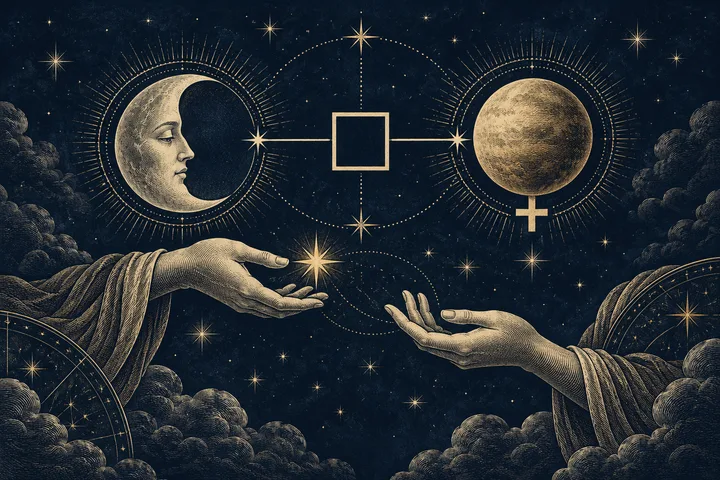
Does Moon square Venus mean care misses the need?
It can symbolize a difference between the comfort one person instinctively seeks and the affection the other tends to offer. That difference can create friction, but warmth can coexist with it: “Synastry Moon-Venus Aspects” by Kerykeion describes the square through contrasting comfort and affection styles, while “Synastry: Moon–Venus Aspects Between Charts” by Cafe Astrology includes warmth alongside possible strain around feeling appreciated or understood. Neither reading measures how much someone cares or forecasts what will happen between you.
A gesture can miss a need even when it is caring; a single exchange can also turn on timing, an unclear request, or circumstance. The chart cannot choose among those explanations. So treat the square as an interpretive prompt about a possible difference, not evidence that affection is absent. Notice what each person actually asked for and offered before mapping the symbol onto the moment. Read the contact in sequence: identify what Moon and Venus symbolize, check whose planets meet, then consider the aspect’s geometry and the wider chart before deciding whether the symbolism helps describe a real exchange.
In synastry, one person’s Moon square another person’s Venus can symbolize a difference between the comfort the Moon person needs and the affection the Venus person tends to offer. Astrological interpretations allow friction and warmth to coexist; the aspect does not prove a lack of care or predict a relationship’s outcome. Identify whose placements form the contact, check degrees against a stated orb rule when available, and ask whether the interpretation helps describe a recurring exchange. If it does not fit, give more weight to the people’s own accounts and the circumstances around the moment.
Sources: Synastry Moon-Venus Aspects; Synastry: Moon–Venus Aspects Between Charts
What do the Moon and Venus each contribute to this contact?
In “Synastry Moon-Venus Aspects,” Kerykeion gives the Moon and Venus different jobs in the symbolic reading. The Moon points to emotional instincts and the forms of comfort associated with feeling at ease. Venus points to relational values, liking, and ways affection is expressed or received. A square brings those functions into a tense relationship: what feels emotionally settling to the Moon may not match what Venus finds pleasant or loving. This is a contrast between symbolic functions, not a ranking of which person’s preference matters more.
The distinction is easier to see in a simple illustration. Imagine someone asking for quiet company after a demanding day, while the other person responds with a cheerful outing chosen to make the evening feel special. Quiet presence and a lively treat can both carry care, yet they answer different ideas of comfort and affection. In this example, the Moon-like need is for calm reassurance; the Venus-like offering is a pleasing shared experience. The example illustrates the symbolic contrast only. It does not describe actual people or establish what either person feels.
Kerykeion’s treatment is concise: it links Moon with emotional instinct and Venus with relational values, then applies that difference to the square. Cafe Astrology’s “Synastry: Moon–Venus Aspects Between Charts” uses broader language around warmth, appreciation, and understanding across Moon–Venus contacts. Read together, these sources support a possible tension in how affection lands while leaving room for positive regard. Cafe Astrology groups some challenging contacts, so its broader description should not be mistaken for a unique square rule. The two accounts are best used at different levels: Kerykeion supplies the clearest square-specific contrast, while Cafe Astrology helps keep the interpretation from collapsing into a story of pure discord. Neither source turns the symbol into a report of what either person has done. The useful question is narrower: could these placements describe different routes to feeling cared for, and does that distinction illuminate the exchange being considered? If it does, the symbolism gives language to compare intentions and reception. It still leaves the actual meaning of a gesture to the people involved.
This symbolism does not reduce either person to one need or one love style. The placements’ signs and the rest of each chart can color how the Moon and Venus functions are expressed; those details refine the reading rather than replace the basic distinction. For instance, “comfort” need not mean the same routine for everyone, and “affection” can be shown in more than one form. The planetary labels name interpretive functions, not fixed scripts or complete descriptions of character. Keep the chart construction clear, too: this assignment concerns one person’s Moon contacting another person’s Venus. A Moon–Venus square within one natal chart raises a different question, because both planets belong to the same chart. Here, the interpretive contrast sits between two chart owners; it is not a claim that one person embodies only need while the other embodies only giving. Both people have Moon and Venus placements of their own, and those placements belong to the larger comparison. The specific contact simply brings one selected pair into focus.
Sources: Synastry Moon-Venus Aspects
Whose Moon meets whose Venus, and why does direction matter?
Start by writing the owners beside the placements: chart A’s Moon square chart B’s Venus. In “Introduction to Synastry,” Kerykeion describes synastry as a comparison of two charts and inter-aspects as contacts between them; naming both owners keeps the interpretation attached to the right chart roles. Within the symbolic method used in “Synastry Moon-Venus Aspects,” Kerykeion gives the Moon person’s felt safety and emotional response one emphasis, while Venus describes the other person’s values and characteristic way of expressing affection. The labels identify interpretive roles in this contact. They do not tell you what either person actually feels or intends.
A brief reading aid: the Moon person’s side foregrounds what feels comforting, safe, or emotionally responsive; the Venus person’s side foregrounds what they value, enjoy, or offer as affection. This is a comparison of questions to bring to the chart, not a scorecard assigning one person more need or more care. The same inter-aspect involves both charts. In Kerykeion’s account, each person can experience a contact through a different planetary lens, so the Venus person is not excluded from emotional needs, and the Moon person is not only a recipient of care.
Direction matters when you compare another contact. Chart A’s Moon square chart B’s Venus names one cross-chart pairing. Chart A’s Venus square chart B’s Moon reverses which person’s Moon and Venus are being read; it is a separate contact with the roles reassigned. If both are present, read each by its own owners and planetary roles. Do not assume that the reversed contact produces an identical experience, or that one automatically confirms the other. Kerykeion’s “Introduction to Synastry” offers a framework for distinguishing those roles, not evidence that partners report them in a particular way. The people’s own descriptions of comfort, appreciation, and care are needed to decide whether this symbolism illuminates their experience.
This ownership check also prevents a shorthand from turning into a claim about a whole person. “The Moon person” means the chart owner of the Moon in this particular contact, not someone whose entire role is to need reassurance. “The Venus person” means the owner of the Venus involved, not someone who only gives affection or has no vulnerabilities. Each chart contains both planets, and this reading isolates one cross-chart link to ask a focused question. Kerykeion’s “Introduction to Synastry” places inter-aspects within a comparison of two natal charts; the selected link does not replace either person’s wider chart or their own account of the exchange.
When describing the contact to each other, say whose Moon and Venus you are comparing before discussing what the square might symbolize. That small step keeps the reading clear if the charts contain additional Moon–Venus contacts or if you are comparing both directions. It also makes room for each person to disagree with the interpretation without having to accept a role assigned by the chart.
Sources: Introduction to Synastry; Synastry Moon-Venus Aspects
Can friction coexist with affection in a Moon–Venus square?
Yes. In “Synastry Moon-Venus Aspects,” Kerykeion describes the square as tension between emotional comfort and affectionate values or style. That is a possible friction in how care is offered and received, not a statement that warmth is absent. Cafe Astrology’s “Synastry: Moon–Venus Aspects Between Charts” also describes positive regard alongside possible difficulty feeling appreciated or understood. Its discussion groups some challenging contacts, so it supports the coexistence of warmth and strain across Moon–Venus contacts, not a square-only prediction. Neither source makes an aspect a verdict about the quality or future of a relationship.
The contrast with other aspects helps clarify what “square” contributes. Kerykeion treats a conjunction as a close blending of Moon and Venus themes: emotional response and affection are brought together, though closeness alone does not settle how they work. Its sextile and trine discussion presents a more naturally cooperative or easy flow between comfort and affection. For the square, the same functions meet with friction, so what feels soothing to the Moon may differ from what Venus expresses as pleasant or loving. For opposition, Kerykeion emphasizes polarity or contrast across the two functions. These are interpretive textures in that source’s framework, not a ladder from best to worst.
A square can therefore make a difference more noticeable without proving that care repeatedly misses its mark. One possible reading is adjustment: the contrast prompts people to make their preferences clearer and find a way to include both kinds of comfort and affection. Another is that the contrast feels meaningful or enlivening rather than troublesome. Those are alternatives to test against what the people say and do, not outcomes guaranteed by the aspect. The strongest case for a mismatch is not the square by itself, but the people recognizing a recurring difference in what feels caring. If their experience does not fit that description, the symbolism should not overrule it.
The distinction is between aspect quality and relationship quality. In Kerykeion’s vocabulary, a square describes friction between functions; Cafe Astrology’s cross-chart account helps show why friction need not erase warmth. Neither source licenses a conclusion about how much affection exists, whether a pairing will last, or whether it will succeed. Read the Moon–Venus contact as one possible account of how comfort and affection meet, while leaving the meaning of actual exchanges to the people involved.
This comparison is useful only if the aspect labels stay specific. Kerykeion treats the conjunction as blending the two planetary functions, while its square passage emphasizes a point of tension between them. Its sextile and trine account describes cooperation or ease, whereas the opposition highlights a polarity. The words describe how the aspect is framed in that source; they do not tell you that any contact is effortless in daily life. A flowing contact can still involve different preferences, and a square does not erase the Moon–Venus themes of care and affection. Keep the comparison at the level of symbolic interaction, then see whether the people recognize it.
Sources: Synastry: Moon–Venus Aspects Between Charts; Synastry Moon-Venus Aspects
Does a natal Moon–Venus square mean the same thing as a synastry square?
No. The phrase “Moon square Venus” names an angular relationship, but the chart owners determine what is being compared. In “Moon Square Venus: When Emotional Need and Love Pull in Different Directions,” Astrologist.com discusses Moon and Venus together inside one natal chart. That is one person’s Moon in relation to that same person’s Venus. Synastry asks a different construction question: does one person’s Moon make a square to another person’s Venus? Kerykeion’s “Introduction to Synastry” defines the practice as comparing two charts and describes inter-aspects as relationships between placements across them.
A simple chart sketch makes the distinction visible. Natal: Chart A contains Moon A and Venus A; read Moon A in relation to Venus A. Synastry: Chart A contains Moon A, while Chart B contains Venus B; compare Moon A with Venus B. The first pairing is within one chart. The second crosses chart ownership. Both may be described with the same aspect name and involve the same two planets, yet the question changes from how two factors relate within a chart to how selected factors from two charts meet in comparison.
That boundary matters because a natal interpretation cannot be transferred word for word to a cross-chart reading. Astrologist.com can establish that natal Moon square Venus is a one-chart configuration; it does not establish what happens when one person’s Moon contacts another person’s Venus. For that, use synastry sources such as Kerykeion’s “Synastry Moon-Venus Aspects,” which explicitly treats the Moon and Venus as placements belonging to different chart owners. Its symbolism can frame a possible contrast between emotional comfort and affectionate expression across those owners, but it does not turn either person into a fixed role or report their actual behavior.
Some symbolic language may overlap because Moon and Venus retain their meanings in both readings. But the chart construction changes the subject of the interpretation: a natal contact relates two factors owned by one chart, while synastry places the selected factors in a comparison between chart owners. The natal source is useful to identify the first construction, not to supply a ready-made account of how two people interact. The decisive check is still ownership: write the chart beside each placement before interpreting the contact. “Moon A square Venus A” is natal; “Moon A square Venus B” is synastry. That one-letter difference prevents an inward chart relationship from being mistaken for evidence about an exchange between two people.
Sources: Moon Square Venus: When Emotional Need and Love Pull in Different Directions; Introduction to Synastry; Synastry Moon-Venus Aspects
What makes this a measured square, and which orb rule applies?
A square is the aspect whose exact geometry is 90 degrees. An aspect is the angular relationship between two chart positions; its orb is how far their actual separation sits from the exact angle. To check a cross-chart Moon–Venus square, first label the owners and record both zodiacal longitudes in degrees. Find the smaller angular separation around the circle, measure its distance from 90 degrees, then compare that difference with the orb convention you have chosen. The result distinguishes an exact or close measured aspect from a sign-based suggestion.
For example, suppose two explicitly hypothetical positions have a smaller separation of 86 degrees. The exact square is 90 degrees, so 90 minus 86 gives a four-degree orb. If the separation were 94 degrees, it would also be four degrees from exact. The orb states the permitted distance from exactness under a chosen rule; it does not alter the 90-degree geometry of a square. The orb is the distance from the exact angle, not the separation itself. A hypothetical separation of 89 degrees and one of 91 degrees are each one degree from exact, despite falling on opposite sides of 90. This calculation tells you geometric closeness under the selected convention; it does not by itself decide what the contact means in a relationship.
The source conventions differ. Philip Graves’s “Introduction to Relationship Astrology 2: Synastry” recommends allowing 4.5 degrees for squares in his method. That is Graves’s working recommendation, not a universal rule. For instance, a hypothetical separation five degrees from exact would fall within the report’s six-degree rule but outside Graves’s 4.5-degree recommendation. The same measured positions can therefore receive different aspect labels under different stated conventions. Astrology.com’s “What’s Your Sign? An Intro to Synastry Charts and Astrological Compatibility” gives broader guidance favoring orbs of six degrees or less and discusses chart placements by degree; it is general editorial guidance rather than a square-specific standard. The comparison shows why a reader should name the rule being used instead of treating one threshold as compulsory across astrology.
The Synastry Comparison Report uses a declared six-degree orb for selected major-aspect calculations when degree values are supplied. With the hypothetical four-degree result above, a square falls within that stated threshold; a separation more than six degrees from exact would not meet that rule. That is a product convention, not a claim that every astrologer must use six degrees. Where the supplied degrees support calculation, the report can compare those positions under its stated rule. It uses placements supplied by the reader and does not calculate natal positions from birth details.
For a reproducible calculation, treat each longitude as a position on a 360-degree circle. Subtract one from the other, take the absolute difference, and if that result exceeds 180 degrees, subtract it from 360 to obtain the smaller separation. Then compare that smaller separation with 90 degrees. This wraparound step matters near the end and beginning of the zodiac: positions on either side of 0 degrees can be close even when direct subtraction looks large. The example remains purely geometric; it introduces no personal chart data or interpretation.
Signs alone provide less precision. If you know only the signs, you can describe a sign-based relationship that suggests a square under the chosen sign-pattern framework, but you cannot calculate the actual angular separation or say how close the aspect is to exact. Sign names do not reveal the degree positions within those signs. Without degrees, do not call the contact a measured four-degree or six-degree square, and do not infer applying or separating motion from sign labels. Those require more chart information than the sign pairing supplies.
Keep the calculation limited to the information at hand. A supplied pair of degrees can support the angular comparison and orb check; it does not supply house placement, and this report does not derive either person’s natal chart from birth data. Different astrologers may choose different orb thresholds or give sign context a role, so state the convention before interpreting. Then the reader can tell whether “square” means a geometrically measured contact within a named orb or a sign-based interpretive prompt, and can keep that technical distinction separate from the symbolic question of how the contact may describe comfort and affection.
Sources: Introduction to Relationship Astrology 2: Synastry; What’s Your Sign? An Intro to Synastry Charts and Astrological Compatibility
What can the wider chart change about this one contact?
A wider chart changes how much weight you give the Moon–Venus square; it does not erase the contact or turn it into a verdict. Kerykeion’s “Introduction to Synastry” says that one aspect never defines a relationship and places inter-aspects in the context of the wider charts. A useful reading therefore moves from the specific contact to the pattern it may describe, then checks whether that pattern is actually recognizable. Treat that sequence as an interpretive method: the symbolism offers a question to investigate, while the people and circumstances supply the concrete account.
Begin with what is already established: whose Moon and Venus are involved, and whether the contact is measured by degrees or being read from signs. Section 5 explains that geometry; here the question is what the confirmed contact contributes. In Kerykeion’s “Synastry Moon-Venus Aspects,” the square can frame tension between one person’s felt comfort and another’s affectionate values or style. That gives a specific possibility to consider: a caring offer may be sincere and still miss the form of comfort the other person wanted. It does not establish that this happens often, that either person is at fault, or that the contact is the main feature of their synastry.
Consider an explicitly illustrative moment. One person comes home after a difficult day hoping for quiet company. The other has arranged an upbeat outing because shared activity is how they mean to make the evening feel special. A Moon–Venus reading could help them name two different ideas of care: one is seeking calm presence; the other is offering a pleasurable shared experience. If similar exchanges recur in different settings, and both people recognize that description, the symbol may be a useful lens for a recurring difference in how comfort is requested and affection is offered. The meaningful evidence for that interpretation is the repeated exchange and the people’s recognition of it, not the aspect alone.
Now test the strongest ordinary alternative. Perhaps the outing was planned before the difficult day, the person offering it did not know quiet company was wanted, or a work deadline left little time to change plans. In that version, timing, workload, or an unspoken expectation may explain the missed-care moment more directly than a stable difference in style. Ask what each person knew at the time, what they intended, and what they needed. If the explanation becomes clear once those details are known, let the practical circumstance carry more of the interpretation. The chart need not be made responsible for every disappointment.
The wider synastry can add context if other known contacts echo or complicate this theme. A repeated symbolic emphasis around emotional response, affection, or communication may make the Moon–Venus question more relevant to explore; other contacts may point toward ease, different priorities, or a distinct issue altogether. Kerykeion’s “Introduction to Synastry” supports reading a single inter-aspect as part of the whole chart comparison, but it does not provide a formula for counting confirmations or ranking placements. Do not invent supporting contacts when the placements are unknown, and do not assume that a second symbol proves the first. Context refines the reading by raising better questions, not by turning symbols into a tally.
A chart factor changes emphasis only when its placement and role are actually known. For example, another contact involving one of these planets may invite a question about how the contrast is expressed, but the assigned information may not include enough detail to interpret that contact. In that case, keep it as an open possibility rather than borrowing a generic meaning and treating it as evidence. The same restraint applies when a wider pattern seems to repeat the square: ask whether the repetition adds a distinct, recognizable theme or merely restates the same interpretation in different words. More chart language is useful only when it changes what can reasonably be understood.
Use an evidence-ranked order of attention. First, make sure the chart roles and geometry are accurate. Second, ask whether the Moon–Venus contrast illuminates a recurring exchange the people themselves can describe. Third, consider whether other known chart factors repeat, soften, or complicate that interpretation. Fourth, compare it with the people’s account and the practical conditions around the event. The order keeps a symbolic possibility in view while giving specific experience and the actual situation room to change its weight. It is an editorial reflection method, not a proven scoring system.
The strongest exception is simple: a reading can sound compelling yet fail to describe these people. Recognition is not proof that the chart caused an exchange, and lack of recognition is a good reason to set this interpretation aside. If one person says the outing was welcome, or the two can identify a clear scheduling problem, do not insist that it secretly represents unmet emotional needs. If the pattern does fit, keep the conclusion equally narrow: this contact offers language for discussing one possible difference in comfort and affection. It does not say who cares more or settle what the relationship means.
This is also where missing chart information matters. With known Moon and Venus signs, the comparison can remain at the level those placements support; optional degrees can clarify whether the contact meets a chosen orb. Unavailable placements elsewhere in either chart cannot be treated as confirming or conflicting evidence. The Synastry Comparison Report uses supplied Moon, Venus, and Mars signs and optional degrees, so it can help readers organize those known placements. It does not calculate natal positions from birth details. Whatever the available chart context, the decision about whether this interpretation fits belongs with the people comparing it.
Sources: Introduction to Synastry; Synastry Moon-Venus Aspects
What can you ask each other next?
Choose one specific moment rather than debating what the chart says about either person. One partner might ask: “When I came home worn out, I hoped for quiet company. You planned something fun because you wanted us to enjoy the evening together. Can we talk about what each of us meant and needed, then agree on one adjustment for next time?” Change the details to match the real exchange. The point is to name what happened, the intention, the need, and one change both people can consider. The chart is a conversation lens; the actual request belongs to the people. If the request does not fit, or an agreement, capacity, or circumstance better explains the moment, leave this aspect out of the immediate decision. Keep the question mutual: ask what kind of response would help next time, then offer your own preference with the same clarity. A small agreement could be to ask whether the person wants listening, practical help, or a change of plan before arranging an activity. That choice comes from their conversation and circumstances, not from assigning a fixed script to Moon or Venus.
If you already know your placements, the Synastry Comparison Report compares supplied Moon, Venus, and Mars signs and optional degrees; it does not calculate natal positions from birth details.
A little more clarity
Can you confirm Moon square Venus from signs alone?
Signs can suggest a sign-based square, but degrees are needed to calculate the exact angular separation and measured orb. Without degrees, keep the interpretation sign-based.
Sources & further reading
- Synastry Moon-Venus Aspects
Kerykeion’s interpretive account assigns Moon emotional instincts and Venus relational values; specifically, its square passage describes possible difference in comfort and affection styles, including warmth and friction, while distinguishing square themes from conjunction, flowing aspects, and opposition.
- Synastry: Moon–Venus Aspects Between Charts
Cafe Astrology’s cross-chart Moon–Venus interpretations describe attraction or warmth alongside possible friction about feeling appreciated or understood; use only the specific Moon–Venus interpretation and avoid treating grouped challenging contacts as square-specific proof.
- Introduction to Synastry
Kerykeion defines synastry as comparing two charts, describes inter-aspects as geometric relationships, associates squares with friction, and says aspect types are not inherently better or worse and a single contact does not define a relationship.
- Introduction to Relationship Astrology 2: Synastry
Philip Graves’s synastry teaching material treats inter-chart contacts in relation to the two natal charts and gives a 4.5-degree allowance for squares as his recommended working convention; this is one astrologer’s method, not a universal orb standard.
- What’s Your Sign? An Intro to Synastry Charts and Astrological Compatibility
Astrology.com explains that chart planets have degree positions and describes a preferred orb of six degrees or less within its stated broad guidance; this supports the distinction between sign-level symbolism and degree-based closeness, not a universal threshold for Moon–Venus synastry.
- Orb
Astrodienst’s glossary defines orb as the allowed deviation from an exact aspect and explicitly notes that astrologers vary their orb rules; it gives examples of differing ranges and factors that affect convention.
- Moon Square Venus: When Emotional Need and Love Pull in Different Directions
The page discusses a natal Moon–Venus square within one chart, useful chiefly to distinguish same-chart interpretation from a cross-chart synastry contact; do not transfer its natal claims directly to two people’s charts.
Synastry Comparison Report
Enter known placements for two people. Get an input-by-input comparison, selected aspect calculations and a clear record of what remains uncertain.
Compare our placements