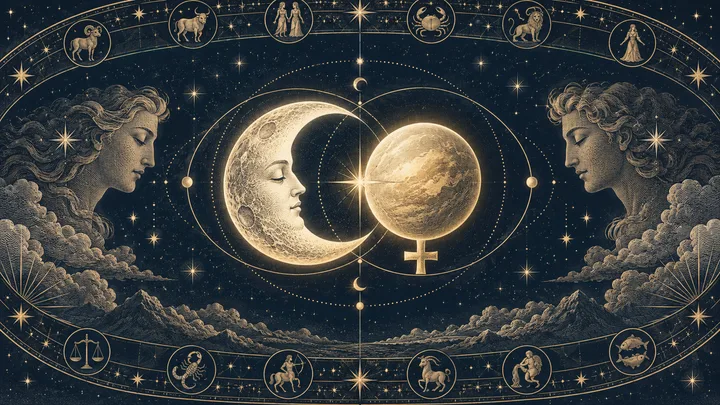
A kind, ordinary moment can reveal what ‘easy’ means
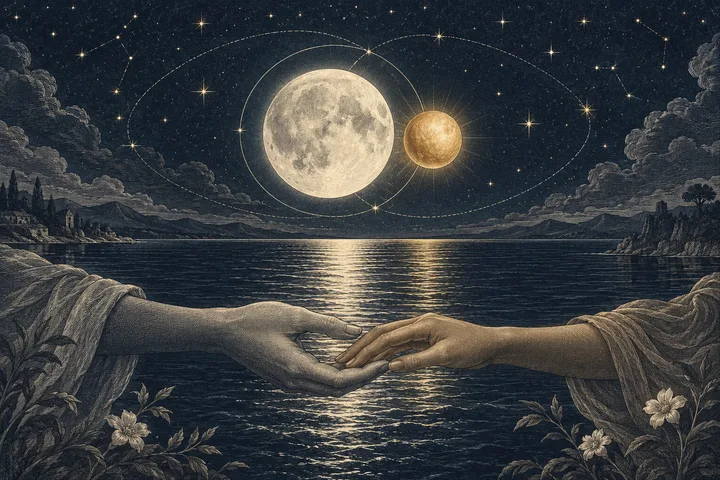
Imagine Lina has had a draining day. Omar notices that she wants quiet company, not a plan to fix everything. He sits beside her and makes tea. She relaxes; he feels glad that the small gesture was welcome. Nothing dramatic happens. The moment matters because each person gives and receives care without much translation.
That scene is illustrative, not a report of real people or a chart we calculated. It gives a concrete shape to the phrase ‘affection feels easy.’ In synastry, a close conjunction between one person’s Moon and the other person’s Venus is often read as a natural meeting between emotional receptivity and affection. Practitioner descriptions of the contact emphasize warmth and ease, while broader synastry guidance treats any one contact as part of a larger comparison (Astromapped, ‘Moon Conjunct Venus Synastry’; Cafe Astrology, ‘Synastry’).
But a kind moment does not prove that the two charts contain this aspect. Nor does it prove that every need is understood. To read the symbolism carefully, begin with the actual Moon and Venus placements, establish their degree distance, and keep track of which person carries each planet. The scene helps us ask what the contact might describe. The chart comparison determines whether the contact is present under the chosen method.
Sources: Synastry | Cafe Astrology; Moon Conjunct Venus Synastry: Tenderness and Easy Affection | Astromapped
What does the easy feeling point to in synastry?
Synastry compares placements from two natal charts. It asks how one person’s planets contact the other person’s planets and interprets those relationships as a pattern between the charts. In this case, the planets are the Moon and Venus. The Moon is commonly read through instinctive feeling, familiar comfort, and emotional needs. Venus is read through affection, pleasure, attraction, appreciation, and what a person values. Cafe Astrology’s synastry overview discusses Venus in relation to pleasure and a person’s approach to relationships; its Moon–Venus page groups the contact with warmth and ease (Cafe Astrology, ‘Synastry’; ‘Synastry: Moon-Venus Aspects Between Charts’).
A conjunction brings two placements to nearly the same zodiacal longitude. In interpretation, the functions meet closely and can blend or intensify one another. Applied here, the symbolic question is whether one person’s way of feeling and seeking comfort meets the other person’s way of showing affection. A small greeting, a chosen word, a shared meal, or quiet company may carry a sense of welcome. Those are examples of the symbolism, not behaviors guaranteed by the aspect. The chart gives a language for the connection; the people supply its actual expression.
The easiest reading is not ‘you are compatible in every way.’ It is narrower: affection may feel emotionally familiar, and care may be easier to offer or receive in this particular channel. GetBirthChart’s Moon–Venus page similarly separates the Moon’s instinctive feeling and security needs from Venus’s affection and style of appreciation. Astromapped describes the contact as tender and quietly bonding. Both are contemporary practitioner interpretations, not measurements of how couples behave (GetBirthChart, ‘Moon Conjunct Venus in Synastry’; Astromapped, ‘Moon Conjunct Venus Synastry’).
This distinction makes the aspect useful. If you are comparing known placements, it can help name why ordinary affection feels welcome. It cannot tell you whether a partner will always respond well, whether your desires match, or whether the relationship will endure. Those questions ask for more chart context and, above all, for attention to what the two people actually say and do.
The term ‘synastry’ can sound as if it promises a complete verdict, but a comparison is only as broad as its inputs and question. This article reads one interchart relationship: Moon to the other person’s Venus. It does not read the composite chart, determine house placements, or infer what either person intends. The narrow scope is a strength. It lets the reader see what this contact contributes before other layers make the picture more complex. When the exact question is why affection feels easy, the Moon–Venus symbolism deserves attention without being asked to carry the whole relationship.
A close Moon–Venus conjunction in synastry links one person’s emotional needs and familiar ways of seeking comfort with the other person’s style of affection. The Moon person may feel welcomed by what the Venus person offers; the Venus person may find it natural to appreciate and soothe the Moon person. That makes the contact a persuasive symbol of tenderness and liking. First verify the cross-chart degrees: this report’s convention counts major aspects within six degrees, while sign labels alone cannot establish an orb. Then read the two roles separately and notice whether a real gesture of care landed as intended. The strongest exception is simple: warmth can keep a couple kind while a harder need or disagreement remains unspoken. This aspect describes one meaningful thread, not every part of a bond.
Sources: Synastry | Cafe Astrology; An Introduction to Aspects and Chart Shaping in Natal Astrology | Skyscript; Moon Conjunct Venus Synastry: Tenderness and Easy Affection | Astromapped
First check whether the conjunction is actually close
A conjunction is centered on zero degrees of separation. An orb is the distance between the measured angle and the exact aspect. For a conjunction, the exact angle is zero, so the orb is the angular distance between the two placements. The Skyscript article adapted from Nicholas Campion’s astrology text defines orb as deviation from exactness and notes that astrologers use different allowance systems. It also gives tighter aspects greater weight within its teaching framework (Skyscript, ‘An Introduction to Aspects and Chart Shaping in Natal Astrology’). That is a useful technical distinction, not a universal rule shared identically by every astrologer.
For this publication’s Synastry Comparison Report, major aspects are evaluated with a six-degree orb when optional degrees are supplied. This is the report’s stated convention. It does not mean all practitioners use six degrees, and it does not mean that every contact within six degrees has equal interpretive force. A closer contact is closer by measurement. Calling that geometry ‘stronger’ in a relationship would turn a distance into a claim the calculation itself does not make.
Consider two hypothetical comparisons. In the first, one person’s Moon and the other person’s Venus are only a few degrees apart. That is a close conjunction under the stated method. In the second, both placements carry the same sign label but sit far apart within that sign. Their shared sign may still offer a symbolic connection, but the labels alone do not establish a close conjunction. These examples are invented to explain the method; they are not personal charts.
A conjunction can also cross a sign boundary. One placement near the end of a sign and another near the beginning of the next may sit close together by longitude even though their labels differ. If you use only sign names, that geometry is hidden. To answer whether the aspect is actually present, compare degree positions on the same zodiac framework. GetBirthChart’s technical explanation likewise separates the zero-degree angle from the measured orb and warns readers to identify the profile behind any quoted allowance (GetBirthChart, ‘Moon Conjunct Venus in Synastry’).
The order matters. Establish the geometry first. Interpret the planetary functions second. If you reverse that sequence, a pleasant relationship can tempt you to find an aspect that the supplied positions do not show. A warm experience remains meaningful, of course. It simply cannot substitute for the chart comparison when the question is specifically about a conjunction.
Degree comparison also needs a consistent reference frame. If one source gives tropical zodiac positions and another gives sidereal positions, do not place those numbers side by side as though they were generated from the same zodiac. The question is not which system a reader must use; it is whether the two supplied positions belong to the same framework. A valid angular comparison uses compatible longitudes. If the source of a placement is unclear, settle that before deciding whether the orb meets the six-degree convention.
It helps to write the comparison in a compact form: person A’s Moon at the stated sign and degree; person B’s Venus at the stated sign and degree; the measured separation; the selected orb rule. That little record prevents a common interpretive slide. A reader may begin with two sign labels, infer a conjunction, and then remember the emotional story as evidence for the aspect. Recording the placements first keeps the direction and measurement visible. It also makes it easier to notice a transcription error or an absent degree rather than quietly filling it in.
The six-degree limit here is a working editorial convention, not a law of the sky or a claim that all schools use the same orb. Skyscript’s treatment notes variation in allowance, and the contemporary calculator page also says its supported range depends on the profile being used. When reading a different astrologer’s work, use their stated method. When comparing this publication’s report, use its stated six-degree rule. The interpretation becomes much more useful when the rule travels with the conclusion.
Sources: An Introduction to Aspects and Chart Shaping in Natal Astrology | Skyscript; Synastry: Moon-Venus Aspects Between Charts | Cafe Astrology; Moon Conjunct Venus in Synastry | GetBirthChart
Why the Moon role and Venus role feel different
The contact has two roles. The Moon person brings the Moon placement into the comparison: instinctive responses, familiar comforts, and the conditions that help them feel emotionally received. The Venus person brings Venus: a style of affection, appreciation, attraction, and pleasure. When those placements meet closely, the Moon person may experience the Venus person’s warmth as welcome. The Venus person may find the Moon person’s emotional expression easy to appreciate or respond to. These experiences connect, but they are not identical.
Astromapped’s current interpretation makes this directional distinction directly: it describes the Moon as feeling and need for closeness, and Venus as warmth and a way of loving. GetBirthChart likewise separates the Moon person’s need for emotional safety from the Venus person’s affection and values (Astromapped, ‘Moon Conjunct Venus Synastry’; GetBirthChart, ‘Moon Conjunct Venus in Synastry’). These sources support a useful symbolic reading. They do not establish that one person feels more or that the same pattern occurs in every pair.
Imagine Lina is the Moon person in a hypothetical chart comparison. When she is quiet after a tiring day, Omar’s Venus might be symbolized by a gentle welcome or an offer to share something pleasant. Lina may feel that the gesture meets her emotional state. Omar may feel that showing care comes naturally. Now reverse the placements: if Omar’s Moon contacts Lina’s Venus, the roles change. Omar brings the Moon need; Lina brings the Venus style. It is not safe to keep the names fixed and claim that the same person always gives or always receives.
A single direction does not automatically tell us that the reverse contact also exists. Moon A conjunct Venus B and Moon B conjunct Venus A are separate comparisons. The same two signs could participate in one cross-chart contact without creating a second one. Read the actual placements rather than turning ‘Moon–Venus’ into a vague statement that both partners feel exactly the same thing.
This also changes the question couples can ask. ‘Who feels it more?’ invites a ranking the aspect cannot supply. Try: ‘What does the Moon person seem to need in this exchange? What kind of affection does the Venus person offer? Does that care land as care?’ That keeps the roles clear and gives each person room to describe a different experience without treating difference as proof that the symbolism has failed.
This directional approach avoids a subtle but common mistake: assuming that a planetary role describes a person’s whole character. ‘Moon person’ is shorthand for the person whose Moon participates in this particular contact. It does not mean that person is always the emotional one, needs more, or behaves in a fixed way. ‘Venus person’ likewise names a chart role, not a promise that this person always initiates affection or is responsible for keeping the bond pleasant. Each individual has a full chart and a life beyond the one contact.
A reader can also separate three statements that often get collapsed. First, the geometry: A’s Moon is close to B’s Venus. Second, the symbolic interpretation: A’s emotional function and B’s affection function meet directly. Third, the lived observation: a particular gesture made A feel cared for, or did not. The first is a measurement if the placements are known. The second belongs to astrological interpretation. The third comes from the people. Keeping these statements distinct gives the reader a grounded reading without flattening the tradition into mere geometry.
The contact can matter to both people without producing symmetrical effects. The Moon person may experience warmth as reassurance; the Venus person may experience the same interaction as pleasure in giving, attraction to the Moon person’s emotional style, or simple enjoyment of their company. Those are plausible interpretations, not a universal ranking of intensity. Ask each person separately what they feel and what they offer. A couple’s own descriptions are more revealing than a blanket claim that one side ‘feels it more.’
Sources: Synastry | Cafe Astrology; Moon Conjunct Venus Synastry: Tenderness and Easy Affection | Astromapped; Moon Conjunct Venus in Synastry | GetBirthChart
What the sign pair changes about the same conjunction
The aspect describes the relationship between the planets. The signs describe how each planet tends to express its function. A Moon–Venus conjunction therefore does not erase the signs involved. It brings the functions together, while the signs add style, emphasis, and possible differences in what feels comforting or affectionate. Cafe Astrology’s broader synastry treatment stresses that relationship interpretation draws on multiple factors, while current Moon–Venus pages also point to sign pairings as context for how care may be expressed (Cafe Astrology, ‘Synastry’; GetBirthChart, ‘Moon Conjunct Venus in Synastry’).
Avoid reading sign names as a ready-made verdict. A sign associated in popular astrology with directness does not guarantee that its Venus owner will always initiate affection. A sign associated with steadiness does not prove that its Moon owner wants the same routine every day. These are symbolic vocabularies, not personality scripts. The useful question is more precise: what form of comfort does this Moon placement suggest, and what form of appreciation does this Venus placement suggest? Then ask whether those forms can meet in practice.
For a purely illustrative contrast, imagine one person expressing affection through visible praise and frequent invitations, while the other person feels most settled through predictable follow-through and unhurried time. The two styles can fit well if each recognizes the other’s gesture. They can also miss if praise is offered when practical support was wanted, or if dependable help is mistaken for emotional distance. The illustration does not assign either style to a particular sign or claim a real chart. It shows why ‘easy’ still needs a vocabulary of its own.
If you know both sign placements but not degrees, you can discuss this layer tentatively: the signs may describe how the Moon and Venus functions are colored. You still cannot establish the aspect’s exact angular relationship. If you know only one sign, describe only that placement’s symbolic style. Do not fill in the absent sign or degree from the relationship story.
A sound sign reading stays close to the actual comparison. It does not list every trait associated with two signs, and it does not assume that similar sign elements guarantee harmony. It asks whether the two symbolic styles help explain the particular way affection moves between these people. That keeps sign interpretation in its proper place: a refinement of the contact, not a replacement for geometry or a substitute for knowing one another.
Signs also matter through the distinction between planetary function and planetary style. The Moon continues to describe an emotional function even when its sign changes; Venus continues to describe an affectionate or valuing function. The signs add a vocabulary for how those functions operate. If a reader jumps straight to sign traits, the central contact can disappear beneath a list of adjectives. Start with the two functions. Add sign detail only when it clarifies how they meet.
Suppose the Moon person feels cared for through consistency, while the Venus person naturally expresses affection through verbal warmth. Neither approach is deficient. The conjunction may describe an underlying ease or willingness to connect, but the signs could help explain why the first gesture does not always match the first need. Then the useful move is not to declare the signs incompatible. It is to translate: what does consistency look like to the Moon person, and how can verbal warmth be paired with it? This is an illustrative question, not a claim about any particular sign pair.
If the signs share an element or belong to a configuration some astrologers treat as harmonious, that can add context, but it still should not erase the actual degrees. Similarly, signs traditionally described as having different styles do not cancel a measured conjunction. The chart is layered: aspect geometry gives one kind of relationship; signs give a mode of expression. Readers who keep those layers apart can describe both ease and difference without forcing a single verdict.
Sources: Synastry | Cafe Astrology; An Introduction to Aspects and Chart Shaping in Natal Astrology | Skyscript
Why ‘easy affection’ is a stronger clue than instant intensity
People often look for an aspect to explain intensity: the spark, the pull, the moment that seems to change everything. Moon conjunct Venus points to a different quality. Its strongest traditional and contemporary reading concerns affection meeting emotional receptivity. It can describe tenderness, fondness, or the feeling that ordinary kindness arrives in a language the other person recognizes. Cafe Astrology’s Moon–Venus overview associates the contact with cooperation and warmth; Astromapped distinguishes its gentle tone from more overtly charged attraction language (Cafe Astrology, ‘Synastry: Moon-Venus Aspects Between Charts’; Astromapped, ‘Moon Conjunct Venus Synastry’).
That makes calmness worth noticing. If two people enjoy a comfortable silence, remember small preferences, or feel at ease offering ordinary affection, they do not need to dismiss those moments because they lack dramatic tension. The symbolism is not less meaningful simply because it is quiet. A supportive contact may show itself as a daily tone rather than a grand event. Still, the chart cannot certify that a gesture happened or tell a reader why another person made it.
Keep affection separate from desire, commitment, and overall compatibility. Venus has associations with attraction and pleasure, but a Moon–Venus conjunction alone does not establish sexual chemistry. A warm emotional-affection channel does not answer whether two people want the same relationship structure, handle disagreement well, or intend to build a life together. Those are different questions. The temptation to stretch one attractive symbol into a complete answer is precisely where interpretation loses its usefulness.
The same caution applies to words like ‘mutual.’ Both people may enjoy the contact, yet their experience can differ because one contributes the Moon and the other contributes Venus. Mutual warmth in a broad sense does not mean identical needs, equal effort, or matching expectations. Ask what each person actually receives and offers. A reader who names the specific ease has learned more than one who declares the whole connection perfect.
So if the relationship feels gentle rather than electric, do not force the contact to explain a kind of intensity it does not primarily symbolize. Ask whether affection and emotional comfort appear to meet naturally. Then leave the questions of desire, commitment, and shared direction open until the relevant chart layers and real conversations address them.
Sources: Synastry | Cafe Astrology; Moon Conjunct Venus Synastry: Tenderness and Easy Affection | Astromapped
Is the conjunction different from a Moon–Venus trine?
Yes. A conjunction and a trine are different angular relationships, even when both involve the Moon and Venus. The conjunction centers the planets at the same longitude. The trine centers them about 120 degrees apart. Both can be interpreted as supportive contacts, but they do not carry the same geometry or the same image. Skyscript’s aspect lesson explains aspects through angular distance and gives each configuration its own place in chart interpretation (Skyscript, ‘An Introduction to Aspects and Chart Shaping in Natal Astrology’).
In a Moon–Venus conjunction, the planetary functions come into close contact. A reader might describe emotional needs and affection as blending into one another. The benefit is directness: a Venus gesture can feel closely tied to the Moon person’s comfort. The challenge is also directness: the functions can become hard to distinguish. One person may assume that keeping things pleasant has answered the emotional need, when the need itself calls for a different response.
A trine is commonly read as a flowing relationship between the planets. Its ease may feel less fused and more like a current between two functions. Cafe Astrology discusses harmonious Moon–Venus contacts as ease and cooperation, though a specific trine reading still depends on the chart and its interpretive framework (Cafe Astrology, ‘Synastry: Moon-Venus Aspects Between Charts’). This is a comparison of astrological meanings, not a claim that one aspect is better for a relationship.
A sign-only comparison can confuse these forms. Two planets in signs that are traditionally compatible by element might suggest a harmonious style, but that does not establish a trine. Likewise, same-sign placements may sound like a conjunction, but their degrees may be too far apart for the chosen orb. Aspect names refer to measured geometry. Sign relationships can add another layer, but they do not replace the angle.
If someone says ‘we have Moon–Venus,’ ask which aspect they mean and which person owns each planet. A conjunction, trine, or sextile can each have a different interpretation. Naming the actual shape prevents a general feeling of ease from being mistaken for a specific configuration. The present question concerns the conjunction: close contact, linked functions, and the need to distinguish tenderness from every other kind of compatibility.
Sources: An Introduction to Aspects and Chart Shaping in Natal Astrology | Skyscript; Synastry: Moon-Venus Aspects Between Charts | Cafe Astrology; Moon Conjunct Venus Synastry: Tenderness and Easy Affection | Astromapped
When is ease warmth—and when can it hide a need?
The strongest exception to the easy-affection reading is not that the contact suddenly means its opposite. It is that comfort can coexist with something still unspoken. Two people may know how to soothe one another and still avoid a difficult conversation. The warmth is real; it simply does not settle every question. Contemporary Moon–Venus interpretations sometimes name the wish to preserve harmony as a possible shadow. GetBirthChart describes pleasantness covering a need that still calls for words; Satyori similarly discusses conflict avoidance as a possibility, though it makes broader claims that should not be treated as universal (GetBirthChart, ‘Moon Conjunct Venus in Synastry’; Satyori, ‘Moon Conjunct Venus’).
Treat this as an interpretive caution, not a diagnosis. A Moon–Venus conjunction does not prove that a couple suppresses conflict, that one person is dependent, or that affection is manipulative. The aspect’s soft symbolism can invite a question about how kindness functions. Does it make an honest conversation safer? Or does one person use a pleasant gesture to close a topic before the underlying concern has been heard? Only the people involved can answer that from experience.
The difference can be observed after a mismatch. Suppose one partner offers comfort in the form they themselves would enjoy. The other appreciates the intention but still needs something different. In a responsive exchange, the recipient can name that difference; the giver can listen without withdrawing warmth; both can adjust. In an avoidant exchange, the first gesture becomes proof that the issue should be over, or the recipient stays quiet to protect the good mood. The contact’s symbolism is useful because it focuses attention on how tenderness and need meet, not because it predicts which path a couple will take.
This is also why ‘easy’ should not be confused with ‘effortless forever.’ A naturally welcoming contact can make affection feel less guarded, but care still asks for attention. Needs change. A gesture that worked last month may not work today. Venus’s wish to create pleasure and the Moon’s search for comfort can meet beautifully while remaining distinct functions, each with its own preferences.
The practical test is not whether there is ever tension. It is whether affection leaves room for directness and repair. If the pair can say what they need, hear a different answer, and return to warmth without pretending the disagreement never occurred, ease is helping honesty. If the pleasant atmosphere keeps replacing the conversation, name the issue plainly. The chart can suggest where to look; it cannot speak on either person’s behalf.
A useful boundary is the difference between accommodation and responsiveness. Accommodation can look generous: one person gives way so the mood stays light. Responsiveness includes curiosity about whether the offered gesture was actually helpful. In the first case, the same hidden need may return because it was never addressed. In the second, the partners can adjust the form of care without treating the original kindness as a failure. The Moon–Venus symbolism can focus attention on receiving and offering; it does not tell us which of these patterns is present.
Some practitioner pages make sweeping claims about healing, nervous-system safety, or long-term outcomes. Those descriptions reach further than the aspect alone can justify within this article’s scope. We can retain a more modest and useful interpretation: tenderness may feel natural, and people may value the ease. We should not claim that a conjunction heals prior wounds, guarantees reliability, or protects a relationship from stress. Those outcomes involve a whole life, not a single interchart angle.
If a topic is repeatedly avoided, ask what makes it difficult to raise. Is one person worried that a complaint will be heard as rejection? Does the other assume that a gift or affectionate mood has resolved the concern? Can they agree on a time to return to it? These questions describe conduct and choice. They keep the symbolic reading respectful while leaving agency with the people rather than assigning fate to the chart.
Sources: An Introduction to Aspects and Chart Shaping in Natal Astrology | Skyscript; Moon Conjunct Venus | Satyori; Moon Conjunct Venus in Synastry | GetBirthChart
What changes when the aspect is wider or only sign-based
A closer conjunction is more exact by geometry. A wider one is less exact. That statement concerns the angle, not the total strength of a relationship. Skyscript’s discussion of orb presents one teaching approach and notes that astrologers differ in how they assign allowances. GetBirthChart likewise distinguishes the measured orb from the meaning a reader gives it (Skyscript, ‘An Introduction to Aspects and Chart Shaping’; GetBirthChart, ‘Moon Conjunct Venus in Synastry’). Keep these ideas separate: distance is calculated; significance is interpreted.
Under this publication’s convention, a major aspect within six degrees can be included when optional degrees are supplied. A contact near exact is more tightly measured than one near the edge of that range. Neither measurement is a compatibility score. There is no basis here for converting a smaller orb into a percentage of affection, a prediction of relationship success, or a ranking against another couple. A precise angle helps establish what aspect is being discussed. It does not calculate a human outcome.
When you know only the two signs, there are three honest levels of statement. You may describe the possible sign-based relationship between the placements. You may say that the contact is worth checking if the degrees are available. You may not claim that a measured conjunction exists or quote an orb. This keeps the reading useful without turning missing information into false certainty.
The reverse issue also matters. If two placements are close across a sign boundary, sign labels alone might make the conjunction easy to overlook. A person may see different signs and assume there is no conjunction, even though the actual longitudes are near zero degrees apart. The method asks for comparable degree positions, not a visual impression from labels. For a precise reading, confirm the zodiac system used by the chart source and compare like with like.
Think of evidence as a ladder. Sign labels offer a first description of style. Degree positions establish whether the stated aspect convention is met. Observed exchanges help you decide whether the interpretation illuminates the relationship’s lived tone. None of these steps replaces the others. If degrees are missing, leave the conjunction provisional. If the contact is present, still let behavior refine the reading. Precision should make interpretation clearer, not more absolute.
If a reader has a placement list from two different websites, it is worth checking how those lists were produced before comparing degrees. A rounded sign-and-degree display may conceal minutes of arc; that usually does not alter a broad reading, but it can matter near an orb boundary. One source may also show degrees measured from zero within each sign, while another gives a continuous longitude. Both can describe positions, yet the values must be converted or interpreted consistently to calculate separation. If the contact appears close to the edge, preserve that uncertainty and use a clearly stated rule rather than implying more precision than the display provides.
The same discipline applies when people quote an orb from a report or astrologer. Ask what aspect rule that source uses, whether the number refers to the Moon–Venus pair, and whether it is a measured distance or a general interpretive guideline. A clear answer makes comparisons fair. Without it, two readers may appear to disagree when they are simply using different conventions.
Sources: An Introduction to Aspects and Chart Shaping in Natal Astrology | Skyscript; Synastry: Moon-Venus Aspects Between Charts | Cafe Astrology; Moon Conjunct Venus in Synastry | GetBirthChart
What a single contact can—and cannot—decide
Moon conjunct Venus can support a reading of natural fondness, emotional welcome, and an easy bridge between one person’s Moon needs and another person’s Venus style. That is a meaningful conclusion. It is also bounded. A single contact cannot establish that the two people are equally nourished, sexually compatible, committed to the same future, or destined to remain together. Those claims go beyond the symbolism of this aspect and beyond the information supplied in a placement comparison.
Broader synastry references emphasize that a relationship reading draws on many chart factors. Cafe Astrology’s overview places Venus among a wider set of relational considerations and cautions against treating one placement as the whole answer (Cafe Astrology, ‘Synastry’). GetBirthChart similarly states that its aspect name alone does not supply house overlays or a complete relationship reading; its page distinguishes the cross-chart angle from additional chart data (GetBirthChart, ‘Moon Conjunct Venus in Synastry’). The useful inference is modest: context can support, redirect, or complicate the contact.
If you have additional supplied placements, read them as additional layers rather than as votes for or against the relationship. Another contact may describe communication, desire, steadiness, friction, or a different emotional pattern. It does not erase the Moon–Venus symbolism. Nor should a favorable aspect be used to excuse a repeated behavior that hurts someone. A chart interpretation should help a reader notice and discuss a pattern, not overrule what the people know from living it.
House overlays and angles require chart information that the present article does not have. Birth time can matter for chart features such as houses and angles. The Synastry Comparison Report described in this publication uses supplied placements and optional degrees; it does not calculate natal charts from birth details. Therefore, a reader who brings only signs or degrees can ask about those placements, but should not expect a house-based conclusion from this contact alone.
The verdict can stay direct: if the cross-chart degrees meet the chosen orb, Moon conjunct Venus is a persuasive signature of tenderness and natural liking. Its strongest exception is that kindness may coexist with unmet needs or unspoken disagreement. It does not decide the relationship. It gives one clear thread to compare with the rest of the available chart and with the couple’s actual exchanges.
This boundary is especially important when a reader arrives with only a placement list. The list may include signs but no degrees, birth times, houses, or angles. It can still support a sign-level discussion and, when degrees are present, an aspect comparison. It cannot answer questions that depend on chart features not supplied. A careful writer should say exactly which layer is being read instead of implying a complete synastry analysis from partial inputs.
The same contact can also sit within a broader pattern that changes emphasis. Another supplied aspect may reinforce a theme of care, introduce tension around expression, or describe a different kind of attraction. If those placements are not available, do not invent them to make the story feel complete. State the strongest conclusion the known contact supports and stop there. A reader can always compare more known placements later; the current answer does not need to pretend they were examined.
Relationship experience deserves its own place beside chart symbolism. If the chart suggests ease but a person consistently feels unseen, that experience should not be argued away by the aspect. If the chart contains no close contact but affection feels natural, that lived warmth remains real; the lack of this particular aspect does not invalidate it. Astrology is most useful here as a language for reflection and comparison, not as an authority that overrules the people whose lives are being interpreted.
Sources: Synastry | Cafe Astrology; An Introduction to Aspects and Chart Shaping in Natal Astrology | Skyscript; Moon Conjunct Venus in Synastry | GetBirthChart
How to compare the contact with one real exchange
A practical reading begins with one recent exchange, not a general verdict about the relationship. Choose a moment when one person wanted comfort or closeness and the other responded with affection. Keep the example ordinary. The aim is to see whether the Moon–Venus language clarifies the interaction, not to prove that the chart caused it. GetBirthChart’s interpretation also proposes looking at how a gesture is received and whether pleasantness leaves a need unnamed; use that as a prompt for reflection, not as a finding about any particular couple (GetBirthChart, ‘Moon Conjunct Venus in Synastry’).
First, name the need as the Moon person might describe it. Was the person seeking reassurance, quiet, familiar company, a practical form of support, or room to feel without being corrected? Do not assign the need from a sign stereotype. Ask the person, or use their own account. This step keeps the Moon symbolism connected to an actual experience rather than an assumption about what someone must want.
Second, name what the Venus person offered. Was it a compliment, a gentle touch, a shared pleasure, a thoughtful choice, an invitation, or simply a warm tone? Then ask how the gesture landed. The Moon person may have felt seen; they may also have appreciated the affection while needing something else. A gesture’s intention and its effect are related, but they are not the same thing.
Third, notice what happened when the first response did not quite fit. Could the recipient say, ‘I like that you’re here; what I need right now is for you to listen’? Could the giver hear that without turning the request into rejection? A flexible exchange supports the reading of ease as a channel for care. A shutdown does not cancel the aspect; it points to a need that deserves direct attention.
Finally, compare the exchange with the chart in the right order. Confirm that the degrees fit the stated orb. Identify the Moon person and Venus person. Consider the sign expression if known. Then decide whether the symbolism helps you understand the moment. This small method is more useful than asking whether the aspect is simply ‘good’ or ‘bad.’ It produces a concrete question the couple can answer together: what kind of affection feels like comfort to each of us?
A report based on supplied placements can help organize this layer if readers want a structured comparison. Its proper role is bounded: it works with placements provided by the reader and optional degrees. It does not calculate natal positions from birth details. That boundary matters because the current article is about interpreting a known Moon–Venus contact, not promising a chart service that derives every position, house, and angle from a birth record.
Sources: An Introduction to Aspects and Chart Shaping in Natal Astrology | Skyscript; Moon Conjunct Venus in Synastry | GetBirthChart
Compare the placements, then let the conversation complete the reading
Return to Lina and Omar. Their imagined moment still looks kind, but we can now read it with more care. The gesture resembles the tenderness associated with Moon conjunct Venus. That interpretation becomes specific only if the cross-chart Moon and Venus degrees meet the chosen orb, and it remains directional: one person brings the Moon, the other Venus. One warm moment can illustrate the symbolism. It cannot establish the chart or settle every question about the bond.
If you have both placements, compare the signs and optional degrees. If you have only signs, keep the aspect unconfirmed. Then name one kind of comfort each person welcomes and ask whether the affection offered actually meets it. The Synastry Comparison Report can compare supplied Moon, Venus, and Mars placements and optional degrees; it does not calculate natal placements from birth details. That makes it useful when you already have the placements and want to compare their symbolic pattern.
The direct answer is simple: a close Moon–Venus conjunction often describes affection that feels emotionally natural, with distinct roles for the Moon person and Venus person. Read it as a meaningful signature of tenderness, not a promise of mutuality in every domain. Verify the geometry, notice where warmth flows, and let an honest conversation reveal what the chart cannot: whether the care fits both people now.
One can keep a simple note for the comparison: placement and degree; who owns Moon and who owns Venus; what the sign expression adds; one example of affection that felt welcome; one need that still calls for words. That is enough. More detail is not automatically better, especially when birth times, houses, or the rest of the chart are absent. The reading should match the evidence at hand.
Sources: Synastry | Cafe Astrology; Synastry: Moon-Venus Aspects Between Charts | Cafe Astrology
A little more clarity
Does Moon conjunct Venus mean both people feel the same way?
No. The Moon person and Venus person contribute different functions. The Moon person may experience affection as emotionally welcome, while the Venus person may find it natural to offer or appreciate affection. Their experiences can connect without being identical, and the aspect does not establish equal effort or identical needs.
Can we confirm Moon conjunct Venus from sign names alone?
No. Sign names can suggest a possible style or relationship between placements, but degrees are needed to measure the angular distance and orb. Under this publication’s report convention, major aspects use a six-degree orb when optional degrees are supplied.
Sources & further reading
- Synastry | Cafe Astrology
Defines the broad synastry comparison and places Venus among several relationship factors rather than treating one contact as a complete reading.
- An Introduction to Aspects and Chart Shaping in Natal Astrology | Skyscript
Explains angular aspects, orb as distance from exactness, and variation in astrologers’ orb conventions.
- Synastry: Moon-Venus Aspects Between Charts | Cafe Astrology
Provides a practitioner interpretation of Moon-Venus interchart contacts as associated with warmth, ease, and cooperation.
- Moon Conjunct Venus Synastry: Tenderness and Easy Affection | Astromapped
Separates Moon needs from Venus affection and offers a contemporary reading of the contact as gentle tenderness.
- Moon Conjunct Venus in Synastry | GetBirthChart
Distinguishes the Moon and Venus roles, defines conjunction geometry and orb, and frames unmet needs as a possible interpretive exception.
- Moon Conjunct Venus | Satyori
Offers a contemporary practitioner counterpoint that protecting a harmonious atmosphere can sometimes make difficult topics harder to raise.
Synastry Comparison Report
Enter known placements for two people. Get an input-by-input comparison, selected aspect calculations and a clear record of what remains uncertain.
Compare our placements