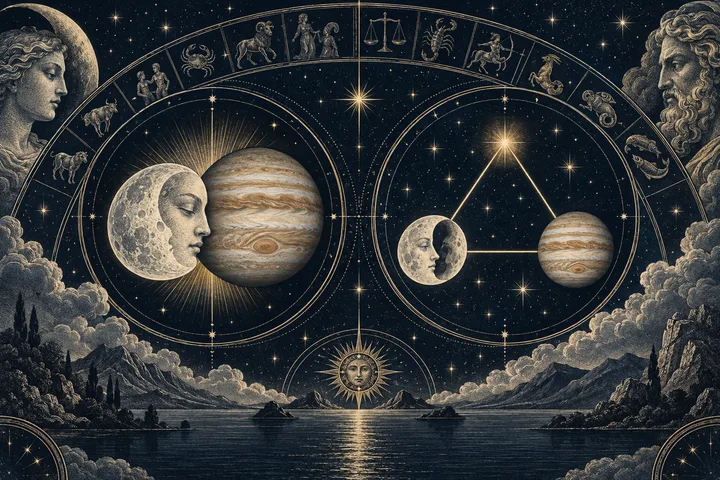
What stays the same when the aspect changes?
In synastry, a cross-aspect links a planet in one person’s chart with a planet in the other’s. Here, one person’s Moon meets the other person’s Jupiter. Keep those owners fixed as you compare the conjunction and trine: the Moon person brings emotional needs, immediate responses and receptivity into the reading; the Jupiter person brings themes of encouragement, meaning, confidence, generosity and expansion. The direction matters. A Jupiter-to-Moon contact describes this exchange, not automatically a reciprocal Moon-to-Jupiter contact from the other chart. The aspect-specific reference “Synastry: Moon–Jupiter Aspects Between Charts” describes joy, goodwill, hope and generosity in both contacts. It also gives each a caution around excess or overextension. “Synastry Moon-Jupiter Aspects” likewise frames the pair around emotional responsiveness meeting Jupiter’s expansive nature. So the shared ground is substantial: either contact can symbolize a generous, encouraging tone. The aspect name adds a distinction to that common theme; it doesn’t replace it with a different pair of planets or prove that one couple has more love. Imagine one person tells the other about a disappointment. The Moon person is sharing a feeling; the Jupiter person responds with hope or perspective. This is an illustrative scene, not a report about a real couple or a chart. It helps hold the people and moment steady while the aspect changes. In a conjunction reading, the feeling and the hopeful response are interpreted as more joined. In a trine reading, they are interpreted as cooperating with greater ease. The specific texture belongs to the next step of the comparison. That distinction keeps the reading fair. Don’t turn “conjunction” into automatic intensity or “trine” into a relationship ranking. The same supportive themes can appear in both, and either can be expressed with more or less care in a real exchange. Nor should you blend the direction of this contact with its reverse: who carries the Moon and who carries Jupiter is part of what you’re interpreting. Start, then, with the stable facts: whose Moon, whose Jupiter, and which aspect connects them. This like-for-like frame lets you compare the geometry without quietly changing the people or importing a generic “good aspect” score.
Sources: Synastry: Moon – Jupiter Aspects Between Two Charts; Synastry Moon-Jupiter Aspects
What makes the comparison technically fair?
A fair comparison starts by keeping the people and planets in the same roles. In both contacts, one person’s Moon is compared with the other person’s Jupiter. Then ask how far apart those two positions are in the zodiac. The aspect name describes their angular relationship: a conjunction is centered on 0°, while a trine is centered on 120°. Cafe Astrology’s “Glossary of Astrology Terms” defines aspects through these angular relationships and identifies both angles directly. Keep the owners fixed to isolate the aspect difference. The measured distance from an exact aspect is called its orb. If the Moon and Jupiter sit exactly at the aspect’s defining angle, the aspect is exact; if they sit to either side, the separation from that angle is the orb. Cafe Astrology’s glossary describes an orb as the range of degrees within which astrologers treat an aspect as operating. It calls one or two degrees close and ten degrees loose, which shows that the word also carries a judgment about strength. These are that source’s guidelines, not a universal allowance; state the rule you use. This publication’s Synastry Comparison Report uses a six-degree orb for selected major aspects when degrees are supplied. That is the report’s working convention. It gives a consistent boundary for supplied Moon–Jupiter degrees, not a universal law or a claim that all qualifying contacts carry identical weight. The closer an aspect lies to its exact angle, the more exact it is under the chosen method; the orb tells you about closeness, while the aspect name still tells you whether you are reading a conjunction or trine. Cafe Astrology’s “The Meaning of the Aspects in Astrology” offers an interpretive reason to keep closeness in view. It describes conjunctional energies as united and blended, and says closer conjunctions act more subjectively as combined energies. Its account of trines emphasizes natural support that may be so familiar it goes unnoticed. This helps explain why exactness matters, but closeness neither decides the whole relationship nor replaces the distinction between joining and flowing. A close trine remains a trine; a wider conjunction remains a conjunction if it falls within the orb rule being used. Signs alone can support a provisional comparison, but they cannot show the exact angular separation or establish how close either contact is to 0° or 120°. If degrees are unknown, do not call one contact tighter or stronger; leave exactness open. When degrees are available, compare both contacts using the same zodiac framework and the same orb convention. A changing rule can make the comparison unfair. The useful sequence is simple: identify whose Moon and whose Jupiter are involved; confirm whether the separation is centered on conjunction or trine; note the supplied degrees and apply one stated orb rule; then interpret the contact. The report can organize Moon, Venus and Mars placements supplied by the reader, with optional degrees for selected major-aspect calculations. It does not calculate natal placements from birth details. With sign placements alone, hold strength open and compare the two aspect meanings provisionally. With degrees, use one consistent setting. This gives you a fair starting point, not a complete relationship reading.
Sources: Glossary of Astrology Terms; The Meaning of the Aspects in Astrology
How do conjunction and trine geometry shape the texture?
Think of aspect geometry as the way two planetary functions meet. In The Meaning of the Aspects in Astrology, Cafe Astrology describes a conjunction as energies “united” and acting together, while a trine is described as supportive, accepting, and naturally flowing. Applied to a cross-chart Moon–Jupiter contact, the geometry gives a first clue about the texture of emotional exchange: does feeling and encouragement arrive as a more joined emphasis, or does encouragement find an easier path alongside feeling? The Moon-Jupiter Aspects in Synastry, from Kerykeion’s Learn Astrology guide, applies that distinction to this pair. Its conjunction interpretation brings the Moon’s emotional responsiveness and Jupiter’s expansive nature together “into a single point of contact.” Its trine interpretation describes a “flowing connection” and natural resonance. Both can signify warmth and generosity in this interpretive tradition. Instead, conjunction symbolism gives the paired themes a more blended, concentrated emphasis; trine symbolism gives them cooperation with less friction. The word “blended” belongs to the reading of the aspect. It doesn’t mean that either person becomes the other, or that their feelings and beliefs are identical. The conjunction brings the functions into one interpretive focus; it doesn’t erase the Moon person’s emotional style or Jupiter person’s way of offering meaning. Consider the same illustrative moment in both readings. One person shares a disappointment; the other responds with hope and encouragement. With a Moon conjunct Jupiter contact, the response may feel woven into the emotional moment itself. The feeling can seem to grow larger as reassurance and possibility gather around it. This is one way to picture the conjunction’s joined symbolism, not an observation about a particular couple. A combined emphasis may feel generous and uplifting; it can also make the emotional volume seem high. With Jupiter trine Moon, the same encouragement may come more readily, but feel like a supportive current alongside the feeling rather than one intensified emotional event. Their functions remain more distinct while cooperating easily. Cafe Astrology’s general aspect guide calls trine energies natural and automatic; its Moon–Jupiter synastry page associates easier contacts with joy, generosity, openness, and goodwill. “Less friction” means the symbolism suggests ready cooperation; it does not mean passivity, constant agreement, or the absence of effort in a relationship. A smooth symbolic channel can still call for attention and choice. That distinction is useful precisely because it stays modest. Cafe Astrology’s pair-specific descriptions give both the conjunction and the easier Moon–Jupiter contacts shared themes of joy, generosity, and abundance. The conjunction entry itself can be strongly positive, while also warning of overdoing or overextending. So a reader shouldn’t turn “blended” into “too intense,” or “flowing” into “better.” The comparison is about interpretive texture, not a measured forecast or a ranking of couples. To use the distinction, keep the Moon person and Jupiter person fixed, then ask a grounded question: in moments of support, does hope seem to swell inside the feeling, or accompany it with ease? Treat the answer as a way to notice and discuss a possible pattern, not as proof of what either person intends. Geometry offers a useful first impression. The lived exchange gives it meaning.
Sources: The Meaning of the Aspects in Astrology; Synastry Moon-Jupiter Aspects; Synastry: Moon – Jupiter Aspects Between Two Charts
What can a Moon conjunct Jupiter contact emphasize?
In a Moon conjunct Jupiter synastry contact, the Moon person’s emotional responses meet the Jupiter person’s hope, generosity, and appetite for possibility at a shared focal point. The conjunction can make those themes feel closely joined: warmth may arrive with encouragement, and a difficult moment may quickly open toward meaning or a next step. This is a symbolic reading of the aspect, not a promise that either person will always respond in a particular way. The page “Synastry: Moon – Jupiter Aspects Between Two Charts” describes the conjunction through joy, hope, goodwill, adventure, open-mindedness, and a wealth of feelings. It also names abundance and excess as parts of the contact, and urges balance and wise choices. “Synastry Moon-Jupiter Aspects” likewise reads the conjunction as lunar responsiveness blending with Jupiter’s expansive nature. It describes emotional warmth and validation as possibilities, while also warning that reassurance can come too quickly. Together, these sources support a reading of generous emotional scale, with a real question about how that scale is used. Consider this illustrative exchange. One person tells the other about a disappointment and says they feel unsure what to do next. In a supportive expression of the conjunction, the Jupiter person’s encouragement helps the Moon person feel that the emotion can be held and that new options remain. The response doesn’t shrink the disappointment; it makes room for feeling and possibility at once. The pair might then find practical generosity in listening, sharing time, or helping with a next step. These are examples of how the symbolism could be expressed, not observations about a real couple. The same expansive impulse can overshoot. If the Jupiter person jumps straight to “Everything will work out” or proposes a grand plan before the Moon person has finished speaking, the Moon person may feel that hope has displaced the feeling. That listening concern is an interpretive application of the sources’ warnings about excess and reflexive reassurance, not a guaranteed feature of conjunctions. The useful question is simple: does encouragement help the feeling become more speakable, or does it hurry the conversation toward a brighter ending? The conjunction’s abundance can also affect commitments. Cafe Astrology’s pair-specific interpretation cautions that the two people may overdo or overextend themselves, while presenting generosity and opportunity as potential resources. Read that as a prompt to weigh enthusiasm against capacity. Saying yes to every plan, promise, or shared expense can turn warmth into strain. A generous offer matters most when both people can sustain it. “Synastry Moon-Jupiter Aspects” makes a related point about emotional inflation: reassurance can amplify a feeling or bypass discomfort when presence would serve better. So read this contact as concentrated encouragement, with both uplift and excess in view. Notice whether the Moon person feels welcomed in the full feeling, and whether the Jupiter person’s optimism leaves room for limits, uncertainty, and a slower answer. When both people can name what they have capacity for, the conjunction’s intensity can support generosity without making a promise of luck, prosperity, or relationship success.
With the same person’s Moon and the other person’s Jupiter held constant, a conjunction suggests a more joined, concentrated exchange; a trine suggests easier cooperation between emotional response and encouragement. Both can symbolize warmth, hope and generosity, and either can be qualified by signs, closeness, natal context and the wider synastry. Compare supplied degrees using one stated orb rule, then treat the contact as one interpretive layer rather than a relationship verdict.
Sources: Synastry: Moon – Jupiter Aspects Between Two Charts; Synastry Moon-Jupiter Aspects
What does the trine change, and what can ease conceal?
A Jupiter trine Moon contact can describe emotional generosity and reassurance that come readily. In synastry, one person’s Moon meets the other person’s Jupiter through an aspect traditionally read as easy or supportive. The trine’s ease can make goodwill feel dependable. It can also make that goodwill so familiar that neither person names or tends it. This is a resource in the chart reading, not proof that hard feelings are automatically understood. The pair-specific guide “Synastry Moon-Jupiter Aspects” describes the trine through joy, generosity, openness, and emotional resonance. “Aspects in Astrology” frames trines more generally as easy flows that can be taken for granted. Together, those descriptions suggest a particular strength: encouragement may be available without the exchange feeling forced. The Moon person can bring a tender or unsettled response; the Jupiter person may offer perspective, confidence, or room to hope, and the Moon person may find that support easy to receive. That is an interpretation of the symbols, not a report about observed couples. The same Moon-Jupiter guide complicates a sharp split between the aspects. It gives the conjunction many of the same positive themes, including joy, goodwill, generosity, and hope, and it also describes the conjunction as a positive influence. Both contacts can carry warmth and abundance. The useful distinction is therefore not “good trine, difficult conjunction,” or “weak trine, powerful conjunction.” It is a question of texture: the trine suggests cooperation with less friction, while the conjunction suggests a more joined or concentrated emphasis. Neither description ranks the people or predicts how they will treat each other. Ease has an edge. A naturally reassuring response may help someone feel supported, but pleasantness alone doesn’t show that the listener has understood the whole feeling. In an illustrative exchange, imagine one person says they’re worried about a change at work. The other responds, “You’ll find a way through this.” That answer might offer welcome confidence. But if it arrives before the worry has been heard, the same optimism could leave uncertainty or practical limits unnamed. This is one possible expression to consider, not an outcome established by the cited astrological sources. The strongest counterpoint is that a trine may be more usable and steady than a conjunction. A readily available response can suit the people better than a concentrated one, especially if intensity feels like too much. Conversely, ease can become routine and go unnoticed, while a conjunction’s visible emphasis may draw attention to the exchange. The sources support these as interpretive possibilities, not measured differences in relationship outcomes. Context decides which quality serves the people. So ask whether the goodwill is actively shared and maintained. Does encouragement make room for the Moon person’s feeling, including its uncertainty? Can the Jupiter person offer hope without making promises the situation can’t support? Those questions keep the trine’s ease in view without mistaking effortlessness for depth or superior compatibility. The contact can describe an open channel of support; how the people use that channel is the more useful thing to notice.
Sources: Synastry: Moon – Jupiter Aspects Between Two Charts; Synastry Moon-Jupiter Aspects; The Meaning of the Aspects in Astrology
How do signs and degrees qualify the first impression?
Aspect geometry gives the first reading; signs and closeness refine its style and emphasis. A close trine remains a trine, and a wider conjunction remains a conjunction if it falls within the chosen orb rule. Sign placements can color how the Moon person receives support and how the Jupiter person offers it, but they don’t tell you how near the planets are to an exact aspect. Keep the questions separate: what kind of contact is this, how close is it, and through which signs does it speak? A conjunction centers on 0°, while a trine centers on 120°. The distance from that exact angle is the orb. In “Glossary of Astrology Terms,” Cafe Astrology describes an orb as the range around an exact aspect in which astrologers consider the contact operative. That definition explains the measurement, but it doesn’t set one universal cutoff. Astrologers use different allowances, so a statement about strength should name its rule. The Synastry Comparison Report uses a six-degree orb for selected major aspects when degrees are supplied. That is the report’s convention, not a universal standard. Nor does it mean every contact within six degrees has equal weight. A contact near the edge of the chosen range may count under that rule while remaining wider than one nearer exactness. Say which convention you’re using; don’t turn “within the orb” into “universally strong.” With sign-only information, you can discuss the signs and whether their arrangement suggests a conjunction or trine in the zodiac system being used. You can’t calculate the exact separation or compare closeness without degrees. “Synastry Aspects Explained: How Two Charts Actually Interact” notes that sign context changes how an aspect expresses. Signs add an interpretive layer; they don’t replace the measured angle. A vivid sign-based impression also shouldn’t overrule a measured aspect without a reason. First identify the cross-chart aspect from the supplied positions. Then consider the signs as the style through which its symbolism may be expressed. If you use different zodiac systems, state which one, since sign labels can change while the angular comparison remains a separate question. Closeness and ease aren’t synonyms. Ranking a contact as closer to exactness is a measurement under a stated orb convention. Calling a conjunction more blended or a trine more flowing is an interpretation of aspect type. One doesn’t prove the other. A close trine is still read through trine symbolism; closeness doesn’t make it a conjunction. A close conjunction doesn’t guarantee warmth or a pleasant exchange. Signs, each planet’s wider chart condition, and other synastry contacts can qualify the first impression. When degrees are missing, name the possible aspect and sign expression, then leave exactness and relative strength unresolved. When degrees are available, compare both contacts with one consistent zodiac framework and orb rule before saying which is closer. The aspect gives you the first lens, not the whole reading. Signs show its particular voice; the wider chart tells you how much weight that voice can carry.
Sources: Glossary of Astrology Terms; Synastry Aspects Explained: How Two Charts Actually Interact
How much should one contact decide?
One Moon–Jupiter cross-aspect can describe a channel of warmth or growth, but it cannot stand in for either natal chart or the full synastry pattern. Read it as one relationship between two chart functions, then check how both people actually use encouragement, limits and emotional presence. The question is not whether a conjunction or trine wins. It is what this contact contributes when the rest of the chart is allowed to speak. The Astrology Podcast’s “Ep. 165 Transcript: Synastry: The Astrology of Relationships” describes synastry as comparing two charts to understand the dynamic between people. The speakers warn against reducing a chart to a single cookbook line: an aspect can touch a planet already involved in a more complicated natal pattern. Their example uses another planet pair, so it does not establish a Moon–Jupiter rule. It supports a reading method: understand the person’s natal context, then interpret the cross-chart contact within that context. That context matters for both aspect forms. Cafe Astrology’s “Synastry: Moon – Jupiter Aspects Between Two Charts” gives the conjunction and easier Moon–Jupiter contacts overlapping themes of joy, generosity, hope and abundance. It also names the risk of excess and overextension. The same source describes the conjunction as a positive influence, while warning that optimism can outrun balance. So a conjunction should not be filed automatically under “too intense,” and a trine should not be treated as the only supportive version. The distinction is more modest and more useful: the conjunction suggests a more joined, concentrated exchange; the trine suggests an easier flow. Either can be nourishing. Either can be mishandled. The strongest counterreading is that the trine may be the more dependable resource precisely because it asks less effort to access, while a close conjunction can feel so full that one person’s needs get crowded by the other’s enthusiasm. “Synastry Aspects Explained: How Two Charts Actually Interact” likewise frames trines as easy and potentially taken for granted, and conjunctions as concentrated. These are interpretive descriptions, not measured outcomes, and cannot tell you which expression is present in a particular relationship. That depends on the signs, each planet’s natal condition, the wider contacts, and what the people actually do. Use the aspect as a prompt for observation. Does encouragement make room for the Moon person’s feeling, or hurry toward a brighter story? Does the trine’s ease show up as steady support, or does everyone assume goodwill needs no care? These questions turn symbolism into conversation without pretending the chart proves anyone’s intentions. Another Jupiter theme elsewhere may reinforce or complicate the first impression; a full reading weighs contacts rather than counting them mechanically. The Astrology Podcast transcript stresses the work of synthesis across both natal charts and their interwoven patterns. One contact can open a door. It cannot decide whether to pursue, continue or end a relationship. Notice the pattern, ask whether the support is welcome and realistic, then let the answer come from the whole chart and the lived exchange together.
Sources: Ep. 165 Transcript: Synastry: The Astrology of Relationships; Synastry: Moon – Jupiter Aspects Between Two Charts; Synastry Aspects Explained: How Two Charts Actually Interact
Which comparison rule should you carry into your chart?
Compare in order: identify whose Moon and Jupiter are involved; check the angular relationship; measure closeness when degrees are available; then interpret shared themes, aspect texture and the wider chart. Keep the planet owners the same. A Moon in one chart to Jupiter in the other isn’t interchangeable with the reverse or a reciprocal contact. Each is its own cross-chart relationship.
Next, name the geometry. Cafe Astrology’s Glossary of Astrology Terms defines a conjunction at 0° and a trine at 120°. Its orb entry describes the distance allowed from an exact aspect. The Synastry Comparison Report uses a six-degree orb for selected major aspects when degrees are supplied. That is its convention; astrologers may use different allowances. Degrees show how close a contact is to its exact angle under the chosen rule. Closeness doesn’t change the aspect or decide whether it feels supportive. Without degrees, don’t call one contact tighter or stronger.
Then hold both the shared meaning and the difference in view. In Synastry: Moon – Jupiter Aspects Between Two Charts, Cafe Astrology describes joy, generosity, hope, openness and possible excess in both the conjunction and easier aspects. The conjunction reads as more joined or concentrated; the trine as more flowing. These words are an interpretive synthesis of aspect geometry and pair-specific descriptions, not measured outcomes. Their overlapping themes also caution against claiming that warmth belongs only to the trine or that a conjunction must be difficult. Ask what form Jupiterian encouragement may take in the Moon person’s emotional experience.
Finally, let signs and chart context qualify the reading. The Astrology Podcast’s transcript on synastry discusses contacts alongside natal charts and the broader pattern. One aspect can’t describe the whole bond; the wider chart may support, redirect or complicate its symbolism. Read the conjunction as possible blending, the trine as possible ease of cooperation, then consider the signs and each planet’s natal condition. Neither label outranks the other by itself.
| Contact | First emphasis | Shared themes | Useful question | | --- | --- | --- | --- | | Moon conjunct Jupiter | Blended, concentrated | Warmth, hope, generosity | Does encouragement join the feeling, or enlarge it too quickly? | | Moon trine Jupiter | Flowing, cooperative | Warmth, hope, generosity | Does ease help both people stay open, or go unnoticed? | Treat these as reflection prompts, not tests of behavior. Look to the exchange itself.
The Synastry Comparison Report organizes supplied Moon, Venus and Mars signs, optional degrees, and selected major aspects under its six-degree convention. It doesn’t calculate natal placements from birth details. Use it to organize inputs, then notice whether encouragement makes room for feeling and generosity respects real limits. Same owners first; angle and orb next; shared themes, texture and chart context after that. Neither aspect wins by name.
Sources: Glossary of Astrology Terms; Synastry: Moon – Jupiter Aspects Between Two Charts; Ep. 165 Transcript: Synastry: The Astrology of Relationships
What can you do with the comparison now?
Start with the chart facts you have. Write down whose Moon meets whose Jupiter, and whether you know only the signs or also the degrees. If you have degrees, note the orb rule used; the Synastry Comparison Report uses a six-degree orb for selected major aspects. Then name the contact: conjunction or trine. If degrees are missing, leave exactness open.
Now turn the symbolism into a question for a conversation: when one of you shares a feeling, does encouragement join it, or move quickly toward a brighter outlook? Does generosity leave room for limits? A conjunction suggests a more blended Moon–Jupiter emphasis; a trine suggests an easier flow between the functions. Those are interpretive starting points. The Astrology Podcast’s discussion of synastry supports reading a contact within both natal charts and the wider pattern, so let the rest of the chart and lived exchange refine that impression.
If you want to organize placements you know, the report compares supplied Moon, Venus and Mars signs, with optional degrees and selected major aspects. It doesn’t calculate natal placements from birth details. Carry forward a bounded conclusion: the conjunction may gather feeling and encouragement closely, while the trine may let them cooperate more readily. Neither wins by name. Broader chart context and how support is actually offered can change which description fits best.
Sources: Ep. 165 Transcript: Synastry: The Astrology of Relationships
A little more clarity
Can I compare these contacts using sign placements alone?
You can make a provisional symbolic comparison from known signs, but signs alone cannot establish exact angular separation or orb. Without degrees, leave relative closeness unresolved.
Does a Jupiter trine Moon contact mean better compatibility?
No. A trine suggests easier cooperation in this interpretive framework, while a conjunction suggests a more joined emphasis. Neither aspect ranks a relationship or guarantees a particular outcome.
What orb does the Synastry Comparison Report use?
For selected major aspects, the report uses a six-degree orb when degrees are supplied. This is the report’s convention, not a universal astrology standard.
Sources & further reading
- Synastry: Moon – Jupiter Aspects Between Two Charts
Supports the shared interpretive themes of joy, hope, goodwill and generosity in Moon–Jupiter contacts, and gives cautions about excess and overextension.
- Synastry Moon-Jupiter Aspects
Distinguishes conjunction as a blending of lunar responsiveness with Jupiterian expansion and trine as natural resonance or flow.
- Glossary of Astrology Terms
Defines aspects through angular relationships and explains exactness and orb as distance from an exact aspect.
- The Meaning of the Aspects in Astrology
Supports the general interpretive distinction between conjunctions as joined planetary functions and trines as easy flows that may be taken for granted.
- Ep. 165 Transcript: Synastry: The Astrology of Relationships
Supports reading cross-aspects in the context of both natal charts and the broader synastry pattern rather than as a complete verdict.
- Synastry Aspects Explained: How Two Charts Actually Interact
Notes that sign context changes aspect expression and provides broad synastry aspect definitions for contextual comparison.
Synastry Comparison Report
Enter known placements for two people. Get an input-by-input comparison, selected aspect calculations and a clear record of what remains uncertain.
Compare our placements