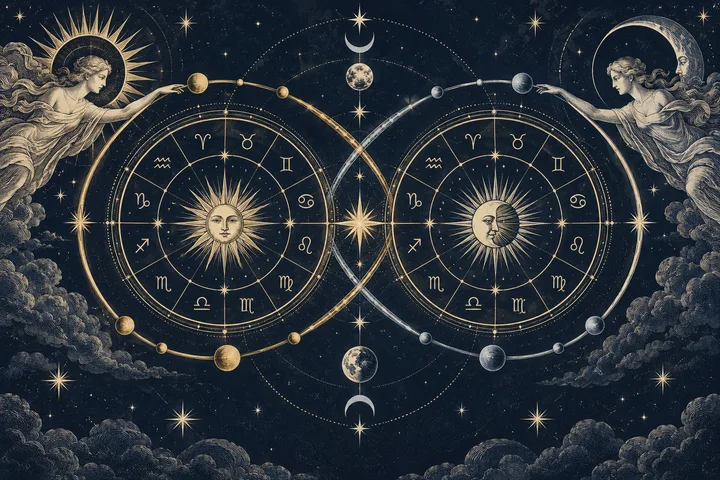
What does a mixed-aspect double whammy mean?
Imagine a couple comparing a pattern they call a double whammy. One person’s Moon trines the other’s Saturn; in reverse, the second person’s Moon squares the first person’s Saturn. They wonder whether the easier contact softens the harder one, or two contacts make the pattern twice as strong. Neither conclusion follows from the label. A mixed-aspect double whammy means the same two planetary functions connect across both charts, while each direction keeps its own aspect. Here, Moon and Saturn recur. The trine and square do not merge into an average. First identify the pair, then read each contact separately; only after that ask what their recurrence adds. This example is illustrative, not a calculation for a real couple. “Double whammy” is informal practitioner language for a repeated two-way theme. “Double Whammy Synastry: What a Reciprocal Aspect Really Means” notes that the same planetary pair can recur even when the aspects differ, and that each contact should be examined on its own. A trine and a square describe different relationships between planetary functions, so calling both “Moon-Saturn” doesn’t erase their contrast. Double counts the directions in which the pair appears. It doesn’t measure force by itself. There is a stronger recurrence-first view. “Double and Triple Whammies in Synastry” argues that repeated planetary energies become a focal point and aspect type matters less. That view gives repetition real weight, but its claims of infallible or multiplied power go beyond a careful reading rule. A repeated pair is a reason to look closely, not proof that either person feels the pattern equally or that the relationship will unfold in a certain way. Keep the contacts intact. Ask what the trine might describe in the Moon-Saturn exchange, what the square might describe, and how each person occupies the Moon or Saturn role. The useful result isn’t a verdict about the couple. It’s a precise question to discuss: where does care feel steady, and where does responsibility start to feel like pressure?
Sources: Double Whammy Synastry: What a Reciprocal Aspect Really Means; Double and Triple Whammies in Synastry
What exactly repeats when a double whammy uses different aspects?
Under a narrow working definition, a double whammy is the same two planetary functions connected twice across two charts, with the people reversed. Synastry is the comparison of two natal charts; each cross-chart connection is an interchart aspect. Direction tells you whose planet meets whose. So if A’s Moon aspects B’s Saturn, and B’s Moon aspects A’s Saturn, the Moon-Saturn pair recurs. One contact might be a trine and the other a square. That is a mixed-aspect double whammy: one repeated pair, two distinct contacts.
The distinction is easier to see by comparing four patterns. A Moon-to-Saturn contact in only one direction is one interchart aspect, not a double whammy. If the reversed Moon-Saturn contact also forms a trine, the pair repeats with the same aspect type. If it forms a square instead, the pair repeats with different aspect types. A single Moon-to-Moon contact is still one interchart aspect: both charts contribute a Moon, but there is no second reversed Moon-Saturn contact. These labels describe chart structure. They don’t tell you yet how to interpret either contact.
The opened guide “Double Whammy Synastry: What a Reciprocal Aspect Really Means” uses the narrow pair-and-reversal definition. It says the aspect types need not match, and its example keeps the planetary pair while changing the contact from one direction to the other. By contrast, “Double and Triple Whammies in Synastry” uses broader language for repeated factors and also counts reciprocal midpoint combinations. Those are different working conventions, not grounds for treating every repeated theme as the same pattern.
For this question, keep the label tied to two identifiable contacts between the same planetary pair in reverse chart directions. If different planets contact one shared planet, that may repeat a wider theme, but it doesn’t meet this narrow definition. Naming the actual pattern is clearer than arguing over the nickname: for example, “Moon-Saturn repeats in both directions, as a trine and a square.” That description lets you audit what qualifies before interpretation begins. It also preserves the key distinction: the pair repeats, while each aspect keeps its own form.
A useful test is to name the two rows before naming the pattern: A Moon to B Saturn, then B Moon to A Saturn. If both rows contain the same planetary pair, the direction is reversed; if their aspect labels differ, the pair is still reciprocal, but the geometry is mixed. If only one row exists, or if the second row uses a different pair, describe that accurately instead of stretching the term. This small naming step keeps later interpretation attached to the contacts actually present in the chart.
When the same two planets form cross-chart aspects in both directions but the aspects differ, the planetary pair repeats while each contact remains distinct. Check both directions from degrees under one stated orb rule; then interpret each aspect, orb, planetary owner, and sign context separately. Recurrence is a reason to examine the shared theme, not proof of equal feelings or a relationship outcome.
Sources: Double Whammy Synastry: What a Reciprocal Aspect Really Means; Double and Triple Whammies in Synastry
How do you verify both directions from the chart degrees?
A synastry aspect is the angular distance between two chart factors. To check a proposed double whammy, calculate that distance twice: first from A’s Moon to B’s Saturn, then from B’s Moon to A’s Saturn. Keep the owners in the record. The two rows answer different questions, even though both involve the same planetary pair. Philip Graves’s “Introduction to Relationship Astrology 2: Synastry” gives a practical way to do this: make an interchart grid, label each person’s factors with sign and degree, calculate the angular separation for each cross-chart pair, and mark the aspects that meet the chosen criteria. For a simple worksheet, record the person and planet in each row, the measured separation, the proposed aspect’s exact angle, the difference between those angles, and whether that difference fits your orb rule. The orb is the distance from exactness. A conjunction is measured against 0 degrees, a sextile against 60, a square against 90, a trine against 120, and an opposition against 180. For example, if a measured separation is 3 degrees from the exact angle, its orb is 3 degrees. That is an arithmetic illustration, not a placement for a real couple. For each row, write the direction, planet owners, aspect, measured separation, exact angle, resulting orb, and whether it qualifies under your stated rule. Use the same declared inclusion rule in both rows. Nicholas Campion’s “An Introduction to Aspects and Chart Shaping in Natal Astrology” describes orb as the distance an aspect may vary from exact and notes that astrologers use different allowances. Graves gives his own narrower synastry allowances, which are a method, not a universal standard. Different settings can therefore produce different aspect lists. Name the rule and retain each orb so another reader can see why both directions count, or why one drops out. Record the convention beside the pair whenever you share your reading. Sign labels alone can suggest a possible relationship between placements, but they don’t give the precise angular separation needed to confirm an aspect within an orb. If degrees are missing, leave the contact unverified. The Synastry Comparison Report organizes supplied Moon, Venus, and Mars placements and optional degrees, checking selected major aspects within its stated six-degree orb; it doesn’t calculate natal charts from birth details. Once both rows are checked, you can tell whether you have two qualifying directions or one confirmed contact under the chosen convention.
Sources: Introduction to Relationship Astrology 2: Synastry; Aspects
Why does the direction and planetary owner change the reading?
Imagine a couple comparing two hypothetical cross-chart contacts: Person A's Moon is trine Person B's Saturn, while Person B's Moon is square Person A's Saturn. The example illustrates a method, not a calculated chart. The planet names repeat, but their owners change. In the first contact, A brings the Moon role, associated in astrological interpretation with feeling, needs, and responses; B brings Saturn, associated with limits, duty, structure, and steadiness. In the reverse contact, B brings the Moon role and A brings Saturn. The pair recurs, yet the people carrying each function have switched. That switch gives the reader two distinct questions. How might B's way of setting limits, keeping commitments, or offering structure meet A's emotional needs? Then reverse the inquiry: how might A's approach to duty and boundaries meet B's needs for care and response? These are interpretive prompts, not claims about what either person feels. The chart shows whose planet is involved in each contact, so consider each role in turn. Planetary ownership and aspect geometry answer different questions. Ownership tells you who brings the Moon or Saturn function; geometry tells you how those functions relate. Here, the trine describes one relationship between A's Moon and B's Saturn; the square describes another between B's Moon and A's Saturn. Neither contact transfers its aspect to the other. A trine does not make the square easy by association, and a square does not erase the trine. Read owner and aspect together: whose planet is involved, which function it represents, and what kind of connection the aspect describes. Cafe Astrology's guide to interchart aspects advises readers to track which person owns each planet and to consider the planets' signs and houses. That guidance helps prevent the leap from “the same planets repeat” to “we experience the same thing.” Signs add style and context to each planet's expression. A fuller natal chart can show more about how each person handles that planet. Houses require accurate birth-time information, however, and the supplied placement report does not calculate houses or derive natal charts from birth details. Without those inputs, keep the interpretation to supplied placements and degrees. Philip Graves's “Introduction to Relationship Astrology 2: Synastry” makes the asymmetry explicit: a synastry factor need not be felt mutually or evenly. In his account, a contact may feel positive to one person, burdensome to the other, or scarcely register for one of them. This is an astrologer's interpretive guidance, not a measured finding about couples, but it reinforces the value of separating directions. Ask each person about their own experience instead of assigning both one shared feeling. The useful reading is not “we have the same dynamic.” It is two careful questions about how care and responsibility meet for each of you.
Sources: Interchart Aspects; Introduction to Relationship Astrology 2: Synastry
Why shouldn't the trine and square be averaged together?
A trine and a square describe different relationships between the same two planetary functions. They do not combine into a neutral middle aspect. In a mixed double whammy, keep both contacts in view: one direction may suggest easier flow, while the reverse direction may call for more active adjustment. That difference is the point of the pattern. Averaging it away would erase information before interpretation even begins. In the language of aspect astrology, a trine links planets through an easy relationship, while a square marks friction. The reference “Aspects” by Skyscript explains both qualities as having more than one face. Ease can become something a person takes for granted; friction can prompt effort and development. So “easy” does not mean automatically beneficial, and “hard” does not mean harmful. These words describe a mode of interaction, not a grade for the relationship. Consider an explicitly hypothetical Moon-Saturn pair. Suppose A’s Moon forms a trine to B’s Saturn, while B’s Moon forms a square to A’s Saturn. The trine could symbolize a more natural route between A’s emotional needs and B’s way of offering structure or steadiness. The square could symbolize a more effortful negotiation when B’s needs meet A’s limits or sense of duty. Those are two symbolic readings of the same planetary pair, with the owners and aspect geometry changing in each direction. They do not establish how either person will behave. Compare the contacts by asking what each invites you to notice, rather than which one wins. For the trine, ask: where does care and reliability come easily, and could that ease leave something important unspoken? For the square, ask where emotional needs and responsibilities require clearer timing, boundaries, or requests? The first question can reveal an underused strength. The second can make a recurring strain easier to discuss. Neither cancels the other. This avoids treating the aspects as moral labels. Calling the trine “good” and the square “bad” can push a reader toward a verdict before you have read the chart. The trine may describe a resource, but it still needs attention. The square may describe tension, but tension can make a need visible and invite a response. Interpretation depends on the planets, the direction of each contact, and the wider chart context. Cafe Astrology’s “Interchart Aspects” also advises tracking which person owns each planet and considering sign context; That keeps an aspect keyword from becoming a claim about a whole person. Preserve the contrast. Read the trine as one possible expression of the Moon-Saturn theme and the square as another. Then bring the interpretation to a concrete question: when one person needs reassurance, what response feels supportive, and when does responsibility start to feel restrictive? The chart offers language for exploring both sides without turning them into a score.
Sources: Aspects; Interchart Aspects
How do orb and exactness affect the comparison?
An aspect names a measured angular relationship between two chart factors. Its exact angle is the target geometry: 120 degrees for a trine or 90 degrees for a square. The orb is the distance between the measured separation and that target. If two factors sit 3 degrees from exact, the contact has a 3-degree orb. A smaller orb means a closer contact; it doesn’t change a square into a trine. Nicholas Campion’s “An Introduction to Aspects and Chart Shaping in Natal Astrology” defines orb as the distance an aspect may deviate from exact and says closer aspects carry more strength within the technique described there.
To decide whether both directions count, choose an orb rule and apply it consistently. A rule is a threshold: inside it, the contact qualifies; outside it, it doesn’t. Closeness answers a separate question about emphasis. If A’s Moon trines B’s Saturn closely while B’s Moon squares A’s Saturn at a wider orb, both may qualify, yet the trine is tighter. Preserve both entries, but don’t describe them as equally prominent just because each passed the threshold.
Reverse the pattern and the interpretation still needs two entries. If the square is close and the trine wide, the square is the more exact contact under a method that gives weight to closeness. That doesn’t make the trine meaningless or prove the square will dominate. Name the shared Moon-Saturn topic while keeping each aspect’s mode visible. This is a qualitative ranking, not a formula for predicting what either person will do.
State your convention instead of presenting one allowance as universal. Campion gives different orb allowances by aspect and notes that traditional practice can consider planetary prominence. Philip Graves’s “Introduction to Relationship Astrology 2: Synastry” recommends narrower allowances for synastry than for a birth chart, with separate limits for trines and squares. These methods have different scopes. Name the one you’re applying and show the orb for each direction so another reader can follow the comparison.
Now test the edge. Suppose one contact falls just beyond your chosen limit. Under that stated rule, it doesn’t qualify, so call the pattern one qualifying contact rather than a double whammy. You can add that a wider convention would include it, but don’t quietly switch thresholds halfway through. If both contacts sit near the limit, say that the reciprocal reading depends on the chosen allowance. Recurrence is then conditional, and deserves less emphasis than a pair of clearly qualifying contacts.
Finally, compare the result with the rest of the chart. A repeated pair earns attention because the same planetary relationship appears in both directions. But two loose contacts don’t automatically outrank one close personal-planet aspect elsewhere. “Double” counts qualifying directions; it doesn’t mean double force. Record each planet owner, aspect, measured separation, orb, and whether it passes the same rule. Then interpret the contacts separately before describing their shared theme.
Sources: Aspects; Introduction to Relationship Astrology 2: Synastry; Double Whammy Synastry: What a Reciprocal Aspect Really Means
When does the repeated pair deserve priority in the wider comparison?
A repeated planetary pair deserves priority as a theme to investigate, not automatic first place in the whole chart. The distinction matters. Two contacts can make the same planetary combination recur, while their aspects, orbs, and owners still tell different stories. Calling the pair important is a reason to look closer; it is not a ranking rule that settles the reading before you examine the contacts. There is a stronger recurrence-first view. In “Double and Triple Whammies in Synastry,” CosmiTec argues that repeated planetary energies form a focal point, that the aspects are not what count, and that more repetitions make the pattern more powerful and meaningful. That approach has a clear appeal: it keeps attention on the shared planetary ingredients instead of letting a label such as trine or square dominate the whole interpretation. If the same two planets return in both directions, their symbolism is plainly present twice in the comparison. But the claim goes too far when it treats repetition as a multiplier or sets aside aspect form. Nicholas Campion’s “An Introduction to Aspects and Chart Shaping in Natal Astrology” gives trines and squares different meanings, and says both harmonious and tense aspects have two faces. That is a useful reminder for a mixed double whammy: the planetary pair recurs, but the two relationships between those planets are not interchangeable. A trine and a square should not be blended into a single neutral description just because the planets repeat. “Double Whammy Synastry: What a Reciprocal Aspect Really Means,” from Velvet Zodiac, offers a practical counterweight. It says to read each direction separately and cautions that two wide reciprocal contacts may deserve less attention than one exact personal-planet aspect elsewhere. The evidence here is interpretive guidance, not a shared scoring formula. None of these sources gives a validated calculation that turns two contacts into twice the force. Treat “more prominent” as a qualitative judgment, not arithmetic. A sound order of attention follows from that comparison. First confirm that the same planetary pair forms two qualifying cross-chart contacts. Then record each direction’s aspect and orb, keeping the planetary owner visible. Consider the planets and signs involved, and each person’s natal handling of those functions when the relevant chart details are available. Only then name the recurring theme and compare it with the relationship as the people describe and live it. Each step can change the emphasis. So let recurrence earn the pair a place in the reading, not a crown. A close, personally relevant contact may deserve more space than two loose reciprocal ones; a mixed pair still deserves both aspect descriptions. The useful question is not “Does double mean twice as strong?” but “What repeats, what differs, and which part is most exact and relevant here?”
Sources: Double and Triple Whammies in Synastry; Double Whammy Synastry: What a Reciprocal Aspect Really Means; Aspects
What changes when one side is wide, missing, or defined differently?
A double whammy depends on two contacts meeting the same stated rule. If both directions fit the chosen orb, the pair is present. If one sits near the boundary, report that sensitivity: the pattern may qualify under a wider convention and disappear under a narrower one. Nicholas Campion's “An Introduction to Aspects and Chart Shaping in Natal Astrology” defines an orb as the distance an aspect may deviate from exact, and explains that astrologers vary allowances by aspect and, in some techniques, planetary prominence. Its table belongs to a natal framework, not a universal synastry limit. Consider an example with two proposed Moon-Saturn contacts. Suppose one direction is clearly within the couple's chosen limit, while the reverse contact is just inside it. Under that rule, both count, but the edge contact deserves a note. If the couple or astrologer chooses a narrower allowance and that second contact falls outside, keep the valid one-way aspect and drop the double-whammy label for that method. The rule changed; the symbolism did not vanish. A close single contact elsewhere may then deserve more attention than a borderline repeat. Missing degrees create a different problem. Sign names alone do not show the precise angular distance between two planets, so they cannot confirm whether either proposed contact falls within an orb. Record the signs as worth checking, but leave the aspect unverified until you have degrees. The Synastry Comparison Report uses placements supplied by the reader and optional degrees; it does not calculate natal charts from birth details. A date of birth by itself therefore cannot settle this check through that report. The label itself also varies. “Double and Triple Whammies in Synastry” uses the term for reverse contacts between the same factors and extends it to shared midpoint combinations. That broader practitioner usage differs from the reverse-aspect test. If you include midpoint contacts or unlike planets, name the factors and method plainly. Otherwise, keep the narrow definition: the same two planets, each contacting the other's chart factor, with both aspects tested under one declared orb rule. This makes the conclusion easy to revise when better degrees or a different convention becomes available.
What can reciprocity tell you about how each person experiences it?
A reciprocal contact gives you two viewpoints to read, not proof of one shared feeling. In a Moon-Saturn example, A’s Moon meeting B’s Saturn describes one direction: A brings the Moon function, while B brings Saturn’s structure, limits, or steadiness. Reverse the contact and the owners change. B’s Moon meets A’s Saturn. The planetary pair recurs, but the person receiving the Moon contact and the person expressing Saturn are now different. That distinction matters even if both contacts appear under the same aspect label; when they form different aspects, preserve that difference too.
As Cafe Astrology’s “Aspects Between Charts” explains, each person whose planet is involved may take on that planet’s role in the particular interaction. It also advises considering each planet’s sign and house, since those placements change how the interplay is expressed. The role is local to that contact, not a permanent verdict on either person’s character. A may express Saturn-like limits when B expresses Moon-like needs in one exchange, while B may express Saturn’s organizing function when A is the Moon person in the reverse contact. Each natal chart adds context to how those planetary functions are carried.
Philip Graves’s “Introduction to Relationship Astrology 2: Synastry” makes the asymmetry explicit: a synastry factor can feel positive to one person, burdensome to the other, or pass almost unnoticed. He connects that difference to each person’s chart factors being conditioned by different factors in the other chart, and by the natal pattern around the factor being contacted. This is an interpretive account, not a measure of what every couple experiences. Its useful point is narrower: reciprocal geometry does not require reciprocal sensation. A repeated pair can matter to both readings without producing matching stories.
Consider the hypothetical Moon-Saturn pair. Instead of deciding that both people must feel equally cared for, restricted, or responsible, ask each one separately: “When I need reassurance, what response helps me feel held?” and “When I offer support, when does it feel steady, and when does it feel like pressure?” The answers may differ. One person may value a reliable routine; the other may want more room to name feelings before solving a problem. Those are possibilities to explore, not facts supplied by the aspect. Notice what each person says and what happens in the exchange.
This is where the chart can serve as a shared language. It can suggest that care and responsibility deserve attention, while the separate contacts help you frame two distinct questions. It cannot establish equal attraction, consent, intention, commitment, or destiny. Keep the astrological reading, but leave room for each person to describe their own experience.
Sources: Introduction to Relationship Astrology 2: Synastry; Interchart Aspects
What should you check next, and what should you ask each other?
Start with the placements you actually know. For each direction, write down the two planet owners, the proposed aspect, its exact angle, the measured separation, and the resulting orb. Apply one orb policy to both contacts. If both qualify, name the recurring planetary pair, then keep the contacts distinct: for example, a trine in one direction and a square in the other. If one fails the rule, record a single qualifying contact rather than preserving the double-whammy label. When degrees are missing, you can discuss known signs, but you can’t confirm the exact aspect from sign names alone.
That record gives you a disciplined starting point, not a script for what either person must feel. Cafe Astrology’s interchart-aspects guidance asks readers to track which person owns each planet and to consider sign context. Skyscript’s discussion of aspects describes different modes of relating; it doesn’t turn an easy aspect into a promise or a tense one into a sentence. Use the symbolism to frame a question, then listen to the answer and notice the pattern you both describe.
If you want help organizing known placements, the Synastry Comparison Report uses supplied Moon, Venus, and Mars signs, with optional degrees, and checks selected major aspects within its stated six-degree orb. It doesn’t calculate natal charts from birth details or calculate houses. The report can help lay out the comparison; missing degrees still limit which exact contacts you can verify. Then bring the chart language back to something you can discuss plainly: When one of us needs reassurance, what response feels supportive, and when does responsibility start to feel like pressure?
Sources: Interchart Aspects; Aspects
A little more clarity
Does a double whammy mean both people feel the same connection twice as strongly?
No. It identifies a repeated planetary pair in reverse chart directions under the chosen orb rule. Each contact has its own aspect, orb, and planetary owners, so read them separately. The pattern does not establish equal subjective experience or relationship outcomes.
Sources & further reading
- Double Whammy Synastry: What a Reciprocal Aspect Really Means
Defines a narrow reciprocal planetary-pair pattern and discusses different aspects in the two directions.
- Double and Triple Whammies in Synastry
Presents a recurrence-first interpretation and a broader use of the term that includes midpoint combinations.
- Aspects
Explains aspect meanings, orb variation, and the distinct possible expressions of harmonious and tense aspects.
- Introduction to Relationship Astrology 2: Synastry
Describes calculating cross-chart angular separations and notes that synastry contacts need not be experienced mutually or evenly.
- Interchart Aspects
Advises tracking which person owns each planet and considering sign and house context when interpreting interchart aspects.
- Synastry Comparison Report
States the report uses supplied Moon, Venus, and Mars placements, optional degrees, and selected major aspects within a six-degree orb.
Synastry Comparison Report
Enter known placements for two people. Get an input-by-input comparison, selected aspect calculations and a clear record of what remains uncertain.
Compare our placements