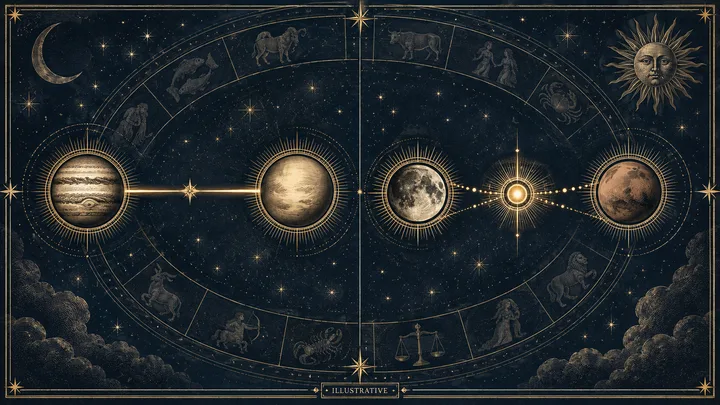
The assumption to test: a midpoint contact is not just a stronger aspect
A midpoint contact can feel special because it names a hidden meeting point in a chart. Someone's Venus lands on your Sun/Moon midpoint, and the language arrives quickly: this person completes something in you. That reading is tempting. It is also too fast.
A direct synastry aspect and a midpoint contact answer different questions. A direct aspect compares two active chart factors across two people. Your Mars square her Venus describes a direct meeting between desire, pursuit, attraction, and values. Her planet is not a symbol hovering outside the connection. It is one of the two forces being compared.
A midpoint contact begins inside one person's chart. The midpoint is the halfway point between two planets or points. When the other person's planet touches it, that planet activates a pair as a unit. The contact says something like, ‘Your Venus enters the place where my Sun and Moon are trying to work together.’ That's a more layered statement than ‘Your Venus aspects my Sun.’
The difference matters when you decide what to read first. A tight midpoint contact may explain why an ordinary-looking exchange carries extra weight by showing what a partner's presence stirs between two natal needs. Name the natal pair, the activating planet, the aspect, and the orb before you give it weight.
The supported position here is simple. Direct planet-to-planet aspects should lead a first synastry reading. Midpoint contacts should come next, where they can combine two natal themes and sharpen the question you ask about the relationship. The common mistake is to treat the more technical layer as the more important layer. Precision helps only when it clarifies the chart in front of you.
Direct synastry aspects show how one person's planet meets another person's planet. A Moon-Venus trine, for example, gives you a two-factor story about feeling, affection, and response. A midpoint contact adds a third factor: one person's planet or angle activates the midpoint between two planets in the other chart. It can show how that person enters an inner combination, such as the meeting of identity and emotional need at the Sun/Moon midpoint. That makes midpoint work more specific, not automatically more important. Start with close direct aspects between the personal planets. Then check whether a tight midpoint contact confirms, combines, or complicates the same theme. For this comparison, you need known placements and optional degrees. Use a six-degree orb for the offered major-aspect comparison, but treat midpoint contacts as a precision layer and rank exact or very close contacts first. Midpoints refine the story. They don't replace it.
Sources: Aspect - Astrodienst Astrowiki; Interaspect - Astrodienst Astrowiki; Synastry - Astrodienst Astrowiki; Astrology Topics: Midpoints - Cafe Astrology
Why direct planet-to-planet aspects feel easier to read
Direct aspects are the front door of synastry because the pieces are visible. One person's Moon opposes the other's Saturn. One person's Venus trines the other's Mars. You can name both planets, measure the angular relationship, and then ask how the two principles behave together.
They also tell you where the exchange is easiest to locate. With a direct contact, each planet keeps its identity while it enters the other's field. Her Moon remains her Moon. His Saturn remains his Saturn. Their aspect describes the meeting. This matters in practice because you can ask each person what they do, feel, and expect instead of treating the relationship as a single personality.
Astrodienst defines an aspect as an angular relationship between horoscope factors. The major aspects include conjunction, opposition, square, trine, and sextile. Each carries a different kind of motion. A conjunction fuses. An opposition polarizes. A square presses for action. A trine tends to flow. A sextile offers a usable opening. The planets tell you what is meeting; the aspect tells you how.
That two-part sentence keeps a reading honest. Venus square Mars isn't automatically bad. It can bring attraction, heat, and friction around pace or preference. Moon-Saturn isn't automatically cold. It can describe steadiness, responsibility, and a serious emotional tone, while also asking whether care has become duty. The aspect gives the relationship a shape, not a verdict.
Direct interaspects also make roles easier to see. In a synastry contact, the planet person often expresses the planet's function, while the receiving chart experiences that function through its own planet or point. If his Saturn squares her Moon, his way of setting limits may meet her need for safety and responsiveness. That doesn't tell you who is right. It gives you a concrete interaction to observe.
This role-based view is especially helpful when the same planets appear in both directions. Her Venus may trine his Mars, while his Venus squares her Mars. The first contact can describe ease in how she offers affection and he responds with desire. The second may show that his style of affection meets her desire differently. A blended phrase such as ‘you have chemistry’ loses that useful asymmetry.
For a practical first pass, rank the direct contacts by three things: the planets involved, the closeness of the aspect, and repetition of the same theme elsewhere. Personal planets deserve the first look because they describe daily feeling, desire, speech, and self-expression. A close contact usually leads a wider one. A theme repeated by the Moon, Venus, and Mars deserves more attention than a single isolated symbol.
If you lack degrees, compare sign meanings and describe the contacts you would check once exact positions are available. If you do have them, record both charts in one zodiac framework before calculating. A midpoint shifts when its underlying positions shift, so the cleaner the inputs, the cleaner the ranking.
Sources: Aspect - Astrodienst Astrowiki; Interaspect - Astrodienst Astrowiki; Synastry - Astrodienst Astrowiki; Midpoints in Synastry: A Complete Guide - Kerykeion
What a midpoint adds to the same relationship story
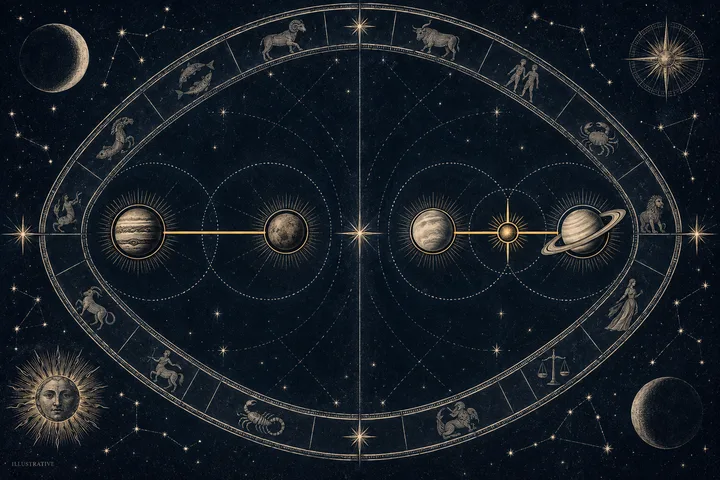
A midpoint is a sensitive degree halfway between two planets or points. Every pair offers a near midpoint and a far midpoint, opposite one another on the zodiac. The notation is compact: Sun/Moon means the midpoint between the Sun and Moon. When a third planet makes a hard aspect to that point, astrologers write a planetary picture, such as Venus = Sun/Moon.
The midpoint isn't a third planet waiting to act on its own. It is a calculated point whose meaning comes from the two bodies that define it. That is why the pair must stay visible in your language. ‘His Venus conjuncts her midpoint’ is incomplete. ‘His Venus conjuncts her Sun/Moon midpoint’ tells the reader which inner combination is being touched.
The equal sign can hide an important detail. The third planet isn't merely making another ordinary aspect. It activates the combined meaning of the pair. A planet at your Sun/Moon midpoint doesn't simply touch your identity or your feelings in isolation. It enters the place where those two parts are being brought into one expression.
This is why midpoint work feels triangular. Direct synastry asks, ‘What happens when her Venus meets his Mars?’ Midpoint synastry asks, ‘What happens when her Venus activates his Venus/Saturn combination?’ The second question contains three planetary principles. Venus may bring affection, attraction, pleasure, and values into the way he is integrating love with boundaries, patience, or commitment.
The activating planet can ease the pair, intensify it, or make its tension visible. A Jupiter contact to a Moon/Saturn midpoint might invite warmth and confidence into a guarded emotional pattern. It might also expose a habit of promising more comfort than daily life can hold. The symbol gives you the structure. The lived exchange shows its expression.
Read the pair as a pair before you read the activating planet. Sun/Moon is not two separate keywords added together; it is a meeting between self-definition and emotional belonging. Venus entering that midpoint brings affection into the meeting. Mars brings urgency or assertion. Mercury brings language. The third factor changes the way the pair is engaged, while the pair tells you what is being engaged.
That distinction protects you from cookbook astrology. A Venus contact to the Sun/Moon midpoint may feel intimate, but the chart alone cannot tell you whether the connection becomes a relationship, a friendship, or an important encounter that changes how someone understands closeness. The same picture can manifest through affection, conversation, creative partnership, or a conflict that forces a person to define what they need.
A midpoint picture is most useful when it explains why a relationship theme feels linked to a second concern. If attraction and restraint already appear, Venus = Mars/Saturn can show that desire and limits are being negotiated together. If the picture introduces a wholly new subject, keep it provisional until the rest of the chart supports it.
The same method works with a difficult contact. A square to a midpoint does not make the picture useless or doomed. It can show where the third planet presses the pair into consciousness. Mars at a Venus/Saturn midpoint may bring urgency into a slow process of trust. That can create impatience, but it can also make an unspoken rule impossible to ignore. The aspect describes the pressure; the people decide how to use it.
The aspect still matters inside the midpoint picture. A conjunction brings the activating planet directly to the sensitive degree, while an opposition reaches the far end of the same axis. A square creates a more active point of friction. Don't translate all three into the same sentence. ‘Her Mars activates his Venus/Saturn midpoint’ tells you the triangle; ‘by square’ tells you that the contact may demand adjustment rather than simply blend into the pair.
Sources: Interaspect - Astrodienst Astrowiki; Astrology Topics: Midpoints - Cafe Astrology; Midpoints in Synastry: A Complete Guide - Kerykeion
A worked example: Venus on a Sun/Moon midpoint
Imagine Maria knows that her Sun is at 10 degrees Aries and her Moon is at 20 degrees Aries. The near Sun/Moon midpoint falls at 15 degrees Aries. Her partner's Venus is at 15 degrees Aries. In a midpoint reading, his Venus is conjunct her Sun/Moon midpoint, written Venus = Sun/Moon from his chart into hers.
The arithmetic is simple. The interpretation needs more care. Maria's Sun describes her sense of self and vitality. Her Moon describes her emotional rhythm and need for belonging. Their midpoint marks a sensitive place where those two parts meet. His Venus brings attraction, pleasure, taste, affection, and value into that meeting point. She may experience his presence as touching the way she wants to be both known and emotionally received.
Now compare the direct layer. His Venus at 15 Aries is five degrees from both her Sun at 10 Aries and her Moon at 20 Aries. The direct layer therefore gives us two close Venus contacts: he may appreciate her style and respond warmly to her self-expression, while also meeting her emotional rhythm with affection and ease. The midpoint contact adds a different statement. It doesn't merely repeat Venus-Sun and Venus-Moon separately. It shows his Venus activating the connection between being herself and feeling at home in that self.
The example also shows why a midpoint contact isn't the same as two separate contacts. Here, his Venus is five degrees from Maria's Sun and five degrees from her Moon, so you have two direct relationships to describe, each with its own conjunction and orb. Venus = Sun/Moon makes one additional statement about Venus touching the combined meeting point. It doesn't erase the two direct contacts, and it doesn't grant permission to treat the midpoint as proof that Venus has one identical effect on both planets.
Those are related readings, but they aren't identical. The two direct contacts are clearer and should lead. The midpoint contact helps explain why the attraction may feel personally integrating rather than merely admiring. It can also show a pressure point. If Maria's Sun and Moon want different things, his Venus may draw that difference into the relationship. She could feel cherished one day and unusually exposed the next, especially when affection reaches a private need she hasn't named.
Notice the wording: his Venus may draw the difference into the relationship. It doesn't mean he creates her inner conflict or has the power to resolve it. The midpoint belongs to Maria's chart. His planet activates it. That distinction gives both people agency. She can name what the contact stirs, and he can decide whether his way of showing affection meets the need or presses against it.
You can test the interpretation in ordinary moments. Does his affection make it easier for her to say what she feels? Does it invite her to perform a version of herself? Does warmth stay present when she needs reassurance rather than praise? These questions do not reduce the astrology. They show how the symbolic pattern becomes a relationship pattern, which is where the reading gains its value. That is the point of the comparison: clearer attention, kinder choices, better timing, and shared language, too.
The example is illustrative, not a supplied couple's chart. It uses clean degrees so you can see the method. A real reading would check the far midpoint, the aspect type, the exact orb, the sign context, and the rest of both charts. It would also ask whether Maria's Sun/Moon midpoint is already activated in her natal chart. A partner may trigger a pattern that was present before the relationship began.
The practical question becomes better after the midpoint is found. Don't ask, ‘Does he complete me?’ Ask, ‘When his affection reaches my need to feel both visible and emotionally safe, what happens in our actual conversations?’ That question turns a symbolic contact into something you can observe. It also leaves room for choice, skill, and change.
How to rank the two layers without drowning in symbols
A chart can produce too many contacts to read with equal weight. Midpoint work makes that problem sharper because every pair of planets creates a possible midpoint. If you treat every hit as a headline, the reading loses its center. Rank the evidence before you interpret it.
First, read the personal-planet contacts that speak to the question. Note the planets, aspect, degree distance, and sign relationship. Second, look for repetition. If direct contacts point to affection mixed with caution, Venus/Saturn may deepen that story; if Mercury contacts are lively and Mercury = Moon/Venus appears, the midpoint can show how conversation becomes part of bonding. Third, rank midpoint contacts by precision and relevance. A contact at 0 degrees 20 minutes deserves more attention than one at 5 degrees 40 minutes.
Fourth, keep the source chart in view. A planet activating your midpoint is not the same as your planet activating your partner's midpoint. Both directions matter, but they may not feel identical. One person may feel an inner combination stirred; the other may feel that they are bringing a particular function into the connection. Read the direction before you flatten the contact into a shared sentence.
Fifth, separate confirmation from novelty. A midpoint that repeats a direct theme gives you confirmation and added texture. A midpoint that introduces a completely new subject may be a real discovery, but it needs stronger support before it becomes the article's conclusion. This is where disciplined interpretation beats a longer list of symbols. The point that explains the question outranks the point that merely expands the chart.
Finally, ask what decision the symbolism can inform. Venus and Mars point toward desire, initiative, and consent. Moon and Saturn point toward care, time, and emotional responsibility. Mercury points toward how you explain needs. Astrology becomes useful when it helps you name the conversation.
A useful note names the contact, explains the combined symbols, and gives the couple something to notice. ‘Her Mars activates his Venus/Saturn midpoint. Desire may meet his careful pace, so watch whether directness creates trust or pressure.’ The interpretation stays useful because it ends in an observable question.
The same note can distinguish evidence from interpretation. ‘Mars is 0 degrees 20 minutes from his Venus/Saturn midpoint’ is the chart fact. ‘Her directness may press on his way of joining desire with caution’ is the interpretation. ‘Ask whether a slower pace helps both people stay engaged’ is the practical test. Keeping those three sentences separate makes the reading easier to revisit when the relationship shows a different expression.
Sources: Interaspect - Astrodienst Astrowiki; Synastry - Astrodienst Astrowiki; Astrology Topics: Midpoints - Cafe Astrology; Midpoints in Synastry: A Complete Guide - Kerykeion
Degrees and orbs decide whether the contact is real enough to lead
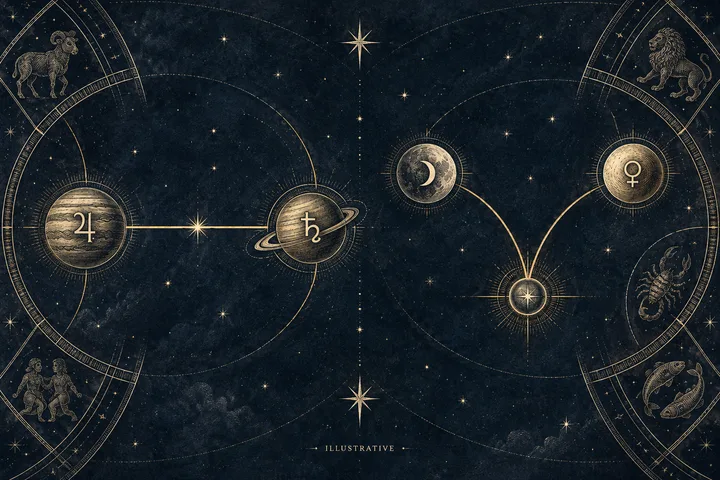
Midpoint interpretation depends on degrees. Without them, you can discuss a Sun/Moon midpoint in principle, but you can't claim that a partner's Venus touches it. Sign placements alone don't supply that distance, so stay at the sign-pair level until the degrees are known.
An orb is the distance allowed between an exact aspect and the actual positions. Astrologers use different orbs for different techniques. Astrodienst notes that interaspects are often read with smaller orbs than natal aspects because synastry already doubles the number of chart factors. Its chart tools also distinguish the tighter aspects drawn in the visual chart from wider aspects listed in tables.
Think of the orb as a volume control, not an on-off switch. A close aspect speaks plainly. A wider one may still color the exchange, but it should use softer language and yield to closer contacts. The same rule becomes stricter with midpoints because the chart already contains many possible combinations. If you widen every midpoint orb, you quickly create more ‘important’ contacts than the reader can test against experience.
Midpoint work generally tightens the rule again. A conjunction to a midpoint is direct and easy to locate. An opposition can also activate the same midpoint axis. Squares, semi-squares, and sesquiquadrates belong to the hard-aspect approach used by many midpoint practitioners. Trines and sextiles may be recorded in some practices, but they shouldn't outrank a close hard contact simply because their names sound supportive.
Here is a useful reading ladder. Exact or near-exact midpoint contact comes first. A contact within about one degree is strong enough to investigate closely. A contact around two degrees may still matter, especially when the same theme repeats through direct aspects. Beyond that, keep your language modest and let the rest of the chart decide whether the contact deserves a footnote. These are working boundaries, not a license to turn every near miss into a revelation.
Consider an example. Your Moon is at 28 degrees Gemini and your Venus is at 2 degrees Leo. In absolute longitude, those positions are 88 and 122 degrees. Their shorter-arc midpoint is 105 degrees, or 15 degrees Cancer, with the opposite point at 15 degrees Capricorn. If your partner's Mars is at 15 degrees Cancer, the conjunction is exact enough to examine. If Mars is at 21 degrees Cancer, a six-degree report orb may flag a broad contact, but midpoint practice would place it much lower in the ranking.
That distinction is easy to lose when a chart program presents every contact in one table. A listed contact has been found by a setting; it hasn't automatically been promoted to a central theme. Separate the report's detection rule from your interpretive rule. The first tells you what the tool noticed. The second asks whether the contact is close, relevant, repeated, and visible in the question you and your partner are actually exploring.
The calculation scope matters as much as the interpretation. A report using supplied placements can compare the positions you provide and identify selected contacts within a stated orb. It can't fill in a missing birth time, choose an unprovided house cusp, or treat an uncertain degree as exact.
When positions cross the 0-degree Aries boundary, calculate in absolute zodiacal longitude rather than averaging the printed sign numbers. A late Pisces Sun and an early Aries Moon may be only a few degrees apart, even though the sign labels look far apart on a simple list. Once the midpoint is found, note its opposite point as well. A planet near either end of the axis may activate the same midpoint picture through a different aspect.
Also record applying or separating motion only when your chosen method uses motion and the chart data support that judgment. Don't smuggle timing language into a static placement comparison. For this article's scope, the essential record is simpler: the two midpoint owners, the activating planet, the contact type, the exact degree distance, and the question that makes the contact relevant.
Sources: Aspect - Astrodienst Astrowiki; Synastry - Astrodienst Astrowiki; Astrology Topics: Midpoints - Cafe Astrology; Midpoints in Synastry: A Complete Guide - Kerykeion
The strongest exception: when the midpoint leads the story
A very tight midpoint contact can lead when it names a central combination that the direct aspects only hint at, especially when the activating planet is personal and the midpoint pair is central to the question.
Suppose the direct contacts are mild: a wide Venus trine, a loose Mercury sextile, and no close Moon contact. Then you find one person's Mars within a few minutes of the other's Sun/Moon midpoint. That exact picture may deserve the first paragraph. It could describe why the connection feels activating at the level of identity and emotional belonging even though the ordinary aspect list looks quiet.
This exception is strongest when the midpoint names a question the couple is already living. If the reader is asking why affection feels both warm and exposing, a close Venus = Sun/Moon picture deserves attention. If the reader is asking about shared finances and the midpoint involves Venus and Saturn, the symbolism becomes relevant only after the practical issue is named. The chart should sharpen the lived question, not manufacture one.
A direct aspect can also remain the stronger guide even when the midpoint is exact. Imagine a close Moon-Saturn opposition alongside a precise Venus = Sun/Moon picture. The opposition may describe the daily emotional work more plainly, while the midpoint describes why affection reaches the person's core sense of belonging. Read the opposition first if the couple is struggling with availability. Bring in the midpoint when you ask what that struggle touches underneath. This is ranking by usefulness, not by technical glamour.
But leading with a midpoint does not mean reading it alone. Check the direct planets that form the pair. Is the Sun already under pressure from Saturn? Is the Moon supported by Venus or Jupiter? Does Mars have a constructive role in the activating person's chart, or does it repeat a conflict pattern? The midpoint tells you where the three factors meet. Natal context tells you what each person brings to that meeting.
Another exception comes from a repeated midpoint network. Several close contacts may converge on the same pair. A partner's Venus touches the Sun/Moon midpoint, their Mars reaches the Venus/Mars midpoint, and their Mercury activates the Moon/Venus midpoint. That cluster can be more informative than one isolated direct aspect because the relationship keeps entering the same integrated territory: identity, feeling, attraction, and communication.
There is also a quieter version of the exception. A midpoint can lead because it resolves an apparent mismatch between direct contacts. Imagine supportive Venus contacts alongside a tense Saturn contact, with the partner's Mercury exactly on a Venus/Saturn midpoint. The midpoint doesn't erase the warmth or the restraint. It offers a sharper question: how do words help the couple negotiate affection and limits? In that case, the midpoint earns attention by explaining the pattern's hinge.
A strong chart signature still needs a lived expression. The person whose planet activates the midpoint may not experience the combination in the same inward way as the person who owns it, so let the symbolism guide observation rather than substitute for it.
Sources: Interaspect - Astrodienst Astrowiki; Astrology Topics: Midpoints - Cafe Astrology; Midpoints in Synastry: A Complete Guide - Kerykeion
A clean reading sequence for your own comparison
Begin by writing down the supplied placements. Record each person's Moon, Venus, and Mars sign, then add the Sun and Mercury if you know them. If degrees are available, write them beside the signs and keep the charts separate. This prevents you from confusing a person's natal pattern with what the partner activates.
Next, read the direct contacts. Which personal planets meet by conjunction, opposition, square, trine, or sextile? Which are closest? Describe the contact in one plain sentence. ‘Her Moon squares his Mars, so emotional timing and action may collide’ is more useful than a paragraph of adjectives. Then add the sign layer. Fire, earth, air, and water change how the aspect speaks, but the aspect remains the relationship between the two planets.
After that, identify the central question. Are you trying to understand attraction? Start with Venus and Mars. Are you trying to understand emotional safety? Start with the Moon and Saturn, if known. Are you trying to understand how one person affects another's sense of self? Start with the Sun. The reader's question chooses the first lens.
Only then calculate or inspect midpoints. Begin with Sun/Moon, Venus/Mars, Moon/Venus, and any pair directly tied to the question. Check the near and far points. Note the activating planet, the aspect type, and the orb. Write the picture in a line. Then translate it into a question: ‘What happens when his Mars activates her Venus/Saturn midpoint?’ The question keeps the interpretation open without making it vague.
Rank the result by the question, exactness, repetition, and direction. A Venus-Mars trine can show ease in desire while a Venus = Moon/Saturn picture asks how affection meets emotional caution. Both can be true, but they don't carry the same job.
Before you settle on a meaning, reverse the direction. If her Venus activates his Mars/Saturn midpoint, ask what his chart is receiving from her planet. If his Mars activates her Venus/Saturn midpoint, ask what her internal pattern is responding to in him. The same three symbols can describe different roles because synastry is relational, not a single blended chart. Write both directions when both are present.
This is also where a midpoint can correct a too-simple direct reading. A Venus-Saturn contact might be described as either devotion or restraint. If Mars activates the Venus/Saturn midpoint, the question becomes more exact: how does desire move through that devotion or restraint? The answer may be tenderness, impatience, protection, or a push toward clearer commitment. The midpoint doesn't choose among those expressions by itself. It tells you where to look.
Keep a short record as you read. Write the direct aspect, the midpoint picture, the orb, and one behavior that could express it. Then remove any interpretation that has no observable path. This simple test keeps a technical comparison from becoming a cloud of attractive phrases.
The Synastry Comparison Report can compare supplied placements and optional degrees, with selected major aspects and a stated six-degree orb. It doesn't calculate missing natal positions, houses, or a complete chart from birth details.
Close with one question that can be answered in ordinary life. Ask, ‘When this contact brings these themes together, what do you notice between us, and what would help us handle it well?’ If the answer names a request, a limit, or a new habit, the symbolism has done its job. It has made the relationship easier to see and the next choice easier to discuss.
Sources: Aspect - Astrodienst Astrowiki; Interaspect - Astrodienst Astrowiki; Synastry - Astrodienst Astrowiki; Astrology Topics: Midpoints - Cafe Astrology; Midpoints in Synastry: A Complete Guide - Kerykeion
A little more clarity
Is a midpoint contact stronger than a direct synastry aspect?
Not automatically. A midpoint contact is more layered because it joins an activating planet with a pair of natal planets, but a close direct aspect should usually lead the reading. Rank both by relevance, exactness, repetition, and the question you're asking.
What orb should you use for a synastry midpoint contact?
Use a tight orb. Many midpoint practitioners work within about one to two degrees for conjunctions and oppositions, and closer for squares or semi-squares. A six-degree orb can serve a selected major-aspect comparison, but it is too broad to make every midpoint near-hit a leading interpretation.
Can I read midpoint synastry without birth times?
You can read midpoints between known planetary degrees, but you cannot claim a midpoint involving an angle or house cusp without reliable birth-time data. If you only know signs, stay with sign-level interpretation. The comparison report uses supplied placements and optional degrees; it doesn't calculate missing natal positions.
Sources & further reading
- Aspect - Astrodienst Astrowiki
Defines major aspects as angular relationships and explains how orb measures deviation from exactness.
- Interaspect - Astrodienst Astrowiki
Defines interaspects in synastry and recommends tighter orbs because two charts create more possible contacts.
- Synastry - Astrodienst Astrowiki
Describes synastry as comparison of horoscopes and distinguishes harmonious flow from productive friction.
- Astrology Topics: Midpoints - Cafe Astrology
Explains midpoint calculation, near and far midpoints, hard aspects, planetary pictures, and midpoint interpretation as refinement.
- Midpoints in Synastry: A Complete Guide - Kerykeion
Provides a current technical overview of midpoint activation in synastry, triangular interpretation, and tight working orbs.
Synastry Comparison Report
Enter known placements for two people. Get an input-by-input comparison, selected aspect calculations and a clear record of what remains uncertain.
Compare our placements