The short answer: neither setting wins every time
A synastry report can show a different North Node degree when you switch from mean to true nodes. That does not mean one chart is broken. It means the report is using two accepted ways to locate the same lunar nodal axis.
The useful rule is simple. Keep the calculation consistent, read the stable contact first, and slow down when the changed degree affects the aspect or sign. A true node is not automatically the better astrological answer. A mean node is not automatically the safer one. The right choice depends on what the comparison needs to show.
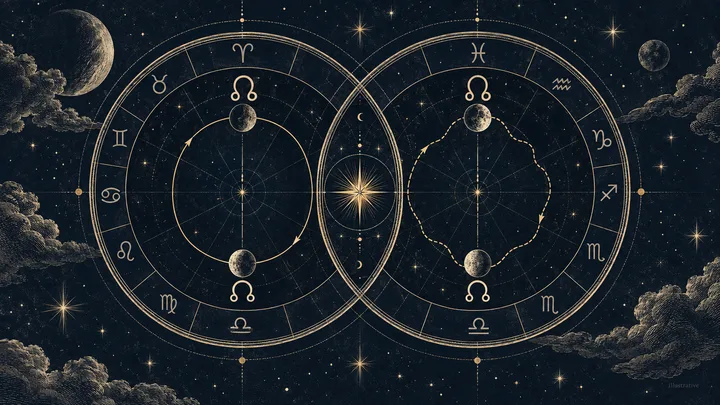
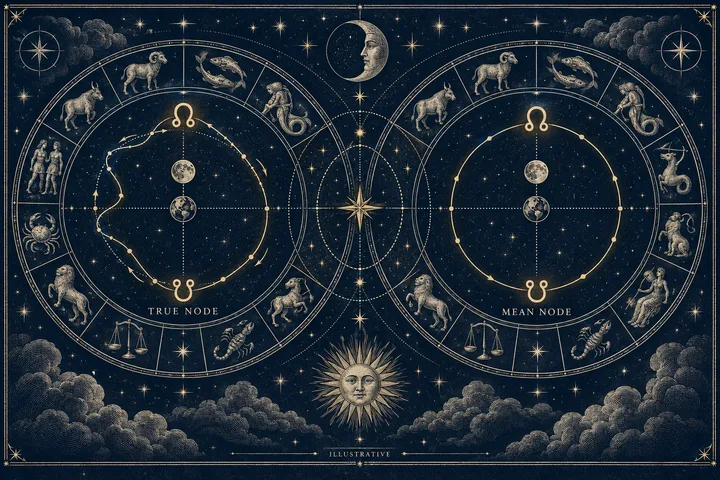
The mean node gives you a smoothed path. It averages the short-term wobbles in the Moon's nodal motion and continues in a steady retrograde direction. The true node follows the momentary position of the lunar orbit. It can slow, pause, and briefly move direct before returning to its larger retrograde course. Astrodienst's technical documentation describes the true node as the osculating node of the momentary lunar orbit, while its Astrowiki distinguishes the mean value as an average and the true value as uneven in motion.
In a synastry reading, the practical question is not which label sounds more convincing. Ask what changed. Did the node move by less than a degree while the same contact remained close? Did it cross from 29 degrees of one sign to 0 degrees of the next? Did a planet move from inside your chosen orb to outside it? Those changes deserve different weights.
Imagine Maria has Venus at 16 degrees Taurus. One report puts her partner's North Node at 15 degrees 20 minutes Taurus. Another puts it at 17 degrees 05 minutes Taurus. Venus is close to the node in both versions. The setting changes the tightness, not the central reading. Affection, attraction, taste, and values belong in the nodal comparison. Nothing in those degrees proves a permanent bond or decides what either person should do.
Start with the degree. Then read the sign. Then read the meaning. That order keeps a small technical difference from swallowing the whole relationship chart.
Mean and true lunar nodes describe the same nodal axis through two calculation methods. The mean node smooths the Moon's uneven motion into an average path. The true node follows its momentary oscillation. In synastry, that difference usually leaves the broad story intact, but it can change a close contact, move a node across a sign boundary, or place a planet just inside or outside a six-degree orb. Use one method consistently for both charts. Record the exact degrees. Let a contact that survives both settings lead, then use the tighter position as a refinement. If only one setting creates the aspect, keep the interpretation qualified and compare it with the rest of the synastry before giving it weight.
Sources: Moon's Nodes - Astrodienst Astrowiki; Swiss Ephemeris 2.10: Lunar and Planetary Nodes and Apsides; The North and South Nodes - CHANI
What mean and true nodes are measuring
The lunar nodes are points where the Moon's orbit meets the ecliptic, the Sun's apparent path through the zodiac. The ascending, or North, Node and the descending, or South, Node always sit opposite each other. If the North Node is at 10 degrees Aries, the South Node is at 10 degrees Libra. You read an axis, not two unrelated points.
The mean node calculates an average of the nodal motion. It removes the short-term wobble and gives the point a smooth course. This makes it useful as a consistent baseline, especially when you want to compare a nodal cycle across many charts or follow an established tradition.
The true node uses the momentary, or osculating, position of the lunar node. The Moon's orbit is perturbed by the Sun, so the node does not move with the same even rhythm as the mean position. Swiss Ephemeris notes that a true-node conjunction corresponds to the Moon having zero latitude at that moment, while a mean-node conjunction does not carry that same immediate condition. It also warns that even the true position is an approximation between exact node passages.
That technical detail matters because the word true can tempt a reader into a false hierarchy. True does not mean that every true-node interpretation should replace every mean-node interpretation. CHANI notes that astrologers may choose either method and that the two can differ by up to 1 degree 45 minutes, enough to change a sign or house for some charts.
In synastry, the other person's planet stays where it is when you change the setting. The node moves. A planet at 17 degrees Gemini remains at 17 degrees Gemini; the mean and true nodes may sit on either side of it. The aspect changes only when the geometry is already close.
Use this distinction as a reading habit. Name the node setting. Write down the North Node degree. Derive the opposite South Node degree. Record the other person's planet degree. Then calculate the distance. The symbolism comes after the record, not before it.
Sources: Moon's Nodes - Astrodienst Astrowiki; Swiss Ephemeris 2.10: Lunar and Planetary Nodes and Apsides; The North and South Nodes - CHANI
The three changes that matter in synastry
A mean-to-true switch can change a synastry interpretation in three useful ways.
First, it can change the orb. Suppose a partner's Mercury is at 23 degrees 30 minutes Virgo. The mean North Node sits at 24 degrees 10 minutes Virgo, while the true North Node sits at 22 degrees 45 minutes Virgo. Mercury is conjunct both. The mean contact is 40 minutes; the true contact is 45 minutes. The shared interpretation leads, and the difference adds almost no uncertainty.
Move Mercury to 18 degrees Virgo. The mean gap is 6 degrees 10 minutes, outside a six-degree working orb. The true gap is 4 degrees 45 minutes, inside it. Now the contact depends on the setting. You can read it, but you should say so. A calculation-sensitive contact belongs behind contacts that survive both methods.
Second, the node can cross a sign boundary. A mean North Node at 0 degrees 20 minutes Taurus and a true North Node at 29 degrees 10 minutes Aries are still less than two degrees apart in continuous longitude. The sign language changes, but the geometry stays close. Do not write two unrelated stories. Start with the exact contact, then explain the Aries-Taurus threshold as the variable layer.
Third, the true node can change direction around a station. That matters most in timing work, where a degree may receive repeated emphasis. In a static synastry comparison, it is a detail about motion, not a command to inflate the relationship meaning. CHANI describes the true node's apparent wobble between retrograde and direct motion, while the mean node smooths those movements away.
Rank the differences. A contact that disappears outside the orb matters more than a small change in wording. A sign change matters when the sign is central to the question, but less when the same close conjunction remains. A station matters most when the reading has a date and a transit purpose. Use the calculation to set emphasis, not to create drama.
Sources: Moon's Nodes - Astrodienst Astrowiki; Swiss Ephemeris 2.10: Lunar and Planetary Nodes and Apsides; The North and South Nodes - CHANI
A worked Venus-node comparison
Consider an example. Person A has Venus at 16 degrees 00 minutes Taurus. Person B's North Node appears at 15 degrees 20 minutes Taurus under the mean setting and 17 degrees 05 minutes Taurus under the true setting. The South Node is opposite in Scorpio in both versions.
Under the mean setting, Venus is 40 minutes from the North Node. Under the true setting, Venus is 1 degree 05 minutes away. Both contacts sit well within a six-degree orb. The first conclusion is stable: Person A's Venus is part of Person B's nodal story. The second conclusion is more careful: the true-node version is tighter, so it gives the contact extra emphasis if the rest of the chart supports that method.
Venus describes affection, attraction, pleasure, taste, and values. In nodal synastry, Person A's way of giving warmth may draw Person B toward a quality that feels important, unfamiliar, or growth-oriented. Person B may experience the connection as meaningful because Venus touches the axis that astrologers read through familiarity, release, and direction.
But the node does not turn Venus into proof. It does not certify mutual feeling. It does not promise that the relationship will last. Person A's natal Venus still has its own sign, house, and condition if those details are supplied. Person B's nodal axis still works with the rest of the chart. Saturn, the Moon, Mars, and the angles can change how the Venus contact is lived.
Now change Person A's Venus to 11 degrees 30 minutes Taurus. The mean gap is 3 degrees 50 minutes. The true gap is 5 degrees 35 minutes. Both qualify, but the mean position is closer. This is the strongest reason to reject a simple rule that the true node always intensifies the reading. It can make a contact looser.
The comparison gives you three sentences worth keeping. The Venus-node contact survives both settings. The exact emphasis changes with the node method. The wider synastry decides how much weight the contact deserves. These are illustrative supplied placements, not a calculated personal chart.
Sources: Moon's Nodes - Astrodienst Astrowiki; Swiss Ephemeris 2.10: Lunar and Planetary Nodes and Apsides; The North and South Nodes - CHANI; The Lunar Nodes in Natal Astrology - Dane Rudhyar
How to rank a shared contact and a one-setting contact
When both settings agree, lead with what they share. When they diverge, name the split and reduce the claim. Do not average the meanings into fog.
Use this order. First, check whether the North Node stays in the same sign. Second, check whether the same planet remains within the six-degree orb. Third, compare the exact distance under each method. Fourth, inspect the opposite South Node. Fifth, place the nodal contact beside the rest of the synastry.
The South Node matters because it is not an optional second point. If a planet is close to the North Node, its opposite relationship to the South Node may also shape the axis story. The planet can describe a pull toward familiar habits, a release of an old pattern, or a tension between what feels known and what asks for development. Keep that symbolism proportional to the actual aspect.
The strongest exception is a near-threshold chart. If the mean position leaves a square outside the orb while the true position brings it inside, the two readings do not deserve equal confidence. If both positions keep a close conjunction, the threshold is less important than the shared contact. If the node changes sign but stays close by longitude, read the degree first and describe the sign difference as a layer of tension.
Consistency matters just as much as preference. Do not compare one person's mean node with the other person's true node. Use the same node setting for both charts. If two websites disagree, check the node method, zodiac, displayed precision, and aspect orb before treating the reports as contradictory.
A clean conclusion might sound like this: 'Venus is conjunct the North Node under both settings, so affection and values belong in the nodal reading. The true-node calculation makes the contact tighter, but it does not decide the relationship. Compare the wider synastry before treating it as a defining theme.' That is precise. It still has warmth.
Sources: Moon's Nodes - Astrodienst Astrowiki; Swiss Ephemeris 2.10: Lunar and Planetary Nodes and Apsides; The North and South Nodes - CHANI; The Lunar Nodes in Natal Astrology - Dane Rudhyar
What to do with the difference in real life
A node setting can change the degree, sign language, or orb. It cannot tell you what a partner feels today. It cannot make a connection mutual. It cannot choose whether you stay, leave, forgive, or begin again. Those decisions belong to the people living the chart.
Use the report as a clear conversation tool. For the Venus example, ask: 'When do our ways of showing affection help us grow, and when do they pull us back into an old pattern?' That question honors the nodal symbolism without turning it into a verdict. Each person can answer with a real moment, not a theory about destiny.
If the contact is inside the orb under both settings, keep it in the main reading. If it appears under one setting only, describe it as a possible emphasis. If the node changes sign, separate the stable geometry from the changing sign story. If the birth information is incomplete, do not add houses or angles that the supplied placements cannot support.
This report's scope is supplied placements and optional degrees. It can compare a nodal axis with selected major contacts using a stated six-degree orb. It does not calculate a natal chart from birth details, calculate houses, or turn a nodal contact into a compatibility score. Narrow scope helps the interpretation stay readable.
The ranked method is short. Record the setting and degrees. Keep contacts that survive both methods at the front. Qualify contacts that depend on one method. Then test the meaning against the Moon, Venus, Mars, Saturn, angles, and the couple's actual pattern of care and conflict.
Before you compare your placements, choose one question for the conversation. 'What does this bond guarantee?' asks the calculation for too much. 'What pattern are we being asked to notice, and what would changing it look like?' gives the symbolism somewhere useful to go.
Sources: Swiss Ephemeris 2.10: Lunar and Planetary Nodes and Apsides; The North and South Nodes - CHANI; The Lunar Nodes in Natal Astrology - Dane Rudhyar
A little more clarity
Should I use the mean or true lunar node in synastry?
Use one setting consistently, then check the other when the degree is close to an aspect or sign boundary. The mean node gives a steady baseline for the nodal cycle. The true node adds detail about the Moon's momentary motion. If a planet contacts the node under both settings, read the contact as stable and use the tighter degree as a refinement. If only one setting creates the aspect, keep it qualified rather than making it the central relationship conclusion.
Can mean and true nodes change the sign of a synastry North Node?
Yes, when the node sits near the end of one sign and the start of the next. The two positions remain close in longitude, and the South Node stays opposite the North Node. Read the exact degree first, check whether the planet contact survives the same six-degree orb, and then describe the sign boundary as a changing layer. It calls for a more careful reading, not two unrelated stories.
Sources & further reading
- Moon's Nodes - Astrodienst Astrowiki
Astrodienst defines the nodal axis and distinguishes the averaged mean node from the uneven true node.
- Swiss Ephemeris 2.10: Lunar and Planetary Nodes and Apsides
Swiss Ephemeris explains the true node as the momentary orbital intersection and describes its oscillation and limits.
- The North and South Nodes - CHANI
CHANI explains mean and true node calculations, their possible degree difference, opposite axis, and sign changes.
- The Lunar Nodes in Natal Astrology - Dane Rudhyar
Rudhyar provides an astrological interpretation of the nodal axis and its longer cycle.
Synastry Comparison Report
Enter known placements for two people. Get an input-by-input comparison, selected aspect calculations and a clear record of what remains uncertain.
Compare our placements