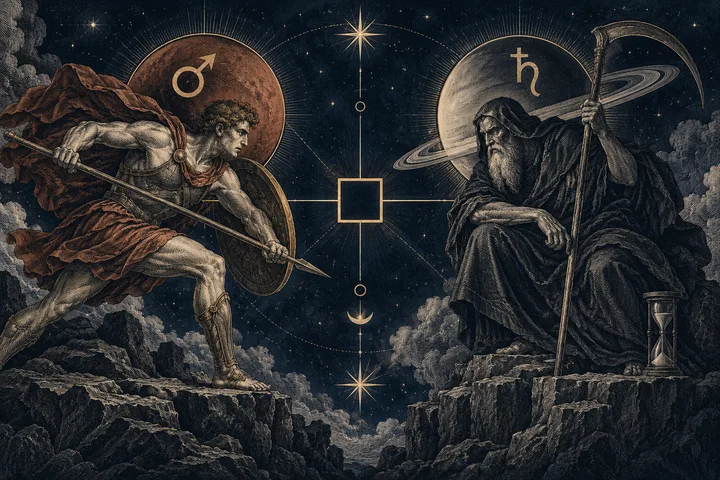
What makes a contact a square by angle, rather than by sign label?
A square is an aspect whose exact angular target is 90 degrees. In Astrology Aspects Explained, an aspect is the angular distance between two chart factors, while the orb is the amount by which their measured separation differs from an exact aspect. For Mars and Saturn in synastry, the relevant factors belong to two different charts: one person's Mars is compared with the other person's Saturn. The aspect name describes their geometry; it does not yet explain what the contact means.
To check the geometry, use the planets' actual zodiacal longitudes on a 0-to-360-degree circle. Subtract one longitude from the other, take the absolute difference, and if that difference exceeds 180 degrees, subtract it from 360 to get the shorter angular separation. Then compare that separation with 90 degrees. The absolute difference between the separation and 90 is the square's orb. For example, in an explicitly hypothetical calculation, longitudes of 40 and 133 degrees are 93 degrees apart, so their shorter separation is 93 degrees and the square is 3 degrees from exact. This arithmetic illustrates the method only; it describes no person's chart and is not a report result.
Astrology Aspects Explained sets out this general geometry and gives the square a 90-degree target. Sign labels can serve as a preliminary shorthand for an aspect family in some reading contexts, but they do not supply the exact angular distance. Even when two placements carry signs commonly associated with a square relationship, the degrees determine how close their separation is to 90 degrees. A sign-only description therefore leaves the orb unknown. It cannot establish whether a particular degree-based cutoff includes the contact.
This step also keeps two different questions from collapsing into one. The sign relationship may suggest why a reader is checking for a square, but the angular calculation verifies whether the two positions actually sit near the square's target. In the hypothetical 40-degree and 133-degree example, the numbers leave a three-degree deviation; another pair of longitudes could carry the same sign relationship yet produce a different deviation. The geometry gives the comparison, while the selected orb rule decides whether that deviation counts for the reader's stated method.
For this article, the working language is the Western zodiacal aspect framework: compare the two longitudes around the zodiac, treat 90 degrees as exact, and state any orb convention separately. If only signs are available, call the proposed square unverified by degree rather than treating the label as a measured contact. If degrees are available but no orb policy has been chosen, report the separation and deviation first; a reader can then see exactly what a chosen convention includes. Establishing the angle answers whether this geometry is present under a declared method. It does not, by itself, settle the interpretation of resistance or effort.
In synastry, Mars square Saturn links one person’s Mars with the other person’s Saturn. Astrologers commonly interpret the hard contact as friction between initiative and restraint; a more structural reading is possible when the cited framework and chart context support it. Confirm the contact from available degrees under a named orb convention, record whose planet is whose, and consider each planet’s natal context if known. Orb rules vary, and sign labels alone do not verify the exact contact. The symbolism can frame a question about effort meeting resistance, but it cannot explain a specific delay. For that, look at what was said, what next step was agreed, and whether both people took part.
Sources: Astrology Aspects Explained
Why do astrologers use different orb cutoffs?
A reader can choose an orb cutoff by naming a tradition or working rule and applying it consistently; no single number should be presented as a universal synastry limit. Astrology Aspects Explained publishes a seven-degree allowance for squares in its aspect policy and acknowledges that astrologers use different orb approaches. That is a concrete, auditable convention. The page describes its calculation policy in a natal-aspect context, however, so its seven degrees should be cited as that publisher's example, not silently transferred into a rule for Mars–Saturn synastry.
The distinction matters because an orb is a way to classify angular closeness within a method. It is not a scale of how much tension, effort, or resistance two people experience. If one reader uses a wider allowance and another a narrower one, they may describe the same measured separation differently: included as a square by one rule, outside the working orb by another. The underlying longitudes and their angular distance have not changed. The disagreement concerns the boundary each reader has chosen for treating that distance as an operative aspect.
Introduction to Relationship Astrology 2: Synastry (subjective compatibility factors) presents a narrower orb approach for synastry than the broader allowances it discusses for natal aspects. Its recommendation belongs to Philip Graves's particular instructional method, not to every astrologer. The useful comparison is methodological: a reader can distinguish a rule made for cross-chart contacts from a published allowance made for natal aspects, instead of combining them into a purported standard. If following Graves, state that choice and use it throughout the reading; if following another named method, identify that method's own boundary. Neither approach warrants claiming that all practitioners agree.
Estimation of aspect orbs by the computer, by Kyösti Tarvainen, adds a different kind of comparison. Tarvainen describes three computational procedures for estimating working orbs and reports that outcomes vary with the procedure and available data, including substantial variation among published synastry recommendations. That analysis does not establish a universally validated Mars–Saturn threshold or show that an orb causes a relationship outcome. It does reinforce a narrower point: proposed maxima depend on the method and assumptions used to derive them. A stated cutoff makes a reading reproducible; it does not convert the cutoff into a fact about every chart or couple.
A practical convention can still be useful. Record the measured separation, the resulting deviation from 90 degrees, and the rule used to decide whether that deviation falls within orb. A reader may also distinguish an exact or close contact from a wider one within the chosen framework, while making clear that the relative emphasis is an interpretive judgment. Changing the cutoff changes the classification, not the measured angle, and it cannot tell a reader how serious a real-life impasse is. The strongest reason to prefer one convention is that its scope is explicit and it is applied consistently, not that its number promises a particular meaning.
A useful record therefore separates three entries: the observed angular separation, its deviation from exact square, and the declared inclusion rule. This lets another reader reproduce the classification without guessing whether the author switched methods midstream. When a contact falls close to a chosen boundary, report that fact plainly rather than smoothing it into certainty. The reader can then compare interpretations while knowing whether their difference comes from the chart positions, from the orb convention, or from the meaning assigned after the contact is admitted.
The Synastry Comparison Report's confirmed calculation scope does not settle this question: it accepts supplied Moon, Venus, and Mars signs, optional degrees, and selected major aspects, while the saved product description does not establish Saturn placement or Mars–Saturn support. Its selected-aspect orb must not be borrowed as this article's cutoff. For a Mars–Saturn comparison, use chart information and an orb method that actually covers the contact, or leave its degree-based status unresolved. This keeps a publisher's convention, an individual astrologer's method, an estimation paper, and a product's documented inputs distinct.
Sources: Astrology Aspects Explained; Introduction to Relationship Astrology 2: Synastry (subjective compatibility factors); Estimation of aspect orbs by the computer
What do Mars and Saturn symbolize before the square is interpreted?
In Mars–Saturn Aspects in Synastry: Relationship Astrology, Mars supplies the symbolism of action, assertion, and pursuit, while Saturn supplies restraint, limits, and the conditions that shape what can be sustained. Read together, the planets name two functions in contact: an impulse to act and a force that slows, tests, organizes, or contains action. This vocabulary describes the chart factors being compared. It does not, by itself, describe either person as naturally aggressive, cold, controlling, dependable, or difficult.
Mars can signify initiative that is purposeful, but initiative can also be mistimed, poorly coordinated, or insensitive to a limit. Saturn can signify responsibility, patience, and structure, but restraint can become excessive or frustrating when it closes off action without a workable reason. These are interpretive possibilities, not fixed moral roles. The same symbolic pairing can therefore raise a question about how movement and limitation meet without deciding in advance that one is right and the other is wrong.
This is why “Mars does the acting and Saturn does the stopping” is too simple as a complete interpretation. It turns a possible interaction into a fixed division of labor and can make the symbolism sound like a transcript of behavior. A more precise formulation is that one chart contributes a Mars function and another contributes a Saturn function, and the astrologer interprets how those functions relate. The chart can suggest themes of assertion and limitation; it does not tell the reader whether a pause was mutually chosen, imposed, necessary, or avoidable. Those distinctions belong to context and evidence about the actual exchange.
The distinction matters because planetary shorthand can turn too quickly into a story about character. Calling one chart’s Mars “the pursuer” and the other chart’s Saturn “the blocker” may sound concrete, yet it can smuggle in motives that the chart symbolism has not established. Mars does not prove that its chart holder is pushing unfairly; Saturn does not prove that its chart holder is withholding or acting wisely. The terms identify functions in an interpretive framework, not evidence about intention, conduct, or who bears responsibility for a real disagreement.
Introduction to Relationship Astrology 2: Synastry (subjective compatibility factors) treats synastry factors as belonging to particular charts, which is useful for keeping those functions distinct. One chart contributes the Mars factor and the other contributes Saturn; ownership tells the reader where each symbol comes from. It does not settle how either person experiences the contact or what either intends. That distinction lets the interpretation remain specific without turning chart ownership into a verdict about the people.
The two symbols are also broader than a single behavior. Mars can describe the act of initiating, defending, or pursuing something, while Saturn can describe a rule, obligation, delay, or boundary that gives action a form. In an interpretive reading, a Saturn limit might be experienced as a useful condition for acting carefully; it might also be experienced as discouragement or a narrowing of options. Likewise, Mars may represent direct assertion, but the symbolism alone cannot tell whether that assertion is welcome, badly timed, or necessary. The terms are most useful when they keep these possibilities open long enough for the rest of the chart and the lived context to matter.
This vocabulary sets up the next interpretive step. Mars names the effort or assertion under consideration, and Saturn names the limit, demand, or structure that meets it. If the contact is a square, the aspect supplies a relationship between these functions; the planet names alone do not yet say whether that relation feels obstructive, productive, or mixed. Keeping the meanings separate makes it possible to ask what the square adds while leaving sign and natal context available to qualify the symbolism later.
Sources: Mars–Saturn Aspects in Synastry: Relationship Astrology; Introduction to Relationship Astrology 2: Synastry (subjective compatibility factors)
What does the square add to the Mars–Saturn symbolism?
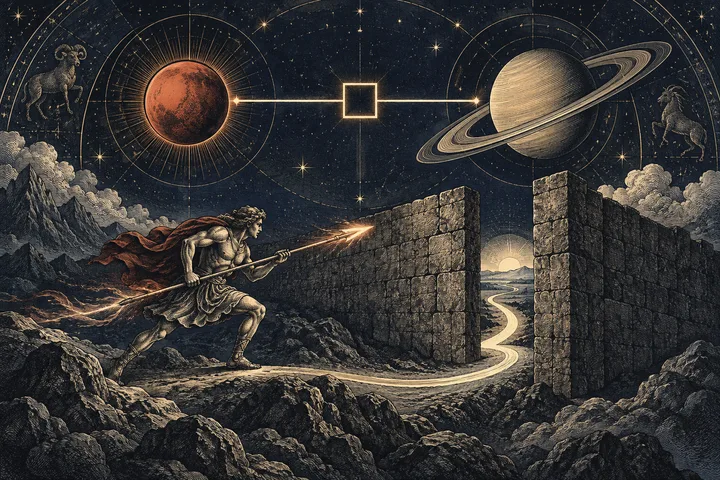
The square adds pressure to the meeting of Mars and Saturn: initiative encounters resistance, and action may feel slowed, tested, or constrained. For a question about effort repeatedly meeting a limit, this resistance-centered reading is the most direct starting point. An Introduction to Aspects and Chart Shaping in Natal Astrology describes tense aspects as friction that can bring difficulty, while Mars–Saturn Aspects in Synastry: Relationship Astrology applies a hard-contact interpretation to cross-chart Mars and Saturn and discusses restrictive possibilities. Together, they support a symbolic reading of strain around action and restraint, not a factual account of a particular couple’s conflict.
In this reading, friction can concern pace: one function presses toward movement while the other requires delay, proof, preparation, or a narrower path. It can also concern criticism or inhibition, if the contact is interpreted through the more restrictive possibilities in Mars–Saturn Aspects in Synastry: Relationship Astrology. The point is not that every square produces the same scene. The square describes a challenging relation between the functions; the synastry source offers one interpretive vocabulary for what that tension may represent.
The friction reading is strongest when it stays at that level of interpretation. “Pressure” does not mean constant arguments, and “resistance” does not establish that Saturn’s chart holder is deliberately frustrating Mars’s chart holder. The language describes a tension astrologers may associate with the contact: progress can seem to require extra effort, or the conditions for action may feel restrictive. A reader can use those terms to identify what to examine in the interpretation, but the terms do not substitute for a description of events.
That makes “effort meets resistance” a useful symbolic shorthand, but a limited one. It can frame a question such as whether movement seems checked, whether action is being tested against a boundary, or whether frustration gathers around getting something underway. It cannot identify who initiated a particular argument, establish whose description of events is accurate, or reveal why a real plan stalled. Those are questions about events and people; the aspect is an astrological interpretation of a relationship between chart factors.
Campion’s account also keeps friction from becoming a single fixed outcome: tense aspects may describe difficulty, yet the same pressure can prompt work through a problem and development. That possibility belongs in the reading, but it should not displace the resistance interpretation simply because a constructive ending feels reassuring. For the assigned situation, begin with the obstruction or strain the square most directly symbolizes, then ask whether the broader chart context gives a reason to qualify that emphasis.
The developmental possibility is therefore a qualifier, not an equal default that cancels the contact’s friction. In Campion’s general framework, working through tense aspects may prompt development; that is a statement about the interpretive potential of tension, not proof that a particular pair will resolve it well. Cafe Astrology’s direct synastry account makes the constructive reading conditional, while still describing hard Mars–Saturn contacts in restrictive terms. A fair synthesis keeps both claims in view and ranks them for this question: resistance explains the felt pattern named in the topic, while development remains possible only when the interpretation and context support it.
Cafe Astrology’s direct synastry interpretation likewise leaves its constructive possibility conditional on how the contact is handled, rather than treating the aspect as automatic growth. Its restrictive language can help name possible themes such as frustration, inhibition, or pressure around action; it does not show that these themes occurred in a reader’s relationship. Campion’s general natal-aspect framework adds a broader account of friction and development, not direct evidence about couples. The sources therefore contribute at different levels: one gives a tense-aspect framework, and the other interprets hard Mars–Saturn contacts in synastry.
A careful reader can use the square to organize reflection around the symbolic tension: what is trying to move, what limit is encountered, and whether the limit functions as a meaningful constraint or as a source of strain in the interpretation. The chart cannot answer those questions by assigning motives or deciding what happened outside it. Context must do the qualifying work, and observable events must carry any practical conclusion. The square names a kind of astrological pressure; it does not cause or prove the couple’s circumstances.
Sources: An Introduction to Aspects and Chart Shaping in Natal Astrology; Mars–Saturn Aspects in Synastry: Relationship Astrology
Whose Mars and whose Saturn are involved, and why record direction?
Write the contact with its chart owners attached: for example, “A-Mars square B-Saturn.” The letters are neutral placeholders in a hypothetical notation, not people or chart data. This records that Mars belongs to chart A and Saturn belongs to chart B. Reversing the viewpoint does not change the angular relation: the same two factors remain in a square. But the ownership labels are not interchangeable. “B-Saturn square A-Mars” describes the same contact from the other end, while preserving which chart contributes each planet.
That distinction gives the interpretation a clear subject. With A-Mars square B-Saturn, the astrologer can ask how the Mars function from A’s chart is read in contact with the Saturn function from B’s chart. The notation does not say that A always initiates, that B always restrains, or that either person behaves in a particular way. It simply keeps the symbolic roles attached to their chart sources. Without the labels, a note such as “Mars square Saturn” can make it easy to reverse the factors while discussing the contact, or to slide from chart symbolism into an unsupported description of who is pushing whom.
The letter convention can be kept simple and consistent throughout a reading: assign one label to each chart, then write the planet before the aspect and the other planet after it. “A-Mars square B-Saturn” makes the direction legible at a glance; “B-Saturn square A-Mars” is an equally valid reverse description of the same pair. The notation is a bookkeeping aid, not a ranking of whose planet matters more. It also helps when a reader compares multiple contacts, because each statement continues to identify which chart contributes which factor instead of relying on an ambiguous phrase such as “the Mars person” once the discussion turns to another aspect.
In Introduction to Relationship Astrology 2: Synastry (subjective compatibility factors), Graves treats the factors as belonging to particular charts and emphasizes that a cross-chart link may be subjectively experienced differently by the people whose charts are involved. Applied here, that framework allows the astrologer to distinguish A’s Mars factor from B’s Saturn factor, then consider the contact from each chart holder’s symbolic position. It is a feature of Graves’s interpretive approach. It does not establish that either person actually feels more pressure, that the contact matters equally to both, or that a specific episode has the meaning assigned to it.
This way of recording direction also keeps two interpretive questions apart. First, what is being said about the contact as a relation between Mars and Saturn? Second, how does a particular astrologer consider that relation from the standpoint of each chart's owner? Graves's subjective-factor framework gives a reason to ask the second question, while the reciprocal geometry remains intact. Neither question answers what either person consciously thinks or feels; those would be claims about people that this notation and interpretive framework alone do not establish.
A useful record therefore keeps three things together: the named aspect, the owner of each planet, and the direction from which the interpretation is being considered. For instance, retain “A-Mars square B-Saturn” when describing the Mars-to-Saturn reading, and state explicitly if you then consider how B’s Saturn is interpreted in relation to A’s Mars. The geometric description stays reciprocal; the interpretive question changes its focus. This notation prevents accidental role reversal and makes the reasoning inspectable without turning direction into proof of unequal impact.
Sources: Introduction to Relationship Astrology 2: Synastry (subjective compatibility factors)
How does each planet's natal setting qualify the cross-chart contact?
After recording which chart owns each factor, consider what the relevant natal information says about Mars in its own chart and Saturn in its own chart. Mars comes first because it is the action function in this pair. Note the Mars information that is actually available and relevant to the interpretive method being used, then ask whether it supports a simple picture of direct, unqualified initiative or calls for a more particular reading of that function. This is a question about the natal setting of Mars, not a license to assign the chart holder a fixed personality or to infer conduct from the cross-chart contact alone.
Mars–Saturn Aspects in Synastry: Relationship Astrology specifically recommends considering the natal condition of both planets when interpreting their synastry contact. Its guidance makes the Mars side a qualification rather than a label: the astrologer should not assume that every Mars factor means the same kind of action before considering the natal information available for that planet. If the reader has only a placement sign, that sign can be recorded as the known context and interpreted only as far as the chosen method permits. If no relevant natal information is available, the record should say so. Missing context cannot be supplied by a more confident description of the square.
Then make the same inquiry for Saturn in its own chart. What relevant natal information is actually known about that Saturn factor, and how does the selected method use it to qualify restraint, limits, or structure? Cafe Astrology’s recommendation to consider both planets means Saturn should not be reduced automatically to “the blocker” any more than Mars should be reduced to “the pursuer.” Its natal setting may lead an astrologer to qualify how the Saturn function is interpreted, but the source’s interpretive instruction does not make unknown chart details available. Keep the evidence for Saturn separate from what is known about Mars, and do not let one planet’s description stand in for the other’s.
Keep the method's scope visible when making these entries. The section concerns the natal setting of the two planets already named in the contact; it does not require a general inventory of every feature in either chart. A reader can ask what the available information contributes to Mars, then what it contributes to Saturn, and stop when the selected interpretive approach has no further supported instruction. This guards against treating “consider the natal condition” as permission to introduce unrelated chart factors or technical claims that the supplied information cannot establish.
A compact working note can use two entries: “Mars in its own chart: [known relevant information, or not supplied]” and “Saturn in its own chart: [known relevant information, or not supplied].” The bracketed phrases are a recording template, not claims about a chart. Add an interpretive qualification only when the information is present and the chosen approach explains how it bears on that planet. This keeps the natal layer useful and bounded: it adjusts the reading of each symbolic role rather than generating a full-chart account from absent details.
The value of this check is that it can interrupt the formula “Mars pushes, Saturn blocks” before that shorthand hardens into the whole interpretation. Cafe Astrology’s recommendation directs attention back to each planet’s own natal condition, so the contact is read as two qualified functions in relation, not as a complete story supplied by the aspect label. A reader can therefore distinguish what the cross-chart contact suggests from what each natal setting adds. If the available chart information does not support a qualification, leave that part open instead of filling it with a familiar archetype.
This context check has a limit of its own. More natal detail does not automatically produce a better interpretation, and a reader should not invent a condition simply to make the contact feel complete. The plan here is modest: record known, relevant information for Mars; record known, relevant information for Saturn; use the selected method to explain any qualification; retain the uncertainty where data are absent. Cafe Astrology supplies an interpretive hierarchy, not a rule that every reader must have a complete natal inventory before considering the contact. The contact’s symbolism can be discussed provisionally, while its fuller qualification remains proportionate to what is actually known.
Sources: Mars–Saturn Aspects in Synastry: Relationship Astrology
When is a structural reading a genuine alternative to obstruction?
A structural reading is a genuine alternative only when the interpretation can say what the restraint is organizing. Cafe Astrology’s “Mars–Saturn Aspects in Synastry: Relationship Astrology” allows a constructive possibility when a hard contact is handled considerately and with a growth-oriented approach, while still describing limiting expressions. Its condition matters: the source does not turn every restriction into support. “Astrology.com’s “Saturn Square Mars: Natal and Transit” supplies adjacent vocabulary for disciplined action, slow progress, and planned effort, but its natal and transit passages are not claims about what one partner does to another. Taken together as interpretive material, they permit a conditional question: might a limit give action a workable form here?
The threshold is specificity. Name the task the boundary serves, the interval or condition it creates, and the context in the chart reading that makes this meaning plausible. For example, “Saturn organizes Mars” is too vague if it merely renames frustration. A more specific symbolic interpretation would identify restraint as pacing around a defined preparation, duty, or sequence: action is delayed until a stated prerequisite is met, and that prerequisite has a recognizable place in the situation being interpreted. The symbolic account then has a structure to describe, rather than a flattering adjective attached after the fact. The relevant chart context should support considering that function; the phrase “discipline” on its own does not do the work.
This is an interpretive threshold, not a formula for deciding whether a real arrangement is fair. Cafe Astrology supplies a conditional synastry possibility; Astrology.com contributes a vocabulary that can help articulate what a disciplined or planned expression might mean. Neither source establishes that a particular limit is useful, mutually accepted, or followed through. The synthesis is modest: where the symbolic roles and available context make organization a coherent reading, consider it alongside resistance; where no specific organizing function can be named, the direct obstruction reading remains the clearer account of effort meeting a barrier. A reassuring interpretation should have to explain more than why the barrier sounds purposeful.
The chart-context test also keeps the interpretation from becoming circular. If every delay is called preparation because Saturn symbolizes structure, then the symbolic label explains nothing: any evidence of blockage would be made to confirm the constructive reading. Instead, state in advance what feature of the available chart context makes a particular organizing function worth considering, and what observable feature of the proposed symbolism it is meant to clarify. The source does not prescribe a universal checklist for this judgment, so the reader should present it as an interpretive choice and explain its basis rather than implying a rule the source never gives.
It helps to distinguish a boundary’s form from its interpretation. A clear limit can still be restrictive; a planned process can still be unwelcome; and a delay can have a practical reason without proving that a Mars–Saturn contact expresses it. The symbolic reading is strongest when its terms remain proportionate: “this could describe pacing around a specific responsibility” is narrower than “the obstacle is good for the relationship.” The first proposes a function to examine. The second makes a judgment about benefit and shared meaning that the chart sources do not establish. Keeping that difference visible allows the constructive possibility without turning it into a verdict.
Consider a clearly hypothetical illustration, not a couple case: a shared activity is postponed until a known preparation is complete, with a definite check-in or restart point. A reader might describe the delay symbolically as pacing that supports preparation, if the chart context also warrants considering restraint in that role. Change the illustration: the activity is repeatedly deferred, no condition for resuming is named, and each attempt meets another indefinite hold. Calling that pattern “discipline” would add a purpose the interpretation has not specified. The contrast is not a rule that deadlines prove goodwill or that an open-ended delay proves bad intent. It shows what the two readings need to explain: organization points to an identifiable task and sequence; obstruction names movement checked without an evident organizing role.
The alternative therefore earns its place through explanatory detail, not optimism. It should identify what is being paced or prepared, say which available chart context supports exploring that symbolism, and remain conditional about the lived meaning. If the interpretation cannot meet those conditions, do not convert blockage into growth by vocabulary alone. Even when it can, a coherent symbolic structure does not prove that the real limit benefits anyone or that both people accept it. The distinction improves the chart reading; the actual boundary still has to be considered on its own terms.
This also clarifies how to weigh mixed readings. If the context supports a defined organizing role but the interpretation still describes pressure or frustration, retain both: the boundary may structure action and remain difficult. A constructive possibility need not erase the cost named by the resistance reading. Its value is that it specifies another possible function, not that it guarantees a better outcome.
A reader can therefore preserve the tension without forcing a single moral: structure may be a possible meaning, while resistance remains the starting emphasis.
Sources: Mars–Saturn Aspects in Synastry: Relationship Astrology; Saturn Square Mars: Natal and Transit
Why keep natal, transit, and synastry meanings separate?
Natal, transit, and synastry readings ask different chart questions, so a Mars–Saturn phrase from one technique cannot be carried into another as if its scope stayed fixed. “Astrology Aspects Explained” distinguishes natal aspects, transits, and synastry as different uses of chart relationships. In ordinary terms, a natal aspect relates factors within one birth chart; a transit considers a moving planet in relation to a chart at a particular period; synastry compares factors belonging to two charts. The same planetary symbolism may appear in each, but the factors being related, and therefore the question being interpreted, change.
Astrology.com’s “Saturn Square Mars: Natal and Transit” illustrates why the distinction matters. Its natal description frames the square through disciplined action and frustration with slow progress; its separate transit description uses sustained, planned effort. Those are adjacent interpretive vocabularies for a same-chart pattern and a moving activation. They may suggest language for thinking about discipline or pacing, but they do not describe a Mars factor in one person’s chart contacting Saturn in another person’s chart. The shared planet names do not make the contexts interchangeable.
The distinction is not merely terminology. A natal interpretation describes a relationship among factors housed in one chart; a transit interpretation introduces movement and a time frame; synastry puts factors from separate charts into relation. Before borrowing a phrase, identify which of those relations the source actually discusses. This simple check prevents a statement about someone’s internal chart pattern or a period of activity from being restated as a description of interaction between two chart holders. It also makes comparison fair: the interpretations may share a symbolic vocabulary while answering different questions.
A careful translation therefore keeps the planetary idea tentative and changes the question to fit the technique. For natal interpretation, ask how the Mars–Saturn relation is read within that one chart. For a transit, ask what the moving contact signifies in its stated period and chart context. For synastry, ask how the two owned chart factors are interpreted in relation to one another, then give priority to the direct synastry treatment and relevant natal context. The Astrology.com language can suggest a possible structural reading, but it cannot establish that one partner supplies discipline, slows the other, or organizes their effort. Those are claims about a cross-chart relationship and require a synastry basis; the adjacent source alone does not provide it.
This separation does not require discarding shared symbolism. It assigns that symbolism the right weight. A reader may test whether “planned effort” helps clarify a synastry interpretation, provided the reading states it as a possibility, identifies the context that makes it relevant, and does not present the natal or transit wording as direct evidence about partners. If the direct synastry source points toward a different emphasis, that interpretation should not be displaced merely because a neighboring technique offers more appealing language. The chart layer determines what the source can support; the vocabulary remains a prompt for interpretation, not a substitute for it.
The limit is especially important when the imported phrase sounds like a practical conclusion. “Planned effort” may be useful symbolic language, but it does not establish that a partner is helping, hindering, or responsible for a delay. Those meanings must remain attached to the technique and context that support them.
Sources: Astrology Aspects Explained; Saturn Square Mars: Natal and Transit
How much of the chart should one square be asked to explain?
A focused reading should widen only when another chart factor has a clear job. Philip Graves’s Introduction to Relationship Astrology 2: Synastry (subjective compatibility factors) treats synastry as a field with many possible links between chart factors. That breadth makes selection important: a reader can keep adding contacts until the chart seems to confirm almost any story. The useful question is not whether another factor exists, but what it would help explain. Does it answer a question left open by this Mars–Saturn contact, or materially qualify how Mars or Saturn is being read? If neither, leave it outside this interpretation.
Use a short sequence to make that choice visible. First, establish whether the contact is confirmed under the orb convention already declared; when degrees or a consistent method are missing, mark it provisional. Second, record any available natal qualification that bears directly on Mars or Saturn, without filling gaps in the chart. Third, name the question another factor would answer before bringing it in. That question might be about a distinct symbolic theme in the charts, or whether another contact changes the emphasis placed on initiative and restraint. If no specific question can be stated, adding the factor contributes volume but not explanation.
For example, in a purely hypothetical reading, a second, separately established contact might be considered because the reader wants to understand a different theme alongside the Mars–Saturn tension. The astrologer should name that theme and explain why this other contact bears on it. No particular placement is assumed here. The second contact does not become extra evidence that the square is accurate simply because it can be fitted to the same account. It has interpretive value only on its own terms, with its own chart factors and method made clear. A factor that addresses a different question may broaden the reading; it does not automatically strengthen the first claim.
This selection rule is not a claim that one square outweighs the rest of a chart. A broader reading may change the emphasis, and a relevant factor may complicate rather than support the first interpretation. The point is to make each addition earn its space: state what it contributes, what it changes, and what remains uncertain. If two factors point in different directions, retain the difference and explain the distinct interpretive roles instead of counting both as votes for a single conclusion. Accumulation is not confirmation, and disagreement between factors can be meaningful context rather than a problem to smooth away.
A useful stopping point arrives when the available factors have answered the question the reading set out to examine, or when the information needed to go further is absent. This is not a universal rule that every chart must be read in a fixed order. It is a way to show the reader why the interpretation stops where it does. If a potentially relevant factor cannot be confirmed, say that it remains outside the reading; if its meaning would require a chart detail not supplied, do not infer that detail. The reading can remain partial and still be coherent, provided its boundary is explicit.
The Synastry Comparison Report cannot perform this inventory or adjudicate the Mars–Saturn contact. Its confirmed scope is supplied Moon, Venus, and Mars signs, optional degrees, and selected major-aspect calculations; it does not establish support for Saturn placements or this square. Those supported comparisons may serve a separate question about the placements they include, but they cannot verify, weigh, or complete this Mars–Saturn reading. Keep that boundary clear when deciding whether a broader chart view is actually available. A focused account can stop after the confirmed contact and relevant qualification; it need not claim to represent the whole chart.
Sources: Introduction to Relationship Astrology 2: Synastry (subjective compatibility factors)
What can a recurring real-life episode tell you that the chart cannot?
A chart can offer a symbolic lens for effort meeting resistance; an actual episode can show what happened between two people. Keep those records separate. Describe the event in observable terms: what plan was delayed, what constraint was stated, what next step was agreed, who participated in it, and whether that step happened. This description does not settle anyone’s motive. It gives you a clearer basis for deciding what to ask or what arrangement you need, while the chart remains a way to reflect on the theme rather than an explanation of the event’s cause.
Consider this constructed illustration, offered for reasoning rather than as firsthand research or a relationship standard. Two people have a shared plan that must be delayed. In one version, they name the constraint, agree to check back on a particular day, and each knows what they will do before then. When that point arrives, they revisit the plan. The observable record includes a delay, a stated reason, a return point, participation in setting it, and a follow-up. It does not prove that the arrangement is fair or that either person welcomes the delay. It shows that the pause has an agreed next step that can be discussed.
In the paired version, the same plan is delayed, but no return point is agreed. One person asks when it might resume; the answer remains open, and later attempts to revisit it do not produce a next step. The record is still limited: there may be a genuine constraint, a changed deadline, a forgotten check-in, or some other explanation. The account should not turn those possibilities into a claim about intent. It can say that the plan remains unresolved and that no follow-up has yet been agreed. That is precise enough to identify the practical uncertainty without assigning a hidden cause.
The contrast is about what can be observed and clarified, not which version predicts a better relationship. A return point makes it possible to ask whether both people can work with the proposed timing and whether they follow through on revisiting the decision. An open-ended delay raises a different practical question: is there a condition or time at which the plan can be reconsidered, and does each person want to keep pursuing it? Either answer may change what arrangement is workable. One exchange cannot establish a recurring pattern, and a clear check-in does not guarantee that the plan suits both people.
To examine a pattern, keep notes on repeated episodes without converting them into a tally of character or motive. Record the stated constraint in the words used, the next step that was actually agreed, each person’s participation in that agreement, and what happened at the return point. If no step was set, record that too. Separate a missed check-in from the reason it was missed; the first may be observable, while the reason may need to be asked about. A repeated absence of an agreed next step may tell you that coordination remains unresolved, but it cannot by itself tell you why or what the other person intends.
That record can lead to a concrete question: “Can we choose a time to revisit this, and what would make that timing workable for each of us?” If a time is proposed, you can then decide whether it meets your needs and observe whether both people participate in the plan. If no time or condition can be agreed, that is also useful information about the arrangement available now; it is not proof of a motive or a forecast of what will happen. You may choose to ask again, set your own limit on waiting, or make a different plan. The chart need not decide among those choices.
In this use, Mars–Saturn symbolism can prompt reflection on how initiative and limits are being understood, but it should not substitute for the event record. A symbolic reading cannot identify the real constraint, verify that a promise was made, or establish who is responsible for a stalled plan. The practical account cannot confirm an astrological interpretation either. Keep both in their proper roles: use the chart language to frame a question about the theme, and use what was said, agreed, and followed through to decide what you need in the actual situation.
The illustration is deliberately narrow. Even when a return point is agreed and honored, the plan may remain unsuitable; even when a deadline changes or a check-in is missed, the reason may be ordinary and correctable. A single episode cannot settle a recurring pattern, and coordination alone does not guarantee that both people want the same outcome. The reader still has to decide what arrangement meets their needs. What the observation method offers is a way to make that decision from specific exchanges rather than inferred motives or a chart contact asked to explain more than it can.
Your next step: verify the contact you can, then decide what to ask
Write down whose Mars and whose Saturn are being compared before interpreting the contact. If both degrees are available, check their angular separation using the orb convention you have chosen; if a degree or consistent convention is missing, keep the exactness provisional rather than treating the sign labels as confirmation. Then consider each planet's natal context only where that chart information is actually available. This gives the symbolic reading its proper owners and context without asking it to settle what happened between you.
For the practical question, name one exchange in plain terms: what plan met resistance, what reason or limit was stated, and what next step was agreed, if any. From that record, choose what would help now: ask what condition would make the plan workable, state how long you are willing to wait, or propose a time to revisit it. You do not need a report to have that conversation.
If you have a separate question about supported placements, the Synastry Comparison Report can organize supplied Moon, Venus, and Mars signs, optional degrees, and selected major aspects. It does not calculate natal charts from birth details, and its stated scope does not establish a Mars–Saturn comparison. Choose whether that separate placement comparison is useful; otherwise, act on the practical conversation without a report.
Sources & further reading
- Astrology Aspects Explained
Defines aspects as angular distances, orb as deviation from an exact angle, gives square as 90 degrees and its own seven-degree square policy, describes square pressure as potentially conflictual or skill-building, and distinguishes natal, transit, and synastry scopes.
- An Introduction to Aspects and Chart Shaping in Natal Astrology
Nicholas Campion's guide describes tense aspects as friction that can bring difficulty or prompt development, and states that orb practices and interpretive weight vary within astrological methods.
- Mars–Saturn Aspects in Synastry: Relationship Astrology
Interprets hard Mars–Saturn contacts as potentially limiting, controlling, or confidence-undermining, while allowing considerate, growth-oriented handling; says the natal condition of both planets changes the relationship interpretation.
- Introduction to Relationship Astrology 2: Synastry (subjective compatibility factors)
Philip Graves presents synastry as links between factors belonging to two charts, emphasizes that each person may subjectively experience contacts differently, recommends keeping factor ownership clear, and proposes narrower synastry orbs than natal orbs.
- Estimation of aspect orbs by the computer
Kyösti Tarvainen compares computational approaches to estimating maximum working orbs and reports that values vary with method and available data, including substantial variation in published synastry orb recommendations.
- Saturn Square Mars: Natal and Transit
Astrology.com uses disciplined action, frustration with slow progress, and grit in its natal interpretation, and sustained, planned effort in its distinct transit interpretation.
Synastry Comparison Report
Enter known placements for two people. Get an input-by-input comparison, selected aspect calculations and a clear record of what remains uncertain.
Compare our placements