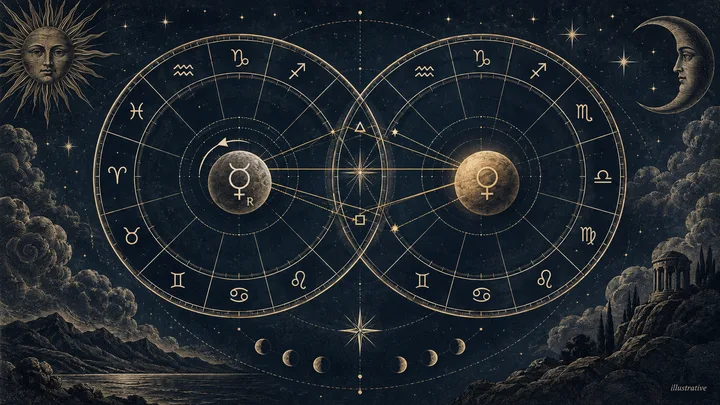
Interpret a retrograde personal planet in synastry as an inward, less automatic way of expressing that planet's relationship function. It doesn't cancel attraction, care, desire, or communication. It changes the route those qualities take. Start with the retrograde person's natal planet, then read the exact synastry contact, the sign, and the rest of both charts. Mercury retrograde may need more time to shape a thought. Venus retrograde may protect private values before naming affection. Mars retrograde may act indirectly, pause before asserting, or release desire in bursts. A close aspect can make that pattern vivid for the other person, but the experience isn't automatically equal. If you have no degrees, treat the sign connection as a broad theme, not a confirmed major aspect. The useful next step is simple: ask what helps this planet speak clearly, rather than treating retrograde as a warning label.
Start with what retrograde changes
When you see an Rx beside Mercury, Venus, or Mars in a synastry chart, don't jump to the conclusion that the planet is weak. That is the first mistake to remove. Retrograde describes motion from Earth's point of view, and astrology reads that unusual motion as a change in how the planet's function turns toward life. The function still works. It may work privately first, through review, hesitation, return, or a route that doesn't look obvious from the outside.
That distinction matters in a relationship comparison. Synastry doesn't create a new personality out of two charts. It shows how one person's chart factors meet and condition the other person's factors. A retrograde planet belongs first to its natal chart. The relationship then gives that planet a particular mirror, pressure, invitation, or audience. Read the natal pattern before deciding what the contact means.
Astrologers use the word personal for Mercury, Venus, and Mars because these planets describe everyday ways of meeting life. Mercury speaks, listens, names, compares, and makes sense of experience. Venus values, attracts, receives, delights, and negotiates closeness. Mars wants, initiates, pursues, protects, competes, and sets force in motion. A retrograde condition can turn any of these inward before it becomes visible between two people.
So the central question isn't, ‘Is this person difficult to love?’ It is, ‘What does this planet need in order to express itself without being rushed?’ You might see a person who revisits a conversation before answering, tests whether affection is safe before displaying it, or needs private contact with desire before taking action. Those patterns can feel mysterious to a partner who moves more directly. They can also become thoughtful, loyal, and skillful once both people recognize the rhythm.
This is why a retrograde personal planet deserves a close reading, but not a dramatic one. It adds texture. It doesn't overrule sign, house, aspect, dignity, condition, or the planet's role in the whole natal chart. Astrology becomes more useful when each symbol keeps its proper weight.
Synastry has two people and two directions. Call them Person A and Person B. If Person A has natal Venus retrograde and it forms a close aspect to Person B's Moon, begin with Person A's Venus. Then ask how Person B's Moon receives it. Reverse the lens and ask what Person B experiences through the Moon. The same contact can feel like private devotion to one person and emotional uncertainty to the other.
The planet person carries the retrograde pattern. The person whose planet receives the contact may notice it, draw it out, misunderstand it, or give it a place to develop. Person B doesn't become Venus retrograde because Person A has Venus retrograde. Person A doesn't automatically feel the contact more strongly simply because the planet is personal. The sign, aspect, house overlay when accurately available, and the rest of the chart decide how loudly the pattern speaks.
Next, identify the other planet. A retrograde Mercury touching someone's Venus is a different story from retrograde Mercury touching their Mars. Mercury-Venus can pull private thoughts toward affection, taste, and reassurance. Mercury-Mars can make words energizing, provocative, defensive, or strategically delayed. Retrograde Venus touching the other person's Sun may raise questions about being valued and seen. Retrograde Venus touching Mars may make attraction compelling while each person learns a different pace for pursuit and response.
This step sounds basic, but it prevents a common reading error: treating the Rx symbol as the headline and the planets as decoration. The planets are the headline. Retrograde is the lens. A contact must be understood as a sentence with a subject and a verb, not as a single ominous mark.
If a report lists a retrograde personal planet without a close contact, keep the interpretation modest. You can describe the natal style if that placement is known. You can't claim that the relationship activates it in a specific way until you know what it touches.
Also ask whether the Rx planet is one of the two people's own placements or a transit being displayed over the comparison. A natal retrograde is part of the person's enduring chart pattern. A transiting retrograde describes a period in the sky. The first can shape how someone approaches closeness. The second can time a review that touches an existing pattern. They belong to different layers and should be labeled before interpretation begins.
A clean worksheet helps. Write the planet, its sign, its degree if known, and the word retrograde beside Person A. On the other side, write the planet, sign, and degree for Person B. Then record the aspect and its orb. This small act stops the eye from wandering toward the most dramatic symbol on the page. It makes the reasoning reproducible, which is exactly what a useful field guide should do.
Keep a second note for the lived expression. Beside the chart description, write one sentence about what each person actually does: ‘needs a day before answering,’ ‘shows care through practical acts,’ or ‘waits until desire feels safe to state.’ Then compare the sentence with the symbolism. If the two agree, you have a grounded interpretation. If they differ, don't force the chart to win. Ask what other natal or synastry factors may be carrying the expression.
Sources: Retrograde Planets in a Birth Chart | Cafe Astrology; Retrograde: Planets in Retrograde Meanings | Astrology.com; Introduction to Relationship Astrology 2: Synastry | Philip Graves
Read retrograde Mercury through communication and repair
Retrograde Mercury in synastry often makes communication a process rather than a straight line. The person with Mercury retrograde may think deeply, revise a first impression, notice details later, or prefer to speak once an idea feels internally sound. They may answer quickly in one setting and need silence in another. A partner can mistake this for avoidance. The better interpretation begins with the Mercury person's actual natal style and the aspect involved.
With a close contact to the other person's Moon, words can reach feelings before either person has organized the experience. Person A's retrograde Mercury may circle a subject because the thought is carrying memory, emotion, or several meanings at once. Person B's Moon may feel understood, or may feel that a simple question has become hard to pin down. The practical task is to slow the exchange without making silence punitive.
With Venus, the conversation may return to love language, approval, values, or the meaning of a gesture. One person may say, ‘I know you care, but I need to hear what you meant.’ The other may need time to find words that don't feel borrowed. This can be tender. It can also become a loop if both people use interpretation instead of asking direct questions.
With Mars, Mercury retrograde can describe a mind that sees the perfect reply after the argument has ended. Anger may gather internally, arrive sideways, or emerge after repeated reconsideration. The chart doesn't excuse cruelty or make conflict inevitable. It shows a communication pattern worth naming. A couple can agree to pause, write down the issue, and return at a stated time. That gives Mercury room to work without leaving Mars to guess whether the conversation will ever resume.
The strongest reading is not ‘Mercury retrograde means bad communication.’ It is ‘communication improves when this person gets a clear path from private processing to shared language.’ Watch for the difference between a thoughtful pause and a disappearing act. The first has a return. The second leaves the other person carrying the whole conversation.
Sign changes the sound of this process. Mercury retrograde in an earth sign may review facts, wording, and practical consequences. In a water sign, memory and feeling may shape the thought before the person can state it. In an air sign, several interpretations may remain active at once. In a fire sign, the person may need to revisit a strong first impression before deciding whether it still holds. These are starting points, not substitutes for the actual chart.
Watch the difference between repetition and refinement. Repetition circles the same question without adding information. Refinement returns with a clearer request, a better example, or a more honest account of what felt wrong. If the relationship can reward refinement, retrograde Mercury becomes a strength in repair. It can notice what a quick answer missed.
Sources: Retrograde Planets in a Birth Chart | Cafe Astrology; Retrograde: Planets in Retrograde Meanings | Astrology.com; Introduction to Relationship Astrology 2: Synastry | Philip Graves
Read retrograde Venus through values, trust, and receiving
Retrograde Venus in synastry asks how love becomes believable. The Venus person may feel affection intensely yet reveal it carefully. They may question inherited ideas about beauty, partnership, money, loyalty, or what they are allowed to want. They may dislike polished social scripts and prefer a bond that feels private, sincere, and earned. A partner can experience that depth as warmth one day and reserve the next, especially when the Venus person is still deciding what the connection means.
A close contact to the other person's Sun can make visibility a central theme. The Sun person may draw the Venus person out and may also feel responsible for confirming that they are wanted. If the Venus person takes time to name affection, the Sun person might read the pause as rejection. If the Sun person demands constant proof, Venus may retreat further. The useful interpretation holds both sides: one person needs time to value openly, while the other needs clear signs of recognition.
A contact to the Moon brings the question into emotional safety. The Venus person may show care through steady presence, food, practical kindness, or small private rituals rather than public declarations. The Moon person may want a more immediate emotional response. Neither style wins by force. They need to translate care into a form the other can receive.
A contact to Mars brings attraction and friction into the same room. Retrograde Venus may review desire, question the pace of pursuit, or alternate between drawing close and protecting its autonomy. Mars may want a clear signal. Venus may need to know that desire won't erase discernment. This isn't a promise of hot-and-cold behavior, and it isn't a license to keep someone guessing. It is a reason to ask what each person calls consent, reassurance, space, and commitment.
Retrograde Venus is often misread as a sign that someone can't love. The stronger reading is that love has to pass through a personal value filter. That can take longer. It can also produce unusual honesty, because the person won't accept a relationship script simply because it is familiar.
Ask how Venus receives, not only how Venus gives. Some people with this signature can offer care easily but struggle to believe care offered to them. Others seem reserved until a value has been tested in ordinary life. In synastry, the other person's Moon, Sun, or Venus may make receiving easier, or may expose the exact place where reassurance is still being measured.
The useful evidence is behavior over time. Does the person name what they value? Do their choices match it? Can they accept affection without turning it into a test? A retrograde Venus may need more time before it trusts a promise, but it can still communicate that need. Ask for that communication. Don't demand mind reading, and don't volunteer to live inside ambiguity forever.
Sources: Retrograde: Planets in Retrograde Meanings | Astrology.com; Retrograde Planets in a Birth Chart | Cafe Astrology; Introduction to Relationship Astrology 2: Synastry | Philip Graves
Read retrograde Mars through desire, timing, and boundaries
Retrograde Mars changes the route from wanting to acting. The Mars person may hesitate before making a move, act after a long private build-up, or find that anger and desire arrive in waves. They may dislike being pushed into a contest or may need to set their own pace before they can act with confidence. A partner may see restraint, mixed signals, or a sudden surge. The reading becomes fairer when you ask what Mars is doing in the natal chart before assigning a relationship meaning.
Suppose Person A has Mars retrograde in Libra and it makes a close square to Person B's Venus in Cancer. This is an illustrative pattern, not a calculated couple's chart. Mars in Libra may weigh the effect of an action on the bond and may delay direct confrontation. Venus in Cancer may need emotional safety and a felt sign of care. The square creates a live negotiation between pursuit, harmony, protection, and timing. Attraction can be real. So can frustration.
In practice, Person B might say, ‘I can feel that you want closeness, but I can't tell when you'll take the next step.’ Person A might answer, ‘I do want it. I need us to talk about what happens after I act, because I don't want desire to decide everything for us.’ That exchange is the astrology made useful. It turns a symbol into a question about pace and responsibility.
A Mars contact to Mercury can heat up speech. A contact to the Moon can bring instinctive reactions and protective habits to the surface. A contact to Saturn can make action feel constrained, judged, or patiently trained. A contact to Venus can join desire and pleasure, but it still needs explicit boundaries. No aspect replaces a person's choices. Mars describes force and initiative. People decide how to use them.
The central mistake is to call retrograde Mars passive. It may be indirect, private, delayed, or unconventional, but it isn't empty. Look for where energy accumulates, what makes action safer, and whether the person can state a want before resentment takes over.
The sign shows what kind of action feels natural or difficult. Mars in a cardinal sign may initiate quickly but reconsider the method. In a fixed sign, desire can build with impressive persistence and then resist a change of plan. In a mutable sign, action may adapt to the situation and appear less predictable. Add the aspect before you rank any of these possibilities.
A partner shouldn't have to decode a surge of Mars after weeks of quiet. The higher expression is not perfect timing. It's ownership. ‘I wanted this, I hesitated, and here's what I can offer now’ is clearer than a dramatic gesture that asks the other person to absorb all the uncertainty.
Sources: Retrograde: Planets in Retrograde Meanings | Astrology.com; Retrograde Planets in a Birth Chart | Cafe Astrology; Introduction to Relationship Astrology 2: Synastry | Philip Graves
Use sign, aspect, and degree to rank the story
Once you know the planet and its retrograde condition, rank the rest. Sign describes the style of the function. Aspect describes the relationship between the two functions. Degree describes how close and immediate the contact is. House overlay, when the birth time is reliable and the houses are actually available, describes where the exchange tends to show up. Don't let a vivid sign description outrank an exact aspect without a reason.
For this publication's comparison scope, use supplied Moon, Venus, and Mars placements, optional degrees, and selected major aspects with a six-degree orb. A conjunction within six degrees gets the closest attention. Wider contacts may still describe a background theme, but they shouldn't be written with the same force as an exact contact. If degrees are missing, you can compare signs and describe possible relationships between them, but you shouldn't announce a confirmed conjunction, square, trine, or opposition.
A useful order is planet first, exactness second, aspect third, sign fourth, and repetition last. Planet first tells you what is moving. Exactness tells you how much weight to give it. Aspect tells you whether the exchange blends, challenges, pulls, or polarizes. Sign tells you how each person performs the function. Repetition asks whether another contact says the same thing and therefore strengthens the theme.
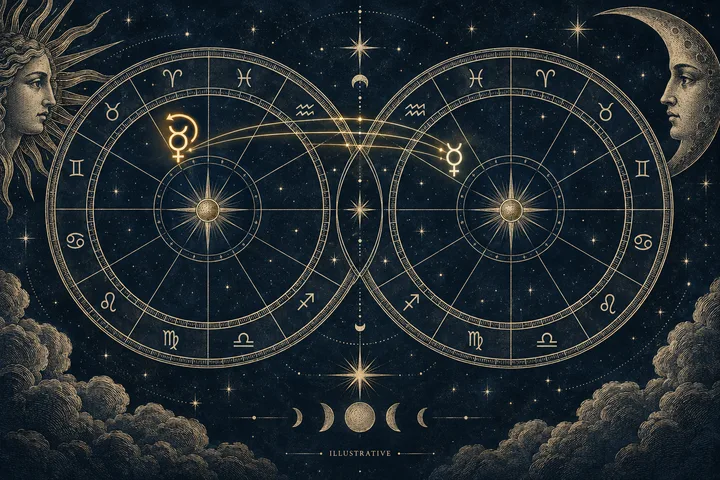
Imagine Maria has Mercury retrograde at 14 degrees Taurus, while Daniel has Venus at 15 degrees Scorpio. The one-degree opposition deserves attention because the contact is close and the planets have a clear relationship. Maria may take time to settle on words and may prefer concrete proof. Daniel's Venus may seek emotional intensity and trust through direct engagement. The opposition can create fascination and translation work. It doesn't prove that either person is withholding or that the relationship will last.
Now remove the degrees. You can still say Taurus Mercury and Scorpio Venus may bring different ways of naming value and security into the comparison. You can't say the opposition is exact. Precision protects the reading from becoming a story that the chart data never supplied.
The aspect itself describes a relationship between functions, not a moral quality. A conjunction combines them and can make the theme constant. An opposition creates a pull between two ends that may need conscious balancing. A square demands adjustment and can keep the issue active. A trine may make the exchange easy to access, while a sextile often asks for participation before its help becomes visible. These are useful distinctions, but the planets still tell you what is being connected.
Orb matters because closeness concentrates attention. An aspect at one degree may show up in the first exchange, the first attraction, or the first argument. An aspect near the edge of the allowed range may describe a background tendency that needs other contacts to become prominent. Don't use the maximum orb as a promise that every listed contact deserves equal space.
Sources: Introduction to Relationship Astrology 2: Synastry | Philip Graves; Retrograde Planets in a Birth Chart | Cafe Astrology; Retrograde: Planets in Retrograde Meanings | Astrology.com
Separate the natal pattern from the synastry activation
A retrograde planet exists before the relationship. Synastry shows what happens when another person's chart meets it. Keep those layers separate. First ask how the person already handles Mercury, Venus, or Mars. Then ask whether the other chart supports that pattern, challenges it, gives it language, or presses on its most sensitive edge.
Consider an example. Person A has natal Venus retrograde and has always taken relationships seriously. They don't enjoy casual labels, but they also don't announce commitment after one intense week. Person B's Saturn makes a close trine to that Venus. The synastry may give the Venus person a structure in which affection can become dependable. Person B may feel that their steadiness matters. The retrograde Venus remains private and deliberate, but it has a supportive channel.
Now change the contact. Person B's Mars squares the same Venus. The relationship may activate a stronger push-pull around desire and pace. Person A may want to decide what the attraction means before acting. Person B may want an answer through movement and physical closeness. The natal Venus hasn't suddenly become confused. The interaction has made its value filter part of a live negotiation.
This distinction also keeps you from assigning every behavior to the relationship. If the Mercury retrograde person revises messages with everyone, the partner didn't cause the pattern. If Venus becomes more expressive with one person, the synastry may be helping that natal function find a welcome. If Mars is direct in work but hesitant in romance, the relationship context has changed the expression without changing the planet's core condition.
The best reading names both layers in plain language: ‘This person may process affection privately, and your Moon contact gives that process emotional importance.’ That sentence has more value than ‘You have karmic Venus energy.’ It tells you what to watch, what may be felt, and what conversation could clarify it.
You can test the distinction by asking a counterfactual question: ‘Would this person show the same pattern with a friend, family member, or colleague?’ If yes, you are probably looking at a natal habit that the relationship is revealing. If no, examine the synastry contact and the situation around it. This doesn't reduce the chart. It gives the chart a sharper job.
The relationship may also offer a new expression of the planet. A person who rarely states affection may do so when Venus meets a partner's Sun or Moon in a supportive way. A person who normally argues directly may become cautious when Mars meets a sensitive Moon. Neither result is guaranteed. The chart describes a field of response. The people still have to enter it consciously.
Sources: Retrograde Planets in a Birth Chart | Cafe Astrology; Retrograde: Planets in Retrograde Meanings | Astrology.com; Introduction to Relationship Astrology 2: Synastry | Philip Graves
Read the strongest contact, then test the exception
A chart can contain several retrograde personal-planet contacts. Don't flatten them into one verdict. Rank the closest and most relevant contact first. Then check whether another aspect supports it or changes its expression. A retrograde Venus square the partner's Mars may describe a pace problem, but a close Venus trine Moon can offer emotional ease. A retrograde Mercury opposite Mars may sharpen arguments, but Mercury sextile Saturn can help both people build a reliable repair process.
The strongest meaningful exception is an exact, well-supported contact that gives the retrograde planet a clear outlet. Retrograde doesn't always make the relationship harder. A close trine or sextile can let a person express the planet's inward style without having to perform it on someone else's schedule. A conjunction can make the theme unmistakable, but its result still depends on the planets and signs involved. Even a tense aspect can become productive when both people can name the pattern and choose a response.
The reverse exception matters too. A relationship may look gentle by sign, yet an exact hard aspect can make the contact immediate. Broad sign compatibility doesn't erase degree-based tension. Nor does one attractive contact erase a repeated pattern of silence, pressure, or crossed boundaries in lived experience. Astrology ranks symbols. It doesn't ask you to ignore what happens in front of you.
Use a three-question test. What is the closest contact involving the retrograde planet? What contact gives that planet support or friction? What behavior would show the higher expression of the pattern? For Mercury, the higher expression may be careful, honest conversation that returns after reflection. For Venus, it may be clear values and affection that doesn't need a public performance. For Mars, it may be direct desire and clean boundaries instead of delayed resentment.
This is where a reading becomes a decision aid. You're not asking whether the Rx symbol is good or bad. You're asking which expression is being rehearsed between you, and what would help the better expression become real.
If several contacts compete for attention, use a simple ranking. First, take the closest contact involving the retrograde planet. Second, give priority to Moon, Venus, Mars, and the Sun when the question is emotional or romantic. Third, note whether the same theme repeats through another aspect. Fourth, check lived behavior. A reading that ignores the last step may sound polished while missing the relationship in front of you.
This ranking also protects the reader from a single-symbol spiral. You don't need to interpret every line in a report to understand the main story. Choose the contact that changes the decision. If it says the pair needs clearer timing, discuss timing. If it says affection is being expressed in different forms, compare those forms. Keep the chart connected to a question.
Sources: Introduction to Relationship Astrology 2: Synastry | Philip Graves; Retrograde: Planets in Retrograde Meanings | Astrology.com; Retrograde Planets in a Birth Chart | Cafe Astrology
Know what the supplied chart can and cannot show
A precise interpretation starts with precise inputs. You need to know which zodiac framework the placements use, which planets are being compared, whether degrees are supplied, and whether the Rx notation describes natal motion or a current transit. Mercury, Venus, and Mars can be retrograde at birth, while a current retrograde is a time-based transit with a different job in the reading. Don't blend those meanings because both use the same symbol.
For the Synastry Comparison Report, the reader supplies placements and may add degrees. The report can compare Moon, Venus, and Mars signs, identify selected major aspects within a stated six-degree orb, and explain missing degree data. It doesn't calculate a natal chart from birth details. It doesn't calculate houses, and it doesn't turn an unknown birth time into a reliable angle or house overlay. That boundary keeps the interpretation honest and useful.
If you know only that one person has Venus retrograde in Gemini and the other has Mars in Sagittarius, read the broad polarity of mental curiosity and freedom-loving desire. Don't claim a confirmed opposition without degrees. If you know Venus is at 3 degrees Gemini and Mars at 4 degrees Sagittarius, the close opposition becomes a stronger candidate within the six-degree scope. If you also know the birth times and house system, you may add house meaning in a fuller chart review, but that is outside this report's promise.
A missing degree is not a dead end. It changes your language. Say ‘may,’ ‘can,’ or ‘the sign comparison suggests’ when the contact isn't confirmed. Reserve ‘the exact opposition places pressure on’ for a contact whose degrees support that weight. Precision isn't cold. It gives the reader a fair map.
The same rule applies to transits. A transit to a natal retrograde planet may bring a review or repeat passage at a particular time. This article answers how to interpret a natal retrograde personal planet in synastry. If your question is about the current sky, record the transit date, time zone, station, and shadow period separately. A stationary planet can feel more emphatic in timing work, but that doesn't rewrite the natal synastry pattern.
Birth time deserves special care because angles and houses depend on it. A rounded time can move a house cusp or angle enough to change the story, especially when a planet sits near a boundary. If the time is unknown, stay with planets, signs, and degree-supported aspects. A smaller, solid reading serves the couple better than a detailed house narrative built on a guess.
Calculation scope also includes the reference frame and zodiac setting used by the source chart. If two tools disagree, record the settings before deciding that one person has a different planet. Compare like with like. The point of a report is not to produce the longest list of symbols. It is to make clear which inputs produced which interpretation.
Sources: Introduction to Relationship Astrology 2: Synastry | Philip Graves; Retrograde: Planets in Retrograde Meanings | Astrology.com; Retrograde Planets in a Birth Chart | Cafe Astrology
Turn the interpretation into one honest conversation
A synastry reading earns its place when it helps two people speak more clearly. Start with behavior. What happens when one person needs time to answer? Who usually names affection? How does desire move from feeling to action? What happens after a disagreement? These questions give the chart something real to illuminate.
If Mercury is retrograde, ask, ‘Do you need time to process before we talk, and what will tell me you’re coming back to the conversation?’ If Venus is retrograde, ask, ‘What makes affection feel genuine to you, and how can you show it in a way I can recognize?’ If Mars is retrograde, ask, ‘What helps you state a want directly, and how should we handle it when our timing differs?’ Each question respects the planet's rhythm while asking for a concrete bridge.
Don't use the chart to prosecute a case. ‘Your Venus is retrograde, so you never love openly’ is a sentence that closes the door. ‘Your Venus may need privacy before it can name what it values. What kind of reassurance feels natural to you?’ leaves room for truth. The first turns astrology into a label. The second turns it into a practice.
You can also make a small agreement. A Mercury person can say when they need a pause and name a return time. A Venus person can state one value and one form of affection rather than waiting to be decoded. A Mars person can name desire, a limit, and a next step before pressure builds. These are not rituals imposed by the chart. They are choices that give the chart's symbolism a constructive outlet.
The conversation to initiate is this: ‘When your retrograde planet goes inward, what helps you bring it back into the relationship?’ Listen for an answer you can observe. Then offer your own. That is the most grounded way to compare your placements.
You can make the answer specific without making it heavy. ‘Text me that you need an evening, then tell me when we'll talk.’ ‘Tell me one thing you value about what we're building.’ ‘If you want physical closeness, ask plainly and let my answer stand.’ Small agreements give a private planet a public bridge. They also give the receiving partner something better than guesswork.
If the answer is always postponed, refused, or turned back on you, name that pattern separately from the astrology. A retrograde planet can explain a need for time. It doesn't erase reciprocity. The chart is most helpful when both people use it to become more direct, more patient, and more responsible with each other's trust.
A little more clarity
Is a retrograde planet in synastry a bad sign?
No. Retrograde is a modifier, not a punishment. It can describe a more private, reflective, delayed, or unconventional expression of Mercury, Venus, or Mars. The contact's planets, signs, aspect, degree, and the wider natal charts matter more than the Rx symbol alone. A supportive aspect may give the retrograde planet room to express itself, while a tense aspect may make its timing or needs harder to translate.
Who feels a retrograde personal planet more strongly in synastry?
Don't assume the answer from the symbol. The person with the retrograde planet carries that natal style, while the person whose planet receives the contact may experience it as attraction, pressure, recognition, or uncertainty. Synastry factors aren't always felt equally in both directions. Compare the planet person’s natal pattern with the receiving person's planet, sign, degree, and other contacts before ranking the experience.
Can you read retrograde synastry without birth times or degrees?
You can read supplied signs and a broad natal retrograde theme without birth times or degrees. You can't confirm houses, angles, or a close major aspect without the needed data. In a placement comparison, use the available Moon, Venus, and Mars signs, add degrees when supplied, and treat any unconfirmed aspect as a possibility rather than a settled fact.
Sources & further reading
- Retrograde Planets in a Birth Chart | Cafe Astrology
Supports the distinct natal interpretations of retrograde Mercury, Venus, and Mars, including inward processing, value depth, and indirect or delayed assertion.
- Retrograde: Planets in Retrograde Meanings | Astrology.com
Supports the distinction between apparent retrograde motion and its astrological reading as an exception, inward turn, or need for adjustment.
- Introduction to Relationship Astrology 2: Synastry | Philip Graves
Supports directional synastry interpretation, planet-to-planet aspects, degree-based orbs, and the need to restrict analysis to significant contacts.
- Retrograde Cycles/Stations 2024-2026 | Cafe Astrology
Supports the distinction between natal retrograde interpretation and timed stations, retrograde periods, shadows, and time-zone-specific transit data.
Synastry Comparison Report
Enter known placements for two people. Get an input-by-input comparison, selected aspect calculations and a clear record of what remains uncertain.
Compare our placements