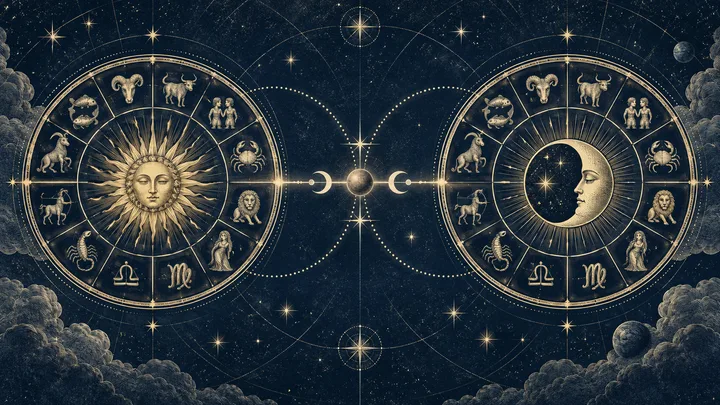
Imagine a couple meeting at the same crossroads
Imagine Maria and Daniel planning a weekend away. Maria wants one place, open time, and room to follow the mood. Daniel wants a route, bookings, and a plan he can trust. They want the same weekend. They keep reaching for it from opposite ends.
Now suppose Maria’s Moon opposes Daniel’s Sun. The aspect doesn’t prove that every travel argument comes from the chart. It gives the astrologer a useful lens: feeling, timing, and familiarity meeting purpose, direction, and self-expression. That meeting can become recognition. It can also become a contest over whose way sets the tone.
Read the opposition as a relationship task, not a relationship sentence. Ask what each person brings, what the other activates, and what sharing the axis would look like in daily life. Maria and Daniel don’t need a verdict. They need to know whether their difference can become a shared arrangement.
What the opposition means in synastry
Synastry compares factors in one person’s natal chart with factors in the other person’s chart. An opposition is an aspect of about 180 degrees. The planets face each other across an axis, so the contact can feel immediate, personal, and hard to ignore.
Astrodienst describes the opposition through polarity and tension. Its task is to integrate both poles so they strengthen each other instead of working against each other. Cafe Astrology adds the lived picture: attraction and complementarity can sit beside competition, insecurity, and a see-saw effect. That is why calling the aspect simply hard tells you too little.
Start with three layers. The planets tell you which relationship functions meet. The signs show how those functions operate. The orb tells you how closely they connect. Then look at the wider comparison. A close opposition deserves attention, but no single contact should speak for the whole relationship.
An opposition in synastry describes two chart energies facing each other across 180 degrees. It can feel magnetic because each person encounters a quality the other carries strongly, but it can also create a see-saw: one person moves, the other counters. Read it as a relationship task, not a relationship sentence. Start with the planets, check how close the aspect is, then ask what happens in ordinary life when one person leads with that planet. A close Moon opposition may require a shared rhythm for comfort and independence. A Venus-Mars opposition may bring desire with different timing. Saturn or Neptune can make the work heavier and more specific. The fairest reading ranks the exact contact, the wider chart pattern, and the couple’s actual behavior in that order. If you know only signs, compare the polarity. If you know degrees, use the six-degree orb for this report’s major-aspect scope. Then turn the pattern into one concrete conversation and one repeatable practice.
Sources: Synastry: Love and Relationship Astrology; Opposition - Astrodienst Astrowiki
Let the planet pair set the question
A Sun-Moon opposition brings identity into contact with emotional rhythm. One person may want direction while the other protects comfort, privacy, or timing. The question becomes whether the Sun can lead without dismissing feeling, and whether the Moon can express need without making the Sun responsible for every feeling.
A Venus-Mars opposition speaks more directly to attraction, desire, approach, and timing. Venus may want tenderness before intensity. Mars may experience direct pursuit as proof of desire. The useful practice is clear: invitations stay invitations, and a no doesn’t become a negotiation. Attraction remains strong when it stays mutual.
Venus-Saturn shifts the question toward affection, limits, responsibility, and fear of rejection. Mars-Saturn brings action against restraint, with possible frustration or different speeds. These contacts can build form when both people respect the other’s timing. They can also turn control into a daily pattern. Name the agreement. Name the limit. Set a time to revisit it.
Planet pairs rank first because they identify the function under pressure. A tight Venus-Mars contact matters most when the live question is sexual timing. A Saturn contact comes forward when the question is commitment, money, or responsibility. Read both directions. The planet labels track the exchange; they don’t assign one person all the agency.
Sources: Synastry: Love and Relationship Astrology; Synastry: Sun-Moon Aspects Between Two Charts
Use signs and orb to rank the contact
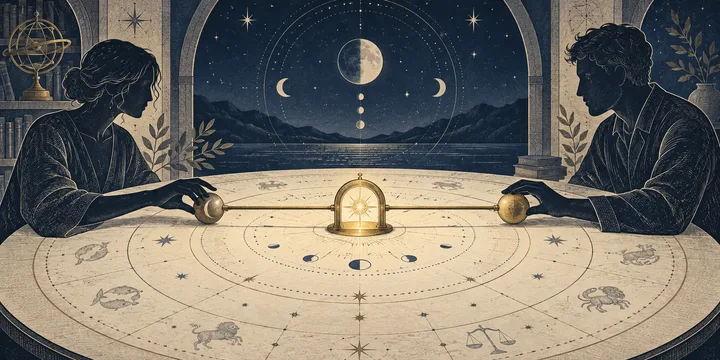
Signs give an opposition its style. Aries and Libra can pull between direct action and consultation. Taurus and Scorpio can pull between preservation and surrender. Gemini and Sagittarius can pull between detail and meaning. Cancer and Capricorn can pull between private care and public duty. These are axes, not enemy camps. Name both needs before describing the friction.
For this report, a selected major opposition uses a six-degree orb. A tighter contact usually deserves more weight than a wider one. Astrodienst defines an orb as the allowed distance from an exact angle and notes that astrologers use different limits. Record the degree distance instead of hiding it inside words such as powerful or fated.
Consider Venus at 12 degrees Aries opposing Mars at 16 degrees Libra. The four-degree distance falls within the report’s scope, so you can read both the Venus-Mars contact and the Aries-Libra style difference. Now consider Moon at 2 degrees Cancer and Sun at 12 degrees Capricorn. The signs show the Cancer-Capricorn axis, but the 170-degree distance falls outside this six-degree major-aspect boundary. That is a sign polarity, not a selected opposition in this report.
If the signs are opposing but the degrees sit across an unusual sign boundary, call it a dissociate aspect when that is the layer you mean. Some astrologers keep the measured aspect; others give more weight to the sign relationship. State the choice. With signs only, compare polarity. With degrees, calculate and rank the contact.
Sources: Opposition - Astrodienst Astrowiki; Aspects - Astrodienst Astrowiki
Find the pattern in the counter-move
The chart becomes useful when the symbolism meets a repeated exchange. Write one working sentence for each planet: "My Moon needs emotional safety." "His Sun needs room to lead." Then write the counter-move: "When I ask for reassurance, he hears criticism." "When he takes charge, I hear dismissal." The counter-move is where the synastry comes alive.
Look for the trigger, the setting, and the ending. Does the pattern begin with a request, a silence, a delay, a touch, or a criticism? Does it appear around travel, sex, money, public life, or time apart? What would each person do differently if the exchange were to end well? Those observations test the symbol without forcing a story onto it.
Return to Maria and Daniel. Maria can name the feeling she wants from the weekend. Daniel can offer a plan with one open block. Maria can stop reopening every detail. Daniel can check in without treating uncertainty as resistance. Neither person becomes the other. They give both ends of the axis a place.
If the exchange appears once, call it a possibility. If it repeats across settings, it has a stronger claim as a working interpretation. If it appears nowhere, leave it in the background. Astrology can show a potential meeting point. Daily life shows whether the couple actually stands there.
Sources: Synastry: Love and Relationship Astrology; Opposition - Astrodienst Astrowiki
Check what supports or sharpens it
No opposition stands alone. A supportive Moon-Venus contact may help tenderness return after a hard exchange. A helpful Mercury contact may make repair easier. These aspects don’t erase the opposition. They give the couple another route through it, if the couple uses that route.
Other contacts can intensify the same subject. Saturn may add duty or reserve. Uranus may make closeness and distance change quickly. Neptune may blur promises or expectations. Pluto may raise the stakes around power and desire. Keep the reading tied to the supplied planet pair. Intensity isn’t proof of permanence.
Synastry and a composite chart also answer different questions. Synastry compares the two people point by point. A composite chart describes the relationship as a unit. Cafe Astrology notes that themes may repeat between the charts, but they don’t always. A synastry opposition remains an interaction even when the composite chart emphasizes another pattern.
Here is the strongest exception: a close opposition may feel vivid and still not be central if daily life never activates it, while a wider polarity may matter greatly when the couple meets it every week. Orb ranks technical closeness. Repetition shows where attention belongs. And if one person pressures, punishes, controls, or dismisses the other, no symbolic promise makes that pattern acceptable.
Sources: Synastry: Love and Relationship Astrology; Composite Chart & Synastry
Turn the reading into a decision
Use this order when you read an opposition: name the planets, calculate the orb, describe both sign styles, identify the attraction or recognition, find the counter-move, then check repeating and supportive contacts. Only after that should you choose a practice.
A two-degree Venus-Mars opposition deserves more technical weight than a five-degree Venus-Saturn opposition, but the live question still decides where to begin. Sexual timing points to Venus-Mars. Commitment, money, or responsibility points to Venus-Saturn. Rank the contact that answers the question in front of you.
Then write one strong sentence: "This opposition shows a repeated difference in pace that can become attraction when both people make room for the other’s timing." That sentence is more useful than a compatibility verdict, and more honest than saying anything could mean anything. It names the tension and the condition that lets the relationship work with it.
If you have signs only, stop at polarity. If you have degrees, record them exactly and use the six-degree scope stated for this report. It compares supplied Moon, Venus, and Mars signs, optional degrees, and selected major aspects. It does not calculate natal positions or houses from birth details.
Now ask one question: "When this opposition appears, what does each of us protect first?" Let both people answer. Choose one shared response and review it after one real instance. If both people can name the pattern and carry a share of the adjustment, the opposition is workable tension. If only one person must shrink, wait, submit, or guess, name that relationship pattern plainly.
That is the decision an opposition can help you make. Not whether the aspect is good or bad. Whether both people can recognize the two needs, create a third response, and repeat it in real life.
Sources: Synastry: Love and Relationship Astrology; Opposition - Astrodienst Astrowiki; Composite Chart & Synastry
A little more clarity
Does an opposition in synastry mean two people are incompatible?
No. It means two chart energies face each other across a polarity. The contact can bring attraction, recognition, competition, or insecurity. Read the planets, signs, orb, and repeated behavior before judging its role. A close opposition may describe a relationship task, but it cannot decide whether two people can meet that task well.
Is a tighter opposition stronger in synastry?
Usually, yes. A smaller orb makes the contact more exact, so it deserves more weight than a wider opposition between the same kinds of planets. This report uses a six-degree orb for selected major aspects and records optional degrees when supplied. Strength still needs context. A technically close contact may matter less to a couple’s current life than a repeated, wider pattern they keep acting out.
Sources & further reading
- Synastry: Love and Relationship Astrology
Supports the interpretation of opposition as polarity, attraction, competition, insecurity, and a see-saw dynamic in synastry.
- Opposition - Astrodienst Astrowiki
Supports the 180-degree definition, polarity framework, projection theme, and integration of the two opposing poles.
- Synastry: Sun-Moon Aspects Between Two Charts
Supports the worked Sun-Moon opposition example and the distinction between attraction, balance, and recurring style clashes.
- Aspects - Astrodienst Astrowiki
Supports the definition of orb, exactness, major aspects, and the need to record degree distance precisely.
- Composite Chart & Synastry
Supports the distinction between synastry as interchart interplay and the composite chart as a relationship-level chart.
Synastry Comparison Report
Enter known placements for two people. Get an input-by-input comparison, selected aspect calculations and a clear record of what remains uncertain.
Compare our placements