
An intercepted house makes a synastry house overlay less direct. It doesn’t cancel the house or the partner’s planet. It adds a second sign and ruler to the same life area, so you read the visible cusp ruler first, then the intercepted sign, its ruler, and any planets inside the house. In practice, the partner’s planet may awaken a subject that feels private, delayed, or easier to express through another person than alone. But that meaning only applies if the interception exists in the chosen quadrant house system. Whole-sign and equal houses don’t produce intercepted signs. Start by comparing the same overlay in both systems. If the planet stays in the same house, the house topic has weight and the interception adds texture. If the planet changes houses, settle the house-system question before making a relationship judgment.
The short answer: an interception adds a hidden layer, not a relationship verdict
You’re looking at a synastry chart. Your partner’s Venus falls in your fifth house, which sounds easy to read: affection, pleasure, romance, play, creative spark. Then you notice that the fifth house contains an intercepted sign. Does that Venus still count? Yes. The interception changes the route by which the house speaks. It doesn’t remove the attraction, and it doesn’t turn the overlay into a warning label.
The cleanest interpretation is this: the sign on the house cusp shows the front door, while the intercepted sign describes a room inside the house that has no door of its own. The cusp ruler remains the primary ruler. The ruler of the intercepted sign becomes a secondary ruler or co-ruler in traditions that use interception as an interpretive layer. That distinction matters. It keeps you from treating a hidden sign as either irrelevant or all-powerful.
In synastry, the partner’s planet activates your house. The house shows where you experience the contact. The planet shows what the partner brings. The sign shows how that planet acts. An interception asks one more question: does part of that house’s sign language feel indirect, contained, or dependent on another channel before it becomes easy to name? The answer can be yes, especially when the partner’s planet is in the intercepted sign or makes a close aspect to the intercepted sign’s ruler.
That is the useful difference. A standard overlay might say, ‘Her Mercury in his sixth house brings talk about schedules and daily work.’ An intercepted sixth house could add, ‘Some of the work and care conversation stays unspoken until routine forces it into view.’ That is a reading about access and timing. It is not a claim that the couple will fail, stay together, or carry a permanent blockage.
Before you interpret any emotional meaning, verify the structure. Interceptions occur in some unequal or quadrant house systems. They don’t occur in whole-sign or equal houses. If you don’t know which system supplied the houses, you don’t yet know whether you’re reading a stable layer of the comparison or a feature created by one house division method. The first task is technical. The relationship meaning comes after it.
Sources: Intercepted Sign - Astrodienst Astrowiki; Synastry: Planet Overlays in Houses - Cafe Astrology; Ruler - Astrodienst Astrowiki
First check the house system, because the interception may belong to the method
An intercepted sign is a zodiac sign enclosed entirely within a house. No house cusp crosses it. The opposite sign is intercepted too, and another pair of signs appears twice on house cusps. Astrologers often call those repeated signs duplicated signs. The pattern comes from the way a quadrant system divides the sky into unequal houses, especially at higher latitudes. It isn’t an extra planet or a new point in the chart.
This matters more in synastry than many readers expect. A house overlay depends on the receiving person’s house cusps. When you place one person’s planets into the other person’s chart, you’re asking which area of that person’s life receives the planet. Change the house system, and the boundary can move. A planet may remain in the same house but change from an ordinary sign to an intercepted one. It may also cross a cusp and move into a neighboring house.
Use a simple comparison. Read the receiving chart in the house system you normally use. Then check the same chart in whole-sign or equal houses. Record three things: the house containing the partner’s planet, the sign on that house cusp, and whether the planet is close to a cusp. If all three remain broadly stable, the overlay has a firm interpretive base. If the planet shifts from the fifth to the sixth, don’t use interception to smooth over the change. You have a house-system question first.
Whole-sign houses place the whole rising sign in the first house and assign one complete sign to each house. Equal houses use twelve thirty-degree houses beginning from the Ascendant degree. Neither arrangement leaves a full sign hidden between cusps. Quadrant systems such as Placidus divide the chart through the angles and intermediate cusps, so house widths can vary. They can contain a full sign inside one house.
There isn’t one house system that every astrologer uses for every purpose. That is why a good synastry reading names the system. If birth times are unknown, uncertain, or rounded, house overlays become less secure because the Ascendant and cusps can move. A sign placement or a close planet-to-planet aspect may still be useful, but a fine claim about an intercepted seventh house needs dependable house data. Precision begins with naming what the chart can actually show.
Sources: Intercepted Sign - Astrodienst Astrowiki; House System - Astrodienst Astrowiki; House - Astrodienst Astrowiki
Read the visible cusp ruler before the hidden sign
The most common mistake is to see an interception and let it take over the reading. Don’t. Start with the sign on the cusp. Its planetary ruler is the primary ruler of the house. Find that planet in the natal chart. Note its sign, house, aspects, and condition within the interpretive system you use. This tells you how the house normally opens and where its affairs are directed.
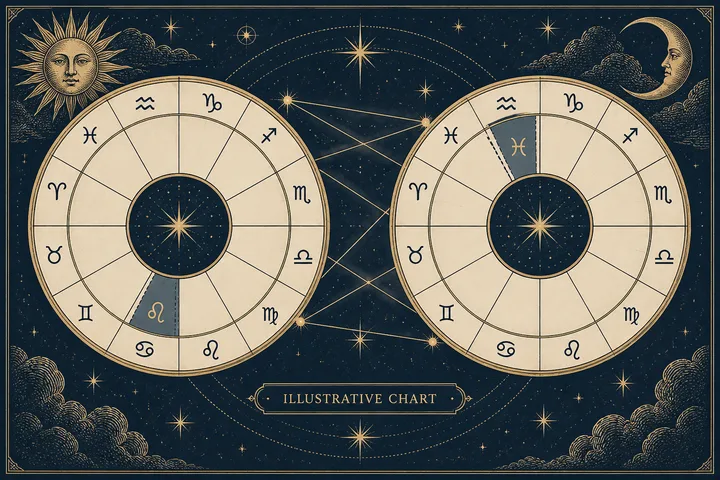
Suppose your seventh-house cusp is in Cancer, while Leo is intercepted inside the seventh. The Moon remains the primary ruler of partnership matters because Cancer begins the house. The Sun, ruler of Leo, adds a second voice. You might experience partnership through care, emotional safety, and familiarity at the front door, while pride, visibility, creative self-expression, or the need to feel chosen sits deeper inside the partnership field.
Now bring in your partner’s planet. If his Venus falls in that intercepted Leo, he may bring warmth and attraction to a part of partnership you don’t always show directly. You may feel seen, admired, or invited to make the relationship more expressive. But you still read the Moon first. If the Moon is under pressure or strongly tied to private matters, the Venus overlay may not simply produce open romance. It may expose the tension between wanting reassurance and wanting recognition.
The ruler’s house is a bridge. If the Moon, ruler of the Cancer cusp, is in the fourth house, relationship needs may return to home, family, memory, and emotional shelter. If the Sun, ruler of intercepted Leo, is in the eleventh, the hidden partnership theme may unfold through friendship, shared groups, or a future you build in public. These are not separate predictions. They are two routes into one house.
Think in ranks. First, the cusp sign and its ruler. Second, planets actually placed in the house. Third, the intercepted sign and its ruler. Fourth, close aspects to the house ruler, intercepted ruler, and partner’s planet. This order keeps the interpretation proportionate. A quiet intercepted sign with no planets and no meaningful ruler contacts shouldn’t outweigh a tight Venus-Saturn aspect or a planet sitting on the Descendant.
Sources: House System - Astrodienst Astrowiki; Synastry: Planet Overlays in Houses - Cafe Astrology; Ruler - Astrodienst Astrowiki
Then ask what the partner’s planet can access
Synastry house overlays are two-way contacts. The partner’s planet activates the house person’s life, while the house person gives that planet a setting. A Moon in your fourth house may make you experience the partner as emotionally familiar or tied to home. Your partner, meanwhile, may feel that your private world draws out the Moon’s need for care and belonging. The contact doesn’t run in one direction.
An interception changes how direct that exchange feels. The partner’s planet may reach the house topic before you have a clear name for it. You might notice the effect through behavior: the two of you fall into a private ritual, discuss a subject you usually protect, or discover that a practical interaction carries more emotional charge than expected. The hidden sign isn’t absent. It can be waiting for the right person, setting, or question to give it a usable form.
Planets make the layer concrete. Venus in an intercepted fifth house can bring affection, taste, play, and romantic attention into a part of your life that you may keep contained. Mars there can activate desire, competition, creative urgency, or a sharper need to act. Mercury can make the hidden theme speakable through jokes, messages, planning, or repeated conversation. Saturn may make the subject feel serious and slow, yet more durable once both people accept its weight.
The sign still shapes the planet. Venus in an intercepted Leo fifth house doesn’t express affection in the same way as Venus in an intercepted Virgo fifth house. Leo may ask for warmth, praise, and a visible heart. Virgo may ask for useful care, craft, and attention to small details. The interception describes access to the sign within the house. It doesn’t flatten the sign into a generic ‘blocked energy’ story.
Pay attention to the partner’s experience too. The planet person may feel that the house person draws out a side of the planet that is usually private. The house person may feel more strongly affected because the planet is lighting up a concealed layer of the house. Neither reaction is guaranteed. The natal condition of the planet and the rest of the synastry decide whether the contact feels nourishing, demanding, playful, or confusing. The interception gives you a question to test in lived experience.
Sources: Synastry: Planet Overlays in Houses - Cafe Astrology; Ruler - Astrodienst Astrowiki
A worked example: Venus in an intercepted fifth house
Imagine Maria and Daniel comparing known placements. Maria is the house person. In the quadrant system they’re using, her fifth house begins in Gemini, contains Cancer as an intercepted sign, and ends in Leo. Daniel’s Venus falls in Cancer inside Maria’s fifth house. They don’t have birth details precise enough for us to invent degrees, so we’ll read the sign and house relationship only. The chart artwork is illustrative, not a calculated personal chart.
Start with Gemini on the cusp. Mercury is the primary ruler of Maria’s fifth house. Romance, pleasure, and creative expression enter through conversation, wit, curiosity, and shared mental movement. Daniel’s Venus in the fifth house brings affection into that field. Dates may feel more alive when they involve talking, learning, or trading observations. Maria may experience Daniel as someone who makes her more playful and verbally expressive.
Now add intercepted Cancer. Cancer gives the fifth house a quieter interior: tenderness, protection, memory, family feeling, and the wish to create a safe emotional nest around pleasure. Because the sign is intercepted, Maria may not lead with that need. She might talk about what she wants, stay busy, or make romance light until the relationship proves it can hold something softer. Daniel’s Venus in Cancer can open that room. He may show affection through checking in, remembering details, making food, or building a familiar ritual.
The interpretation changes again when you find the rulers. Mercury, ruler of the Gemini cusp, shows the ordinary route. The Moon, ruler of intercepted Cancer, shows the hidden route. If Maria’s Moon is strongly connected to her fourth house, the couple may discover that dating quickly touches questions about home and emotional safety. If the Moon connects to the eleventh, friendship and future plans may help Maria trust the tenderness. If Daniel’s Venus aspects Maria’s Moon closely, his affection may reach the concealed Cancer layer with unusual force.
But suppose Daniel’s Venus falls in Cancer while Maria’s Moon is in a tense relationship with Saturn. Then Venus may still feel sweet, yet Maria may hesitate to receive it. She could appreciate Daniel’s care and still test it, minimize it, or worry that the warmth won’t last. The interception doesn’t cause that pattern by itself. The Moon-Saturn story gives it structure. The Venus overlay brings the relationship into contact with it.
Notice what this example does not say. It doesn’t say Maria is secretly a Cancer person, even if Cancer is intercepted. It doesn’t say Daniel’s Venus has a job to complete inside her chart. It doesn’t say the fifth house has one fixed meaning for every couple. The house remains a field of romance, pleasure, creativity, and risk. The signs and rulers show the style of entry. The actual relationship tells you which expression is alive.
You can make the example more precise if degrees are available. A Venus at 14 degrees of Cancer might be close to Maria’s Moon, a fifth-house cusp, or another personal planet, but you can’t claim any of those contacts from the sign alone. If a selected major aspect falls within the report’s stated six-degree orb, record it as a degree-based contact. If no degrees are supplied, keep the language at the sign-and-house level. That protects the interpretation from false precision while leaving room for a rich reading.
Now reverse the chart. If Maria’s Moon or Mercury overlays Daniel’s seventh house, the emotional meaning may not be evenly distributed. Maria may experience playful tenderness in her fifth house, while Daniel experiences her as a partner who asks for definition or commitment. That difference doesn’t prove one person cares more. It shows that the same connection occupies different rooms in each chart. An interception can make one room harder to enter, but the reverse overlay tells you whether the partner is being invited into a matching room.
Finally, watch the repeated sign pattern. Cancer intercepted in the fifth comes with Capricorn intercepted in the opposite eleventh. Maria’s private romantic expression may sit opposite a quieter question about belonging, friendship, community, or future plans. Daniel’s Venus may awaken the fifth-house tenderness, while the couple still has to decide how romance fits with friends and long-term hopes. The axis keeps the reading from becoming a one-house story. Every intercepted pair asks for a balance between its two ends.
What would the couple observe? Maria may tell Daniel that conversation feels easy, then become unexpectedly sensitive when a private ritual changes. Daniel may think he is simply being affectionate, while Maria experiences his attention as an invitation into a more vulnerable kind of romance. The useful conversation is specific: ‘When you remember the small things and make time for our private rituals, I feel closer. What kind of affection makes you feel chosen?’ That question tests the chart layer without turning it into a verdict.
The strongest exception: sometimes the interception adds very little
An intercepted house isn’t automatically a major synastry feature. Sometimes it adds a subtle note and nothing more. This is especially true when the intercepted sign is empty, its ruler has no close contact with either person’s personal planets, and the partner’s planet sits near a different house cusp or forms a much tighter aspect elsewhere. In that case, the main overlay and the aspect pattern deserve more attention.
The same caution applies when the birth time is uncertain. House cusps are time-sensitive. A small change can move a planet across a boundary or change which signs are enclosed. If the house placement is unstable, don’t build the entire reading around the interception. Use placements you know more securely, such as supplied Moon, Venus, and Mars signs, and any optional degrees that support a stated orb calculation. In a report, label the house layer as conditional instead of quietly blending it with secure sign or aspect information.
There’s another exception. Some astrologers treat interceptions as a technical feature of a particular house system and don’t assign them a separate psychological meaning. That view doesn’t make the chart unreadable. It simply changes the hierarchy. You can still read the cusp ruler, planets in houses, house rulers, aspects, and angles. You can compare the same overlay in a system without interceptions and see whether the central story survives.
A useful test is removal. Write the interpretation with the interception included. Then write it again without the intercepted sign. If the central relationship observation disappears, ask whether the hidden sign was carrying too much weight. If the main reading remains and the interception adds one precise detail about access, privacy, or timing, you’re using it well. Strong technique survives this test.
Consider the condition of the intercepted sign’s ruler. Is that planet angular, cadent, retrograde, closely aspected, or joined to one of the partner’s personal planets? These details can alter how much attention the hidden layer deserves. A ruler tied to the Sun, Moon, Venus, Mars, Ascendant, or Descendant may bring the theme into ordinary encounters. A ruler with little connection to the synastry may describe a private natal tendency that the partner barely touches.
Also separate an intercepted sign from an empty house. An empty house can still have a ruler and a sign on its cusp. An intercepted sign can contain several planets. The terms describe different things. If Venus, Mars, and Mercury all sit inside an intercepted sign, the sign is not quiet just because it has no cusp. The planets give it activity, while their rulers and aspects show how that activity moves through the house.
House cusps near a planet add another judgment. If the partner’s planet sits close to the boundary of an intercepted house, describe the uncertainty instead of forcing a single room. The planet may bridge two topics, especially when the birth time is rounded.
Sources: Intercepted Sign - Astrodienst Astrowiki; House System - Astrodienst Astrowiki; Synastry: Planet Overlays in Houses - Cafe Astrology
How to rank the full synastry picture
Once you know what an interception changes, you can place it inside the wider synastry reading. House overlays tell you where the relationship lands in each person’s life. Interchart aspects tell you how the planets meet. A planet in an intercepted house is one layer of the picture. It should sit beside the planet’s sign, its natal condition, its aspects, the receiving house ruler, and the reverse overlay.
Here is a practical ranking. First, verify the data and house system. Second, read close contacts to the angles and personal planets, especially when degrees are supplied and the orb is stated. Third, read the receiving house cusp and its ruler. Fourth, read planets in the house, including the partner’s planet. Fifth, add the intercepted sign and its ruler. Sixth, compare the reverse overlay. Put the result in two columns: stable signals on one side, conditional signals on the other. That small habit stops an eye-catching interception from silently outranking the chart factors that remain in place across systems.
The reverse overlay matters because one person may feel a contact more personally than the other. Daniel’s Venus in Maria’s intercepted fifth may make Maria feel cherished and emotionally exposed. Maria’s planets may fall in Daniel’s second or eleventh house, giving him a different experience of the bond. If you read only Maria’s chart, you might mistake her intensity for the whole relationship. Synastry asks what each person activates and what each person receives.
Look for agreement between layers. If Venus activates the fifth house, aspects Maria’s Moon, and the Moon rules an intercepted Cancer sign within that fifth, the same theme repeats: affection reaches pleasure, tenderness, and emotional safety. If Venus falls in the fifth but the fifth ruler is tied to Saturn, Mars squares the Venus, and the reverse overlay emphasizes the sixth, the relationship may need ordinary care and clear effort before romance feels easy. The chart contains both the sweetness and the work.
Use degrees when you have them. A six-degree orb can be stated for selected major aspects, but don’t pretend to calculate an aspect from signs alone. ‘Venus in Cancer’ is a sign placement. ‘Venus trine the Moon within two degrees’ is a degree-based claim. The difference is simple and important. If the report you’re using accepts supplied placements and optional degrees, give it the information you actually know. It can compare the stated layer without inventing a birth chart or house calculation.
There is also a difference between a planet in an intercepted sign and a planet in an intercepted house. A house can contain an intercepted sign without containing a planet in that sign. A partner’s planet can fall in the house but in the sign on the cusp. In that case, the planet activates the house, while the interception adds background texture. If the planet falls inside the intercepted sign, the hidden layer becomes more immediate because both the planet and the house are speaking through it.
Use the house axis when the topic feels one-sided. A fifth-house overlay can awaken romance, but its opposite eleventh-house sign may describe the social conditions that either support or strain that romance. An eighth-house overlay can bring intimacy, yet the second-house opposite raises trust, value, and resource questions. A fourth-house activation can feel private, while the tenth-house opposite asks what becomes visible. The interception belongs to an axis, not an isolated box.
When two house systems tell different stories, don’t average them into a vague sentence. State the difference. ‘In this quadrant system, Daniel’s Venus falls in Maria’s intercepted fifth house. In whole-sign houses, it falls in the fifth without an interception.’ That gives the reader a stable romantic core and a conditional Cancer layer. If Venus moves to the sixth, you have a separate daily-life reading to examine.
Sources: House System - Astrodienst Astrowiki; Synastry: Planet Overlays in Houses - Cafe Astrology; Ruler - Astrodienst Astrowiki
Turn the interpretation into a conversation you can actually have
A synastry reading becomes useful when it helps you notice a pattern without handing the pattern control of the relationship. If an intercepted house suggests indirect access, don’t ask, ‘Are we meant to unlock this?’ Ask, ‘Where do we already see this theme, and what would make it easier to speak about?’ The first question looks for a grand answer. The second gives two people room to act.
Then name the partner’s planet in plain language. Venus may bring affection and preference. Mars may bring initiative, heat, and conflict pace. The Moon may bring emotional need and care. Mercury may bring words, questions, and daily coordination. Saturn may bring limits, responsibility, and endurance. Don’t make the planet person a villain or savior. Describe the exchange: ‘Your Mars makes my hidden eighth-house trust question impossible to ignore,’ not ‘You are here to heal my intimacy wound.’
For Maria and Daniel, the conversation might be about the difference between lightness and tenderness. Maria could say, ‘I love how easily we talk and laugh. I also notice that small acts of care affect me more than I expected. What does affection look like to you when you’re not trying to impress anyone?’ Daniel can answer from his experience. Neither person has to accept a symbolic reading as a label. The chart offers language. Their behavior gives it meaning.
Keep the request concrete. Ask for a regular date, a clearer plan, a private ritual, a direct answer about affection, or more room for each person’s creative life. If the house topic is money, agree on what is shared and what remains separate. If it is the fourth house, discuss privacy, family access, and the feeling of home. If it is the seventh, name the relationship expectations that have been assumed rather than spoken.
You can also use the interception as a prompt for pacing. A partner may touch a sensitive house theme before either of you has decided what the relationship is. Slow the naming down, not the honesty. Say what happened, what you felt, and what you want to understand. ‘When we started spending every Sunday together, it felt like more than a casual plan. How do you see that ritual?’ This keeps the conversation tied to an observable event rather than a symbolic conclusion.
And let the other person disagree with your first interpretation. A Venus overlay can feel romantic to the house person and simply natural to the planet person. An intercepted Moon theme may feel obvious to one partner and invisible to the other. That difference doesn’t invalidate the chart. It tells you to look for the conditions under which the theme appears. Does it emerge in private? During stress? After reassurance? Around friends? When plans change? Those details sharpen the reading better than a more dramatic label would.
If you’re comparing placements for the first time, write down the shared core before the conditional detail. For example: ‘Daniel’s Venus is in Maria’s fifth house.’ Then add: ‘In this quadrant system, Cancer is intercepted there, so emotional safety may be a less visible route into the romance.’ That order gives both people something solid to discuss. It also makes later revisions easier if a more reliable birth time or a different house system changes the cusp picture.
End with one observation and one question. ‘I feel closest when we make time for this. Do you feel the same, or does closeness arrive differently for you?’ That is the best use of an intercepted-house interpretation. It moves a hidden theme into a shared conversation without pretending the chart has made the decision for you.
Sources: Synastry: Planet Overlays in Houses - Cafe Astrology; Ruler - Astrodienst Astrowiki
A little more clarity
Does an intercepted house cancel a synastry house overlay?
No. The partner’s planet still falls in that house and still activates its topics. The interception adds a less direct sign layer, along with that sign’s ruler. Read the cusp ruler first, then the intercepted sign and ruler, and finally the aspects that connect them.
Can whole-sign houses have intercepted signs?
No. Whole-sign and equal-house systems assign each sign a complete house structure, so a sign can’t sit entirely between two cusps. If one chart shows an interception and another doesn’t, compare the house systems before deciding that one interpretation is wrong.
Which ruler matters more in an intercepted house?
The ruler of the sign on the cusp is the primary ruler. The ruler of the intercepted sign acts as a secondary ruler or co-ruler in approaches that use interceptions. Give the cusp ruler priority, then increase the hidden ruler’s weight when it has planets or close aspects tied to the synastry.
Can I interpret an intercepted synastry house without exact birth times?
Not securely. House cusps depend on birth time and place, so an uncertain time can change the house or the interception itself. You can still compare known Moon, Venus, and Mars signs, plus optional degree-based aspects, but treat a fine house interpretation as conditional until the house data is reliable.
Sources & further reading
- Intercepted Sign - Astrodienst Astrowiki
Defines intercepted signs, their paired opposites, duplicated signs, and the primary and secondary ruler distinction.
- House System - Astrodienst Astrowiki
Supports the distinction between equal, whole-sign, and unequal house systems and explains why interceptions occur in some systems.
- Synastry: Planet Overlays in Houses - Cafe Astrology
Explains the two-way nature of synastry house overlays and how a partner’s planet activates the receiving person’s house.
- House - Astrodienst Astrowiki
Supports the roles of planets, signs, houses, house cusps, birth time, and the enclosed sign in chart interpretation.
- Ruler - Astrodienst Astrowiki
Supports using the ruler of the sign on a house cusp to connect that house with the ruler’s sign, house, and aspects.
Synastry Comparison Report
Enter known placements for two people. Get an input-by-input comparison, selected aspect calculations and a clear record of what remains uncertain.
Compare our placements