
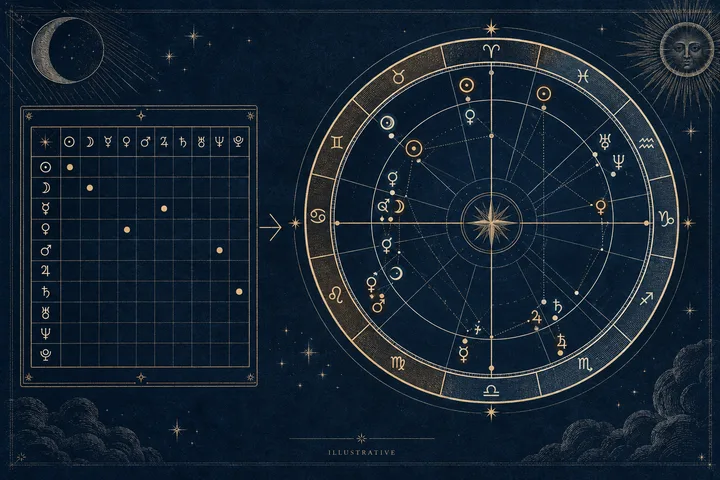
An aspect table is the clearest place to identify a planet pair, name its aspect, and check its orb. A synastry wheel adds spatial context: whose planets are involved, where one person’s planets fall in the other’s houses, whether a planet lies near an angle, and whether placements gather in one area. Use the table to verify contacts, then the wheel to locate them. Treat house and angle context as conditional when birth times or chart settings are uncertain.
The answer: the table names contacts; the wheel locates them
An aspect table and a synastry wheel answer different questions about the same charts. Start with the table when you need to identify a planet pair, name its aspect, and check how close it is. Then use the wheel for context: whose planet is whose, which houses receive the placements, whether a planet lies near an angle, and whether several placements gather in one area. The table gives you a cleaner view of contact and orb. The wheel can show location and relationships among chart layers that a list may flatten. That context can deepen an interpretation, but it cannot strengthen the geometry by appearance alone. A dramatic line or cluster does not make a wide aspect exact. And a house placement depends on a reliable house frame and birth-time information. Cafe Astrology’s “Aspects Between Charts” explains that an interchart contact must be read with each planet’s role and placement in view; “Romantic Compatibility Synastry House Overlays” shows how a bi-wheel locates planets in each person’s houses. Together, they support this order: verify the contact, then ask what its setting adds. Keep exactness and contextual emphasis distinct, and leave any unsupported house reading open.
Sources: Aspects Between Charts; Romantic Compatibility Synastry House Overlays
What does the table establish before the wheel adds context?
An aspect table gives you a compact inventory of selected planet pairs, aspect types, and often degree distances or orbs. Start there. It lets you ask whether a contact is close, wide, or outside the chart's chosen orb before a colored line or a compelling story takes over. But the table only reports what its settings ask it to show. It may omit points, aspect types, or contacts beyond a preset range. Read its scope before treating an empty row as meaningful. An aspect is an angular relationship between two planets or chart points. In synastry, the pair crosses charts: one person's planet is compared with the other person's. The aspect type names the geometry, such as a conjunction, square, or trine. The orb measures how far that relationship sits from the exact angle. A smaller orb is closer to exact; it is a measure of geometry, not a complete interpretation of what the contact means between two people. That distinction matters. A table can tell you that one person's Venus forms a square to the other's Mars, and it may give the orb. It does not, by that geometry alone, say how either person expresses Venus or Mars. Sign placement colors the planetary expression; the aspect describes how the two functions meet. The interpretation comes after you identify the contact and bring in the rest of the chart. In “Aspects Between Charts,” Cafe Astrology advises readers to keep each person's planetary role distinct and to consider the signs and houses of both planets. That is a useful guard against turning a row into a one-sided label. Before interpreting any row, check what kind of table you have. Is it an interchart list, comparing one person's planets with the other's, or a natal aspect list for each person? The glyphs may look familiar in both, but the question differs. In a natal table, a Venus-Mars entry belongs to one chart. In a synastry table, it should identify whose Venus meets whose Mars. If the display labels only the planet names, find its legend or chart-order key. “Venus square Mars” is incomplete for comparison until you know which person's Venus and which person's Mars the row describes. Then inspect the table's selection rules. Does it include only the five major aspects, or also minor aspects? Which planets and points are included? Does it list angles or the lunar nodes? What orb limit does it use for each aspect or body? Some displays apply a single default; others vary the allowed orb by aspect or planet. These choices shape the list. A contact can be absent because it falls outside the selected range, because that point was excluded, or because the service shows only a chosen subset. Absence from a filtered table doesn't establish absence from the chart's geometry. Rounding can blur the edge. A displayed orb may be rounded to a whole degree, while the underlying distance falls just inside or outside a cutoff. If two entries look nearly tied, don't force a ranking from rounded values. Check whether the chart provides more precision, and record the setting you used. Different tables can present the same placements differently when their aspect lists, orb defaults, or rounding differ. So compare like with like: same chart data, same included bodies, same aspect set, and known orb rules. Consider a hypothetical row: “Person A's Moon conjunct Person B's Venus, orb 2°.” The row tells you which functions are connected, the named aspect, and the stated distance from exactness, if the table's labels are clear. It doesn't establish a particular house overlay, angle contact, or life area. Nor does it tell you whether another contact elsewhere in the chart repeats a theme. Those are different questions. Keep the example hypothetical; no actual couple or calculated placement is being described. A helpful way to read the row is in three passes. First, verify the pair and direction: whose Moon, whose Venus? Second, verify the geometry and orb: which aspect, how close, under what listed threshold? Third, pause before interpretation and ask what information remains outside the row: signs, house placements, angles, and the chart's wider pattern. The first two passes establish the contact. The third marks the boundary of the table's answer. This is why the table is a strong baseline for technical contact strength, but not a complete picture of synastry. SynastryCalc's “How to Read a Synastry Chart” separates identifying the two charts, reading planet plus aspect plus orb, and then considering house overlays and angles. Its sequence supports a practical habit: establish the contact before adding context. The guide also treats tightness as a useful priority while leaving room for a wider aspect that echoes a theme elsewhere. That is an interpretive approach, not a universal formula. The table helps you compare exactness; it cannot settle every question of emphasis by itself. The table's compression is useful precisely because it removes much of the surrounding map. A row can make contact-by-contact comparison easy, yet leave the reader without a clear sense of where each planet sits in the other chart's houses, whether several placements gather in one area, or how the two chart rings are arranged. That's where the wheel can add context. For now, keep a short record of the verified pair, aspect, and orb, along with the table's settings. If a line appears missing or a row seems surprising, check those inputs before deciding the chart contains a contradiction.
Sources: Aspects Between Charts; How to Read a Synastry Chart
What information is encoded by the two rings?
A bi-wheel places two charts in one circular display. One chart appears in the inner ring and the other in the outer ring, but no universal rule assigns either position to a person. Start with the names or labels, then check the legend. In the example in “How to Read a Synastry Chart,” Alex is outer and Jordan inner; another display may reverse the order or use different colors. Cafe Astrology’s “Romantic Compatibility Synastry House Overlays” also describes placing one person’s planets around the other’s chart, then reversing the arrangement. Labels establish whose placements you are following. Color alone does not. The rim marks zodiac signs and degrees. Planet glyphs sit at their chart positions, each attached to one of the two chart identities. A sign label gives the zodiac region; degree marks locate the placement. The charts are overlaid for comparison, not blended into a third chart. “How to Read a Synastry Chart” distinguishes this two-chart comparison from a composite chart, a different kind of map. Here, ask whose planet you are tracing and what part of the other chart it meets. House divisions add another coordinate system. They divide a natal chart into twelve areas, with cusp lines marking where one house ends and another begins. In a bi-wheel, the receiving chart’s houses provide the frame for locating the other person’s planets. Identify whose houses you are using, then follow the other person’s planet into that frame. Cafe Astrology’s “Romantic Compatibility Synastry House Overlays” describes two views: one person’s planets against the other’s inner chart, then the reverse. Each chart has its own house structure, so the direction matters. Angle markers provide more landmarks. Many wheels label the Ascendant, Descendant, Midheaven, and Imum Coeli as ASC, DSC, MC, and IC. “How to Read a Synastry Chart” identifies the four angles alongside the rings, houses, zodiac, and aspect lines. They show whether a planet lies near an angle, if birth-time and calculation inputs support those points. An angle marker is a chart location, not an aspect by itself. To establish an angle contact, compare the degrees and apply the chosen orb. Lines across the center usually connect selected placements that form aspects. Their endpoints show which planets or points the chart links; a color may indicate aspect type according to the legend. Read that key first. Displays can use different colors, line styles, or selection rules. A line connects chart positions, while the aspect is an angular relationship measured around the zodiac. The guide notes that line color may hint at aspect type and tighter orbs usually matter more. Check degrees and orb; a drawn line does not make a contact exact. Symbols that look close on screen are not automatically conjunct. Their apparent spacing depends on scale, glyph size, and drawing choices. Two placements may look adjacent while their zodiac degrees are farther apart than the chosen conjunction orb. Conversely, placements on opposite sides of the circle can form an opposition, while symbols that look far apart on the page may form a square or trine. The aspect depends on angular distance around the zodiac, not straight-line distance across the page. Confirm the degrees and settings before treating visual closeness or a line crossing as a contact. A wheel carries several layers at once: chart identity, zodiac position, house frame, angle landmarks, and selected aspect links. The display can also become busy. A chart may omit aspects or points, round degrees, or simplify labels. House lines and colors may reflect settings that require checking the legend or calculation details. A clean picture does not prove every possible contact appears; a crowded one does not make every line equally important. “How to Read a Synastry Chart” begins by identifying both charts before turning to aspects, overlays, and angles. Follow that order: names, rings, then coordinates and connections. Some illustrations are selective or simplified. They may enlarge features or simplify labels. Treat them as explanations of coordinate relationships, not substitutes for actual degrees and settings. Cafe Astrology’s examples show how the chart frames one person’s placements in the other’s houses, and how that direction can be reversed. An illustrative wheel can show where to look. It cannot verify a particular pair’s placements unless it comes from their stated chart data. Before interpreting, find both names and confirm which ring belongs to each person and which chart supplies the house divisions. Locate signs and degrees, then identify angle labels and read the aspect key. If unclear, check settings or placement and aspect tables. The two rings place labeled charts in a shared zodiac frame, making relative positions and selected connections visible. The wheel adds spatial context once you know whose planet and house you are viewing. Interpret only what the chart actually calculated.
Sources: Romantic Compatibility Synastry House Overlays; How to Read a Synastry Chart
Why is an overlay not just another aspect line?
An interchart aspect describes how two planetary functions meet by angle. A house overlay asks where one person's planet falls in the other person's chart. The aspect offers the interaction; the house offers an interpretive setting. They can describe the same chart contact from different layers, but one does not replace the other. Imagine Person A's Venus falls in Person B's seventh house. The overlay begins with a location: A's Venus occupies the part of B's chart associated, in this interpretive framework, with partnership. It does not tell us by itself that the two people have a Venus aspect. That depends on the angular distance between A's Venus and a planet or point in B's chart. The wheel makes the house placement visible because it places A's planetary position against B's house divisions. A table devoted to interchart aspects may show planet pairs and angles while leaving house location out altogether. If the table includes a house column, it may name the overlay without showing how that planet sits within the receiving chart's broader layout. That distinction matters because an aspect and an overlay answer different questions. An aspect asks, “How do these two planetary functions interact?” An overlay asks, “Where does one person's planet enter the other person's chart?” Café Astrology's “Synastry: Planet Overlays in Houses” makes this distinction explicit: it describes aspects as easier places to assign each person's planetary role, while house overlays involve less fixed roles and an exchange between the planet and house themes. The key distinction is that angular contact and house location are separate chart relationships. Take a Venus-Mars aspect as a second, hypothetical example. The aspect describes a meeting between Venus themes, such as attraction or relating, and Mars themes, such as desire or assertion. Now add an overlay: A's Venus might also fall in B's seventh house. That placement does not change the aspect's degree distance, and the overlay alone does not establish a Venus-Mars aspect. If both features are present in a real chart, read them in two clauses: “A's Venus forms this aspect to B's Mars; A's Venus also falls in B's seventh house.” Then interpret the contact and setting together, while keeping each claim traceable to its own chart feature. The distinction also protects against making the house overlay carry more than it can. The overlay can offer a symbolic setting for attention: partnership themes may become one useful lens when Venus falls in the seventh house. It cannot tell you what either person intends, guarantee a particular response, or decide the relationship's outcome. Astrolibrary's “House Overlays in Synastry” describes overlays as a way to consider areas of life affected by another person's planets, then recommends reversing the charts to examine the second direction. Its language about perception and expectations is stronger than this article's claim; use its directional explanation, not a promise that a chart reveals private feelings. Direction is essential. “A's Venus in B's seventh house” means A's planet is placed in B's receiving chart. Reverse the charts and ask a new question: which of B's planets fall in A's houses? You may find a different overlay, or no corresponding placement involving Venus. The first direction does not imply the reverse. Café Astrology's “Romantic Compatibility Synastry House Overlays” illustrates this by describing separate bi-wheels, first with one person's chart at the center and then with the other person's chart centered. Astrolibrary's lesson likewise says to flip the comparison and inspect the second person's planets in the first person's houses. For a useful reading, keep the labels attached to the interpretation. Say who owns the planet, whose chart supplies the house, and which feature supports the statement. “A's Venus falls in B's seventh house” is more precise than “Venus is in the seventh,” which could describe either person's natal placement. If you also discuss an aspect, name both planets and the aspect type. This prevents a table row from being mistaken for an overlay, or an overlay from being treated as proof of a close contact. Café Astrology's overlay discussion notes that a planet's role and the house person's role are not always as mechanically distinct as the roles assigned to the two planets in an aspect. That is a useful caution. A reader can start with the clear chart geometry, then describe house meaning as an interpretive lens rather than a fixed script for who feels what. The wheel supports locating the overlay. It does not settle that interpretive debate. When you compare the two displays, write two short notes rather than one blended verdict. First, record the contact: the two planets, aspect, and orb shown by the table. Second, record the context: whose planet falls in whose house, if reliable chart data and a stated house method support that placement. If there is no aspect between those planets, say so; the house overlay can still be read as a separate layer. If birth time or house settings are uncertain, leave the house clause open and retain only the contacts the available placements support. This simple separation lets you describe both how the planets meet and where the theme may become noticeable without turning either symbol into a prediction.
Sources: Synastry: Planet Overlays in Houses; Romantic Compatibility Synastry House Overlays; House Overlays in Synastry
What becomes visible when the wheel is read in both directions?
Read a synastry wheel twice if you want to understand its house overlays. First, place Person A’s chart in the center and Person B’s planets around it. Then reverse the arrangement: B’s chart in the center, A’s planets outside. The first view asks where B’s planets fall in A’s houses. The second asks where A’s planets fall in B’s houses. Those are related questions, but they aren’t the same question, and the two maps needn’t look alike.
That reversal is the point. In its explanation of bi-wheels, Romantic Compatibility Synastry House Overlays describes one chart with A inside and B outside, then another with B inside and A outside. The first makes B’s planets legible against A’s house divisions; the second shows A’s planets against B’s. The wheel therefore adds a direction marker that a simple list of interchart aspects may not show. A table can say that two planetary functions meet by a certain aspect. Unless it also records house placement, it won’t necessarily tell you whose planet occupies whose house, or whether the overlay changes when you turn the chart around.
Keep the two roles clear. The planet person brings the planet’s symbolic function into the comparison; the house person supplies the chart area where that placement falls. Imagine A’s Venus in B’s seventh house. In an astrological reading, Venus brings its themes into the house area associated with partnership, while B’s house frame gives that placement its setting. Turn the wheel, though, and you’re asking about A’s houses receiving B’s planets. B’s Venus might fall in a different house of A’s chart, and B’s Mars, Moon, or Mercury could gather somewhere else again. The first overlay doesn’t stand in for the reverse one.
Synastry: Planet Overlays in Houses explains this distinction more carefully. It notes that aspect roles can often be assigned more readily to the two planets, while overlay roles are less fixed. The planet is placed in the other person’s house, yet the interpretation involves both the planet’s expression and the receiving house’s themes. The article describes the dynamic as reciprocal: a planet can color the house person’s experience, while the house person’s response can affect how the planet person expresses that function. That account offers a useful interpretive lens. It doesn’t establish a universal rule about who feels an overlay more strongly.
Other teaching approaches put more weight on the planet person’s perception or on the house person’s response. House Overlays in Synastry, for example, describes the planet person as perceiving the house person through the setting of the receiving house, then describes a response from the house person. That is one way to organize the symbolism, and it makes a strong claim about the overlay’s interpersonal direction. But the consulted sources don’t agree on one fixed assignment of roles. A reader can use the distinction to ask better questions without turning it into evidence of private thoughts. A chart placement can suggest a theme for reflection; it can’t tell you what your partner secretly intends.
The reverse view may also reveal that the placements cluster differently in each chart. Perhaps A’s planets fall across several of B’s houses, while B’s planets gather in one area of A’s chart. Or the pattern may be reversed. These arrangements give each person a different astrological context to consider. Romantic Compatibility Synastry House Overlays illustrates this two-way method with separate bi-wheels and calls attention to different house groupings in each. Its specific interpretations reflect that source’s approach; the transferable method is simpler: identify the receiving chart, locate the other person’s planets, then switch directions and repeat.
For a clean comparison, label the two readings before interpreting them: “A’s planets in B’s houses” and “B’s planets in A’s houses.” Under each label, note which planets land in which houses, and whether several placements gather around one area. Keep that overlay list separate from the aspect table. If a table shows a Moon-Venus contact, for instance, record that contact and its orb as one fact. Then check the wheel for house context in each direction, if reliable chart data supports houses. The contact and the overlay may inform one another, but they answer different parts of the reading.
This separation matters because a pattern can be mutual without being identical. Both people may activate significant areas in one another’s charts, yet the houses and planets involved can differ. One person’s chart may emphasize a practical or social area; the other’s may emphasize a private or creative one. Those are astrological interpretations of symbolic placement, not a measurement of equal investment or a verdict about the relationship. Even when one overlay seems more prominent, don’t translate that into “A cares more” or “B feels less.” Ask what each map actually shows, then leave the lived meaning open for conversation.
A useful next step is to compare the two directions aloud. “Where do your planets fall in my chart?” is one question. “Where do mine fall in yours?” is another. If both charts show house overlays, each person can describe what those areas mean in their own chart and whether the symbolism resonates with daily life. This keeps the reading mutual without assuming symmetry. It also gives the table its proper place: use it to verify the planet-to-planet contact, then use each wheel orientation to locate the separate house overlays. Neither direction reveals intention by itself; together, they provide two distinct contexts for considering how the charts fit together.
Sources: Romantic Compatibility Synastry House Overlays; Synastry: Planet Overlays in Houses; House Overlays in Synastry
What can angles and house concentration add to an aspect list?
A house overlay and an angle contact answer questions an aspect list may not ask. An aspect list names a relationship between two planets and may rank it by orb. The wheel can also show where a planet falls in the other person's houses, whether it lies near a chart angle, and whether several planets gather in one area. That setting can give a reading a more specific focus. It doesn't make a wide aspect tighter, turn a placement into a promise, or establish what either person feels. Read the location as context, then return to the contact list to keep the interpretation in proportion. The four angles are the Ascendant (ASC), Descendant (DSC), Midheaven (MC), and Imum Coeli (IC). They mark key points in the chart's framework. In synastry, a planet close to one of these points can be read as especially prominent in the area associated with that angle. The angle is not another planet, and an angle contact is not the same thing as a planet falling anywhere in a house. The distinction matters: a contact to the Ascendant, for instance, is a specific relationship to a chart point; an overlay describes the house region occupied by another person's planet. A wheel places both layers where you can inspect them. A table may list an angle contact if its settings include angles, but a planet-to-planet aspect table can leave that information out. House concentration offers a broader view. In “Romantic Compatibility Synastry House Overlays,” Cafe Astrology explains that a bi-wheel can place one person's planets around the other person's chart so the reader can see which houses receive those placements. Its examples also reverse the two charts: one view shows Person B's planets in Person A's houses, and the other shows Person A's planets in Person B's houses. That reversal is essential. A group of planets in one person's fourth-house region describes a pattern in that person's chart frame; it does not mean the other person has the same planets in the same houses, or that both experience the theme in the same way. A concentrated house area can suggest where the relationship draws attention in an astrological reading. If several of one person's planets fall in the other's fourth-house region, for example, a reader might examine home, private life, family patterns, or emotional foundations as a shared interpretive setting. The planets still matter individually. The Moon, Venus, and Mars don't become interchangeable because they occupy the same house: each carries a different function, and each may or may not form a close aspect with the receiving person's planets. The overlay contributes location. The table contributes the precise contacts. Combining those layers gives a more textured reading than either display can provide alone. This is also why the number of lines on a wheel shouldn't decide how much weight a theme receives. Three lines involving one planet are three listed contacts, but they're not automatically three independent confirmations of a single conclusion. A cluster may instead consist of several planets sharing a house, one or more aspect contacts, and perhaps a planet near an angle. Name each piece separately. Then ask whether they genuinely converge on one interpretive topic or merely look close together in the diagram. The wheel helps you notice a possible pattern; the table lets you check which contacts support it and how close they are. Imagine Person A's Moon, Venus, and Mars all falling in Person B's fourth-house region. This is an illustrative arrangement, not a calculated chart. The wheel may invite a reader to explore how emotional habits, affection, and initiative become connected with themes of home or private life for Person B. But that reading should remain a question, not a verdict. Do the three planets form aspects to Person B's planets? Are any contacts close, or does the theme rest mainly on house placement? Does the reverse wheel show a similar concentration in Person A's chart, or a different emphasis? The answers shape the interpretation. The cluster doesn't prove that either person wants to live together, feels secure, or will build a home with the other. A wheel can also show a planet near an angle while a broad aspect list gives no obvious sense of its position. That visual setting may prompt a useful follow-up: does this planet's contact have a prominent place in the chart comparison, or is the angle close by without a close interchart aspect? Keep the two facts separate. “Person A's planet falls near Person B's Descendant” describes a location relative to an angle. “Person A's planet squares Person B's planet with a close orb” describes an aspect. If both are present, the reading can consider both. If only the first is present, don't quietly upgrade it into the second. The practical result is a layered note, not a score. Record the strongest verified contact with its planet pair, aspect, and orb. Separately note any angle contact or house concentration the wheel supports, along with which person's chart provides the house frame. If the pattern involves multiple planets, name them instead of calling the group one giant aspect. Then keep the conclusion proportional: “Several of your planets fall in my fourth-house region, and our Moon-Venus contact is close; I wonder how themes of comfort and home show up between us.” That sentence marks what the chart shows and leaves room for the people involved to say whether the theme fits.
Sources: Romantic Compatibility Synastry House Overlays; How to Read a Synastry Chart
How should visual clusters be tested instead of counted?
A cluster on a synastry wheel can feel like a verdict. Several lines converge, or a handful of symbols sit in one region, and the eye naturally gives that patch extra weight. Treat the picture as a question instead. What, exactly, is repeating? Separate three kinds of evidence: planet contacts, house or angle locations, and recurrence across distinct chart details. A wheel can show all three, but they are not independent confirmations until checked. Begin with contact evidence. Follow each line to its two planet glyphs, identify which person owns each planet, then find that pair in the aspect table. Record the aspect type and orb, the angular distance from exactness. The guide “How to Read a Synastry Chart” recommends reading planet, aspect, and orb together and sorting closer major aspects before wider ones. “Aspects Between Charts” adds a useful interpretive step: retain the role of each person’s planet and consider the signs and houses of both placements. Name the contact first, then interpret it in context. Next, record location evidence separately. Is one person’s planet in a particular house of the other person’s chart? Is a planet close to an angle? Are several placements gathered in one house area? Those are spatial observations, not extra aspect contacts. “Romantic Compatibility Synastry House Overlays” describes bi-wheels as a way to see one person’s planets against the other person’s house divisions, and its account considers the overlay in each direction. The wheel can show where symbolic emphasis is placed. But sharing a house does not establish an aspect; check degrees in the table. Finally, ask whether the pattern recurs. Recurrence means that distinct chart features point toward a related topic, not that one feature has been drawn more than once. Imagine a hypothetical chart in which A’s Moon forms a close aspect to B’s Venus, while several of A’s placements fall in one of B’s houses. The table can establish the Moon–Venus contact and its orb. The wheel can show the placements’ house setting, if the birth data and chart settings support it. These details may invite attention to feeling, affection, or a life area. They don’t establish an outcome or several Moon–Venus contacts. Use a small worksheet to keep the layers from blending: | Aspect and orb | Contextual pattern | | --- | --- | | Person A’s Moon to Person B’s Venus; listed aspect and measured orb | A’s placements in B’s house, or an angle proximity, if supported by the chart settings | | Other distinct planet pair; listed aspect and measured orb | Related or different house emphasis; note the receiving chart | The left column answers, “What contact is present, and how close?” The right asks, “Where is it situated?” Leave cells blank when data is missing. Don’t infer location from an unverified house frame. This worksheet compares displays; it assigns no universal weights. Now test whether the cluster contains genuinely distinct signals. Suppose three aspect lines all touch the same Moon. Trace each line: they may connect that Moon to three different planets, which are three distinct contacts, or one line may simply be visually repeated in a diagram or shown in more than one view. Even when the contacts are distinct, their shared Moon means they may belong to one connected configuration. That can make a lunar theme coherent, but it doesn’t make three independent proofs. List the pairs, describe their common thread once, and preserve each aspect’s contribution. The same check applies to a house concentration. Several planets in one house can give a reader a reason to examine that house’s themes. Yet a cluster of placements is location evidence; it is not automatically a cluster of interchart aspects. Some placements form contacts with the other person’s planets; others may not. Each contact has its own aspect and orb. “How to Read a Synastry Chart” distinguishes aspects, overlays, angle contacts, and repeating themes in its reading sequence. That sequence is useful here because it prevents the wheel’s overall density from replacing the actual chart questions. A crowded center needs a slower check. Lines may cross; glyphs can sit close together; a display may color or omit aspects according to its own settings. None of those visual features changes the angular distance between two planets. If you can’t tell which glyph a line reaches, return to the labels and table rather than guessing from the crossing. If the table seems to omit a line, check which planets, points, aspect types, and orb limits it includes. The table is a report of selected contacts under particular settings, not necessarily a complete inventory of every relationship someone might choose to examine. Inspect scope and settings before interpreting a mismatch. Here is the practical comparison. Ask the table for the pair, aspect, and orb; ask the wheel for chart orientation, supported house location, angle proximity, and spatial grouping. Then return to the table to verify any contact that seems especially prominent in the picture. Cafe Astrology’s “Aspects Between Charts” explicitly asks readers to retain each planet’s role and account for sign and house placements. Its “Romantic Compatibility Synastry House Overlays” supplies the separate house-location lens. The layers support a reading, while their emphasis remains an astrological interpretation. Your final note can be brief: “The closest verified contact is ____. The wheel also shows ____, if these house settings are reliable. These features may gather around ____, but they are not independent repetitions of one aspect.” Fill the blanks only from the chart in front of you. If a specific pair appears as the same contact in several visual forms, list it once. If separate contacts share a planet or theme, name both and explain their shared thread without inflating the count. That is how a wheel’s visual cluster becomes a useful pattern to interpret, rather than arithmetic masquerading as certainty.

Sources: How to Read a Synastry Chart; Aspects Between Charts; Romantic Compatibility Synastry House Overlays
When does the wheel show less certainty than it seems to?
A bi-wheel can look complete even when the birth time, house system, or chart settings are not settled. Houses and angles rely on those inputs; a planet near a cusp can change house under a different time or house method. When those inputs are missing or disputed, retain only the placements and contacts that remain supported.
The key distinction is between a planet's zodiac position and its place in a house frame. A known sign placement tells you its zodiac sign; a known degree lets you compare it with another planet's degree to identify an aspect and orb. Neither fact supplies the house divisions or angles. Those depend on the birth data and chart settings. A wheel may draw every ring and glyph with equal confidence, but the picture's completeness doesn't certify its inputs.
That matters most when a reading turns on an overlay or an angle. In “Romantic Compatibility Synastry House Overlays,” Cafe Astrology describes placing one person's planets against the other person's house structure, then reversing the bi-wheel to inspect the opposite direction. This is useful context when the house frame is reliable. The source also notes a planet close to a house cusp in its example, illustrating why a placement near a boundary deserves more care than one well inside a house. If a birth time is uncertain, the receiving chart's house divisions and angles may be uncertain too. In that case, don't turn a visually tidy house placement into a firm statement about where a partner's planet falls.
Record a cusp-sensitive overlay as conditional: under the stated birth time and house system, the planet falls in this house; another supported calculation may place it in the next. This keeps interpretation attached to method. If the placement shifts across the cusp, don't select whichever house gives the more appealing story. Pause that reading, or describe both possibilities and the settings that produce them.
Keep the parts that survive uncertainty. Known planetary signs can still be compared; reliable degrees can still be checked for angular contacts. But a birth-time-sensitive position, especially near a sign boundary, calls for closer review. Mark what is known, calculated from reliable inputs, or estimated. For example: “Moon sign: supplied; Moon degree: confirmed; house overlay: conditional because birth time is approximate.” That note is more useful than a complete-looking wheel with no stated limits.
Before comparing displays, audit their settings: which chart is in each ring, which zodiac reference and house system are selected, and which planets or points are included. Check the aspect list and orb limits too. A table may show selected major aspects or use different thresholds; a missing row may reflect those choices, not a disagreement in the chart. Rounding can make a near-boundary value look exact. Know which setup produced the view you're interpreting.
If two wheels place a planet in different houses, compare the inputs before building an interpretation around the difference. Was the same birth time entered? Did both displays use the same house system and zodiac reference? Did one chart round the degree or omit a point that the other includes? These checks don't decide which astrological method you must use. They show whether the displays are describing the same calculated framework. If the settings differ, record that difference first; don't count the new-looking overlay as a separate relationship pattern until you know what changed in the calculation.
“Synastry: Planet Overlays in Houses (Transposed Houses)” cautions that roles in a house overlay are less mechanically clear than roles in a planet-to-planet aspect. Avoid treating every house label as settled. Astrologers may also weigh aspects, overlays, and angles differently; the consulted sources offer distinct emphases, not a universal scoring rule. Name the aspect and orb, house method, and overlay direction, then distinguish technical placement from symbolic interpretation.
There is a fair exception to using the table first. If the question concerns a supported house overlay or angle, the wheel may be primary because it shows that location directly, while an aspect table may omit it. But the receiving chart's time and settings must support that layer. “How to Read a Synastry Chart” treats aspects, orbs, overlays, and angles separately, helping clarify which view answers which question. Use the wheel for location, then return to the table for exact geometry.
So when the wheel appears to show more, ask what holds that added layer up. A reliable time and stated house system can support a house or angle interpretation; a close cusp, unknown time, or mismatched settings call for restraint. Keep confirmed sign placements and degree contacts in view, label conditional overlays, and don't count a vivid visual pattern as extra evidence until the settings and geometry agree. The wheel is valuable because it locates a contact. Its authority ends where the chart inputs stop supporting that location.
Sources: Romantic Compatibility Synastry House Overlays; Synastry: Planet Overlays in Houses; How to Read a Synastry Chart
A fair verdict: use the table for exactness and the wheel for setting
The table and wheel are strongest at different jobs. Use the table to verify aspect type, planet pair, and orb; use the wheel to orient those placements, inspect supported overlays and angles, and see whether a wider pattern gathers in one life area. The wheel can lead when the question is specifically about location, but the table remains the check on exact geometry. This is a working order, not a universal rank of astrological importance. It lets you match the display to the question, then check that the other display does not change what the first seemed to say.
For an aspect question, start with the row. Identify both planets and their chart owners, note the aspect, and compare the orb with the table settings. “Aspects Between Charts” says each person retains a distinct role in an interchart contact and that sign and house placements add context. The row names the contact compactly: it helps you compare closeness, aspect type, and the placements involved. Exactness and meaning are related, but they answer different questions.
Use the wheel to locate placements in both charts. Which ring holds each person’s planets? Where does one person’s planet fall in the other’s houses? Is there an angle nearby or a concentration in one area? “Romantic Compatibility Synastry House Overlays” describes bi-wheels in both orientations, first showing Person B’s planets in A’s houses, then reversing the charts. That makes the wheel direct evidence for a location question. A table may list contacts without displaying house relationships. “How to Read a Synastry Chart” also separates aspects, orbs, overlays, and angles. The wheel answers a different question; it does not always carry more meaning.
Keep the distinction visible as you compare the views:
This comparison keeps three kinds of evidence distinct. A contact is an angular relationship between two placements. A location is where one person’s placement sits in the other chart’s house frame. A repeated theme is an interpretation drawn from several contacts or locations. The wheel makes locations and groupings easier to see; it cannot establish that several lines are close or that symbols represent separate confirmations. The table makes exactness easier to compare; it cannot supply a house frame the chart does not show. When exactness matters, name the planet pair and orb. When a house setting matters, name whose chart provides that house and whether the birth time is reliable.
This comparison keeps three kinds of evidence from blending together. A contact is an angular relationship between two placements. A location is where a placement sits in the other chart’s house frame. A repeated theme is an interpretation drawn from several contacts or locations. The wheel can make locations and groupings easier to see; it cannot, by appearance alone, establish that several lines are close or that several symbols represent separate confirmations. The table can make a contact’s exactness easier to compare; it cannot supply a house frame that the chart or settings do not show. When an interpretation depends on exactness, name the planet pair and orb. When it depends on a house setting, name whose chart provides that house and how secure the relevant birth time is.
The strongest case against a table-first habit is straightforward: the table may be incomplete. A chart service chooses which planets, points, and aspect types to include, and it may apply a preset orb or round degree values. A short list is not necessarily the full set of possible contacts. So don’t treat a table as an infallible master record. Read its legend and settings; if the question depends on an omitted point or a house placement, inspect the chart data and wheel as well. The Cafe Astrology material itself places aspect interpretation alongside sign and house context, while its overlay guide uses the bi-wheel to examine house placement. Together, these sources support a layered method, not a claim that any one screen contains the whole reading.
There is also a fair exception to the recommended order. If the question is only “Where do my planets fall in your houses?”, the wheel is the primary display because it shows the receiving house frame and overlay direction. Begin there, provided the birth data and house settings support those houses. But if the interpretation then depends on a claimed planet-to-planet aspect, return to the table or degree positions to verify the contact. Table-first applies when the reader is comparing aspects. Wheel-first applies when the reader is locating an overlay. Neither sequence turns a symbolic pattern into a verdict about mutual feeling or relationship success.
If the two displays seem to disagree, pause before choosing the more dramatic one. Confirm the names or labels assigned to the rings. Check whether both views use the same zodiac, house system, aspect list, orb threshold, and degree rounding. Then separate what is directly shown from what is interpreted. A difference in house placement may follow from a changed house frame; a missing aspect line may follow from the display’s chosen orb or included aspects. If birth time is uncertain, house and angle context may not be settled even when planet signs or some degree contacts remain usable. “How to Read a Synastry Chart” offers a sequence that keeps these layers distinct; the specific decision rule here is an editorial synthesis of those separate tasks, not a universal weighting formula.
So choose the display according to the question. For exact contact and orb, let the table establish the starting point. For direction, overlay, angle, or concentration, let the wheel show where to look, then verify the settings and return to the contact list when geometry matters. If the table is restricted, inspect its scope rather than assuming it is complete. If the wheel depends on uncertain birth-time data, keep the house reading conditional. That balance gives each view a clear job: the table establishes the contact; the wheel gives it a place in the chart.
Sources: Aspects Between Charts; Romantic Compatibility Synastry House Overlays; How to Read a Synastry Chart
Choose one supported pattern and ask about it
Keep the conclusion small enough to discuss. Record one verified contact: the two planets, their aspect, and the orb shown in the table. Beside it, note one contextual clue the wheel supports, such as an overlay in a house, only if the chart’s birth-time and settings make that placement reliable. Then write down what remains uncertain. This separation matters. The aspect describes a contact; the house offers a setting for interpreting it. Neither tells you what your partner intends or guarantees how the pattern will play out. If either birth time is unknown, leave house and angle claims aside and work with the placements and contacts you can confirm. Turn the strongest supported theme into a question about lived experience: “I notice this pattern around how we make space for each other. Does that fit your experience?” The question invites a real answer; it doesn’t ask the chart to speak for your partner. The Synastry Comparison Report compares supplied Moon, Venus, and Mars signs and optional degrees, and calculates selected major aspects within a six-degree orb. It doesn’t calculate natal charts, houses, or angles from birth details. Use it for the inputs it accepts, then talk about what you both recognize.
A little more clarity
Which should I read first, the aspect table or the synastry wheel?
For an aspect question, start with the table to verify the planet pair, aspect, and orb. Then use the wheel to inspect supported house, angle, and spatial context. If your question is specifically about house location, start with the wheel, provided the birth data and chart settings support that reading.
Can I use house overlays if one birth time is unknown?
Treat house and angle overlays as uncertain when the birth time or house settings are unreliable. You may still be able to compare supplied signs and confirmed degrees, depending on the placements. Keep the uncertain house interpretation open rather than presenting it as settled.
Sources & further reading
- Aspects Between Charts
Explains interchart planet roles and why signs and houses matter alongside an aspect.
- Romantic Compatibility Synastry House Overlays
Describes bi-wheels that show planets in each person’s houses and how to reverse the overlay direction.
- Synastry: Planet Overlays in Houses
Distinguishes interpretive roles in a planet-to-planet aspect from the less fixed roles in a house overlay.
- How to Read a Synastry Chart
Separates aspect identification and orb from house overlays and angles in a synastry reading sequence.
- House Overlays in Synastry
Explains planet-person and house-person framing and considers the reverse overlay direction.
Synastry Comparison Report
Enter known placements for two people. Get an input-by-input comparison, selected aspect calculations and a clear record of what remains uncertain.
Compare our placements