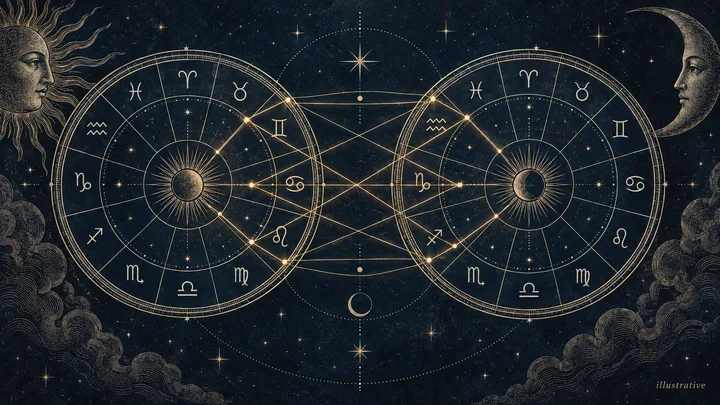
Aspect patterns form across two natal charts when several planets from one chart connect with several planets from the other through a repeated geometric structure. A single Venus-Mars square is an interaspect. Venus from one chart square Mars from the other, joined by a Moon trine or Saturn opposition involving the same planets, creates a larger pattern of attraction, pressure, and response. Read the pattern in layers: confirm the actual degrees, set one consistent orb, identify the planets carrying the shape, then ask which person is expressing which role. The tightest personal-planet contact usually leads. The pattern itself comes second. This matters because a beautiful triangle can describe ease without effort, while one square can show the conversation that keeps demanding attention. Synastry does not turn a relationship into a score. It shows where two people meet, repeat a theme, and choose how to work with it.
A synastry pattern is a relationship shape, not a single aspect
An aspect is one angular relationship between two chart factors. In synastry, those factors belong to different natal charts. Your Moon 90 degrees from his Mars is one interaspect. Add a Venus contact, a Saturn contact, and a repeated geometric link, and the separate lines may become a pattern with a shared story.
A square can press for action. A trine can let energy move easily. An opposition can pull two needs into a face-to-face exchange. When several contacts gather around the same planets or question, the chart describes how the connection keeps returning to one theme.
Don't name a pattern because the wheel looks busy. Name it after you check the degrees, the orb, and the actual shape. A synastry pattern earns attention when it is close, repeated, and relevant to the question you brought to the chart. The geometry shows the meeting. The people give it a voice.
Sources: Aspect - Skyscript Glossary; Aspect Patterns - Skyscript Glossary; Aspects Between Charts - Cafe Astrology
The geometry begins with two complete natal charts
Before you look for a triangle, you need two sound sets of placements. A synastry comparison uses the natal positions of the planets and, when the birth time is known and reliable, the angles and houses. The two charts are placed together so that one person's planets can be compared with the other person's planets. This is not the same as a composite chart, which creates a separate relationship chart from midpoints. Keep those methods distinct.
The basic calculation uses zodiacal longitude. Every planet has a position from 0 to 360 degrees. To test an aspect, measure the shortest angular distance between two positions. A distance near 0 degrees suggests a conjunction. Near 60 degrees, a sextile. Near 90 degrees, a square. Near 120 degrees, a trine. Near 180 degrees, an opposition. A pattern forms only after several of these relationships are confirmed.
Signs add the language of the geometry. A trine between planets in fire signs has a different texture from a trine between planets in water signs. A square across cardinal signs may push toward action, while a fixed-sign square can hold the same question for a long time. The angle tells you how the planets meet. The signs tell you how they try to meet. The houses, when trustworthy, show where the contact becomes visible in each person's life.
The order matters. First identify the exact aspect. Then read the planets. Then read the signs. Then read the houses. Many weak readings reverse that order and start with a familiar sign phrase. That makes the interpretation float free of the chart. If you know only sign placements and not degrees, you can describe sign-based relationships, but you should not claim a close degree pattern. Two planets can be in signs that usually form a trine and still be too far apart for the pattern you want to name.
The same rule protects a placement report. If you supply Moon, Venus, and Mars signs with optional degrees, a report can compare those known placements and selected major aspects within a stated six-degree orb. It cannot fill in missing birth information or quietly calculate houses. Precision begins by saying what the chart contains.
Sources: Aspects Between Charts - Cafe Astrology; Aspects Between Charts - Cafe Astrology
Orbs decide which lines belong to the pattern
An orb is the distance between an exact aspect and the actual positions. Venus at 14 degrees Taurus and Mars at 18 degrees Leo are 94 degrees apart, so they form a square with a 4-degree orb. The aspect is present, but it is not exact. The smaller the orb, the more sharply the contact usually speaks. A wide aspect may still matter, especially with the Sun or Moon, but it should not outrank a close personal-planet aspect without a reason.
There is no single orb that every astrologer uses for every purpose. Astrodienst explains that its synastry drawing uses half the natal orb to keep the two-chart picture from becoming crowded, while its aspect grids can show the normal orb and mark contacts that are not drawn. Other traditions use larger allowances for major aspects and smaller ones for minor aspects. That difference isn't a problem. Inconsistent rules are the problem.
For this field guide, use a six-degree maximum orb for the selected major synastry contacts. Treat 0 to 2 degrees as tight, 2 to 4 degrees as clear, and 4 to 6 degrees as supporting. These bands are a reading discipline, not a promise that every chart will speak in neat boxes. If the Moon or Sun is involved, note its importance. If the contact sits at the outer edge and no other contact repeats it, keep the language measured.
A pattern must pass an orb test contact by contact. Imagine her Moon at 12 degrees Gemini, his Mars at 13 degrees Virgo, her Venus at 16 degrees Libra, and his Saturn at 18 degrees Cancer. The Moon-Mars square has a 1-degree orb. Venus-Saturn squares are 2 degrees apart. Those contacts may form a repeated mutable and cardinal tension only if the remaining geometry actually connects. A chart doesn't become a grand pattern because several aspects are all emotionally vivid.
Degree precision also protects you from a common mistake: counting sign relationships as exact aspect patterns. Consider planets at 29 degrees Aries and 1 degree Leo. They are in signs that relate by trine, but their actual distance is 92 degrees, a square with a 2-degree orb. The signs and the degree aspect are both part of the reading. You don't have to choose one and erase the other. You do have to name what you are reading.
Sources: Aspect - Skyscript Glossary; Aspects Between Charts - Cafe Astrology; Aspects Between Charts - Cafe Astrology
Read the two people inside every cross-chart contact
A synastry pattern never belongs to an abstract couple alone. Each contact has two carriers. If her Saturn squares his Sun, she may express the Saturn role by setting standards, slowing a plan, or asking him to take responsibility. He may experience her as a judge, anchor, or steadying force when he is trying to define himself. He carries the Sun role, but he does not own the whole meaning of the aspect. Her own natal chart shows how she lives Saturn. His chart shows how he lives the Sun.
This is why the same pattern can feel different to each person. A Venus-Mars conjunction may feel like attraction to both people, but the Venus person may notice taste, affection, and receptivity first, while the Mars person experiences pursuit, heat, and initiative. Add Saturn and the contact may become durable, cautious, or heavy. Add Uranus and the same attraction may need more room and surprise. The added planet changes the pattern's behavior.
Look for repetition across roles. If her Moon receives his Mars square and his Saturn opposition, her emotional life becomes the focal point of the pattern. He may activate it through desire and restraint. If his Venus also trines her Moon, the relationship has a softer route into the same emotional field. Now the pattern isn't simply difficult. It has pressure, attraction, and a possible way to soothe or repair.
Do not use the pattern to infer a hidden intention. Saturn contacts can describe a felt weight, a promise, a boundary, or a difference in timing. Neptune contacts can describe imagination, longing, and blurred signals. Pluto contacts can describe depth and intensity. None of them prove what a person secretly wants. The chart describes the field between the people. Their words, choices, and conduct show how they inhabit it.
A good interpretation therefore uses verbs that keep both people present. She steadies his Sun. He awakens her Venus. They repeat a question about safety and freedom. One person may feel the contact sooner, but the pattern remains relational. Ask who carries which planet, then ask how each natal chart supports or complicates that planet. That is how a line on a wheel becomes a useful reading.
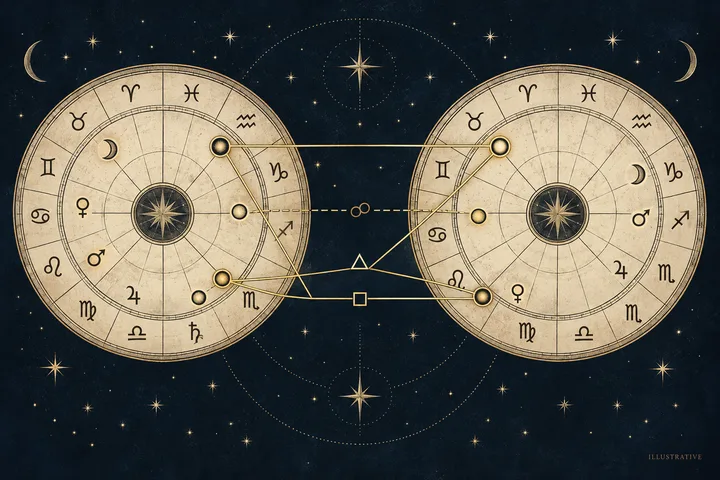
Sources: Aspect Patterns - Skyscript Glossary; Aspects Between Charts - Cafe Astrology
The strongest patterns repeat one relationship question
A pattern matters when its contacts point to one relationship question. Moon, Venus, and Saturn may gather around affection, emotional safety, and commitment. Mercury and Mars may return the couple to speech, timing, and action. Three random aspects can make a wheel look elaborate. Repetition makes it readable.
Rank the planets before the pattern name. The Moon makes the theme felt. Venus shows attraction and values. Mars acts. Saturn sets limits and asks what can endure. The same T-square means something different when these planets change places. The signs refine how the theme moves: cardinal begins, fixed holds, mutable adapts; fire acts, earth gives form, air talks, and water seeks recognition.
Look for the focal planet. In a T-square, the apex receives two squares from an opposition. In a synastry cluster, a planet can become focal without completing a formal figure because several contacts keep activating it. If her Moon receives his Mars, Venus, and Saturn, start with her emotional experience. Ask what action, affection, and restraint are asking of it.
Your test is plain language. Can we stay close without controlling each other? Can desire and reassurance share a pace? If you can't state the question, you're still counting lines.
Sources: Aspect - Skyscript Glossary; An Introduction to Aspects and Chart Shaping in Natal Astrology; Aspects Between Charts - Cafe Astrology
A worked example: a cross-chart grand cross around Venus and Saturn
Consider an example. Imagine Maria has Venus at 14 degrees Aries and Saturn at 16 degrees Cancer. Imagine Daniel has Mars at 15 degrees Libra and Moon at 13 degrees Capricorn. Use a six-degree orb, and treat these placements as an illustrative set, not a calculated personal chart. Maria's Venus opposes Daniel's Mars within 1 degree. Her Venus squares her Saturn within 2 degrees and his Moon within 1 degree. Her Saturn squares his Mars within 1 degree and opposes his Moon within 3 degrees. Daniel's Mars also squares his Moon within 2 degrees. Together, the four cardinal placements complete four squares and two oppositions, a grand cross visible when the two natal charts are overlaid. It concentrates the reading on attraction, emotional response, action, and restraint.
The first layer is the Venus-Mars opposition. It can create a strong pull because each person activates a different mode of desire. Maria's Venus seeks connection through direct affection and preference. Daniel's Mars meets that Venus with action, pursuit, and a need to move. The opposition can feel magnetic, but it can also create a rhythm in which one person reaches while the other defines the terms of response.
The second layer brings in the Moon. Maria's Venus square Daniel's Moon can make affection land in a place of sensitivity. What Maria offers as warmth may feel demanding to Daniel when his emotional rhythm needs time. What Daniel needs as reassurance may feel to Maria like a test of whether her love is being received. The aspect doesn't decide the outcome. It shows why a sweet gesture can still stir a larger conversation.
The third layer is Saturn. Maria's Saturn squares Daniel's Mars and opposes his Moon. She may become the person who slows the pace, asks for proof, or names consequences. He may feel that his desire and emotional needs meet a wall. She may feel that she is carrying the practical side of the bond. Yet Saturn can also give the pattern form. If they agree on timing, boundaries, and what care looks like, the same contact can support steadiness instead of resentment.
Read the pattern as a sequence. Venus-Mars shows the draw. Venus-Moon shows how attraction touches feeling. Venus-Saturn adds a question about value and standards. Saturn-Mars shows where action meets limits. Saturn-Moon shows the emotional cost of unclear limits, while Mars-Moon brings urgency into Daniel's feeling life. The closest contacts lead the reading, but the complete shape explains why the same question returns through several doors.
Now imagine the couple meets the pattern in a real decision. Maria wants to define the relationship quickly. Daniel wants closeness but worries that a promise will remove his room to respond honestly. The Venus-Mars opposition pulls them toward one another. The Moon contacts make the timing feel personal. Saturn turns the question practical. They need to ask what commitment means this month, not what it must mean forever.
Their best conversation would name the roles without turning them into identities. Maria can say, 'When I slow this down, I'm trying to make it dependable, not punish you.' Daniel can say, 'When I ask for time, I'm trying to stay honest, not withhold affection.' Those sentences do not dissolve the square. They give it a form the two people can work with.
The same pattern could appear differently if the natal charts changed. If Daniel had a natal Saturn-Moon conjunction, Maria's Saturn might reinforce a familiar emotional discipline. If he had a natal Moon-Venus trine, her Venus could meet a natural capacity for warmth. If Maria had an unaspected Venus, the contact might feel unusually loud in her experience. The synastry geometry stays the same. The people who receive it do not.
This example's useful question is not whether the couple is compatible. It is what kind of pace lets attraction, feeling, and responsibility work together. Maria can ask for a clear plan without making Saturn a verdict. Daniel can ask for time without making Mars a threat. The geometry shows the meeting. Their choices show the relationship.
A named shape must pass three geometry tests
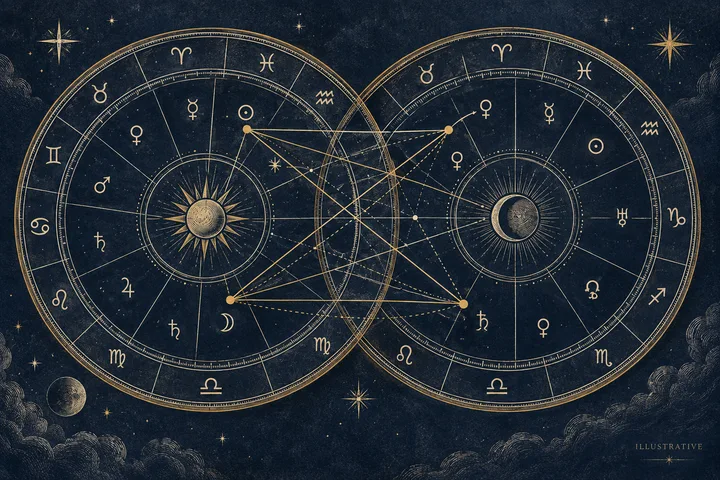
The name comes last. A grand trine needs three linked trines. A T-square needs an opposition and two squares to one apex. A grand cross needs four planets, four squares, and two oppositions. A kite adds an opposition and two sextiles to a grand trine. If one required contact is missing or too wide for your rule, call it a near-pattern.
Check the proposed shape from the supplied degrees, not from the picture alone. Apply the same six-degree ceiling to each selected major contact, then ask whether the contacts share a planet, focal point, element, mode, or question. This is where a vivid but lonely line loses its claim to the pattern.
The difference between a T-square and a grand cross is interpretive. The T-square gives you an apex and a likely pressure point. The grand cross spreads the tension across four points, so the reading follows a polarity rather than one release valve. A grand trine circulates with ease. A kite adds an opposition that can turn that ease toward effort.
In synastry, note who supplies each corner. One person's planets may form most of the shape while the other's planet completes it. That can concentrate the experience without making one person responsible for the whole pattern. Record the shape accurately, then describe the emphasis rather than assigning blame.
Sources: Aspect - Skyscript Glossary; An Introduction to Aspects and Chart Shaping in Natal Astrology; Aspects Between Charts - Cafe Astrology
The pattern adds meaning to the separate contacts
A pattern changes the order in which you read its contacts. In the example, the one-degree Venus-Mars opposition announces the pull. The squares add pressure around feeling, standards, and action. The wider Saturn-Moon opposition shows why the question may return when attraction has to carry ordinary life.
Read that arrangement as a sentence. Venus opens with affection. Mars makes it active. The Moon makes it personal. Saturn asks whether the bond can carry time. No planet is the hero or the problem by itself. The geometry gives each one a job.
That produces a useful judgment, not a grade. Ease shows a route the couple already knows. Tension shows where the route narrows. In this example, the clearest question is how desire and reassurance can share a pace without turning standards into control.
Sources: Aspect - Skyscript Glossary; Aspect Patterns - Skyscript Glossary; An Introduction to Aspects and Chart Shaping in Natal Astrology
Natal context tells you why the same shape lands differently
A cross-chart pattern doesn't arrive in an empty room. Each person already has a natal way of carrying the planets involved. Synastry describes the meeting. Natal context shows the habits and expectations brought to it. If her natal Moon-Saturn square is familiar territory, his Saturn contact may feel recognizable. If her Moon is usually supported by trines, the same contact may feel more disruptive.
Check only the natal factors that carry the pattern. Does her Venus seek proof before trust? Does his Mars act quickly and explain later? Does either Moon already sit inside a pattern that makes closeness demanding? These questions keep the reading from blaming the partner for every reaction.
A planet can feel ordinary to its owner and startling to the person who receives it. His Mars may simply feel like his normal style, while her Moon experiences urgency or heat. Name that asymmetry. Shared geometry doesn't require identical reactions.
Give extra attention to a theme echoed in both natal charts and in synastry, but keep the layers separate. Repeated Venus-Saturn symbolism can make value, loyalty, and timing central. It still doesn't prove that both people want the same form of commitment. When the report uses selected placements, leave absent houses, angles, and planets out.
Sources: Aspect Patterns - Skyscript Glossary; Aspects Between Charts - Cafe Astrology
Turn the confirmed pattern into one clear next question
Now make the reading usable. Keep a short record of each planet pair, supplied degree, aspect, orb, and chart owner. Circle the closest personal-planet contact and the planet repeated across the shape. That is your reading spine.
Translate it into a sentence someone could answer. 'Venus opposite Mars at one degree' becomes 'attraction is strong, but pursuit and response may move at different speeds.' Add the Saturn contacts and the question becomes, 'What agreement lets desire feel dependable?' The translation connects geometry to life.
Choose one observable moment: making plans, asking for reassurance, taking space, or returning after conflict. Don't force the moment to prove the chart. Notice what happens, then let the people speak for themselves. A useful practice might be a clear check-in, protected alone time, or an honest conversation about pace.
So how do two natal charts fit together? Through repeated contacts that gather meaning around a planet, polarity, or question. Read the tightest contact first. Let the full pattern explain the repetition. Then choose one small response. The chart shows where the relationship concentrates energy. Your next conversation shows what you do with it.
Sources: Aspect - Skyscript Glossary; Aspect Patterns - Skyscript Glossary; Aspects Between Charts - Cafe Astrology; An Introduction to Aspects and Chart Shaping in Natal Astrology; Aspects Between Charts - Cafe Astrology
A little more clarity
Can a synastry aspect pattern exist without exact birth times?
Yes, if you have reliable planetary signs and degrees for both people. Planet-to-planet patterns can still be compared without houses or angles. What you cannot safely rank is an Ascendant, Midheaven, house overlay, or any pattern that depends on an uncertain angle. If you have signs but no degrees, describe possible sign relationships and mark the orb as unknown. Keep the reading focused on the placements you actually supplied.
Sources & further reading
- Aspect - Skyscript Glossary
Defines the major aspect angles, their traditional meanings, and why astrologers allow an orb around exact contact.
- Aspect Patterns - Skyscript Glossary
Explains that three or more connected planets can form a named pattern with an additional meaning of its own.
- Aspects Between Charts - Cafe Astrology
Supports role-based synastry reading and asks readers to consider each planet's sign and house placement.
- An Introduction to Aspects and Chart Shaping in Natal Astrology
Provides the aspect geometry, orb principles, pattern structures, and interpretive treatment of supportive and tense aspects.
- Aspects Between Charts - Cafe Astrology
Supports the role-based reading of each person in an interchart aspect and the importance of signs, houses, and personal planets.
Synastry Comparison Report
Enter known placements for two people. Get an input-by-input comparison, selected aspect calculations and a clear record of what remains uncertain.
Compare our placements