
House overlays can add a missing pattern to a short Moon, Venus, and Mars comparison, but their best use isn't to hunt for one romantic house. Read the three planets as a sequence: the Moon shows what helps the bond feel safe, Venus shows what makes it pleasing and worth choosing, and Mars shows how that feeling becomes movement, desire, work, or conflict. If those planets gather around related houses, the overlay gives you a strong lived theme. If they split across home, pleasure, and routine, the split is the message. Verify both birth times and the house method first. When either time is unknown or a placement is cusp-sensitive, keep the reading to known signs, supplied degrees, and selected major aspects.
A short list can hide a full relationship pattern
Few close aspects don't give you a blank chart. They give you a narrower question. What do the Moon, Venus, and Mars keep touching in each person's life?
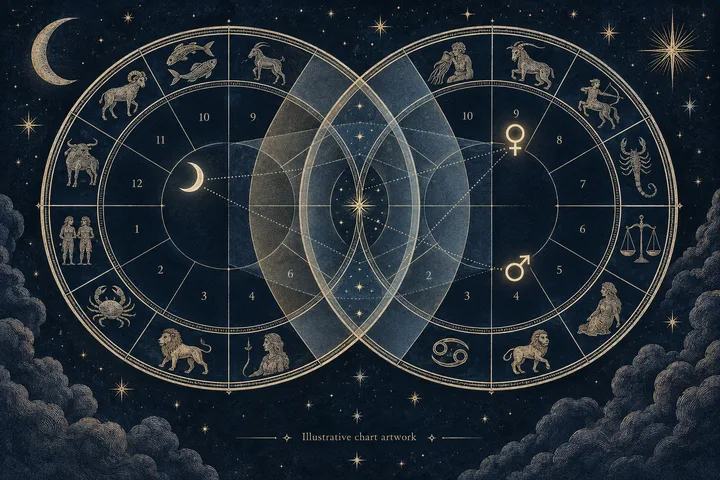
House overlays help answer that question when the birth data is dependable. In synastry, one person's planet falls into a house of the other person's chart. The planet brings its style. The house supplies the life area. Read in both directions, the placements can show whether feeling, affection, and action gather around the same part of life or pull in different directions.
That last distinction is the useful one. A Moon, Venus, and Mars cluster around the fourth, fifth, and sixth houses may describe a bond moving from safety to pleasure to ordinary work. The same three planets scattered across the twelfth, eleventh, and third may describe private feeling, friendship, and constant conversation. Neither pattern is automatically easier. Each asks for a different kind of attention.
Sources: Romantic Compatibility Synastry House Overlays; Synastry: Planet Overlays in Houses (Transposed Houses); Synastry House Overlays
Read Moon, Venus, and Mars as a sequence
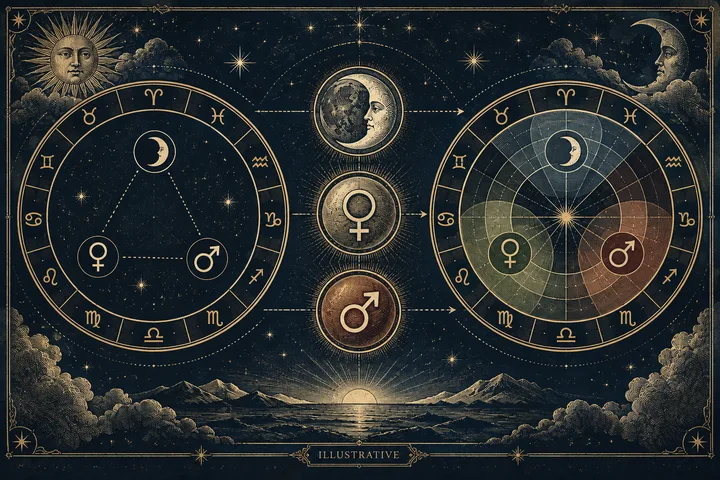
Don't read the three overlays as three unrelated labels. Give them jobs in a sequence. The Moon shows what helps the connection feel familiar, held, or emotionally alive. Venus shows how pleasure, attraction, taste, and value become visible. Mars shows where desire turns into initiative, effort, pursuit, or friction.
This sequence creates a better test than asking which house is most romantic. Suppose one person's Moon falls in the other's fourth house, Venus in the fifth, and Mars in the sixth. The relationship may begin with comfort, find delight through dates or shared creativity, then reveal itself through chores and schedules. The sixth-house Mars doesn't cancel the fifth-house Venus. It asks whether the attraction can survive Tuesday.
The reverse can change the order. If the second person's Moon lands in the fifth, Venus in the fourth, and Mars in the tenth, they may experience the bond through play, private tenderness, and pressure around public direction. The pattern is not a verdict. It's a map of what gets activated first, what gets valued, and where energy must be managed.
Sources: Romantic Compatibility Synastry House Overlays; Synastry: Planet Overlays in Houses (Transposed Houses); Synastry House Overlays
Let the Moon name the emotional setting
The Moon is the first placement to examine because it shows where the bond seeks comfort and where reactions become personal. A fourth-house Moon can draw the relationship toward privacy, belonging, family memory, and a shared base. A fifth-house Moon can make care playful and expressive. A sixth-house Moon may show up through small acts, health habits, and the work of keeping a day running.
The house doesn't describe a fixed mood. It describes the room in which the mood becomes noticeable. A twelfth-house Moon may make feeling quiet, intuitive, or difficult to put into words. An eighth-house Moon may bring vulnerability, trust, and shared resources close to the surface. Those meanings need time and clean language. Don't turn intensity into proof of permanence.
Record the Moon overlay in each direction, then write one observable question beside it. 'What helps us feel private and safe?' is better than 'Who is more attached?' The first question belongs to the symbolism and can be answered in life. The second tries to make the chart judge two people.
Sources: Romantic Compatibility Synastry House Overlays; Synastry: Planet Overlays in Houses (Transposed Houses)
Let Venus show what the pair enjoys and values
Venus tells you where affection wants an outlet. In the second house, the bond may bring questions about comfort, money, taste, and what each person considers worth protecting. In the third, conversation and everyday contact can carry warmth. In the fourth, private tenderness may matter more than public display. In the fifth, flirtation, play, art, and the pleasure of being chosen come forward.
A Venus overlay can also explain a mismatch between what feels loving and what looks romantic. Venus in the eleventh may thrive on friendship, mutual encouragement, and a future imagined together. That is real affection, even if neither person calls it dramatic. Venus in the sixth may prefer dependable help to grand gestures. Ask what the placement makes easier to offer, not whether it earns a compatibility grade.
When Venus follows a Moon in a related house, comfort can become pleasure. When Venus lands far from the Moon's house, the pair may need to translate between emotional safety and visible affection. That translation is often the article's real finding.
Sources: Romantic Compatibility Synastry House Overlays; Synastry: Planet Overlays in Houses (Transposed Houses); Synastry House Overlays
Let Mars show where the pattern has to move
Mars tells you where the relationship takes action. It can describe pursuit, sexual energy, courage, competition, boundaries, and conflict. Its house shows the arena. Mars in the third may heat up messages, errands, and debate. Mars in the fifth can chase pleasure, play, and creative risk. Mars in the sixth can put desire into work, schedules, health, or the division of daily labor.
This is where the Moon-Venus-Mars sequence becomes practical. A fourth-house Moon wants a secure base. A fifth-house Venus wants delight. A sixth-house Mars demands a way to share the ordinary load. The reading becomes useful when it names the bridge between those needs: protect private time, plan pleasure, and decide who handles which task.
Mars in the eighth or seventh can make intimacy or partnership the arena of directness. That doesn't mean control or commitment is inevitable. It means the bond may bring desire and disagreement into one-to-one or deeply private territory. Consent, clear requests, and repair keep the symbol workable.
Sources: Synastry: Planet Overlays in Houses (Transposed Houses); Synastry House Overlays
A worked example: one chain, then one split
Imagine Maria and Daniel with a brief list of close major aspects. Maria's Venus makes one soft contact to Daniel's Mars. Their Moons have no close major contact to the other's Moon, Venus, or Mars. The list says little about the tone between them, so they check reliable birth times and use one named house system.
Maria's Moon falls in Daniel's fourth house, her Venus in his fifth, and her Mars in his sixth. Daniel's Moon falls in Maria's eleventh house, his Venus in her fourth, and his Mars in her third. Maria enters Daniel's chart as comfort, pleasure, and practical pressure. Daniel enters Maria's as friendship and shared plans, private tenderness, and lively contact.
Now the sparse aspect list has a shape. Maria may want the connection to feel safe, enjoyable, and workable in daily life. Daniel may need friendship, a private sense of belonging, and room to talk things through. Their one Venus-Mars contact can add heat, but it doesn't erase the split between Daniel's need for conversation and Maria's need for reliable follow-through.
The right question isn't whether one person feels more. It is whether they can make a bond that has both a home base and enough movement. This is an illustrative example, not a calculated personal chart. The method is to read the six placements as two directional sentences, then ask what the sentences require.
When the planets disagree, keep the disagreement
A split pattern is not a failed interpretation. It may be the most accurate part of the reading. Moon in the fourth, Venus in the eleventh, and Mars in the eighth don't point to one tidy relationship mood. They describe a need for safety, affection through friendship or shared vision, and charged private territory.
Read the tension as a sequence of needs. What makes the Moon feel safe? What does Venus enjoy giving? Where does Mars push for movement? Then ask where the needs collide. A person may want quiet at home, expect companionship to stay light, and still want intense honesty. The chart doesn't choose which need wins. The couple has to give each one a proper place.
The strongest exception is a very tight personal-planet aspect that repeatedly matches the relationship's actual rhythm. A close Moon-Mars contact may describe the emotional and conflict pattern more clearly than a broad set of house placements. A close Venus-Mars contact may explain the attraction's style. Keep the aspect. Use the houses to locate its expression.
Sources: Romantic Compatibility Synastry House Overlays; Synastry: Planet Overlays in Houses (Transposed Houses); Synastry House Overlays
Check whether the house story can hold
House symbolism only helps when the house placement itself is sound. You need each person's birth date, birthplace, and birth time, plus the house system used. The receiving person's time sets the house frame. The reverse overlay needs a separate reading in the other chart.
Mark any Moon, Venus, or Mars near a cusp. If an approximate birth time moves the planet between two houses, write both possibilities and keep the interpretation conditional. A known sign and supplied degree remain useful. A guessed house isn't a substitute for them. Current chart references also stress that unknown birth time can leave houses unreliable while many planet-to-planet comparisons remain available.
State the scope beside the comparison: for example, tropical zodiac, named house system, and a six-degree orb for selected major aspects. The Synastry Comparison Report can organize supplied Moon, Venus, and Mars placements, optional degrees, and selected aspects. It doesn't calculate houses from missing birth details. That boundary protects the reading from false precision.
Sources: Romantic Compatibility Synastry House Overlays; Synastry: Planet Overlays in Houses (Transposed Houses); Synastry House Overlays
Turn the pattern into one useful conversation
End with the theme that repeats, not the house that sounds most exciting. If Moon, Venus, and Mars connect home, pleasure, and routine, talk about privacy, shared enjoyment, and the weekly work that protects both. If they connect friendship, conversation, and intimacy, talk about how much contact feels nourishing, what stays private, and how direct desire should be.
Use the chart as a question, not an accusation. 'Your Mars in my sixth means you'll criticize me' closes the door. 'Our energy gets strongest around routines and small tasks. How do we want to share that?' gives the symbol somewhere to go.
So what can house overlays add when the aspect list is short? They can show whether the Moon, Venus, and Mars form one lived story or three competing needs. That is more specific than calling the chart quiet, and more honest than letting one famous overlay decide it. Write down the leading house theme, the strongest aspect tone, and one action to try this week. Then compare the placements you actually have through the Synastry Comparison Report.
Sources: Romantic Compatibility Synastry House Overlays; Synastry: Planet Overlays in Houses (Transposed Houses); Synastry House Overlays
A little more clarity
Can house overlays matter if the synastry aspect list is very short?
Yes. Aspects describe how two planets interact, while house overlays show where that interaction is experienced in the house person's life. A short list can still become clear when Moon, Venus, and Mars repeat themes such as home, romance, daily routines, friendship, or intimacy across both directions. Use overlays only when the birth times and house method are reliable enough. They add context, not a compatibility score or relationship verdict.
Sources & further reading
- Romantic Compatibility Synastry House Overlays
Supports reading overlays as concentrated life areas, reversing the charts, and comparing receptive and outgoing experiences.
- Synastry: Planet Overlays in Houses (Transposed Houses)
Supports the planet-person and house-person roles, two-way effects, and examples of Moon and house themes.
- Synastry House Overlays
Supports reading Moon, Venus, and Mars overlays as directional life-area themes, noticing clusters, and retaining a close aspect as an important exception.
Synastry Comparison Report
Enter known placements for two people. Get an input-by-input comparison, selected aspect calculations and a clear record of what remains uncertain.
Compare our placements